Movie Villainess 101 Rank #21

Psycho affection doesn’t end with divorce

Movie

The Ex (1997)

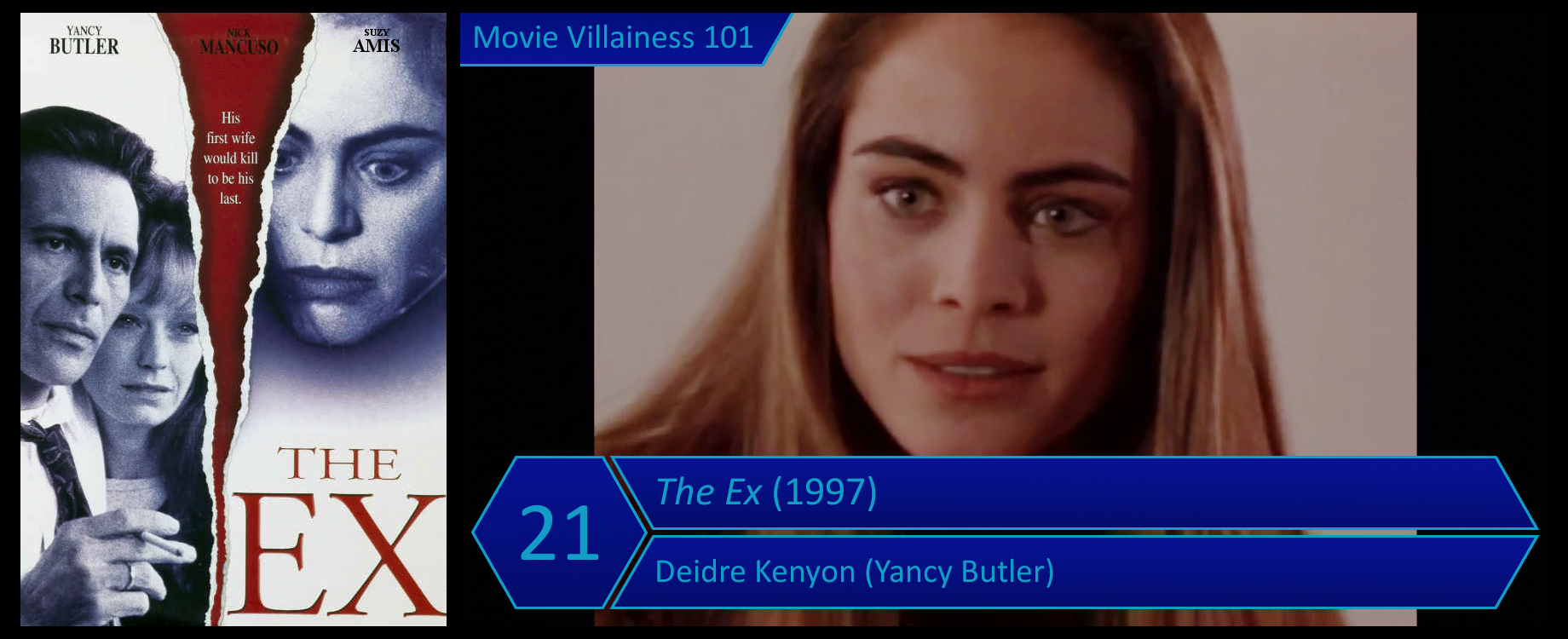
The second film directed by Mark L. Lester to rank in the legendary tier, this movie shows a great villainess can overcome the burdens of a simple plot. Especially since Yancy Butler’s psychotic Diedre gets as much – if not more – screen time than the protagonist David Kenyon (Nick Mancuso). He’s another guy who made the mistake of marrying (and later divorcing) a murderous lunatic.
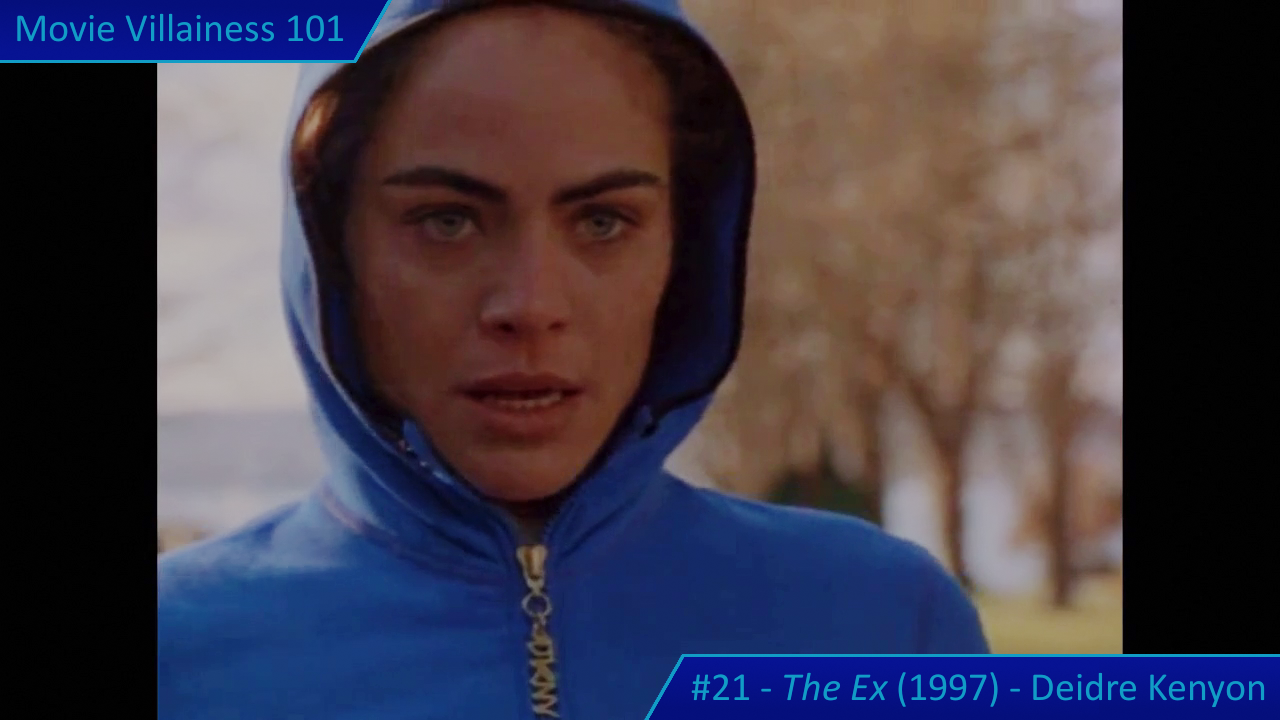
From the opening scene where Deidre stalks David’s wife Molly (Suzy Amis) and child Michael (Hamish Tildesley), it’s clear where the story is going. The villainess gives us a cold-eyed stare as she watches her prey drive away. These generic psycho moments happen a lot, as do montages of Deidre working out with weights. This is a woman who likes to show off her strength when she murders minor characters.

Deidre still has feelings for David and turns up at his workplace one day. As expected, he’s not happy to see his psycho ex-wife, but goes out for a meal. Deidre grips his hand tightly and makes a big deal of him turning around for one last look as he leaves. Still, this counts as rejection, so when another married guy comes onto Deidre, she has sex and drowns him in a bathtub. There’s only one man this villainess wants – everyone else is expendable.
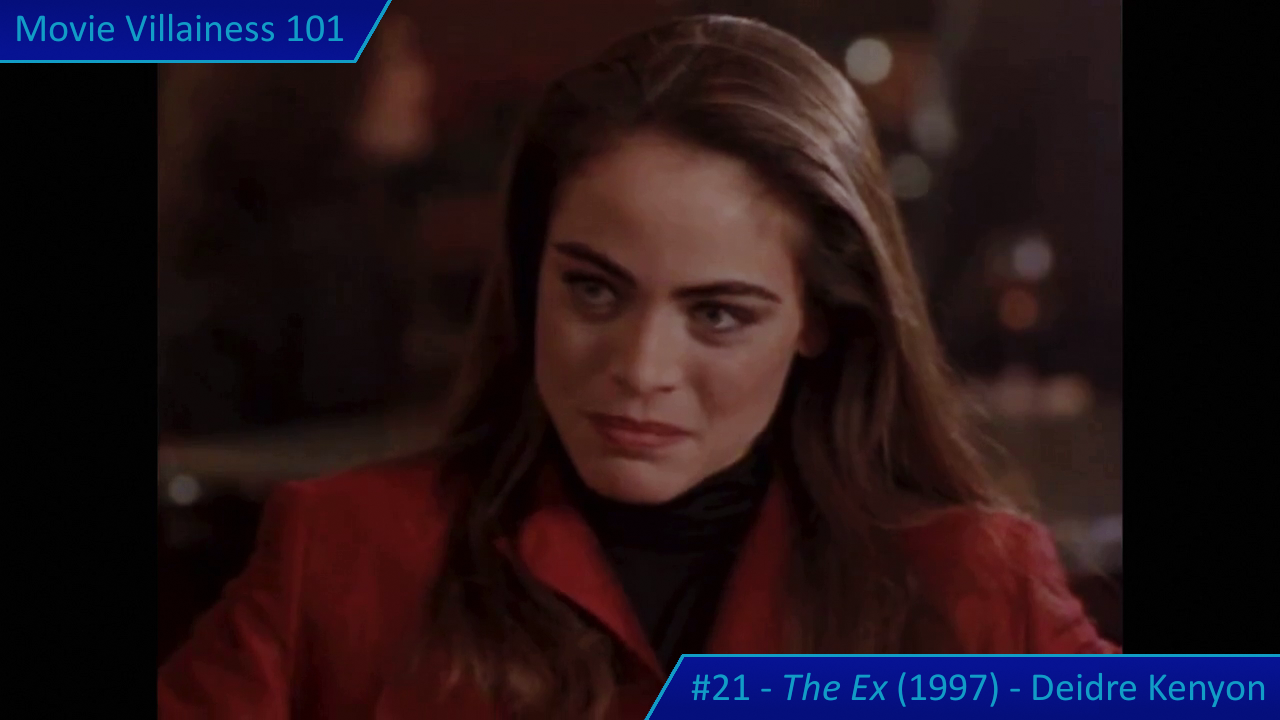
It’s no surprise a woman with these issues has a psychiatrist, and Deidre impersonates Dr Lillian Jonas (Babs Chula) to get close to Molly. After small talk at the local gym, the psycho accompanies the unsuspecting woman and her son on a riverboat trip. Deidre contemplates throwing the boy into a waterwheel until his mother returns, forcing a warm and friendly act. Time to “introduce” herself to David, who goes along with the cover story and pretends he doesn’t know his ex.

If the villainess’ plan is to push David over the edge, it works because he shows up at her hotel and threatens her. Being a psycho, Deidre enjoys this and even stands in an open window daring her ex to push her. To add extra spice, the villainess claims she killed her sister, whom the younger David was in love with. David doesn’t believe it, but flashbacks of the murderess drowning the girl tell us otherwise.

David becomes increasingly stressed and shows his dark side by getting rough with Molly in bed – to the point she’s truly scared. Deidre is out for revenge, and she’s just getting started.

Villainess

Deidre Kenyon (Yancy Butler)

Determined to destroy David’s life, the villainess makes a false rape allegation to Molly. Deidre backs up her claim by describing a birthmark, but the husband comes clean and reconciles with his wife. The ex has other ideas and murders an unfortunate female tenant with a crowbar. She follows the kill with a cheesy postmortem line about a lease being terminated. This gives her access to an apartment across the street from her target’s place, and a perfect vantage point.
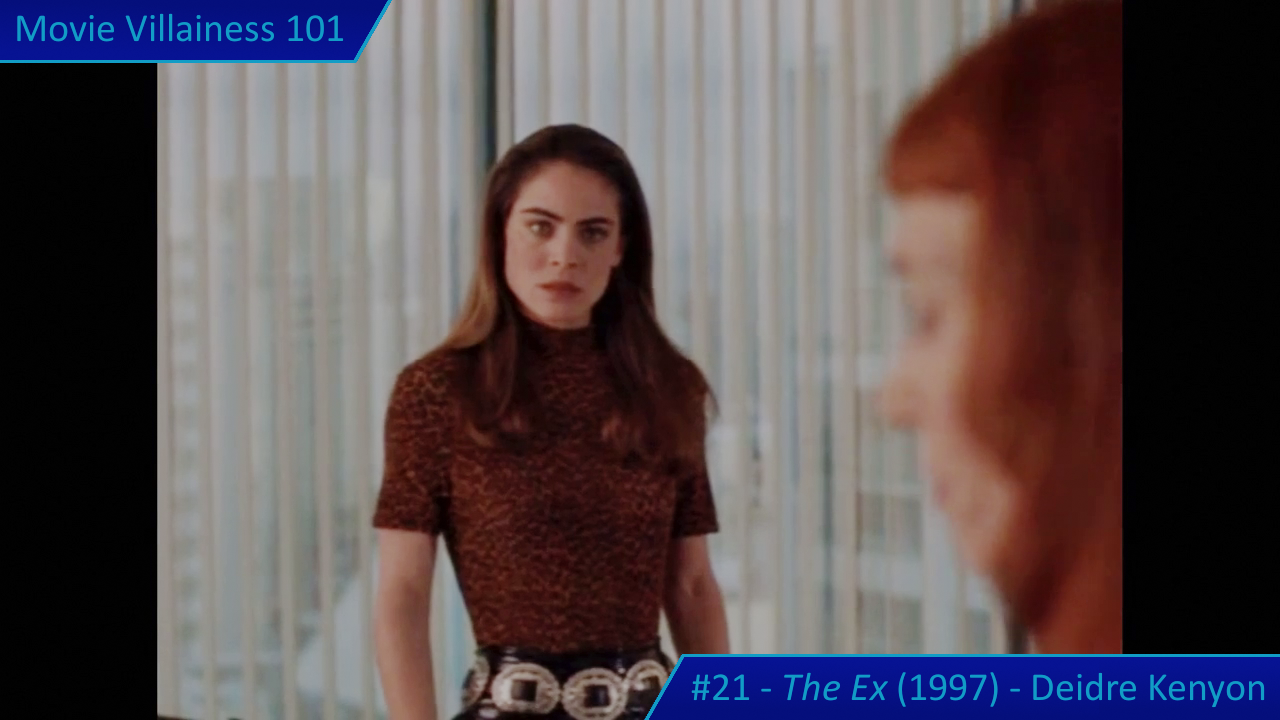
Dr Jonas confronts Deidre about her sister’s suspicious death. Talking to a suspected murderer alone is a surefire way to get yourself iced, but the doc evidently hasn’t watched too many made for cable thrillers. This intervention gives the villainess the excuse to drown a second minor character in a bathtub. And say another psycho one-liner. This is becoming a habit.

David asks his attorney for help, but Deidre turns the tables by showing the lawyer an old video of rough sex to make her ex appear the aggressor. The psycho makes sexual advances to David when he visits her new apartment and allows herself to be seen by Molly. Not content with destroying a marriage, Deidre visits a rough part of town in disguise and pays a guy to beat her up. This frames David for domestic violence, a story the cops are ready to believe.

With him out of the picture, Deidre breaks into his apartment (she copied the key earlier) and tracks Molly and Michael to a cabin. Just the spot for a finale, where the villainess knocks out Molly with a fire poker. David – released on bail – shows up to confront his psycho ex, and only love for his new family prevents him from killing Deidre. The villainess attacks again, and is so busy taunting David for letting her live she doesn’t notice Michael step up behind her with a flaming log.

Yes, the kid gets to be the surprise hero, and we’re treated to a lengthy scene of the psychotic Deidre ablaze. The log cabin burns down as the survivors watch from a safe distance.

Honourable Mentions: Yancy Butler / Drowning Kills

The Last Letter (2004) – Ms. Toney / Alicia Cromwell (Yancy Butler)
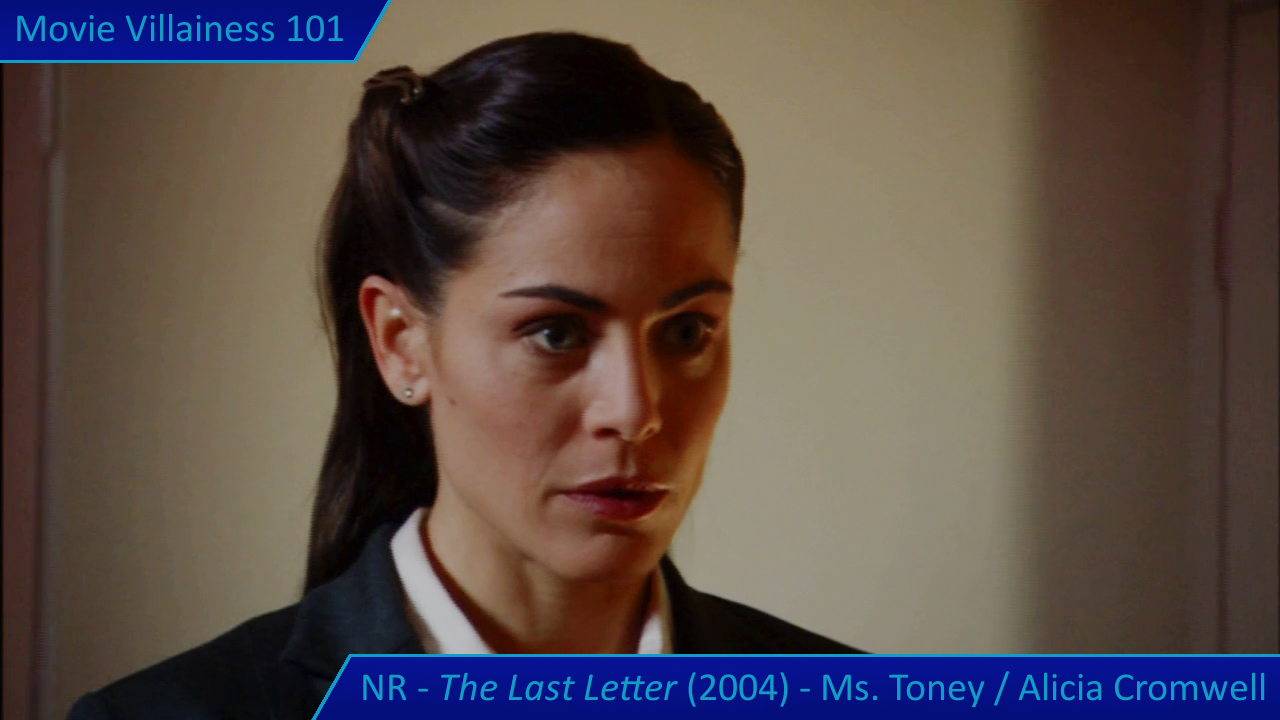
A thriller centred on a jury deliberating a verdict, with the twist that things aren’t as they first seem. Jack Hamilton is on trial for murdering fourteen people, and there are flashbacks of nearly every killing. This ought to be a treat for villainess fans, given that the serial killer is female, but historic events have a sickly yellow tint and a second twist that puts everything in doubt.

Jury members don’t seem to have been selected for their mental stability, which is at odds with the instruction that the verdict be impartial. For diversity, there’s a racist, homophobic bigot who abuses the others, an ill man who can barely speak, and shy people afraid to speak up. Ms Toney offers little to the discussion but becomes more vocal when the foreman (William Forsythe) presents the evidence.

The methodical killer wears a wetsuit and cloth mask to avoid spreading their DNA. Thanks to the foreman’s summary and crime scene photos, we learn the murderer is brazen enough to kill people in their own homes. They also slay an advertising executive at her office and a police detective. Other than a fire and two accidental deaths, the MO is to drain the victim’s blood and paint a letter on their forehead. The foreman writes these on a whiteboard in a certain order, which gradually spells out a cryptic message.

After Hamilton commits suicide, Toney rants at the foreman, but mentions one victim was deaf. A mistake, as this information was never made public. The other jurors then reveal the truth. They are all police officers, and the entire trial – plus the arrest and suicide – was staged to trap the murderess, Ms Toney aka Alicia Cromwell. The foreman is Dr Markley, a criminal psychologist hired as a consultant. This explains his obsession with profiling the killer and the stereotyped jury.

Cromwell murdered four people in London, which gives sixteen alphabet letters. Markley speculates the last letter is Y, and the message is KILLER WAS ME O TONEY. However, the villainess grabs an officer’s gun, scratches the letter G on her head, and blows her brains out. After the jurors leave, Markley discovers Toney has no scars on her body, which contradicts his theory of a struggle.

The doctor deduces the true anagram solution – ONE GAME TWO KILLERS – before an unknown person attacks him. With one of those annoying cliffhanger endings that will never be resolved, we’re left wondering who the villainess actually killed.

Eisfieber (2010) – Daisy Mac (Anneke Kim Sarnau)
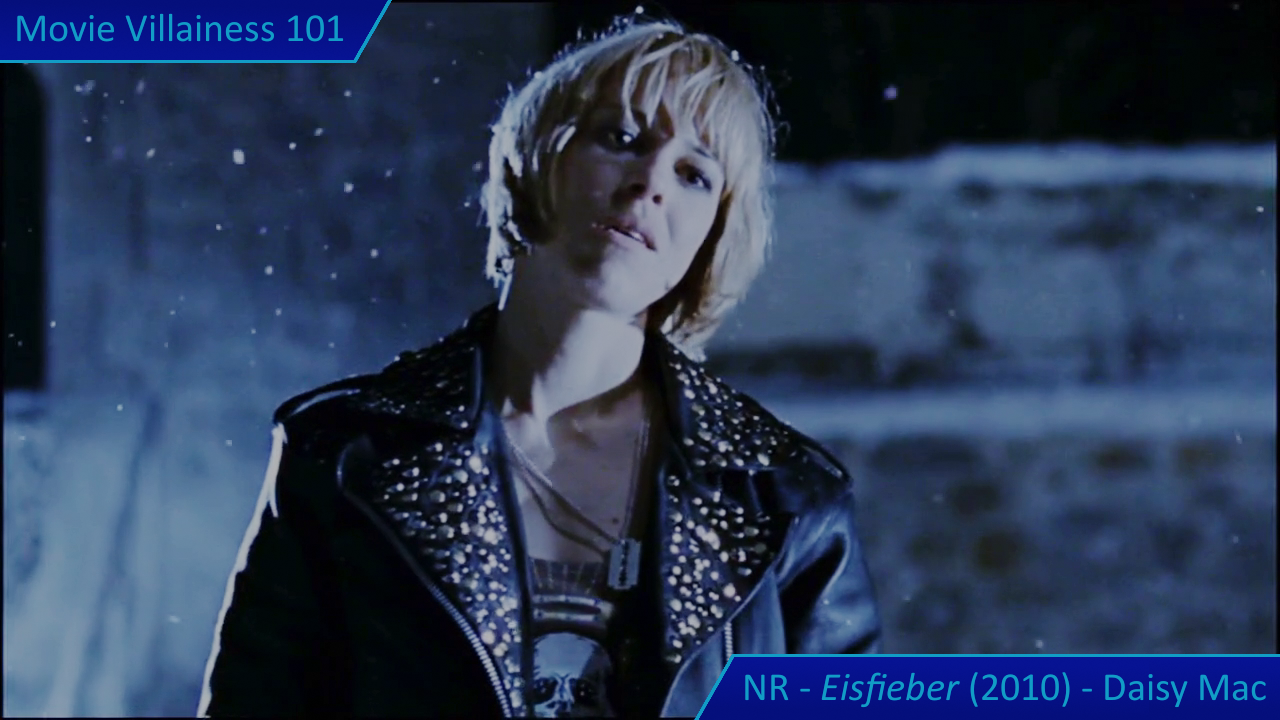
This honourable mention is covered here since its villainess also gets a memorable drowning scene. A two-part miniseries released as a movie, this thriller is set in Scotland at Christmas, a good excuse to feature medieval locations with a snowy backdrop.

My source is a German DVD release, but the familiar plot doesn’t require translation. Scientists have developed a deadly virus in a “secure” lab, and terrorists devise a plan to steal it. One of them is a hacker who’s overconfident until the blonde henchwoman Daisy teaches him a lesson in humility. She’s not that tall or muscular, but still dunks the guy in a swimming pool and holds him underwater. Normally, that would herald a premature demise, but the hacker is essential to the heist. He emerges from the ordeal alive, though drenched and far more afraid.

The first part of Eisfieber is mainly padding, focusing on a family get-together where the hacker is also a guest. That gives him access to a scientist’s keycard, so he works his techno magic and disables the lab security. Daisy wears a brunette wig for the raid, but is mostly a silent player while the villains disguise themselves as maintenance crew. This woman enjoys violence and takes out a security guard with a baton. A well-executed plan, until a road accident forces the terrorists to improvise and find shelter in the local mansion.

As the snowstorm intensifies, lead scientist Toni Gallo (Isabella Ferrari) tracks down the villains and teams up with two family members who escape. Toni gets to be the heroine, and the hacker swaps sides when things look bad for him. With the blizzard raging, no outside help is coming. The tech guy rejoins the villains (!) after a big scuffle with Daisy and everyone else in an all-out brawl. More hostages get away, leading to a shootout and frustration from the henchwoman.

Toni confronts the main villain and isn’t afraid to use a gun. After Daisy has a disappointing non-confrontation with the escapees, they run the henchwoman over and leave her bleeding and cursing in the snow. The villain also ignores Daisy’s cries and rides off with the hacker and the stolen virus. He should have followed the bad guy rulebook and executed her for failure, because the vengeful woman uses her last action to shoot the boss through the rear windscreen.
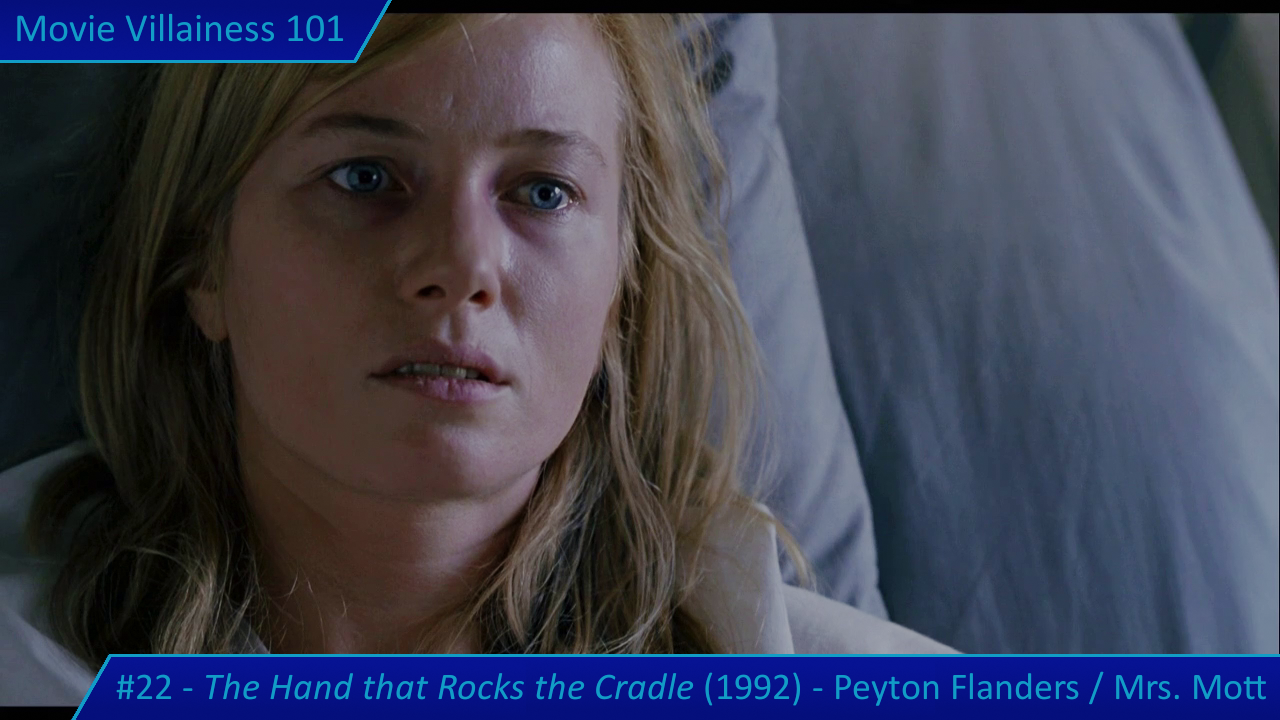
Movie Villainess 101 Rank #22

…is the hand that rules the world, but she’ll settle for motherhood (and murder).

Movie

The Hand That Rocks the Cradle (1992)

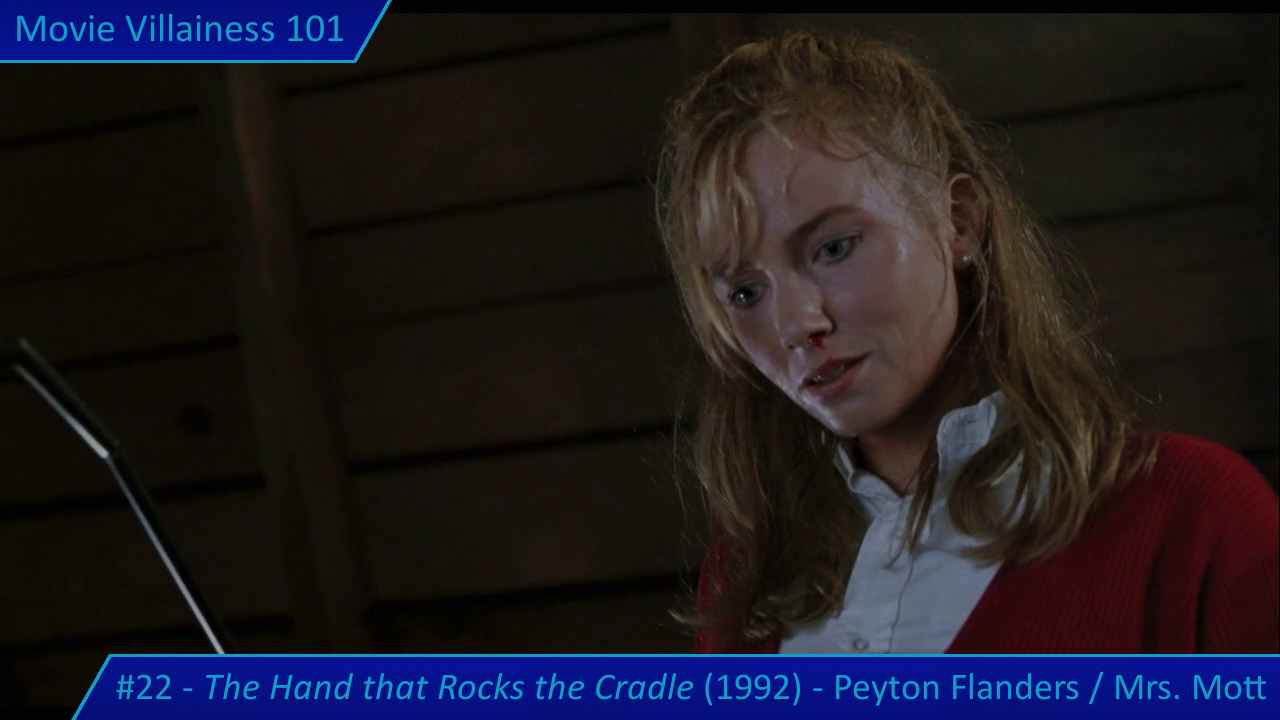
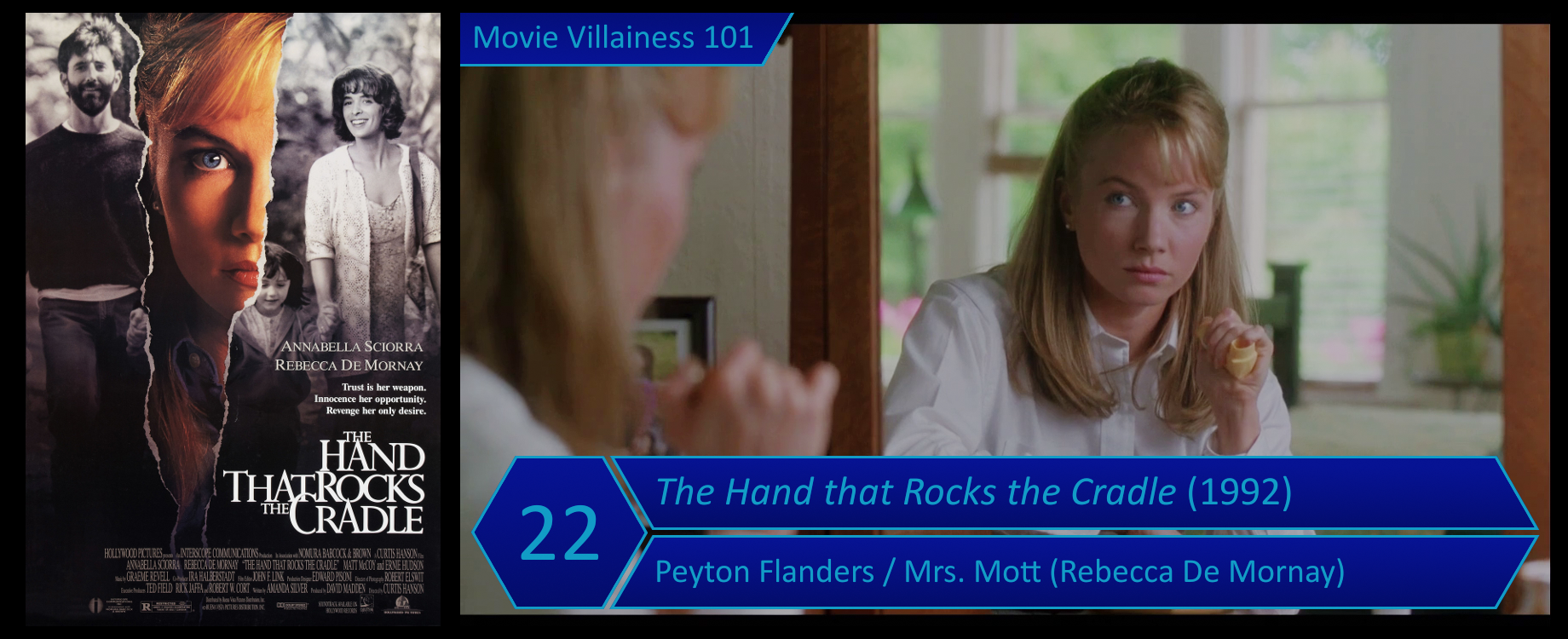
A story recycled dozens of times: a nanny with ulterior motives worms her way into an overly trusting suburban family. This will surely sound familiar, but a strong actress can elevate a film above the mediocre competition, and Rebecca De Mornay delivers the goods as the scheming Peyton Flanders.

Before she employs the nanny from hell, Claire Bartel (Annabella Sciorra) reports a sexual assault during a medical examination. More allegations by other women follow, and the not so good Dr Mott commits suicide to avoid facing justice. Why is this important? Because the nanny is Mrs Mott, a revenge-seeking widow out to ruin the lives of Claire, her husband Michael (Matt McCoy), and her daughter Emma (Madeline Zima). And since Mott had a miscarriage, she sees herself as the true mother of baby Joey.

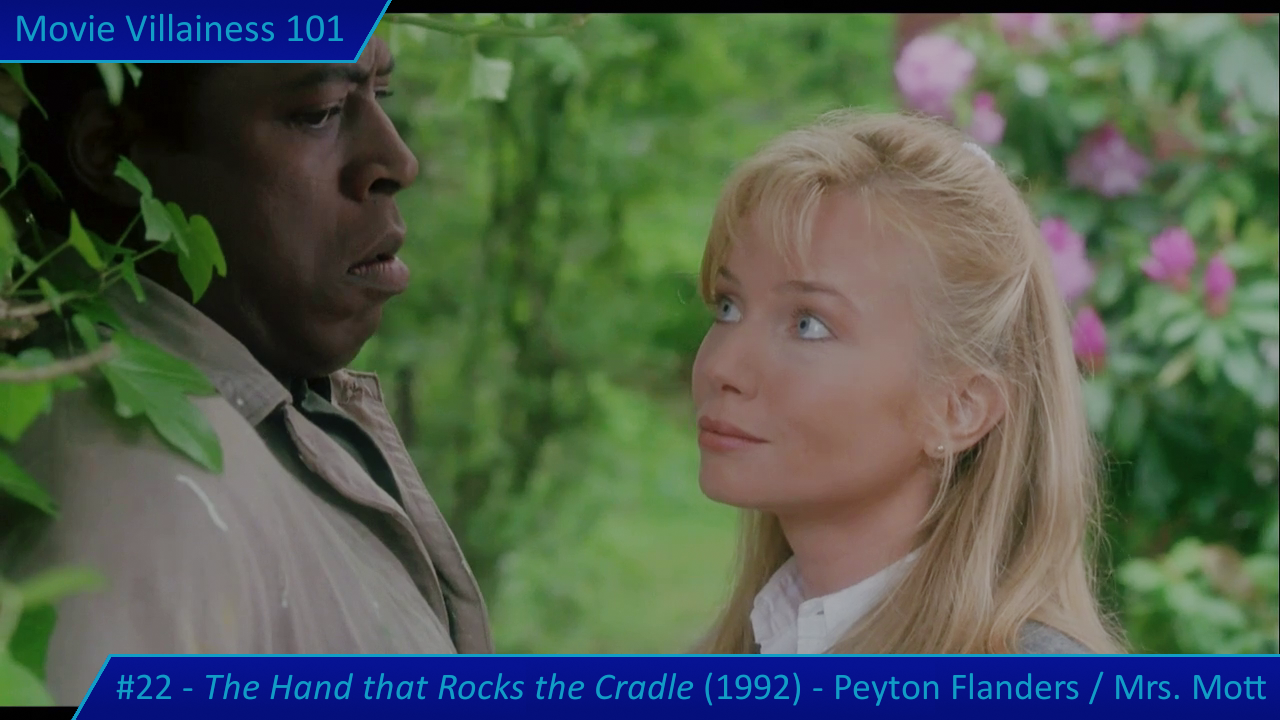
Like many movie families, Claire and Michael don’t do a background check, though Peyton – as she now calls herself – is charmingly sweet. One person the villainess doesn’t fool is Solomon (Ernie Hudson), a mentally ill handyman whose curiosity might shorten his life expectancy.

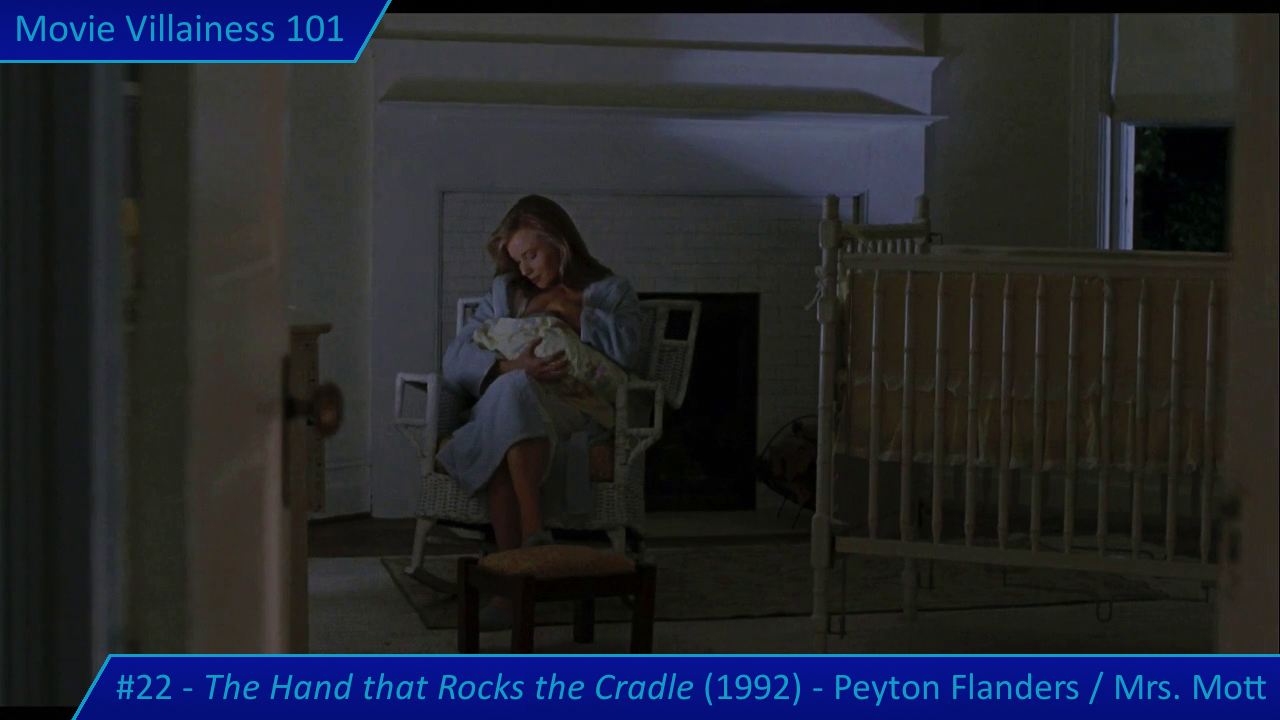
The first two acts are slow going, with the psychotic nanny undermining family relationships and playing people against each other. Peyton wanders the house at night and breast-feeds Joey, which leads to odd behaviour that Claire can’t understand. The villainess develops a false friendship with Emma, lets her watch horror movies in secret, and uses their alone time to manipulate the young girl.

Peyton threatens a child who bullies Emma, scaring him witless. The villainess also steals a document from Claire’s handbag to undermine Michael’s standing with his employer. Rather than simply throwing the paperwork away, she rips it up and smashes a toilet cubicle with a plunger. The rage is building, ready to be unleashed, and this is one film where the climax is not disappointing.

Villainess

Peyton / Mrs. Mott (Rebecca De Mornay)

The villainess is more effective than most copycats. There are no suspicious deaths until late on, and few reasons for the Martels to be wary. Peyton is a conniving woman who twists facts and plants seeds of doubt. She tells Emma to keep their movie watching secret and convinces Claire that her daughter is hiding something more sinister. The villainess arranges a surprise party and meets Michael at unusual times and locations. Then she plants evidence to insinuate an affair with family friend Marlene (Julianne Moore).

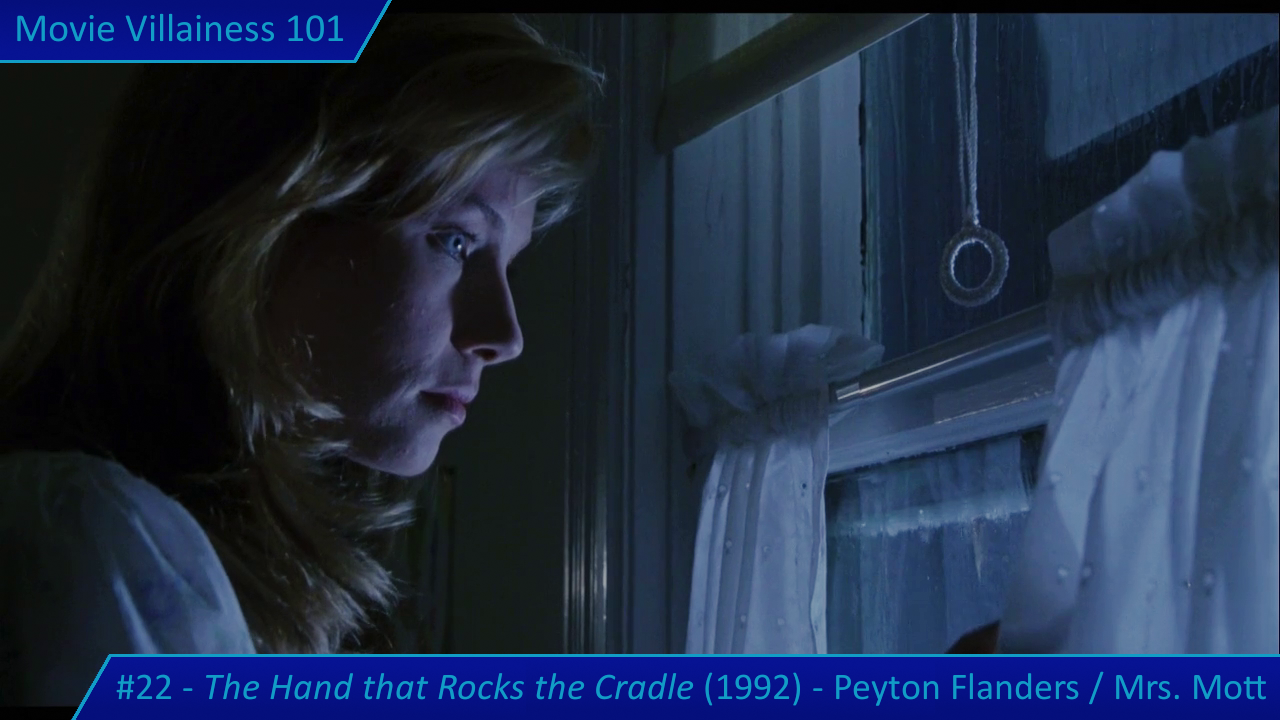
Peyton’s plan unravels when Solomon sees her breast feed while cleaning an upstairs window. She threatens him into silence and mocks his mental condition just to remind us she’s evil. This is a tactic to buy time while she figures out a more permanent solution. Surprisingly, this doesn’t involve murder. Peyton plants Emma’s underwear in Solomon’s cart and tells Claire he’s been acting strangely, which is enough to frame him for child molestation.

Alone with the family, Peyton overhears Claire suggest a holiday to smooth things over with Michael. The villainess sets a trap in the garden greenhouse so that entering will cause the swinging glass roof panels to shatter. Her deadly setup is intended for Claire, but Marlene discovers the wind chimes are from Mrs Mott’s former house. The stupid friend confronts the nanny and dies by raining glass shards.

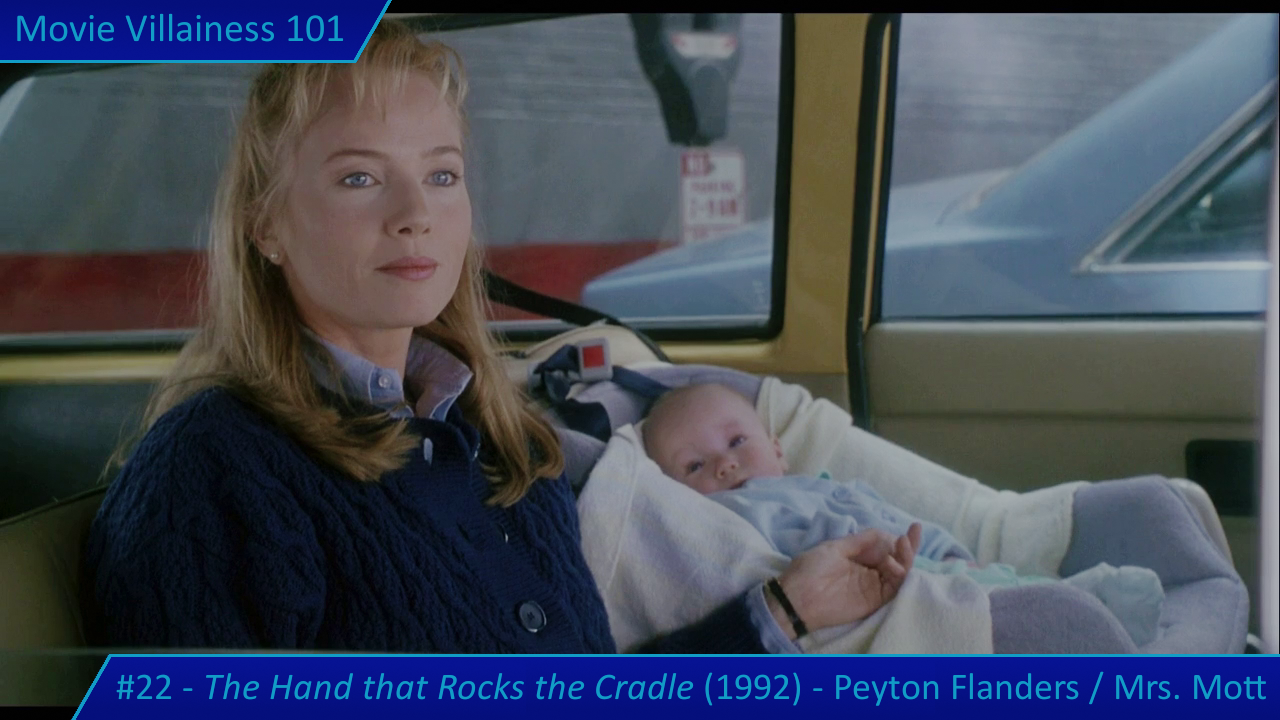
Expecting Claire to have an asthma attack when she discovers the body, the villainess sabotages every inhaler in the house and takes the baby out for a stroll. The plan almost works, but paramedics arrive in time. After a lengthy stay in hospital, the suspicious heroine follows up a note from Marlene, a clue that leads her to the old Mott residence. When she realises the decor matches her baby’s room, Claire deduces the nanny’s true identity, and finding a breast pump confirms it.

Michael and Claire fire Peyton, but no psycho villainess of merit is dealt with so easily. The crazed widow returns and attacks Michael, ruling him out of the chase that follows. Emma outsmarts the killer and protects Joey by using the baby monitor as a distraction, which leads to an attic confrontation. Fortunately, Solomon has been watching Emma and is on site to help the family.

Before the poker-wielding Peyton can snatch Joey, Claire comes upstairs armed with a kitchen knife. It’s a makeshift weapon duel, and soon the asthmatic is on the floor and out of breath. Peyton taunts her, but Claire – who faked the attack – surprises the psycho when she turns to deal with Solomon. The rush attack sends the villainess flying through the window… onto a picket fence below.

Honourable Mentions: Psycho Nannies

The Sitter (2007) – Abigail Reed (Mariana Klaveno)

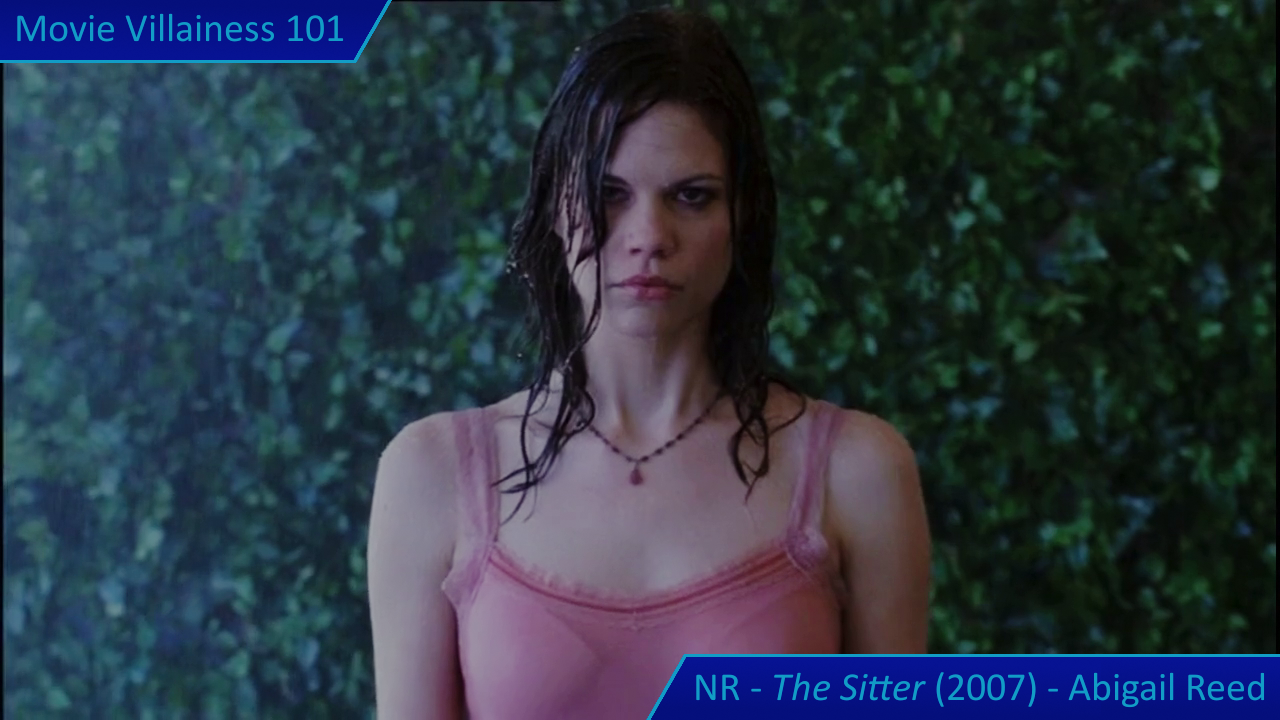
One of many psycho-nanny clones, this formulaic thriller has a couple of plus points. The director is Russell Mulcahy, whose credits include Highlander (1986) and The Real McCoy (1993), so the action scenes are well shot with stunt sequences superior to most TV movies. And the performance by Mariana Klaveno brings a threatening presence. Just as well, because the story is strictly by the numbers.

A nanny with a traumatic past is hired by Carter and Meghan Eastman (William R. Moses and Gail O’Grady). Except she plans to dispose of the wife to have the man all to herself. Her motive is a mystery until the end, but ultimately it’s lacklustre. Abigail fell in love with Carter when he worked as an attorney on her abusive mother’s trial. Hardly riveting, so it’s left to Klaveno to stare insanely and act over the top to maintain the tension.

Standout psycho moments include Abby threatening a school bully and a striptease to seduce the neighbour’s teenage son. Just for the hell of it. Victims are obvious the moment they walk on screen. Carter’s business partner gets a shovel in the neck after he flirts with Abby at a house party. The nosy neighbour gets a late-night visit and a stereo in her bathtub, and the best friend exists for one last kill before Abby reveals her true intentions.
That murder is well done for the genre. The psycho suffocates her victim with a plastic bag and snaps her neck. After that, the viewer expects a showdown and perhaps a catfight, but Abby is killed easily with a pair of scissors. Restrictions on TV movie runtime may have resulted in a rushed and unsatisfying wrap-up. Abby returns from near death, only to get stabbed again and collapse on the stairs. Then the credits roll and… that’s it.

Devious Nanny (2018) (aka The Nanny Betrayal) – Elise (Michelle Borth)

A brief honourable mention for this twisty variation on a tired theme, the story starts out on a familiar path when a loving couple hire a nanny called Amber (Olesya Rulin), who turns out to have a mysterious past. But that’s a red herring because the wife, Elise, is the woman responsible for the recent murder spree.

Sourcing Lifetime movies in the UK can be difficult, and those that are shown on afternoon TV are usually edited for content. Fortunately, there’s always Marvista Entertainment whose spoiler-heavy trailers often sum up the entire movie, reducing 90 minutes to 90 seconds. The official trailer is no longer available on the official site, but can be found on YouTube or video archives.

Everything is included: the setup, characters, key plot developments, and yes… even the final act plot twist that reveals the true murderess and her bizarre motive. Killing people is justified to keep a family together, apparently.

Movie Villainess 101 Rank #23

Paul Sheldon chose an appropriate name for his main character

Movie

Misery (1990)

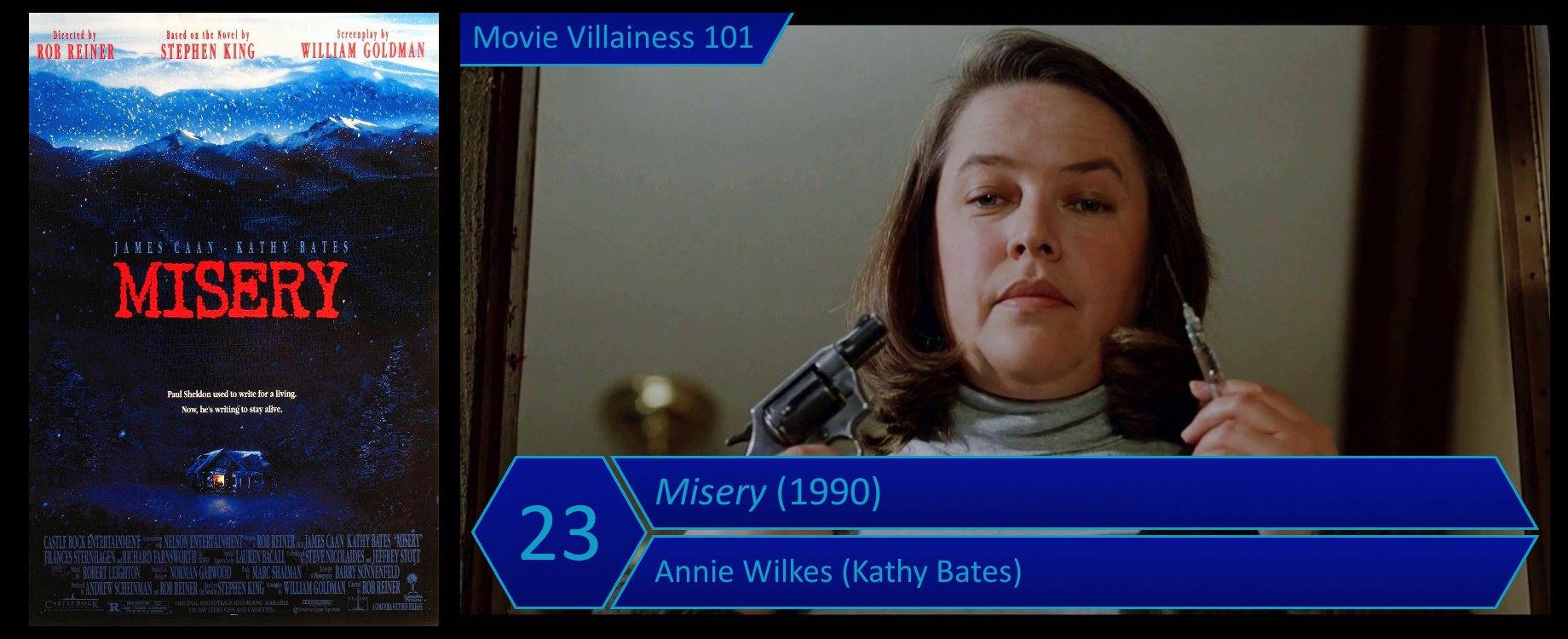
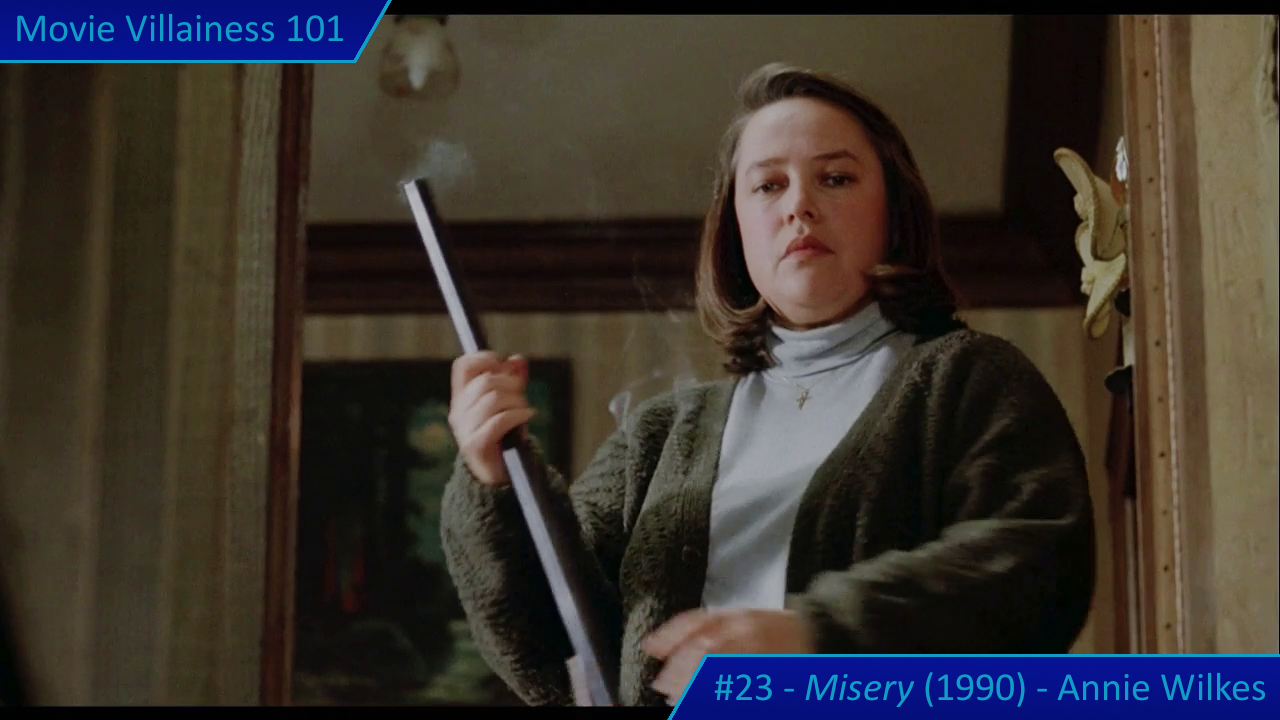
This adaptation of Stephen King’s novel earned Kathy Bates an Academy Award for her portrayal, which took obsessed fandom to a new level. It’s essentially a “can he escape?” story with the main character trapped in a remote house with the villainess. The movie captures the claustrophobic feel, with limited locations and camera angles from the captive’s point of view.

As the film begins, Paul Sheldon (James Caan), author of the popular Misery romance series, finishes an untitled manuscript and travels from Colorado to New York. Perhaps he should have waited for the blizzard to pass. Instead, he winds up in an accident and loses consciousness.

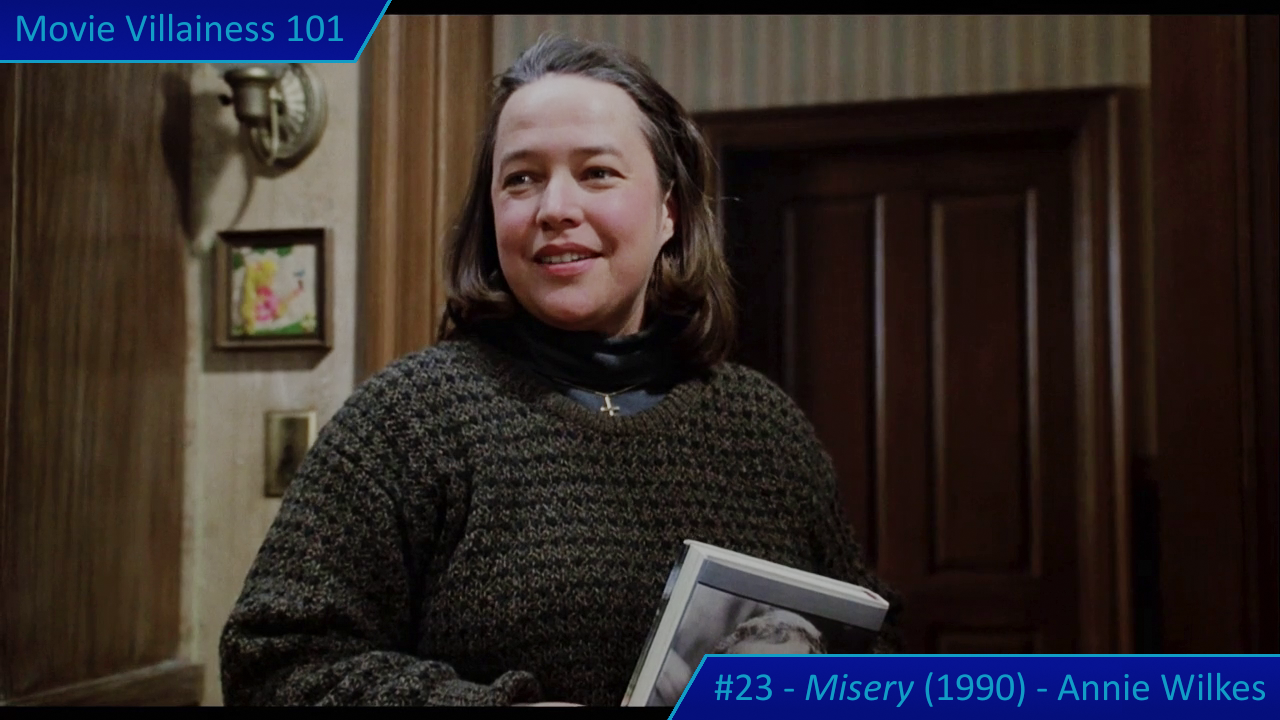
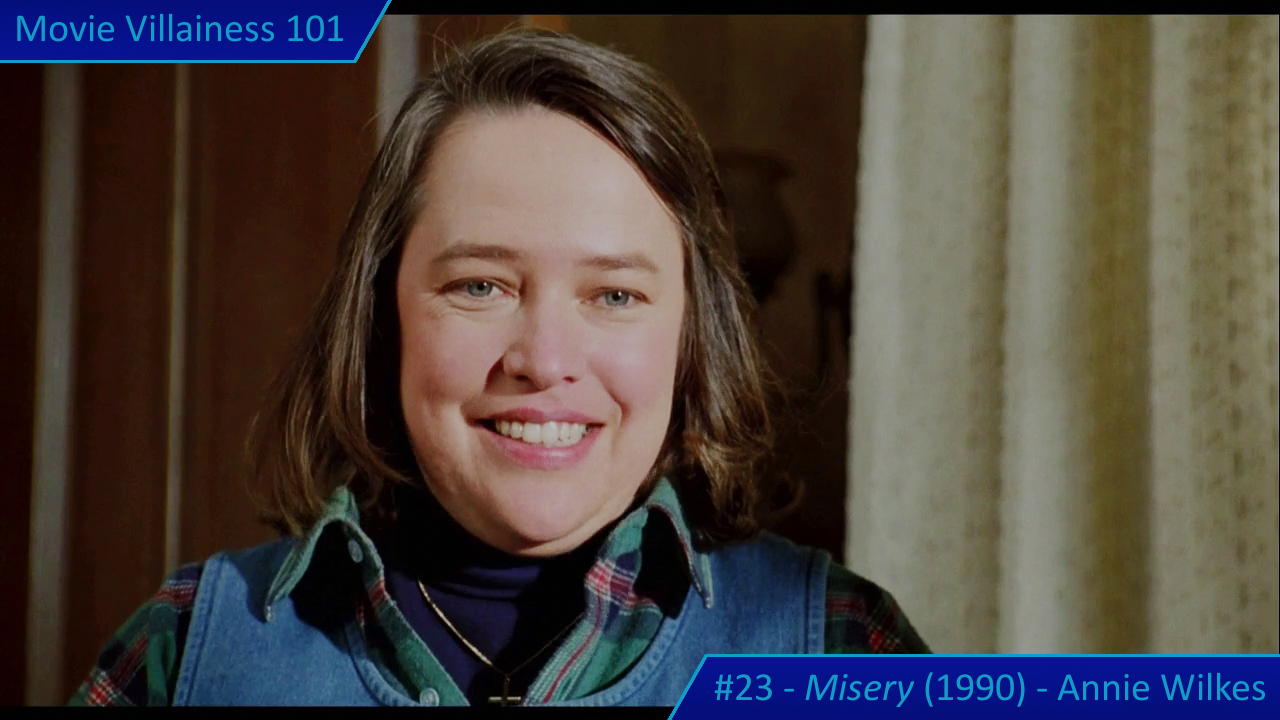
When Paul comes to, he has serious leg injuries and is under the care of Annie Wilkes, a former nurse who lives alone on a farm. Paul is grateful for Annie’s help, but things become tense when his rescuer shows a deeply religious attitude towards profanity. She’s also named her pig after the Misery character – think she might be crazy? Paul figures as much, and since Annie reads the unpublished work, maybe he ought to be worried he’s killed off the fictional hero she adores so much.

Yeah, Annie doesn’t take that well at all. In fact, she screams abuse at Paul – in a brilliantly insane and scary way – and revels in her deception that she never phoned for help. The victim tries to escape, but can only crawl a short distance, and the locked door is a seemingly impassable obstacle. To ensure Paul stays focused (at God’s behest, apparently), Annie has him burn his manuscript on a portable barbecue.

Paul’s agent (Lauren Bacall) is now concerned and asks the local sheriff to search for the missing writer. His investigation becomes a subplot that unfolds in parallel. After initial questions turn up no leads, the authorities locate the car wreckage and assume the worst, but the sheriff doesn’t believe Paul is dead. Still trapped with the deranged Annie, help from the outside world may be his only hope of survival.

Villainess

Annie Wilkes (Kathy Bates)

Annie brings Paul a second-hand typewriter, sets up a writing studio, and demands he resurrect Misery in a reworked novel. Understandably, he doesn’t share her enthusiasm, but he notices a hairpin on the floor. To get Annie out of the house, Paul tells a convincing lie: he needs special writing paper to avoid smudging. She gives him a piece (or several pieces) of her mind before leaving for town, but once she’s gone, Paul fashions a makeshift lock pick.

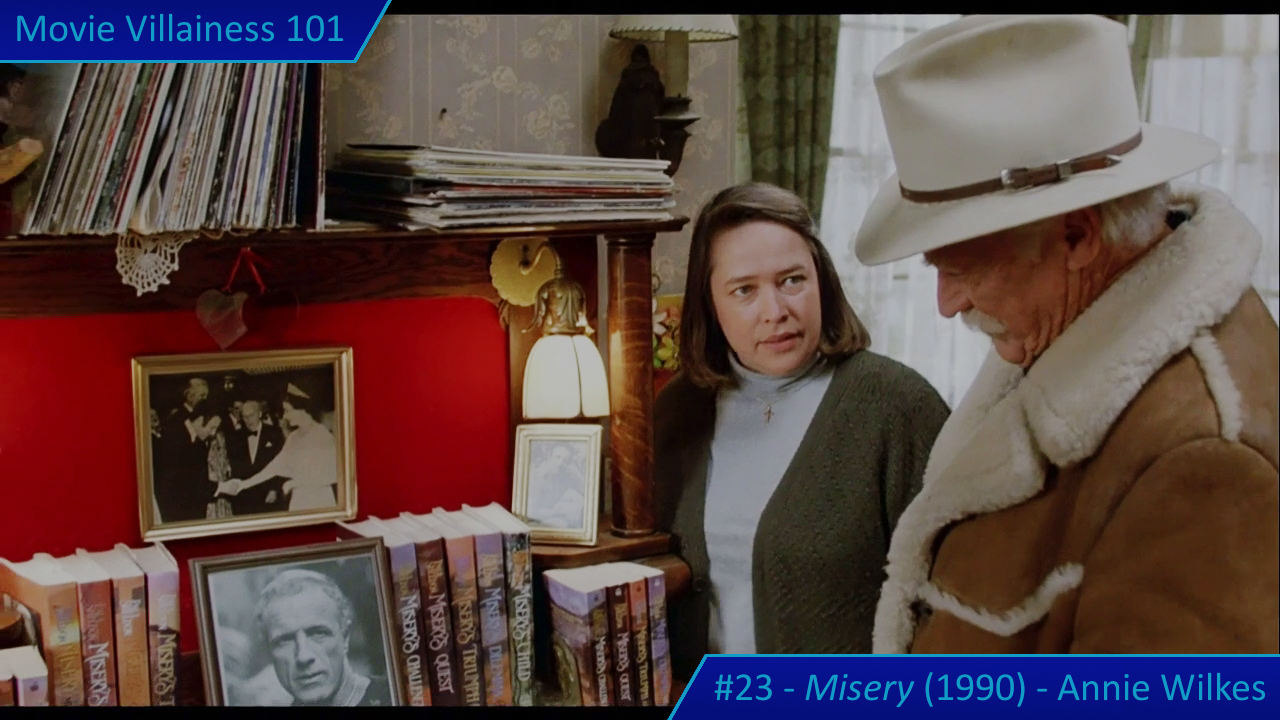
The daring escape plan works, but he’s still trapped in the house. In a wheelchair, Paul’s movement is limited, but he discovers a Misery shrine with the novels lined up behind a picture of himself. Too bad the phone is a useless prop with the mechanism removed. Yes, the kidnapper really is nuts, and there’s no way to call for help. Realising he’s alone, Paul finds Annie’s stockpile of sleeping pills, secretes a packet, and returns to his room.

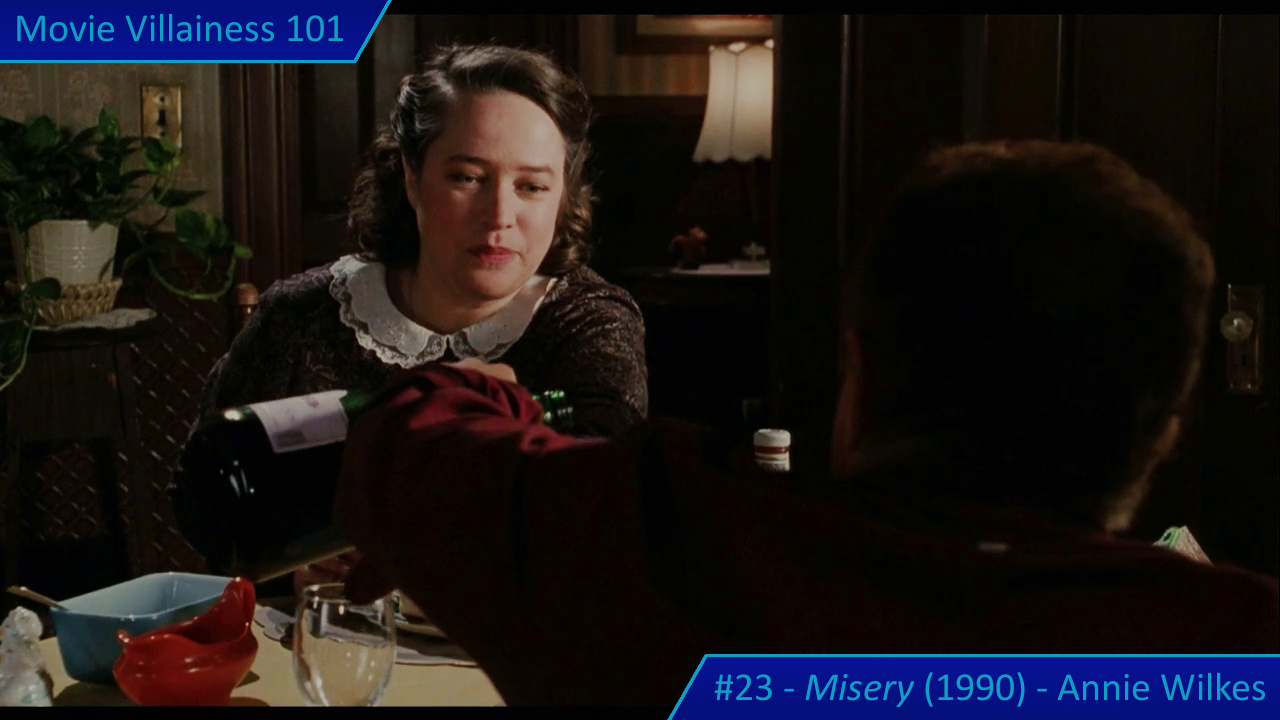
Paul uses the few tools available, and plans to turn the tables on Annie during an evening meal. Having emptied the pills into a paper sachet, he proposes a toast and insists on drinking wine by candlelight. Paul drugs Annie’s drink, but she spills it and foils the plan. With no other viable strategy, he works on the novel and waits for another opportunity.

When Annie leaves the house again, Paul looks around. He arms himself with a kitchen knife and finds a scrapbook of news clippings about his captor’s past. Seems she was a nurse whose infant patients died, and she was put on trial (as if we needed any evidence of psychosis). Paul stows the knife and returns to his room, now ready for violence. Eventually he drifts off, only to find Annie standing over the bed with a syringe of morphine when he wakes.

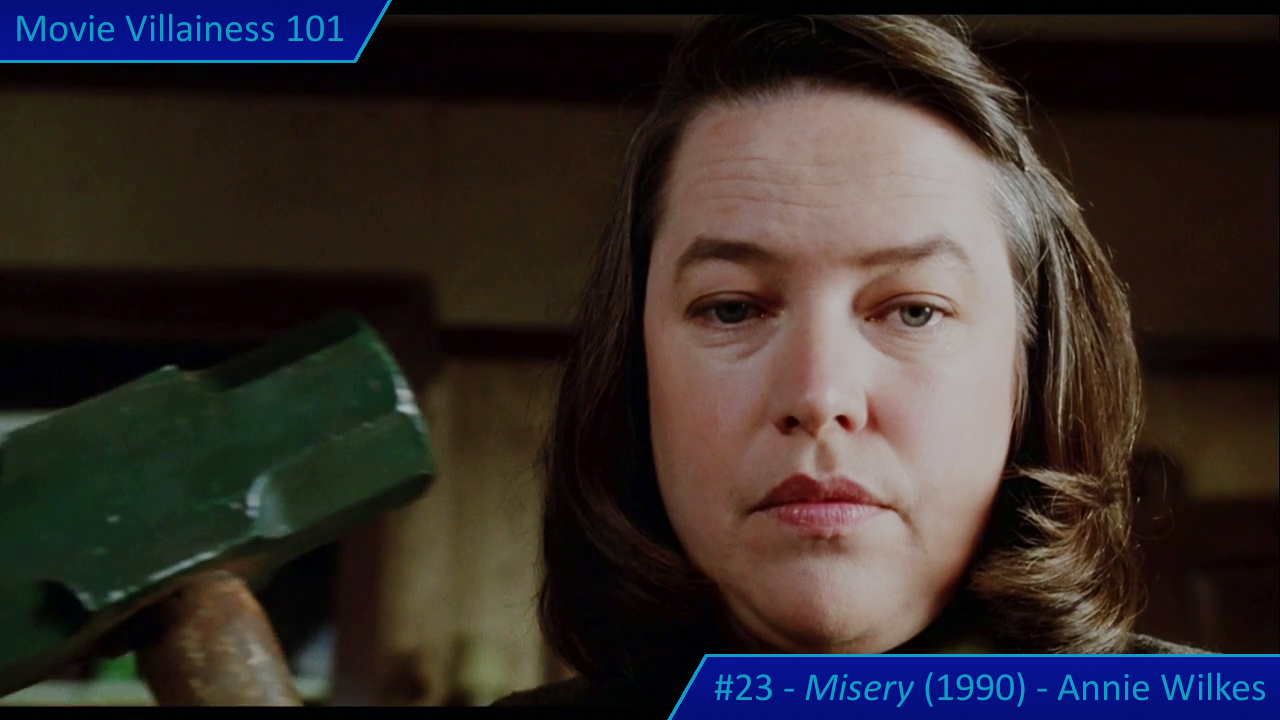
She knew of Paul’s escape because he accidentally knocked over a ceramic penguin and put it back the wrong way. The fussy woman noticed and discovered Paul’s hairpin and knife (and likely spilled the wine on purpose). To dissuade any further breakouts, Annie hobbles Paul. Tat translates as breaking both his ankles with a sledgehammer in a graphic scene that often makes “top scary movie moments” lists.

Away from the torture, the sheriff reviews news archives and connects a quote to something Annie said at her trial. He follows up with a visit to the Wilkes farm, but Annie sedates Paul and dumps him in the basement, while spinning a convincing yarn that she’s a harmless devotee. The sheriff thinks he made a mistake until he hears Paul’s muffled cries for help. Annie kills the nosy sheriff with a shotgun blast to the back and informs her despondent prisoner that she’s loaded a revolver with two bullets. The intent is clear.

Paul – realising he will only get one more chance – finishes the manuscript and demands his customary cigarette and champagne. When Annie leaves, he douses the pages in lighter fluid (which he found in the basement) and sets them alight. This enrages the villainess, and Paul strikes the distracted woman’s head with the typewriter. That’s not enough to kill her, so we get a drag-out fight – during which the gun goes off and wounds Paul – that ends with Annie banging her head.

Just when Paul thinks it’s over, the villainess launches a surprise attack. After a struggle, Paul grabs an ornament and bludgeons Annie, finishing her for good. Upon his return to New York, Paul has lunch with his agent. He sees the psycho wheel a serving tray towards him, but this turns out to be a hallucination. Of a waitress who tells Paul she’s his number one fan.

Honourable Mention: Stephen King

Carrie (1976) – Margaret White (Piper Laurie), Chris Hargensen (Nancy Allen)

This is the adaptation that started it all, based on King’s first published novel. Now considered a classic, Carrie has spawned a sequel and several remakes, but the original is the most loved and acclaimed. It features several prominent stars in early appearances, notably Nancy Allen, John Travolta, and a breakout role for Sissy Spacek.

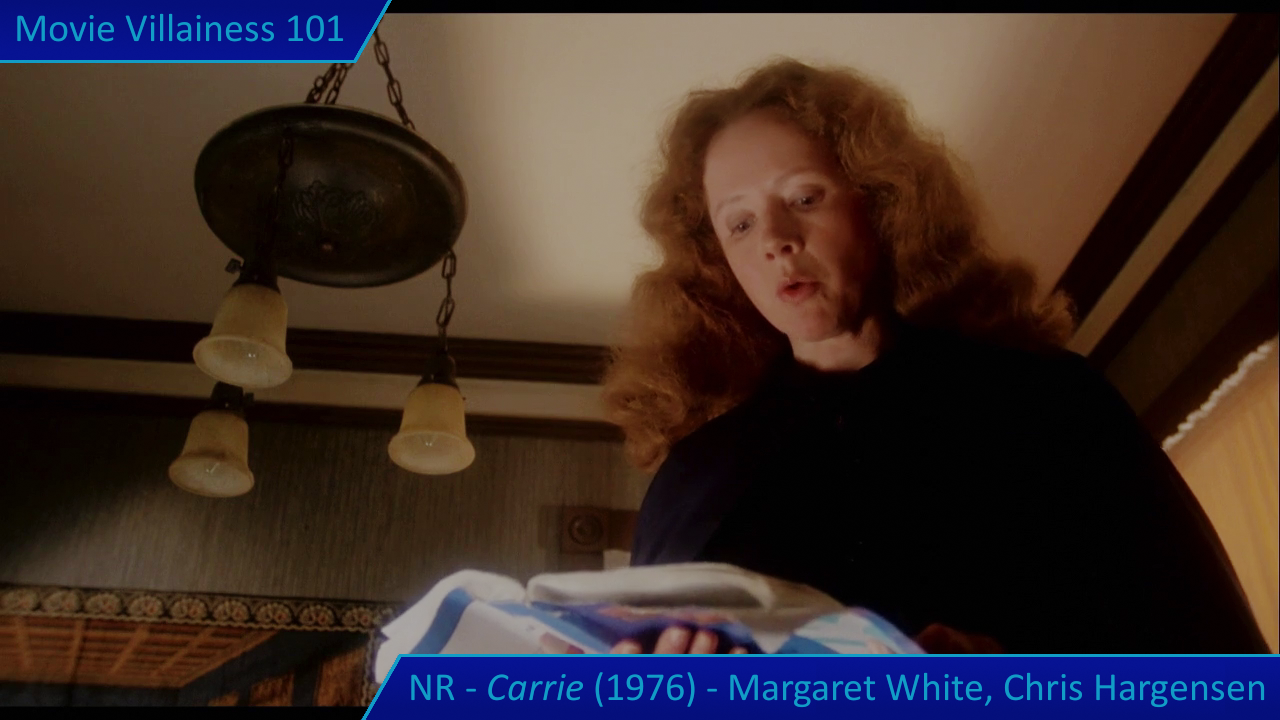
The title character is a schoolgirl tormented by her classmates, a group of mean girls led by the sadistic Chris Hargensen. Carrie is an oddball who doesn’t fit in because of a tyrannical upbringing by her religious mother. Margaret beats her daughter, forces her to recite passages from the Bible, and locks her in a prayer closet to atone for her sins (anything she can think of, basically).
Carrie smashes an ashtray – the first sign of telekinetic powers. Eager to find out more, she reads up on the phenomenon and learns to amplify and control her abilities. Most of the movie is a slow burner as Chris plots revenge for a detention she blames Carrie for, and a repentant student convinces her boyfriend to invite the outcast to the school prom. That’s the big event the film is known for, which makes the final twenty minutes worth the wait.

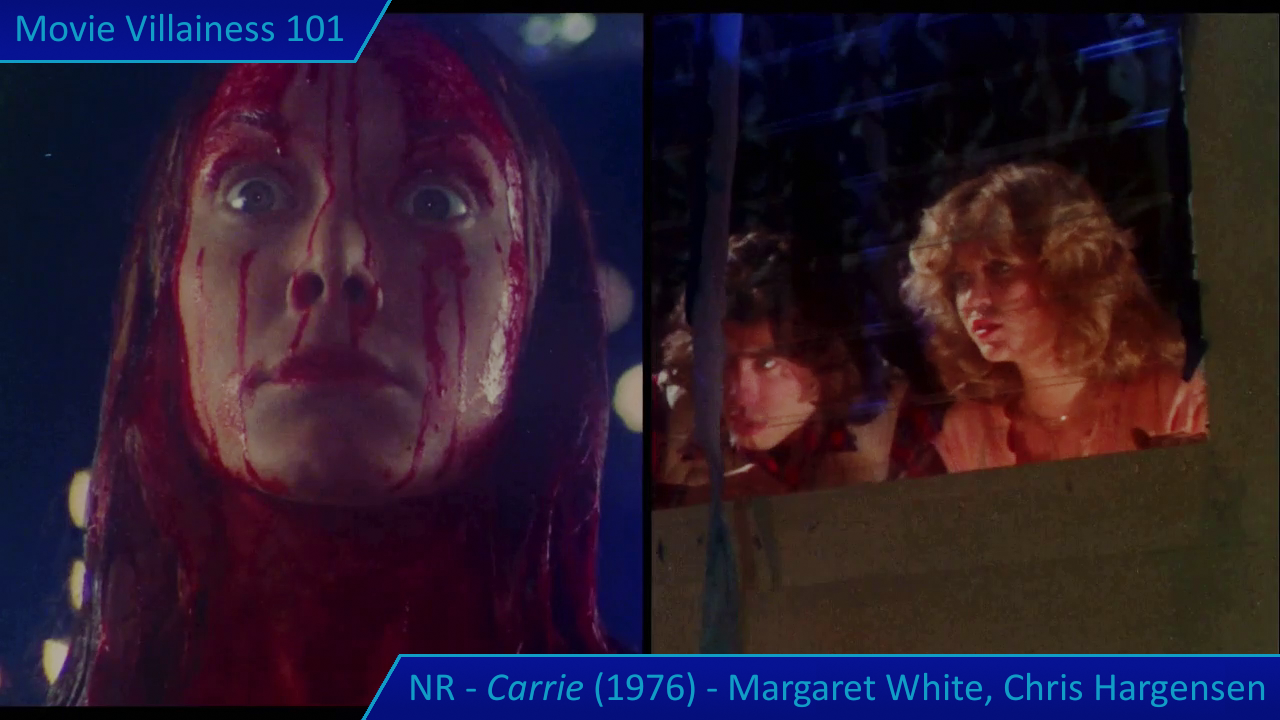
Thanks to a pretty homemade dress and a rigged contest, Carrie gets voted prom queen and receives applause from those present. However, it’s a prank planned by Chris, who drops a bucket of pig blood on Carrie while she celebrates on stage. Terrible mistake, because now this girl is really upset.

A powered-up Carrie slams the doors, sprays the crowd with water, and electrocutes them. Nobody escapes her wrath, not even the sympathetic gym teacher, who was genuinely happy and supportive. Many kills are off screen, but the carnage is clear from the burning school Carrie leaves behind.

With the main cast almost wiped out, Chris and her boyfriend – lucky to escape – attempt to run Carrie over. A stupid move against a psychic, who flips the car over by concentrating. Margaret White – convinced her daughter is a witch – stabs her, only to be impaled by flying objects and crucified. Despite the prom bloodbath, it’s easy to feel sympathy for Carrie as the house collapses. Margaret and Chris are the true villains in this story.

Movie Villainess 101 Rank #24

When you’re in a relationship with this woman, be mindful of incriminating evidence

Movie

Gone Girl (2014)

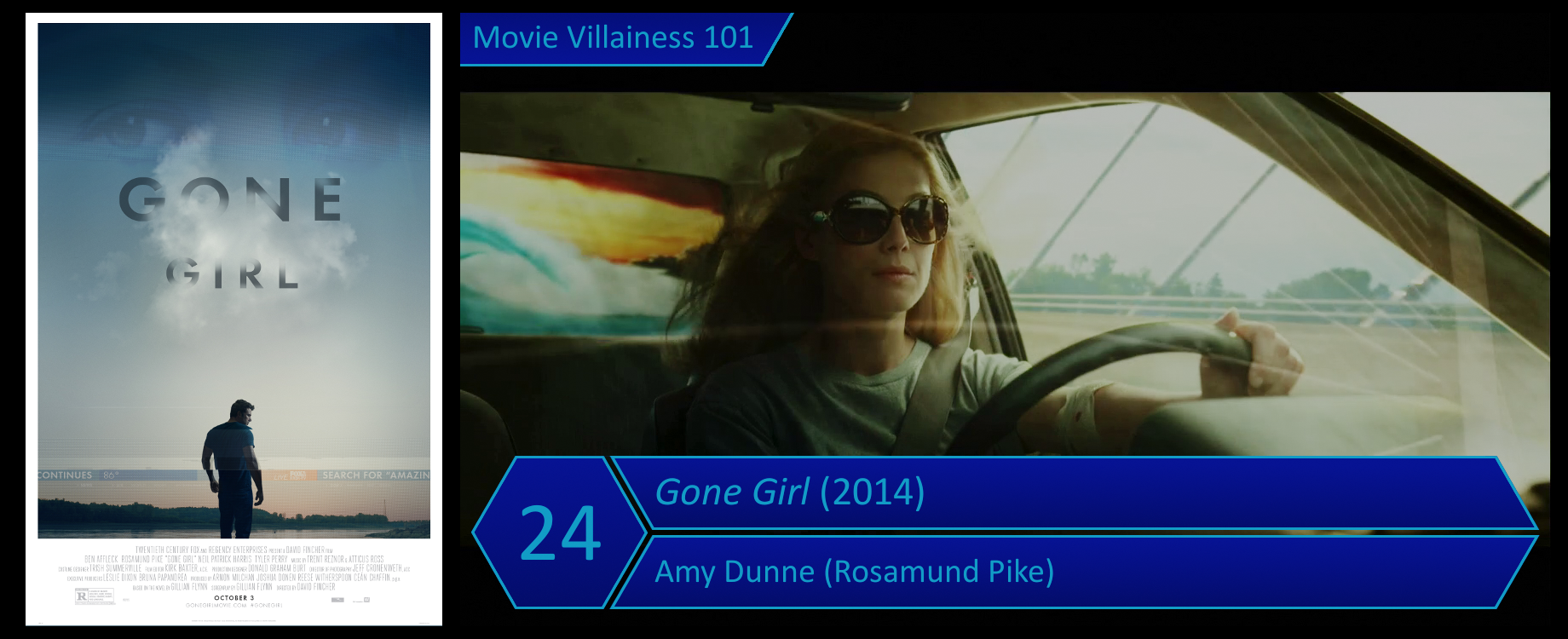
Spoiler alert, though including Amy on my list already gave it away. A film best known for its plot twist, the reveal is unusual because it comes at the midpoint. Savvy viewers – especially those familiar with the unreliable narrator trick – will guess the twist before it happens, but what follows is unpredictable and gripping. The screenwriter Gillian Flynn wrote the novel on which the film is based, so we get the same two-part structure: a mystery for the first half and a suspense thriller for the second.

The story revolves around the disappearance of Amy Dunne, wife of Nick (Ben Affleck). On finding signs of a disturbance at his Missouri home, the concerned husband calls the cops. But when the evidence suggests a staged crime scene, he finds himself suspected of murder. His wife set up an anniversary treasure hunt, and following the clues leads to more incriminating finds.

Amy was the inspiration for the children’s book character “Amazing Amy”, so the case garners widespread media attention and puts Nick in the spotlight. He’s heavily in debt (though he doesn’t seem to know about this), which gives him a motive. With the police suspicious, Nick’s only ally is his twin sister Margo (Carrie Coon).

As the story unfolds, Amy recites passages from her diary in flashbacks. These cover her first meeting with Nick, their marriage, and the happy early years. After Nick’s mother is diagnosed with terminal cancer and the couple moves away from New York, Amy’s story takes a dark turn. A victim of physical domestic abuse, she fears for her life. When the police discover the partially burned diary in a basement furnace, the case against Nick is even more compelling.
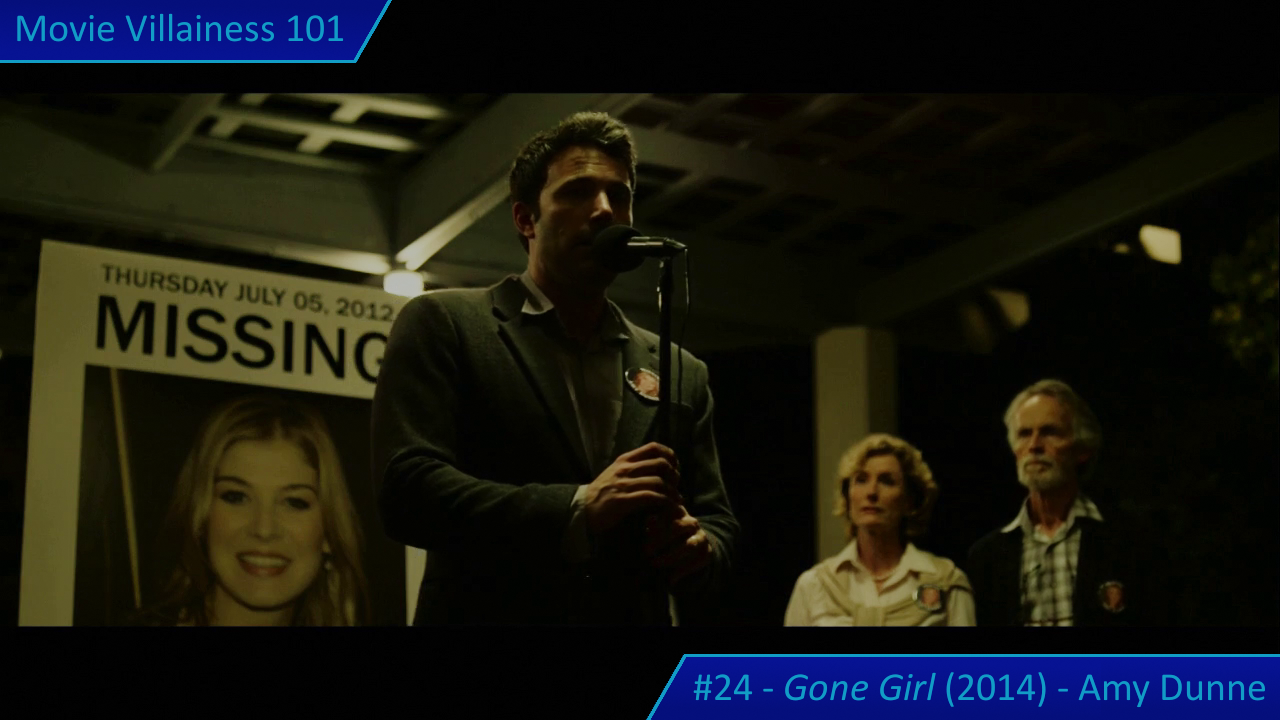
At a vigil for the missing Amy, her friend drops the bombshell that the missing woman is pregnant, and the media frenzy intensifies. The film is a commentary on television and celebrity obsession, with news reports appearing prominently throughout the story. Ultimately, we find out Amy is a scheming liar who staged her own murder to gain revenge on Nick for having an affair. That part is true, so Nick is no saint, even if he married a twisted psycho and a sizeable portion of what Amy wrote is pure fiction.

Villainess

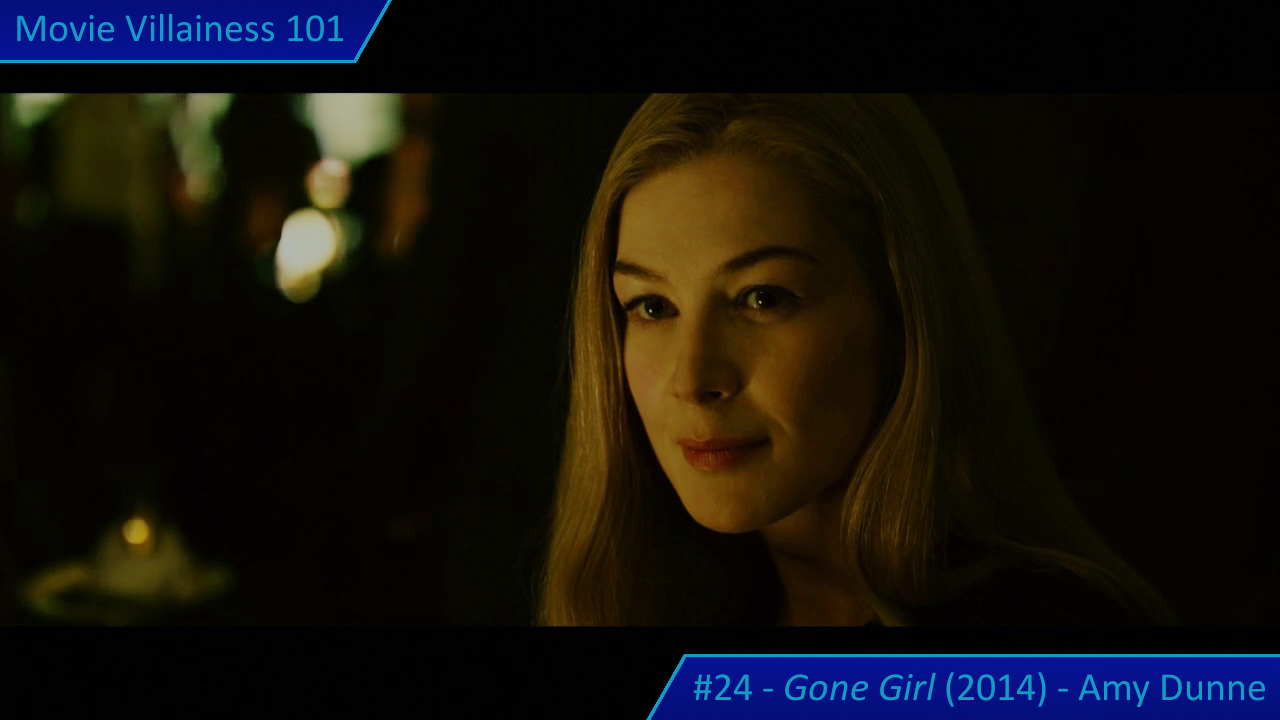
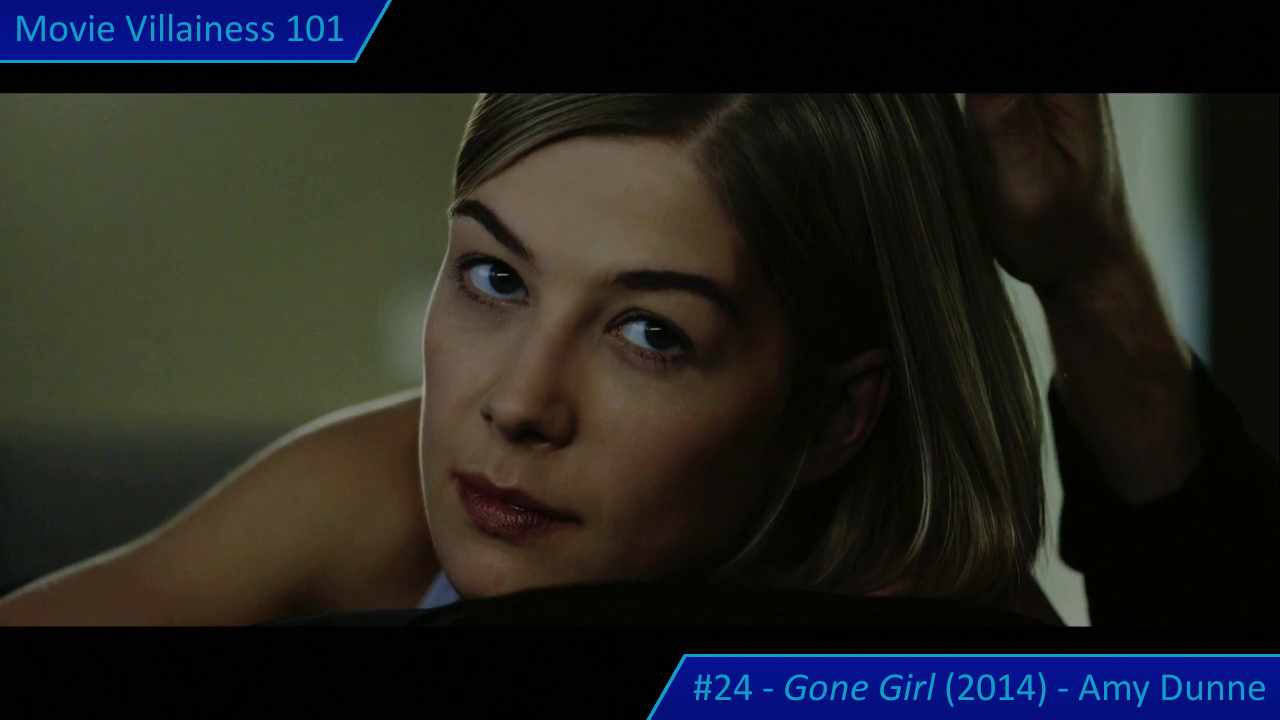
Amy Dunne (Rosamund Pike)

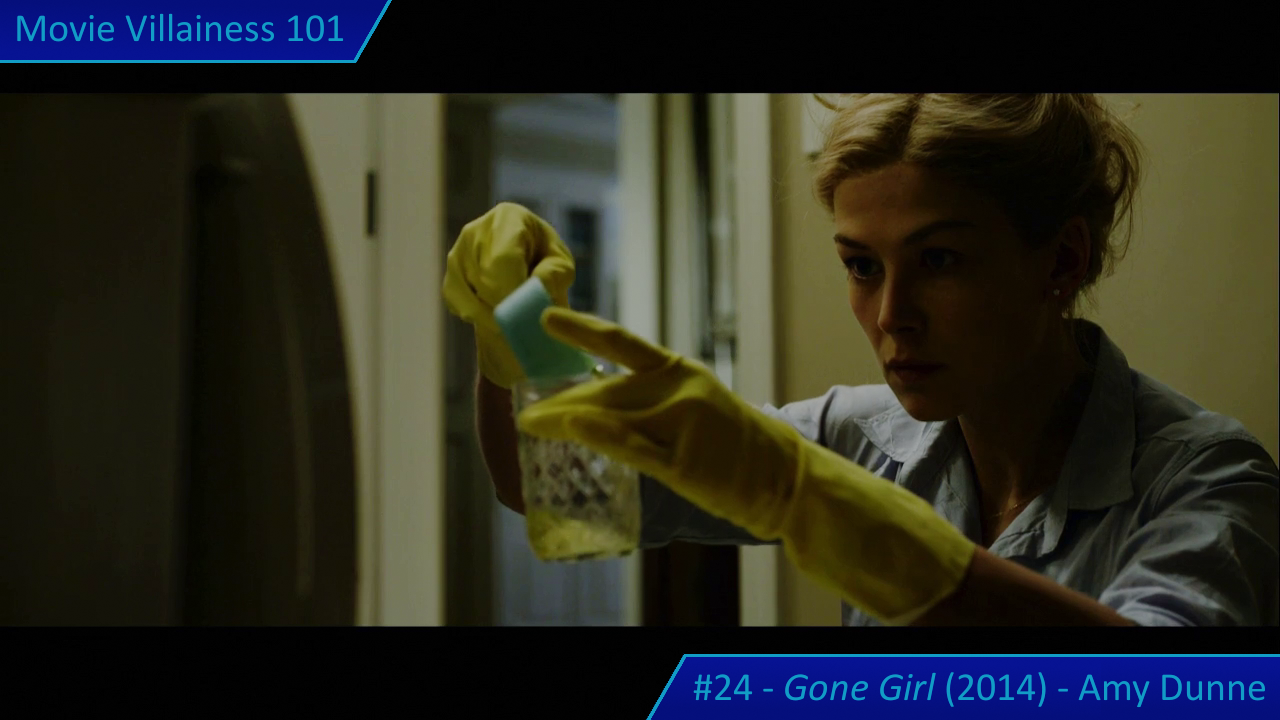
When Amy narrates her wicked scheme, and the clock rewinds to the day of her disappearance, it’s a five minute long mixture of confession and hatred. The villainess talks about her plan as if it’s commonplace to frame someone for murder and get them the death penalty. Amy discusses faking her pregnancy, leaving washed blood at the house to implicate her husband, and preparing to kill herself when it’s over. The whole setup could be described as a “how-to” book for budding psychopaths.

When Nick realises how dire the situation is, he hires high-profile defence attorney Tanner Bolt (Tyler Perry) and works with his sister to expose Amy. Nick visits other men in her life, including one guy she framed for rape and another who still loves her. His mistake will come back to haunt him soon enough. It seems setting people up is second nature to Amy, and nobody knows where she is.

By now, the villainess has changed her appearance and gone into hiding in a rural area. She has plenty of cash, but like all cocky killers, she makes a mistake and reveals her money bag to a couple of local drifters. The two criminals rob Amy, and she’s forced to amend her carefully planned scheme. Time to woo old lover Desi (Neil Patrick Harris) and convince him to be her partner.

The guy should have listened to Nick, because Amy frames him too. After the persecuted husband appeals to his wife on TV, she decides Desi is a liability. So, Amy fakes rope marks on her wrists and puts on a feigned horror show for the CCTV cameras. With the stage set, she seduces Desi and slits his throat with a box cutter. Sorry, pal – you’re just the latest sucker.

Things look bad for Nick when police discover the “murder” weapon and charge him with the crime. He’s barely out on bail when the blood-smeared Amy returns home and falls into his less than welcome arms. She recites a sob story about Desi kidnapping her and blames the cops for arresting her husband. The authorities are happy to believe her version of events, if only to close the case and put an end to media scrutiny. As for Nick, Tanner abandons him and leaves the couple to their own devices. It’s a fake marriage that breaks Margo’s heart, but the lawyer calls it right: Nick and Amy deserve each other.

Honourable Mention: Treacherous Wives

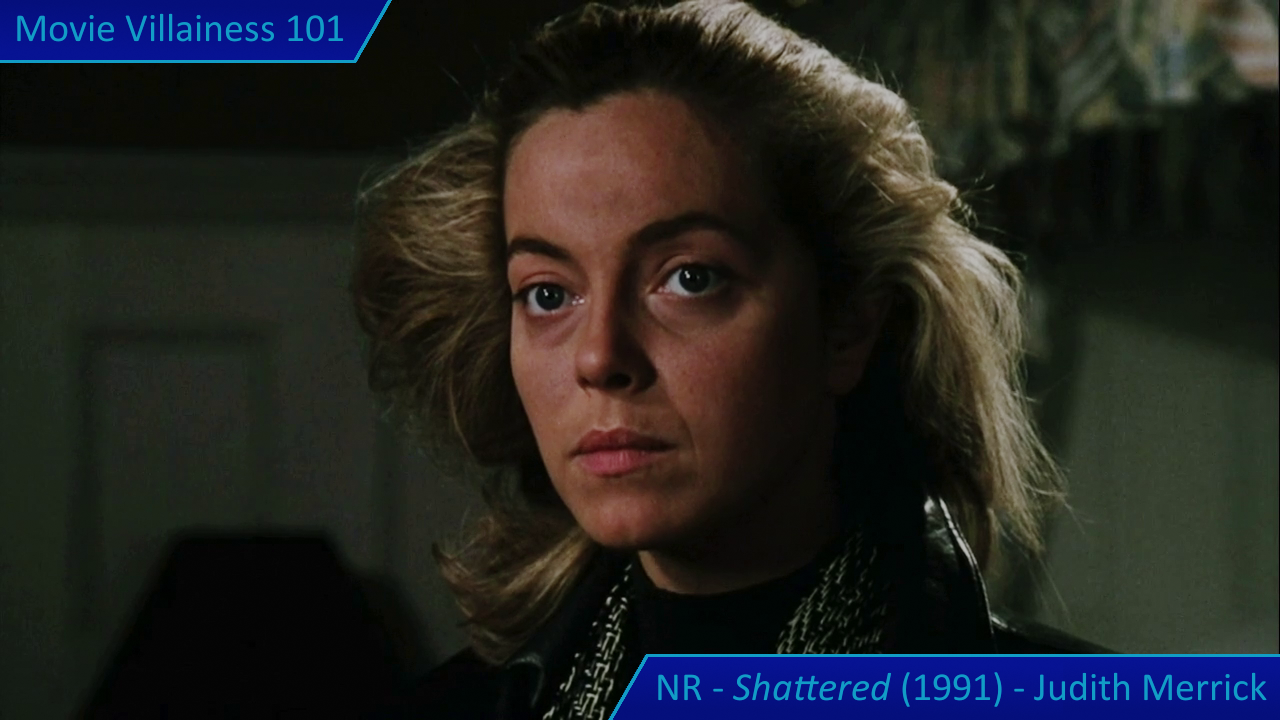
Shattered (1991) – Judith Merrick (Greta Scacchi)

Another film with a treacherous wife (spoiler alert!), this 1990s thriller mixes a standard amnesia plot with enough twists to keep the story original and compelling. Dan Merrick (Tom Berenger) wakes up after a car accident and lengthy coma, but can only remember general details and nothing personal. Following extensive plastic surgery to reconstruct his damaged face, he returns home to his loving wife Judith.

However, a mix of troubling flashbacks and information from his business partner, Jeb (Corbin Bernsen), leads Dan to suspect something is amiss. After he discovers Judith was having an affair with a man named Stanton, who hired private investigator Gus Klein (Bob Hoskins), it appears the car accident may have been attempted murder.

Things get even more mysterious when Dan and Gus observe Judith meet Stanton at a remote hotel, only to get shot at and nearly have a fatal road accident themselves. Then “Stanton” shows up at Dan’s house, and it’s revealed “he” is Judith in disguise. The villainess tells her husband that he’s a murderer. They hid Stanton’s body in a shipwreck, and she’s been covering for him ever since.

Someone fatally stabs Jeb’s wife, Jenny (who Dan was having an affair with) when she gets too close to the truth. Keeping up with this? The biggest twist comes when Dan examines the body – preserved in formaldehyde – and finds it’s actually… well, himself.

Dan is really Stanton, and Judith killed the real Merrick. The wife goes psycho, shoots Gus and takes Dan… er, Stanton on a car ride. Judith disappoints as a villainess since the first murder was self-defence, but she’s still a lunatic responsible for killing Jenny. The murderer gets all crazy and suicidal, and Stanton bails just before she drives over a cliff. Another car accident, only this time it’s Judith who goes up in flames.

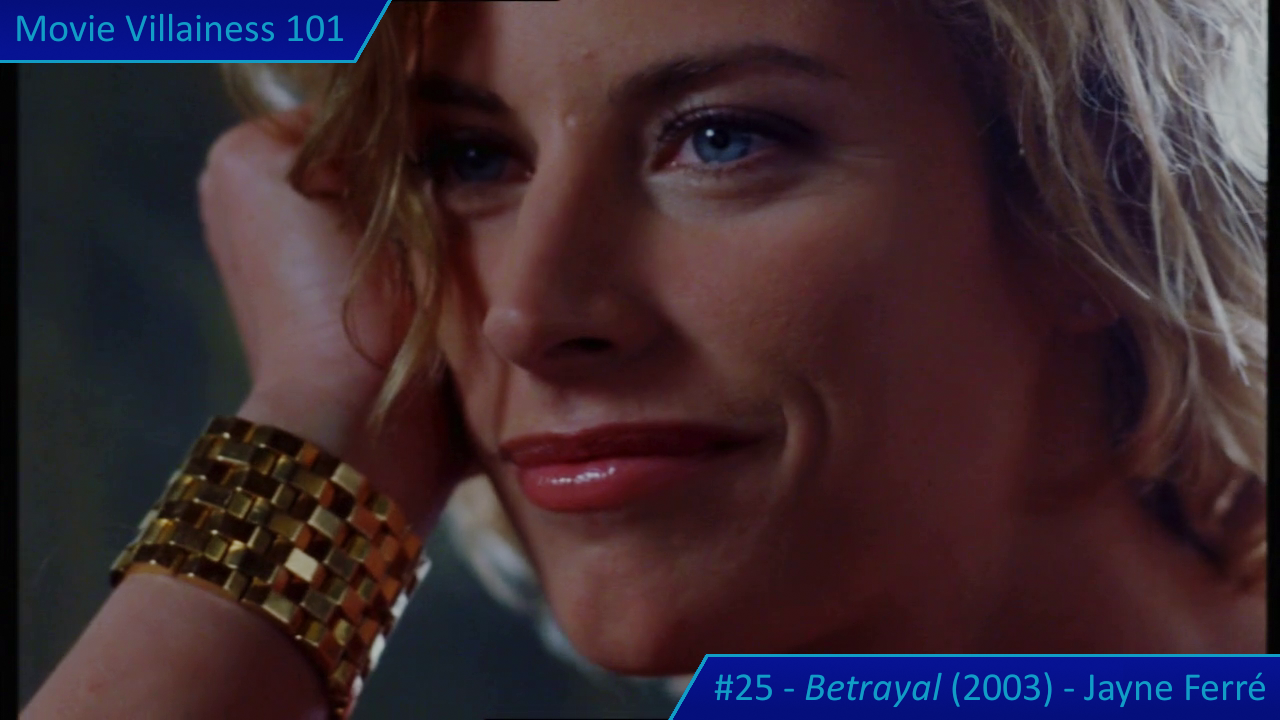
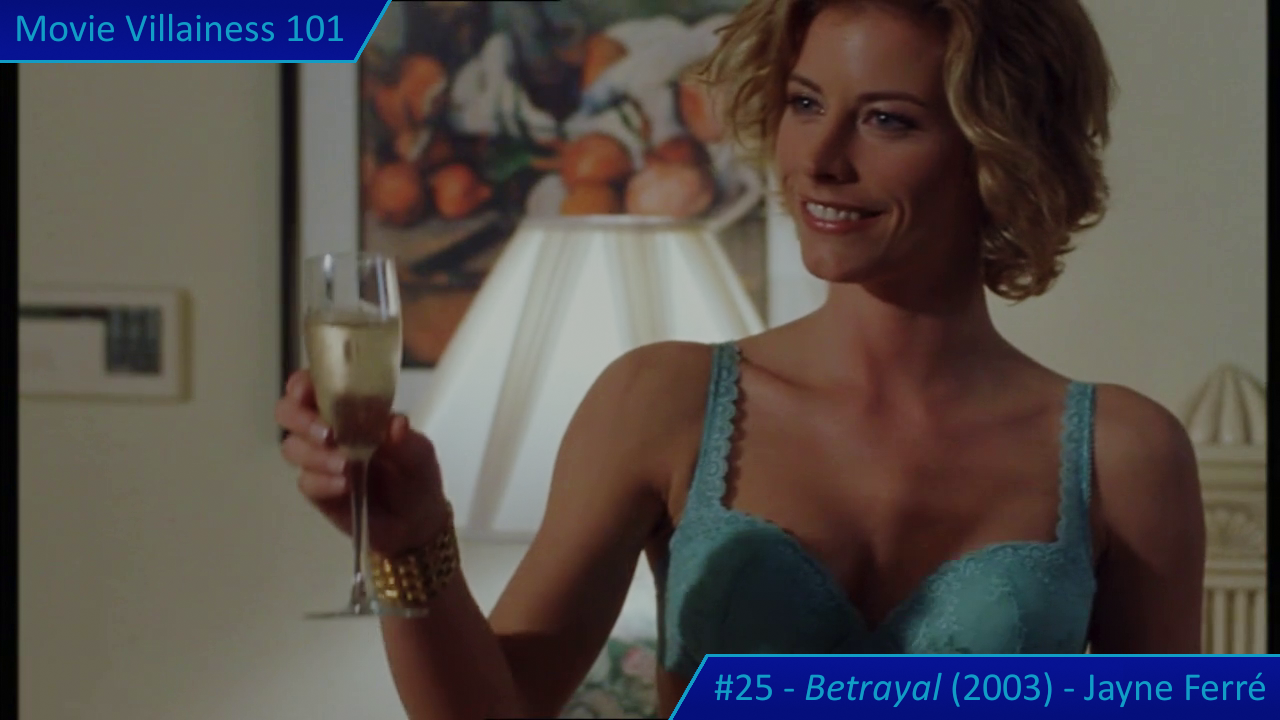
Movie Villainess 101 Rank #25

A prolific assassin with a unique MO – and plenty of spare underwear

Movie

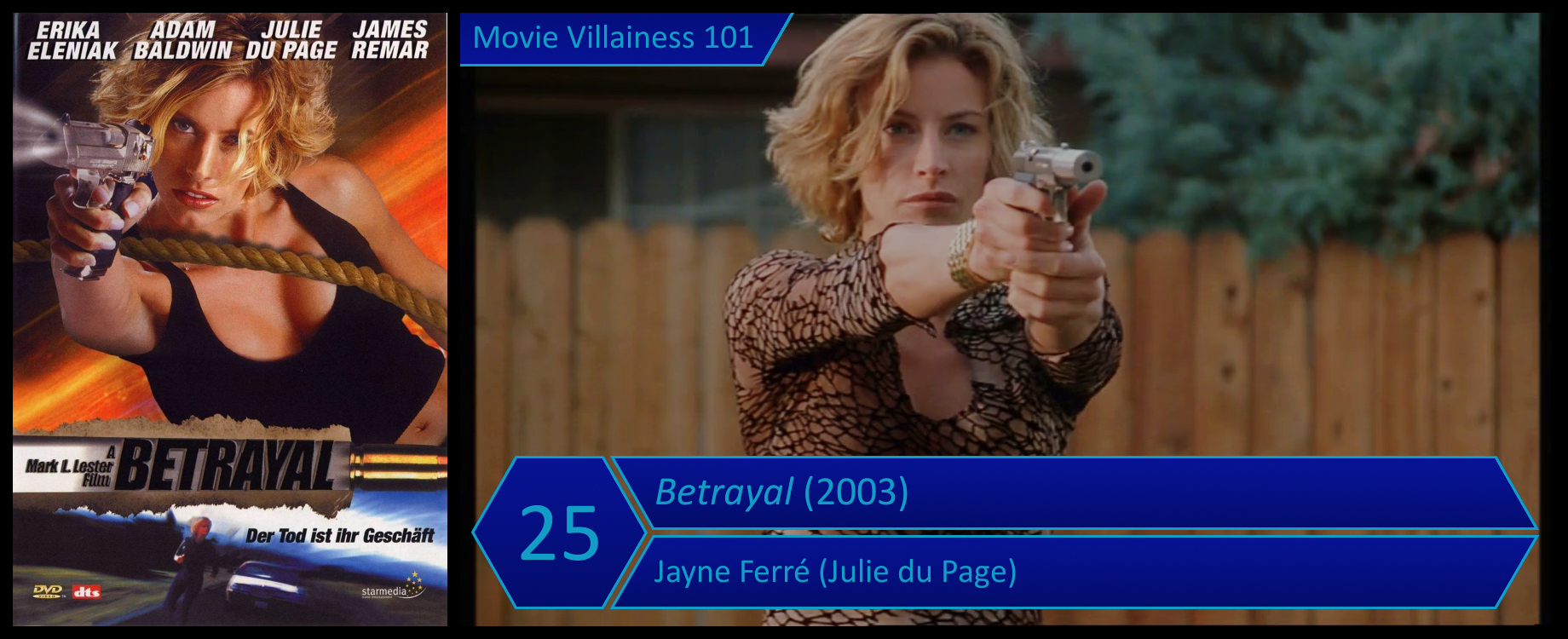
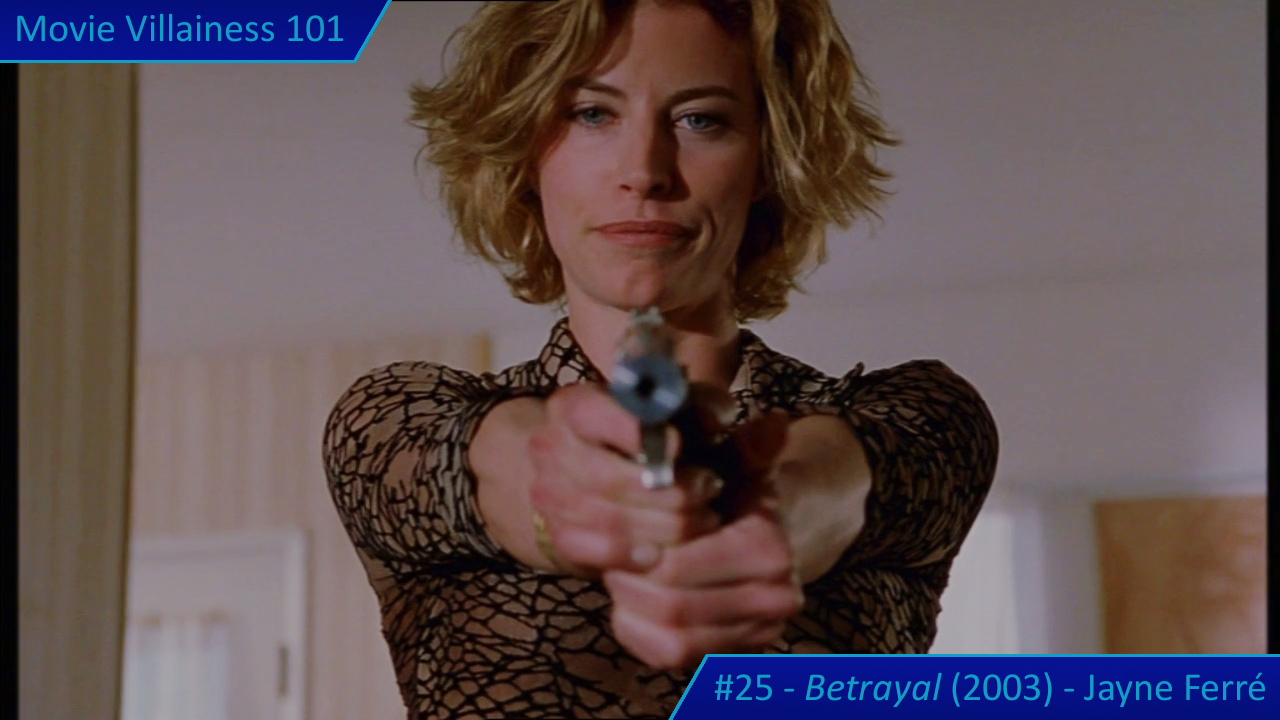
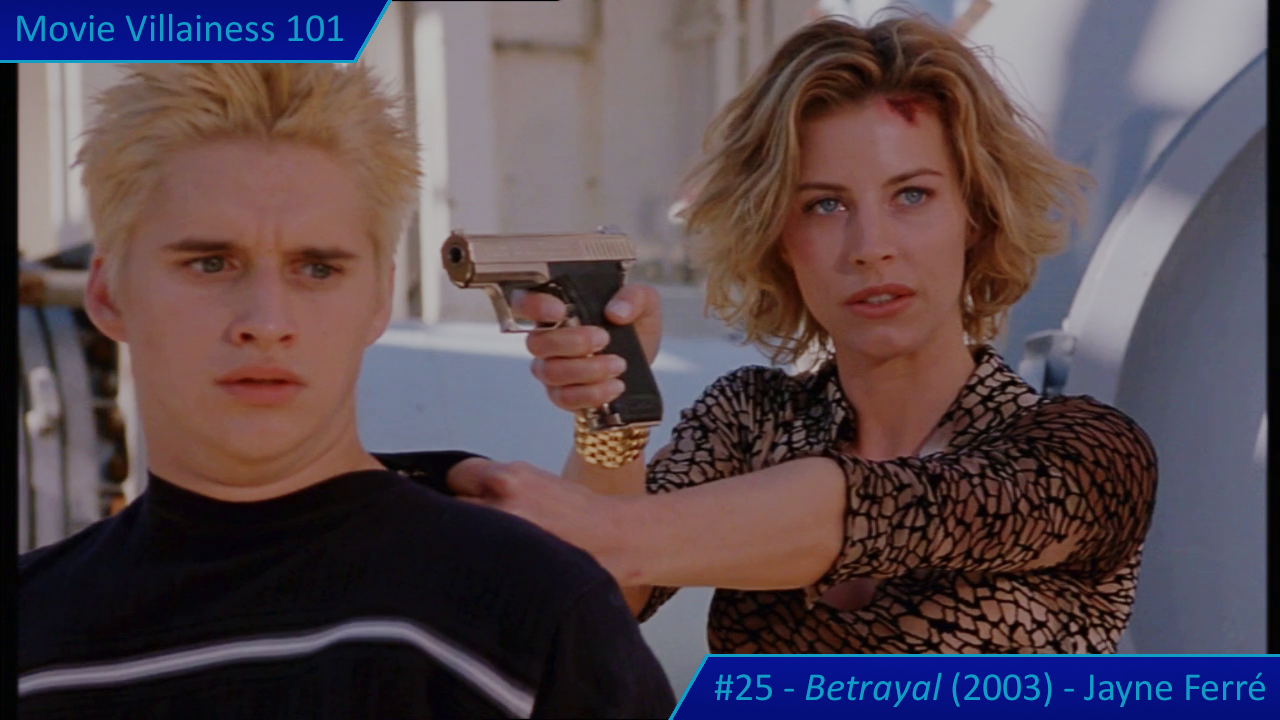
Betrayal (2003)

Director Mark L. Lester’s contribution to female villainy is outstanding. Two movies and their respective antagonists make the legendary tier. As a bonus, the third film gets an honourable mention. For plot, the three movies are totally generic, but the female villains don’t disappoint and all have at least one great kill scene. Betrayal is also known as Lady Jayne Killer, a much better title. When you have a fantastic villainess, why not make her your selling point?

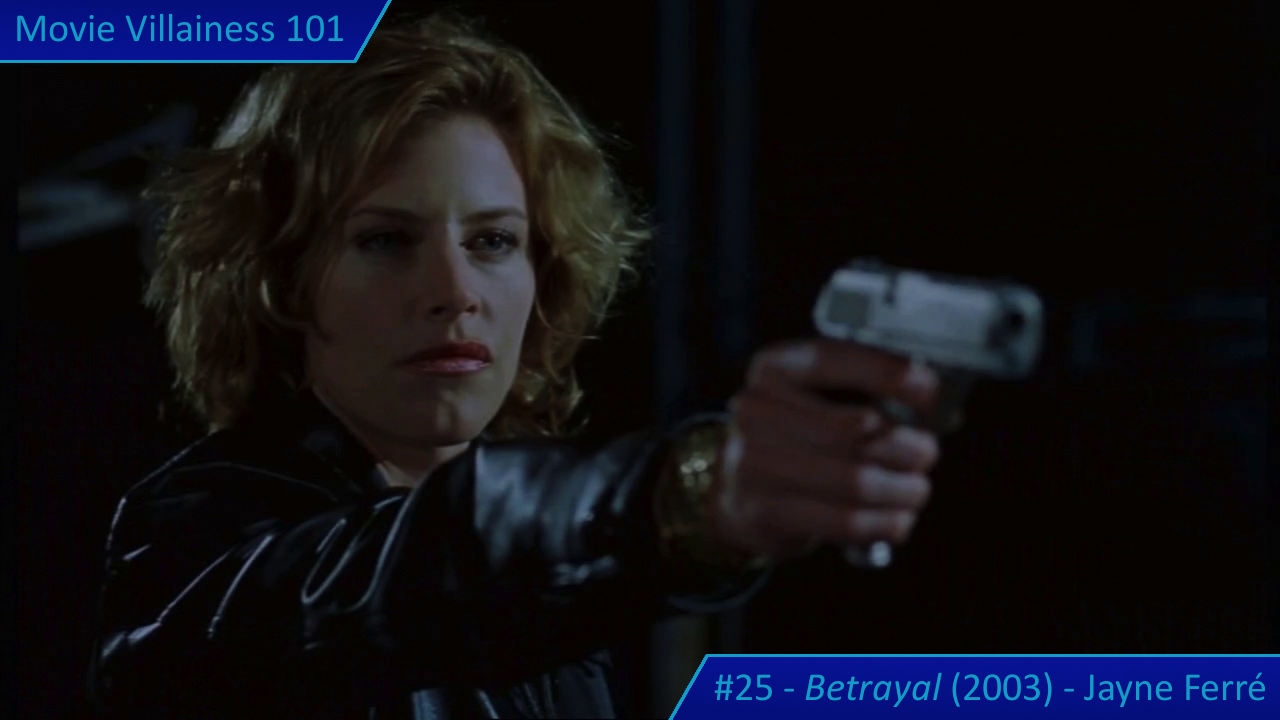
Jayne is a mob hitwoman who doesn’t believe in loose ends. This becomes clear early on when she kills an undercover FBI agent and a mafia man because he betrayed her boss. Jayne’s calling card is to stuff luxury women’s underwear into her victims’ mouths. A unique MO, but contract killing pays well, and given her kill count, she can afford the expense.

Other characters are nowhere near as interesting. A generic mob boss, a corrupt police officer (there has to be one), a bland undercover agent, and a single mother and teenage son who get caught up in things. The kid Kerry (Jer Adrianne Lelliott) deals cocaine to help his mother Emily (Erika Eleniak) pay her bills. A bad idea, since a rival gang steals the drugs and their house gets shot up in retaliation.

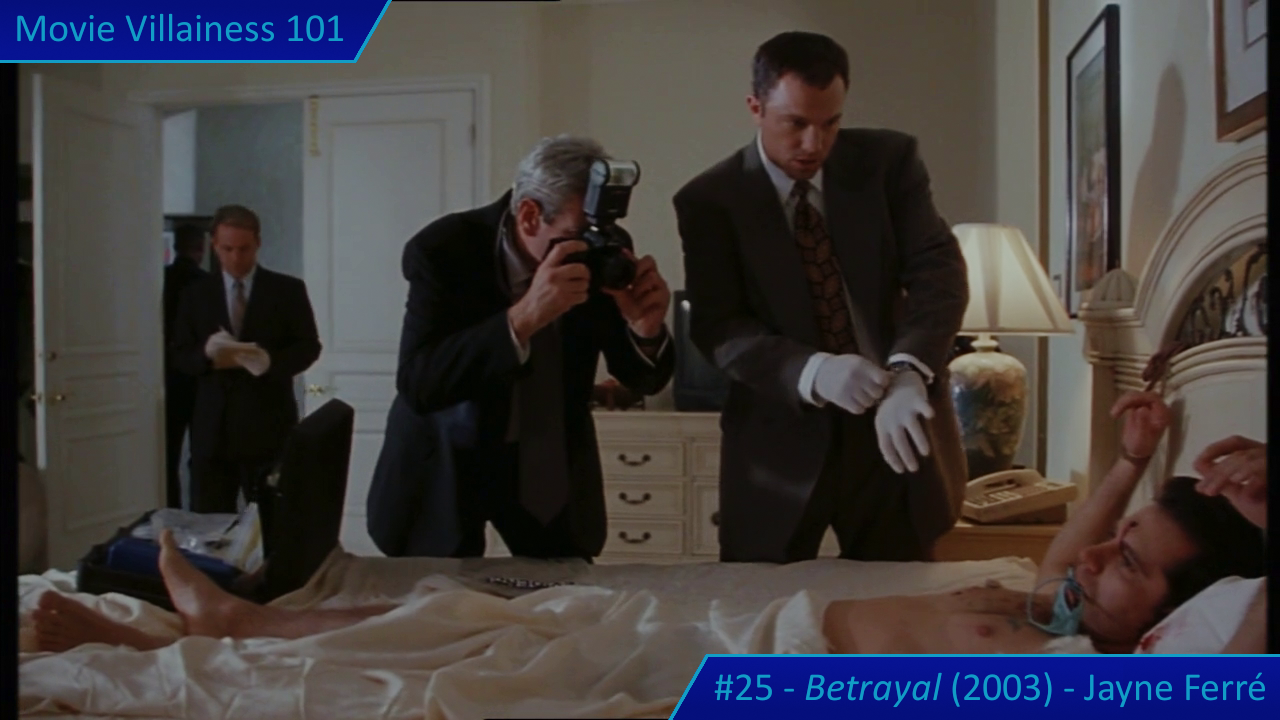
This is an excuse for Emily and Kerry to go on a road trip. Unfortunately, they offer a certain female assassin in a leopard-skin top a ride, not knowing she has stolen a suitcase of mob money. Jayne has dropped two more bodies by this point. The first is another signature kill: a naked man tied up in a hotel room, gagged with panties, and shot in the head with a silenced pistol. The second murder is far less elaborate, where she stabs a thug to evade capture at a train station.

With the mafia in pursuit, things are sure to get hot again, though there’s a lengthy “cooling off” period with little action. This makes the middle third of the movie a chore to sit through. The ending is a lot livelier, even if Emily turns into an unlikely heroine who can best a trained killer in combat.

Villainess

Jayne Ferré (Julie du Page)

The deceptive villainess claims to be an actress, but that falls apart under Kerry’s questioning. So Jayne tells the truth – she’s a hitwoman with over twenty kills – while making it sound implausible. Emily and her son laugh this off, but when Jayne confronts another motorist and smashes his side window with her bare hand, it really should be obvious this woman is psycho. There’s also a trucker she threatens to ramp up the tension while we’re waiting for the mafia’s arrival.

When the hitwoman isn’t scaring people, she practices seduction on Kerry. At a diner, Jayne speaks openly about fondling breasts while Emily has stepped away. The mother returns in time to stop the conversation and save Kerry’s blushes. That doesn’t stop him fantasising about sex with the beautiful assassin in a shower, but he’s brought back to the real world when he discovers the money in Jayne’s motel room.

Realising he’s in danger yet has the answer to Emily’s financial problems, Kerry makes off with the briefcase. Jayne is really ticked off and drops the innocent traveller act. Emily barely has time to react to the assassin holding her at gunpoint before the mafia show up at the motel. In the shootout, Jayne easily outsmarts her opponents, playing dead to gain the advantage and using cover effectively. One guy takes Emily as a human shield, but she escapes, leaving Jayne a free kill shot.

The villainess abducts Emily (she’s used to it by now) and uses her as leverage to recover the stolen money. Emily grabs the wheel of Jayne’s car and escapes, helped by the fact that she’s too valuable to kill. This doesn’t bother the hitwoman. Jayne simply gloats about murdering Kerry now that she knows where he and Emily live.

Kerry hides the case in the laundry room and calls the authorities. Naturally, the man he speaks to is the corrupt cop on the mob boss’ payroll. Meanwhile, Emily is picked up by Jayne’s contact. Putting aside all the coincidences, it’s time all the key players met. The detective and mafia head visit Kerry’s house, but he sees through their lies. Soon after that, Jayne arrives and finishes the men easily. Being a major character in this film just means you last longer than usual.

It’s Kerry’s turn to be the bargaining chip, and Jayne demands Emily bring her the money for her son’s life. Pity the assassin didn’t search the house, eh? The final showdown is a letdown, though better than White Rush (below). Emily – with the mystery man at gunpoint – brings the briefcase to a secluded industrial site. Here, the guy reveals he really is an undercover FBI agent, then throws the money in Jayne’s face and pulls a gun.

There’s a somewhat chaotic scuffle where everyone teams up on the assassin. This leads into a catfight where Emily proves resilient and breaks free of a chokehold with a headbutt. Then she shoots Jayne, who falls back onto a convenient sharp piece of metal.

Honourable Mention: Criminal Hitwomen

White Rush (2003) – Solange (Sandra Vidal)

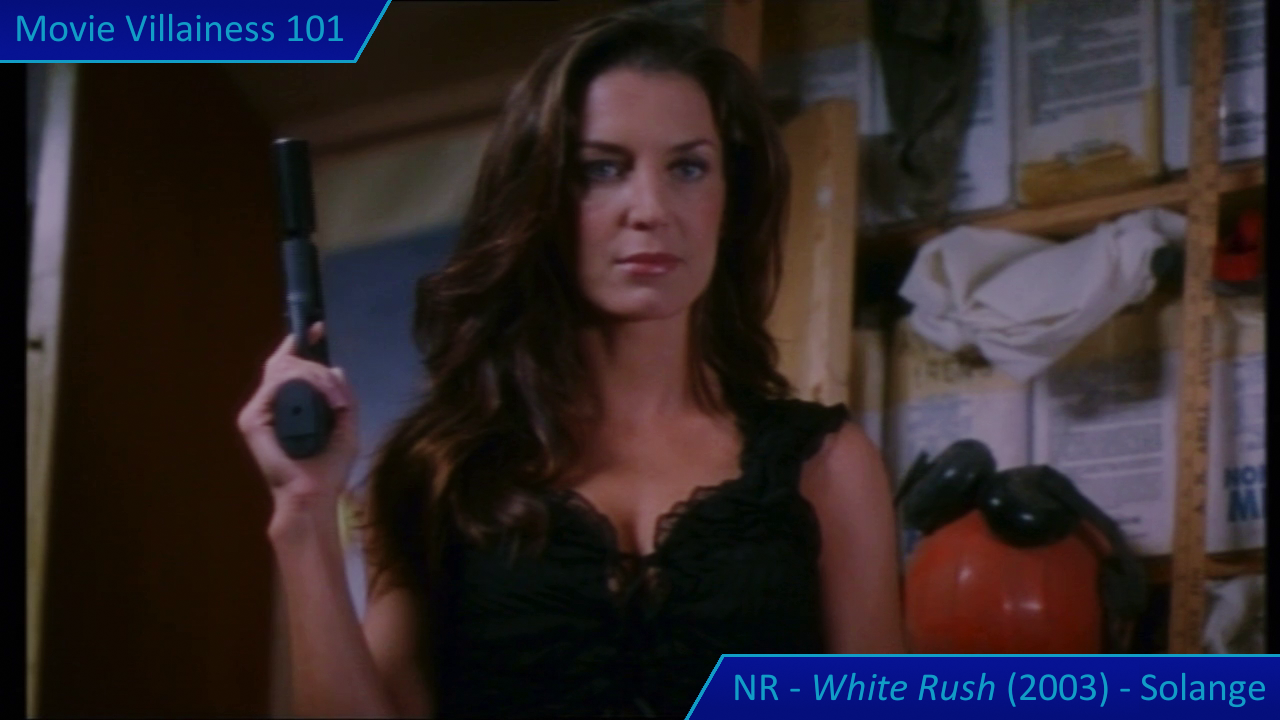
A movie directed by Mark L. Lester, released in 2003, that features a sexy hitwoman as the antagonist. Plus Tom Wright as a detective and Louis Mandylor as a bad guy. There must be a script template for B-grade action films, because White Rush is very similar to Betrayal. Sadly, the assassin lacks Jayne’s style. While she has her moments – notably a brilliant seduction kill in a hot tub – the ending is mediocre.

A group of friends out camping stumble across a drug deal gone bad. That’s when they get greedy and decide to make money selling narcotics. The leader is a corrupt cop who lives the high life, threatens people, and does side deals with criminal gangs. Everybody except the sensible Eva (Tricia Helfer of Battlestar Galactica fame) goes along with the dangerous scheme. Smart move on her part, as the Cartel boss sends in the beautiful and deadly Solange, who is a sicario (an example-setter).

Most of what follows is tired, and the victims’ stupidity and selfishness will have the audience rooting for Solange. To prove how sadistic she is, the assassin kills a minor character even after he helps her. The first main kill is the best, with Solange using her feminine attributes to get close to a guy, lure him to a secluded location, and slit his throat. This outstanding sequence gives new meaning to the word bloodbath, but the standard drops afterward.

Cue panic among the drug dealer wannabes as the lethal assassin thins their ranks. She threatens an undercover cop, who’s smart enough to bargain for his life. The next victim is a woman who surprises Solange with a knockdown, but stupidly traps herself in a room. Walls don’t stop bullets, love. This all leads to a showdown at a refinery, where Solange arms herself with a sniper rifle. However, the expected shootout never materialises, and the hitwoman is defeated all too easily.

Movie Villainess 101 Rank #26

Femme fatales – and scheming murderesses – aren’t a new thing in cinema

Movie

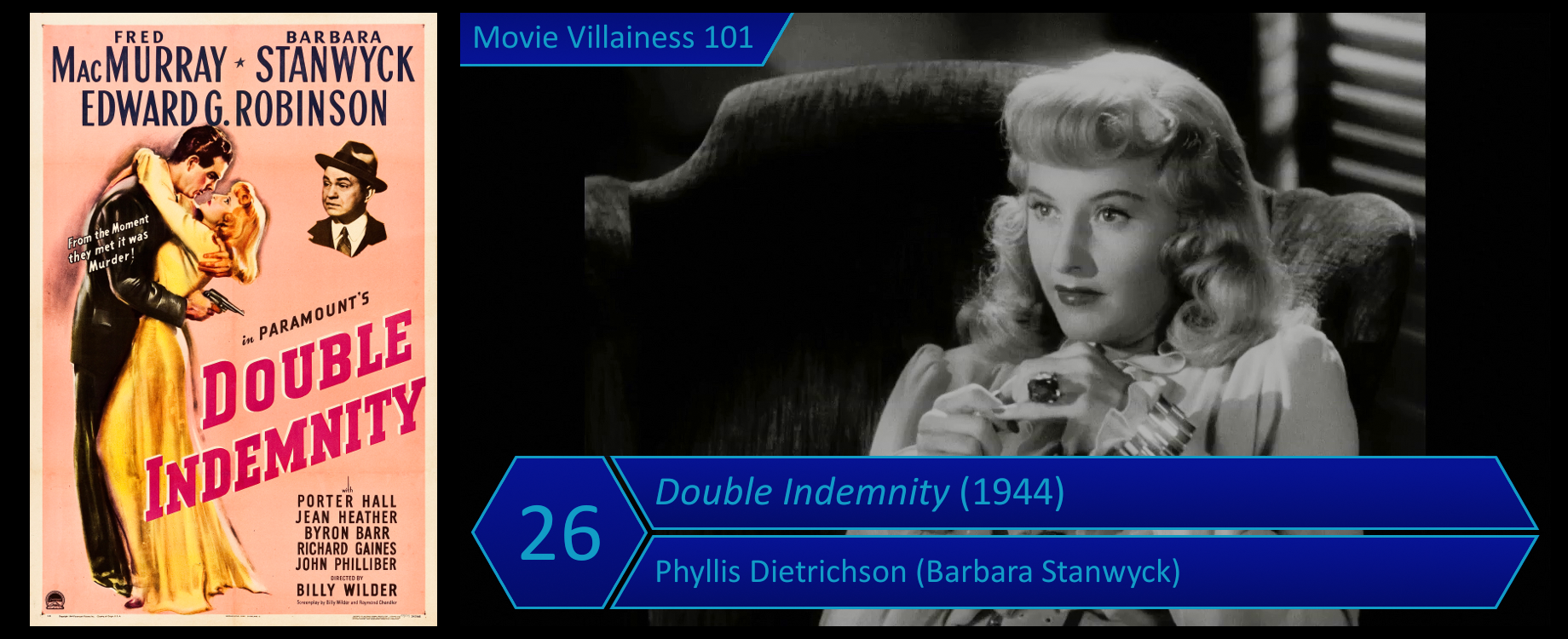
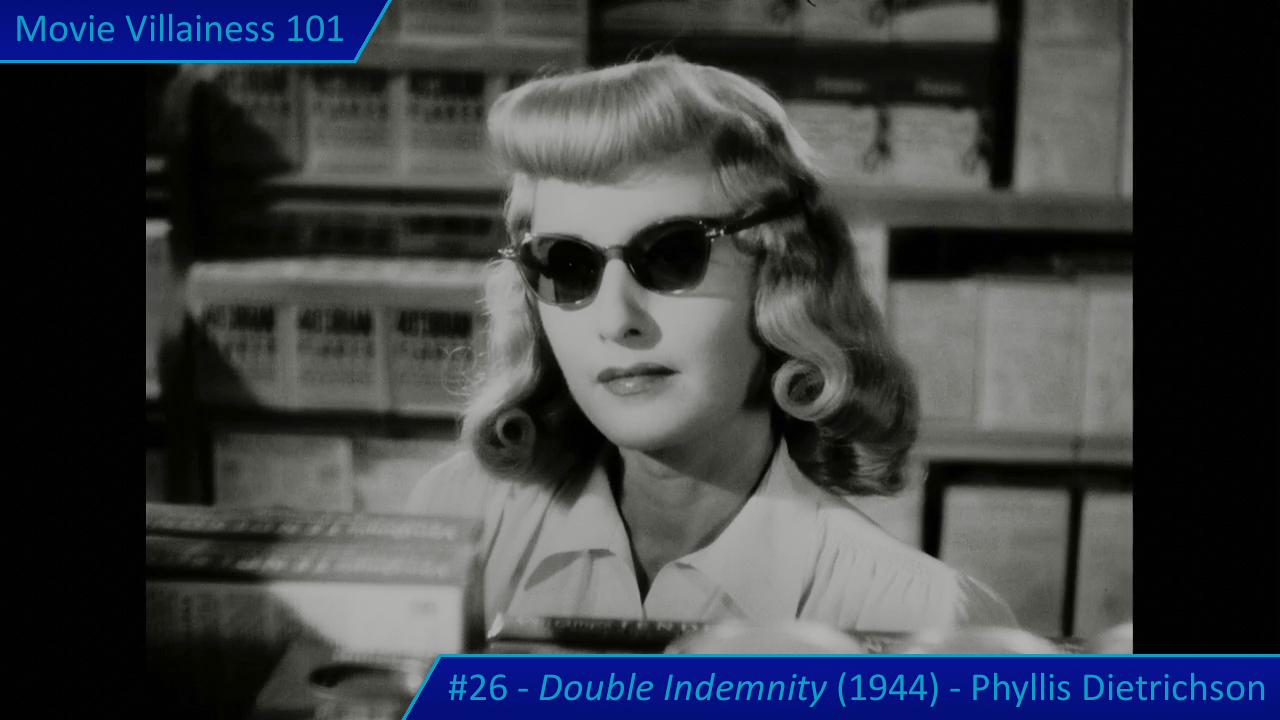
Double Indemnity (1944)

My original list didn’t include films made before the 1960s, mainly because of personal preference. Plus, the black and white era is more dialogue-heavy. However, when said dialogue is well written it becomes timeless, and Barbara Stanwyck’s scheming femme fatale – perhaps the classic film noir villainess – more than merits her place among the legends.

Double Indemnity was produced during World War II, but set in 1930s Los Angeles. The main character is insurance salesman Walter Neff (Fred MacMurray). The story is told in flashback, and since we see a wounded Neff record a confession on a dictaphone (no tape recorders back then), we know it won’t end well. Some advice: getting involved with a beautiful woman who plans to murder her husband is a bad idea.

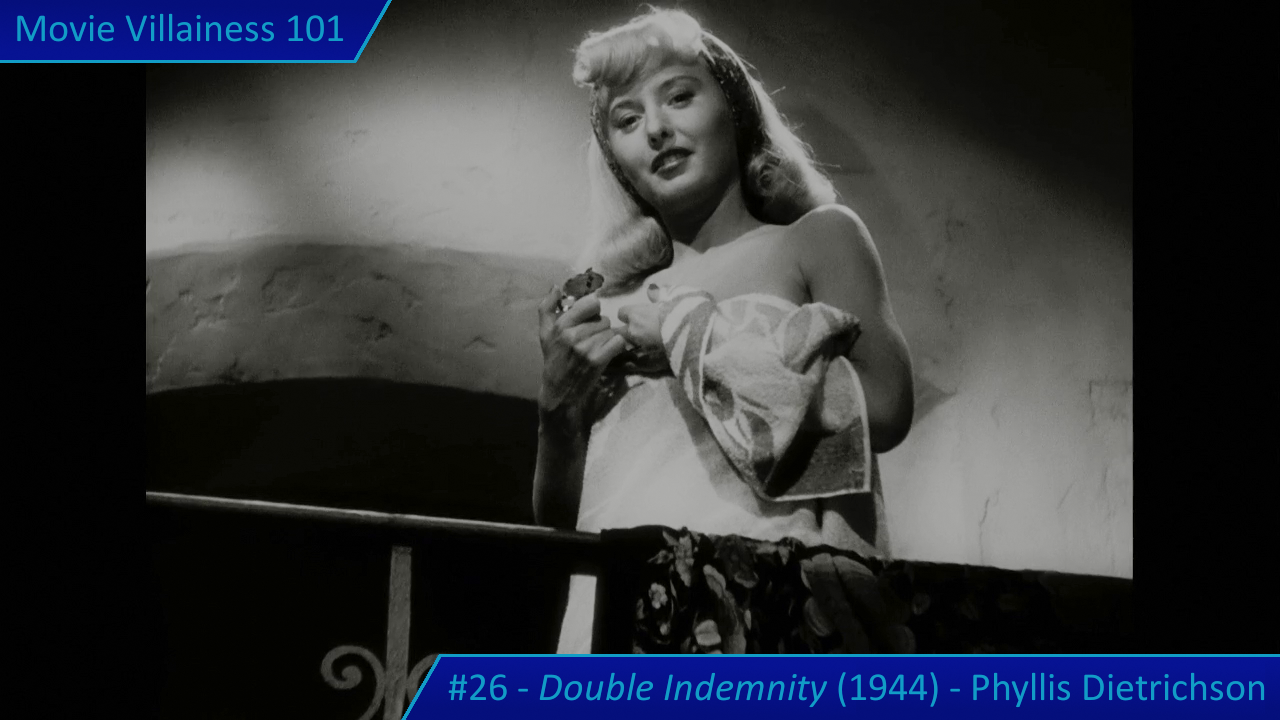
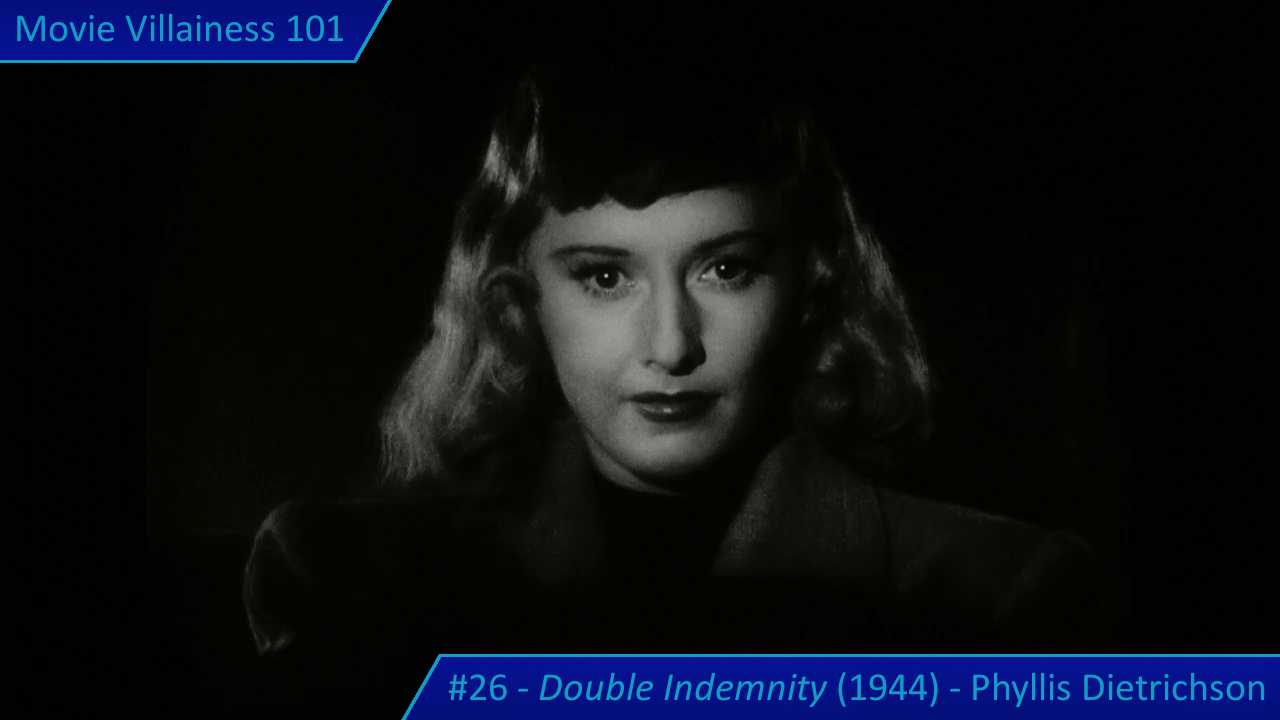
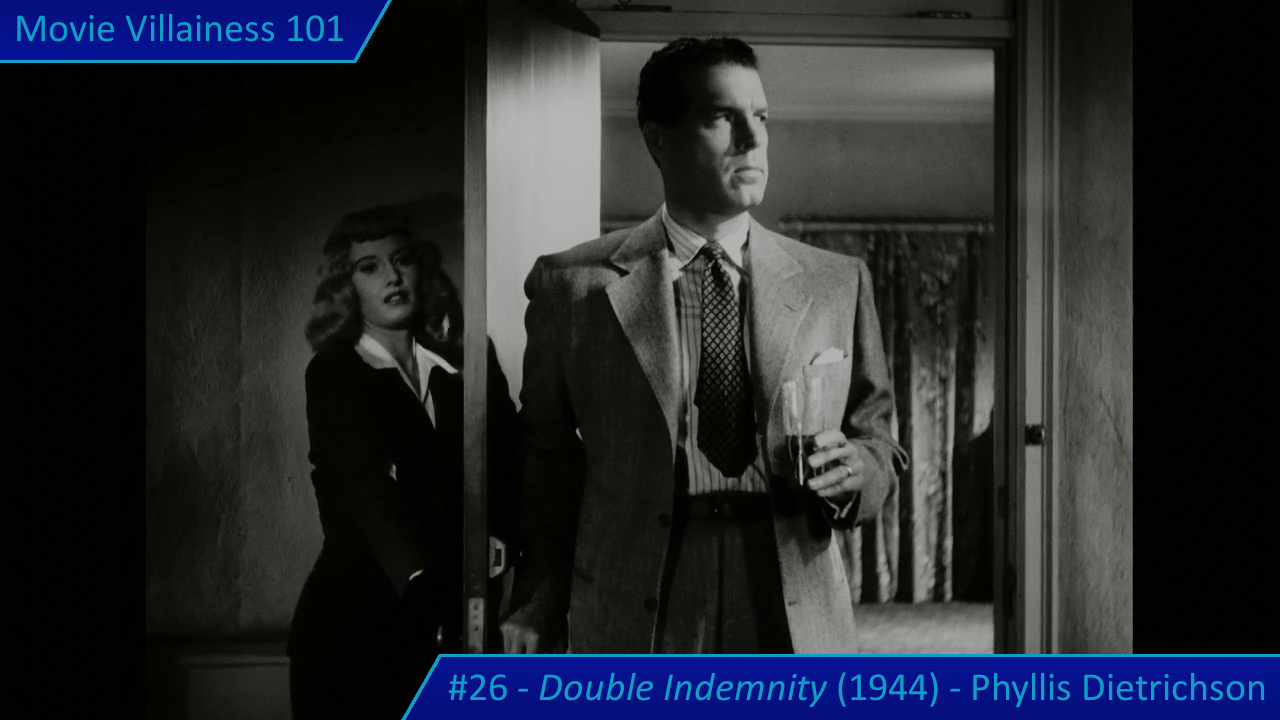
From the moment Phyllis Dietrichson appears on her upstairs landing, it’s obvious she’s trouble personified. Seduction was family-friendly in this era, long before nudity and steamy sex became the norm. Instead, we get suggestive comments about Phyllis’ anklet and sizzling dialogue laden with double entendres. Friendly conversation, but it’s not long before Neff returns and the woman enquires about accident insurance. He quickly deduces what Phyllis has in mind, but it’s her way of testing his intelligence. After he thinks it over, he’s on board with the deadly scheme.

Neff has the husband sign a policy document without his knowledge, by deceiving him into thinking he’s buying automobile insurance. The policy comes with a double indemnity clause – an increased payout for more unlikely accidents – so Neff and Phyllis arrange for their victim to travel by train. As an insider, Neff is careful to create suitable alibis and witnesses and avoid obvious traps. The scheming duo meet in a convenience store to discuss their plans, and the setup seems perfect after the husband injures his leg.

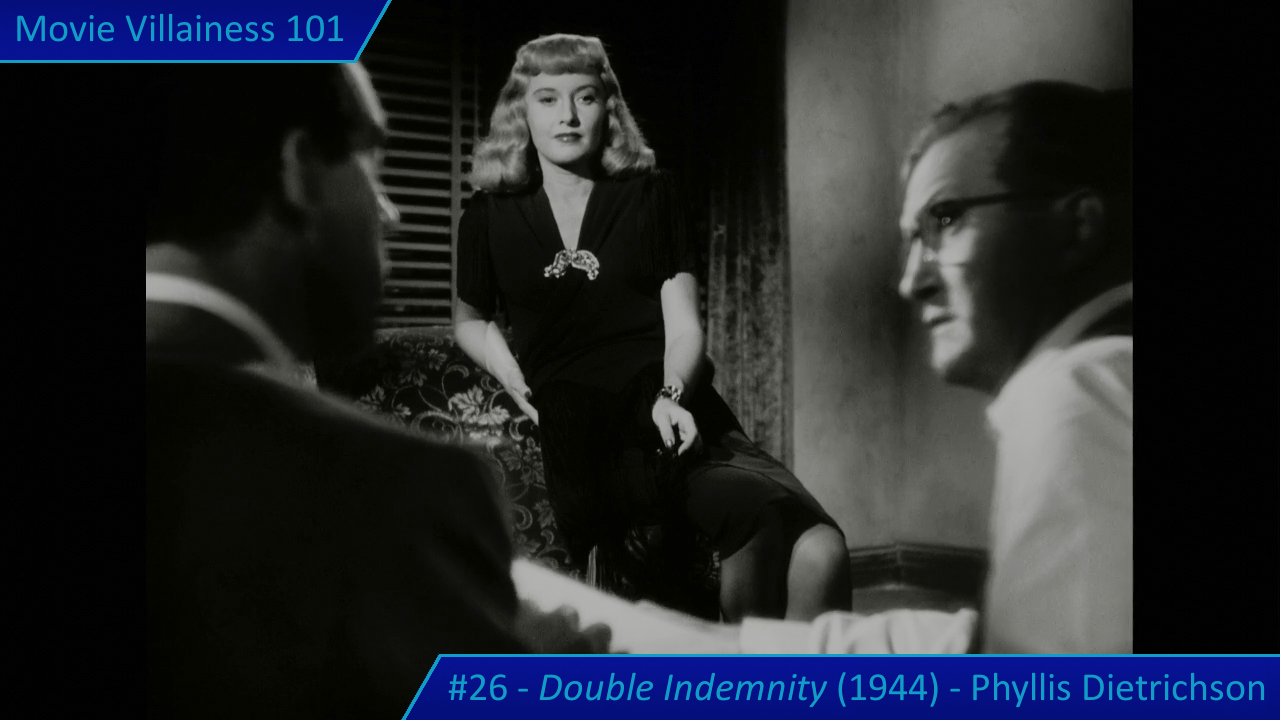
The chief obstacle to the culprits getting away with the murder is Barton Keyes (Edward G. Robinson), a dogged claims investigator who verifies every detail. Long before Columbo found little things wrong with “perfect” schemes, there was this man. By the time Neff learns Phyllis may have also killed her previous husband, it’s already too late. He’s about to learn the hard way that a beautiful woman means trouble.

Villainess

Phyllis Dietrichson (Barbara Stanwyck)

With the groundwork laid, Neff hides in the back seat of Dietrichson’s car while she drives her husband to the train station. After Phyllis beeps the horn – a pre-arranged signal – Neff does the dirty deed. The murder occurs off-screen with only an anguished cry to hint at what takes place, but this is beneficial as we see Phyllis in close-up. Watching her smirk in silence is far more chilling than any 1940s cinema death could be.

The next ten minutes are devoted to Neff staging an accident. Many things go wrong with the plan, notably a witness on the rear carriage platform. Neff gets rid of the man by asking for a cigarette, whilst concealing his face from view. With the coast clear, he jumps and meets up with Phyllis. They place the body and his crutches on the tracks and get away after another scare where the car engine won’t start.

The scheme and convincing act fool Keyes, and the company is prepared to pay out after suicide is dismissed as a possibility. Then the investigator finds the key flaw: that the injured Dietrichson didn’t claim for the accident where he broke his leg. Keyes discusses this with a worried Neff, which leads to a tense moment as Phyllis hides behind the apartment door. Keyes soon locates the witness who testifies that the man on the train was much younger than the husband. That’s when the lies unravel.

Neff learns some disturbing information from Dietrichson’s daughter, and her boyfriend is the perfect fall guy. Phyllis makes it clear she’ll drag Neff down with her, and there’s no option for him to back out. Now the villainess shows her true evil – a woman without remorse who’ll do anything to escape justice.

Neff foolishly confronts Phyllis at her house. This leads to a scene where she switches off the lights and lights a cigarette in the dark. Even though, or perhaps because, the film is black and white, this creates the perfect ambiance for a double cross. It’s obvious Phyllis will shoot Neff because we know he ends up injured. Neither the gunshot nor the wound is shown, and the question of what happens to Phyllis is resolved when Neff fatally wounds her with the same gun.

Soon after that, Keyes arrives to hear the end of Neff’s confession. Walter tries to escape, but dies before he reaches the office elevator. One last victim of the conniving femme fatale.

Honourable Mention: Femme Fatales

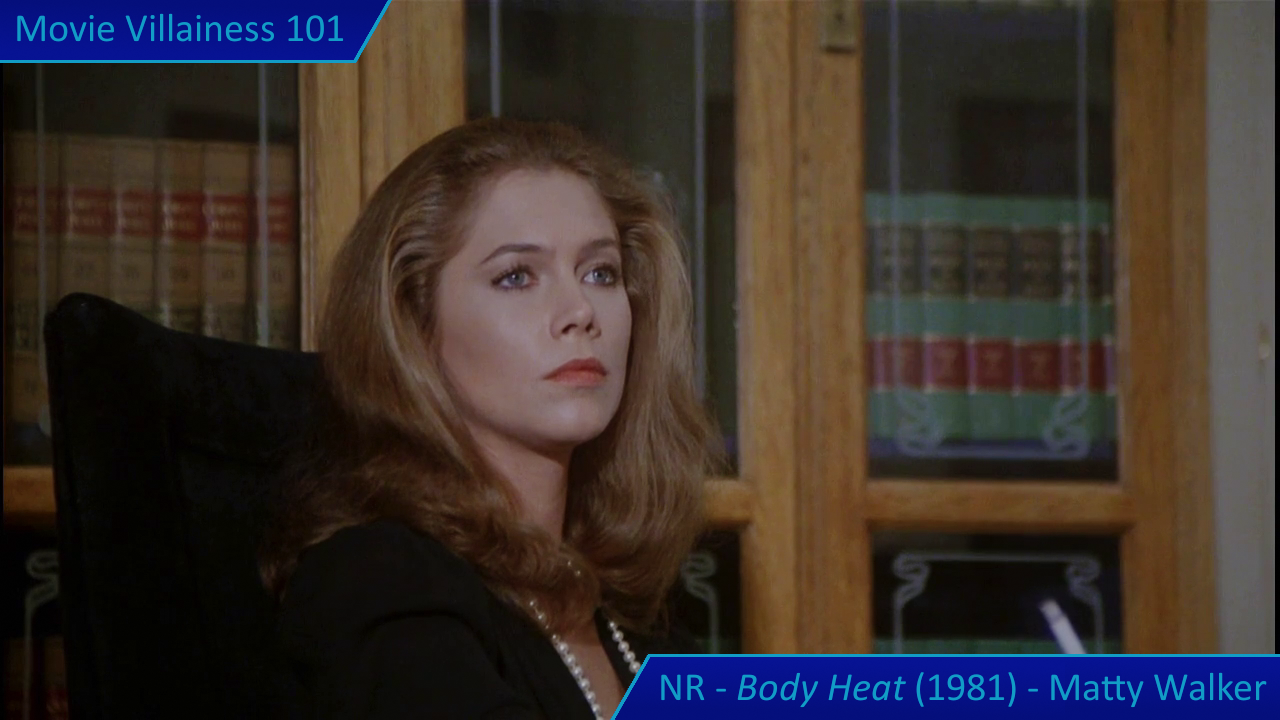
Body Heat (1981) – Matty Walker (Kathleen Turner)

Supposedly inspired by Double Indemnity, this is a steamy 1980s thriller with added sex and nudity. It’s a triumph of style over substance, with clever camera angles but a rather basic story. Turner makes a great femme fatale in her film debut, alongside William Hurt as South Florida lawyer Ned Racine.

Heat is a prominent theme, and the sweltering conditions are a good excuse to have the two leading stars naked. When Ned meets Matty in a supposedly chance encounter (genre-savvy viewers will know it isn’t), they quickly get involved. After a few sweaty nights in bed and cooling off with ice in a bathtub, the lovers plot to murder Matty’s husband, Edmund (Richard Crenna). A name actor, but it’s a cameo role before Ned whacks him over the head and sets up a staged arson gone wrong.

We’re halfway into the film, but the post-murder section is where the double-crossing Matty shows her devious and deadly nature. Racine is incompetent, so the villainess forges a will in his name with a deliberate legal mistake that means the spouse gets the entire inheritance. Matty’s greed tips off Ned’s colleague and detective friend, and they dig into the supposed accidental death.

Matty concocts a crafty scheme where she assumes the identity of a high school classmate, stages her own death, and lets Ned take the fall. By 1981, it was acceptable for a femme fatale to get away with murder, and this villainess was always going to outsmart her dumb patsy. A solid film overall, but no standout moments.

Movie Villainess 101 Rank #27

First means the President – this woman has definitely killed before

Movie

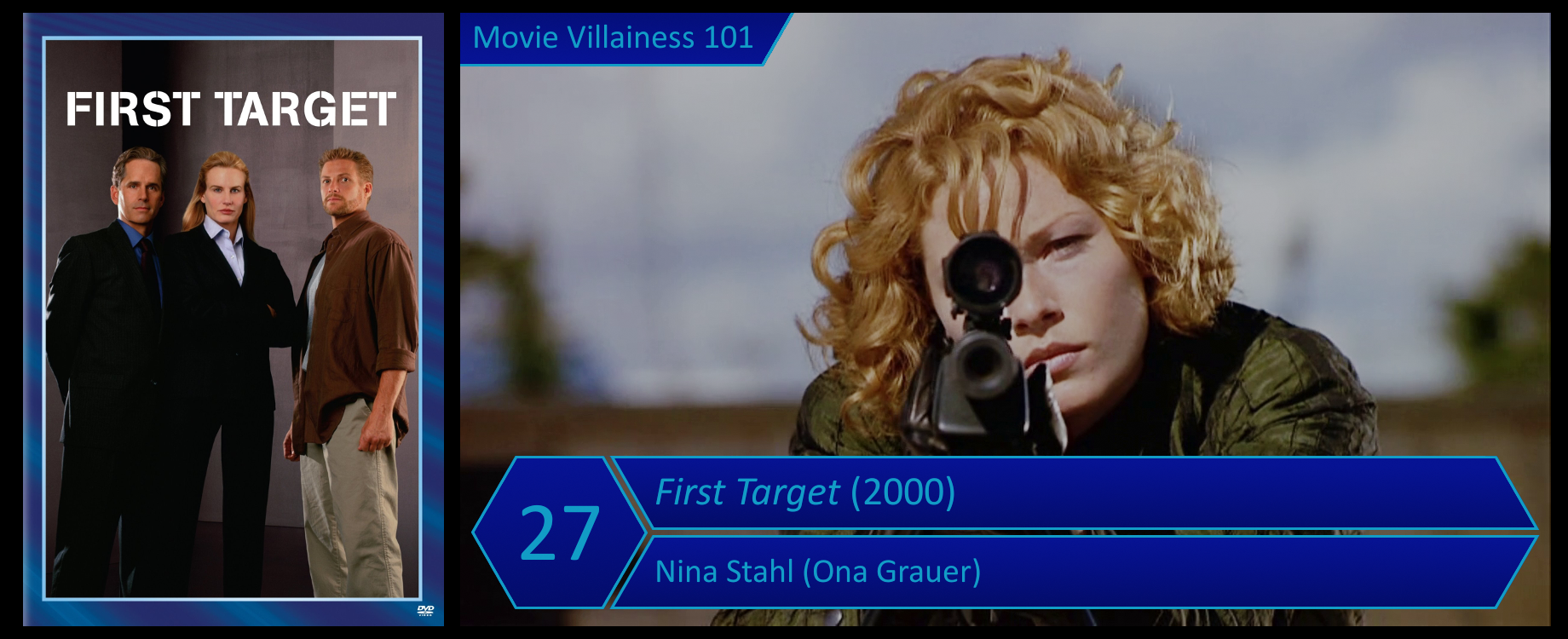
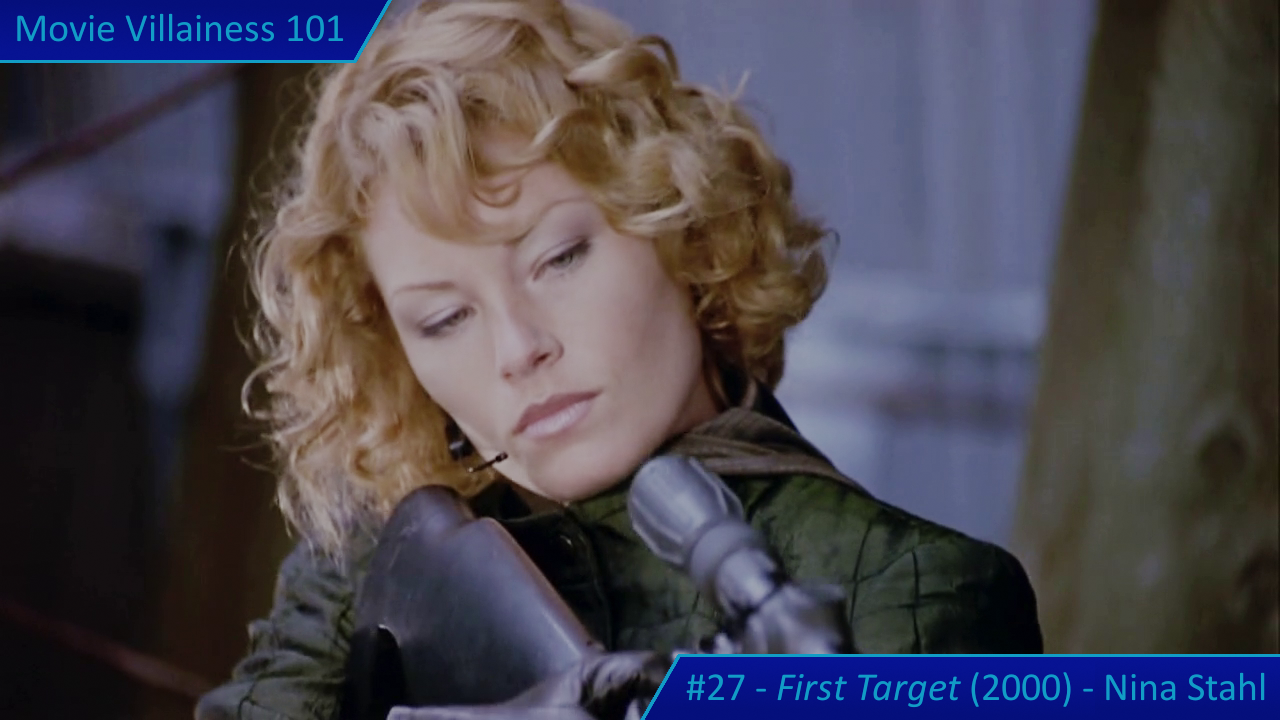
First Target (2000)

In a familiar setup, an assassin targets the US President and must outwit an elite Secret Service agent. The narrative twist: both major players are female. This is the second part of a trilogy, set between First Daughter (1999) and First Shot (2002). For this outing, Daryl Hannah – not Mariel Hemingway – plays Alex McGregor.

A cabal of powerful businessmen is unhappy with policy decisions, so they hire a nasty and deadly woman to eliminate the problem. There’s a secondary plot about an extremist sending video threats – a stereotype weirdo in a log cabin. Add traitors in the Secret Service working against Alex, a rookie agent eager to prove herself, and an obvious late reveal that the Vice President is involved. The result is a mostly predictable story. However, this TV movie has decent production values, and Ona Grauer’s ruthless hitwoman is a memorable villainess.

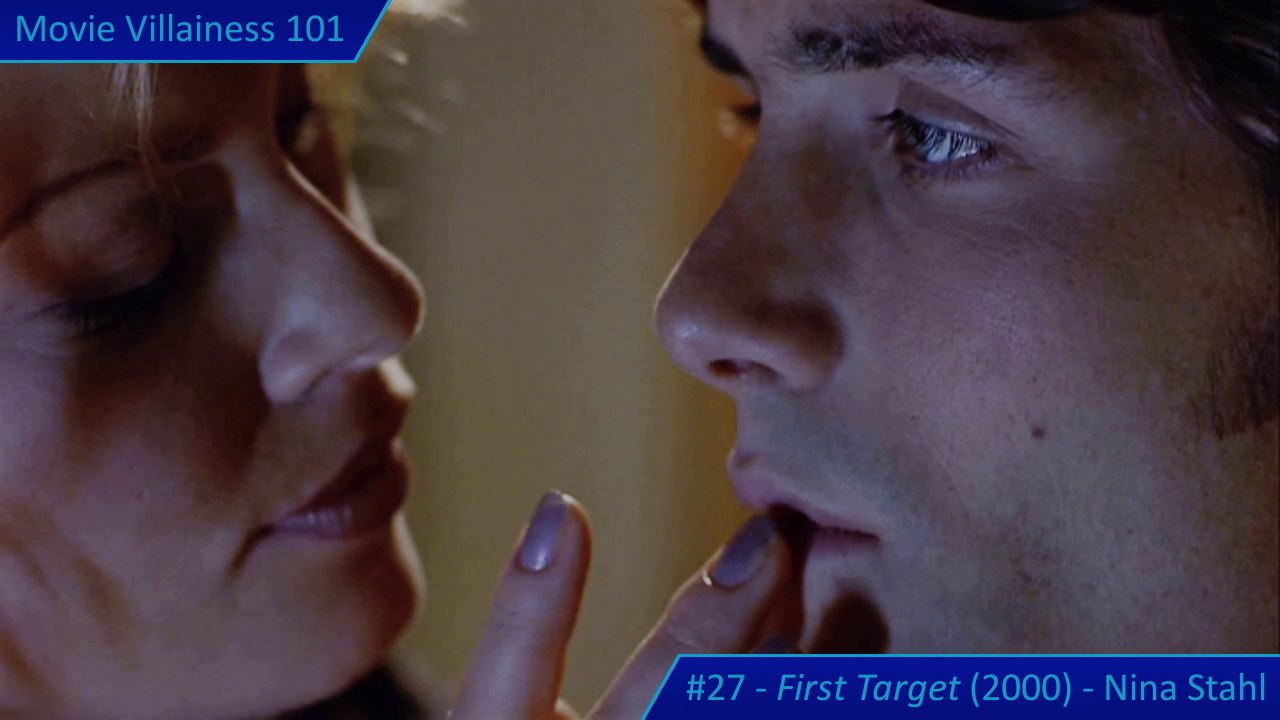
Nina’s introduction is a scene any bad girl fan will relish. Off the Seattle coast, a blonde woman in a bikini seduces a guy on a yacht. Then, she mixes drugs into his margarita and kicks him overboard. Nina could take this man without the advantage, as she’s a competent fighter, but she enjoys besting her opponents. Her confidence almost undoes the plan as the mark proves resilient. He refuses to drown easily, but Nina finishes the job before escaping on a speedboat with her brother, Evan.

With the stage set, the assassin reports to her client, Hunter (Tom Butler). He’s a typical shady money man who lives on a luxury estate and throws lavish parties. His interest in Nina goes beyond professional – watching her shower – and she regards her sexiness as a tool to manipulate and control. Evan is not pleased with Hunter’s attitude, but Nina is twisted enough to torment her sibling.

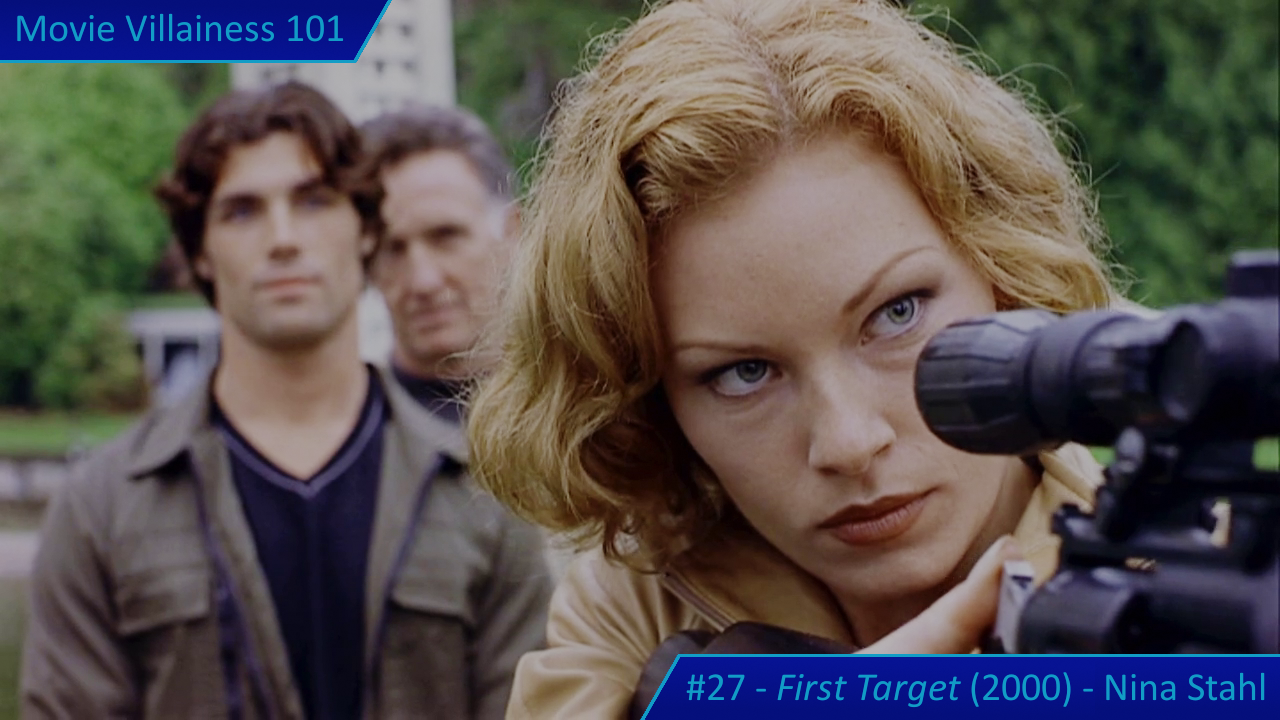
This is all foreplay before a weapons test, where Nina practices her sharpshooting skills. Hunter isn’t the type to leave things to chance, so Evan builds a custom-made weapon. This classy rifle takes special explosive bullets designed to detonate at a specific range. In theory, a miss will be a kill shot. Nina shows off by destroying a boat, and the satisfied smirk tells us she’s looking forward to blowing up the President.

Villainess

Nina Stahl (Ona Grauer)

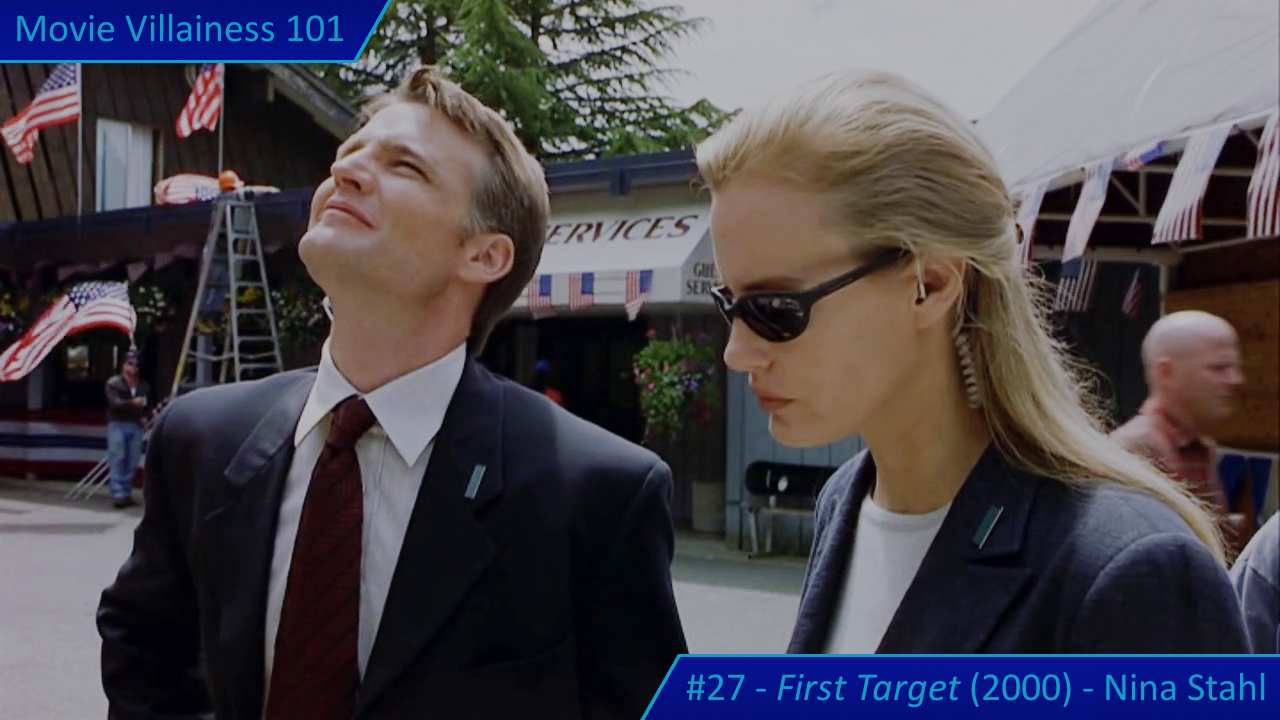
Alex’s first encounter with the assassin comes while scouting out a national park the President is due to attend. Nina deliberately bumps into the heroine and gives her a smile. It’s the audacity that elevates the villainess to legendary status.

This woman enjoys living dangerously. The technician flirting with Nina doesn’t know he’s given a deadly assassin access to the park’s sky tram system. As Evan overrides the security, Nina plays the seductress with her brother and toys with his emotions. To her, manipulation is second nature.

Alex is up against it, especially with the crazed militiaman threat to deal with and a traitor on her team. The man Nina killed on the yacht took photos without her knowledge, but the inside man replaced the incriminating picture to throw Alex off the trail. When the President gives his speech in the park, Nina takes position on a rooftop and prepares her rifle. The killer has a clear shot at the target area, and the sky tram is under Evan’s control. So, the President is an easy target once he’s on board and isolated from his Secret Service detail.

Fortunately, Alex remembers Nina from earlier and identifies her as the shooter. The heroine has help from her boyfriend Grant (Doug Savant), who’s spent most of the movie planning to propose to Alex. Now he gets to play the hero. While Alex and the rookie agent deal with the male villains, it’s Grant’s job to take on Nina. His surprise attack knocks off her aim, which results in a harmless mid-air explosion and one really pissed-off female assassin.

The dramatic fight that follows appears to be formulaic, with Grant given a hard lesson in kickboxing by Nina. In most movies, he’d emerge the unlikely victor, but the confident Nina remains in full control. She counters every move and finishes with a spinning kick. A fantastic slow-motion takedown ends with Grant falling off the roof, much to Nina’s delight. He survives, but won’t be involved in the action any further.

Alex is the only person who can stop Nina from completing her contract. The assassin swaps out her rifle for a conventional submachine gun, but Alex gets the President to safety. After a three-way tussle between the heroine, the President and the traitor, Nina has a free shot at her target. That’s when the rookie proves her worth (of course) and guns down the assassin. Martial arts aren’t much protection against bullets.

Honourable Mention: Sniper Assassins

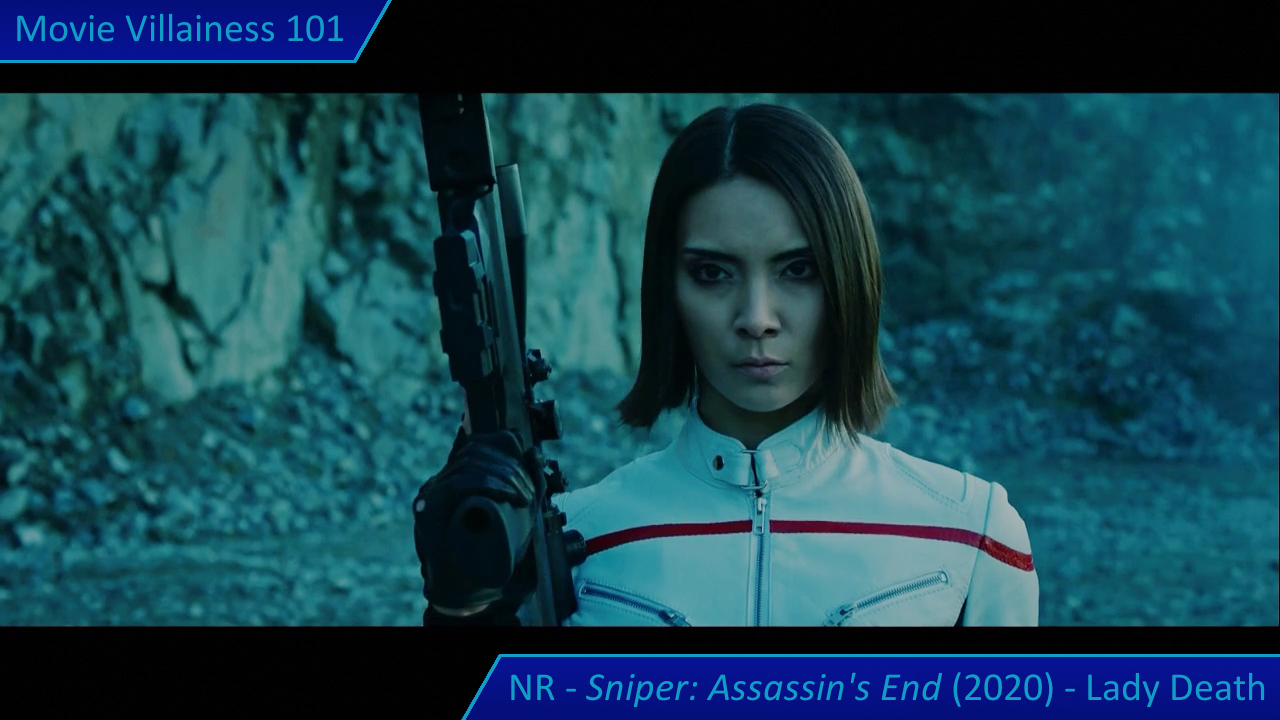
Sniper: Assassin’s End (2020) – Lady Death (Sayaka Akimoto)

Another movie with a sniper / martial artist villainess. This entry in the long-running Sniper series has Brandon Beckett (Chad Michael Collins) team up with his veteran father, Thomas (Tom Berenger) to uncover a corporate conspiracy.

The pre-title sequence establishes Lady Death as a mysterious and lethally efficient killer. In a stylish scene, she assassinates a South American politician from a hotel miles away. Before firing, the female sniper plants hair and saliva to frame Brandon as the shooter. The secondary plan is to stage his suicide, but the authorities arrest him before Lady Death gets there.

The assassin’s employer is annoyed, so he hires mercenaries to attack the prisoner convoy. Lady Death is backup and proves far more effective at killing the security personnel. Even with her fire support, the villains still mess up and Brandon escapes. Lady Death is an exceptional operative who avoids loose ends, so why did the head villain waste his money on incompetent thugs?

Beckett gets help from a mysterious government agent known as Zero (Ryan Robbins) and a female analyst. They don’t believe the obvious story and uncover a plot to make money from a trade deal. The story and lead villain are dull, leaving Lady Death to inject some welcome action and excitement.

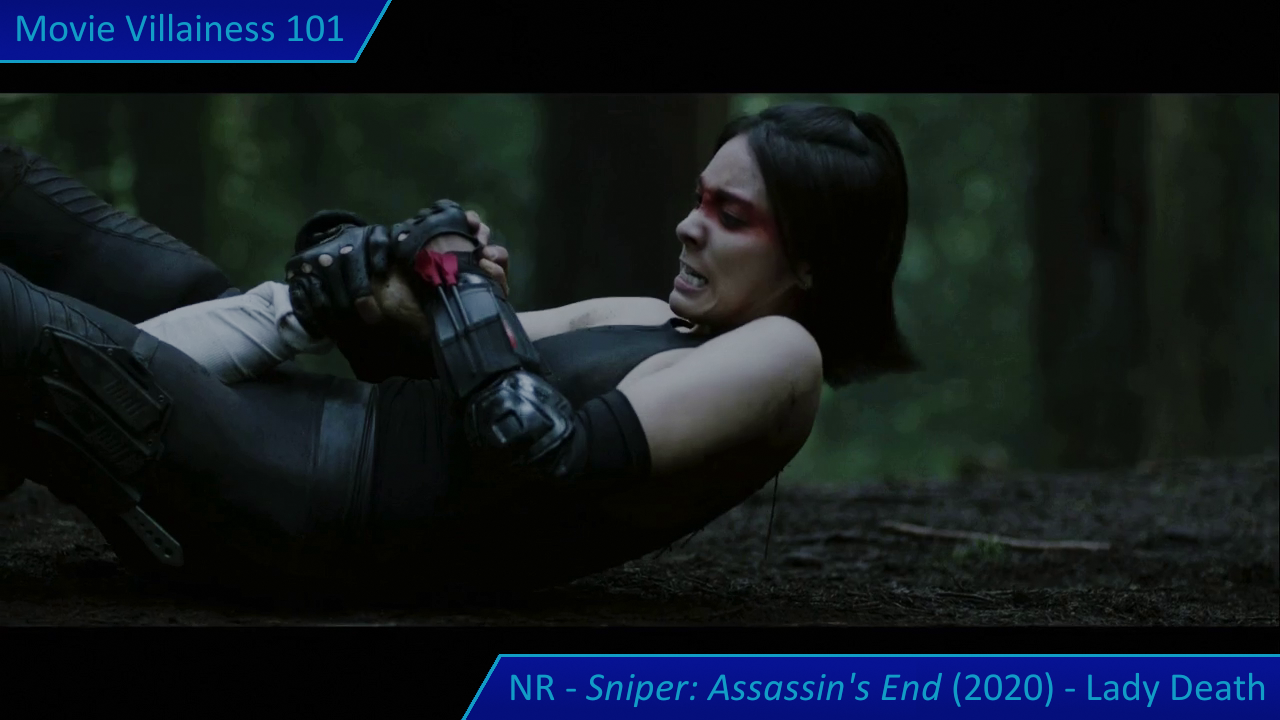
The highlight is a sniper duel in the forest. Government operatives are little more than cannon fodder, but the father and son team is a match for the former Yakuza assassin. After a standoff in the woods with the snipers scoping their targets, shots are exchanged and Brandon gets the drop on the villainess.

She dumps her camouflage for more practical clothing (a tight-fitting black outfit) and fights the hero with martial arts and blades on ropes. It’s a lengthy contest, much better than the usual half-minute affair. It takes the father aiming a sniper rifle at Lady Death’s head to force her to surrender.

That’s about it for major scenes. Now in custody, Lady Death cooperates with Zero and the Becketts to bring down the main villain. She pretends to capture the hero, but the bad guy doesn’t fall for it, and the redeemed sniper gets shot for her betrayal. Thankfully, Lady Death survives, and the last scene has Zero recruit her for a special ops unit.

Movie Villainess 101 Rank #28

She’s not really your wife Doug, so don’t hesitate to shoot her

Movie

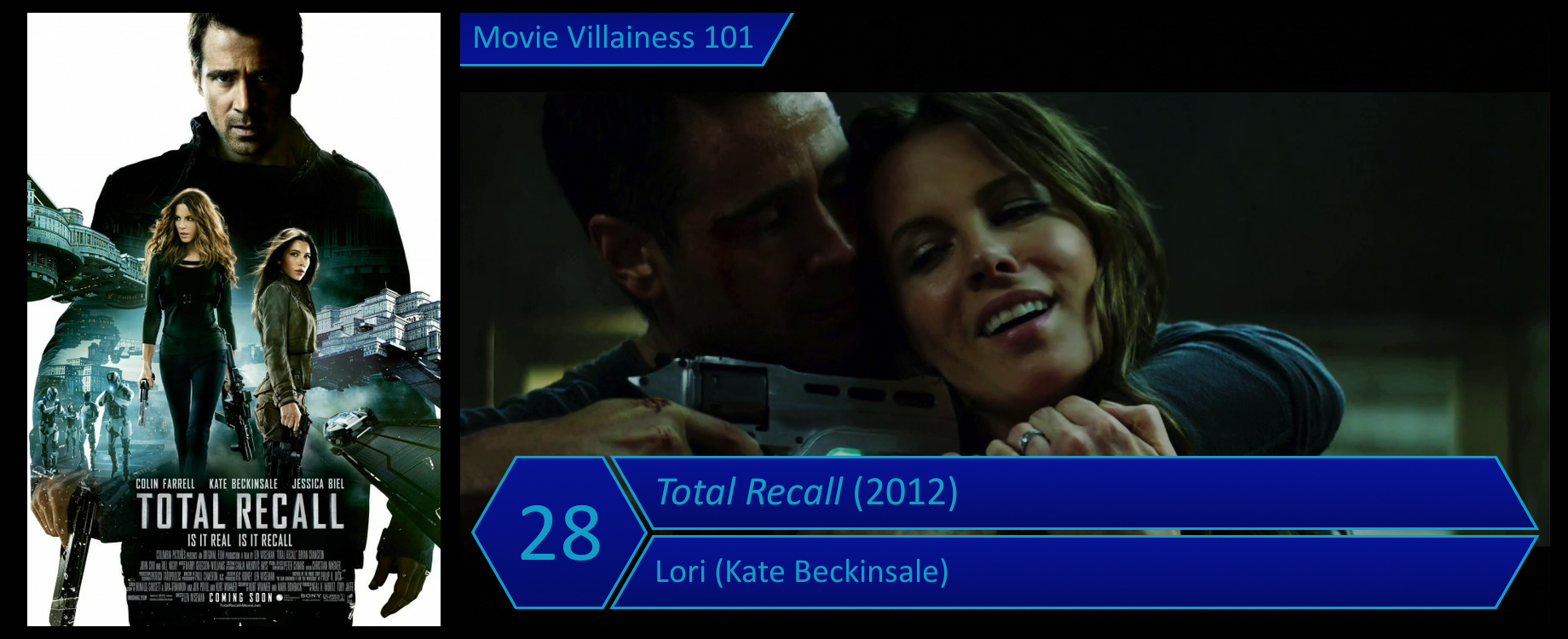
Total Recall (2012)

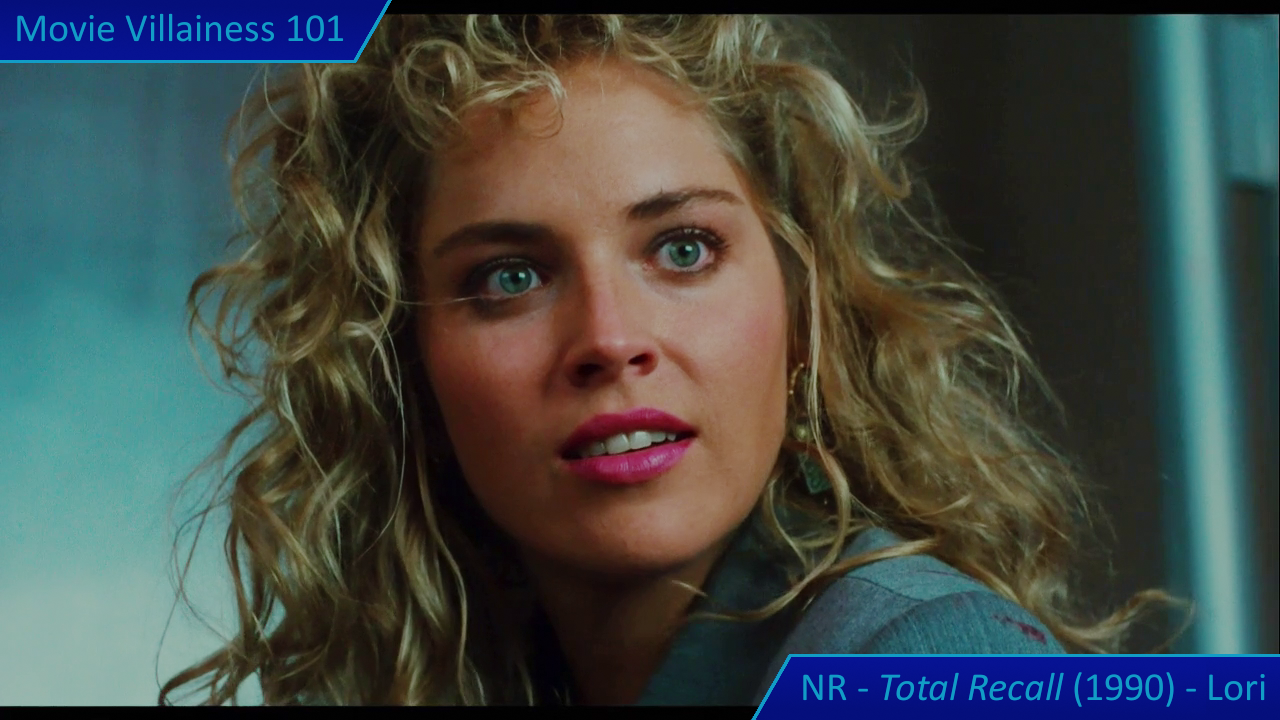
This remake of the Arnold Schwarzenegger film is widely regarded as inferior and falls short in key areas. The Earth setting doesn’t capture the sci-fi feel of Mars, and Jessica Biel is bland as resistance fighter Melina. But Kate Beckinsale’s version of Lori – an all-action, tough as nails operative – is a notable improvement on Sharon Stone’s great but under-used femme fatale.

Anyone who’s seen the 1990 movie will mostly know what to expect, though the update throws in a few variations. Douglas Quaid (Colin Farrell) is a factory worker from The Colony (22nd century Australia) and employed in the United Federation of Britain (UFB for short). In this post-apocalyptic future, most of the planet is uninhabitable, and commuters travel through the Earth using a gravity elevator known as The Fall.

Doug dreams he’s a secret agent on a mystery mission with a beautiful woman. Fleeing UFB troops in black armour is more exciting than his day job, so it’s no wonder Doug wants more. Against the advice of his friend, he goes to a company called Rekall, which implants memories. The tech wizards have a safety policy that nothing in the simulation can be true in real life, but it’s only a dream… right? It turns out Doug really is a spy (with a heavy dose of amnesia), and the UFB is very interested in finding him.

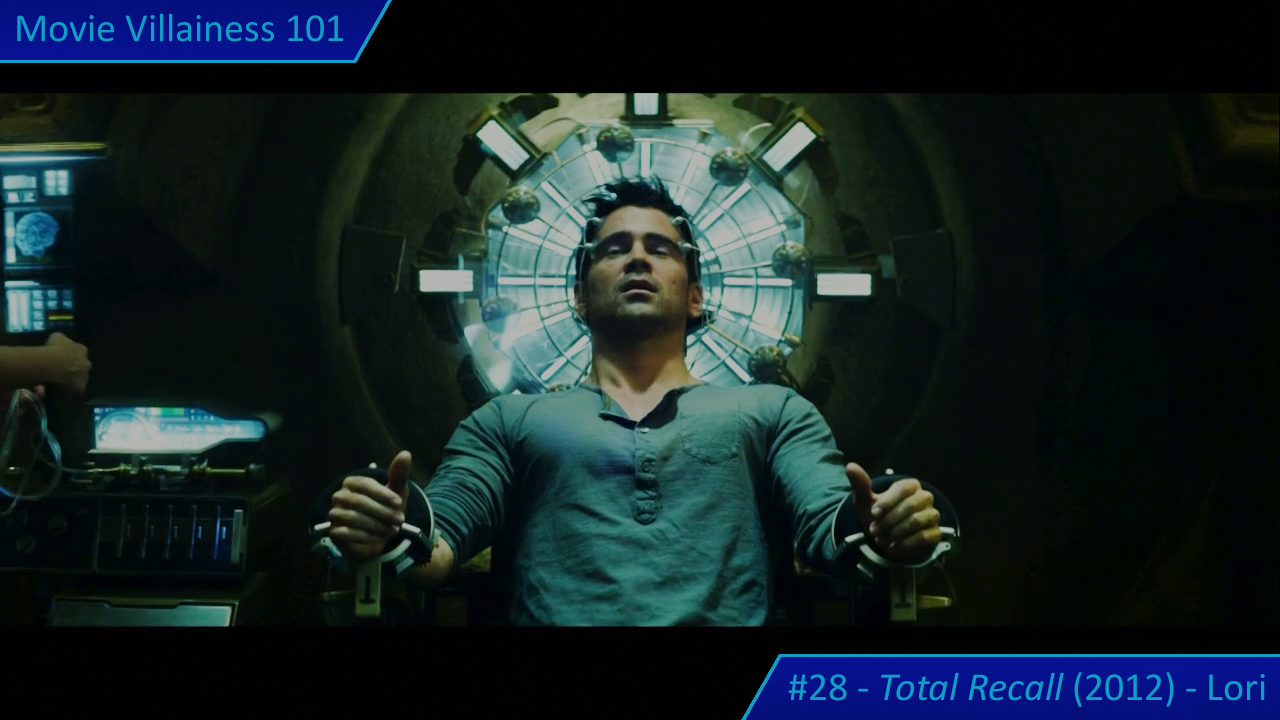
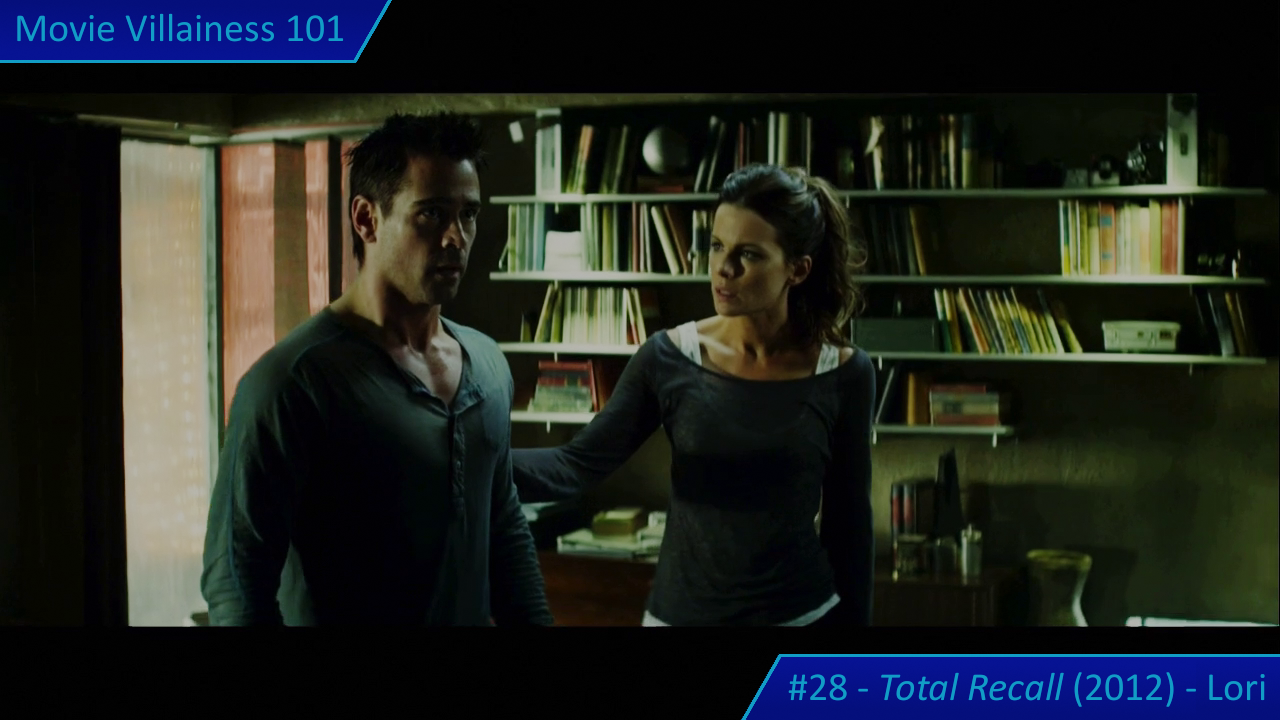
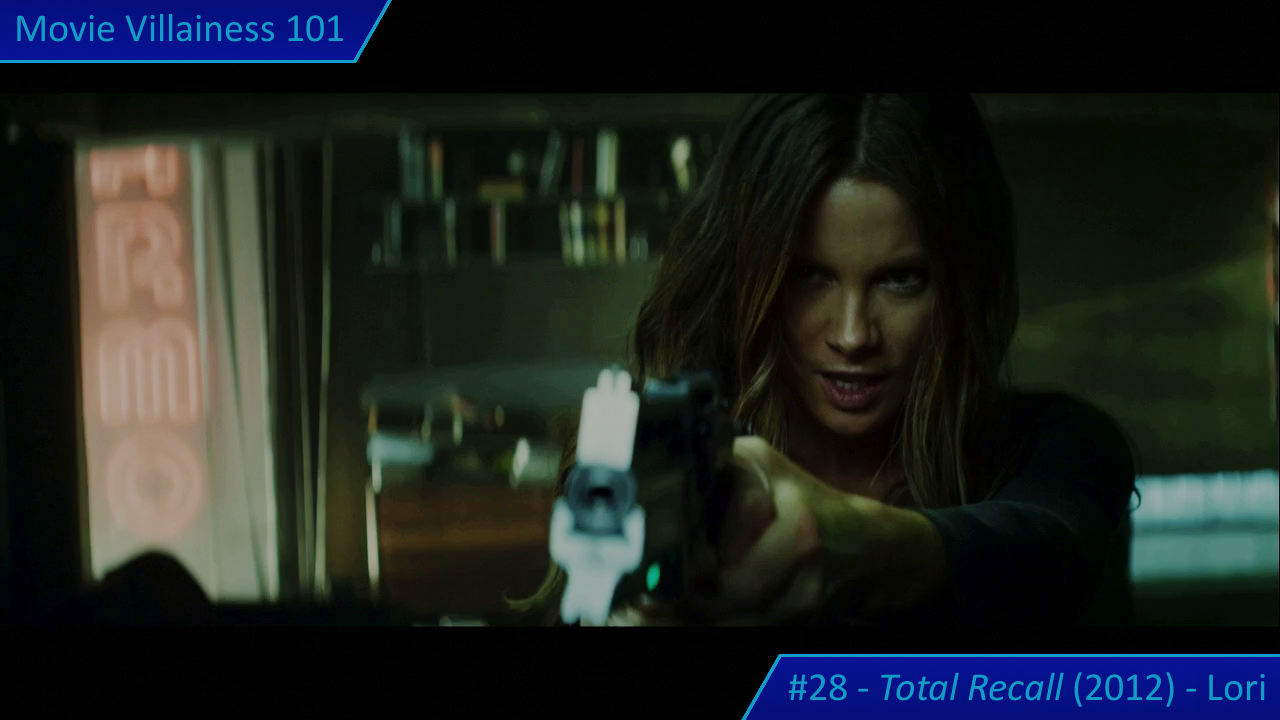
Whatever Rekall did activates Doug, and he bests a dozen UFB troops with martial arts and inventive use of grenades. Not sure what to do, he goes home to his devoted wife, Lori. Except she suddenly develops a British accent and reveals herself as a UFB operative who’s only known Doug for six weeks. He gets her at gunpoint for some brief questions, but Lori is far more skilled than regular troops and quickly regains the upper hand. Doug flees with Lori hot on his tail, which leads to a chase across the enormous Colony shantytown and its Oriental-style tiered levels.

After eluding his false wife, Doug gets a call from a phone implanted in his hand and a message from a former colleague. The man advises the fugitive to get rid of the phone – also a tracking device – and directs him to a safe deposit box. Happy for the assist, Doug cuts out the phone with broken glass and gives it to a homeless guy, who soon receives an unfriendly visit from Lori. That’s a woman you don’t want to be on the wrong side of.

Lori asks her boss for information about Doug’s identity and isn’t happy with his reply. In fact, she orders the UFB soldiers to shoot on sight. In the safe deposit box, Doug finds recorded video instructions from himself before the memory wipe. And high-tech spy equipment, which may come in handy for figuring out who the hell he is.

Villainess

Lori (Kate Beckinsale)

The villainess becomes Doug’s main foe over the course of the movie. Despite working for the ruthless UFB dictator Chancellor Cohaagen, she’s the antagonist with the most screen time. Action ramps up several notches when Doug travels into enemy territory, escapes the authorities, and jumps onto a highway. Good thing the woman of his dreams arrives to rescue him. Melina is a member of the resistance and a skilled hovercar driver. Apparently, she and Doug were lovers, which adds romantic spice to the high-speed chase that follows.

Lori (who else?) leads the pursuers. Besides regular troops, the UFB has a droid army at its disposal. This leads to a CGI-heavy action sequence with all kinds of crazy stunts. Melina gets in a few jibes about Lori before she pulls off a dramatic swerve and shoot manoeuvre. Lori is not that involved in truth. Mostly it’s shots of her looking frustrated, and Quaid eludes the UFB by disabling the hovercar’s magnetic system and dropping to the streets of London. Down there, vehicles still have wheels, including the traditional red buses.

Doug finds another message from his former self, which reveals he previously looked very different and was called Hauser. The former UFB agent apparently had a change of heart and wants to aid the resistance by providing information stored in his brain. Not long after this revelation, Doug’s friend from work (remember the mundane factory job) turns up and claims it’s all a dream. His arguments aren’t at all convincing, such as wearing a bulletproof vest because Doug “put it” on him. He speaks in an unfamiliar accent to reinforce the fantasy, and it takes Melina sweating to stop Doug shooting her and turn his weapon on his “friend” instead.

After that dialogue-heavy ruse, Lori ditches her concerned wife act and resumes her role as the badass agent. The ensuing chase – with a relentless Lori and her droids hunting Doug and Melina through the transporter shafts – is the movie’s most exciting scene. The villainess is actively involved, whether she vents insults at Doug or uses her robots for mobile cover while advancing on the trapped heroes. Lori thinks she’s victorious after she bests Melina in a catfight and plants an explosive charge, but the fugitives prove equally resourceful and jump to another platform to escape the blast.

We’re then treated to bleak landscapes as the heroes enter contaminated territory. However, Doug’s joy at contacting the resistance proves short-lived when it’s revealed the “information” in his brain is really a virus. The entire sequence of events has been a clever charade by Cohaagen to locate the rebel leader. Hauser never switched sides and volunteered to have his mind wiped. Lori gloats as the UFB take Melina prisoner and strap Quaid to a memory-implanting machine. Fortunately, the villains don’t stick around, and a resistance trooper frees Doug before the procedure.

Cohaagen launches a droid invasion of The Colony to gain the most valuable resource in this dark future: living space. Lori’s not as involved in the big action set piece that follows. She chases the heroes around a Fall transporter and is ordered not to intervene directly, while Quaid plants explosives to sabotage the operation. Cohaagen shows up in person to fight the hero and has numbers on his side until Melina pilots a gunship to even the odds. With the villain foiled, the heroes escape the explosion, and Lori is seemingly killed in the blast.

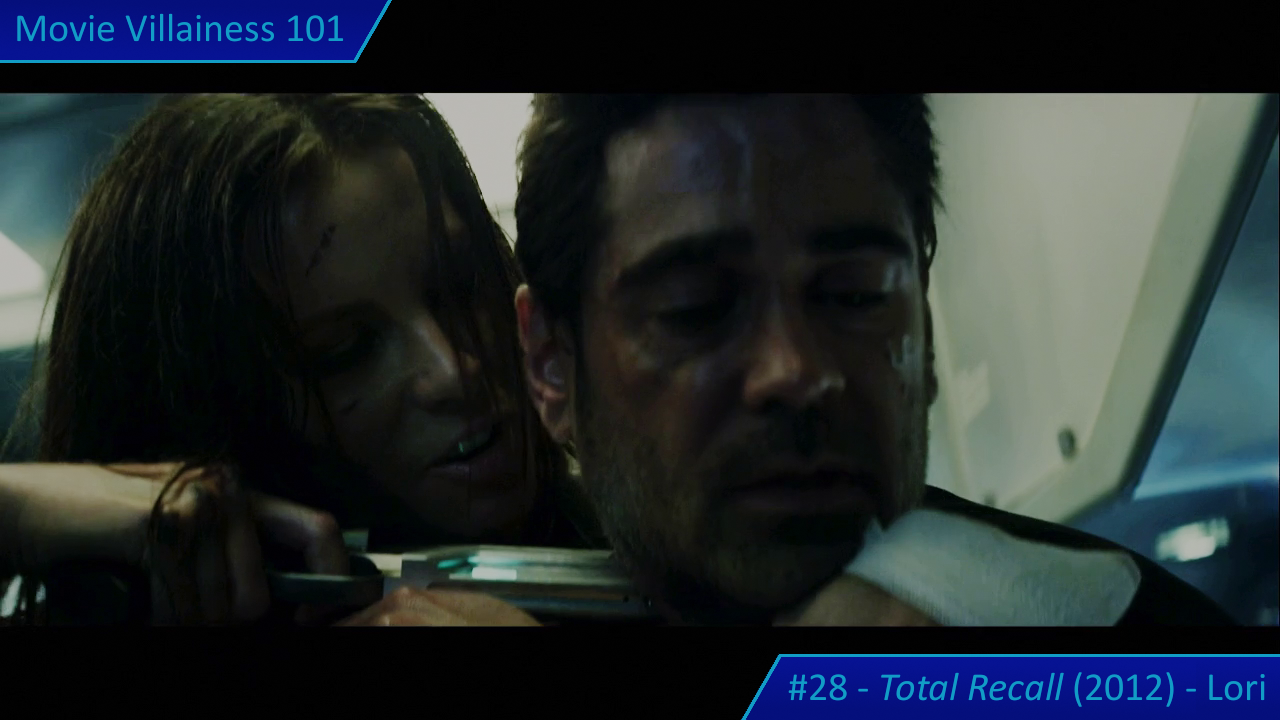
Quaid wakes up in an ambulance with Melina by his bedside. A tough villainess killed off-screen – that can’t be right, surely? Lori’s holographic disguise might have worked if the real Melina hadn’t wounded her hand. Quaid fights Lori – briefly – then finishes her with an electric paddle stun and a gunshot.

Honourable Mention: Total Recall

Total Recall (1990) – Lori (Sharon Stone)

To avoid repetition, this extended honourable mention is light on story details. Douglas Quaid is played by Arnold Schwarzenegger, Melina by Rachel Ticotin, and Cohaagen by Ronny Cox. Other than that, it’s the same tale of an ordinary worker discovering he’s a secret agent and that plenty of people want him dead. The second half is on Mars, with a subplot about an alien device that generates oxygen from ice. The primary henchman is Richter (Michael Ironside), and Lori is relegated to a supporting role.

Despite this, Sharon Stone makes an impression that leaves the viewer wanting more, though what we get is very good. Lori’s reveal is better handled, with a shadowy figure attacking Quaid after he returns home from Rekall. After a brief shootout, the “intruder” is revealed as Lori, and Doug discovers his wife has martial arts skills. She plays the innocent woman to buy time, but Doug is too smart to fall for it.

After flying to Mars, Melina becomes the female lead while Richter pursues the hero. There’s an annoying taxi driver who’s obviously a mole, so the reveal is unsurprising even to a first-time viewer. The false wife doesn’t show herself until the villains try to convince Doug he’s experiencing a false memory. After he sees through their lies, Lori stops pretending to be nice and kicks the hero in some rather sensitive places.

Lori’s best scene is her last. She gets into an extended fight with Melina after the heroine arrives to rescue Quaid. This is a drawn-out tussle – one of the better female v female examples – and it’s Lori who comes out on top. Just when the villainess is about to kill Melina with her own knife, Doug shoots the weapon from her hand. Lori pleads for mercy, but Quaid shows her none and gets a trademark Arnie one-liner: “Consider this a divorce”.

Movie Villainess 101 Rank #29

Using nuclear weapons is justified if the end goal is peace, apparently

Movie

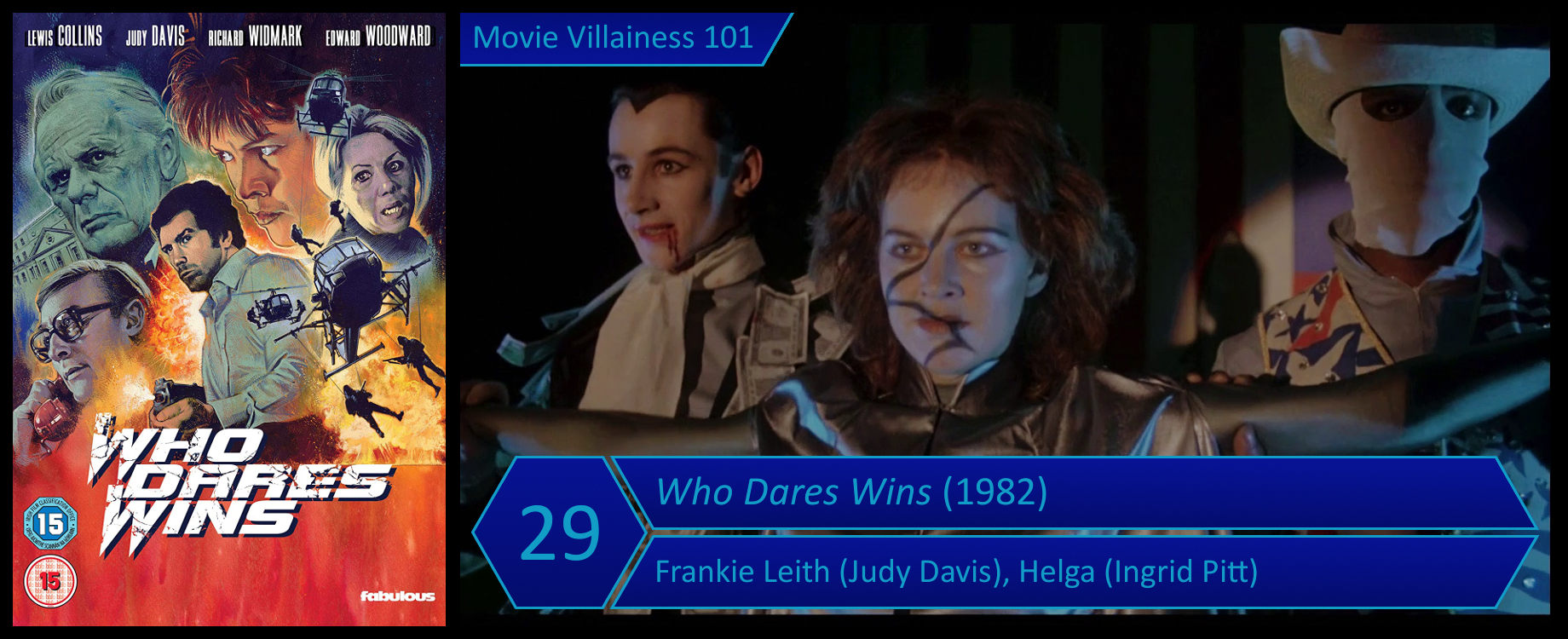
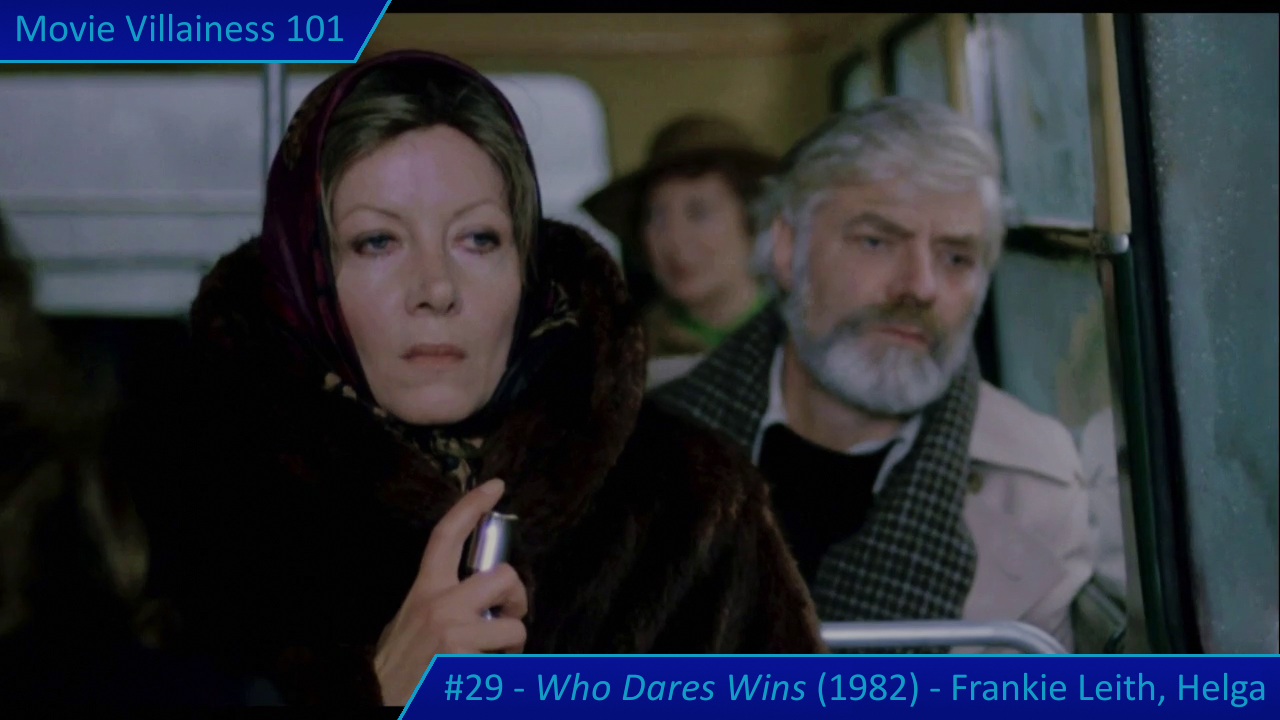
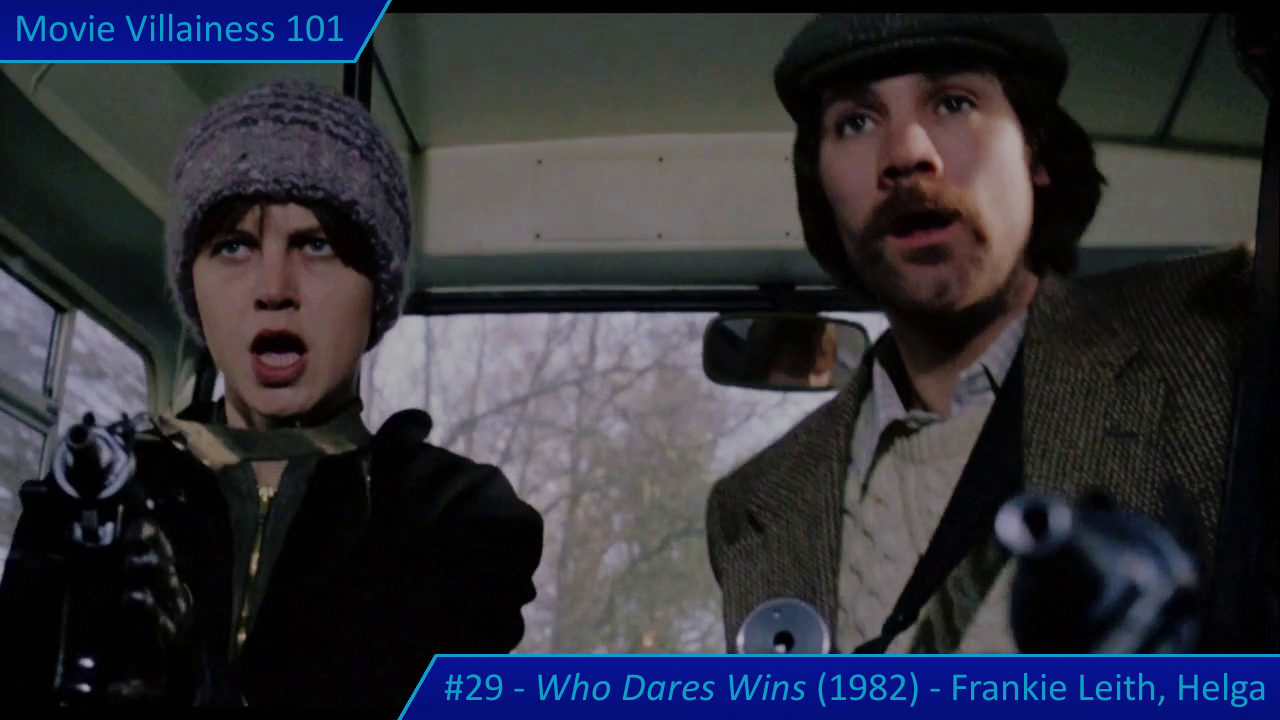
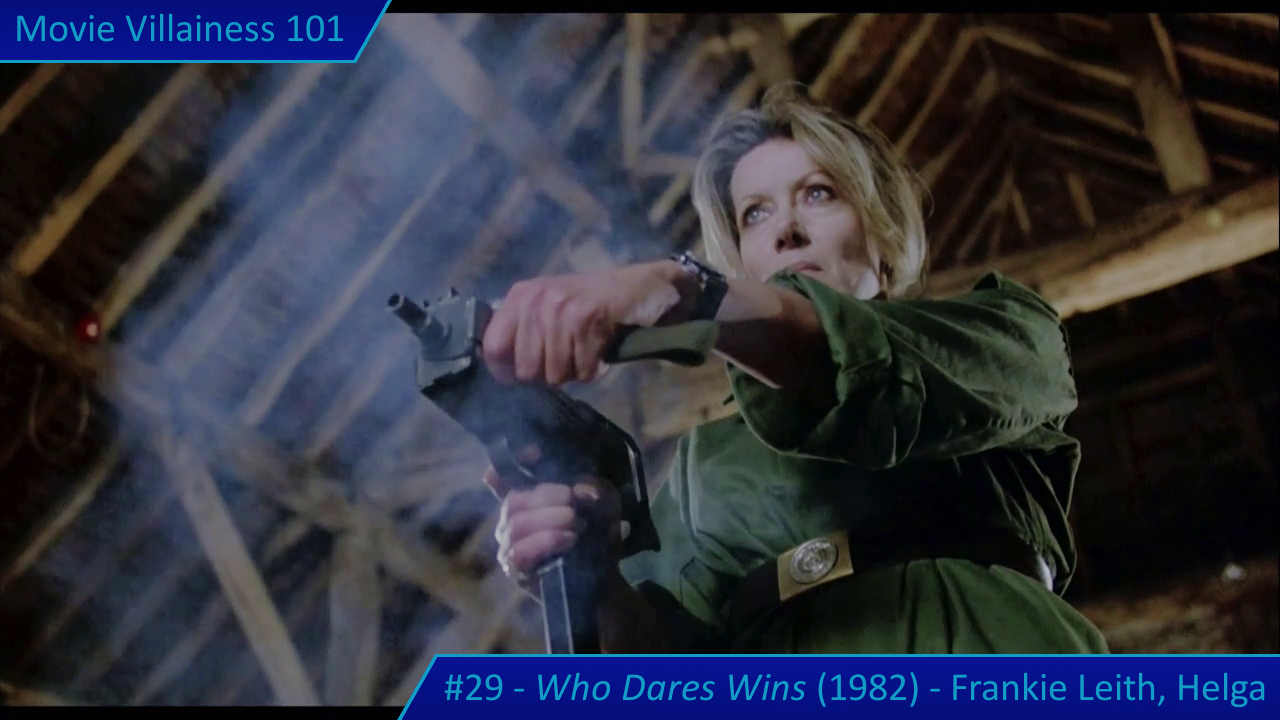
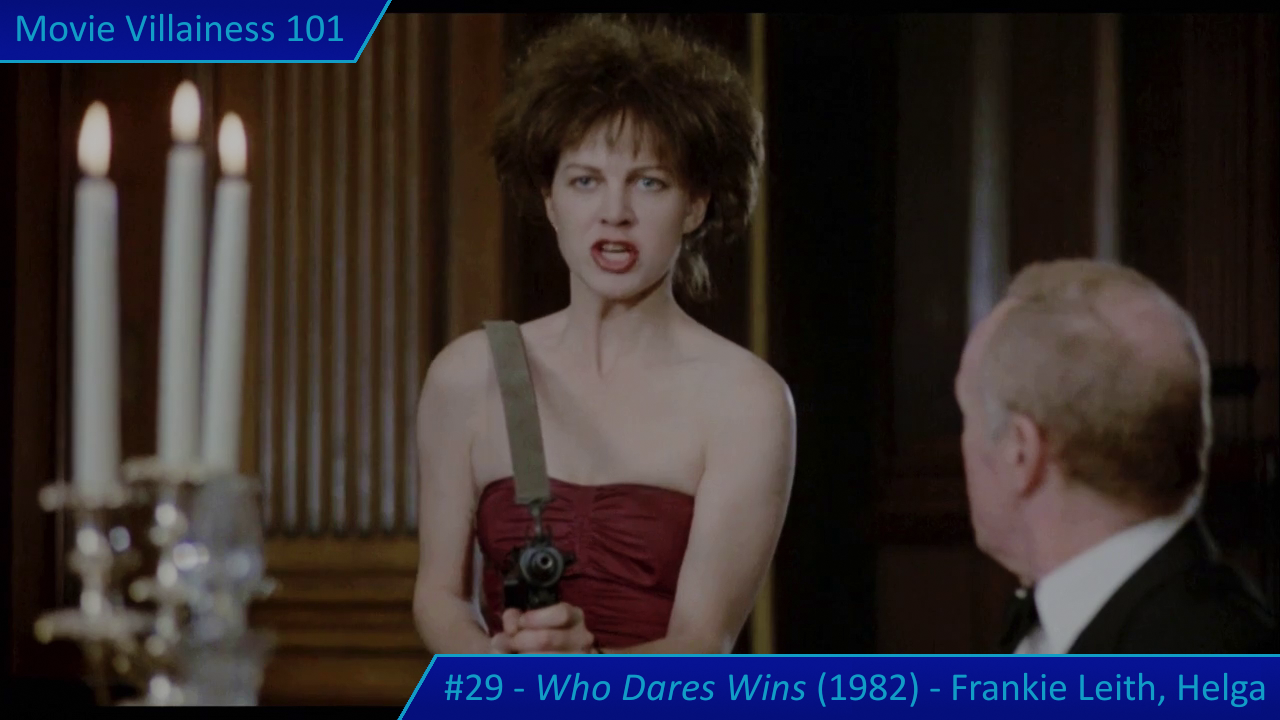
Who Dares Wins (1982)

This British action / spy movie is best known for its action-packed finale, which could be summed up as brutally short and effective. Don’t expect typical Hollywood clichés. There are no extended fight scenes or one-liners, and the main villains are killed as easily as the unnamed terrorists. The title is the motto of the British Special Air Service (SAS), and the story was inspired by the real-life operation that ended the 1980 Iranian Embassy siege in London. Known as The Final Option in the US, presumably because the elite unit is not as familiar to American audiences.

The villains are anti-nuclear extremists with no qualms about resorting to violence. When they discover a secret agent among them, they use a peace demonstration as cover to kill him with a crossbow sniper. That forces the British authorities to implement Plan B (or Plan A again) and send a second man undercover. The chosen hero is Peter Skellen (Lewis Collins), a charming SAS captain who deliberately gets kicked out of his unit by roughing up two foreign officers. That leaves him free to infiltrate and “advise” the terrorists while working against them from within.

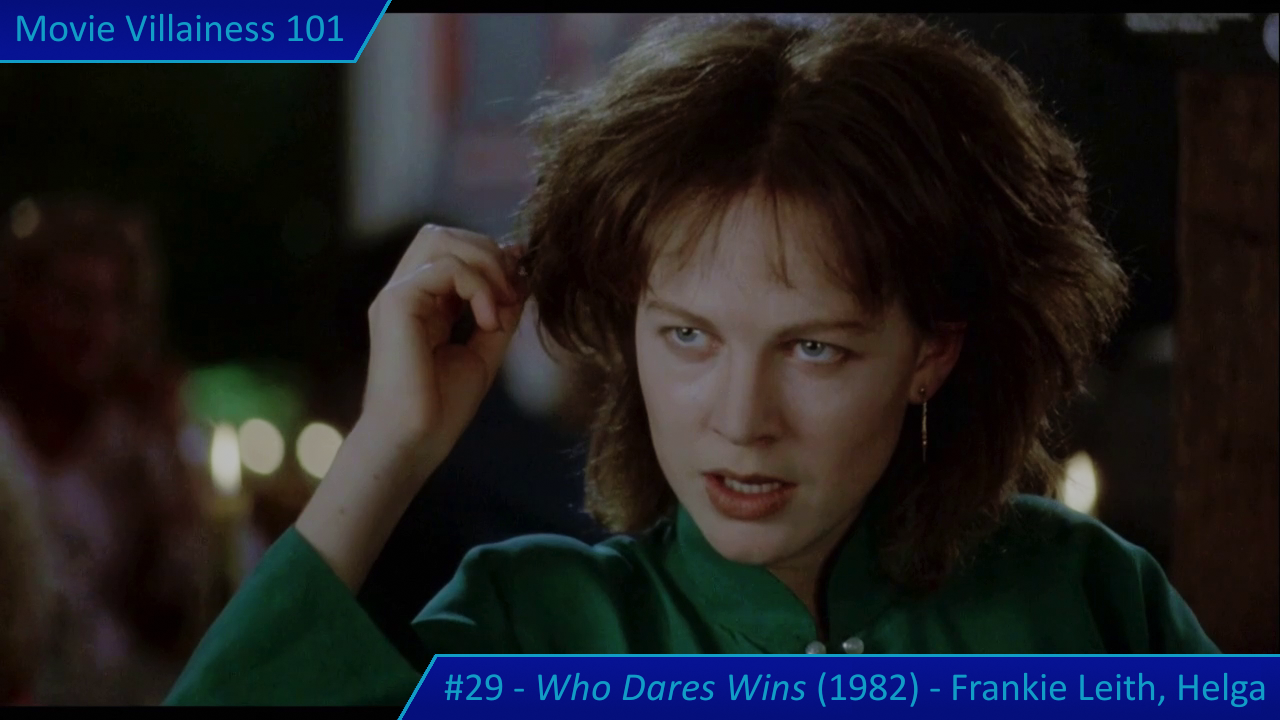
The cloak and dagger stuff is rather amateurish, and it’s no surprise the villains soon become suspicious of Skellen. The main villainess, Frankie, is more trusting because she’s willing to risk success for SAS inside information. Her introduction is a bizarre nightclub scene where she plays a rocket on stage while people dance around her in weird costumes. Skellen goes for a direct seduction approach, which is surprisingly effective, but Frankie is the crazy, thrill-seeking type.

The first hour is devoted to training exercises and talk, with little action. There’s an especially long part with a rock concert in a church, where a sympathetic bishop preaches to the audience. Frankie and her crew incite violence and paint the campaigners in a bad light. That’s about as exciting as it gets, and the henchwoman Helga is far more threatening during the buildup. The tension rises when Skellen gives himself away by visiting his wife. Evidently he’s better at SAS antics than spy craft, and his foolish actions put his family in danger.

Skellen is not exactly discreet about meeting his SAS contact either. While he eludes a male motorcyclist at Westminster Pier, Helga observes the two men together. Frankie is now more suspicious, but wants Skellen around. Helga isn’t one to give up, though. The villains pull off the obvious tail / discreet tail trick again, and Helga uses poison disguised as perfume to eliminate the contact on a bus. With no way to pass on information, it’s up to the lone hero to foil the villains’ scheme.

Who Dares Wins isn’t a Die Hard scenario plot since Skellen infiltrates the terrorist group deliberately. But Frankie and Helga achieve legendary status as the main villainess (relatively rare in this genre) and a nasty henchwoman who poses a threat throughout.

Villainesses

Frankie Leith (Judy Davis), Helga (Ingrid Pitt)

Seventy minutes into the two-hour movie, Frankie and her gang execute their plan. The terrorists pose as a military band after they stage a road accident and abduct the real performers. The US ambassador’s remote countryside residence is the setting for an overnight siege. Frankie kills a hostage during the attack – this is a woman willing to get her hands dirty. Skellen is still embedded with the group, but Frankie orders Helga to hold his family at gunpoint to ensure his loyalty.

Not long after the takeover, Frankie issues demands to Commander Powell (Edward Woodward) who’s taken up position outside the estate. The terrorist leader demands that the British government launch a nuclear missile at a Scottish submarine base. In the name of peace, apparently. When questioned by the US Secretary of State, Frankie rants about a nuclear holocaust while blaming politicians. The Secretary sums it up nicely when he says Frankie is a lunatic.

Powell doesn’t even engage in discussion and gives no pretence that the government will comply. A US general present at the dinner grabs a gun from a terrorist and gets shot and killed. This convinces Powell to call in the SAS. Fortunately, Skellen provides a mix of truth and misinformation to Frankie and signals the authorities from a bathroom window. The oft-used toilet excuse and a mirror to reflect the moonlight do the trick.

The authorities put Skellen’s house under watch after the contact was eliminated, so have already set up a staging post in the building next door. The SAS joins the police and makes a mess of the neighbour’s wall. If drilling a hole for a camera wasn’t enough, special forces blow their way into the Skellen household. Just in time, since Helga had turned nasty. In a matter of seconds, the SAS breach the wall and eliminate Helga and her accomplice with headshots. These guys don’t mess around.

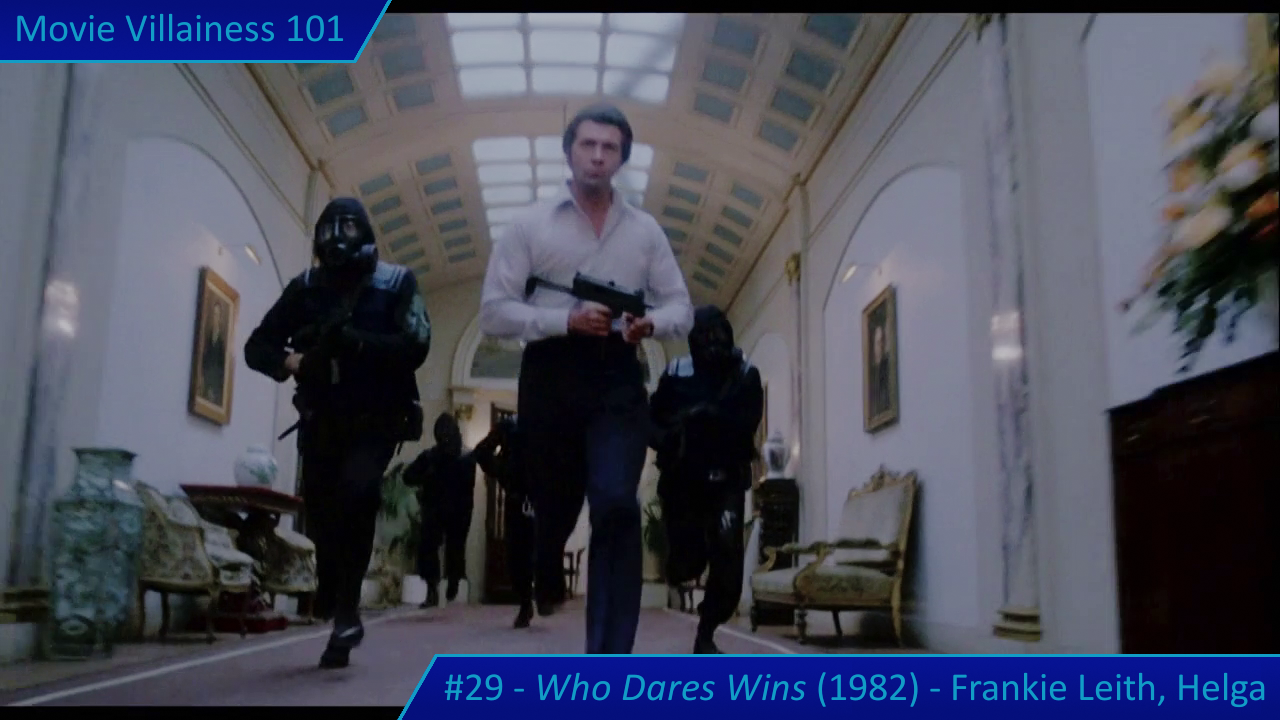
It’s back to the main siege, with the SAS given the go-ahead by the Prime Minister. Skellen reveals his true allegiance after a power cut and frees the dining room hostages in a dramatic shootout. Frankie panics as her plan falls apart, and the SAS executes a perfect raid with no special forces casualties or collateral damage.

Efficient and ruthless, they use the element of surprise to take down the terrorists before they can react. We get a very effective POV through one soldier’s gas mask as the unit wipes out the opposition. Some villains still think Skellen is on their side until he guns them down, links up with his SAS squad, and leads the final charge.

Frankie is the last one standing (what else did you expect?), but Skellen hesitates to shoot her. Perhaps he genuinely feels something, and the undercover work dulled his killer instinct. To the SAS soldiers, Frankie’s just another terrorist, so they kill her without a second thought.

Honourable Mention: Special Forces

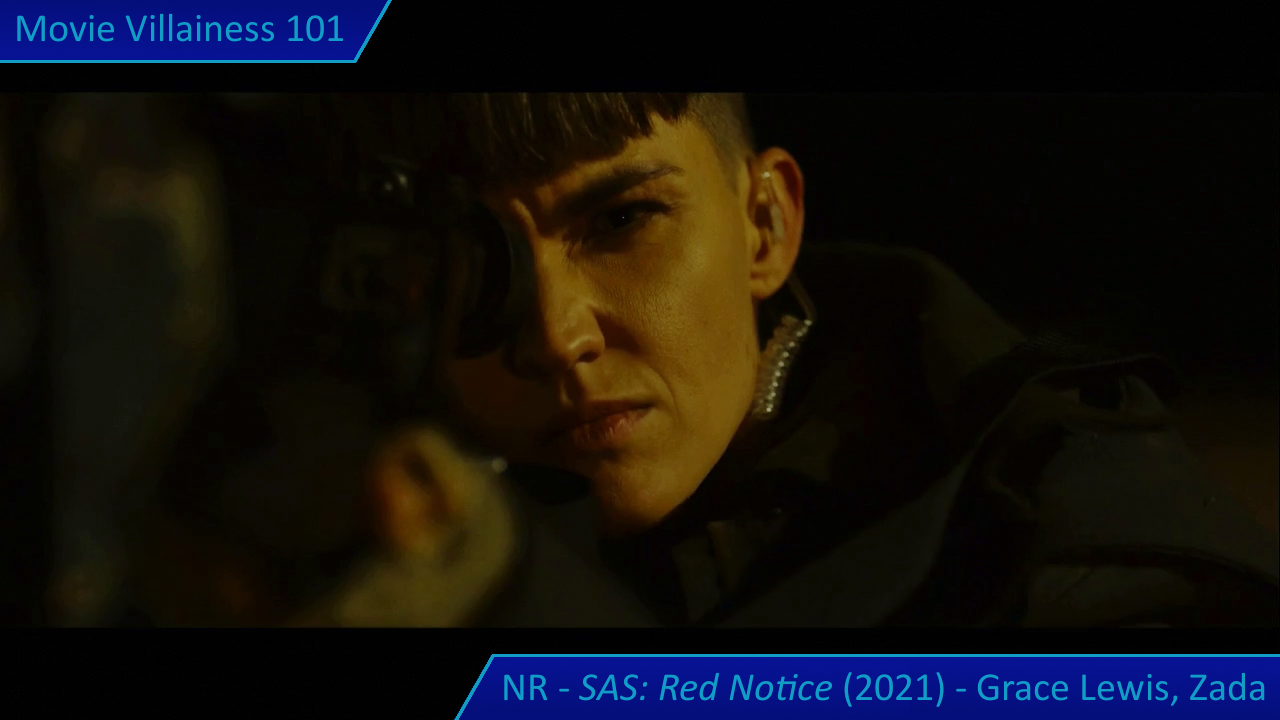
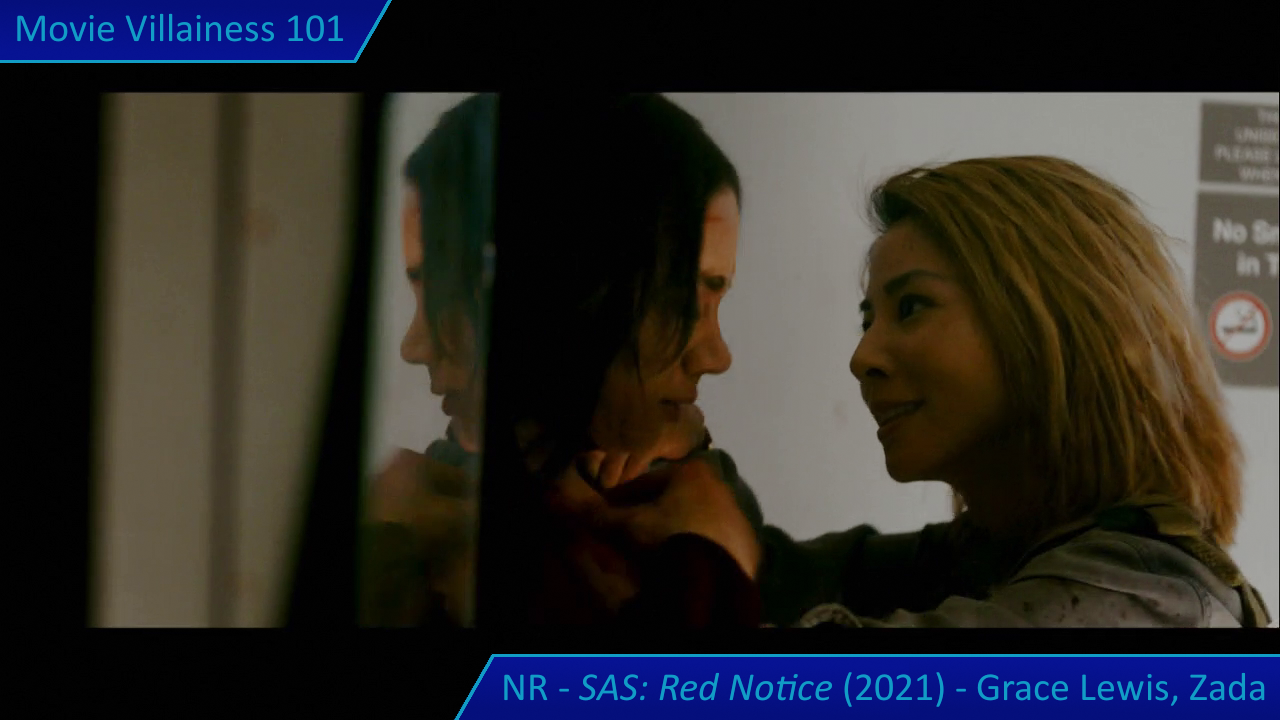
SAS: Red Notice (2021) – Grace Lewis (Ruby Rose), Zada (Jing Lusi)

A more traditional action film, closer to the Die Hard mould. While there’s more fighting and shooting in this one, the SAS tactics are far less realistic. Trained soldiers stand in the open, waiting to get shot by the villains, in this case a militant group led by Grace Lewis, aka The Black Swan. Her mercenaries – who’ve run covert black ops for the British government, only to become expendable – hijack a train in the Channel Tunnel and ransom the hostages.

By pure coincidence, one passenger is Tom Buckingham (Sam Heughan), an SAS officer as upper-class as he sounds. He was taking his girlfriend, Sophie Hart (Hannah John-Kamen) to Paris when the terrorists took over the train. The rest of the movie is routine, with Tom doing the solo hero thing and taking out the villains one by one. The SAS has a traitor in its ranks, and it’s no great surprise the mole ends up being Tom’s best mate Declan Smith (Tom Hopper).

Grace employs female mercenaries, including the henchwoman Zada. She’s not that memorable in truth, with action limited to shooting innocent civilians when the villains torch a village. And she threatens Sophie, who predictably becomes a bargaining chip. Zada goes out tamely, falling to a sniper shot when the terrorists pose as hostages as part of their escape strategy.

Grace gets more satisfying bad girl moments and comes across as a dangerous psychopath. She doesn’t hesitate to kill, which includes putting a bullet in the SAS commander’s head to establish her authority. The finale on the French coast has Tom rescue Sophie from Grace, then engage the villainess in close-quarters combat. This is a lengthy fight, with Grace proving a deadly foe with a blade. After that, there’s a conversation where the wounded woman claims she and Tom are not so different. He agrees and slices her throat.

Movie Villainess 101 Rank #30

The (Good?) Witch of the South is strangely absent

Movie

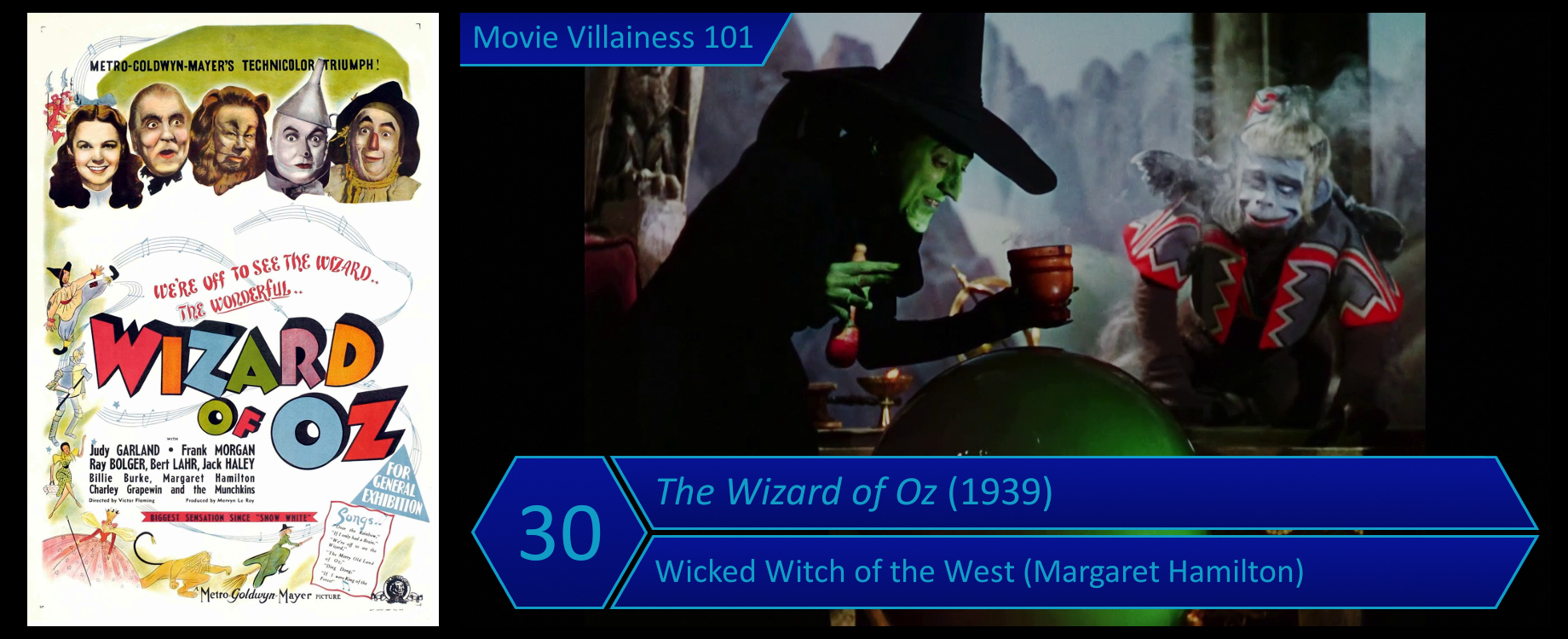
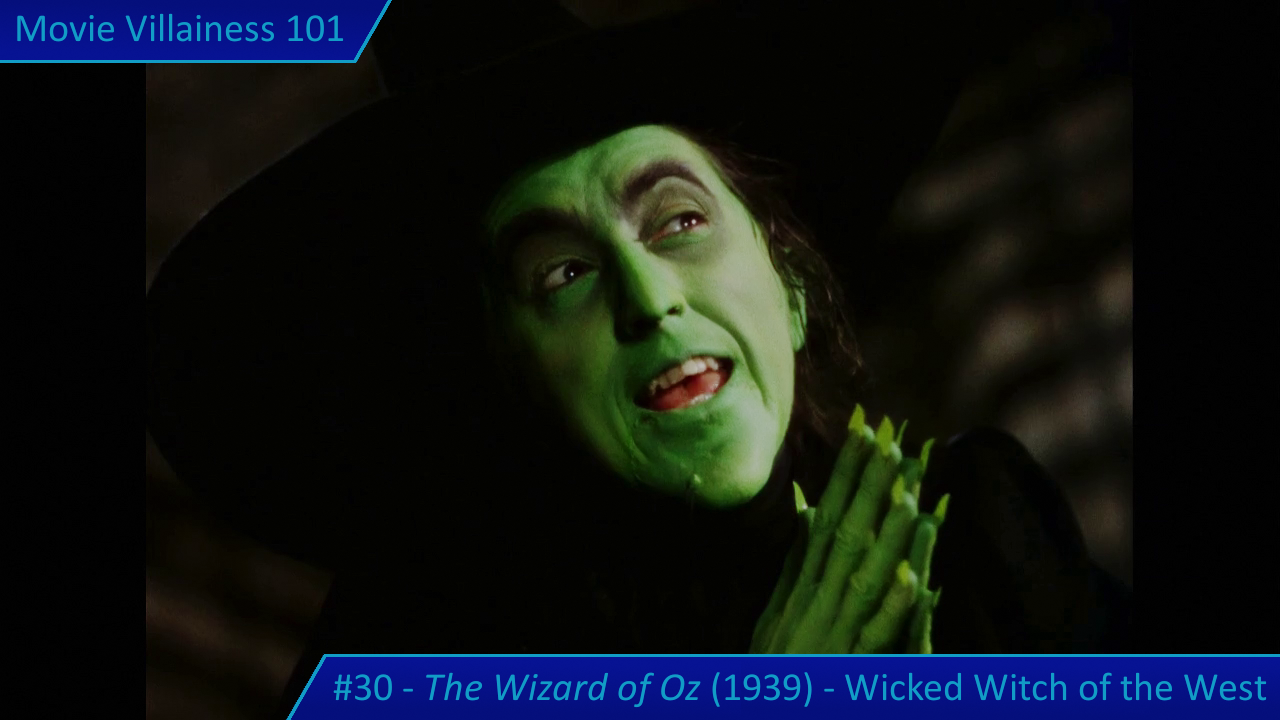
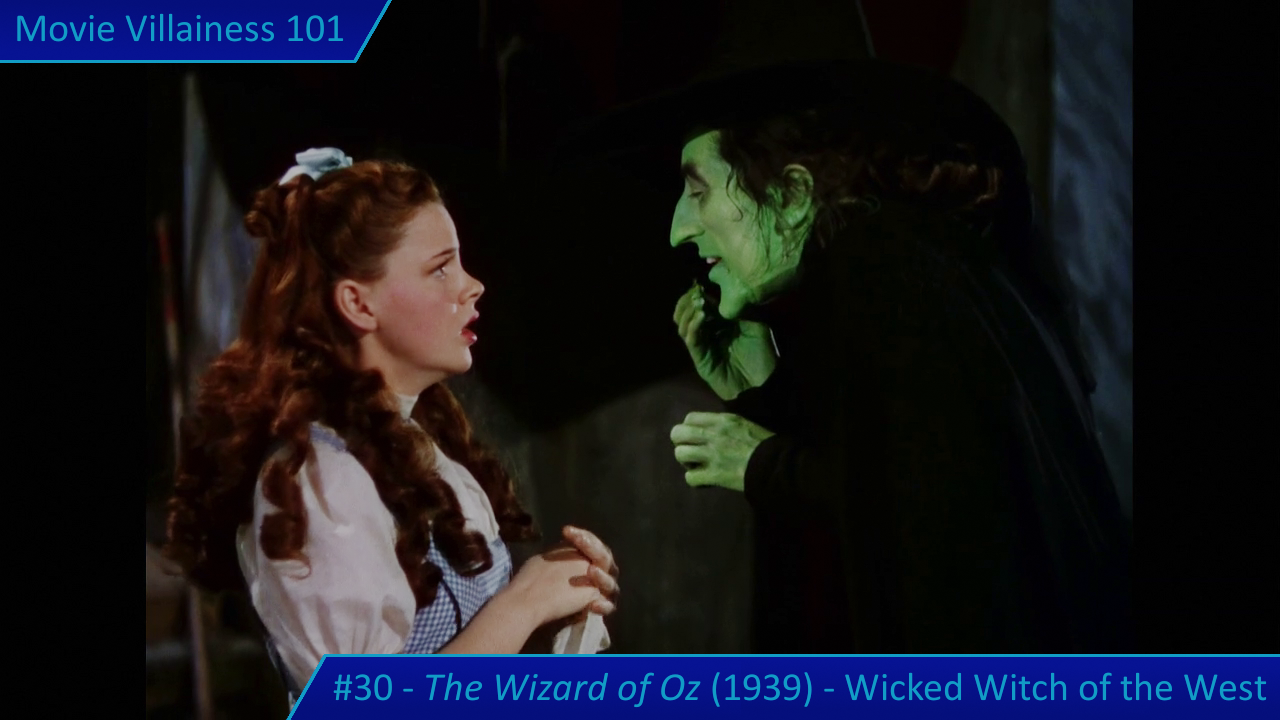
The Wizard of Oz (1939)

The oldest movie on my list was difficult to place, as I’m not a huge fan of musicals, but the Wicked Witch belongs among the legends. Special effects were basic in this era, and the whole feel – simple costumes and painted backgrounds – is akin to a stage production. For a film made in the late 1930s, this was way ahead of its time and an amazing technical accomplishment.

The prologue looks black and white, but filmmakers shot it with a sepia tint. We’re introduced to Dorothy Gale (Judy Garland), a teenage girl who lives on a Kansas farm with her aunt and uncle. There are three farmhands, a mysterious fortune-telling professor, and the nasty Miss Gulch, who wants to put down Dorothy’s dog Toto.

Dorothy longs for adventure and sings the iconic “Somewhere Over the Rainbow.” But she gets more than she bargained for when a tornado sweeps up her house and deposits it (and her) in a strange land. The grand reveal that follows, with a switch from sepia to full colour as Dorothy steps into Oz, is startling even to modern viewers. It must have seemed a technical marvel in the mid-twentieth century.

The residents – a dwarven race known as Munchkins – and the Good Witch of the North aren’t unhappy to see a stranger. Quite the opposite, since Dorothy’s house landed on the Wicked Witch of the East. Nobody seems regretful, so one assumes she must have been a horrible person. In fact, the Munchkins burst into song and treat Dorothy and her dog as practical royalty.

The Good Witch is so indebted that she offers to help Dorothy get home. This involves a long journey along the Yellow Brick Road to the Emerald City, meeting three companions on the way: the Scarecrow, the Tin Man, and the Cowardly Lion. On arrival, they receive an audience with the Wonderful Wizard of Oz. He’s not an all-powerful man as first seems, but a charlatan operating machinery from behind a curtain. The fraudster can provide assistance, but demands that the heroes perform a dangerous task. With no magic, Dorothy has to rely on wits, Toto, and her new friends.

Villainess

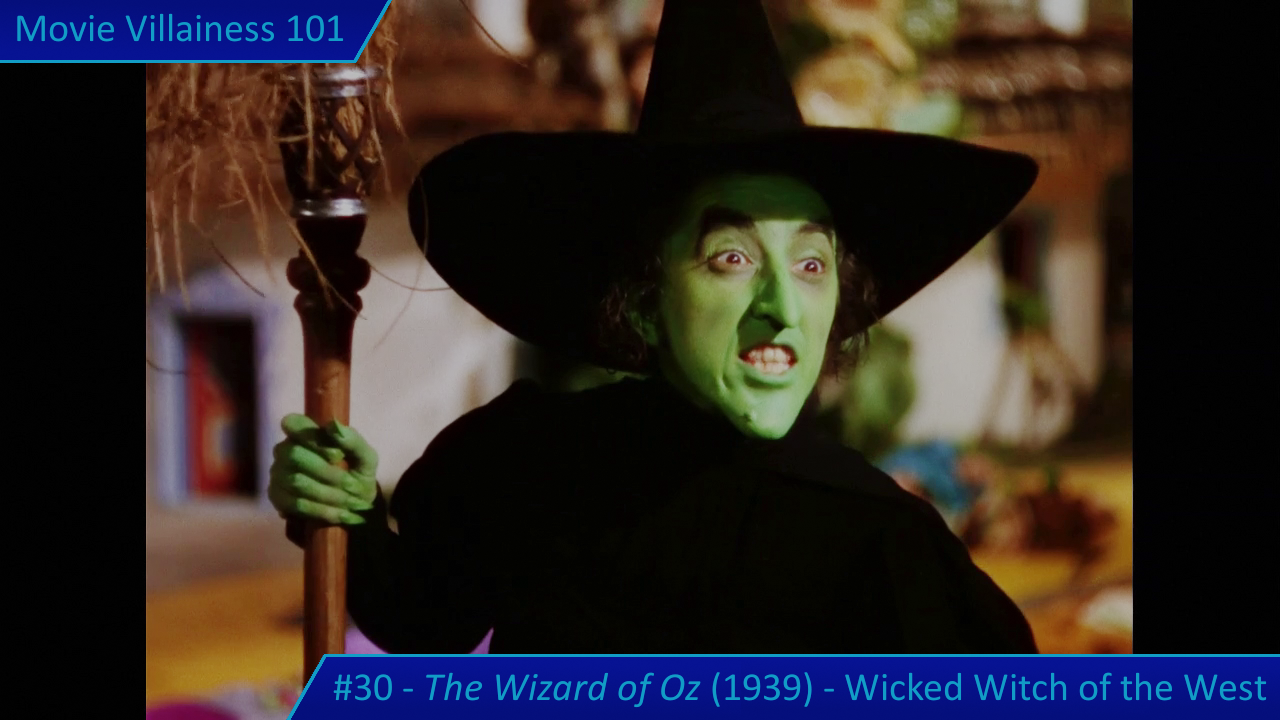
Wicked Witch of the West (Margaret Hamilton)

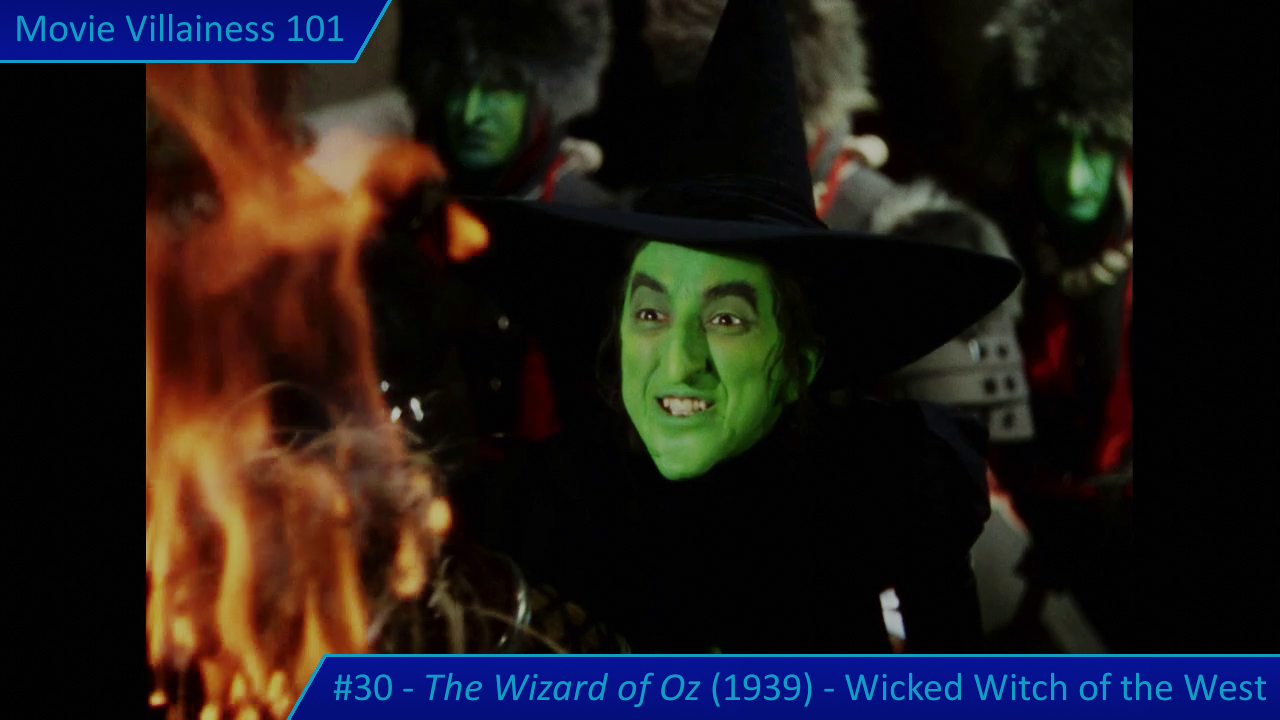
Like any grand quest, there are obstacles to overcome. Turns out the dead witch has a sister even more evil than she. This woman is straight out of a Halloween party with green skin, a black outfit, a shoddy broomstick, and a pointy hat. It’s likely the Wicked Witch was the inspiration for party costumes, such is her cinematic legacy. From the moment she appears in a puff of red smoke, she is a screen presence to be reckoned with and a terrifying sight to young viewers.

Luckily, the Good Witch of the North is around to teleport the ruby slippers from the deceased Witch of the East onto the heroine’s feet and shield her from the Wicked Witch of the West. So many compass directions it could get confusing, but the other two are minor characters. The villainess will be called the Wicked Witch for brevity.

Dorothy’s quest along the Yellow Brick Road brings her into contact with the Scarecrow, Tin Man, and Cowardly Lion. They join Dorothy in search of a brain, heart, and courage, respectively. The supporting cast play multiple roles, distinct characters on Earth and in the fantasy world of Oz, which raises the question whether Dorothy’s experience is just a dream.

In this fairly repetitive section, the Wicked Witch is absent from the proceedings, except for a brief appearance when Dorothy encounters the Tin Man. No epic confrontation, just some threats and a fireball which narrowly misses Scarecrow. There’s only one human antagonist, though she has an army of monkey creatures to do her bidding.

With Dorothy and her three companions (four counting Toto) almost at the Emerald City, the Wicked Witch casts an evil spell. After gazing into a crystal ball, she cackles and creates a poisonous atmosphere. This puts Dorothy and the Lion to sleep, while the Tin Man and Scarecrow are less than helpful. Only the Good Witch’s intervention saves them, but the villainess won’t be stopped so easily. She takes off from her castle lair, riding her broomstick to the Emerald City. Then she flies around and leaves a message in smoke: SURRENDER DOROTHY.

If the heroes are hoping for help from the Wizard of Oz, none comes. He demands that Dorothy bring him the Wicked Witch’s broomstick. Talk about a steep price! The residents of the Emerald City are accommodating and give the heroes all kinds of comforts. But it’s a dangerous mission, especially once the villainess captures Dorothy and her companions must save her.

There’s a lengthy confrontation where the Wicked Witch torments Dorothy and threatens to kill Toto, but she’s thwarted by the magic of the ruby slippers. The shoes won’t come off while Dorothy is alive, so the Wicked Witch unveils a giant hourglass and proclaims her foe will perish when the sands run out. A good thing Toto escapes and brings the rescue party, though the Wicked Witch and her monkeys prevent the heroes from escaping.

After a pantomime chase scene through the castle with the usual chandelier-dropping antics, the Wicked Witch confronts Dorothy and threatens to set the Scarecrow aflame. Dorothy puts out the fire with a bucket of water and inadvertently drenches the villainess. The splash is deadly to witches, and the antagonist melts away, screaming insults as she turns to steam.

Honourable Mentions: Witches

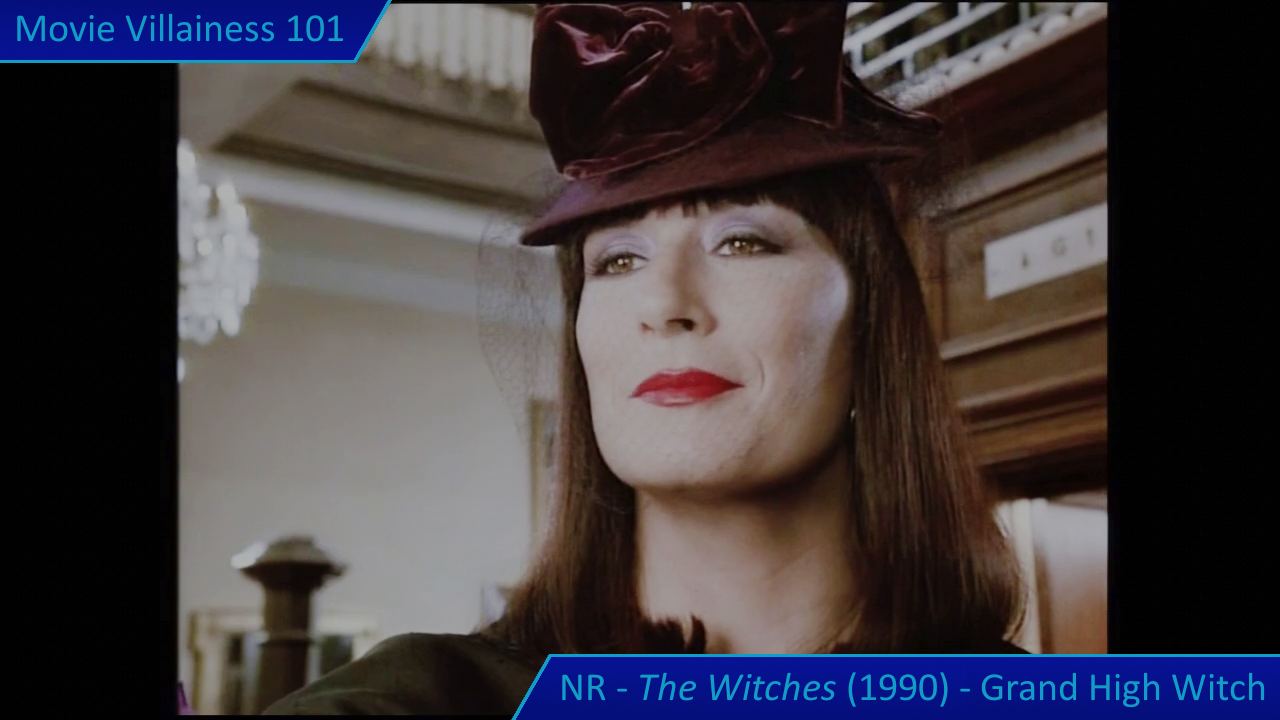
The Witches (1990) – Grand High Witch (Anjelica Huston)

This adaptation of Roald Dahl’s novel is better regarded than the 2020 version, even if the unfaithful happy ending doesn’t fit the dark comic tale. The scene is set early on when an old woman tells her grandson, Luke, all about witches. These evil women have no toes, glowing purple eyes, and masks to conceal their true appearance. Witches hate children and do nasty things like trap them in paintings until they grow old and die. No wonder the tale scares the youngster.

After Luke’s parents die in a car accident, the grandmother Helga becomes his legal guardian, and they move to England. A witch tries to lure Luke from a treehouse with chocolate, but Helga’s knowledge – and the witch’s pet snake – means Luke is not deceived. However, the real danger comes when the family goes on a South Coast holiday. They picked the wrong hotel because every witch in England is there to attend a national convention.

With literally dozens of female villains, it’s disappointing that many are extras. The women cackle while their leader – the Grand High Witch – announces her scheme to turn all British children into mice. Ironically, they masquerade as members of the Royal Society for the Protection of Children. Yeah, right. Luke overhears their plan from a hiding place and watches them test the potion on another child. But the witches discover Luke, capture the boy, and transform him into a mouse!

Luke and his new friend Bruno spend the rest of the movie in animal form, but get the potion into a soup bowl so the witches drink it. There are some comic antics where Bruno’s disbelieving parents almost drink the soup and Rowan Atkinson runs around as an easily panicked hotel manager. But it’s Angelica Huston’s character who steals the show with her disfigured face and insane rants about children.

There’s a sequel hook with Luke transformed back into a boy and finding a list of American witches, but this is a one-off movie. The villainess gets a suitable demise, though. Being evil, the witches change into nasty-looking mice, which gives the holidaymakers a fright. The Grand High Witch seems immune to her potion, but eventually succumbs to the spell and the manager chops her up.

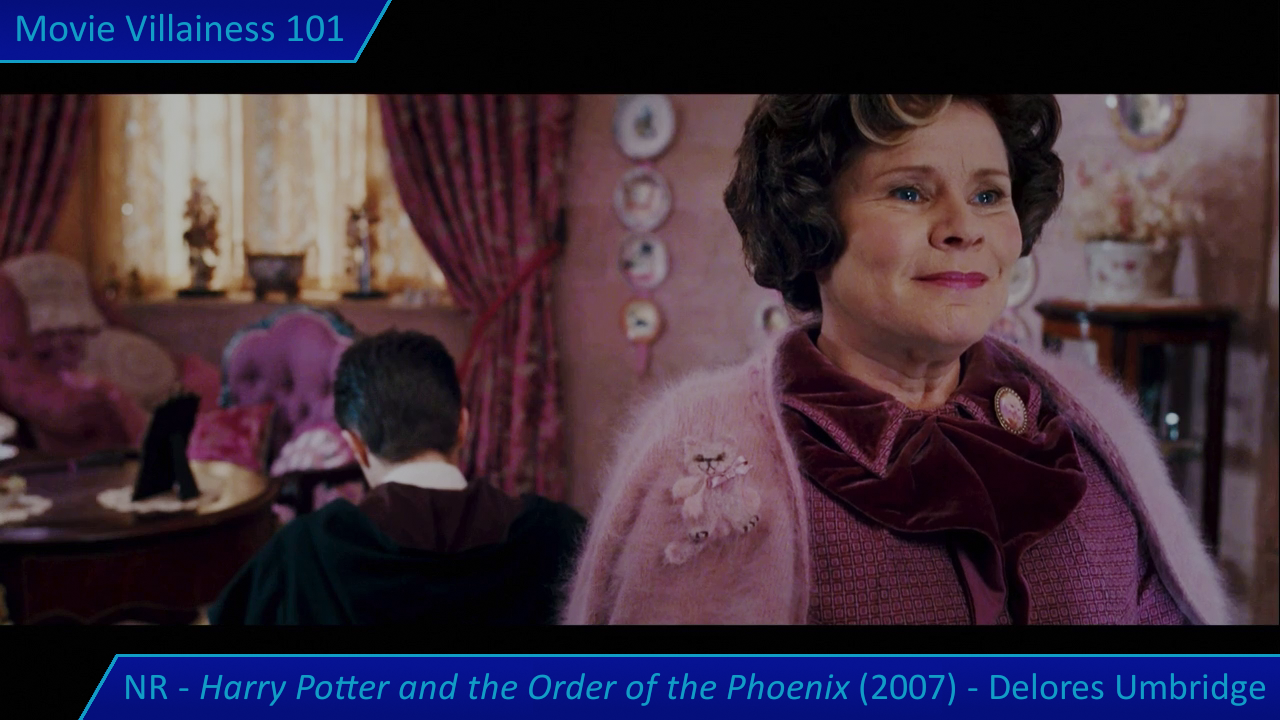
Harry Potter and the Order of the Phoenix (2007) – Delores Umbridge (Imelda Staunton)

Bellatrix Lestrange (Helena Bonham Carter) is the main villainess in the evil magician hierarchy, but her contribution is disappointing for someone who had four movies (Order of the Phoenix onward) to make an impact. She kills two characters, but this doesn’t carry the emotional weight it should because we don’t know the victims well enough. Bellatrix is defeated too easily, with no major confrontation against any of the three central characters.

In the fifth movie, the Dark Lord Voldemort is still regaining his powers after his resurrection, and the main plot at Hogwarts is the Ministry of Magic attempting to quash rumours of his return. Conveniently, the Defence Against the Dark Arts teacher slot is free (isn’t it always?), so they plant a sadistic woman to “educate” young witches and wizards. Delores’ methods are strict and demeaning, and she clearly has no love for children.

Harry resists Delores’ influence and gets detention for his trouble. The villainess has the hero write lines in blood, which carves the same message in his own flesh. This woman is on a power trip and gets the headmaster Dumbledore fired so she can take over the school. Up go notices to remind students who’s in charge, and the House of Slytherin pupils are happy to be Umbridge’s bullying prefects.

When the nasty Dolores is attacked by Centaurs, she begs Harry to tell her captors she’s a nice person. The hero simply responds with the line Delores forced him to write: “I must not tell lies”. Touché, Harry.

Delores Umbridge receives an extended cameo in Harry Potter and the Deathly Hallows: Part One (2010), but she’s not that threatening outside of Hogwarts. With the main villain now in the ascendancy, Dolores is a minor antagonist. While her return is certainly welcome, since female villains are poorly represented in the series, there’s little to comment on.