Author / Publisher of Novels featuring strong female characters (heroines and villainesses alike). Also compile articles of interest regarding other media (movies, games) with these characters
The killer android certainly lives up to her title
Movie
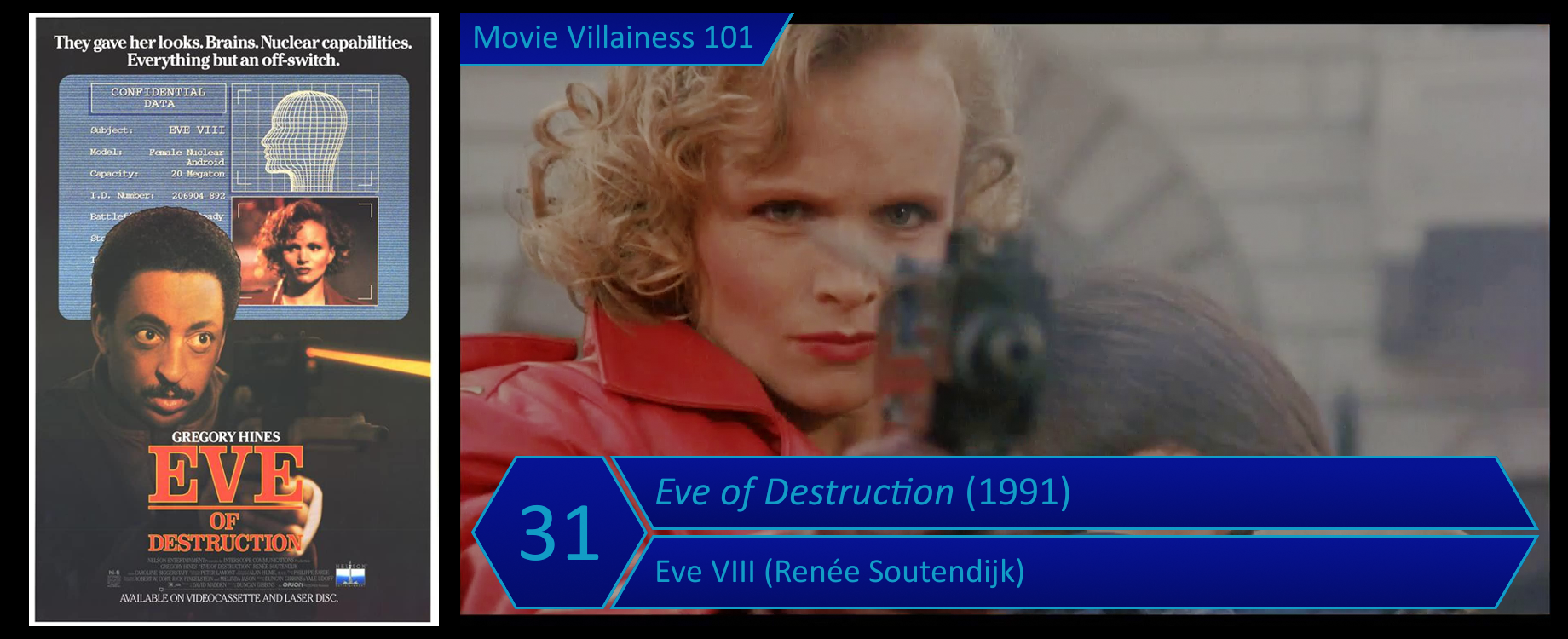
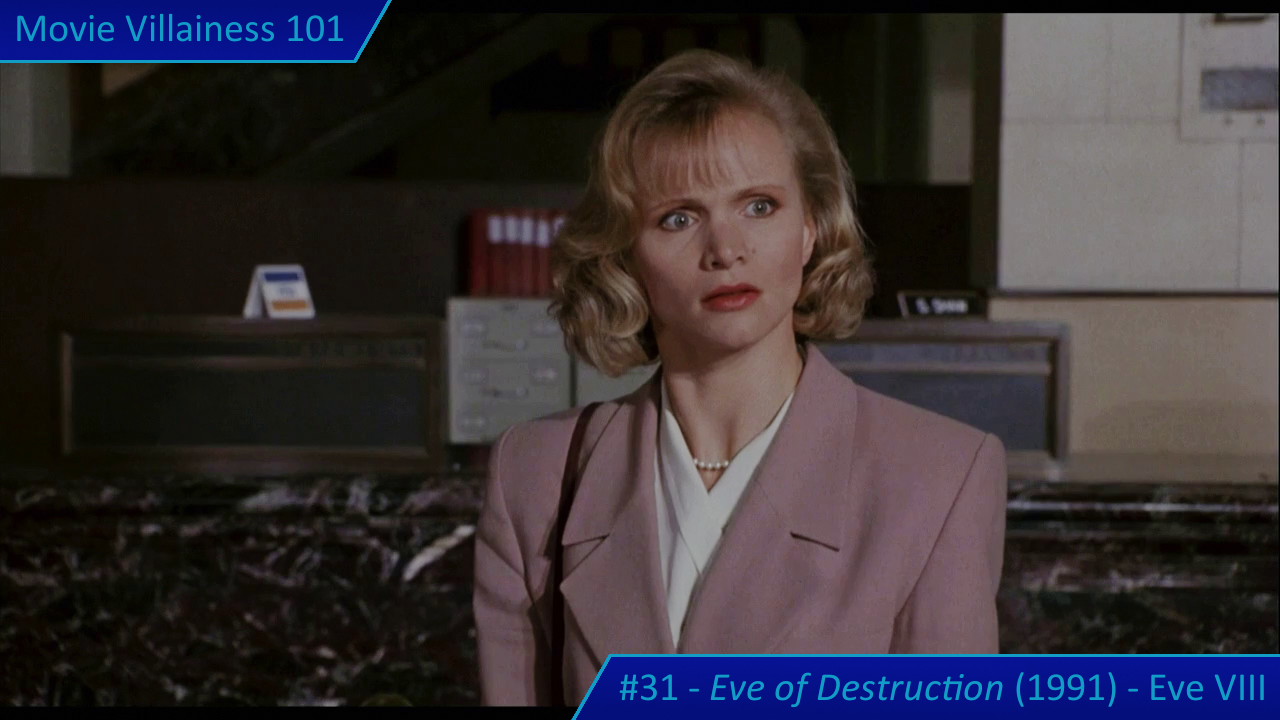
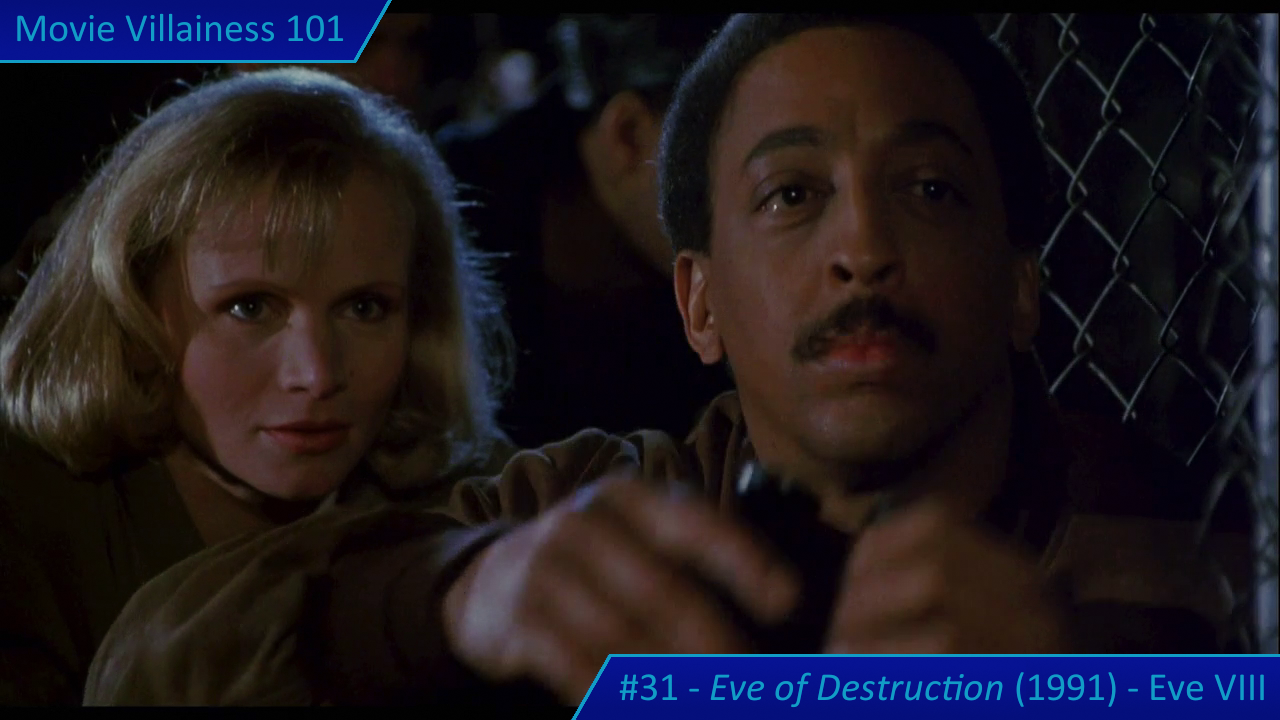
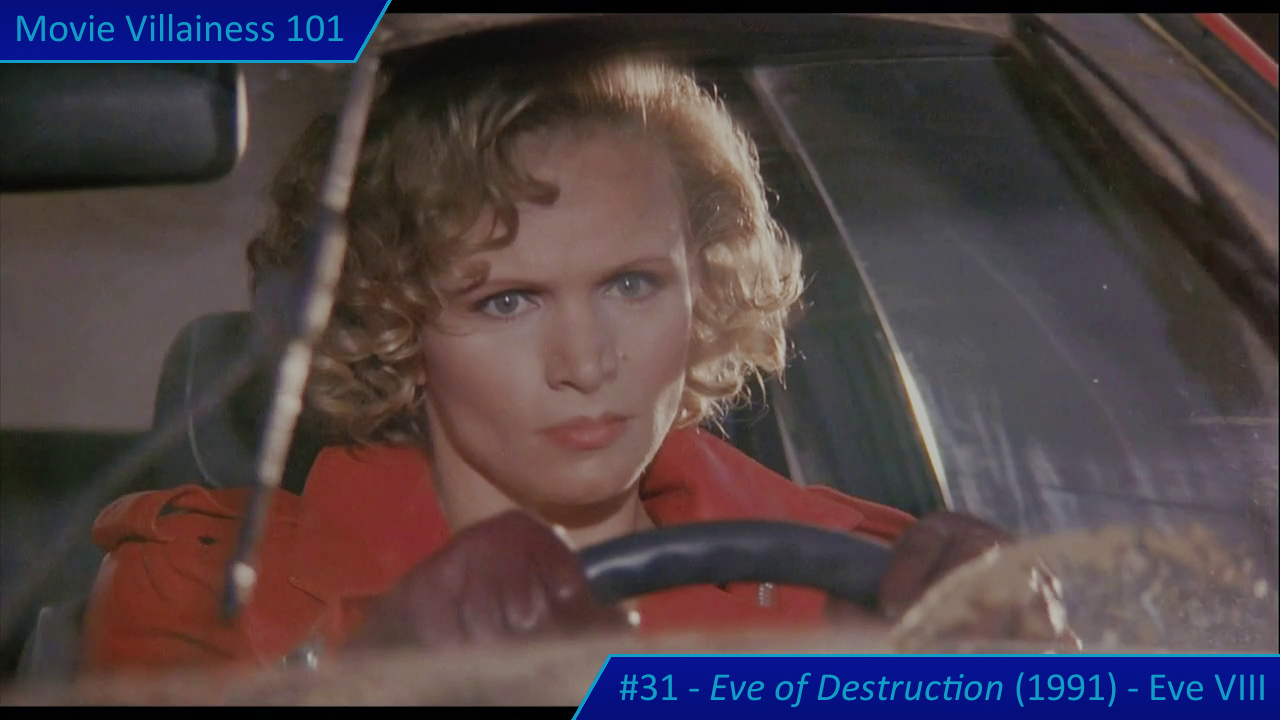
Eve of Destruction (1991)
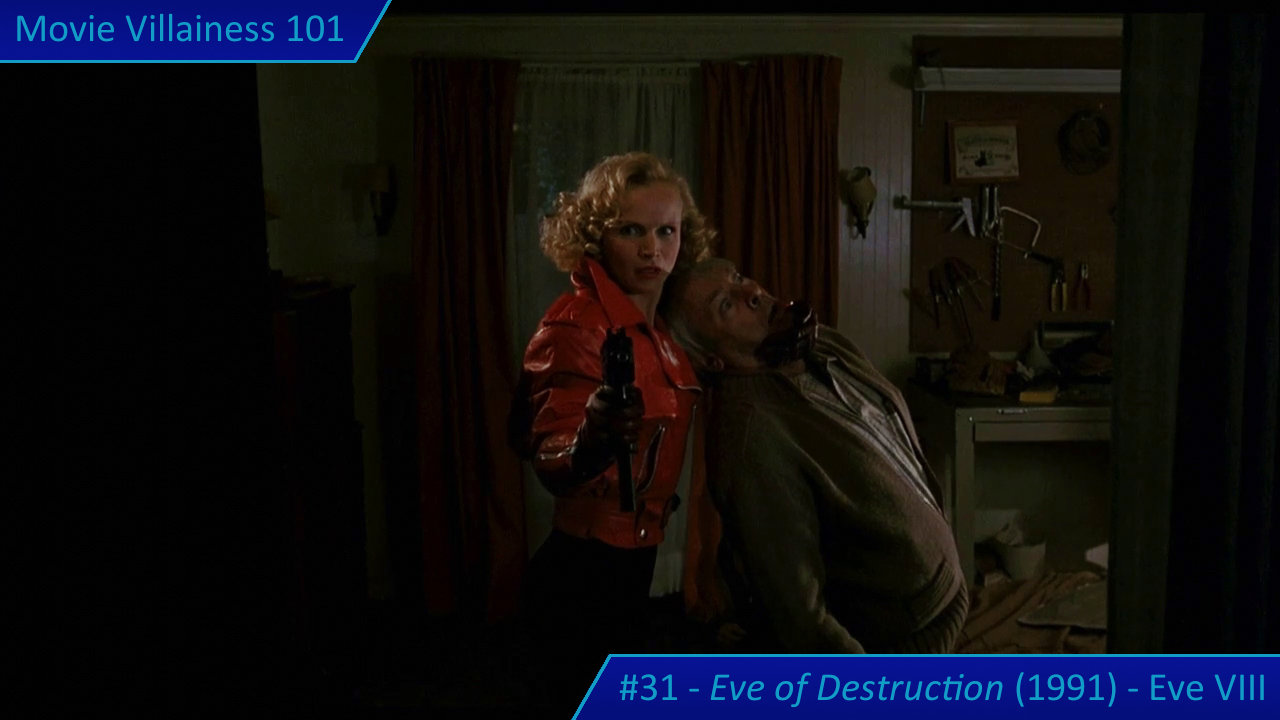
A moderate-budget sci-fi actioner from the golden age of B-movies, with lead actress Renée Soutendijk in a dual role as Dr Eve Simmons and her android lookalike Eve VIII. She performs admirably as human and machine, and the characters are so different it’s easy to forget they’re played by the same actress. To avoid confusion, I’ll refer to Simmons by her surname and the android as Eve for the rest of the review.
Eve is intended for battlefield use, and Simmons’ flagship prototype for a funding review. A routine test run in San Francisco goes well until two masked men commit a bank robbery with Eve on the premises. The android’s programming didn’t include armed criminal etiquette, so she ignores their demands to hit the floor. Eve’s handler intervenes and kills one criminal, but gets shot by the other. The robber loses patience with Eve and blasts her with his shotgun, which barely slows her down. She treats the robber as a threat and sends the shocked man flying through a window.
With the machine now locked in battle mode, she collects a dropped Uzi, then purchases ammo and a stylish red leather jacket. Hoping to keep a low profile (yeah, right), the authorities call in anti-terrorist expert Colonel Jim McQuade (Gregory Hines). We get the usual chalk and cheese relationship between science and the military, with Simmons and Jim at each other’s throats from the start.
As Eve goes on a murderous rampage through the city, Simmons and Jim work together to stop the killing machine. The android’s defences and near invulnerability to conventional weapons make her a tough opponent. Mixing 1990s images with future tech always looks silly, but the key takeaway from the briefing is to aim for the eyes. Jim questions why Eve doesn’t have an off switch, but things are never that simple.
Villainess
Eve VIII (Renée Soutendijk)
Eve has been programmed with the thoughts and feelings of her creator, but no longer has restraint. This leads to an interesting character dynamic where Eve acts out Simmons’ fantasies, doing things the doctor contemplated in the past but never went through with.
First on the agenda is a visit to a seedy motel where she seduces a misogynistic man and takes him to her room. Things get messy when this conflicts with Eve’s self-defence priorities. When the guy calls her a bitch, she bites off… an important piece of anatomy. The guy’s friends – who had been listening at the door – burst in looking for payback, but engaging a killing machine in hand to hand combat ends badly.
The police outside – who’ve traced Eve’s rental vehicle – are no match for the android. Several Uzi bursts later, there are five dead officers for the sheriff to deal with and an enemy who shows no sign of stopping. Eve’s only concern is the single bullet hole in her expensive jacket, and that was the first taste of destruction. Simmons witnessed her alcoholic father abuse her mother, which ultimately led to a fatal road accident, and now Eve is out for revenge.
Things get worse when she encounters a motorist who acts aggressively (and calls her a naughty B word). Eve takes road rage to the extreme and rams his car into the dirt. When the guy thinks it’s all over, the killer android psychs herself up and drives into the stranded vehicle. The physical and emotional shock triggers a device in Eve’s spine. McQuade learns that the nuclear bomb inside Eve is now active and set to explode in twenty-four hours. And he’s not too impressed the military kept him out of the loop.
Jim and Simmons trace her father’s address, which leads to a showdown between the special forces man and the android. McQuade tells his men to wait outside, but Simmons isn’t good at following instructions. After a verbal exchange over the radio gets her nowhere, she enters to witness Eve snap her dad’s neck. Being Eve’s creator doesn’t grant Simmons any special status, and Eve opens fire. The doctor escapes without harm, but some of Jim’s men aren’t so lucky.
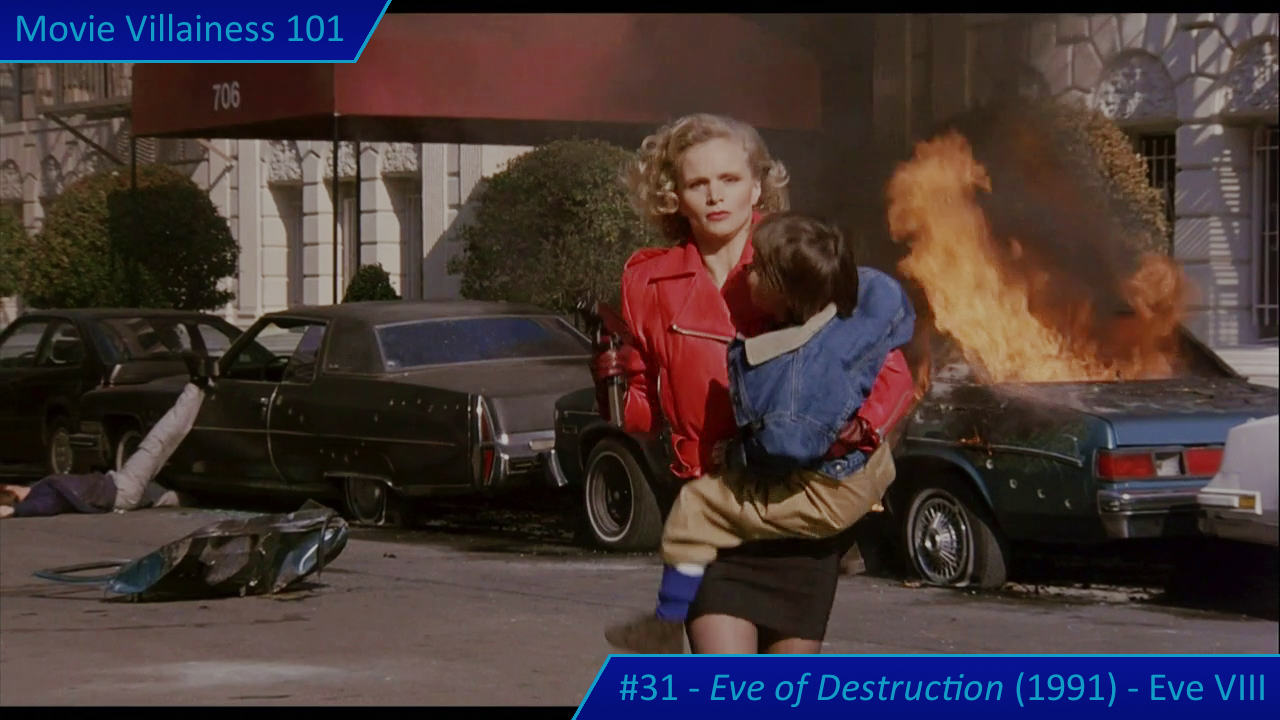
Simmons predicts Eve will travel to New York to visit her son, who’s staying with her ex-husband. While the guess is accurate, covert surveillance by government agents doesn’t prevent Eve from reaching her target. Simmons warns a surprised ex that the “woman” he’s with is an android, but it’s too late. Jim waits in the apartment building lobby, weapon at the ready, but Eve uses the elevator distraction / takes the stairs trick. This android sure is a quick learner.
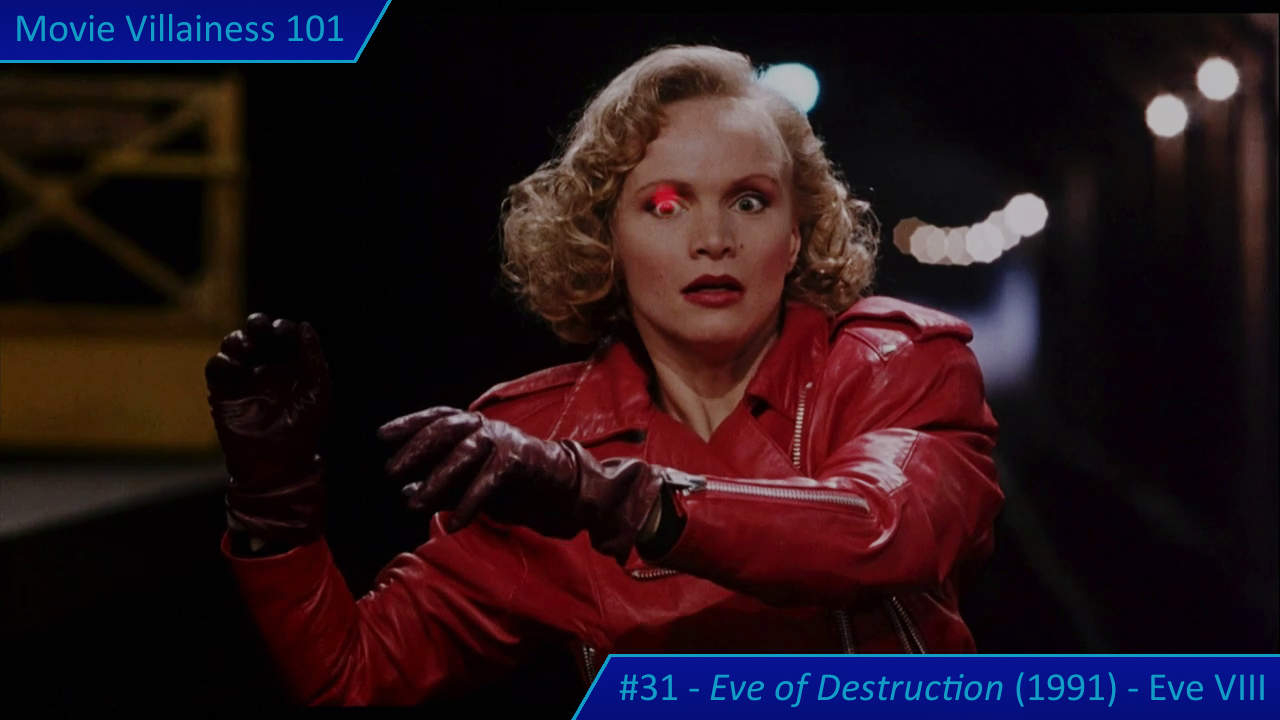
Eve’s path of destruction moves to the streets, with the leather-clad walking time bomb gunning down agents and narrowly missing Jim, and then to a subway station. If you’re in this movie, you’re potential cannon fodder, and Eve murders a bystander who makes the mistake of calling her a bitch. Everyone else wisely flees, and it’s Jim against Eve in a darkened tunnel. He’s wounded by gunfire after he breaks his own rule and loses concentration. Simmons convinces Eve to toss her the child by triggering a memory, and Jim puts a bullet through the android’s eye.
Anyone familiar with killer robot films won’t be surprised that Eve is still functional. She attacks Simmons and Jim – without a clean shot – slides his weapon to the cornered doctor. Bullets don’t stop Eve, but a name-calling bluff from Jim distracts her. Simmons rams the pistol into her empty eye socket, and that kill shot is an effective “off switch”.
Honourable Mention: Synthetic Women
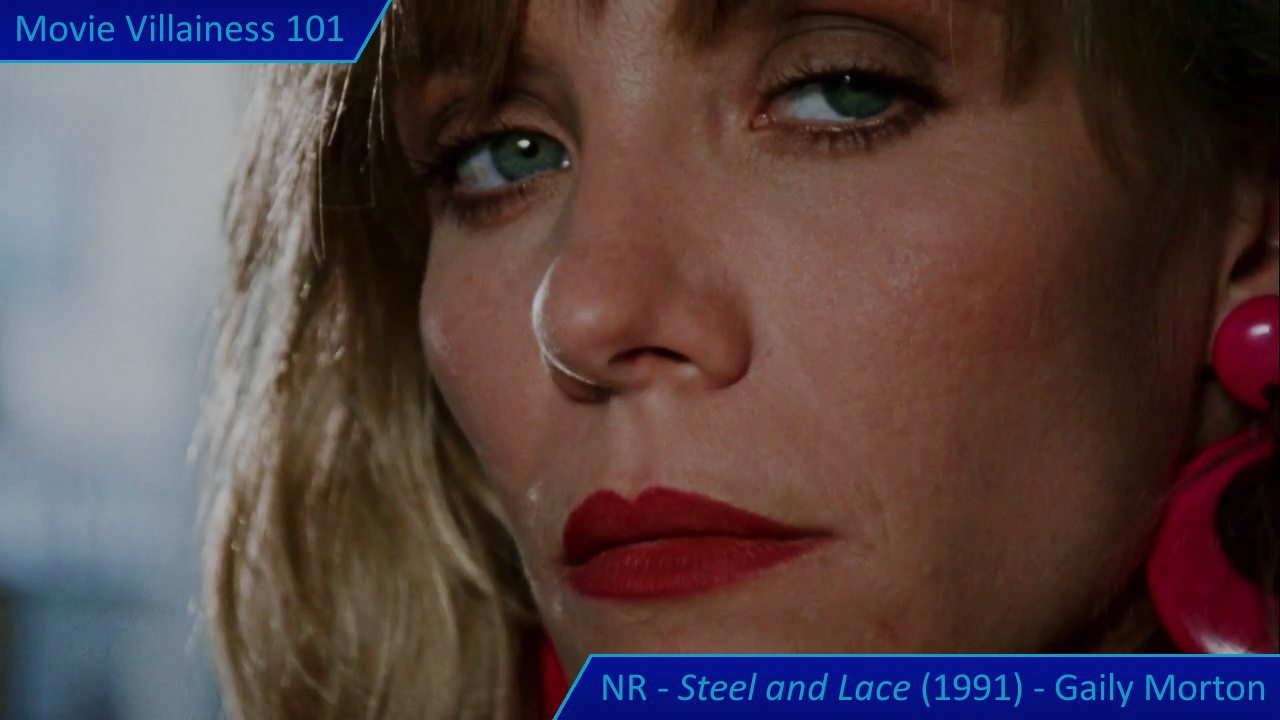
Steel and Lace (1990) – Gaily Morton (Clare Wren)
A year earlier, we had another B-movie sci-fi thriller with the same concept. Gaily Morton commits suicide after a powerful businessman is acquitted in a rape trial, thanks to false alibis from his four male accomplices. The men escape justice for many years, but the victim’s brother, Albert (Bruce Davison) is an expert in artificial intelligence. Time to send his creation – a robotic replica of Gaily – to exact revenge.
The targets – particularly the rapist Daniel Emerson (Michael Cerveris) – are unrepentant scum, and Albert’s desire for vengeance leads to innocent victims too. Being a machine, Gaily is arguably not a true villainess, but stylish kills gain her an honourable mention. Albert satisfies his bloodlust by watching recordings of the murders, which are graphic thanks to the android’s weapons. She has a talent for blending in and uses latex masks to pose as other women. Her best moment, though, is impersonating a man by holographic technology (an unexpected narrative feint).
A former court artist named Alison (Stacy Haiduk) assists the police investigation, though Daniel is the prime suspect until they realise what’s going on. The movie ends with Albert and his creation jumping off a tall building. By then, all five targets are dead, and the android says, “Pretty. Very Pretty,” to reference the rape.
Fans of gory deaths will be satisfied with the killing methods. These include drilling a hole through a man’s chest, decapitation with her bare hands, and draining blood. The later murders – chopping her target’s head in two with a helicopter blade and incineration by lightning bolt (a rather cheap effect) – are almost a letdown.
It had to happen eventually. Ever since Die Hard in 1988, the formula of a lone hero against armed villains has been used in every conceivable scenario. Now the action has come to a football stadium. Americans might call it a soccer stadium, but doing that in East London is likely to get you a punch in the face (as Agent Cho learns the hard way).
Michael Knox (Dave Bautista) is a former soldier whose brother died following a questionable order. Now Mike wants to make amends with his niece Danii (Lara Peake). What better way to do that than to take her to a football match? Especially when that game is a high-profile European semi-final and West Ham United’s last match at the Boleyn Ground (or Upton Park). The team has now moved to London’s former Olympic Stadium, so producers could set off an explosion and do serious damage in the dramatic climax.
The villains are mercenaries led by Arkady (Ray Stevenson), a ruthless general who wants to find his supposedly dead brother, Dimitri (Pierce Brosnan). So badly he’s prepared to threaten the lives of thirty thousand people. The siblings were once leaders of a revolution in Sakovia (a fictional Soviet bloc country) and now Arkady wants to lead a second revolt. For once, the motive isn’t nuclear weapons or money. Everything else is formulaic, including the villains planting C4 explosives to mask their escape and Knox throwing a dead guy off the stadium roof to convince authorities the threat is real.
West Ham fans are so shocked at reaching a European semi-final they don’t notice the chaotic events happening around them. Gun-wielding baddies swarm the concourse, mobile phones go dead, the stadium is locked down. Even a bike chase and crazy stunt jump go ignored. To keep the crowd occupied, West Ham score two goals at convenient times.
It’s only when the hero runs onto the pitch to avert a disaster that anyone pays attention. Knox’s only allies are Steed, a police commander on the outside (competent for a change) and Faisal Kahn, a timid steward who provides comic relief. There’s some dark humour as Faisal acts the Middle Eastern terrorist to clear out hostile spectators.
Don’t think too hard unless you want the plot holes to cause a headache. Predictable, but that’s not necessarily a bad thing, as the movie delivers what action genre fans expect from a Die Hard clone. A gung-ho hero, nasty villains, fights in claustrophobic locations, and an unexpectedly great bad girl who leaves a lasting impression.
Villainess
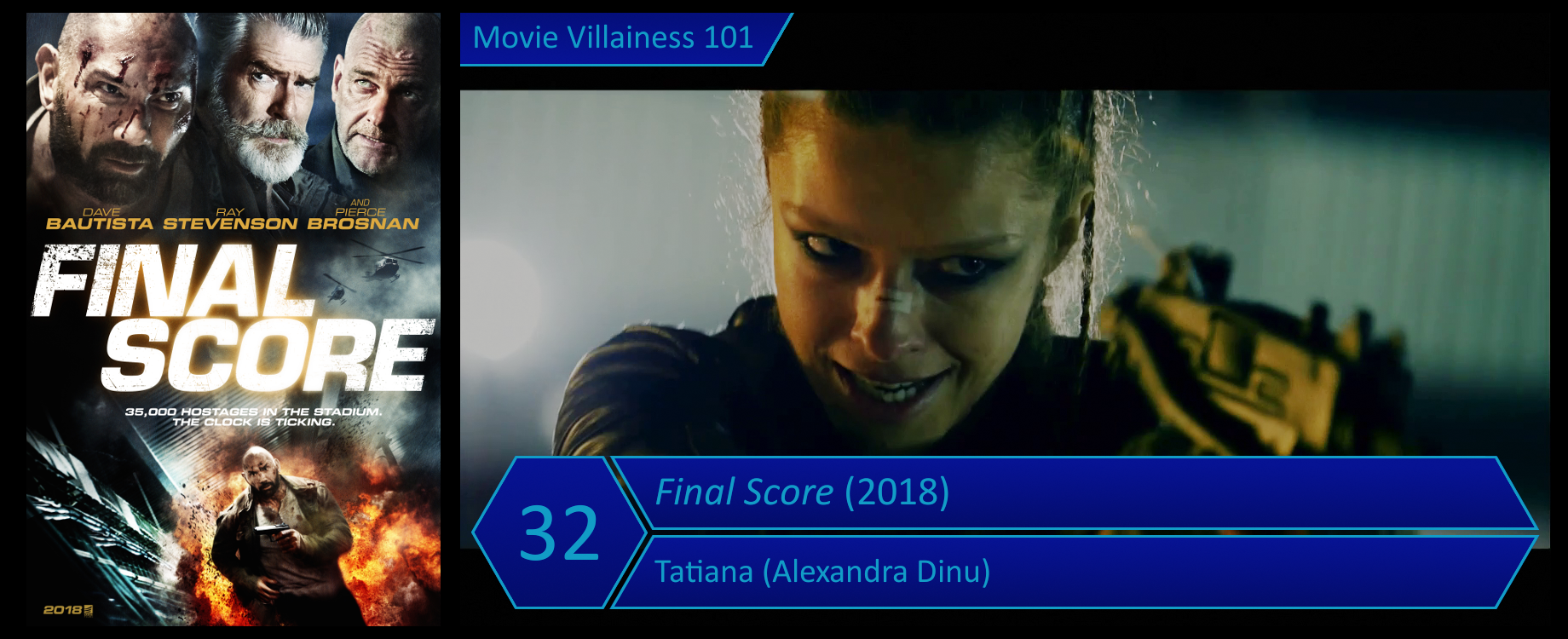
Tatiana (Alexandra Dinu)
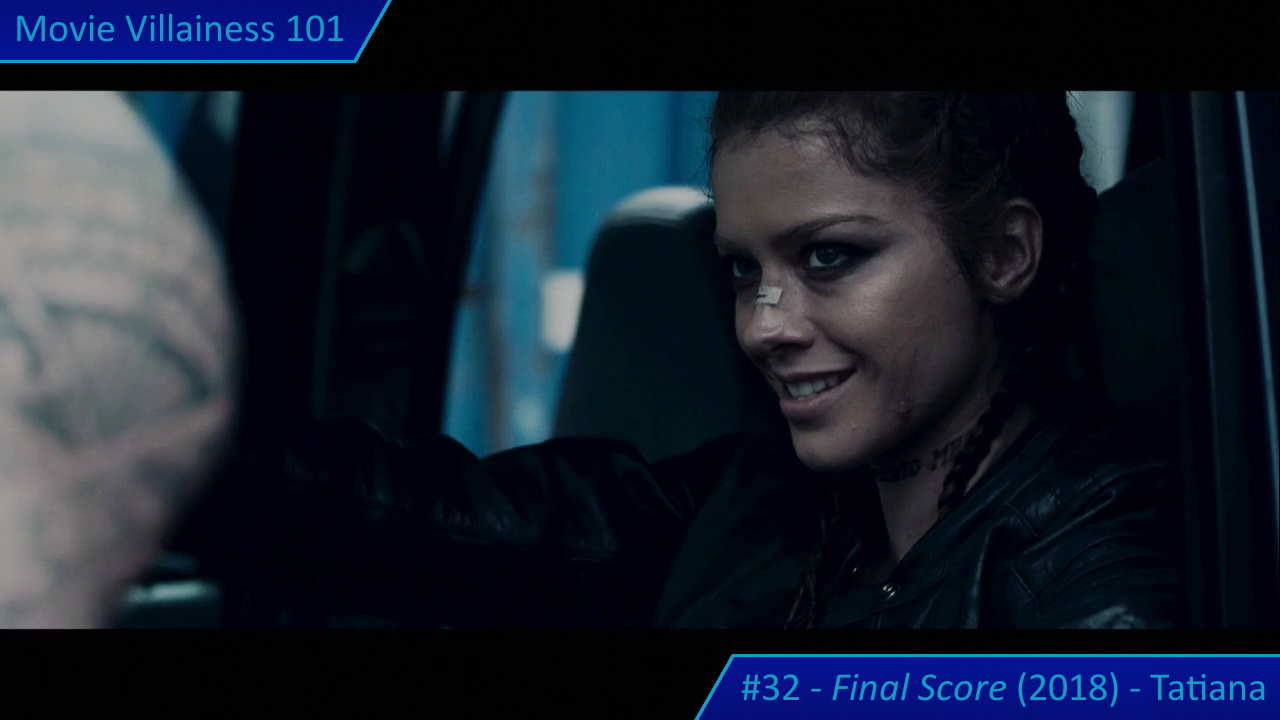
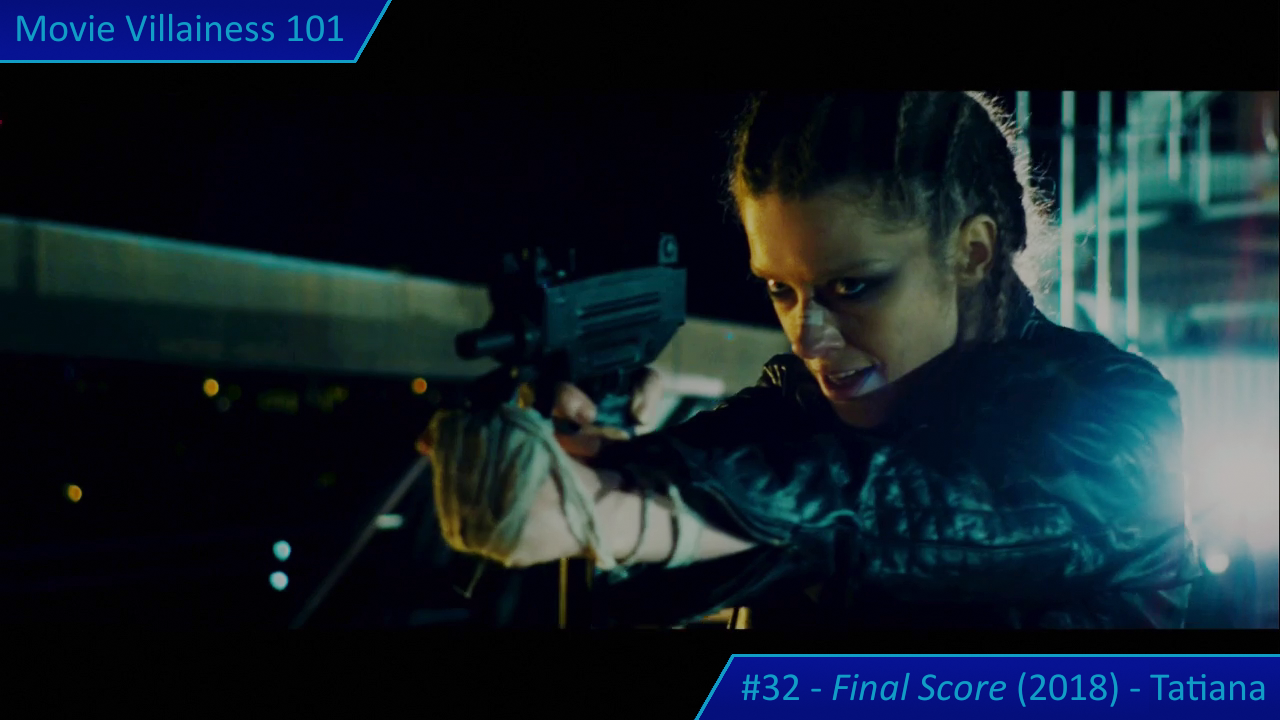
After a long series of disappointing henchwomen, it’s high time we had a female version of Karl from Die Hard, and that essentially sums up Tatiana. Arkady’s lieutenant doesn’t care about being attractive – this is a tattooed warrior with a cornrow haircut and acts every bit as mean as she looks. All that’s missing is a last woman standing scene, since Tatiana dies before the grand finale. At least she goes down fighting and has several run-ins with the hero and his niece. That’s enough to earn Tatiana legendary status.
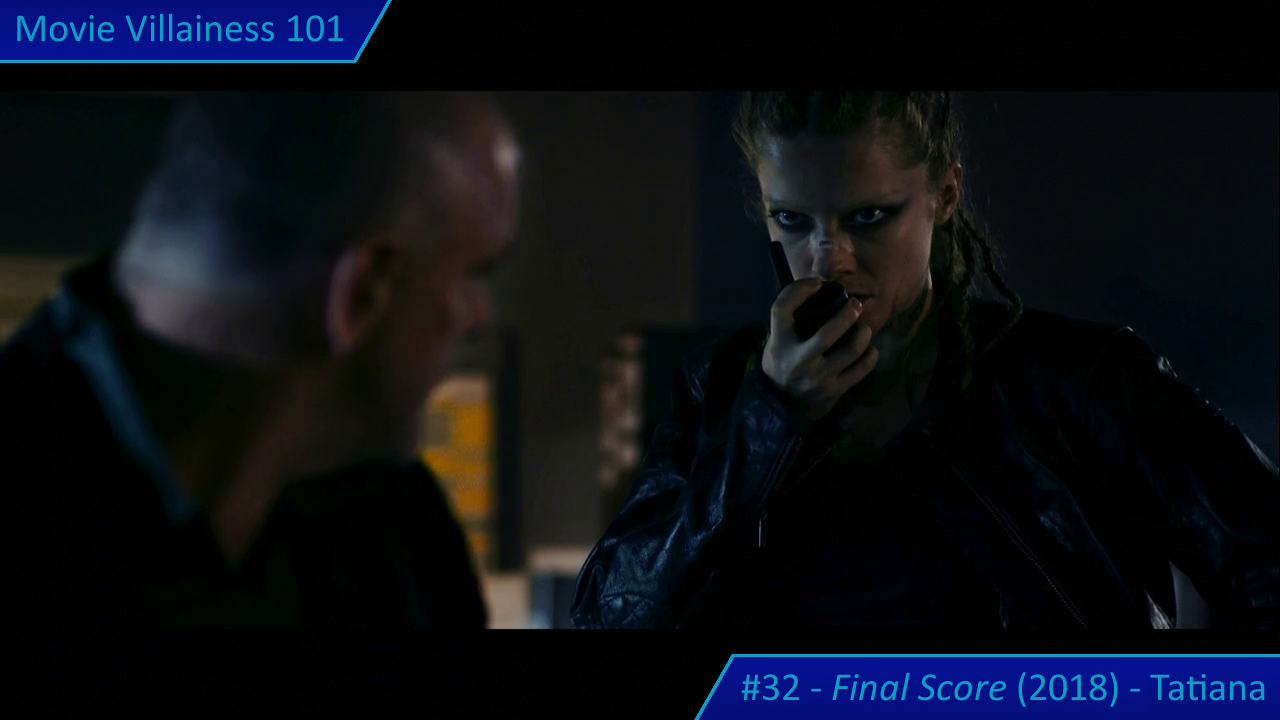
This movie is the UK’s answer to Sudden Death (1995), with a lot of similar themes. Tatiana takes a leading role in the stadium takeover, infiltrating the ground as a paramedic (like in the Van Damme film, the terrorists disguise themselves as employees). Upon arrival, she guns down a security guard and innocent civilians in the police control room to quash any notion of resistance.
After Knox takes out a terrorist in an elevator (or should that be lift?), he gets a big fight in the kitchen. No killer penguin (she featured at #92), but the brute Vlad proves tough to take down. Eventually, Knox finishes the big guy off by dunking his head in boiling fat. This really ticks off Tatiana, since she and Vlad were lovers. In an explosion of rage, she smashes random items and demands to be the one who kills Knox. Getting Karl vibes yet?
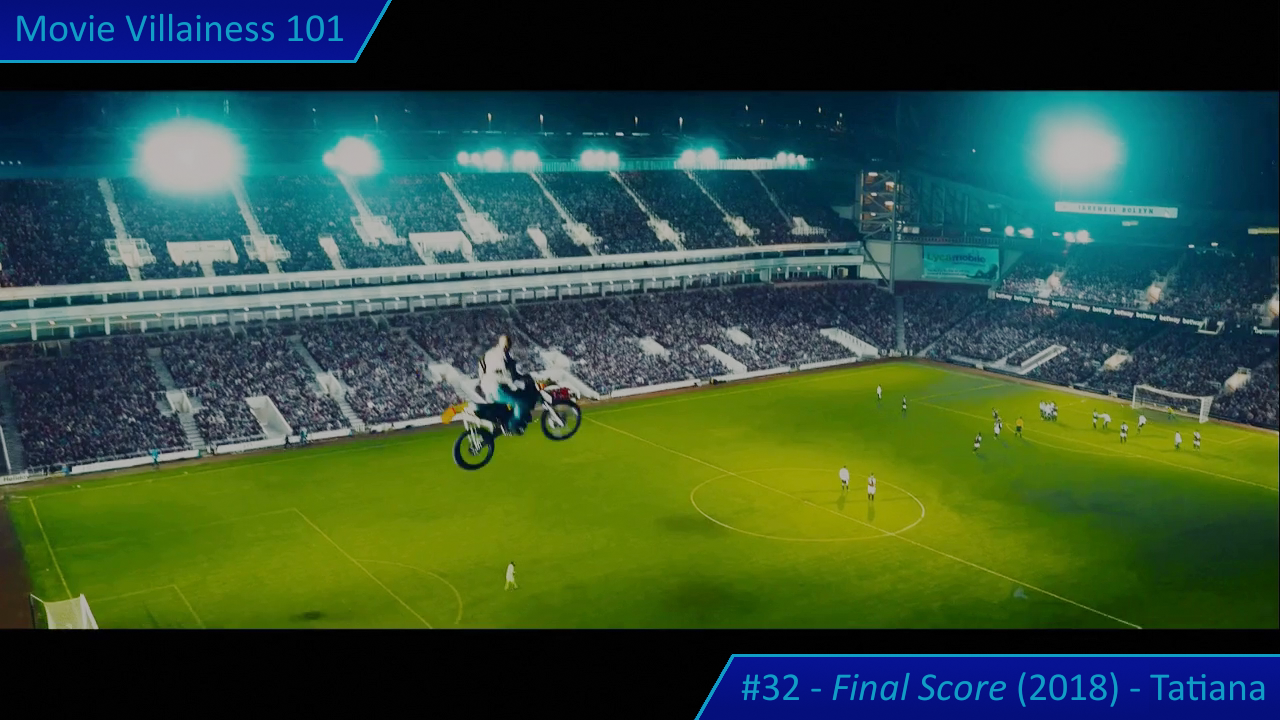
By now, Knox has tipped off the police and offers to rescue Dimitri before the villains find him. Time is of the essence since the stadium is rigged to explode when the match ends, so Knox grabs a motorcycle to speed things up. There are plenty of other bikes (indoors!), which is an excuse to have an action scene. Tatiana and her goons pursue Knox while stunned spectators wonder what’s going on. When her handgun proves ineffective, Tatiana swaps it for a submachine gun. Knox reaches the roof with her not far behind, though her aiming is predictably terrible. Much too early to have the crowd flee in panic, so how about a goal so people don’t notice the motorcycle jump overhead?
After Knox makes it to Dimitri, the villains up the ante by kidnapping Danii to use as a bargaining chip. Tatiana takes great pleasure in knocking out Faisal and torturing the hostage girl. Things are personal as far as she’s concerned. Knox agrees to trade Dimitri for Danii, leading to a prisoner exchange scene on the stadium roof. The villains plan to double-cross the heroes and detonate the explosives anyway (did you expect anything else?). But Knox chose the location wisely, as blinding floodlights hide his own deception: to take Dimitri’s place.
Knox takes down several mooks with the help of special forces. Then it’s the hero against Arkady, with Knox attempting to retrieve the “kill switch” to deactivate the bombs. This is when Tatiana joins the fight and gives him a good beating. He holds the villainess off, but the kill switch rolls off the roof. That’s a convenient time for Knox to grab a banner and do a swinging stunt. He reaches the device, but the henchwoman isn’t finished yet.
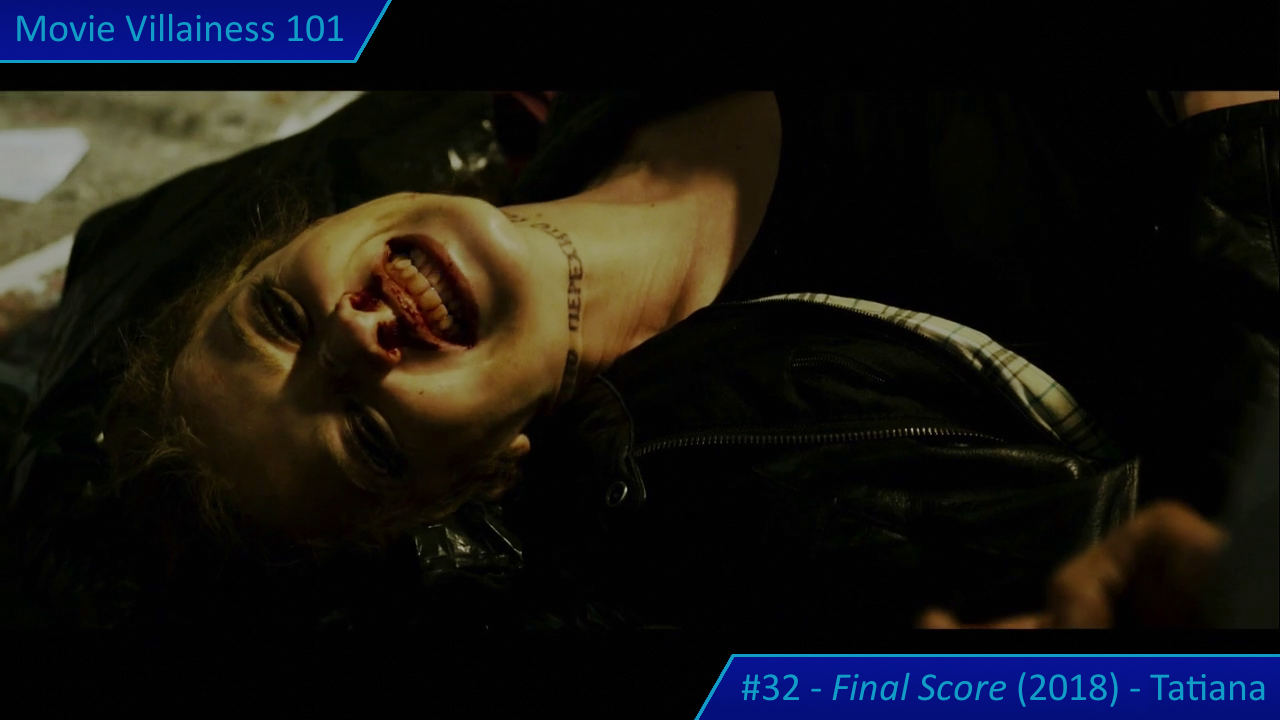
Tatiana’s final fight is rather brief (and somewhat disappointing), but still delivers excitement while it lasts. The knife-wielding villainess attacks Knox, but the hero gets the better of her, and they fall over the roof edge. The villainess is impaled on a metal bar, but gloats that the kill switch is fake before she dies. Of course, the hero saves the day, but Tatiana went out believing she’d won.
Honourable Mentions: Die Hard Scenario
Velocity Trap (1999) – Pallas (Jorja Fox)
Yes, they’ve done Die Hard in space, too. One of the better futuristic variants, with Olivier Gruner as Stokes, a security officer framed by corrupt colleagues after an assassination. A female killer is involved in that plot, but after she detonates an explosive, we never see her again.
The first half of the film is mostly a stretched-out setup. Stokes is too honest to be bought off, and killing him would attract too much attention, so the conspirators assign their patsy to guard duty on a transport ship carrying 40 billion US dollars. That’s the intergalactic currency, and paper money is still apparently in use in the space age.
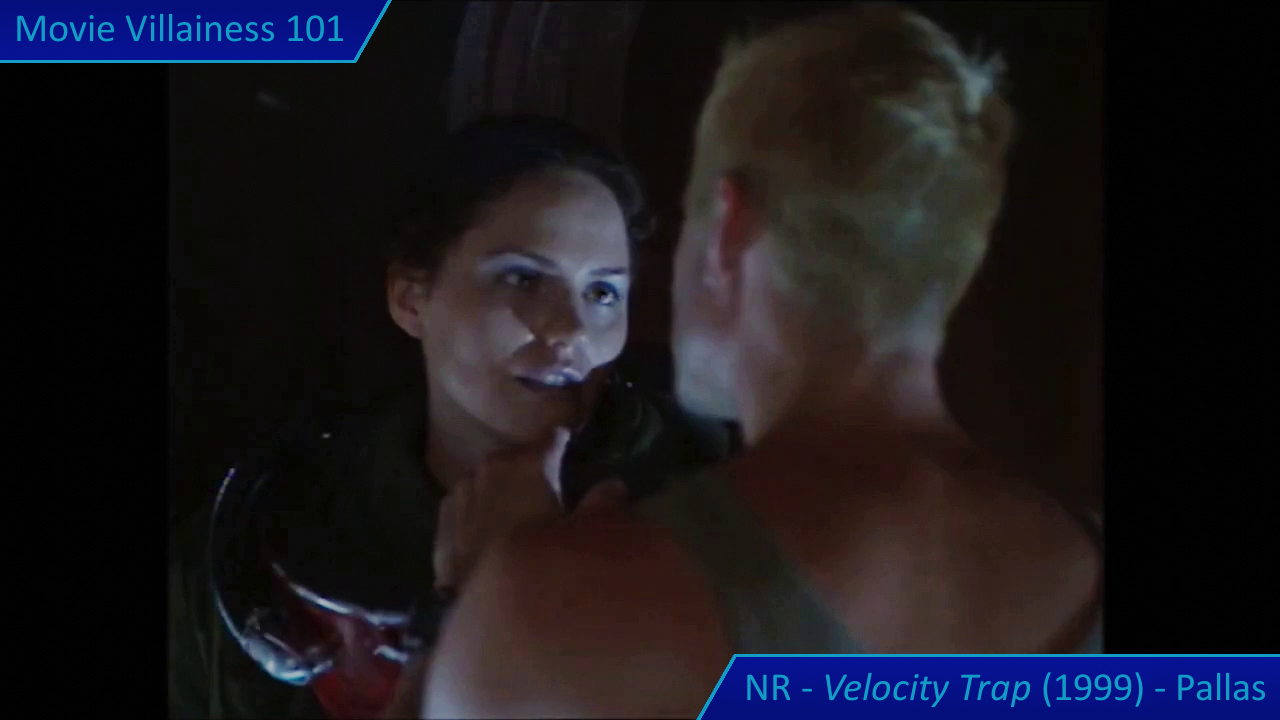
Before this subplot, we’re introduced to the main villains: Simmons (Ken Olandt) and his thrill-seeking wife, Pallas. Before she played Sara Sidle on CSI, Fox was a crazy henchwoman in this B-movie. Pallas likes to live dangerously, leaving it to the last second to escape an asteroid explosion. The purpose of the sabotage becomes clear later, when the transporter drops out of light speed. The “accident” is part of a plan to heist the money and destroy the evidence. Stokes – with the help of navigator Beth Sheffield (Alicia Coppola) – is the proverbial “fly in the ointment.”
The hijackers are light on manpower, probably because they expected no resistance. Besides the psycho husband/wife team, there’s a tough guy named Fallout, a tech whiz who gets no action, and a treacherous engineer who disabled the sentry guns. Fallout gets the honour of a major fight with Stokes before he’s incinerated by Sheffield. All the villains wear stylish body armour, and Pallas sports a feminine version that makes her “assets” stand out.
After a few onboard encounters, the heroes must take a shuttle ride in space. Pallas – really annoyed by now – comes after them in her own fighter craft. There’s an above-average chase with Pallas proving a worthy opponent. It’s disappointingly a vehicle confrontation, but the villainess evades the sentry guns (no small feat) and damages the heroes’ ship. Then she loses control and crashes into a support strut, which also takes out the engineer. A decent demise, better than the anticlimax that follows.
Lethal Tender (1996) – Sparky (Karyn Dwyer)
Die Hard in a water treatment plant, with Jeff Fahey as macho cop David Chase. Villains led by Montesi (Kim Coates) follow the standard playbook, taking hostages as a distraction while they steal bearer bonds. A scenario copied wholesale from the 1988 classic, but the above-average casting offsets the dull location.
Gary Busey is Turner – the same charismatic, dangerous bad guy he always plays. He double-crosses everyone and kills more criminals than the good guys. For added effect, Turner provides an unreliable narrator opening voice-over. Melissa (Carrie-Anne Moss from The Matrix series) is the love interest, but don’t expect a Trinity-level badass. She gets some action, but her role is mostly to provide technical information and get rescued by David.
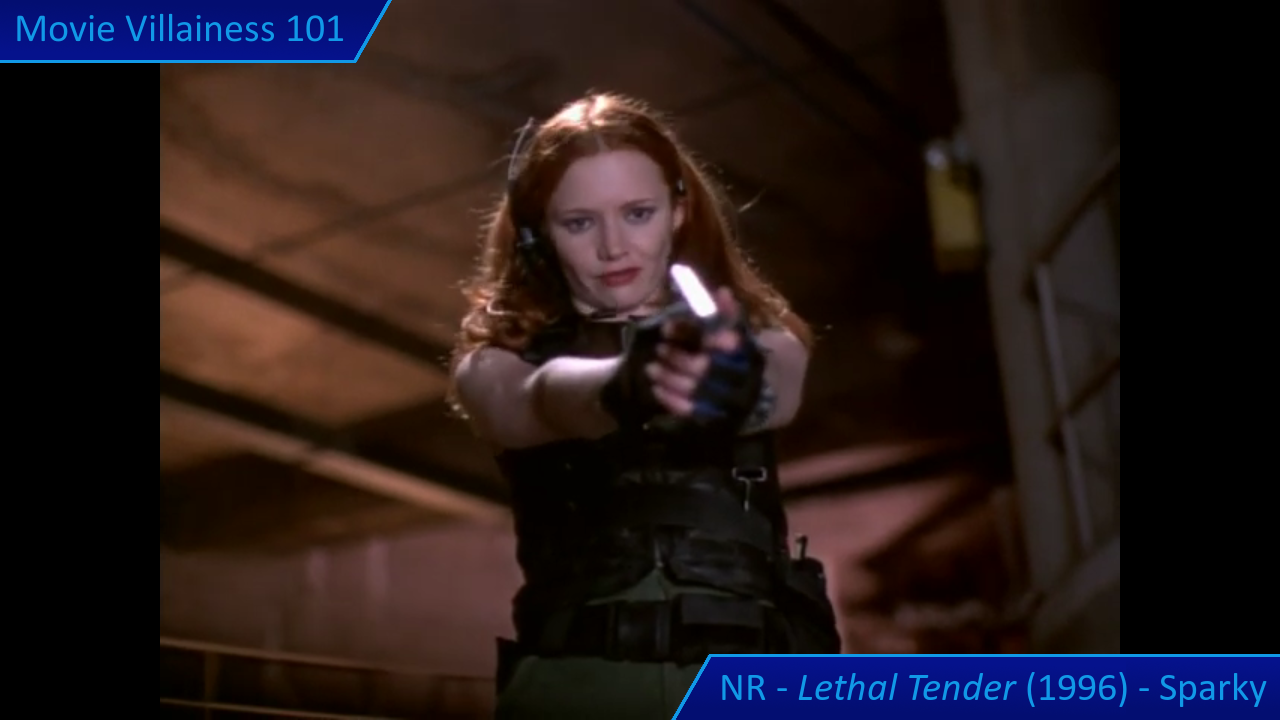
The one female villain limit applies, but Sparky is a fiery redhead in a sleeveless leather jacket who doesn’t mind getting physical. The demolition specialist objects when Turner kills two unarmed civilians, but has no qualms slaughtering a special forces team with an assault rifle. When David is injured, Melissa fights Sparky and lands a few punches. Then the enraged villainess pulls a knife, and the hero shoots her in the back.
No Contest II (1996) (aka Face the Evil) – Lisette (Fiona Highet)
Shannon Tweed returns as martial arts actress Sharon Bell for this sequel that replaces a beauty contest with a museum for the Die Hard scenario. Criminals want a deadly Nazi nerve toxin hidden in a statue, and while Lance Henriksen does an innocent bystander act, it’s so obvious he’s the main villain that the reveal comes within the opening thirty minutes.
Production values are above average, and the 5’10’’ Tweed is convincing as an action heroine. This time, she has support from her sister, Bobbi (Jayne Heitmeyer). Everyone else is expendable, starting with the least important / likeable characters.
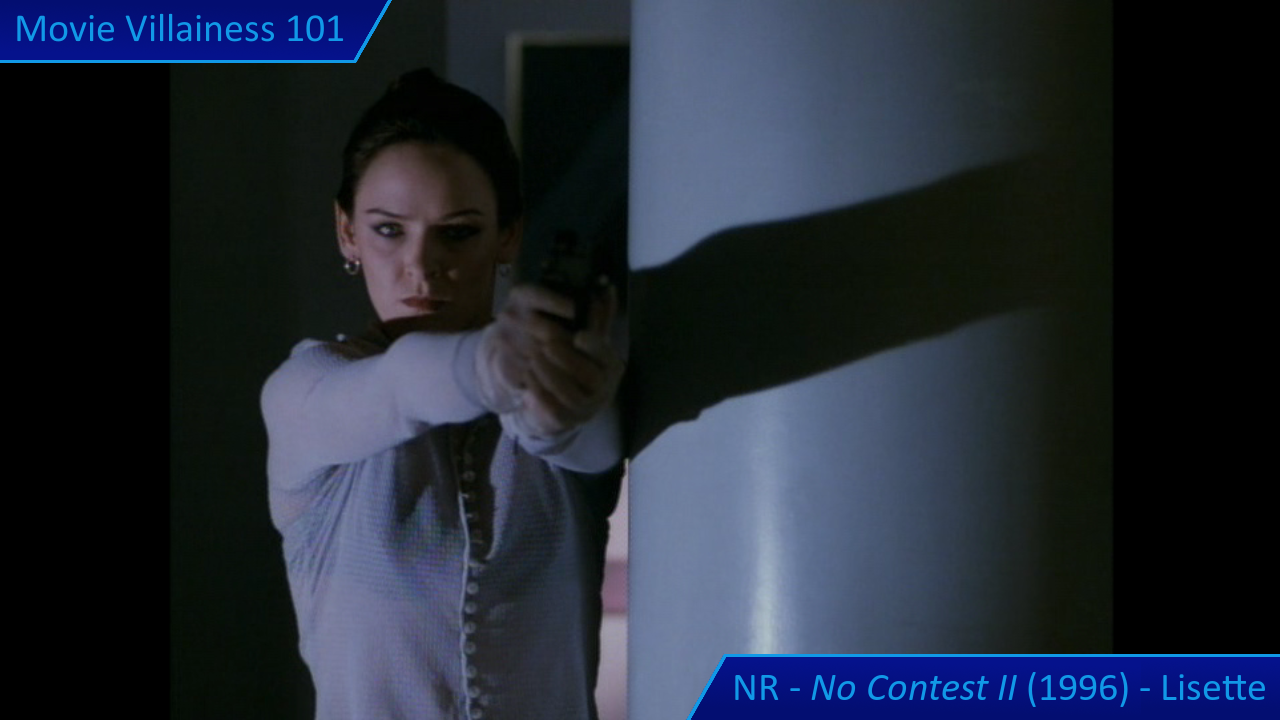
Lisette is the sole female baddie who dons surgical gloves to prepare the chemicals. Once Sharon becomes a threat, there’s a decent chase through the war-themed exhibit halls. Inventive props – barbed wire fences and hanging bamboo – provide background flavour to the gun-fu and kickboxing. Lisette is skilled enough to fight back and twirl a snapped-off wooden pole, but Sharon kicks her off-balance opponent onto the sharp object.
Another early exit (Lisette dies halfway through), but an honourable mention for a decent encounter with a semi-competent foe.
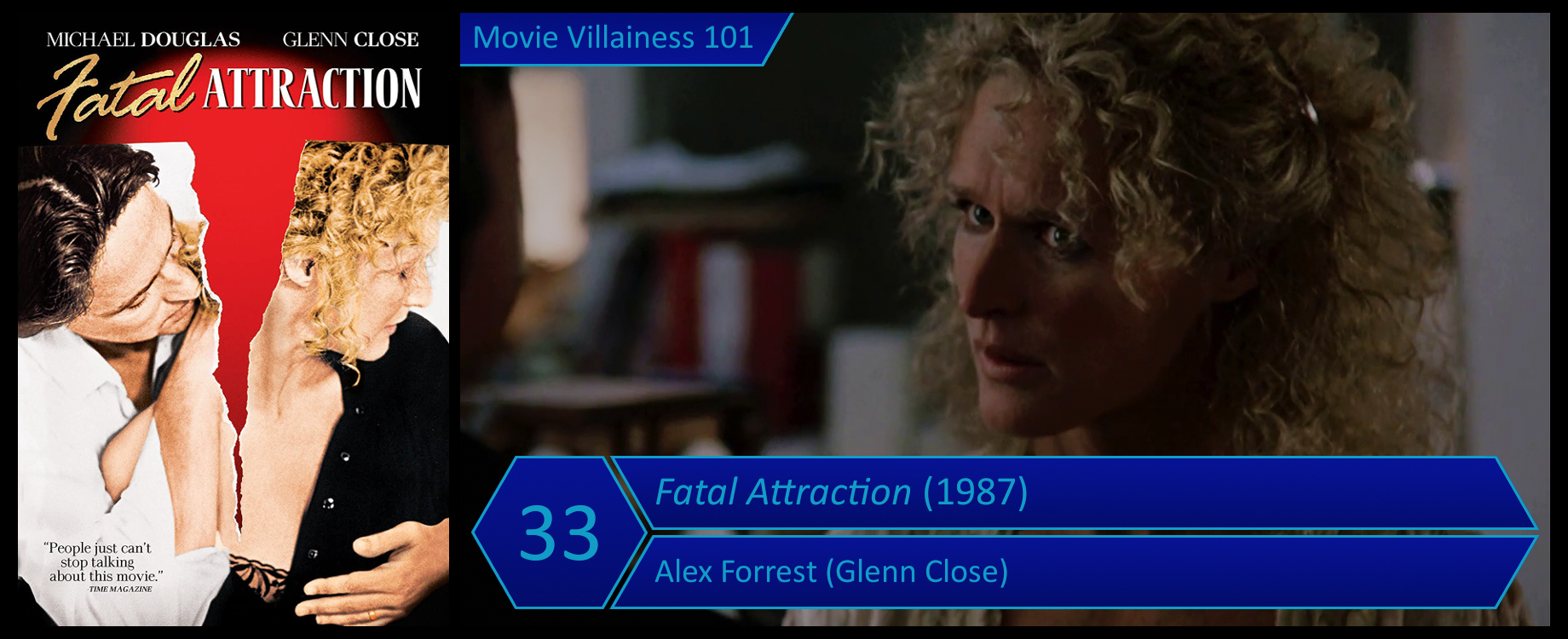
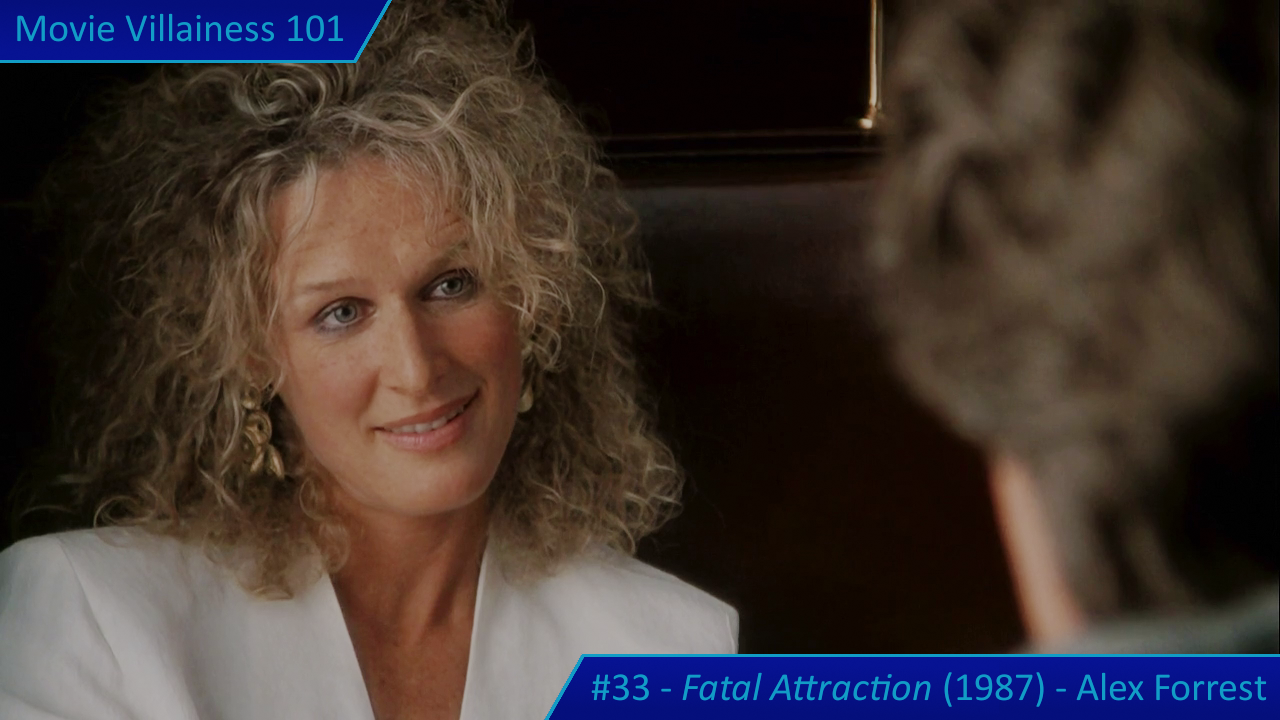
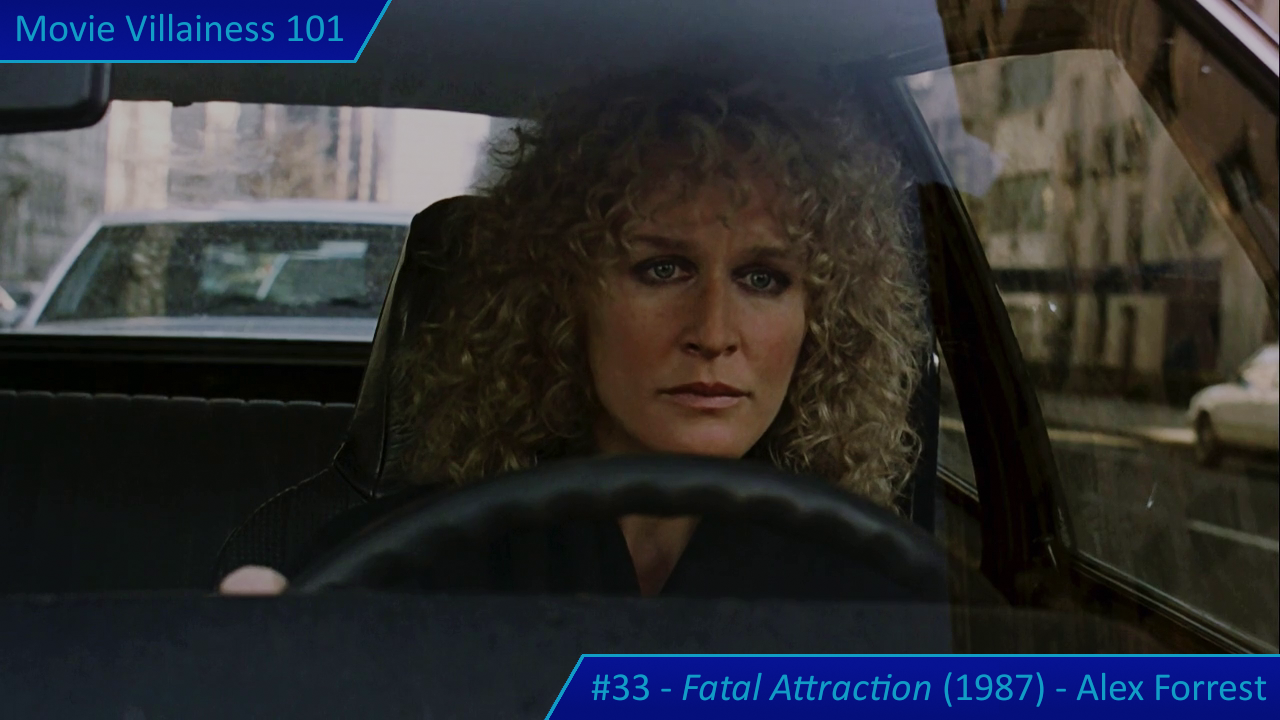
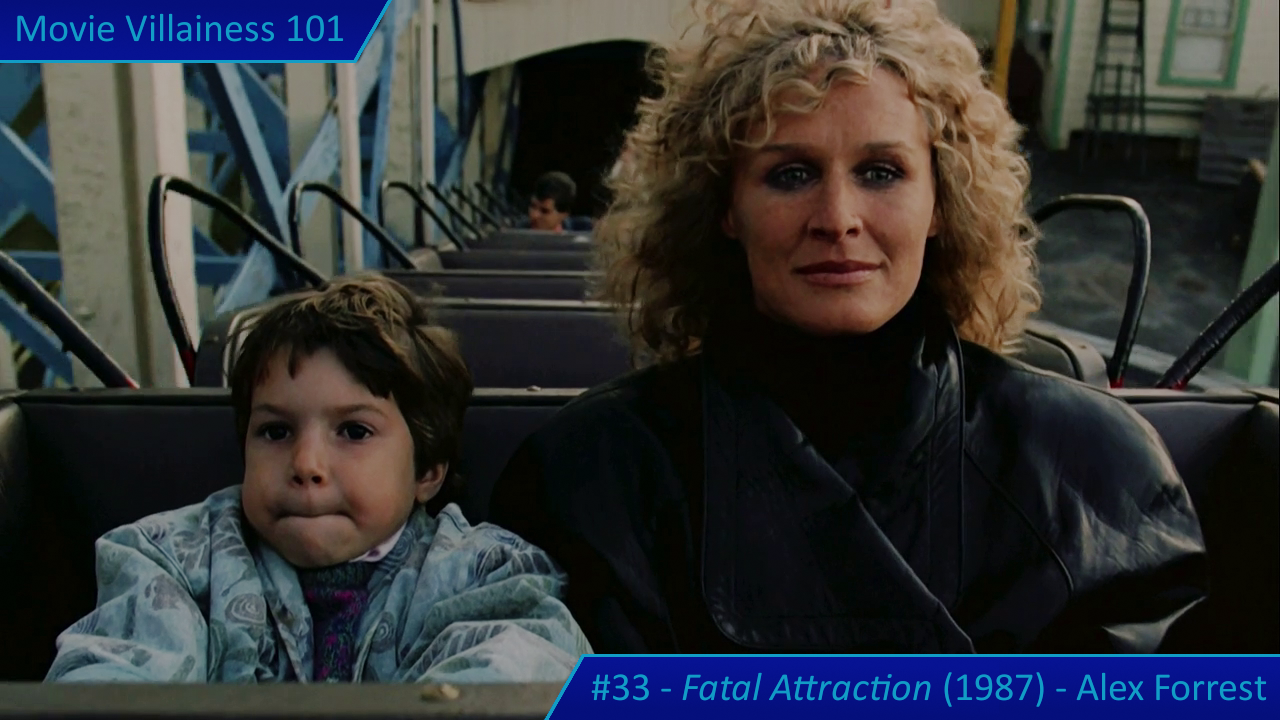
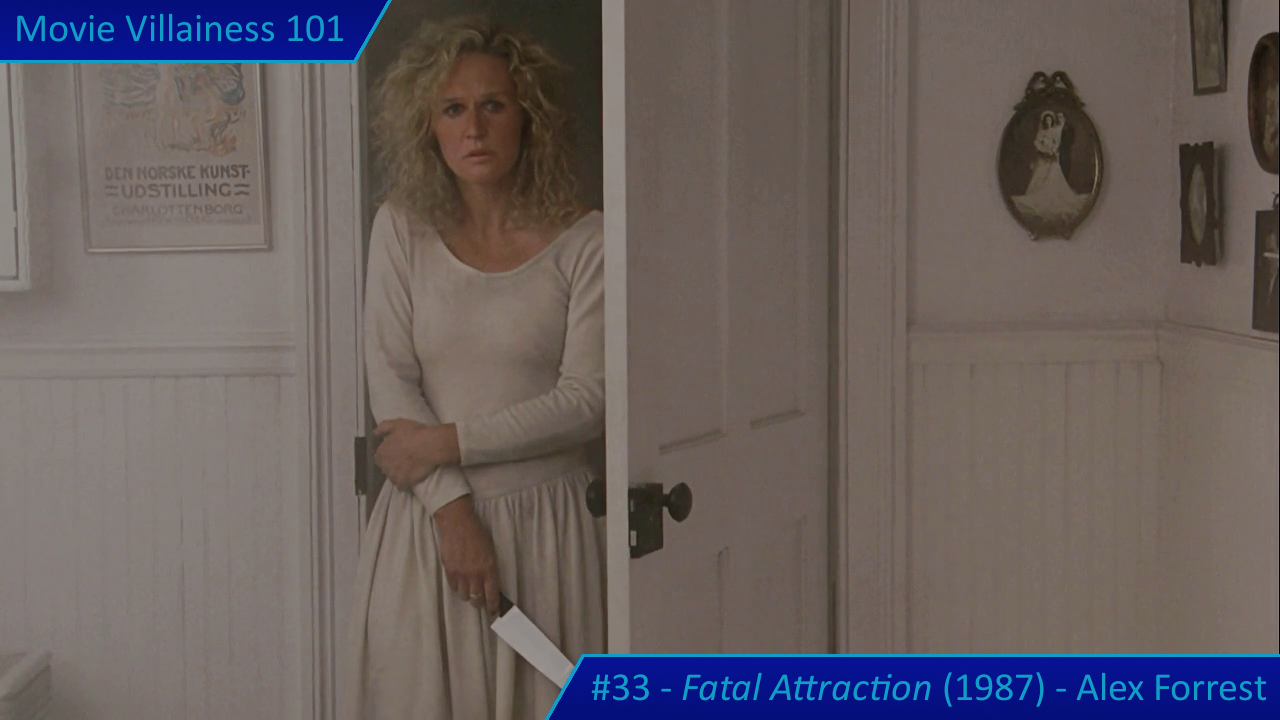
A must-include on any movie villainess list to be taken seriously, Alex is the ultimate deterrent against infidelity. The movie has a straightforward plot and would be nothing special but for Glenn Close’s performance. Don’t expect a murder spree. This is a psychological thriller, with no human fatalities until the frantic climax.
Dan Gallagher (Michael Douglas) appears to be happily married to Beth (Anne Archer) and has a young daughter named Ellen (Ellen Hamilton Latzen). So Dan’s motive for having an affair with Alex is a mystery. The protagonist is unlikeable, but Alex’s increasingly dangerous responses to his rejection gain him sympathy. Signs of obsession are already there when Dan meets Alex at a work social and later in the office. It’s clear she’s interested in sex, and that’s where the relationship goes, and they even make out in a seedy apartment elevator.
Over time, it becomes clear Alex is unstable. She’s not thrilled when Dan feigns a heart attack, as it brings up a childhood memory of her father’s death. When Dan doesn’t return his girlfriend’s affection and regards their fling as a one-off, she tries to commit suicide. Dan cares for Alex, but turns down an offer to go out with her a second time. The repentant protagonist has fun with his family and friends while the psycho woman sits alone in the dark. This is clearly not over yet.
As Dan tries to forget what happened, Alex won’t let him, constantly calling him at the office and at home. Perhaps this man should have been more faithful to his wife and child, and the rest of the movie is about him trying to resolve the mess he’s partly responsible for.
Villainess
Alex Forrest (Glenn Close)
If telephone calls in the night weren’t enough, Dan really panics when Alex insists on a meeting and tells him she’s pregnant. Viewers will think she’s lying, though it’s confirmed as the truth after Dan discovers medical test kits in her apartment. Alex wants the baby, regardless of whether her ex-lover agrees. In desperation, Dan asks his best friend for legal advice, and the tactful reply could be summarised as “You’re screwed.”
After Alex shows up at Dan’s apartment pretending to be an interested buyer, he finally snaps and goes over to her place. That’s when Close delivers her famous line of dialogue: “I’m not going to be ignored, Dan!” (as if she needed to tell us that). The best part of the movie has Alex in full stalker mode. She wrecks Dan’s vehicle by tampering with the radiator, then tails him to his new home in upstate New York. To keep him occupied en route, Alex leaves him an audio cassette (remember those?), full of pre-recorded ramblings about their relationship.
Dan goes to the local police and explains the situation, though he claims the victim is a client and not himself. This gets him nowhere, and Alex watches the house dressed in black, angry that Dan wants to be with Beth and not her. When Dan purchases a rabbit for his daughter, it’s clear that will be significant as it’s continually mentioned / shown. This leads to the well-known bunny-boiling scene where Alex leaves a nasty surprise for Beth in the kitchen.
Dan, realising just how crazy Alex is, tells his wife everything. They’re hardly on happy terms from that point, and he spends time away from the house. After Alex abducts Ellen and takes her to the funfair – and the panicked Beth has a road accident – the Gallaghers reconcile. Dan goes to Alex’s apartment and attacks her, but realises what he’s doing and breaks off. She responds by lunging at him with a kitchen knife, and he narrowly avoids injury. With the movie in slasher mode, Dan tells the police the full truth, and they bring Alex in for questioning.
Obviously, Dan doesn’t watch horror films, as takes him time locking the house doors. Alex breaks in and attacks Beth while Dan is brewing up. After he hears the commotion, Dan rushes to the rescue. This time he shows no restraint and drowns Alex in the bathtub. Like any respectable slasher villainess, Alex comes back for a final scare, but it’s only a brief one since Beth – much more savvy – is ready with a revolver.
Honourable Mentions: Obsessed Women
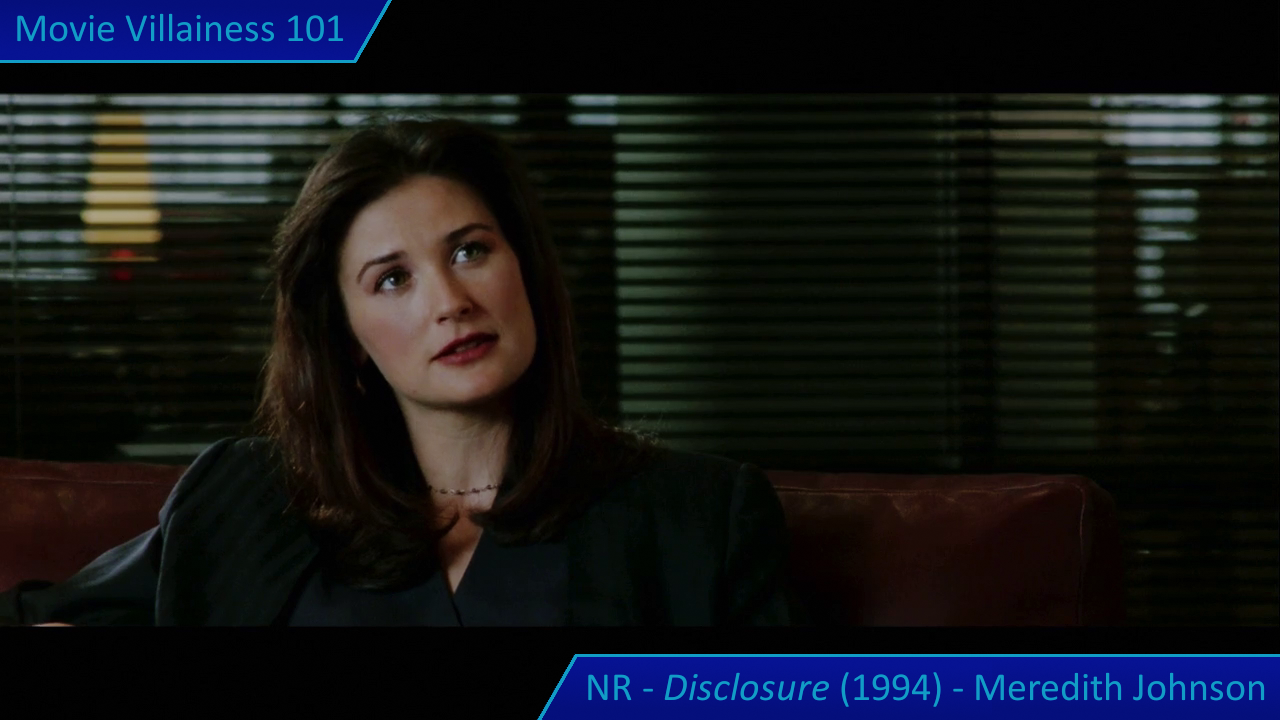
Disclosure (1994) – Meredith Johnson (Demi Moore)
Michael Douglas gets into another ill-advised relationship, though in fairness it’s non-consensual with the female guilty of sexual harassment. This scenario being harder to prove is a central theme of the movie. The setting is a tech company, and Meredith is a new vice president who uses her attractiveness as a weapon, especially against her ex-boyfriend Tom Sanders (Douglas).
Meredith is out to get Tom from the beginning, but it’s a late evening meeting where things heat up. The aggressive woman assaults and practically rapes Tom despite him rejecting her advances. Of course, nobody believes she was the offender, and Meredith threatens or bribes all the witnesses. It’s only through sheer luck – and a mis-dialled phone call – that Tom produces an audio recording to force a settlement.
The harassment case becomes a subplot, part of a conspiracy to oust Tom. Since the boss, Bob Garvin, is played by Donald Sutherland, no prizes for guessing he’s involved. Get ready for technical jargon and laughable virtual reality scenes. Tom enters a digital vault, Meredith’s avatar deletes files with a laser (!), and a mystery “friend” warns Tom by e-mail. After a few red herrings, he turns out to be a guy we’ve never seen before.
In the end, Tom gives Meredith her comeuppance by making her look foolish at a presentation. This leads to a satisfying resolution where Garvin replaces her as VP, but aside from the interesting gender reversal – which just about merits an honourable mention – there’s little to praise.
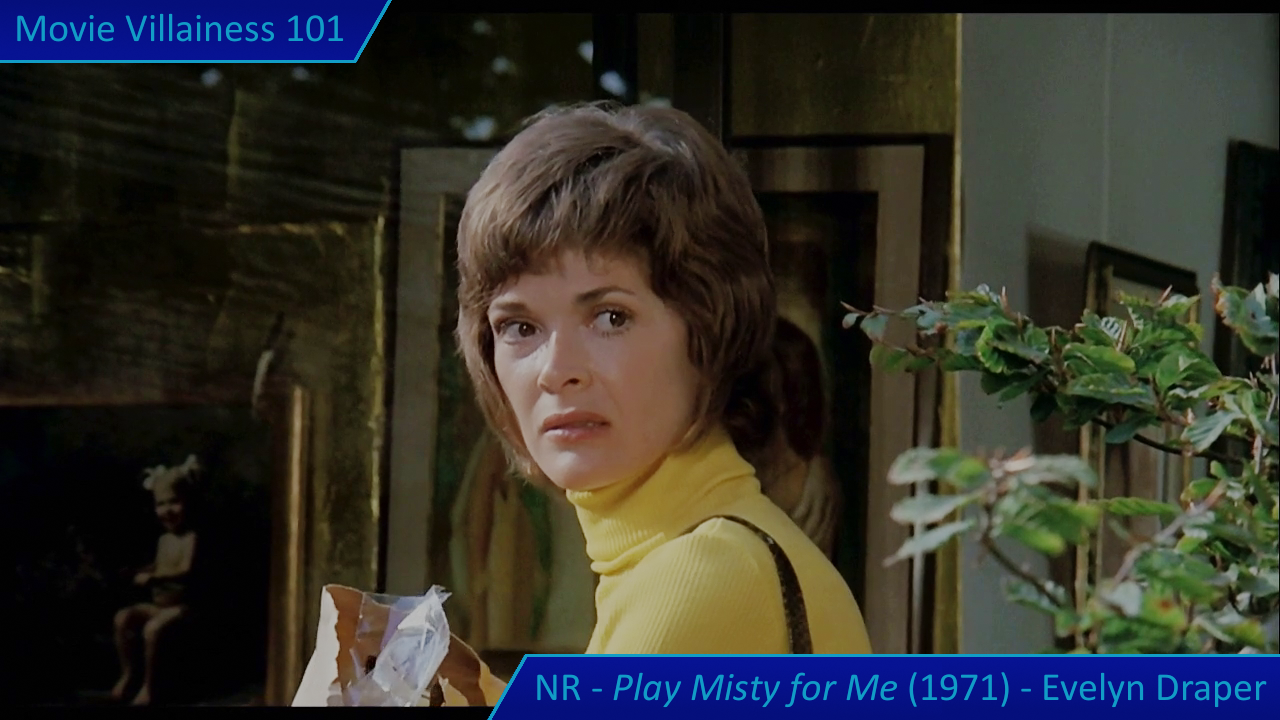
Play Misty for Me (1971) – Evelyn Draper (Jessica Walter)
Clint Eastwood plays Dave Garver, a disc jockey who becomes the target of a crazed female stalker. This film is often brought up as a precursor to Fatal Attraction, and was also Eastwood’s debut as a director. He mostly does a solid job, though there’s an overlong jazz concert scene with Evelyn out of the picture in a mental institute. A tension-free fifteen minutes is never desirable in a thriller.
The story is overly familiar today, making the plot feel basic, but psycho females were relatively fresh in 1971. There’s the usual harmless introduction where Evelyn calls Dave’s show and then meets him in a bar. Obsession surfaces as the woman ruins a business deal through her hysterics, though it’s a slow burn for the first half. Then, Evelyn attacks a cleaner, and Dave realises just how dangerous she is.
After Evelyn’s release, she targets Tobie Williams (Donna Mills), the other woman in Dave’s life. Tobie’s character was reportedly added late in the production cycle, which may explain why the romance feels underdeveloped. In the finale has Dave solves a cryptic clue from the villainess and saves Tobie. But he arrives too late to prevent Evelyn killing the (obvious victim-in-waiting) detective. Don’t fret – the hero punches the psycho woman over a balcony after a well-staged stalk and slash scene in the dark.
For the second time in the franchise, Jean Grey goes over to the dark side
Movie
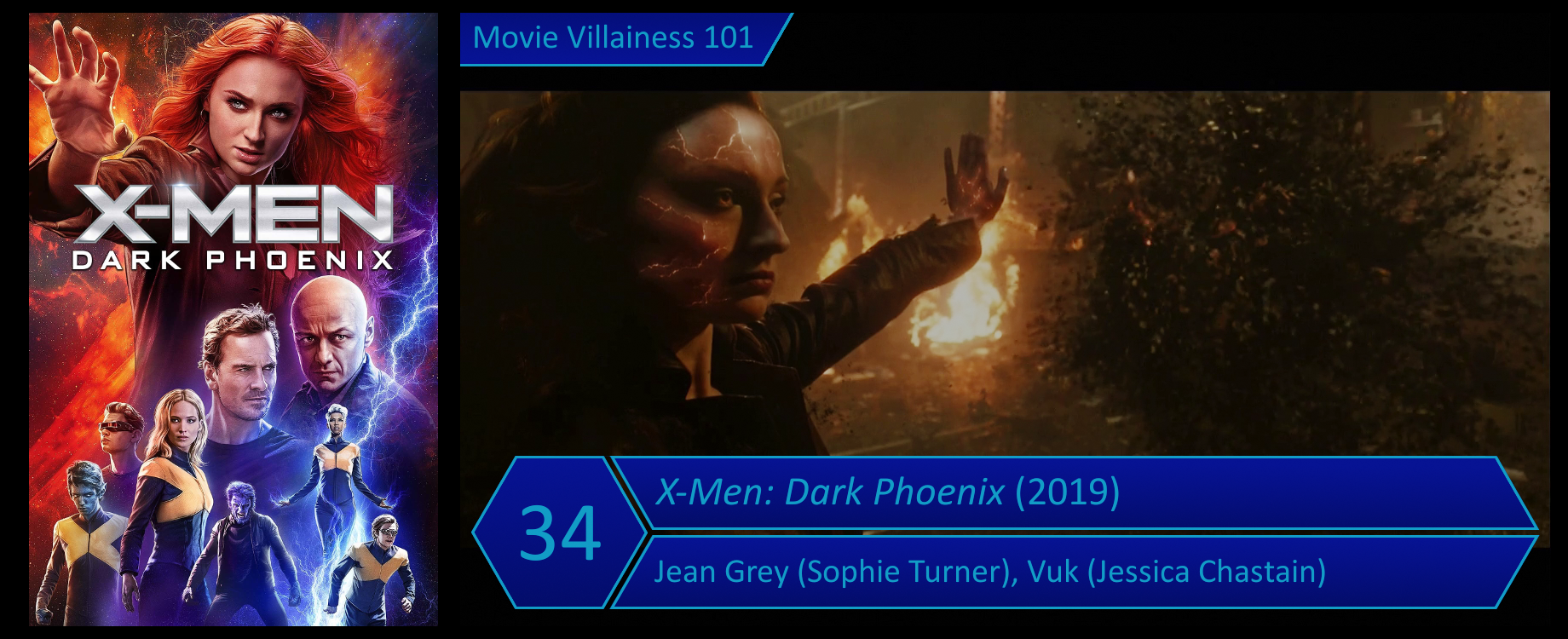
X-Men: Dark Phoenix (2019)
The X-Men film series kick-started the 21st-century comic book adaptation craze. An original trilogy, a prequel quadrilogy, and spinoffs that usually featured Logan / Wolverine. With a large cast of mutants, it’s no shock the series featured some powerful female foes, but Dark Phoenix is the only entry with a woman as the big bad. Throw in the ultra-powerful Jean Grey as an out-of-control antagonist, and the result is an entertaining spectacle.
After a prologue set in 1975, where a young Jean cannot control her telekinetic powers and accidentally kills her mother in a car accident, the rest of the movie takes place in 1992. This continues the trend of setting each reboot film in a new decade. By now the X-Men – and women, as Raven (Jennifer Lawrence) bluntly points out – are international heroes, and Charles Xavier (James McAvoy) has a hotline to the US President. Every team member wears a stylised jumpsuit, and the school HQ building is pristine and modern.
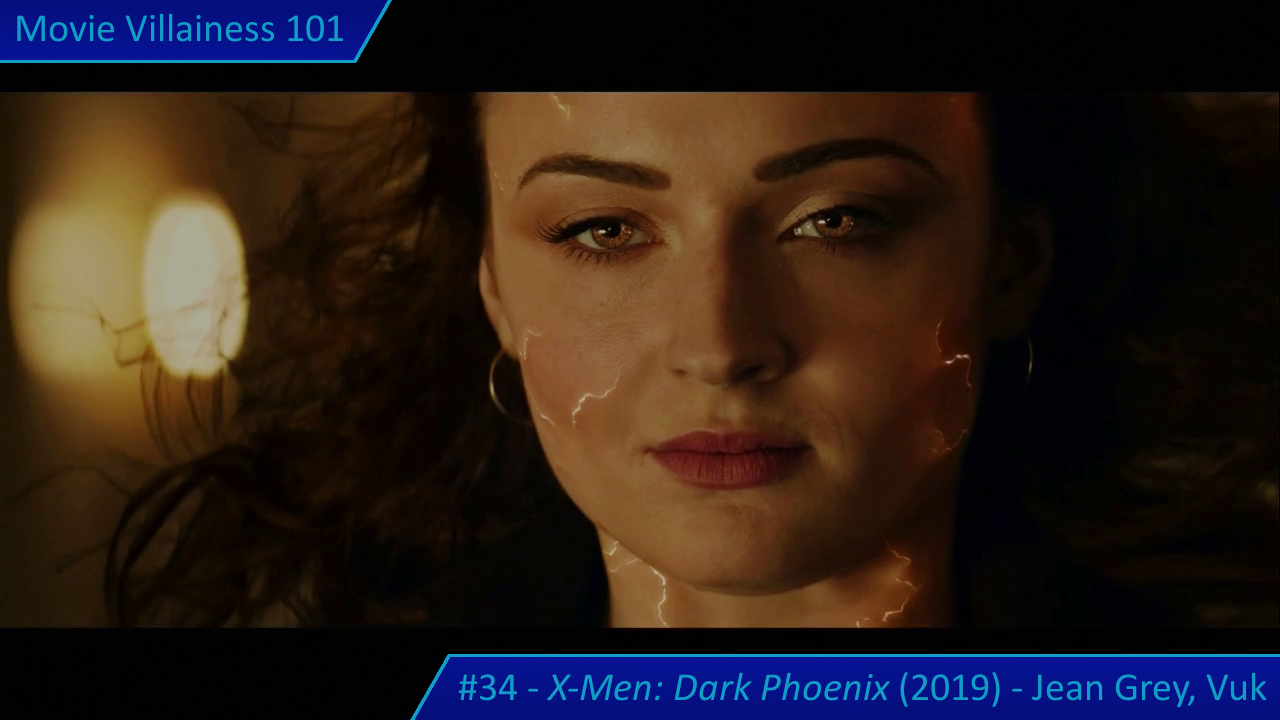
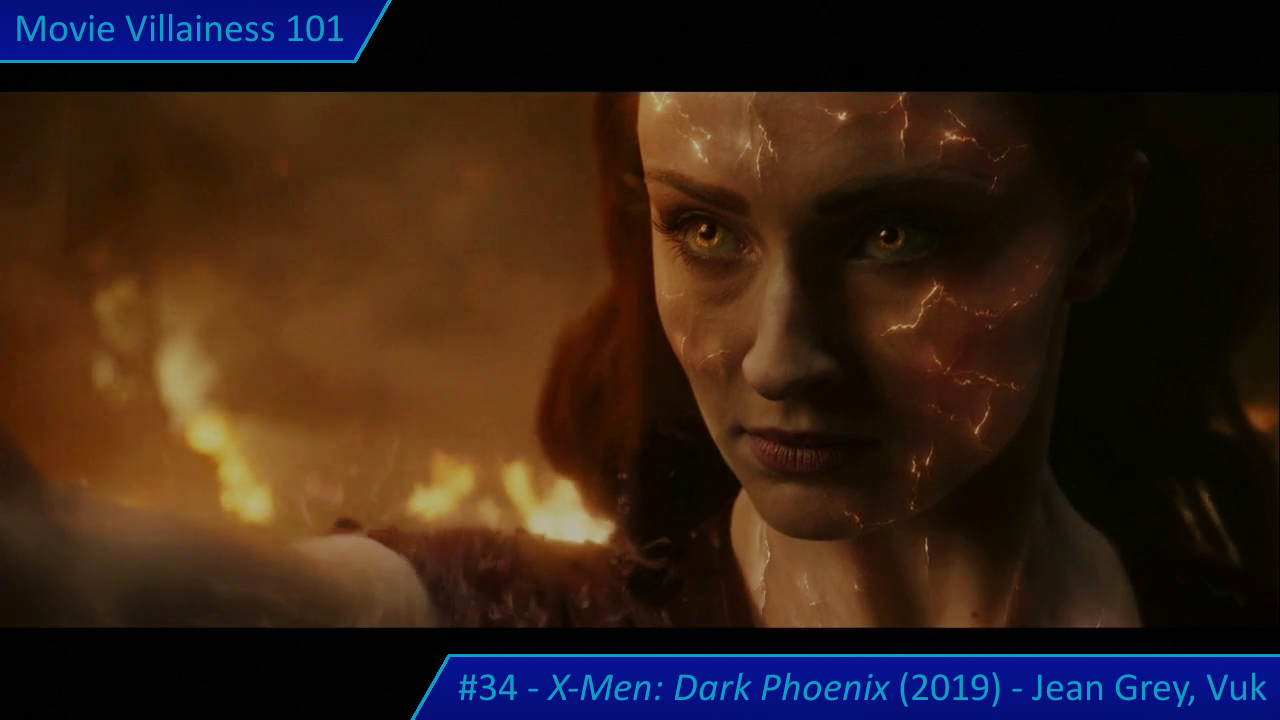
When a space shuttle gets stranded near an odd flare-like phenomenon, the heroes come to the rescue. The team saves the crew, but Jean is trapped after going back for the commander at Xavier’s insistence. She absorbs the energy and somehow survives, though she’s a lot thirstier and um… flirtier. Jean wastes no time in kissing her lover Scott / Cyclops (Tye Sheridan). Anyone familiar with the story (or who’s seen Last Stand) will know what happens next. Jean loses control over her powers, becoming a vengeful and dangerous woman able to match any mutant in combat.
Xavier and his team put their differences aside to counter this new threat, whose destructive rampage threatens to destroy the fragile peace between humans and mutants. To complicate matters, an alien race plans to use Jean to remake the world. Dark Phoenix and aliens? Talk about upping the ante.
Villainesses
Jean Grey (Sophie Turner), Vuk (Jessica Chastain)
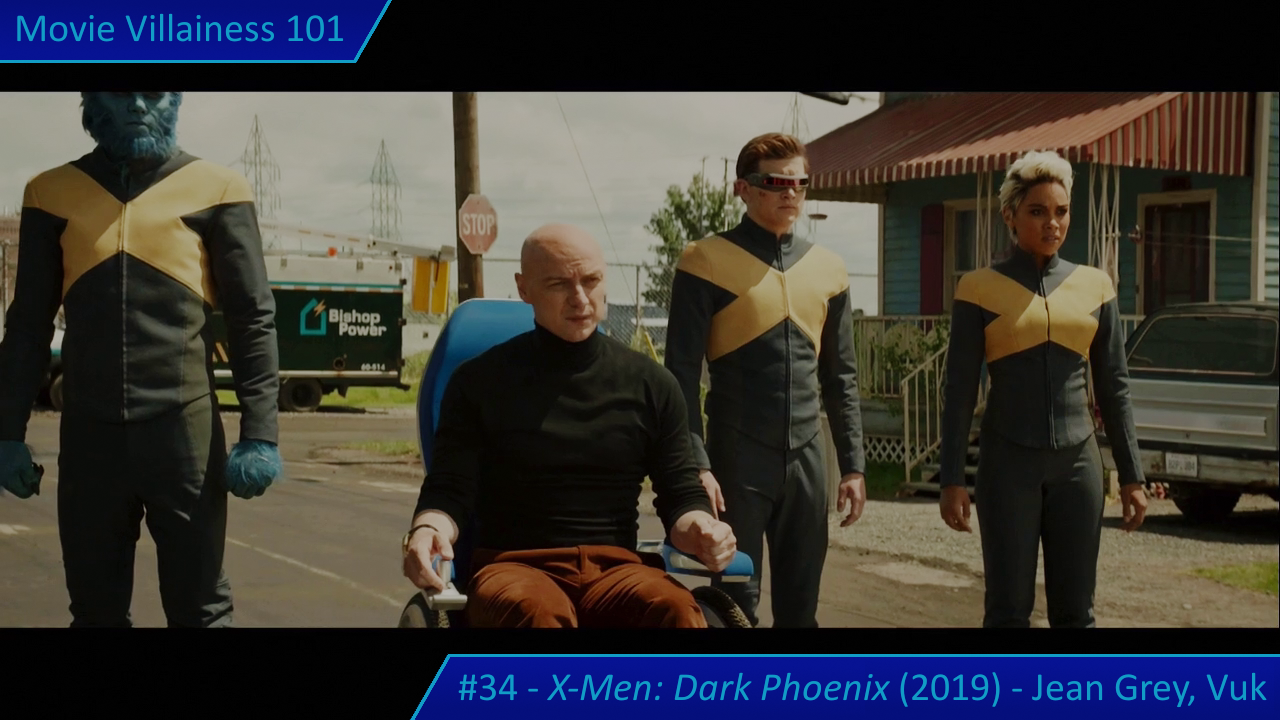
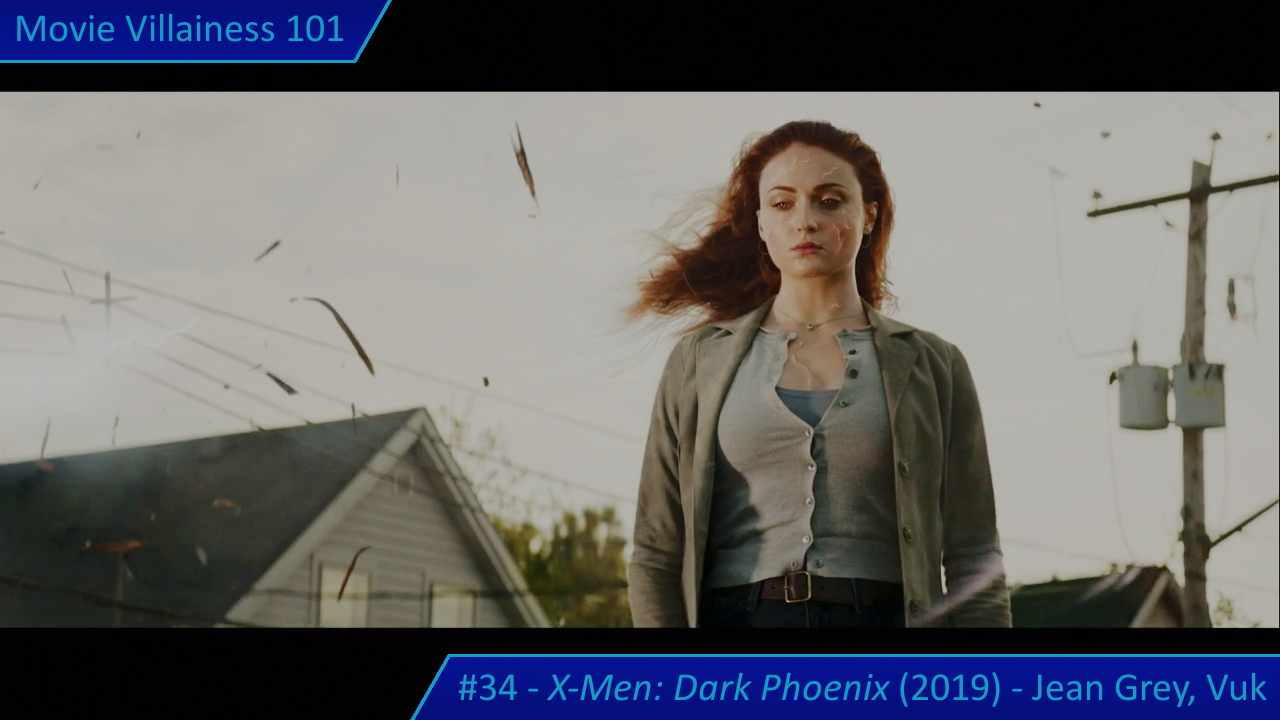
The newly empowered Jean Grey closes her mind to Xavier (yes, she can do that) and goes searching for answers. She starts at her childhood home and confronts her father, who still blames Jean for the car accident. Their meeting ends rather amicably (all things considered) with Jean rendering her pop unconscious. Upon leaving, she discovers the entire X-Men team waiting. Guess they figured this mission needed a full squad.
Jean is bitter that Xavier sealed away her memories, and her fury erupts after the police arrive. The quiet suburban street turns into a war zone as the mutants confront their former teammate. Jean’s powers are so great she shrugs off their attacks, whether that be a bolt of lightning from Storm, the teleporting Nightcrawler (who she traps mid-shift) or the time-slowing Quicksilver.
Xavier freezes the cops by mind control to give Raven a chance to talk to Jean. This goes badly wrong when she kills Raven in anger by impaling her on a fence. The young woman is clearly distraught, and flies off, leaving the X-Men to nurse their wounds and mourn. Raven’s death causes rifts among the team, and Hank / Beast (Nicholas Hoult) argues Xavier is partly responsible.
Jean seeks the help of Magneto (Michael Fassbender), now a mutant community leader on a secluded island. She wisely doesn’t mention who she killed, but a military attack prompts another angry outburst. It’s magnetism versus telekinesis as Magneto battles Jean for control of a helicopter. He just about wins the titanic struggle and demands she leave the island. But when rogue X-Man Hank delivers the news of Raven’s death, Magneto dons his trademark helmet, ready to kill once more.
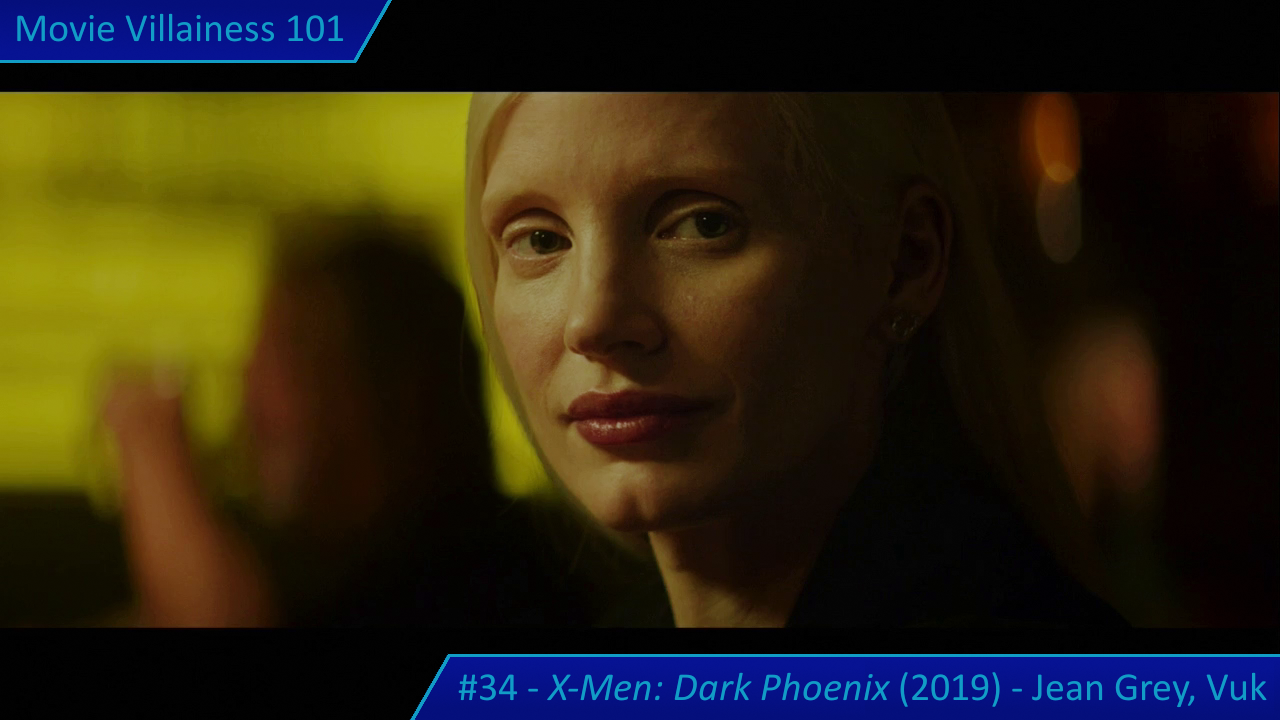
Meanwhile, the alien Vuk kills an American woman, assumes her identity, and wipes out her family with a literal touch of death. Turns out she and the other aliens were tracking the glowing space dust and are interested in Jean. Her father gives up information after some “persuasion”, and Vuk tracks her quarry to a bar. Jean’s mental powers make humans think she’s a harmless old man, but this ability doesn’t work on aliens. Vuk takes Jean to a house in New York and shows her images of planets and stars. It’s all pretty and awe-inspiring, designed to deceive Jean into helping her. By now the mutant is such a lost soul that she falls under Vuk’s evil influence.
This all leads to… where X-Men films always seem to end up: Xavier and Magneto battling it out over their differences. Mutants go at each other in the street, causing all kinds of carnage and destruction while bystanders watch helplessly. The two opposing forces are evenly matched. Storm fights a guy with whip-like braids, Hank and Cyclops duke it out on crashed vehicles, while Xavier and a telepathic female have their own mental battle.
To show his superiority, Magneto lifts a subway train above ground and blocks off the entrance to Vuk’s residence. His powers are no match for Jean, and his attempt to skewer her with a staircase rail is easily thwarted. Jean crushes and shatters Magneto’s helmet and tosses him out the window. It’s then Xavier’s turn to convince Jean. At first, she refuses to listen and has the cripple walk awkwardly upstairs. The telepath is powerless to stop her, but gets through by showing images of the past.
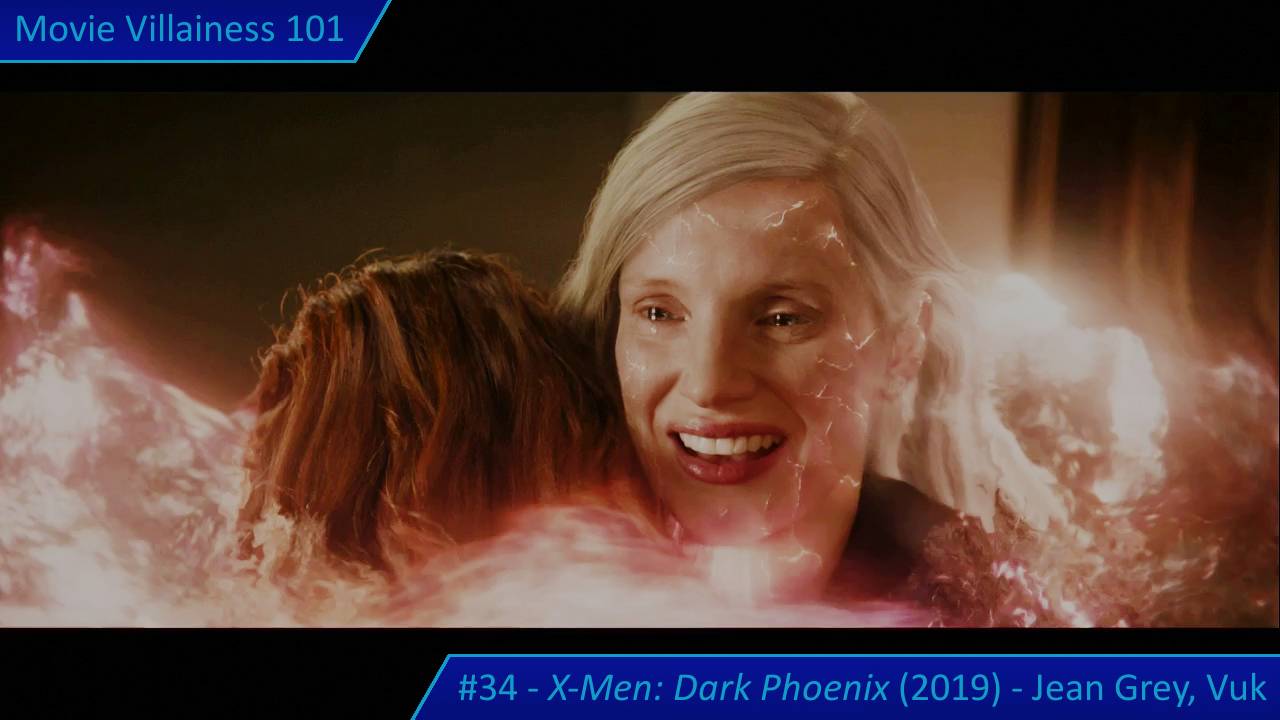
Vuk absorbs Jean’s energy, granting her the same all-conquering powers, and it’s only through Xavier and Cyclops intervening that she’s saved before being drained of life. Vuk survives an energy blast, but is now a truly dangerous foe. Before the X-Men can pursue her, they’re captured by special forces armed with anti-mutant weapons.
The captured mutants reconcile on a prisoner transport train, but there’s no time for further talk since Vuk leads a raid to recapture Jean. Eventually – after failed persuasion efforts and many casualties – a guard releases the mutants. Then it’s humans, X-Men and Magneto’s outcasts against aliens for one last battle. These creatures are hard to kill and resistant to small arms fire. Thankfully, mutant powers are far more effective at dealing with the threat, although some minor characters get killed in the fight.
Vuk joins the fray personally. What follows is like Jean earlier, but even more one-sided. The powerful alien defeats Storm and Nightcrawler with little trouble, then it’s Magneto and every weapon on board. Assault rifles and handguns have no effect, and Vuk soaks up damage like a literal bullet sponge. She tosses Magneto aside, but Jean chooses that moment to break free, crash the train, and create telekinetic bubbles to shield the mutants. She didn’t lose all her powers.
After Jean disposes of the surviving aliens by ripping them into dust, Vuk comes to claim her prize. The redeemed heroine gives her the remaining energy – enough to cause an explosion – after she ascends into space to avoid collateral damage. Think we all knew a heroic sacrifice was on the cards.
Honourable Mentions: X-Men Series
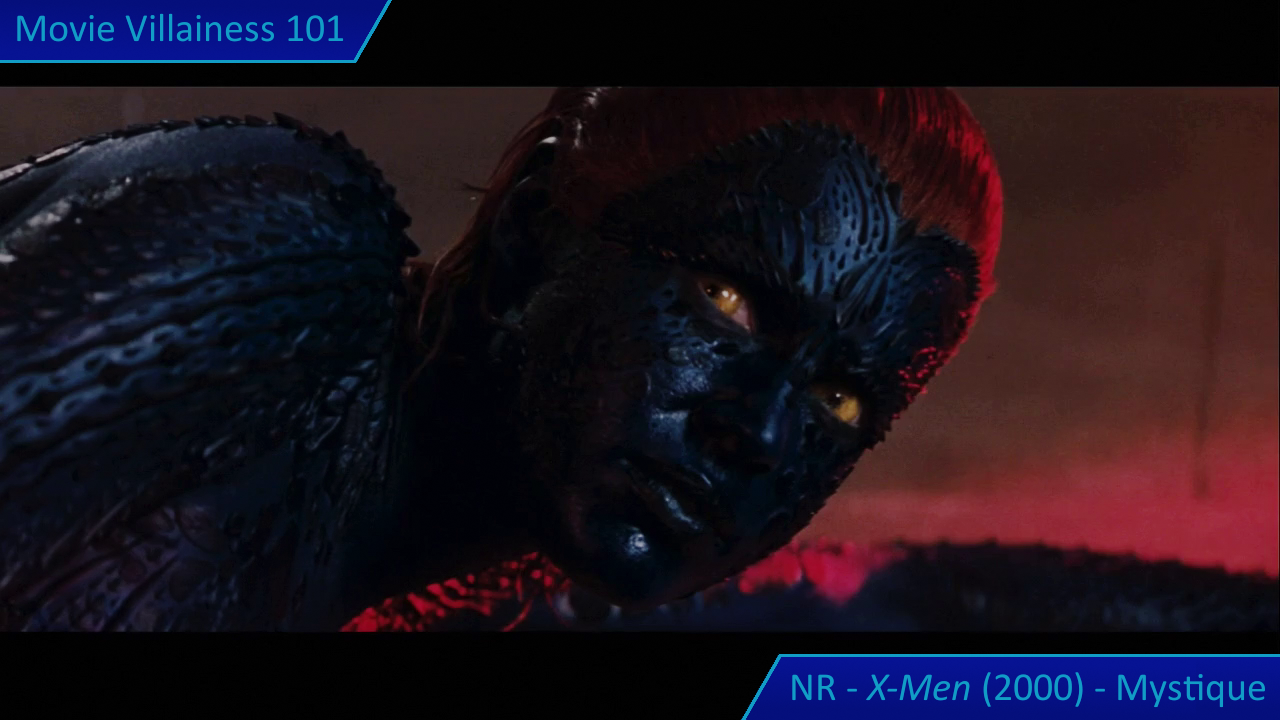
X-Men (2000) – Mystique (Rebecca Romijn-Stamos)
First films are usually origin stories, so expect background for the main characters. Meet a power-sucking girl named Rogue (Anna Paquin), the adamantium-clawed Wolverine (Hugh Jackman), and the two opposing mutant leaders, Professor Charles Xavier (Patrick Stewart) and Magneto (Ian McKellen).
The villain plans to transform prominent humans into mutants, and his henchmen are the whip-tongued Toad (Ray Park), dumb muscle Sabretooth (Tyler Mane) and Mystique. She’s as acrobatic as Toad and can change her appearance at will. This includes copying Wolverine’s claws for an epic fight, but Mystique remains in her natural blue-skinned form where possible. Her best scene is where she reveals herself to an anti-mutant senator and gives him a good kicking. Not one for diplomacy when defending her kind.
Battles between the X-Men and Magneto’s mutants are an ongoing franchise theme. In this outing, it’s mainly Wolverine with help from weather woman Storm (Halle Berry), laser-eyed Cyclops (James Marsden) and telepath Jean Grey (Famke Janssen). The last battle is at the Statue of Liberty, where Wolverine takes down Mystique – but not before they’ve had a good fight. Toad and Sabretooth are one-time villains, but Mystique gets the honour of appearing in every main X-Men movie.
With the introductions over, there’s a lot more action. The principal antagonist is Colonel Stryker, a madman planning to wipe out all mutants. But he’s happy to employ their services provided they’ve been brainwashed or controlled through technology. Stryker created Wolverine, so their personal feud is a major subplot.
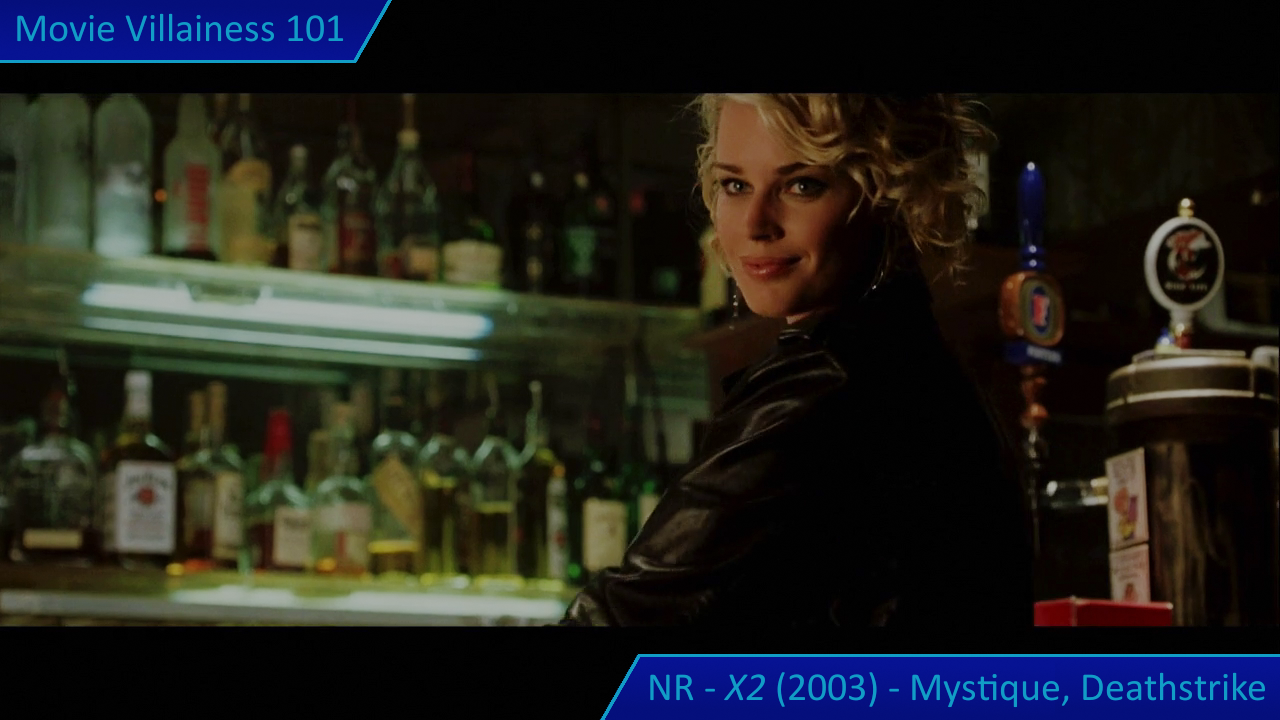
Mystique is back, and her infiltration of Stryker’s base turns up more than expected when she discovers plans to convert Cerebro – Xavier’s mutant-locating machine – into a weapon. Mystique poses as a beautiful blonde to seduce a security guard and inject him with liquid iron. Not good for his health, especially since he’s guarding Magneto’s plastic prison. Unwittingly smuggling metal into his cell is a surefire way to get killed.
The X-Men team up with Magneto and Mystique to stop Stryker after he raids Xavier’s school and kidnaps the professor. With their combined skills, the mutants gain the upper hand, though Magneto has devised a nefarious scheme of his own. What else is new? This leads to a dam bursting, and Jean Grey perishes holding back the flood. Anyone familiar with X-Men lore will know what comes next, but her Phoenix story is deferred until the third instalment.
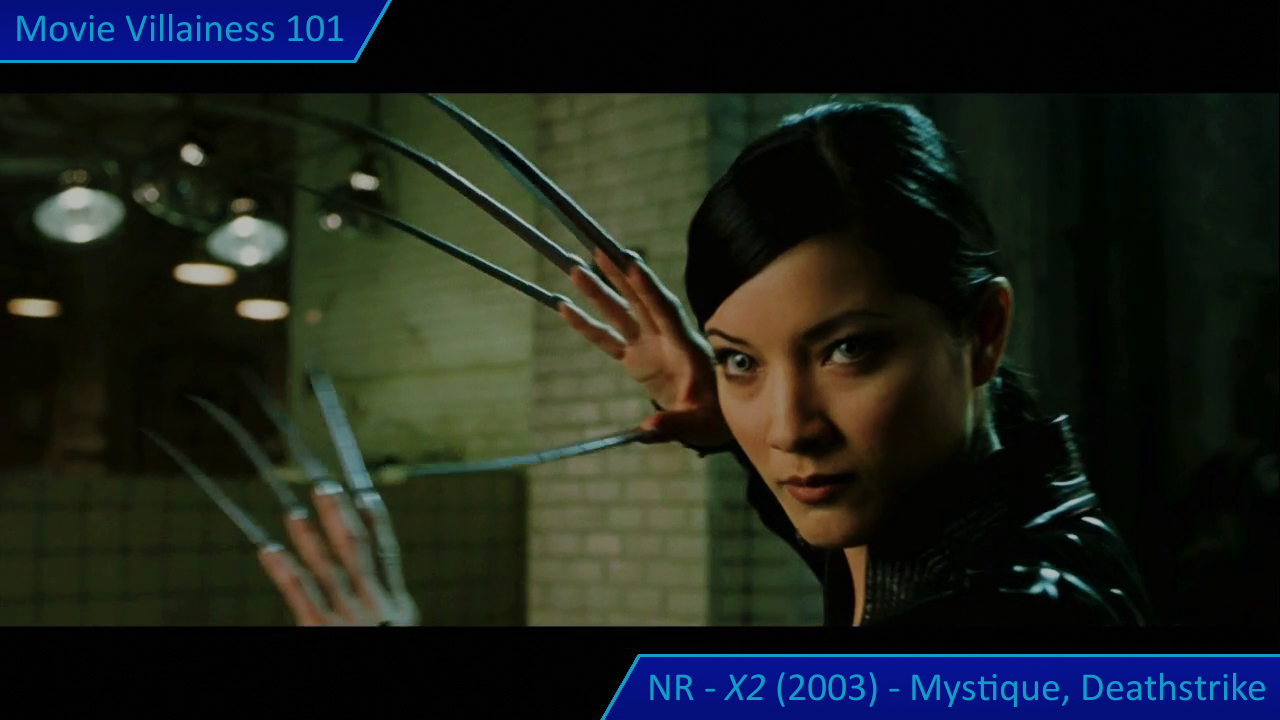
For newcomer mutants, we have Iceman and Pyro. They have opposite powers, and will finish on opposite sides. More important from a villainess fan’s perspective is Deathstrike. She’s the female equivalent of Wolverine, which makes her ideal for bodyguard duty. Early on, she does little except crack her knuckles and follow Stryker around. To show her prowess, Deathstrike takes down Cyclops in Magneto’s prison, a contest she wins easily.
The standout scene is the inevitable fight between Deathstrike and Wolverine. She has claws on her fingers and the same accelerated healing powers he does. Thus, she can survive attacks that would kill any normal human. Wolverine took down scores of opponents beforehand, but Deathstrike is not so easily killed. Eventually, the hero drops his nemesis into a chemical vat, which ends the threat. Then Deathstrike springs back into action, and to ensure she stays dead, Wolverine injects her body with liquid adamantium.
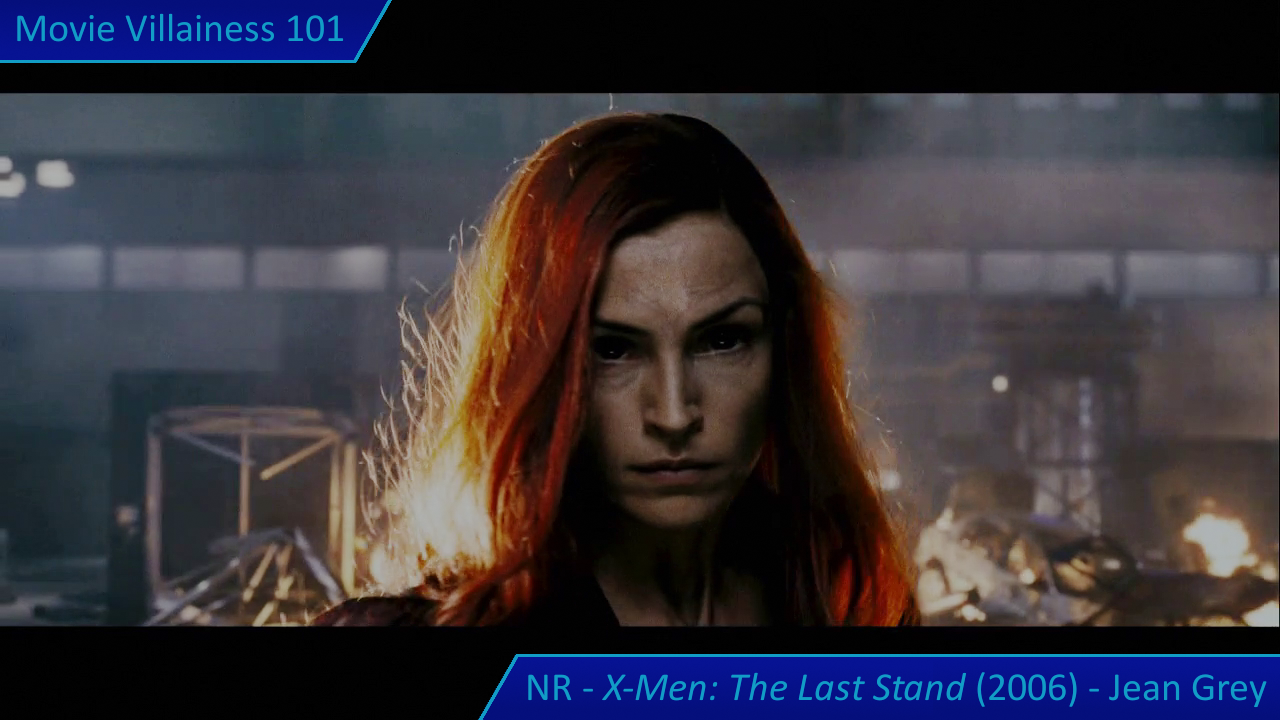
X-Men: The Last Stand (2006) – Jean Grey (Famke Janssen)
Like the prequel / reboot stories, the original trilogy closed with Jean Grey transforming into the unstable and powerful Phoenix. This was tired and forgettable stuff focused around an anti-mutant drug and the politics of its use. The climax involves a battle between the military and a mutant army led by Magneto, and a showdown on Alcatraz Island with the X-Men caught in the middle.
Mystique returns, but don’t expect much from her. After some playtime with her captors, she snaps a guard’s neck, only to be injected with the cure while saving Magneto. He turns his back on her, and Mystique is forgotten after that. Other females join the fight, notably the tattooed Callisto and a woman who generates shockwaves, but none of their scenes are memorable.
Jean is by far the biggest disappointment, though. She disintegrates her lover Cyclops, but most of that occurs off-screen. Even Xavier is no match for Phoenix, and is obliterated when he attempts to reason with her. After being established as such a powerful adversary, Jean becomes a silent observer. She stands back and watches as Magneto repositions the Golden Gate Bridge and leads an all-out assault.
When Jean gets involved, she turns humans and mutants alike into dust in an outburst of rage. It takes Wolverine – the only one able to withstand Jean’s powers – to convince her to stop. Jean begs him to kill her, and he duly obliges. Apparently, the producers didn’t like this ending either, because they rebooted the franchise.
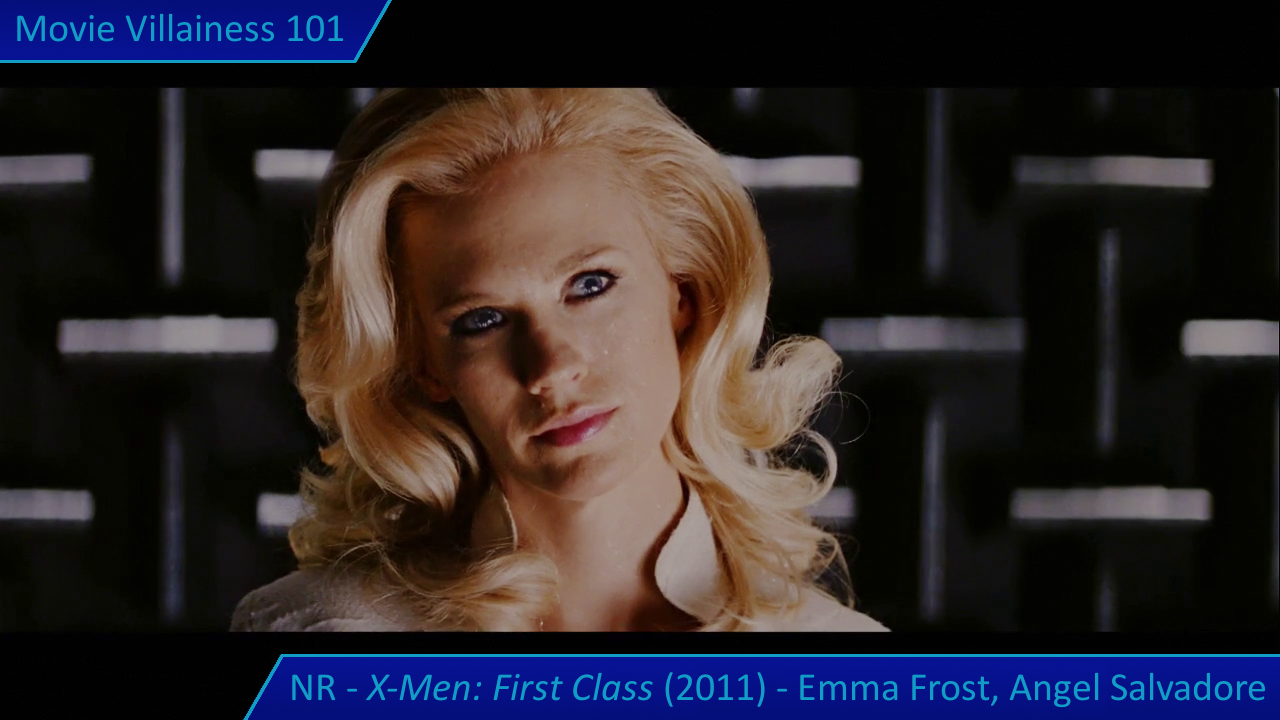
X-Men: First Class (2011) – Emma Frost (January Jones), Angel Salvadore (Zoë Kravitz)
This movie is set before the original trilogy, mostly in 1962 at the height of the Cuban Missile Crisis. We see Charles Xavier, Erik Lansherr and Raven before the characters become Professor X, Magneto and Mystique. Prototype tech includes a primitive Cerebro, the X-Men jet, and fashionable jumpsuits. The titular first class members are inexperienced mutant teenagers who eventually prove their worth.
The main villains are the Hellfire Club, led by Sebastian Shaw (Kevin Bacon), a mutant who can absorb and release energy. His plan is to start World War III so that mutants will thrive in the radioactive wasteland. Villains aren’t known for sanity. Lansherr has a vendetta against Shaw for murdering his mother, which leads to a difference of opinion with Xavier.
The main female antagonist – to begin with – is Emma Frost, a telepath able to change into diamond form. A mix of physical and mental, she shows off these abilities several times. Highlights include beating up Lansherr, blocking Xavier’s mind control, and seducing a Soviet general by implanting sexual experiences. Unfortunately, she’s defeated far too easily when Lansherr traps her against a bed and cracks her diamond shell with twisted metal tubes. So much for the hardest substance in nature.
The injured Frost has no defence against Xavier’s mental powers and spends the rest of the movie off-screen in a secure cell. Actually, it’s not that secure as she cuts through the glass divider and speaks to the agents on the other side.
Shaw gets a replacement villainess in the winged Angel, a woman who spits acid. Seems this young lady didn’t enjoy being a recruit as she betrays her classmates. There’s a long aerial battle between her and Banshee, a boy who uses projected sound waves to fly. Until a blast from Alex Summers / Havoc clips Angel’s wings.
The last scene has Magneto – now in a more familiar outfit – recruit Emma Frost, but viewers shouldn’t get their hopes up. She never featured in the franchise again.
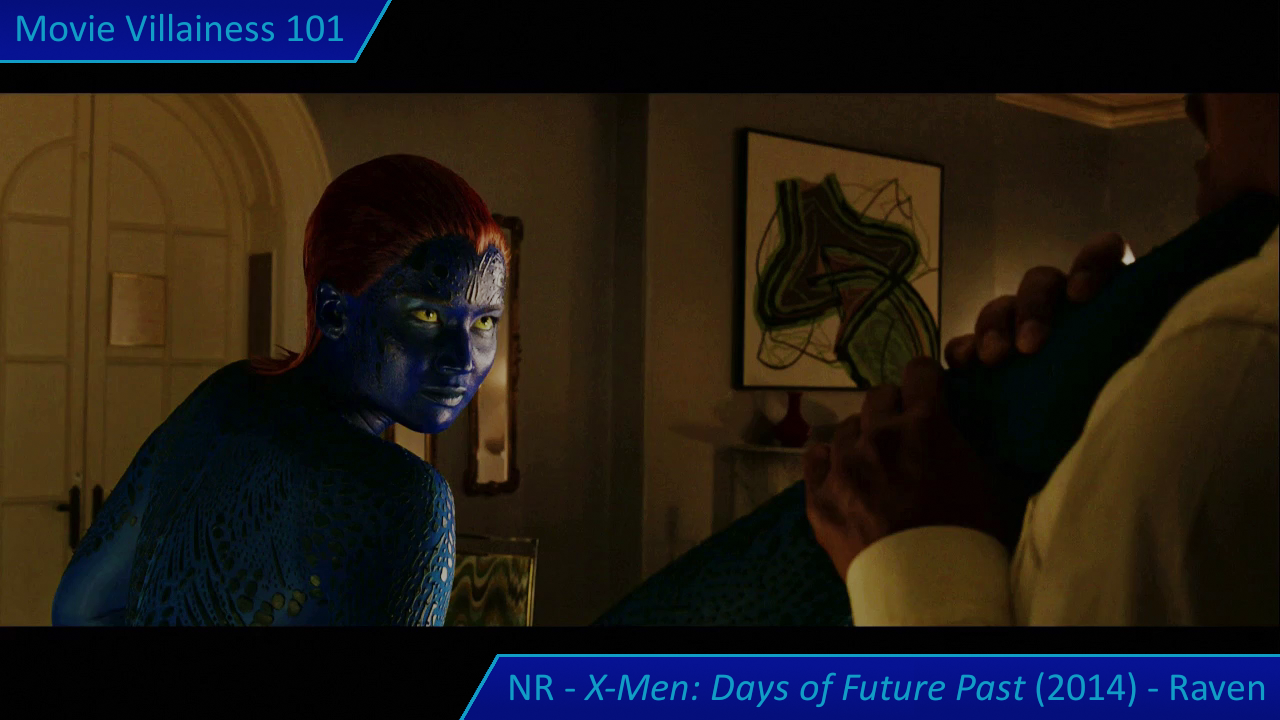
X-Men: Days of Future Past (2014) – Raven (Jennifer Lawrence)
In the only main series entry without a standout female villain, Mystique (Raven) features again, but she’s more misguided than evil. If First Class was a prequel with retroactive continuity, this movie ends with a straight-up reset. The adversaries are Sentinels, machines that can adapt to any mutant power. In a dystopian future, these creations hunt mutants, so the solution is – you guessed it – time travel.
Wolverine is the designated hero when another mutant transfers his consciousness back to his younger self in 1973. The original trilogy and prequel series casts unites, giving us two versions of key characters, though it’s never explained how Xavier is still alive. Past Wolverine convinces other mutants to join forces against Dr Bolivar Trask (Peter Dinklage), the scientist responsible for creating the Sentinels. The X-Men must prevent Raven from assassinating him and setting the dark future events in motion.
Things don’t go according to plan (do they ever?), and Magneto betrays his fellow mutants to fight against humans. The set-piece finale in Washington, DC has Magneto moving an entire stadium and turning the Sentinels against their creator. In the end, Raven is the heroine, and the future – the entire original trilogy – no longer happens.
Following the trend of moving forward a decade, this movie is set in the 1980s, though we get a prologue in ancient Egypt that introduces the villain En Sabah Nur. He’s a mutant able to transfer his consciousness to another’s body and absorb their power, so this blue-skinned baddie has many abilities. Handy when your goal is to enslave humanity.
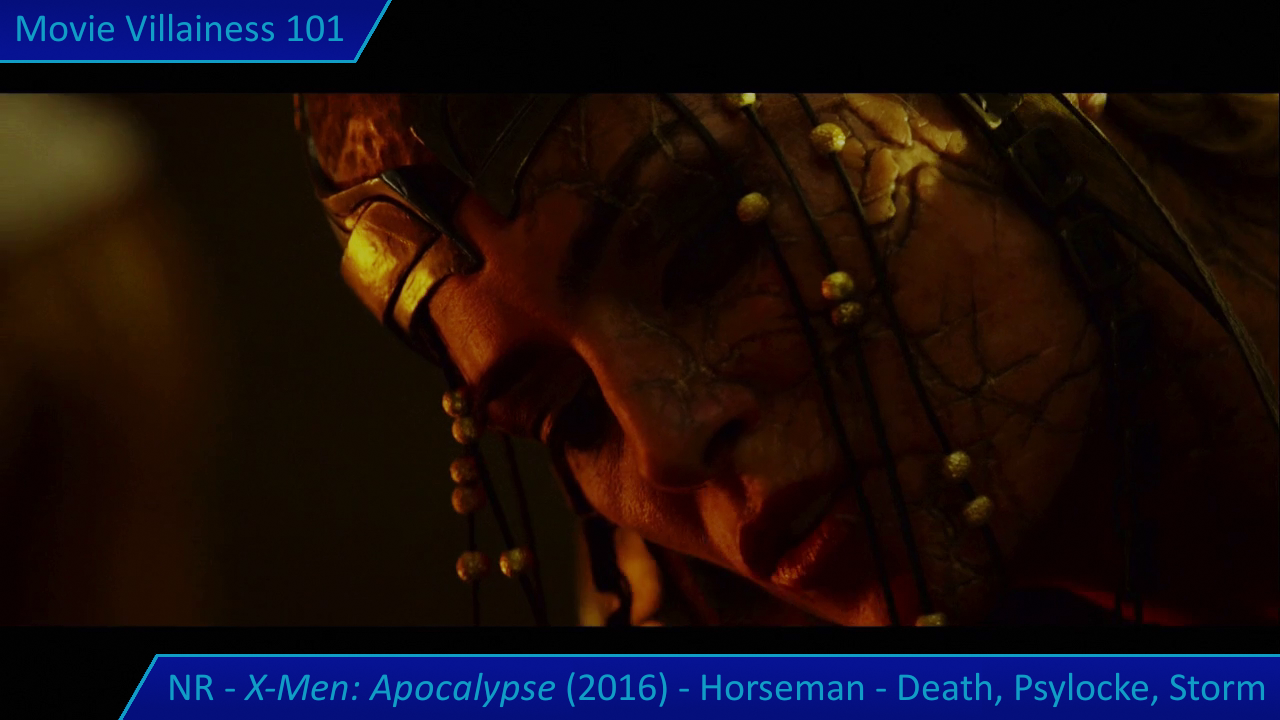
The resistance entombs him mid-transfer, but not before they’re wiped out by the Four Horsemen of the Apocalypse. Monique Ganderton plays their leader and gets a few kills before she sacrifices herself to protect her master. Too bad, because she made a better impression than the main female villains.
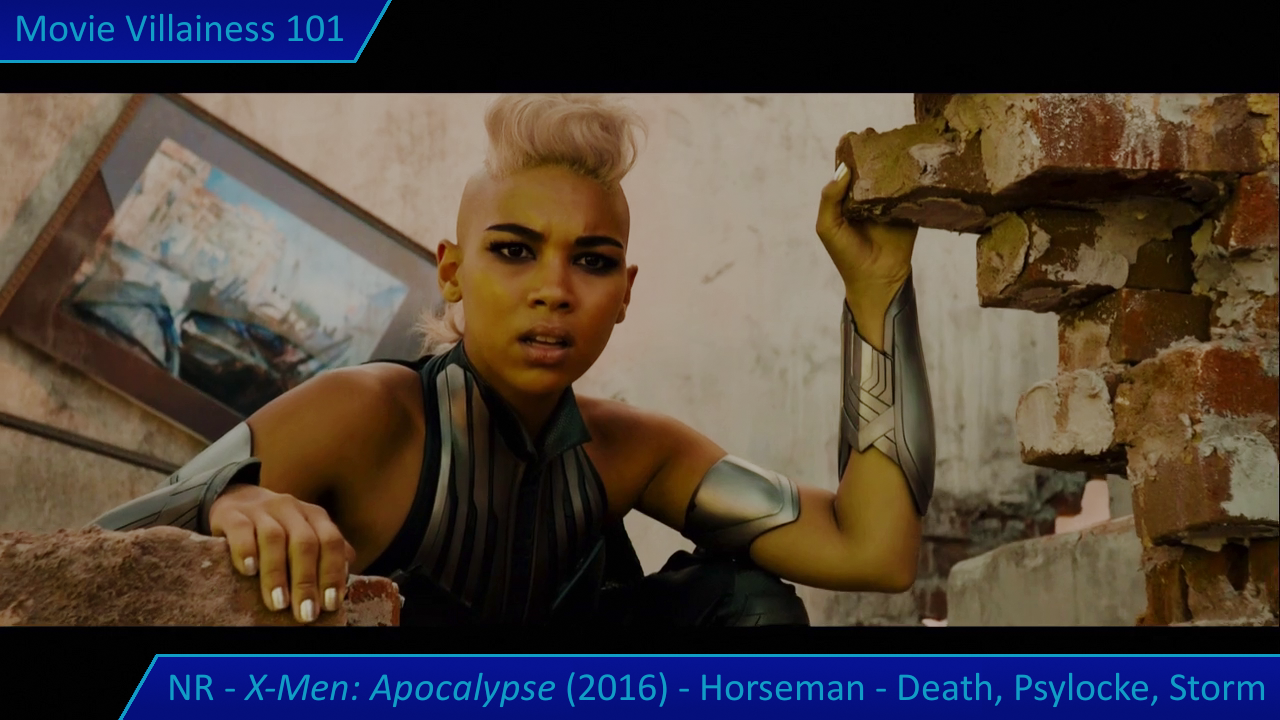
Those two women would be young Storm and Psylocke, recruited by the resurrected En Sabah Nur to be his new lieutenants. Also joining him are Angel and – drum roll – Magneto. His anger, combined with enhanced abilities, makes him even more dangerous. Xavier and the X-Men do their best to contain the threat, but the villain’s almost godly powers make him the most dangerous foe they’ve ever faced. The ancient mutant is intent on restoring his rule and creates a giant pyramid through sheer will alone.
Storm and Psylocke get shiny matching armour sets, but their battles with the heroes are sadly nothing special. Storm has a change of heart when she witnesses Raven (her hero) stand up to En Sabah Nur. Psylocke uses purple energy weapons – swords and whips – and puts up a struggle, but her screen time is still short and she’s often on the wrong end of a beatdown. The henchwoman’s best moment is riding with Angel to attack the X-Men jet, but the heroes simply teleport away and Psylocke makes a narrow escape.
Magneto redeems himself, but even with his help the ancient mutant is strong enough to survive a combined onslaught from all the X-Men. So, Xavier instructs Jean Grey to unleash her true power. Even En Sabah Nur can’t survive the Phoenix, and turns to dust. Her talent for utter destruction provides a glimpse of what’s coming in the next film.
The “devil in white” is more interested in controlling patients than curing them
Movie
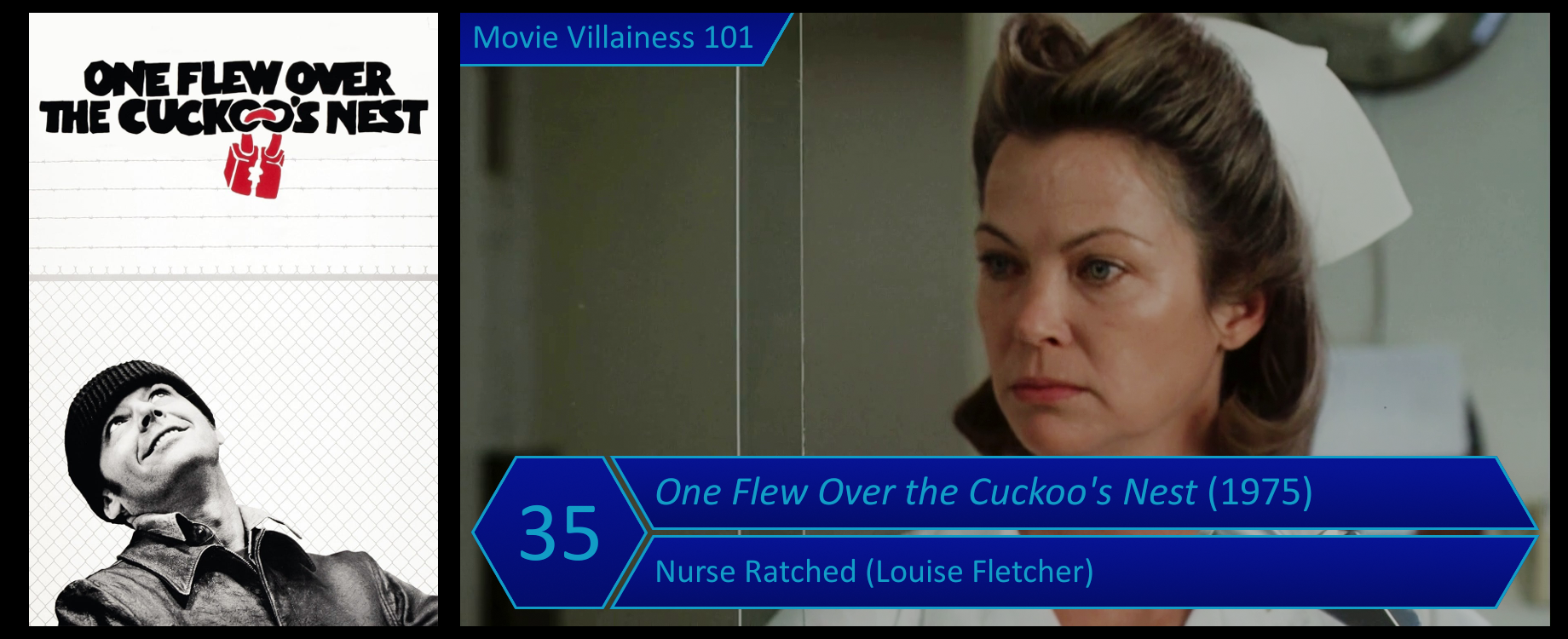
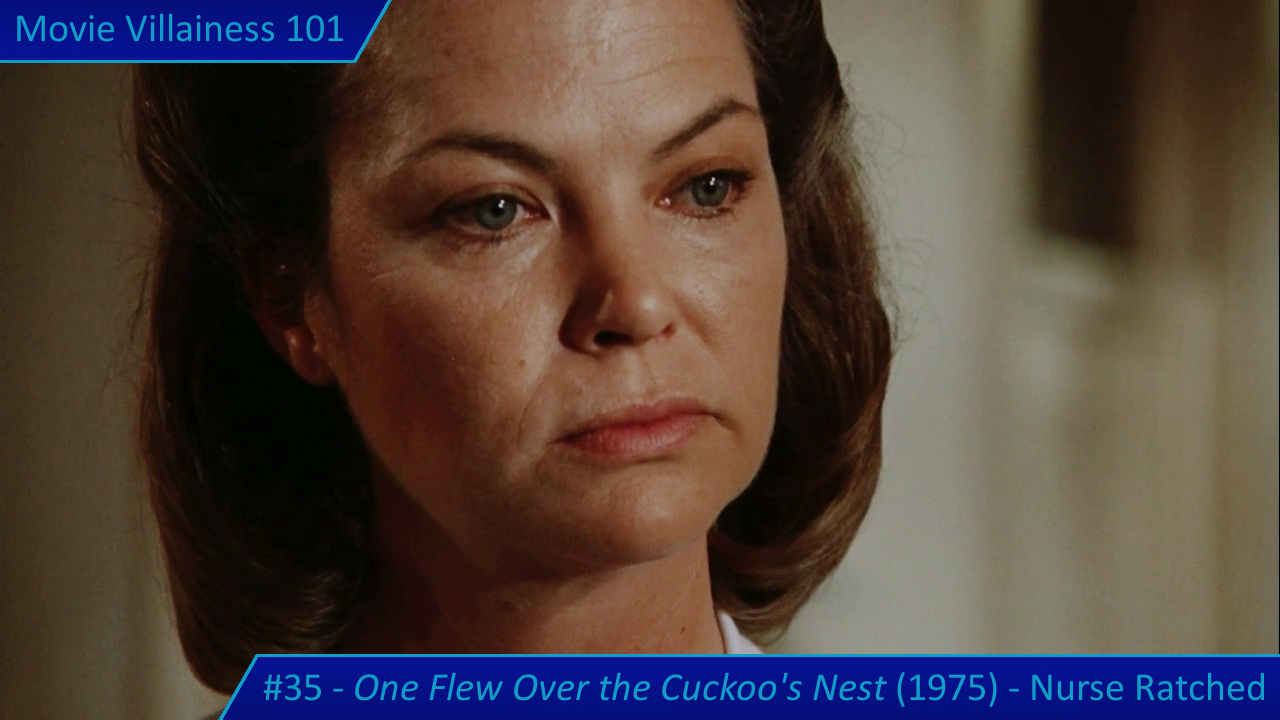
One Flew Over the Cuckoo’s Nest (1975)
Perhaps a controversially low rank, given many female villain lists rate the tyrannical nurse highly, but I consider all the top forty choices to be legendary. The film is undoubtedly a classic, one of only three (to date) to win all five “big” Academy Awards. A lot of time is devoted to patient bonding, and the antagonist is the corrupt US mental health system, even if Nurse Ratched makes a terrifying figurehead.
The biggest threat to her authority comes from Randle McMurphy (Jack Nicholson), a recent transfer suspected of faking mental illness to lessen his sentence for statutory rape. This guy is hardly hero material, but he comes across as likeable because the head nurse is a sadistic control freak and his charisma has a positive influence on the other patients.
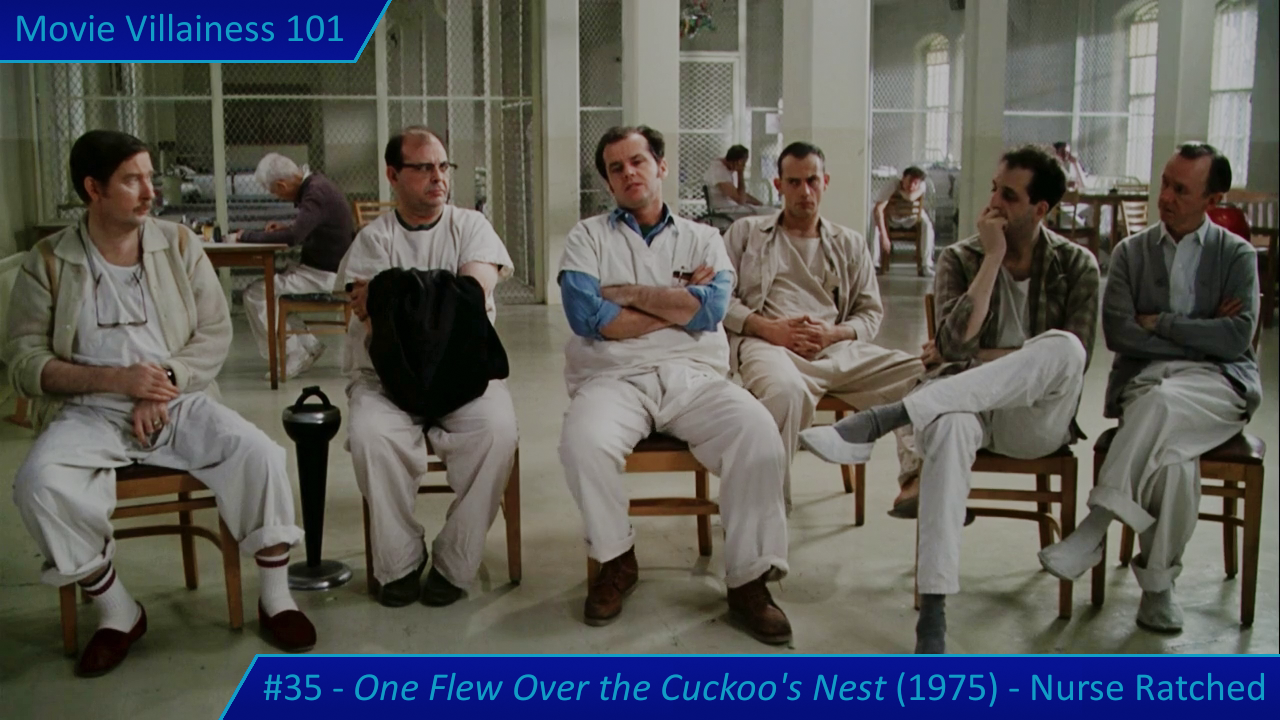
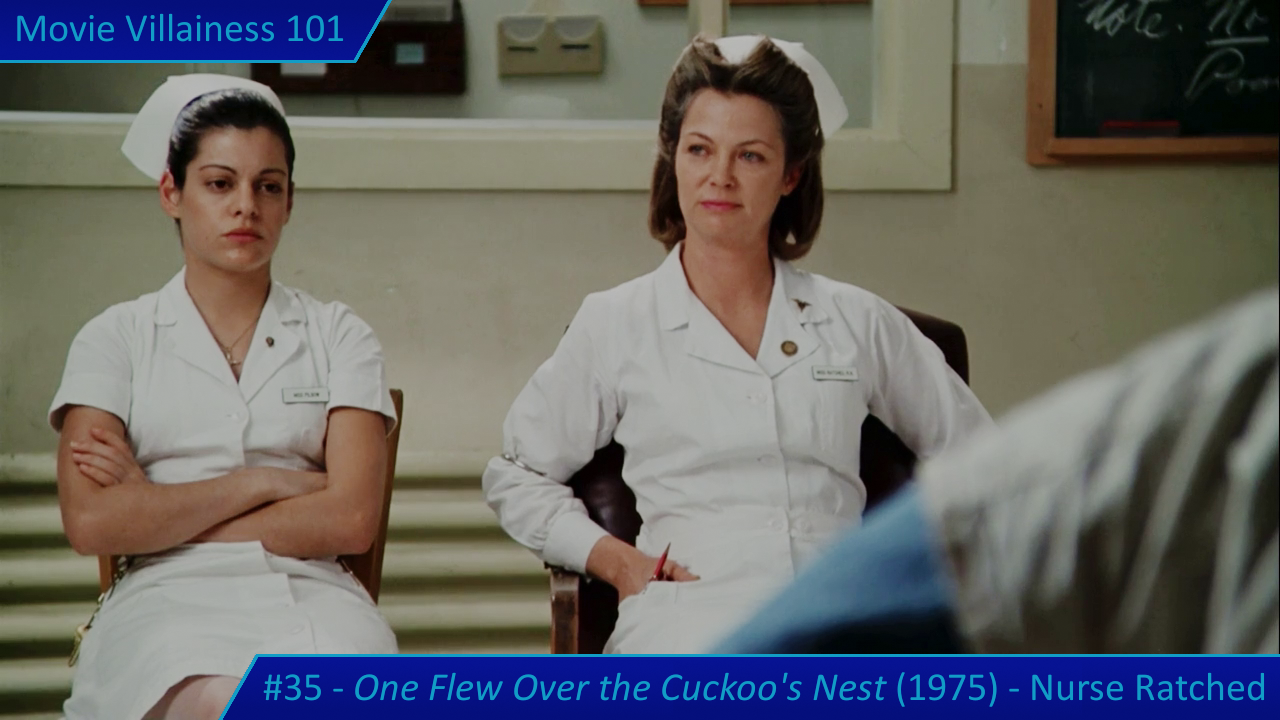
From the outset, it’s obvious a rule-breaker like McMurphy won’t approve of Ratched’s tight-ship approach. Early on, he’s a quiet participant in group therapy, while the nurse and her passive assistant watch in silence. But then Randle encourages his fellow patients to disregard the rules and forms a bond with the giant deaf-mute Bromden, also known as “The Chief”. This relationship matures into friendship, leading to eventual triumph in a bad-tempered basketball game against the hospital orderlies.
The pacing is much slower than in modern movies. A few scenes feel stretched out, notably where the patients play cards for cigarettes, the therapy sessions, and a long section where McMurphy leads an unauthorised fishing expedition. These parts could have been trimmed without losing substance, but the ensemble cast – which includes a young Danny DeVito, and film debuts from Christopher Lloyd and Brad Dourif – all give terrific performances.
Despite the positivity from McMurphy, this is a dark tale and would never end happily. Not a film to watch when you’re feeling depressed and want to finish on a cheery note.
Villainess
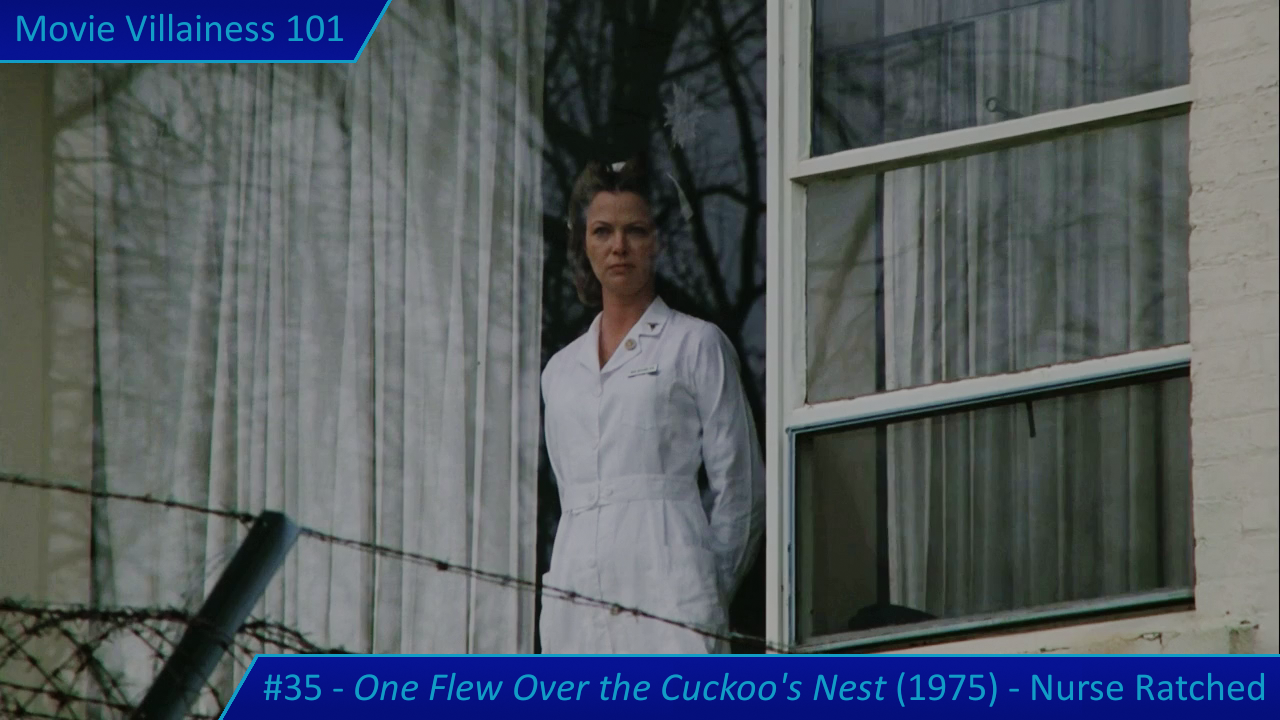
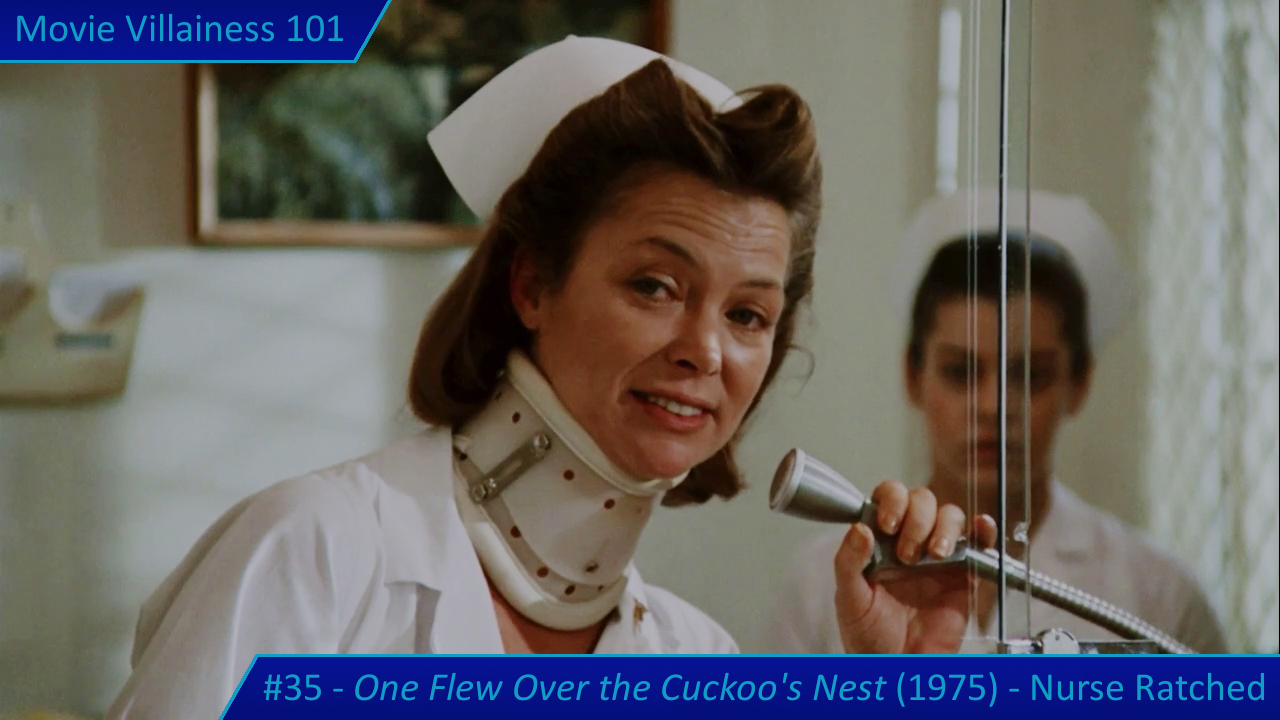
Nurse Ratched (Louise Fletcher)
Early confrontations between McMurphy and Ratched are over trivial matters. First, he wants her to turn down the music on the ward. She refuses, showing an intent to control every little thing. Next on the agenda is the more serious matter of the baseball World Series, which McMurphy wants to watch on television. This goes to a vote, but few patients support the motion, and Nurse Ratched responds with a gloating smile.
McMurphy isn’t one to quit, and after a bit of unorthodox hydrotherapy where he drowns two men and a Monopoly board, he’s got the other men thinking about free will and escaping. For the second vote on the World Series issue, the group votes unanimously in favour. Nurse Ratched, remaining super calm, points out there are nine other men on the ward (the crazy and delusional patients), and McMurphy doesn’t have a majority.
He runs around searching for the one supporter he needs, showing real leadership, but his rallying attempt seems doomed to fail until the Chief raises his hand. Ratched argues the session was closed before the final vote, so it doesn’t count. Do you get the impression she decided the result beforehand?
After McMurphy’s disorganised fishing trip, the head doctor suggests sending him to the work farm, but Ratched insists on helping him. Or so she claims, but her joyful smile when Randle finds out there’s no time limit on his hospital stay suggests she wants to regain control. The previously calm nurse gets angry when the patients act defiantly. One man demands she return his cigarettes, and Ratched shifts blame to McMurphy over gambling to turn the others against him.
Following a ward fight, the staff subject McMurphy to electrotherapy, but this only stiffens his resolve. The Chief – previously thought to be mute – reveals he’s been faking it the whole time, and McMurphy throws a Christmas party. He bribes a staff member to let booze and women onto the premises, and things predictably get out of hand. Another strict nurse almost discovers the patients out of their beds, but this is a delaying tactic until Ratched returns the following morning.
Then the nurse shows her truly evil side. She’d always been a controlling sadist, but could have been misguided. Until she drives a patient to suicide by threatening to tell his mother he’d slept with a woman. This prompts McMurphy to attack Ratched and – tellingly – nobody helps her. Eventually, the staff subdue the anti-hero, and it’s later revealed the nurse had ordered him lobotomised. Talk about extreme measures.
The Chief kills the comatose McMurphy out of pity and uses a hydrotherapy fountain – as Randle suggested earlier – to break out. Nurse Ratched survives with only a neck injury, and she’s back in charge of her patients. This is one villainess victory nobody will want to root for.
Honourable Mention: Controlling Women
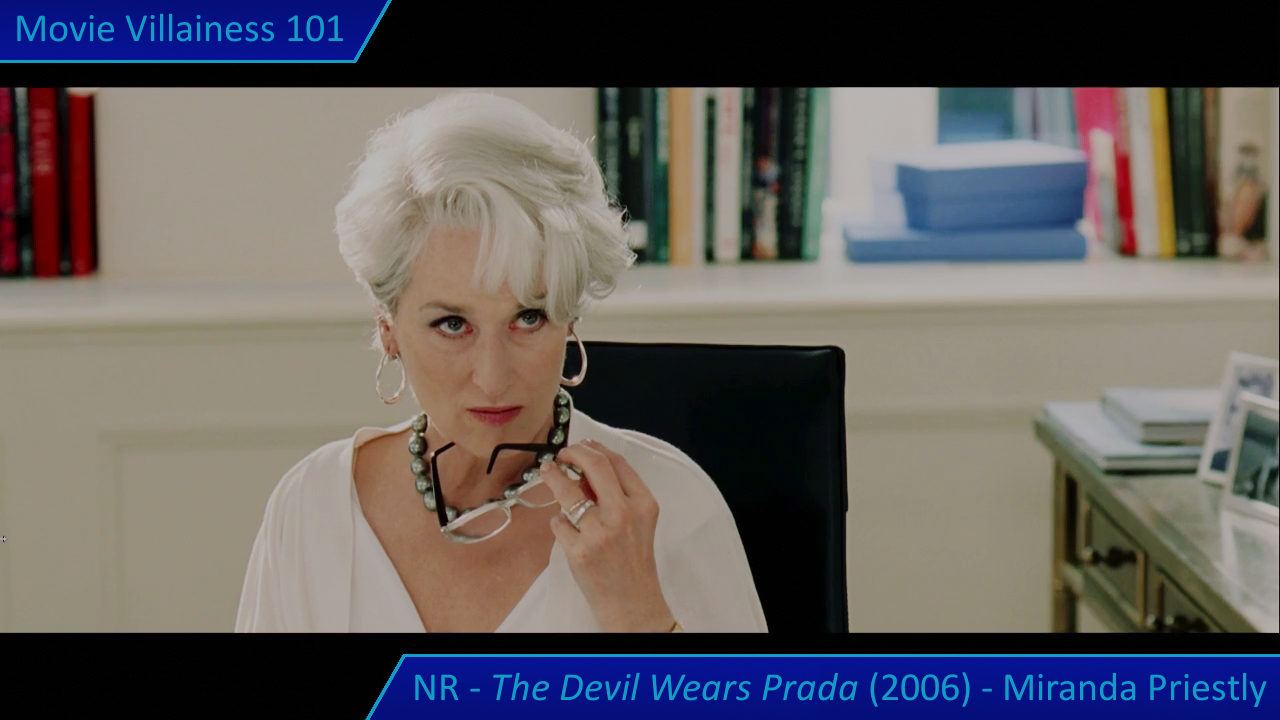
The Devil Wears Prada (2006) – Miranda Priestly (Meryl Streep)
To show I’m considering villainesses from all sources, I’m delving into an area I’m hardly an expert in: women’s fashion. It’s debatable whether Meryl Streep’s “Dragon Lady” boss is actually a villain. She’d make a fine presenter of The Apprentice, but her acts are more ruthless than outright evil. The tough businesswoman even comes to respect the main character, Andrea Sachs (Anne Hathaway).
It doesn’t start out that way. Andrea is a fresh college graduate who shows up unprepared for a job interview with no knowledge of fashion. Hardly good credentials for an assistant role, but her defiant moral speech gets Miranda’s attention, and she takes a chance. That’s the only break she gives Andrea, though, since this boss is akin to a slave driver. Employees run around the New York office to meet her endless list of demands.
Andrea isn’t popular given her unfashionable dress sense, and her relationship with fellow assistant Emily (Emily Blunt) is frosty. After a few mishaps, the newcomer has a wardrobe change and attends high society events, which leads to friction with her unsupportive friends. Andrea is uneasy with Miranda’s ruthless streak, especially when she promises a job to her assistant Nigel but gives it to a rival to save her own skin. That’s as villainous as it gets with Miranda. Welcome to the cutthroat business world.
The movie ends with Andrea quitting her job, but Miranda is pleased for her and gives her a positive reference. So maybe a tough experience was exactly what this young lady needed to further her career. If you’re after a lighter take on female authority figures, this movie is worth a look.
Cory essentially played this role twice – double impact indeed
Movie
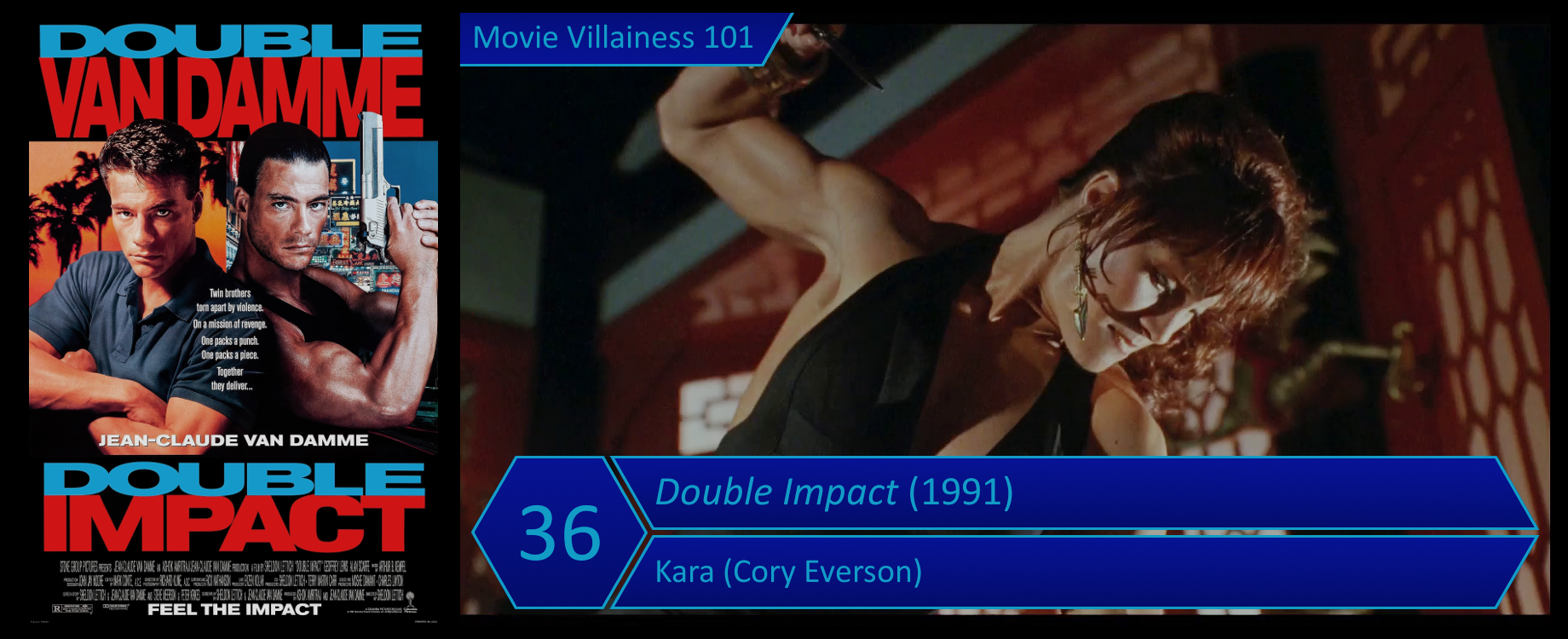
Double Impact (1991)
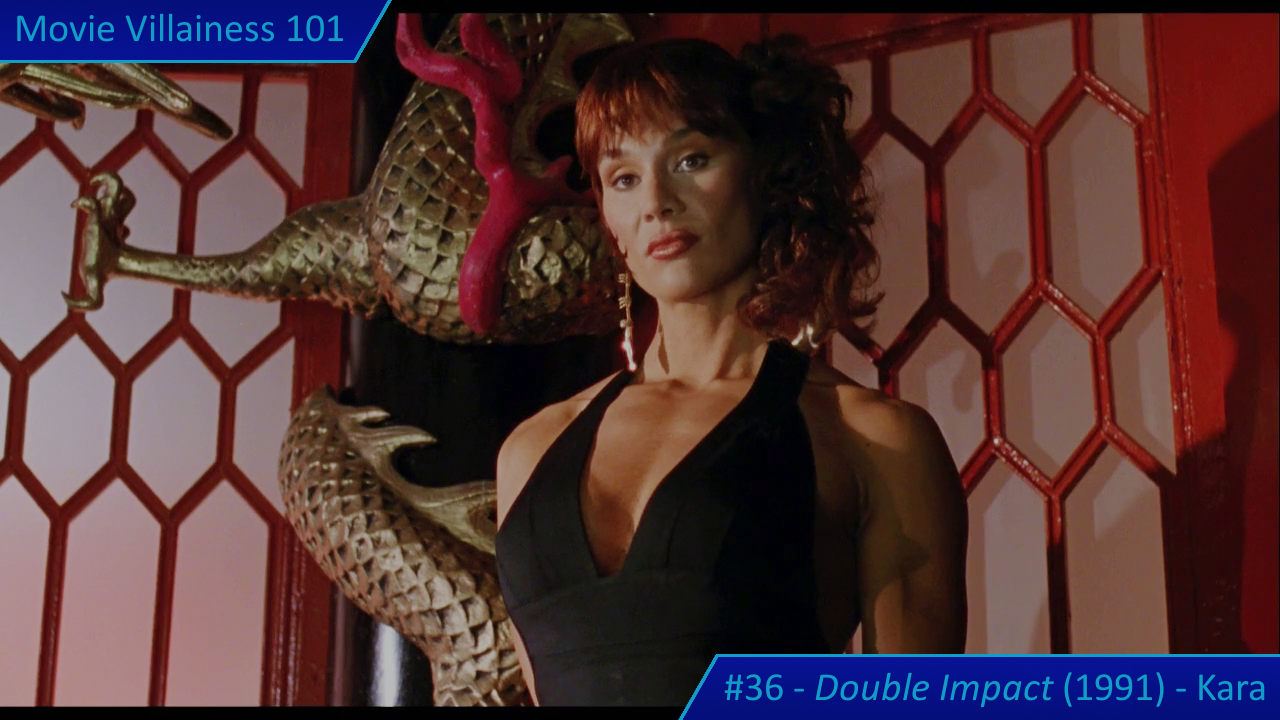
When I put together my list, Cory Everson’s muscular henchwoman Kara – one of two “enforcer” roles she played in her career – was an obvious choice. On reflection, Kara dropped down the rankings quite a bit, but still does enough to be legendary. Amazingly, Kara barely features until the latter half of the movie, but then comes into her own with three impressive scenes to savour.
Before that, there’s the setup with two loving parents murdered by Chinese criminals in Hong Kong. That leaves their bodyguard / security man Frank (Geoffrey Lewis) to look after their twin infant sons Chad and Alex. Actually, he only rescues Chad, and the family maid takes care of the other boy. She gives up on the idea, though, and drops Alex off at the local orphanage.
Chad grows up in relative luxury in California, and twenty-five years later works as a fitness instructor. Since Jean-Claude Van Damme plays both grown-up brothers, this is an excuse to show off his trademark leg split. Frank persuades Chad to go to Hong Kong, and they soon run into Alex, who’s not too friendly, especially after he catches his twin with girlfriend Danielle (Alonna Shaw).
There’s simmering friction between the brothers that’s continually brought up, but eventually they work together. Van Damme times two? The villains really should have killed these boys when they were babies.
Alex – now a criminal smuggler – gets into a shootout on his boat following a deal gone bad. Chad, who gets mistaken for Alex, has a run-in with the gang leader who killed his parents. That would be Zhang (Philip Chan), who has a brutal bodyguard named Moon (bad guy regular Bolo Yeung). Moon gets the better of Chad in a very one-sided fight, but Zhang leaves the hero alive (yes, that mistake again) so inevitably there will be a rematch later on.
Meanwhile, Danielle searches her office for clues, because it just so happens she works for the other main villain, Nigel Griffith (Alan Scarfe). Both the actor and the character are British, naturally. This is where Danielle has her first encounter with Kara (finally!), who handles security for Griffith. Only a few seconds long, but it’s their second office scene that viewers remember.
Villainess
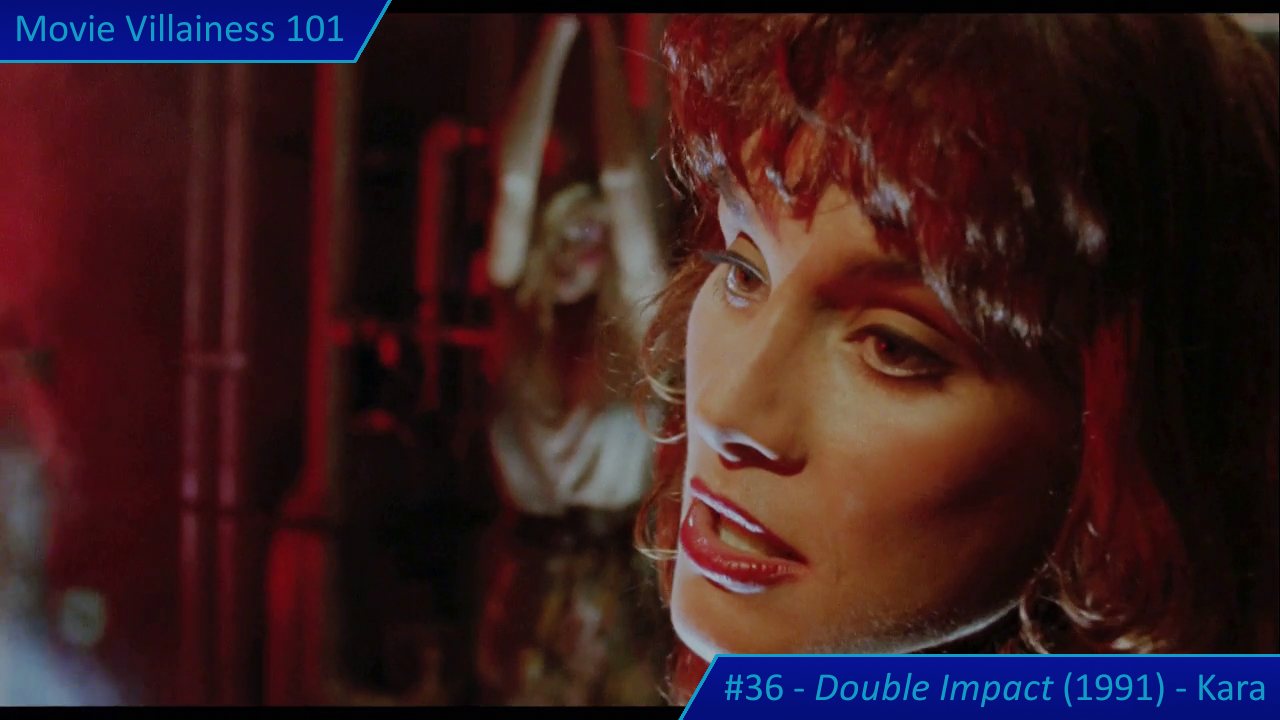
Kara (Cory Everson)
The action intensifies after the brothers raid a drug shipment (thanks to information Zhang gave Chad earlier!) and cause a lot of damage. This is typical action hero stuff with lots of gunfire and near-death moments, and since there are two heroes – plus Frank as backup – it’s no surprise the place goes up in literal smoke.
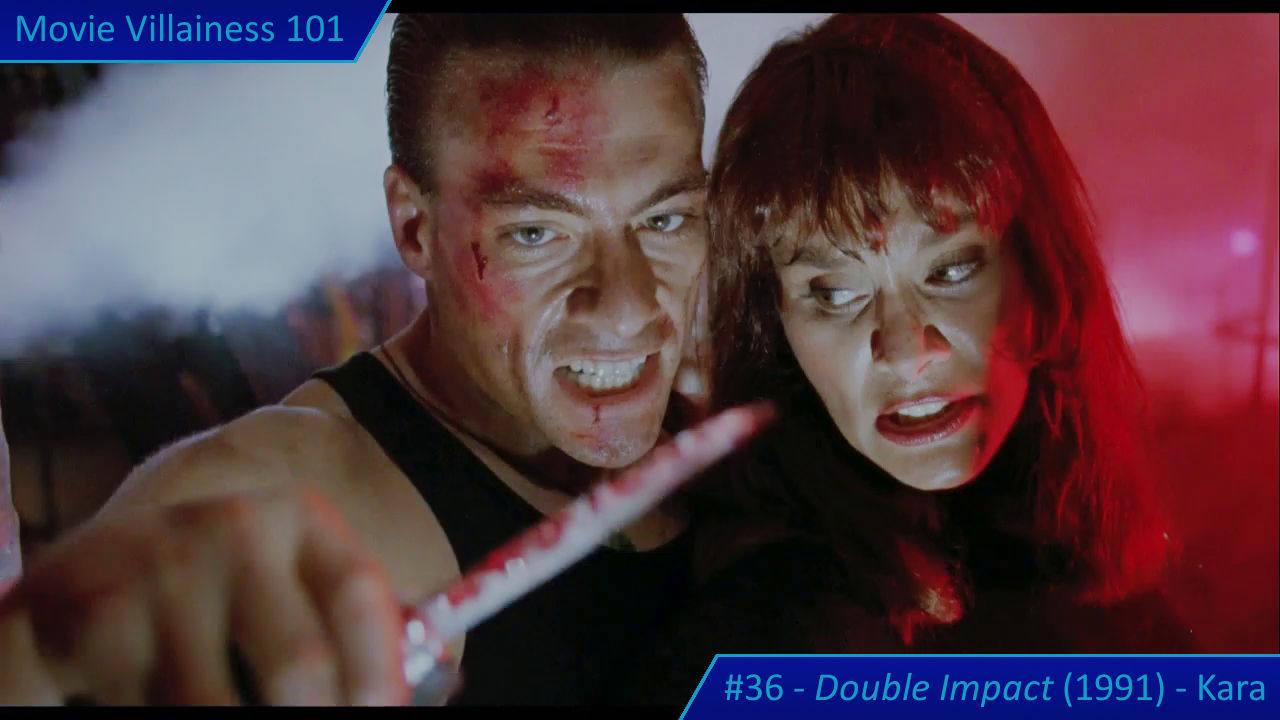
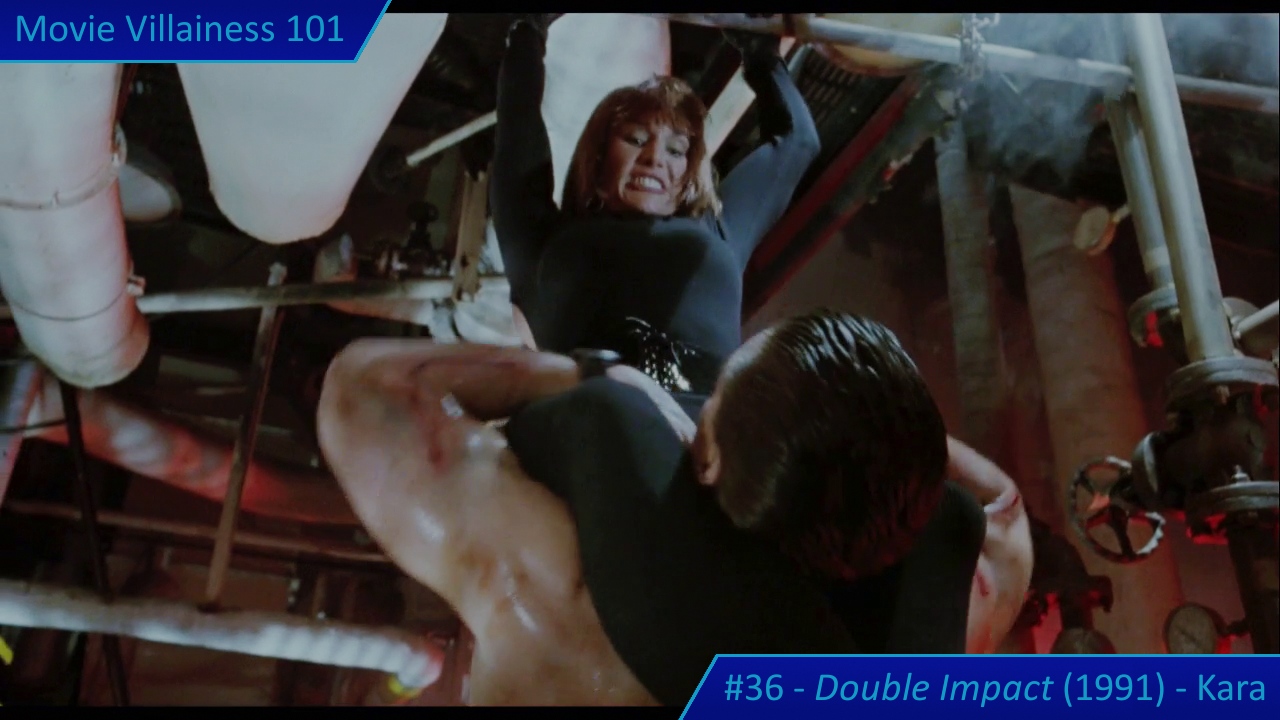
Griffith isn’t too happy with his employees for screwing up, and that’s Kara’s cue to stick a knife in some poor guy’s chest. She flexes her muscles, and the skimpy outfit means we get to see her powerful legs as she kneels over her terrified victim. Anyone who thought this woman was there for show should think again. No wonder the men at the meeting look scared as Kara returns to Griffith with her bloody knife.
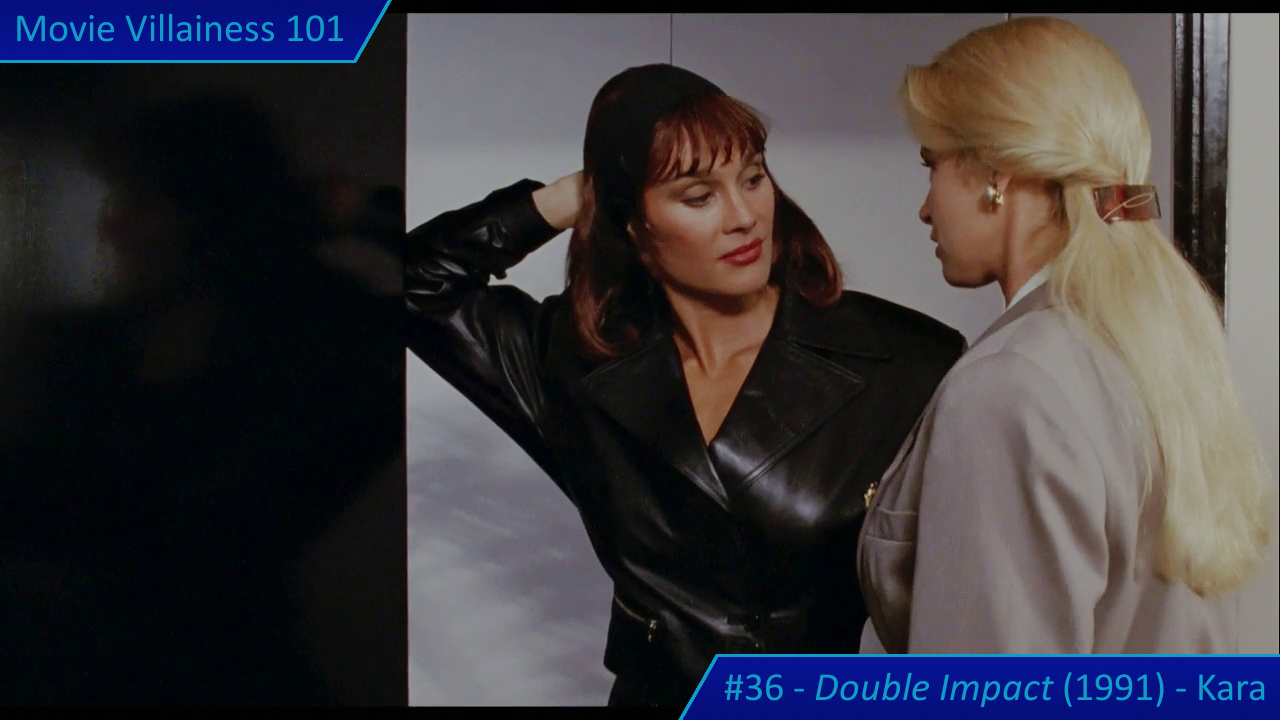
The brothers crash the party and are seen together for the first time. Zhang and Griffith know they’re up against a double dose of the Muscles from Brussels, and they need to up their game. So Kara gets the job – and the satisfaction – of frisking Danielle in the office. This is more than a customary pat-down and closer to sexual assault. A leather-clad strong woman gropes a terrified assistant – the imagery is pretty clear, and Kara clearly enjoys it. Danielle does the expected thing afterward and calls Alex while the villains and their henchwoman listen in.
Kara is strictly the enforcer from that point. The action shifts from a restaurant (and secret back room) to the streets of Hong Kong and moored sampans. Kara’s action is limited to kicking a civilian and long-distance shots of her in pursuit of Chad. After that, she takes to the skies in a helicopter to search for him and Danielle, and follows their boat back to the island hideout. Don’t expect her to be involved in the raid, though. That’s left to Zhang and his henchmen.
Alex and Chad fall out over… what else? Danielle. Alex imagines her having sex with his brother, though they never did in reality (an excuse to show Alonna Shaw naked). The twins put aside their quarrel to rescue Frank and Danielle from a cargo ship. This final sequence is a long string of fight scenes. Alex and Chad waste the goons pretty easily, then come the bigger battles against a spur-heeled killer and Moon. The last one ends with an obvious death by electrocution (the junction box was in shot for a good half minute beforehand).
Eventually, both Zhang and Griffith are defeated. Not much fighting compared to what came earlier, but their ends are suitably brutal considering the pain they’ve inflicted. From a villainess’ perspective, the highlight is Alex against Kara. The muscle woman has changed into an all-black outfit and leather gloves now, and enjoys steaming Frank and threatening Danielle at Griffith’s request.
Knowing one hero is coming for her, Kara leaves Danielle alone with a henchman who molests her. His reward is a headbutt from Alex, but then the enforcer gets the drop on him, trapping his neck between her thighs. Somehow he gets out of that, leading Kara to draw her blade in anger. She cuts Alex – while Danielle watches helplessly – and grabs her opponent by the crotch. Does she want to inflict pain, or feel like groping Alex’s private parts? We’ll never know.
Alex punches her in the face. Kara loses her cool and kicks out in anger, damaging a steam pipe. It’s then a straight test of strength, but no female – even an Amazon like Kara – is a match for Van Damme. She briefly gains the advantage thanks to support fire from Zhang, but Alex turns Kara’s own knife against her and finishes the villainess with a belly stab. Overall, the fight is about a minute and a half long. Not great, but better than many other efforts.
Honourable Mention: Cory Everson
Ballistic (1995) (aka Fist of Justice) – Claudia (Cory Everson)
This review is a Cory tribute, as her other notable film gets an honourable mention. Her climactic fight scene in this direct-to-video action flick is better, but Kara is the strongest overall villainess. I previously owned a terrible VHS copy with poor quality, low-resolution footage. A DVD was released in Germany weeks before I wrote this review, and had an English language soundtrack, which was unexpected.
Good thing Cory stars, because the movie is bland otherwise. Detective Jesse Gavin (Marjean Holden), the statuesque martial arts heroine, is out to prove corrupt cops framed her father (Richard Roundtree). There’s a lot of dirt in the department, from the rookies to the captain. Gavin’s only allies are another female called Lynn and her boyfriend (who’s a handy fighter himself).
The villain is Braden (Sam J. Jones) who deals in drugs and illegal weapons, and arranges rigged fights for money. All the generic bad guy motives rolled into one, which makes the story feel tired. There’s also a witness who gets silenced while Gavin is protecting him, and a busty assistant for Braden to have sex with. Michael Jai White plays a henchman named Quint, but his fights aren’t really that impressive. So it’s left to Cory to save the show, which she does admirably.
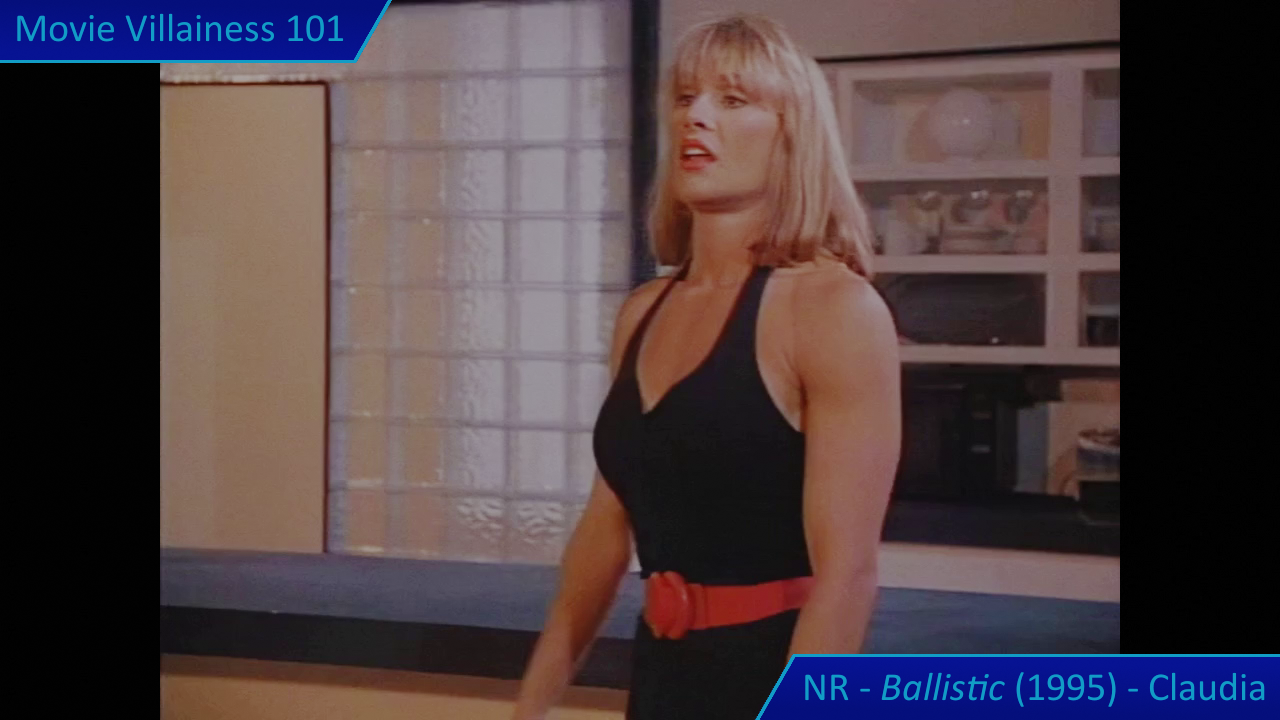
Besides being the silent, glaring type whenever Jesse shows up, Claudia is the villain’s chief henchwoman for eliminating problems. She bests a corrupt cop who knows too much, and knees the guy in the groin just to show her superiority. Then Claudia tosses the guy around his apartment and breaks his neck, leaving a dead body for Jesse to explain. The charges don’t stick, though she is suspended.
This all leads to a climax at Braden’s warehouse hideout. Once again, the main villains are easily beaten – albeit with a big explosion – and it’s Claudia who provides Jesse’s only real test. Holden and Everson get a rewarding and lengthy fight scene, with Claudia in red spandex and Jesse in black. It’s an even contest with the women trading blows and insults. Boxes are used as makeshift weapons, and Jesse’s exonerated father shows up with a gun. Fortunately, he stays out of it.
Jesse gets her opponent in a chokehold, then Claudia regains the advantage with an overhead kick. The overconfident villainess puts her arm around Jesse’s neck, ready to snap it, but lets her guard down and allows the heroine to turn the tables. After a struggle, Jesse inverts the hold and snaps Claudia’s neck. Few impressive scenes in the movie, but this makes up for it.
Fail to meet her high standards – or ask too many questions – and it’s lethal injection time
Movie
The Perfect Bride (1991)
A routine psycho-woman thriller, but the inventive kill sequences and high body count – plus an over the top bad girl – earn this film a legendary rank. That’s probably why the movie airs on Lifetime despite being over thirty years old. Few modern productions have such longevity. Whenever you need a reliable made for TV effort, the 1990s is the decade to choose.
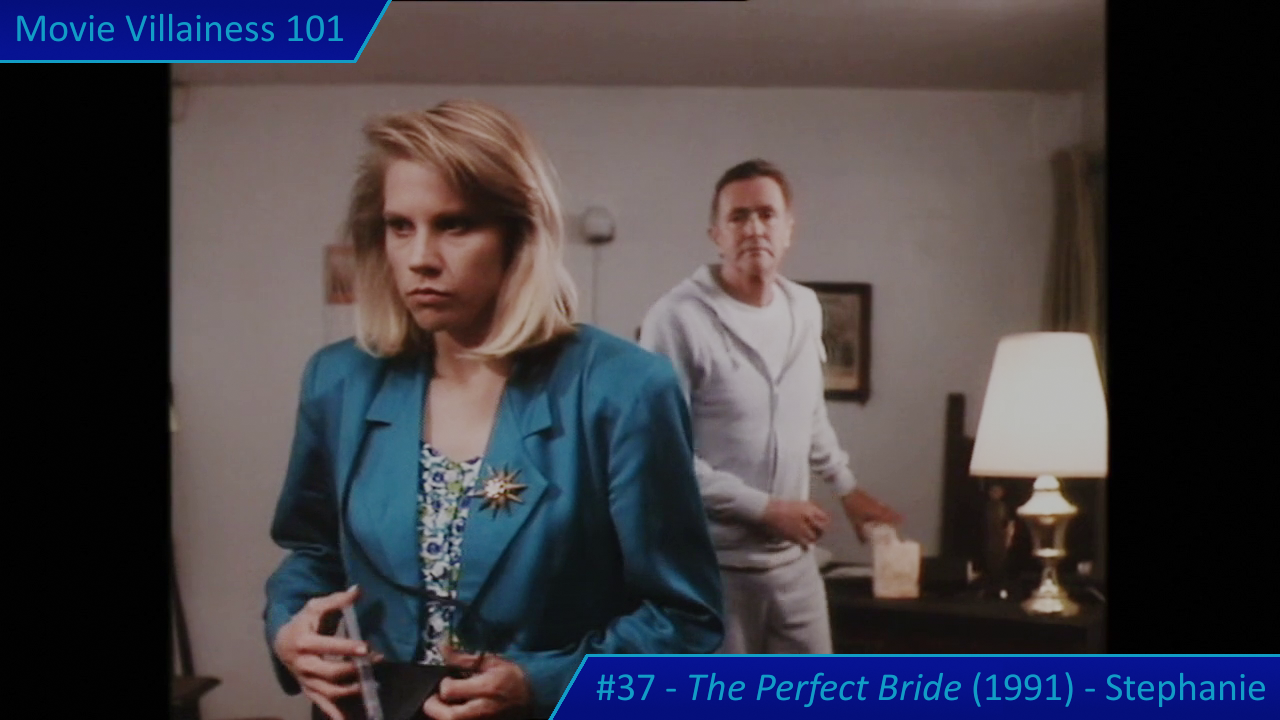
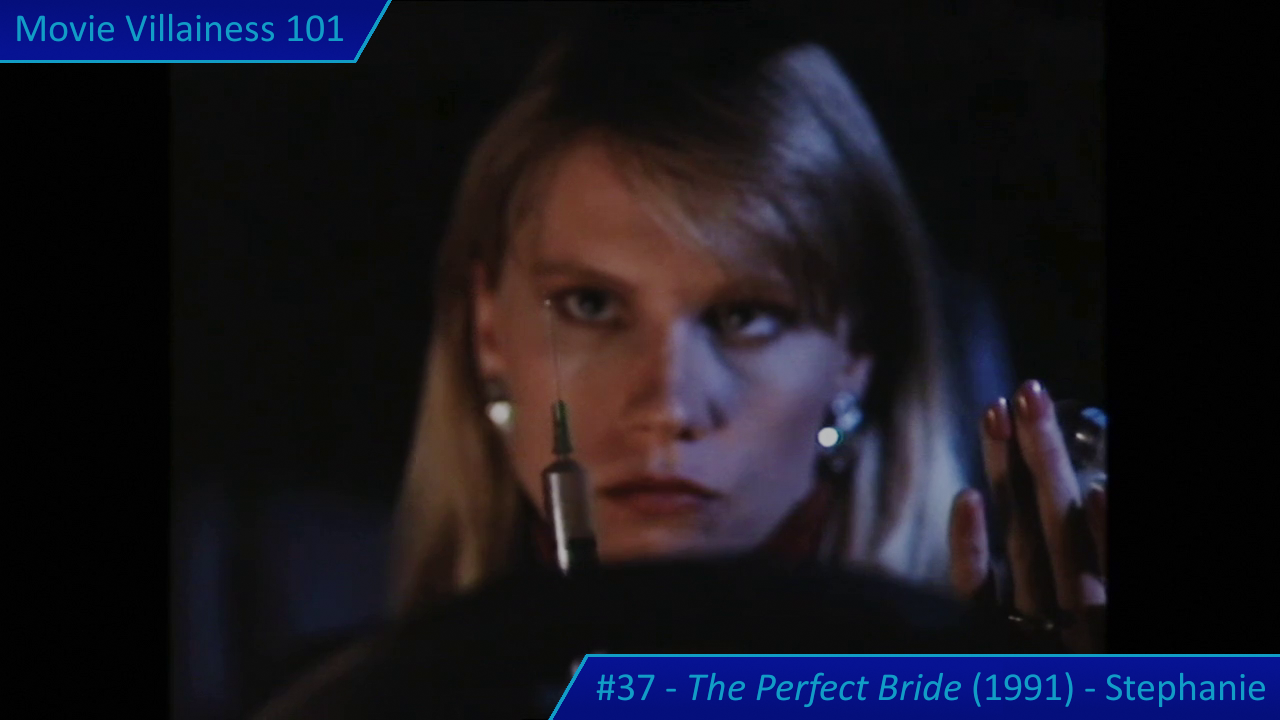
The title character is a woman with high standards for any future husband. Any sign of infidelity or even a hint of imperfection, and you can expect a lethal injection. That also goes for anyone who dares to get in her way, and plenty of minor characters have “unfortunate” heart attacks. One wonders whether the police in this town know about forensics and autopsies. But the plot requires only the heroine, Laura (Kelly Preston) to see the truth about Stephanie, so the deaths are written off as natural causes.
Laura has a stubborn family, which is a problem when her brother’s bride-to-be is a homicidal lunatic. Who spouts “bad girl” lines (in a posh English accent) whenever she eliminates an obstacle. Besides the besotted groom Ted (Linden Ashby), Stephanie also charms Laura’s unsupportive mother, her senile grandfather, and a policeman friend. So it’s down to Laura to be the snoopy investigator and save Ted from the psycho’s needle.
Villainess
Stephanie (Sammi Davis)
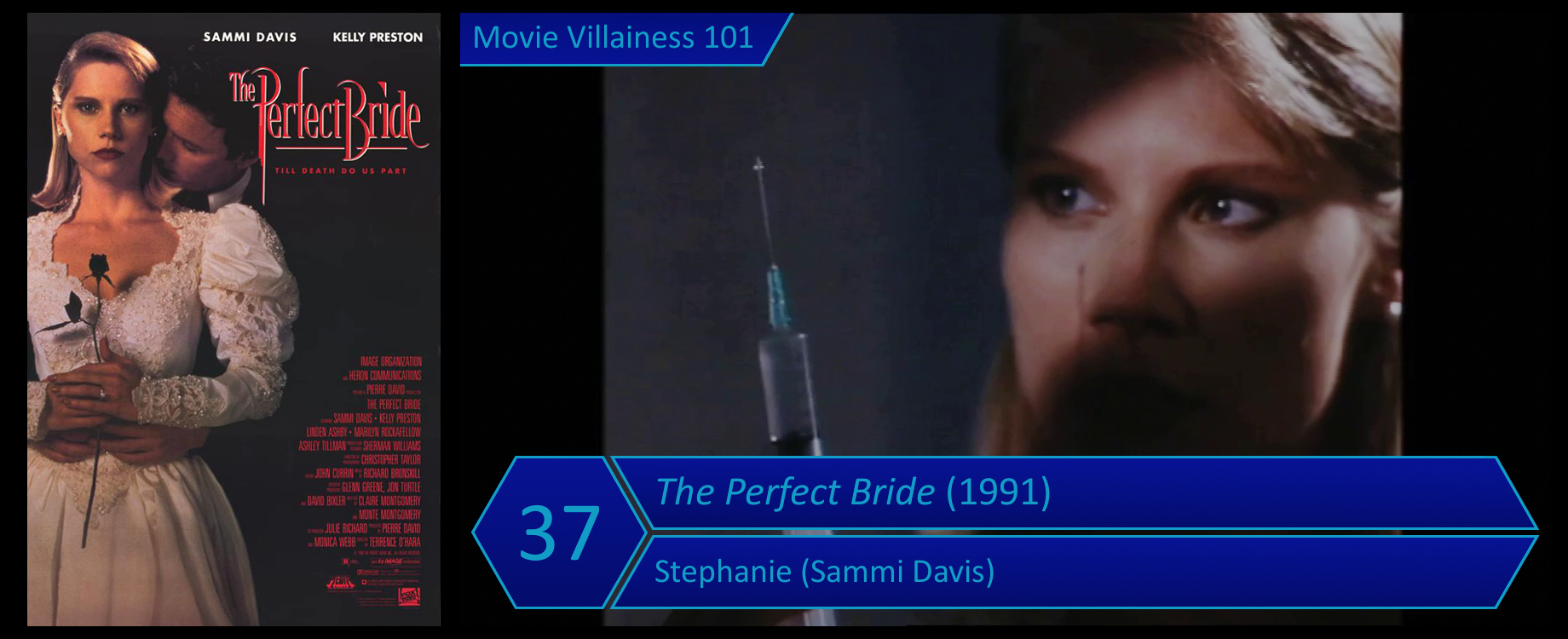
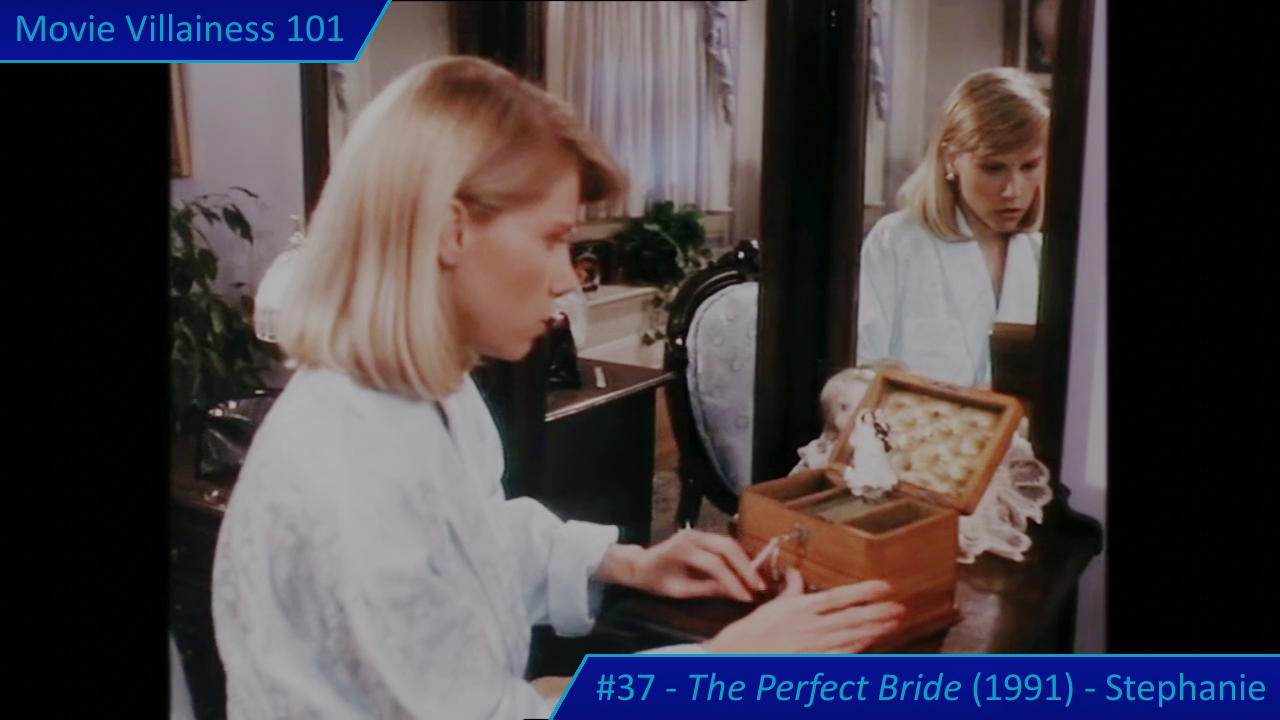
Like all good TV movie villainesses, Stephanie claims her first victim early. A groom looks forward to premarital sex on the eve of the wedding, only to discover the hard way his bride is a psycho. She is not pleased about his visiting his ex-girlfriend. After literally making her point with a syringe, Stephanie smiles at her own reflection in the bathroom mirror. It’s clear this woman is crazy, but that moment should erase any lingering doubts.
With that dealt with, it’s time for Stephanie to enter Ted and Laura’s lives. Initial impressions are good, but Laura becomes suspicious when Stephanie reacts coldly to a receptionist and snaps at a dress fitter over a trivial mistake. Purchasing a cheap tablecloth and claiming it’s a family heirloom is a ruse Laura soon sees through, and now she’s really worried about her brother. Nobody listens to Laura (that would be too easy) and Stephanie always has an excuse ready for any odd behaviour.
To keep things moving, Stephanie bumps off two more victims. First up is a caterer who recognises her from a previous wedding. That’s a threat, so the killer bride comes calling with her hypodermic needle. Surprisingly, the woman puts up a good struggle, considering she’s a minor character and they’re usually killed with little fanfare. After a lengthy scrap in the kitchen, Stephanie flees, but the caterer is stupid and checks out the basement. A fatal error in judgement, but in a cruel twist of fate, Laura’s mother decides not to employ her services.
Laura asks a priest to give Ted and Stephanie marriage counselling, so no surprise he’s next on the kill list. The murderess has flashbacks to her childhood when her mother committed suicide and warned her about men. Quite an impression on a distraught young girl, which explains the obsession with finding Mister Perfect. After one insane rant, the priest postpones the big day. That’s the villainess’ cue to induce a heart attack.
The desperate Laura digs deeper into Stephanie’s past and tracks down a woman who knew the previous groom. Unfortunately, Stephanie listens in on the phone call and puts on a clever disguise – and an American accent – to lure the witness into a trap. There’s a funny moment when Stephanie narrowly avoids a road accident, which causes her to yell “Bloody hell!” and give herself away. The witness escapes, only to be knocked down by an oncoming car.
Stephanie learns the woman survived from a news report, so she visits the hospital disguised as a nurse to finish the job. It’s never a good thing to be unconscious or badly injured in one of these films. Once the killer has asphyxiated her victim, she returns home. Laura’s grandfather sees Stephanie in a nurse’s uniform, but he’s a doddering old guy nobody believes. After gloating over Laura’s dead lead, Stephanie turns her attention back to Ted.
With such ludicrously high standards, the groom was always going to disappoint the bride. The snapping point is when Stephanie sees Ted with the receptionist (remember her?) at a bachelor party. So she dons her wedding gown and readies her needle. Laura comes racing to the rescue and saves a disbelieving Ted, but he changes his tune once Stephanie stabs him with a kitchen knife. There’s a short, semi-decent stalk/chase scene and a brief catfight that ends with Laura hiding in the attic. She arms herself with a baseball bat and sends the psycho on a fatal tumble downstairs.
Honourable Mention: The Perfect…
The Perfect Marriage (2006) – Marianne Danforth (Jamie Luner)
The Perfect prefix usually designates a TV movie aimed at Lifetime audiences, and this is indeed another of those films. Marianne is a scheming woman quite prepared to murder her husbands for their money. She killed her previous spouse with a lethal injection, a crime she planned with her lover Brent (James Wilder). After he used the large payout to settle his debts, Marianne dumped him.
A few years later, she’s happily married to a wealthy businessman’s son. Then Brent re-enters her life, and soon they have eyes on the family fortune. The villainess delays killing the father until he seals a company deal, then it’s time for an induced heart attack. When a nosy assistant gets too close to the truth and carelessly gets seen snooping, Brent murders her.
A female associate named Tia picks up the trail and becomes the protagonist for the last act. As the net closes in, Marianne decides Brent is expendable, so he gets the lethal injection treatment. Perhaps he shouldn’t have provided potassium chloride to a scorned woman.
In the finale, Marianne tries to silence Tia. This leads to a longer than usual chase scene with the villainess hunting her prey in a parking garage. Eventually, after a scuffle and stalking scene, a random motorist runs over Marianne. A disappointing end to a decent thriller.
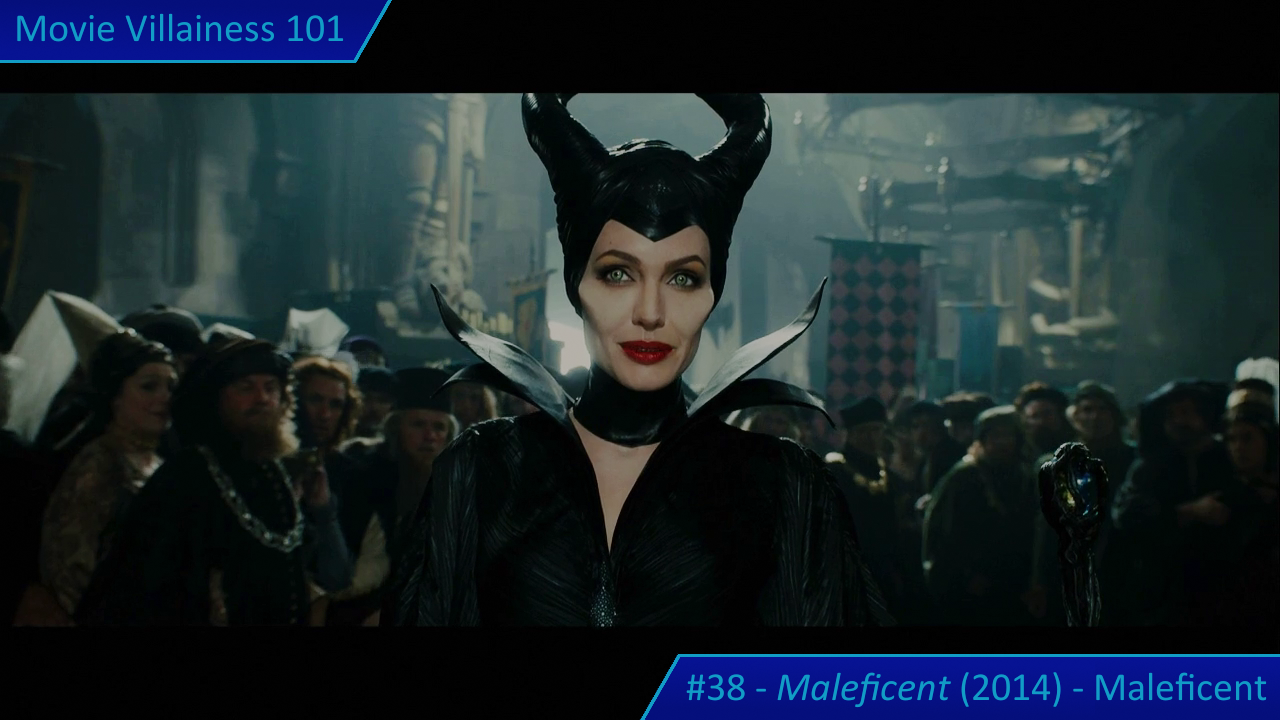
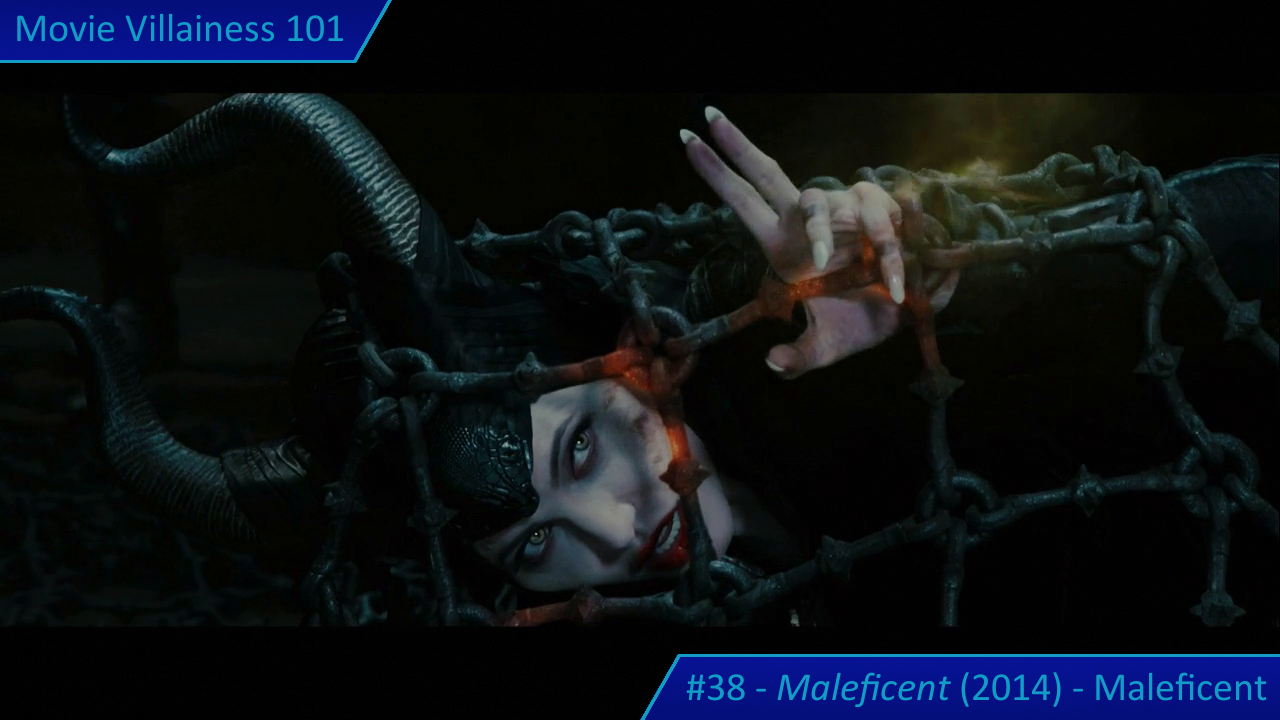
Ranking this villainess protagonist as legendary is a debatable decision because she’s an innocent girl for the prologue and the heroine for the entire last act. However, this live-action adaptation of Disney’s 1959 animated classic Sleeping Beauty is ultra-stylish, and its central character is too iconic to omit. For the villainous portion, Angelina Jolie has such a powerful screen presence that she – literally at times – lights up the somewhat basic redemption story.
In the old animated tale, Maleficent was a straight-up villainess, but here the chief baddie is Stefan (Sharlto Copley), a thief who befriends the titular fairy as a child. When humans invade the Moors (fairy territory), Maleficent and her magical army fight off the offensive. In desperation, the mortally wounded king offers his crown to anyone who slays the winged fairy who bested him. Stefan uses his past relationship to get close, but cannot kill his former lover, so he clips her wings as a trophy.
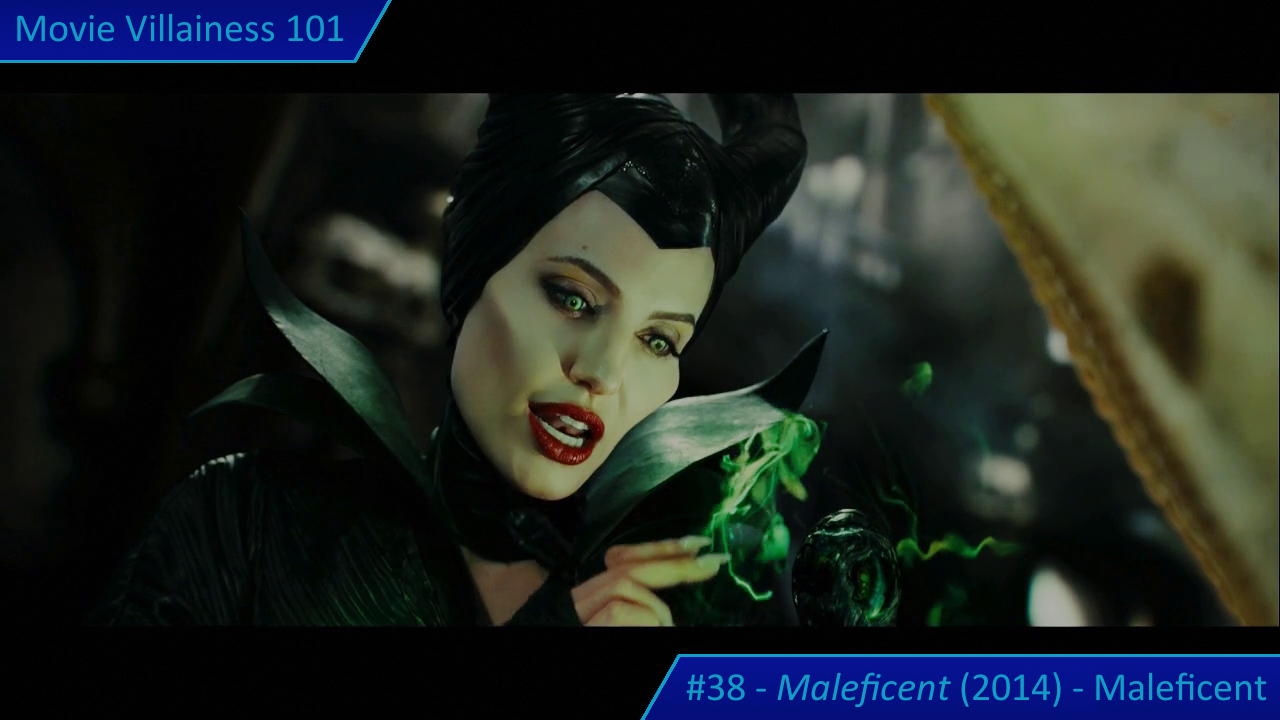
This sets Maleficent on her dark path, and soon she’s crafted a staff and developed a wicked green aura. To symbolise the transformation, the moors grow dark and gnarled tree branches create an impenetrable barrier between the fairy and human kingdoms. Now the villain of the story, Maleficent magically changes a raven into a man and gains a faithful servant in Diaval (Sam Riley).
Many elements from Sleeping Beauty feature: three bickering fairies, a handsome prince, and the beautiful and sweet Aurora (Elle Fanning). The fairytale landscape is captivating, with sprawling fields, towered castles and a variety of weird and wonderful creatures. But viewers expecting the story to unfold like the animated original will be surprised by key changes.
Villainess
Maleficent (Angelina Jolie)
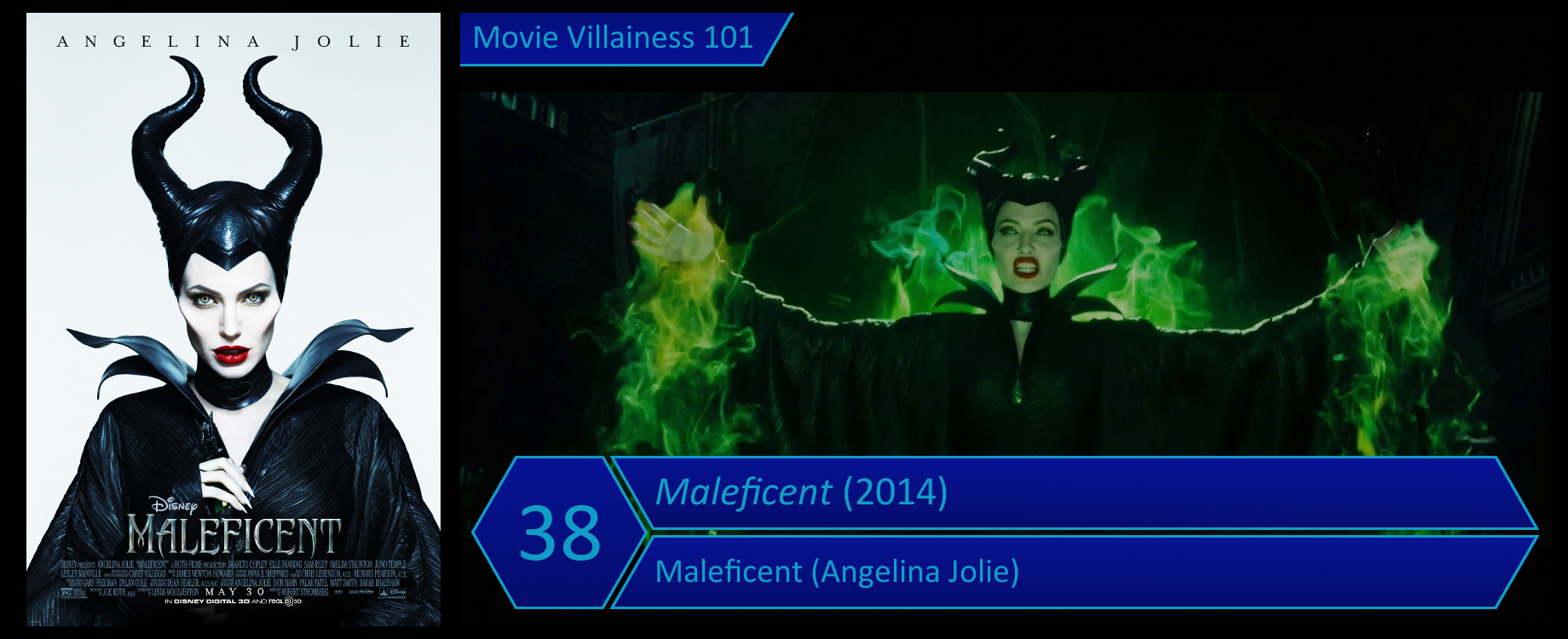
The birth of Aurora brings out the worst in Maleficent. During a celebration party, the black fairy visits the castle and bestows a gift. Actually, it’s a curse that Aurora shall prick her finger on a spinning wheel needle and then fall into an everlasting sleep. Heard of that one? The villainess gives a dramatic speech as green fire bursts from her. Stefan begs for mercy, so Maleficient decrees the curse won’t take effect until Aurora is sixteen. It can be broken… but only by true love’s kiss.
Stefan – obviously unaware that curses always happen – orders every spinning wheel in the kingdom burned and sends his army to assault the Moors. Fire has no effect on the wall of branches, and Maleficent’s magic wards off the lowly footsoldiers. For extra security, Stefan tasks the three fairies to guard Aurora and keep her away from the castle. Over sixteen years, the threesome morph into adults, but they are more interested in playing games and arguing than childcare.
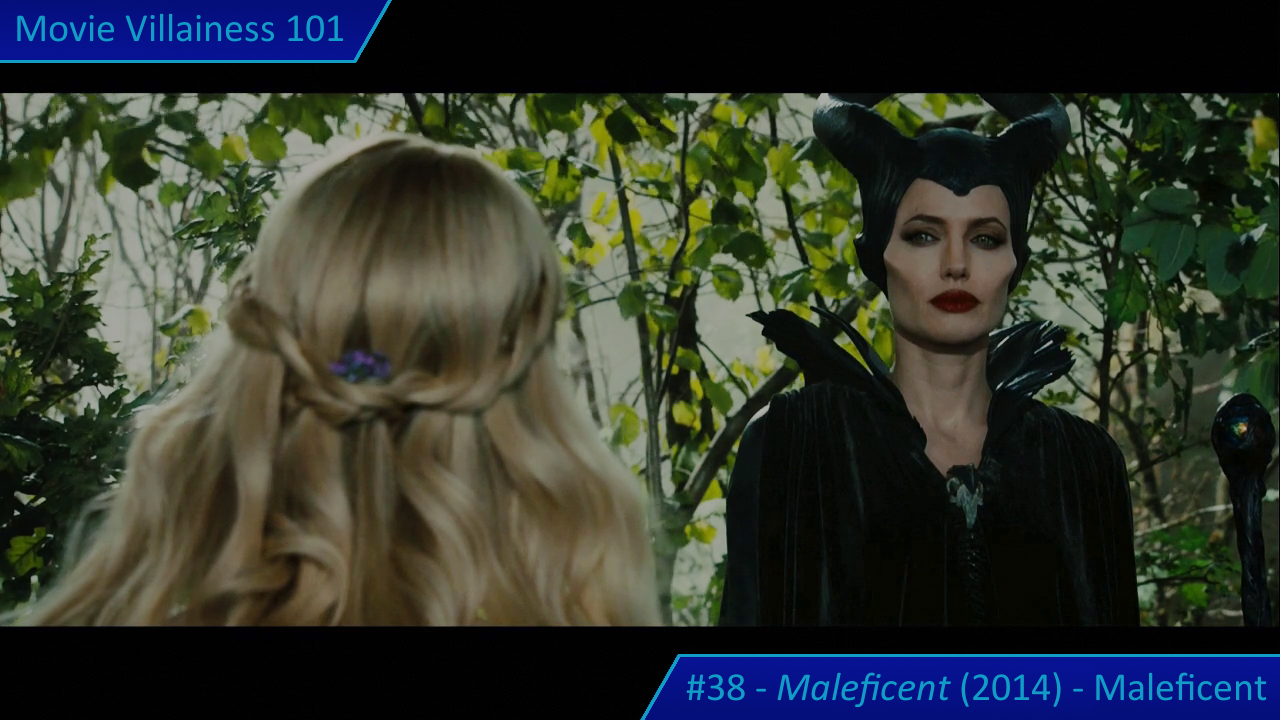
Maleficent and Diaval have a change of heart and keep the princess safe. Over time, the protagonist becomes fond of the girl, and the child regards Maleficent as her fairy godmother. The softened villainess is shocked at the notion, but Aurora’s sweetness and innocence inspire the curse’s creator to revoke it. Unfortunately, Maleficient’s own words – that the curse will last for all time – come back to haunt her.
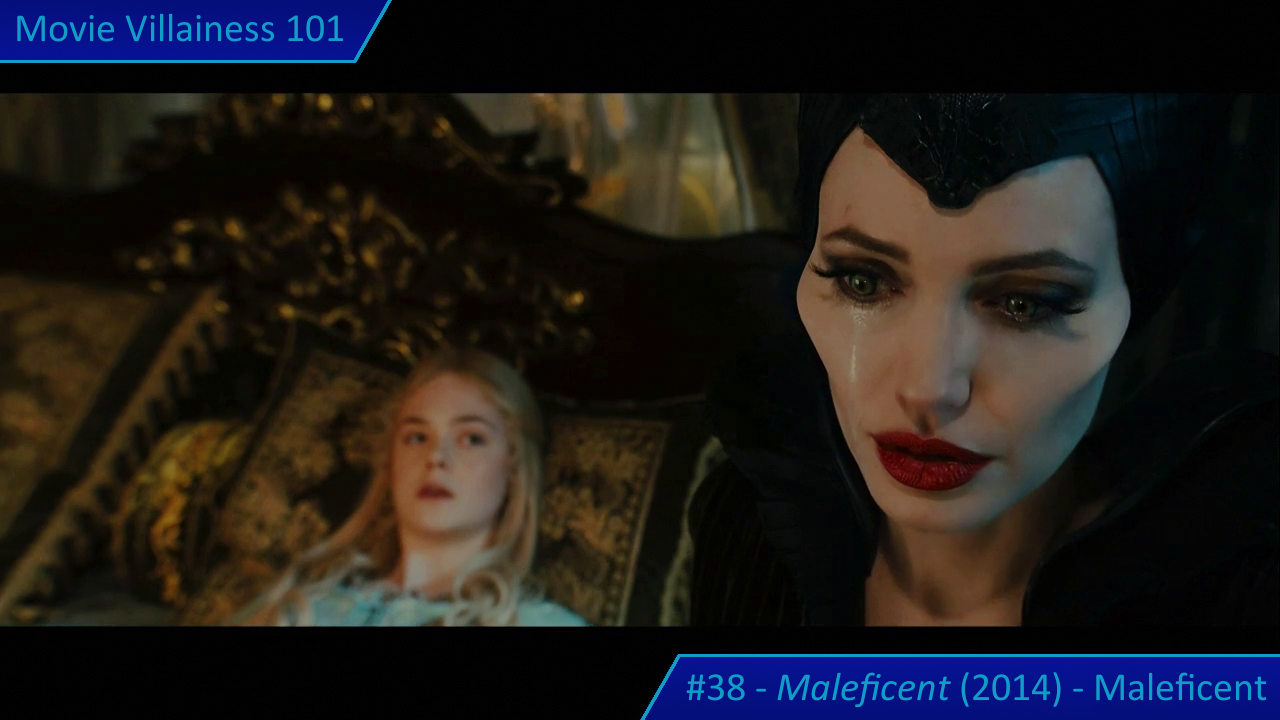
When Aurora learns the truth, she flees to the castle. Then the inevitable happens: a spindle reassembles, the girl pricks her finger, and drops into a magical sleep. Before all this, she met a prince, so Maleficent brings him to the castle hoping his kiss will break the curse. Unlike the animated tale, this doesn’t work as there’s no love between them. That’s when Maleficent visits the sleeping beauty seeking redemption and kisses her. Anyone care to guess what happens next? Yes, in this version, it’s Maleficent who truly loves Aurora, and the curse is duly lifted.
With the females united, Stefan’s troops drop a metal net over the anti-heroine. Since iron burns fairies, that’s not good, but before she falls unconscious, Maleficent transforms Diaval into a dragon. This leads to an epic clash of steel and magic, with armoured troops fighting the beast. While the guards are busy, Aurora smashes a display case to release Maleficent’s wings. They fly back to their owner, turning the tide of the battle. Maleficient shows the deposed king the mercy he deserves – none – and he falls from the castle parapet.
And everyone lives happily ever after… until the sequel, at least. That aspect of the fairytale was never going to change.
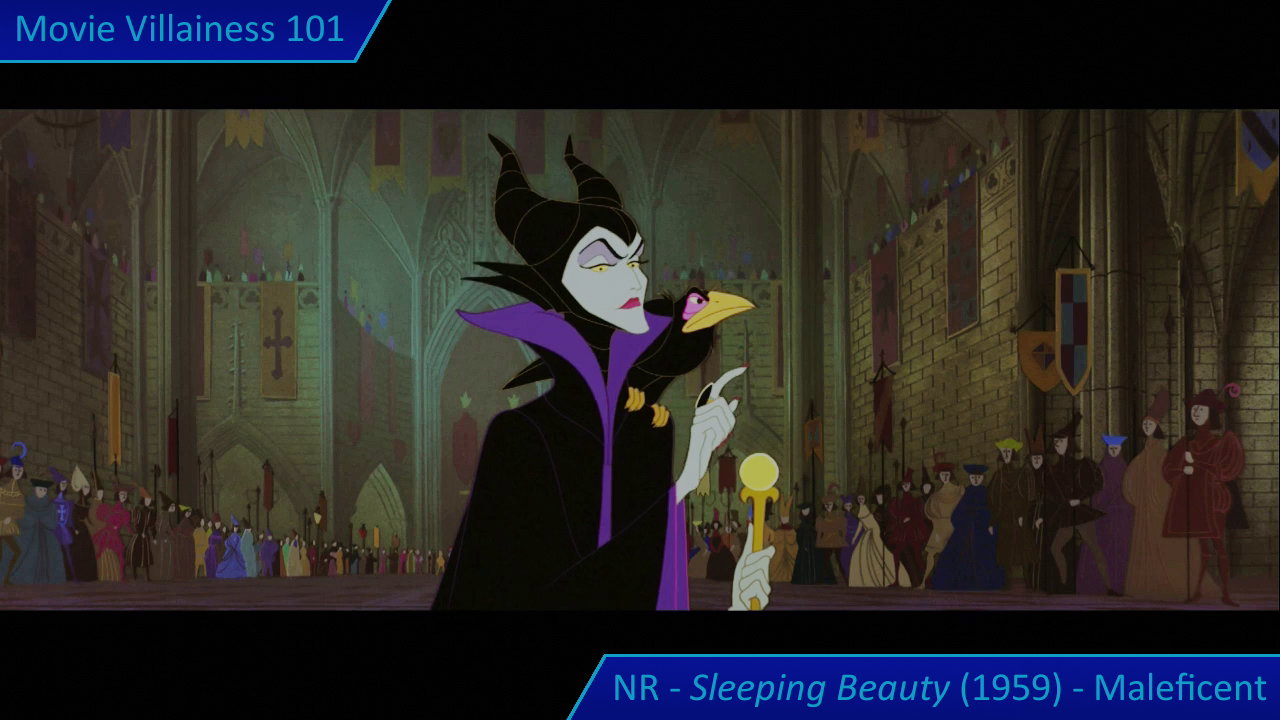
I’ve focused on live-action movies, but it’s only fitting to grant an honourable mention to one of Walt Disney’s best animated features. The classic tale is strictly good versus evil, so don’t expect any character development or grey moral areas.
Stefan is a noble king. Maleficent is a villain just because the story requires one, and there are many musical overtures. And comical moments as the three good fairies fight over the teen princess Aurora. Some key plot details are common with the live-action version, notably when Stefan orders every spinning wheel burned. And of course, Maleficent casts her diabolical curse on the infant.
As children’s entertainment, it’s not overlong at seventy-five minutes. Simplistic by today’s standards, but the animation is top-notch for the era. The highlights are Aurora being deceived into pricking her finger, and the duel between Prince Phillip and Maleficient. Or rather, the dragon she’s shapeshifted into. In the end, the dashing hero vanquishes the evil fairy, wakes his love with a kiss, and marries her. Of course, everyone lives happily ever after.
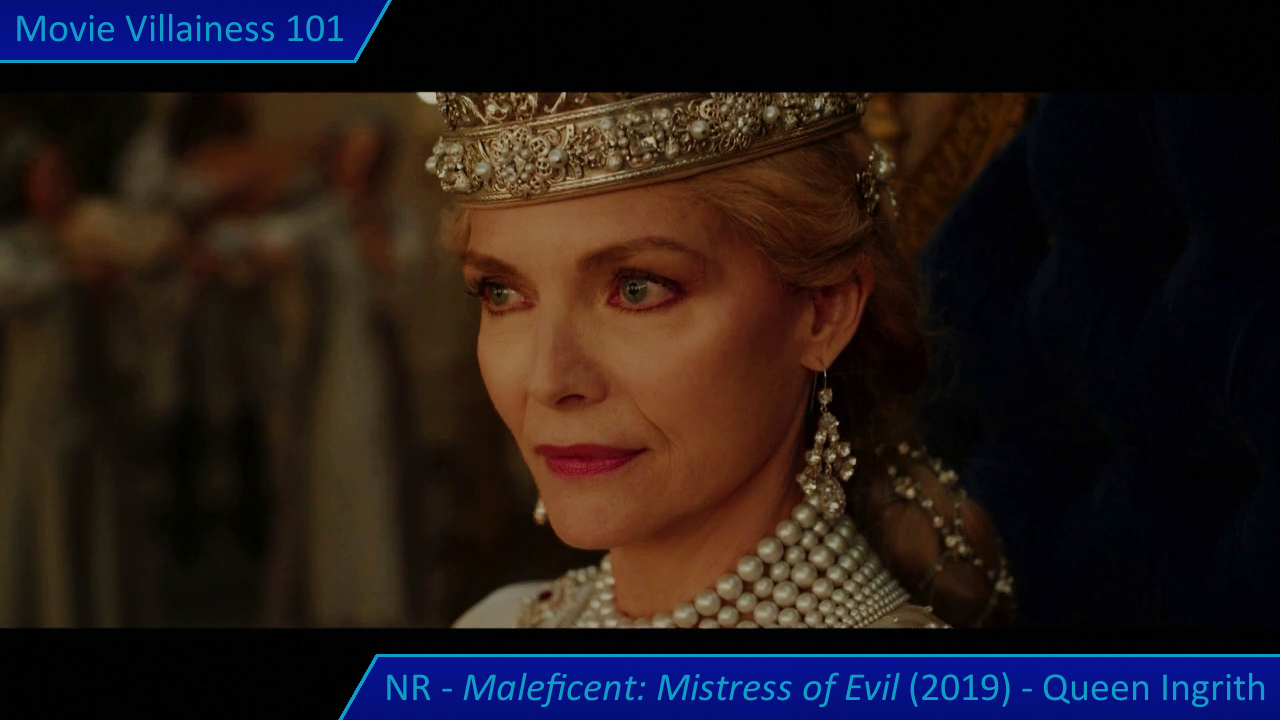
Maleficent: Mistress of Evil (2019) – Queen Ingrith (Michelle Pfeiffer)
The sequel picks up five years later, and many characters return for another epic adventure. Newcomers include the prince’s parents: a peace-seeking king and a scheming queen mother.
Ingrith is so intent on conquering the Moors she frames Maleficent for cursing her husband. This instigates a bitter war between humans and fairies. Michelle Pfeiffer’s villainess has no moral ambiguity, but her backstory is not as interesting as Maleficent’s. A few tyrannical speeches on being a “strong” queen are all we get for motivation.
Ingrith and her gnome assistant harvest anti-fairy powder and stockpile iron weapons for their diabolical plot. The final battle – when we get there – is spectacular. A female guard captain shoots Maleficent with a crossbow contraption, but is then sidelined into shouting announcements and playing an organ. Admittedly, the pipes double as a powder-launching device, and the music accompanies the slaughter of fairies. But soldiers should be fighting.
A swarm of winged fairies joins Maleficent to assault Ingrith’s castle, only to be annihilated by the defences. The marriage of Aurora and the prince is a side story, and there’s some poor exposition about Maleficent being the last living descendant of a phoenix. That’s an excuse to resurrect her from the ashes and shield Aurora from the evil queen. You didn’t expect the central character to die so easily?
Despite the increased stakes, this instalment is a weaker effort. As a humorous touch, Maleficent transforms the defeated villainess into a goat, but that can’t disguise the inferior story.
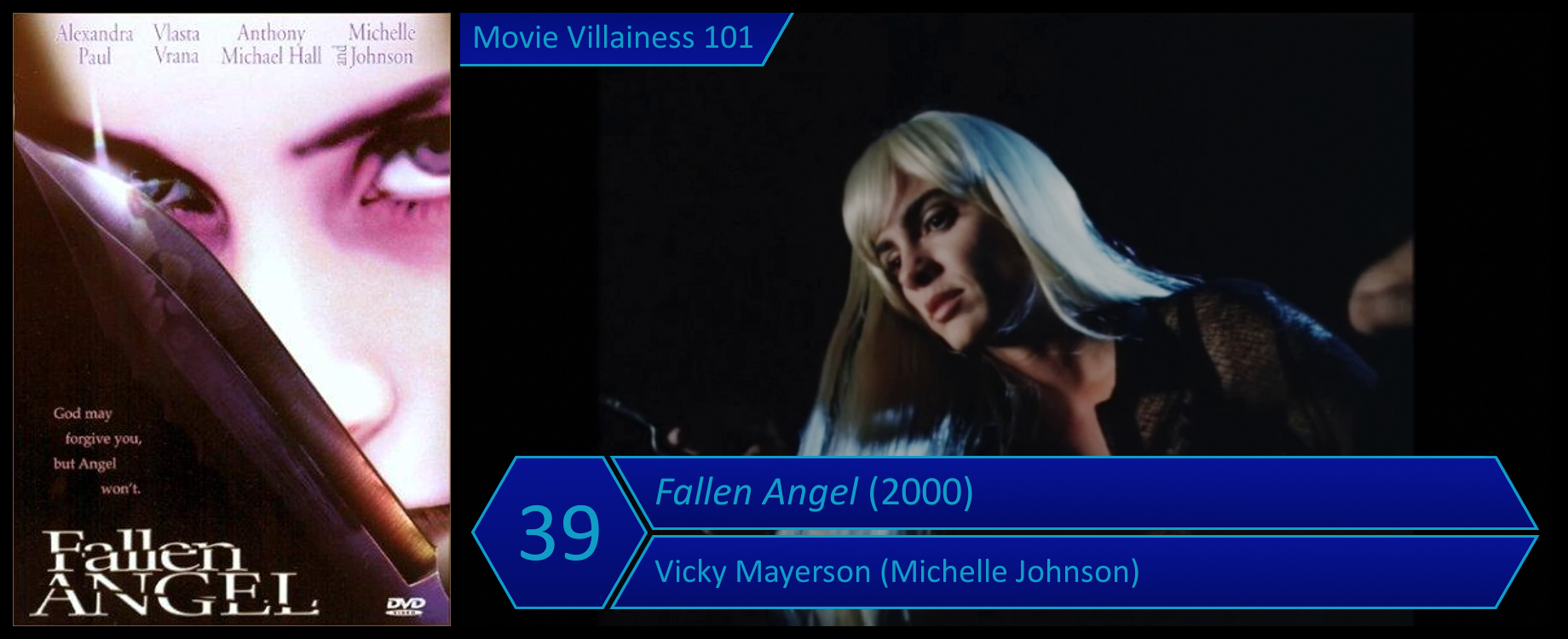
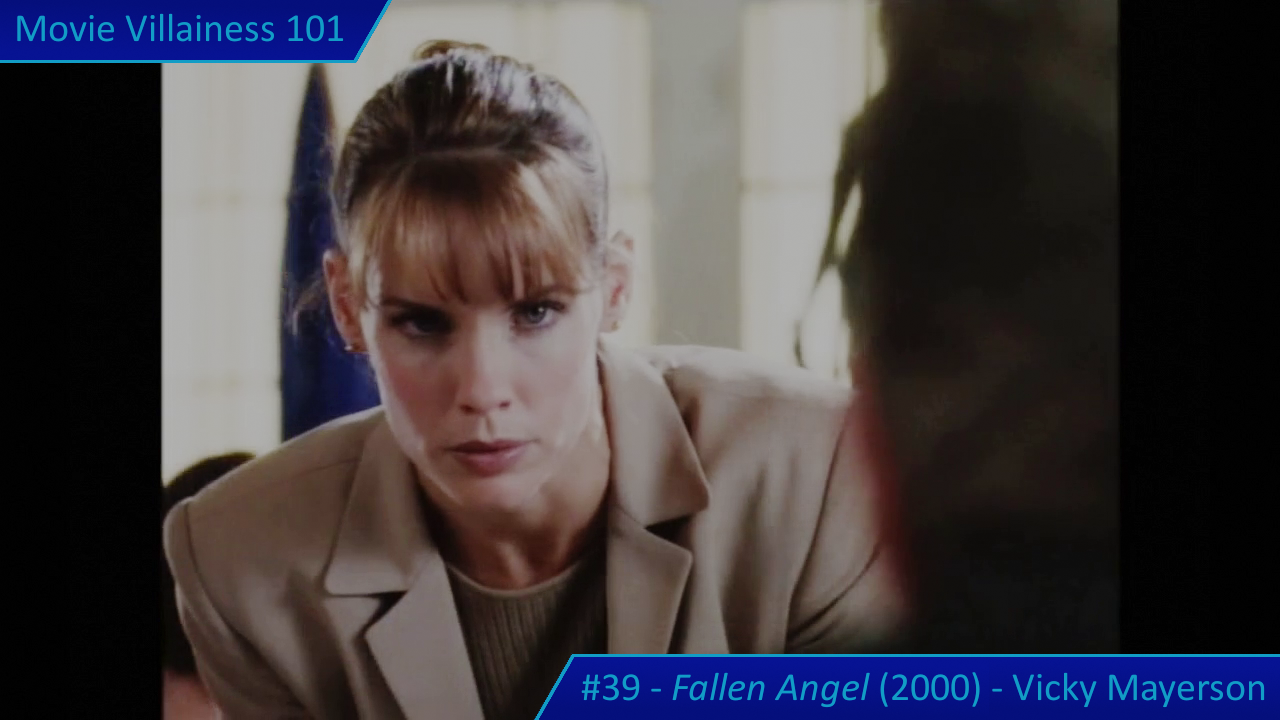
Another direct-to-video movie with Alexandra Paul as a tough police officer, but while Daphne Zuniga in Prey of the Chameleon (1992) ranks just outside the top forty, Michelle Johnson’s revenge-seeking psycho makes it into the upper tier. Vicky commits murder in disguise and stages elaborate crimes, so she’s a more interesting foe than the average nutcase.
Detective Laura Underwood is unorthodox (“normal” cops don’t exist in these movies). In the prologue, she sides with a woman holding her husband hostage and promises to kill the guy. In her defence, the “victim” is violent and abusive, but the cowgirl approach wouldn’t be tolerated in real life. The villainess appears shortly after, and a duel of wits begins between the cop and the killer.
The murderess elicits a lot of sympathy, as her killing spree stems from an attack she suffered from a group of boys when she was a teenager. However, Vicky is crazy enough to be classified as a villain, and her victims become more sympathetic as we progress. It turns out Laura went to the same school as the dead guys, and there’s an inconvenient past relationship with classmate Brian (Anthony Michael Hall). There just had to be an ex involved.
The other men in Laura’s life are her father, Dan (Vlasta Vrana) – also a detective – and a charming rookie named Jimmy (Andrew Simms). He ends up as bait during a potentially deadly high school reunion. It’s dangerous to know Laura.
Villainess
Vicky Mayerson (Michelle Johnson)
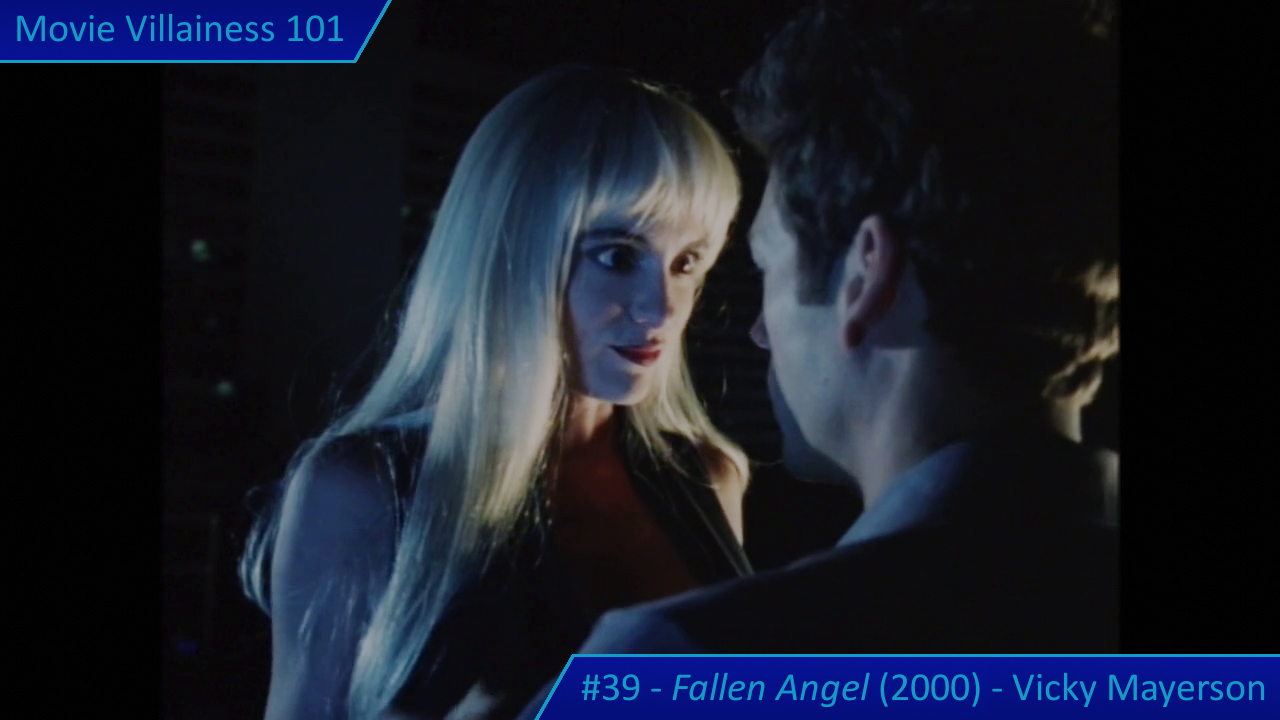
The villainess claims her first two victims within the opening twenty minutes. Not one to waste any time, is she? Vicky seduces the first man on a nightclub roof, acts daredevil by standing on a ledge, and then delivers her catchphrase: “Never trust a man after midnight”. This links back to an assault on an elevated freeway years earlier that we’re shown several times in flashback. Once she’s spoken the line – which terrifies the man – Vicky pushes him off the roof.
It’s hazardous to be in skyscrapers when Vicky is roaming around. For victim #2, she dresses as a maid and enters a hotel room. Pretty soon she has the sole male occupant at knifepoint and directs him to the balcony. Then comes the midnight phrase, and the panicked man protests his innocence. Vicky isn’t big on remorse, so she slits his throat and pushes him over the edge. She casually wipes down the knife and leaves it behind, which puzzles the police.
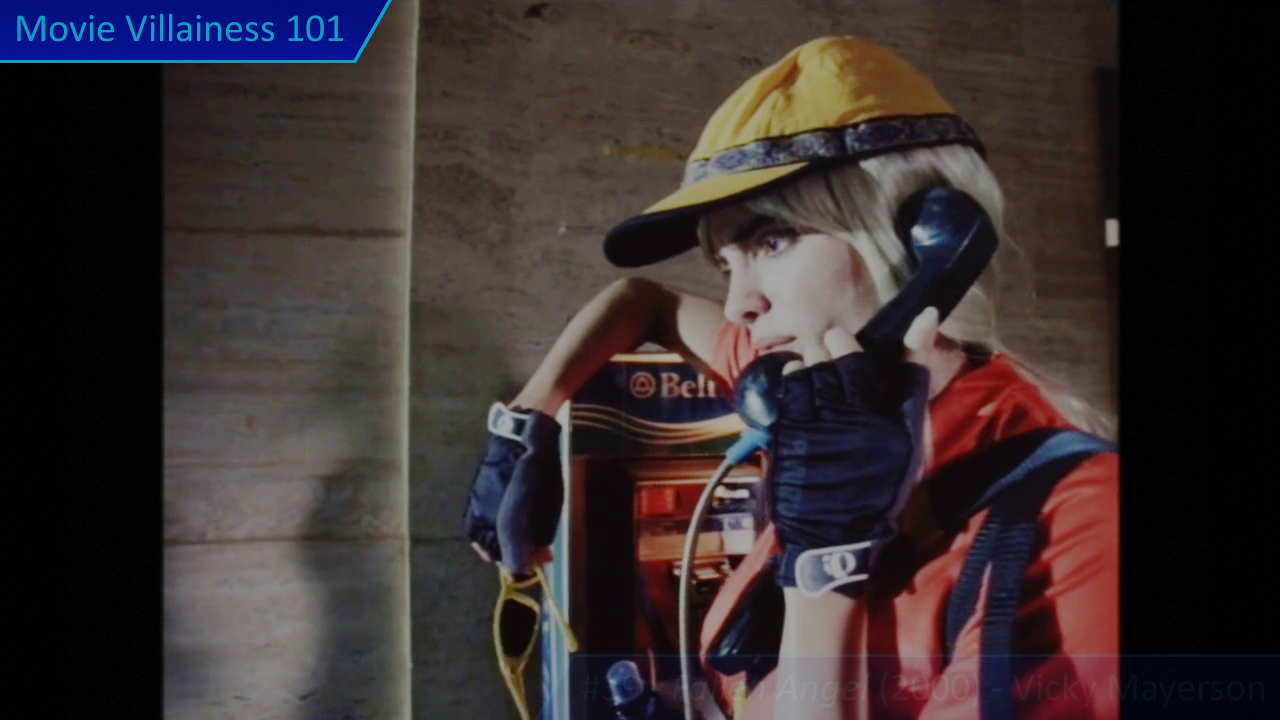
It doesn’t take long for Laura to realise she knew the victim at school, and they’re dealing with a serial killer. After some scenes with Brian that thankfully don’t slow the momentum, the killer calls the detective at the police station. The snappy dresser has changed into a bright outfit, cap and sunglasses to pose as a courier, and gives Laura a cryptic hint. This is clearly a woman with a vendetta who hasn’t finished yet.
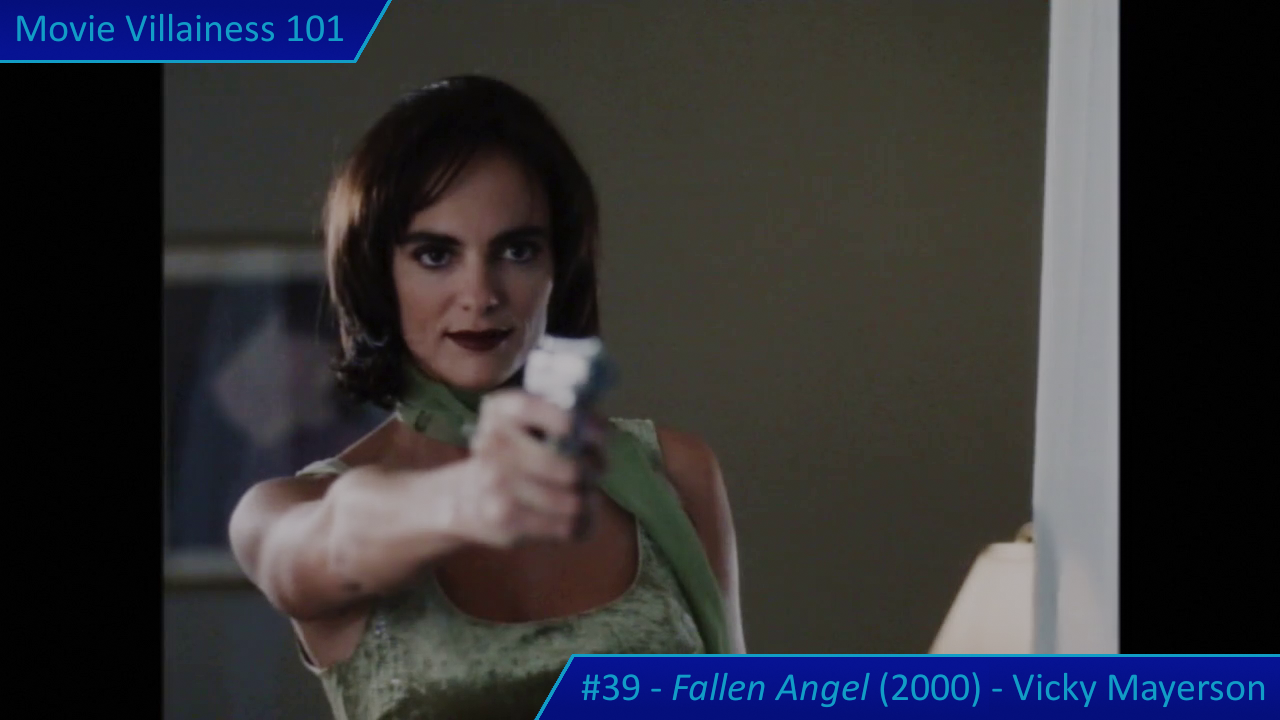
Vicky’s third victim is the most unsympathetic: an aggressive male named Ron with no remorse or desire to co-operate with the police. The killer bluffs her way past the receptionist, takes him hostage at gunpoint and escorts him to… you guessed it – the roof. The police trace Vicky’s call and arrive in time to save Ron. A tense chase scene through the deserted building ends with a brief shootout, and the killer escapes on a bicycle.
Things get more complicated after the police place Ron in protective custody, and Vicky phones Laura at her home. Brian listens in and, to Laura’s frustration, speaks to the killer. It’s clear they have a history, and he’s a target. Ron is next up, though. Laura goes to warn him, only for the ungrateful man to point a gun in her face and force her to handcuff herself to a safe. Terrible decision on his part, because Vicky walks in and there’s nobody to stop her this time.
Laura deciphers Vicky’s cryptic hints and establishes that she dropped out of school (which is why she didn’t recognise her earlier). There’s a whole exposition segment where the police dig up a backstory and question a potential fourth target. Turns out Vicky is copying the MO of what happened to her and using similar props in her murders. Also, her catchphrase was spoken by one boy before the fall, which nearly killed her.
Unlike Ron, the next victim has the sense to co-operate, and Laura devises a plan for Jimmy to impersonate the target at a school reunion and lure the killer out. However, Vicky is too clever to fall for this, deceives the detective on guard duty and does her usual routine of staging a high fall. So much for police protection.
Vicky then turns her attention to Brian. We all saw this coming, right? The finale has Laura confront the murderer on the roof and repeat the prologue “offer to shoot the hostage” trick (which actually works!). Unfortunately, Brian falls for it too, which gives Laura’s plan away, and Vicky pulls out a second weapon. Brian does the hero thing and takes a bullet for his girlfriend. With the police closing in, Vicky commits suicide by jumping off the roof and becomes the Fallen Angel of the title.
Honourable Mentions: Sympathetic Killers / Michelle Johnson
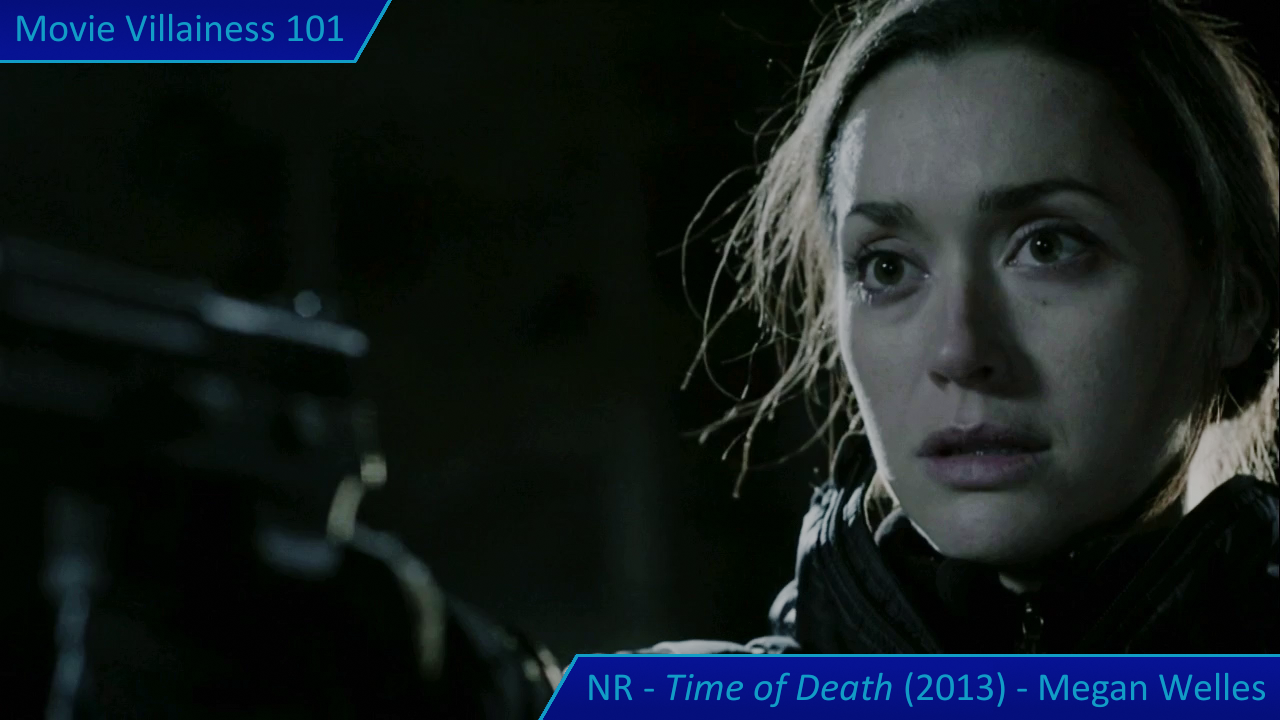
Time of Death (2013) – Megan Welles (Sarah Power)
Another film with a sympathetic killer, this time avenging the rape / murder of her sister. This is a thriller from Canadian producer Incendo, who made a slate of female-driven TV movies before switching genres to romance. As usual, a notable actress plays the lead. Kathleen Robertson is FBI agent Jordan Price, who gets assigned to Baltimore to assist with the murder investigation.
The title refers to the killer’s unusual MO, where victims are killed at exactly 10:44 PM. The first victim is CEO Robert Loring, who gets bumped off in his office with no forced entry. Naturally, the early suspects are his fellow executives and son. But then the assailant kills them at exactly the same time, and Jordan realises someone else is behind the deaths. And that person appears to be an expert climber.
There’s an awkward romance subplot that comes from nowhere, where Jordan hooks up with rookie detective and reluctant partner Elliot Larken (Gianpaolo Venuta). This side angle is utterly pointless and feels tacked on to fill time between the murders. When they get back to work, the duo discover the connection between the victims and a historic case, and that the killer is an ex-Marine named Megan.
The villainess’ background leads to some interesting kill sequences, especially in the finale where she snipes a target and bodyguards with tranquilliser darts. Jordan then confronts Megan at the same waterfall location where her sister was killed. The murderess has her target at gunpoint and threatens to commit suicide by dragging him over the edge. Jordan shoots her dead first, which angered many reviewers. They realise Megan is a cold-blooded killer, and the arrested guy will still be brought to justice, right?
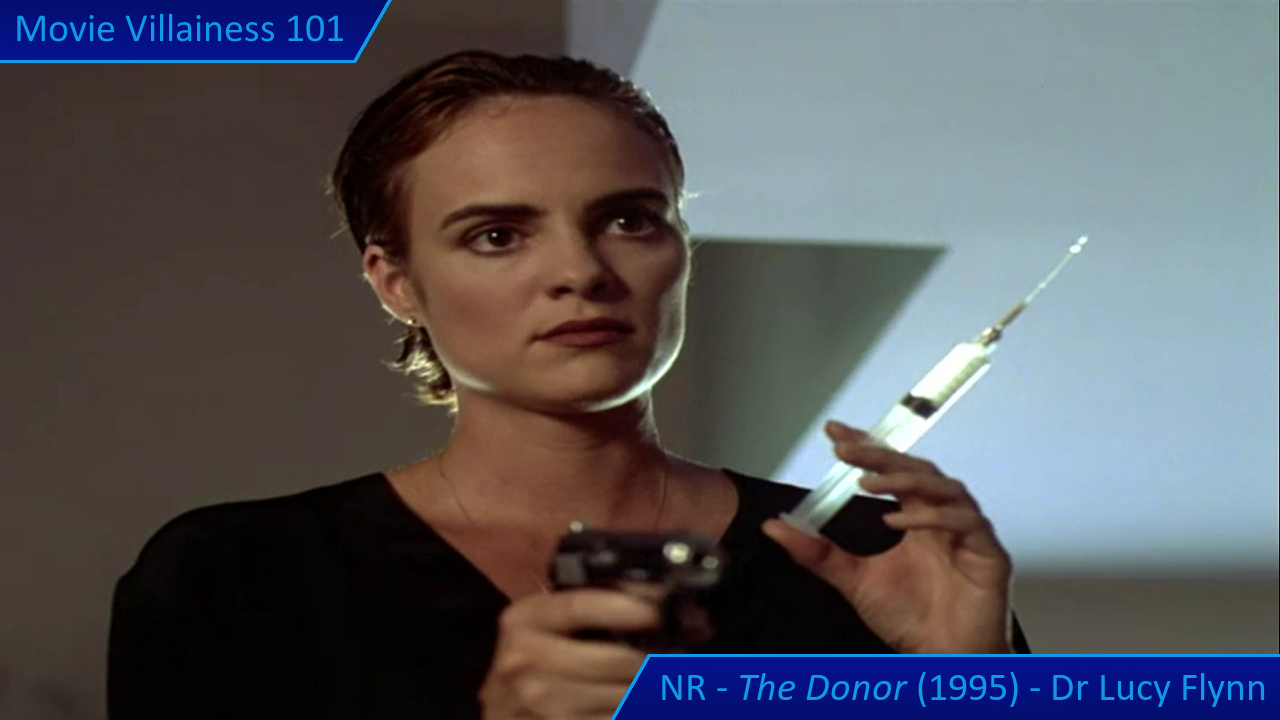
The Donor (1995) – Dr Lucy Flynn (Michelle Johnson)
Jeff Wincott headlines this thriller as stuntman Billy Castle, whose life falls apart after black marketeers steal his kidney. That’s after he sleeps with a beautiful woman who sedates him, but she’s too minor a character to qualify as a villainess.
No loss, because the doctor Billy romances (didn’t he already make that mistake?) is the mastermind behind the illegal organ transplant ring. She plays innocent and supportive, but frames a colleague when her lover gets too close. Positioning the patsy as someone the hero trusts implies he will be the surprise villain, but would they bother introducing Billy’s ex-girlfriend if Lucy was innocent?
An interesting (and surprisingly deep) subplot has the stuntman refuse to accept he’s a victim until he attends a mostly female group of violent crime survivors. The movie reverts to standard thriller fare when Lucy kills off a few loose ends and reveals herself as the evil doctor. For the climax, there’s an above-average chase where the villainess pursues Billy in a car. Then he uses stunt work to fake his death and pull the treacherous woman over a cliff edge.
The top forty villainesses form the legendary tier because of their iconic status in movie history or great but lesser-known examples. First up is Theresa Russell’s serial murderess from this 1980s thriller. Not to be confused with the Marvel Comics character, this black widow is a woman who kills her mates.
Don’t expect a bloodbath. All the kills happen off screen, and the central theme is a psychological battle between the killer and US Justice Department agent Alex Barnes (Debra Winger). Films with two female main characters were rare in the eighties, and the rewarding dynamic makes up for the lack of action.
Alex is a work-obsessed loner with little interest in romance. But the workaholic takes an interest in the Black Widow killings when she discovers two wealthy men have died in suspicious circumstances. We don’t really get acquainted with the victims. The first isn’t shown, and we only witness the aftermath with the “grieving” widow disposing of the evidence.
Next on the kill list is Texas toy company owner Ben Dumers (Dennis Hopper). A prominent actor, but he gets little more than a cameo. After a few scenes with his not so devoted wife, the murderess injects poison into a bottle of alcohol, leaves it for him to drink, and suddenly it’s his funeral. Two murders in the opening fifteen minutes, but things slow down for the rest of the movie.
Villainess
Catharine (Theresa Russell)
The villainess is credited as Catharine, but that’s one of four aliases. For each victim, the killer adopts a different name and appearance. Better to keep things simple, so I’ll refer to Theresa’s character as Catharine in this review.
As the murderer studies Native American artifacts to prepare for her next crime, Alex questions relatives of the previous victims and studies photos of her nemesis. The agent eventually tracks the killer to Seattle and poses as a newspaper reporter to question a museum curator – and next intended victim. So begins a deadly game of cat and mouse, with Alex hoping Catharine takes the bait and investigates her (she does).
The serial killer plans a trip to Hawaii, but only after she discovers the curator is allergic to penicillin. Catharine does her mate and kill thing, mixing some of the powdery drug into his toothpaste. This leads to a third off-screen death, and the Black Widow becoming even richer. Determined to catch her elusive prey, Alex pursues Catharine to Hawaii. From that point on, she’s a lone wolf, though she enlists the help of shady private investigator Shin (James Hong).
Alex takes a leaf from the killer’s book and uses a false name, while Catharine seduces her latest target: a hotel chain owner named Paul. The murderess learns Alex has followed her, and that she’s a government agent. As the two women attempt to outsmart each other, they become acquainted. After an “accident” while scuba diving, Catharine confesses without being specific, carefully choosing words to taunt her foe.
Catharine suggests Paul date the investigator, but this is a setup. The villainess hires Shin to take photos of Alex with Paul, intending to frame her for the next murder. Catharine seduces Paul, so he dumps Alex to marry the killer. Then, Alex presents the villainess with a black widow brooch and promises to bring her to justice. This is an especially barbed exchange and typifies the dialogue-heavy nature of this movie.
After the wedding, Catharine poisons Paul and plants incriminating evidence in Alex’s room. She then breaks into Shin’s office, holds him at gunpoint, and stages a heroin overdose. Alex is arrested for the crime, and Catharine visits her at the courthouse.
The murderess gloats, thinking she’s outsmarted her opponent. Then a relative of a previous victim walks in, followed by Paul, who’d been tipped off by Alex. She staged the arrest as a trap, and the overconfident killer fell for it.
Honourable Mention: Dangerous Relationships
Flirting with Danger (2006) – Laura Clifford (Charisma Carpenter)
Black Widow is a “template” movie, so the serial killer wife story is often copied by lesser productions. Such as cheap Lifetime thrillers. Among the many clones, this effort stands out because of the villainess’ unique kill method. A psychopathic woman smears her victims with poisonous oil that’s ingested through the skin when they take a bath or shower. That’s a great excuse for a steamy intro where a mysterious naked beauty bumps off a topless male in a hot tub.
Things are quite dull after that, as Rafe Marino (James Thomas) digs into the mysterious circumstances of his friend’s death. He and his police officer girlfriend, Gloria Moretti (Victoria Sanchez) discover other men have died recently. Seems they all received mysterious faxes, and femme fatale Laura Clifford might be the woman responsible. Other women are suspects because their Southern accents resemble the killer’s voicemail message, but this won’t fool experienced viewers.
After a slow buildup, Laura seduces Marino. This leads to a near-death experience after he gets oiled by the villainess and takes a shower. A weak confrontation follows as Gloria guns down the knife-wielding Laura with little fanfare. Nothing special, but worth a mention.