Movie Villainess 101 Rank #11

With a kill count in double figures, this lethal henchwoman certainly is a jewel

Movie

Bounty Tracker (1993)

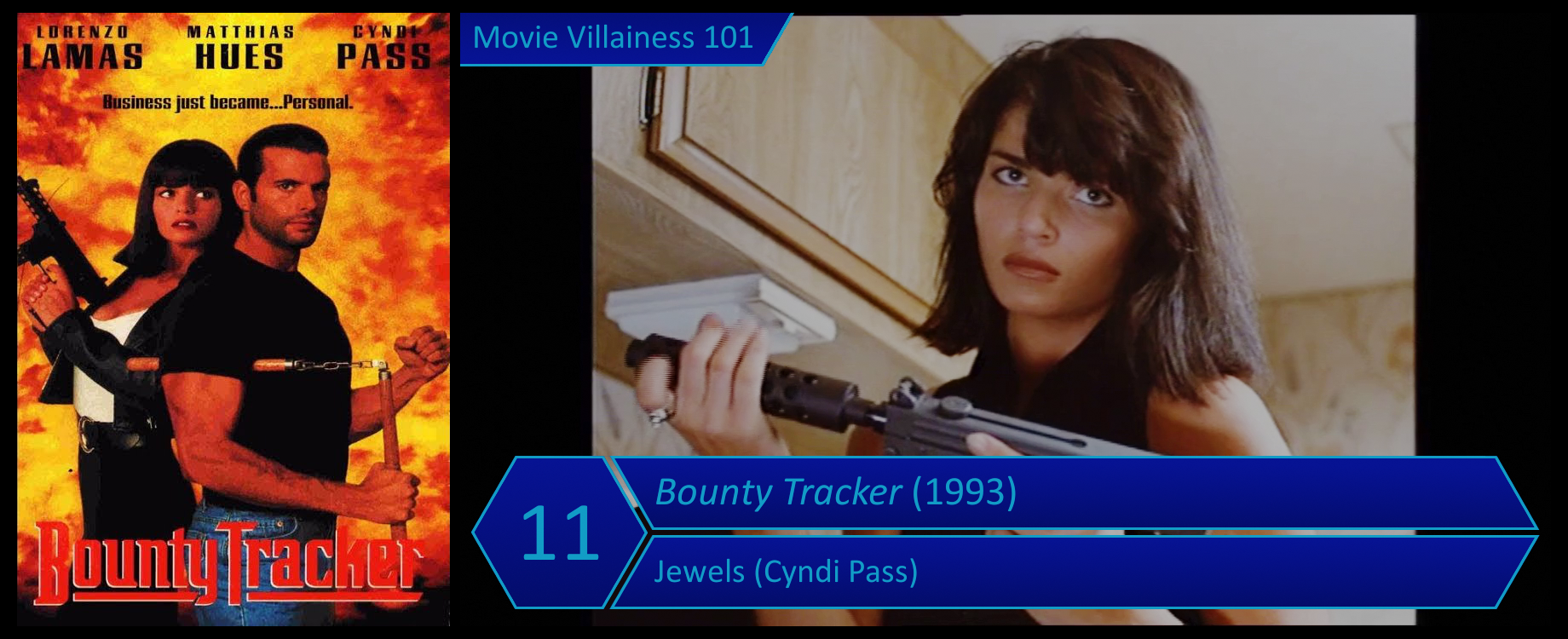
The top ten ranks are reserved for main villains, so Cyndi Pass’ lethal mercenary has the honour of being the highest-ranked legendary henchwoman. A constant presence throughout, Jewels is always involved. Not content to be a background character, she happily guns down innocent civilians. She also provides technical support, acts as an intermediary between Erik Gauss (Matthias Hues) and his mafia paymaster, and looks badass whenever there’s a lull in the action.
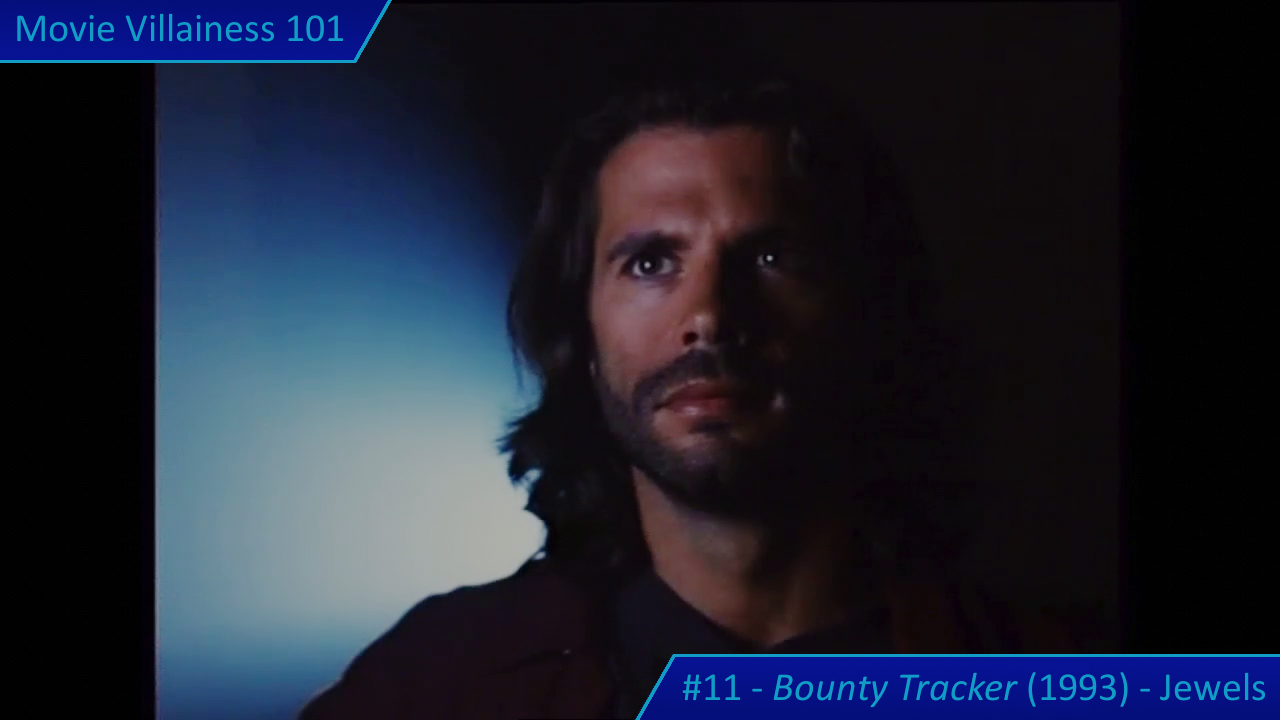
B-movie martial artist Lorenzo Lamas (known for the TV series Renegade) is Paul Damone, a bounty hunter who gets the typical establishing scene when he beats up a gang of thugs. With that out of the way, it’s time to move on to the main plot. An accountant and his partner plan to give financial data to the police that incriminates a mob boss. He might think he’s safe in his office, but Gauss and his hit squad have other ideas.
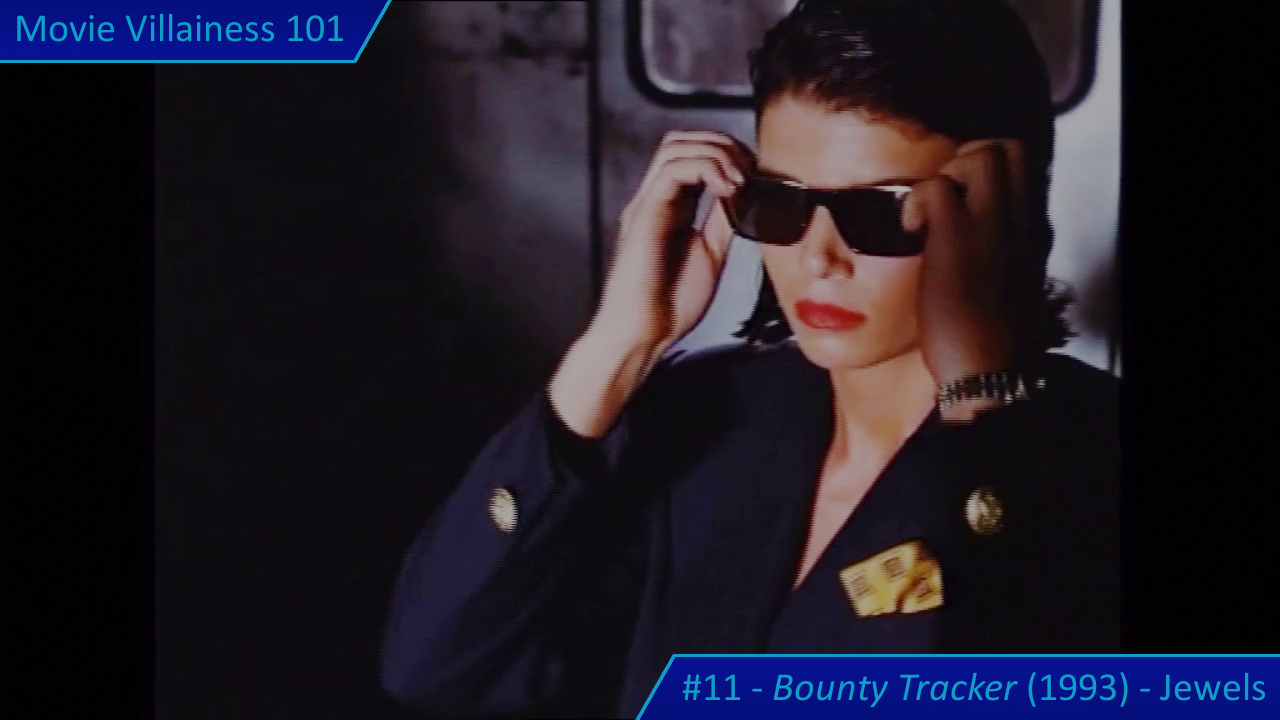
Jewels – wearing smart clothes and shades – leads the assault. An innocent secretary barely has time to ask a question before the assassin blasts her with a machine pistol. The first of many killing sprees then follows, with nobody safe from gunfire. One man takes cover in an office, but Jewels shoots him through the wall. Gauss wipes data from computers and kills the accountant, but his partner escapes. Matthias Hues is often cast in muscle roles, so we must have a scene where two cops attempt to arrest Gauss, only to get a brutal response.

When it’s revealed the man who escaped is Damone’s brother, and the bounty tracker is in Los Angeles, any action fan knows what’s coming. The witness has police protection, but the officers are no match for Gauss’ team. Jewels takes up a sniper position overlooking the house, coolly kills a sentry, and announces the coast is clear. Fifteen minutes in, and the villainess has racked up several kills.
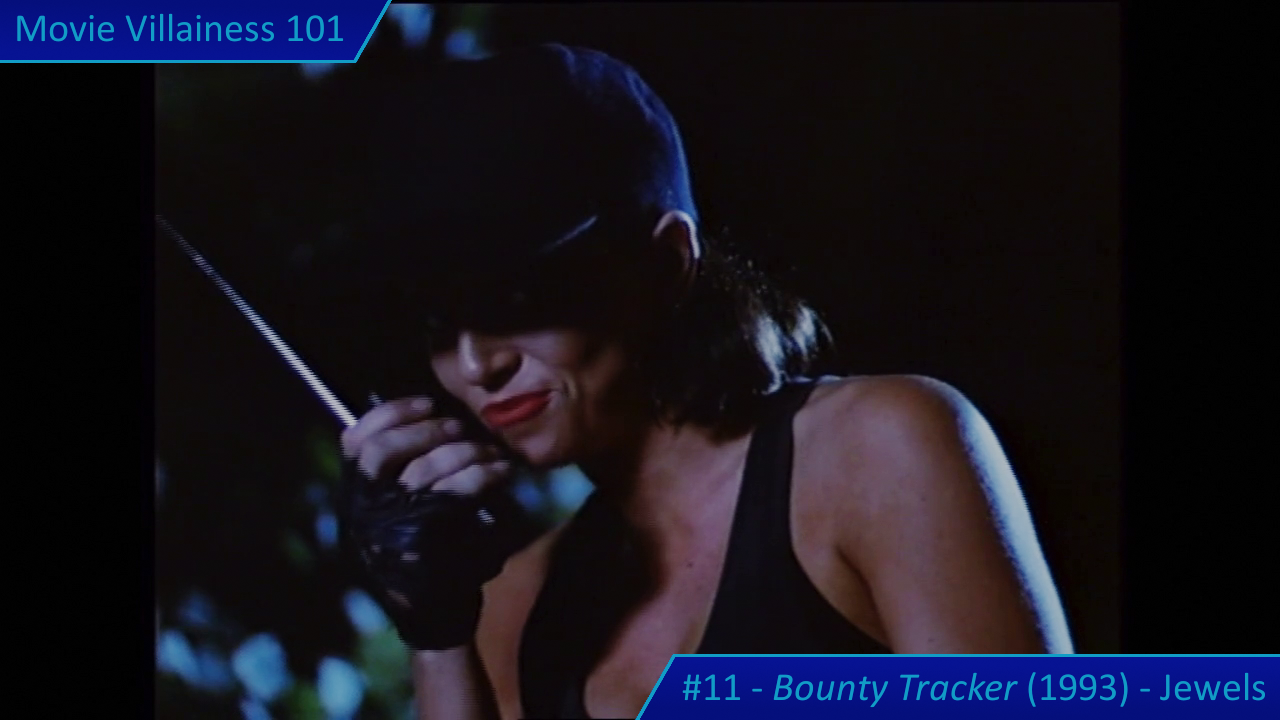
Damone and his brother were enjoying a family get-together. That’s until Gauss raids the house. The hero puts up some resistance and takes out two minor henchmen. Jewels isn’t about to die this early, so she pins Damone down with bursts of gunfire. The villainess doesn’t care an innocent female relative is caught in the crossfire – she’s simply another witness to eliminate.

Without Damone to protect him, the brother is easy prey for Gauss. The police give the hero the lowdown on the suspect, and it’s a routine revenge thriller from this point on. Gauss and Jewels make fine adversaries, and there are plenty of criminals for Damone to get through first.

Villainess

Jewels (Cyndi Pass)
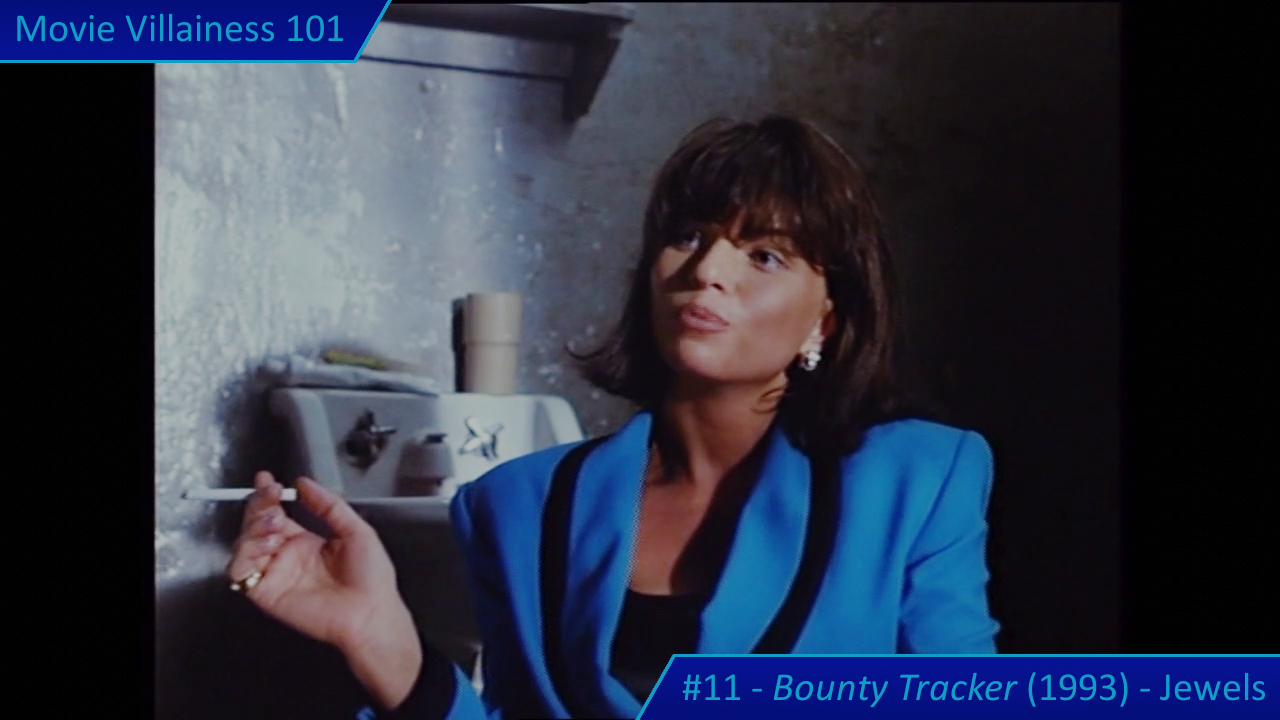
Mercenary work is expensive, so Gauss sends Jewels – posing as a smartly dressed attorney – to visit the imprisoned mafia boss. She arranges payment in diamonds, but the man unwisely romances the deadly assassin. Her response is cold, and even in this dialogue-heavy sequence, the henchwoman finds time to slam another prisoner into the cell bars.

Damone’s investigation takes him on a montage trek through the city streets, and he gets a lead from a crippled veteran. The clue is a martial arts school staffed with men loyal to Gauss, which is an excuse to have a mass brawl. When unarmed attacks prove ineffective, the tougher thugs arm themselves with melee weapons, but the hero is unfazed.

Gauss – being the meticulous sort – sends Jewels after Damone as backup, and when the martial artists fail, she follows the hero back to his hotel. A maid becomes her latest innocent victim, then the assassin bursts into Damone’s room. In the resulting shootout, he escapes (killing heroes is never that easy) by jumping down into a garbage bin. Time for Jewels to report back to Gauss and promise not to fail again.
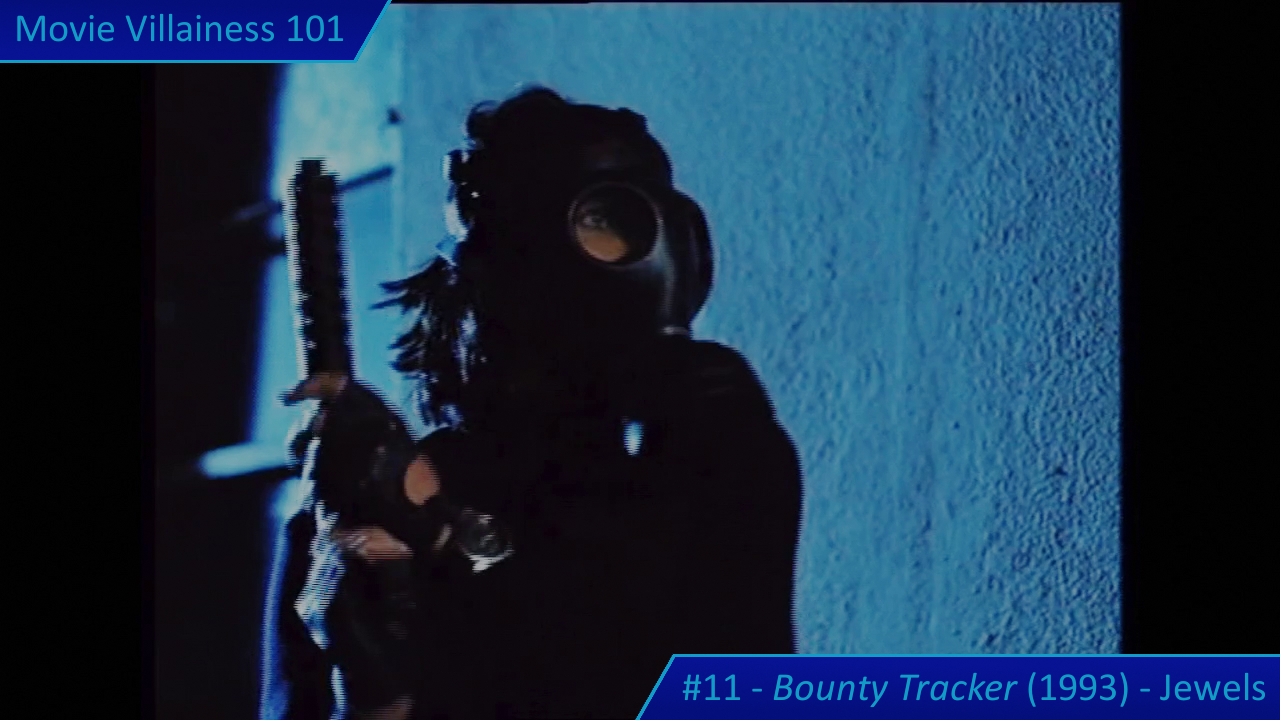
One witness remains at large, but the assassin tracks a police detective to the isolated safe house. The cops are again outgunned by the mercenaries, who come equipped with silenced weapons and tear gas. The black-clad Jewels and Gauss wear gas masks to eliminate their targets. Sadly, this is a murky scene, but the henchwoman body count keeps on rising.

After Gauss murders the cripple, Damone teams up with the gang members the victim was helping rehabilitate, and the unlikely heroes locate Gauss’ base of operations. The trailer is empty, but Damone makes the mob boss connection after he sees a television news report. Planning to follow the money trail, a gang banger hides in a car trunk and provides directions to the bounty tracker, who follows in a van.
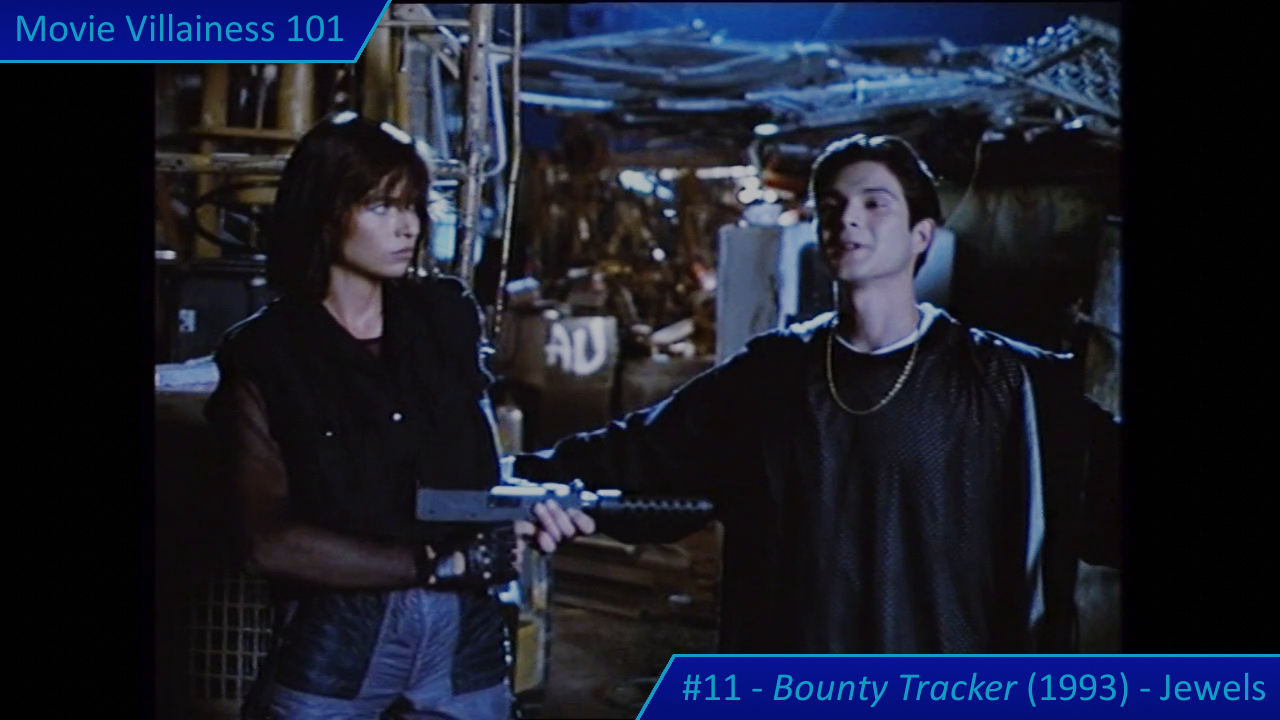
The mafia men are smart enough to pay Gauss with genuine diamonds, but after a radio call from Damone reveals the stowaway, the mob is expendable. Jewels shoots a slow to react henchman and easily hunts down the escapee. Eventually, there’s the expected big fight with Gauss that goes on for several minutes, with the villain taken out by a conveniently protruding nail and a spectacular kick from Damone.
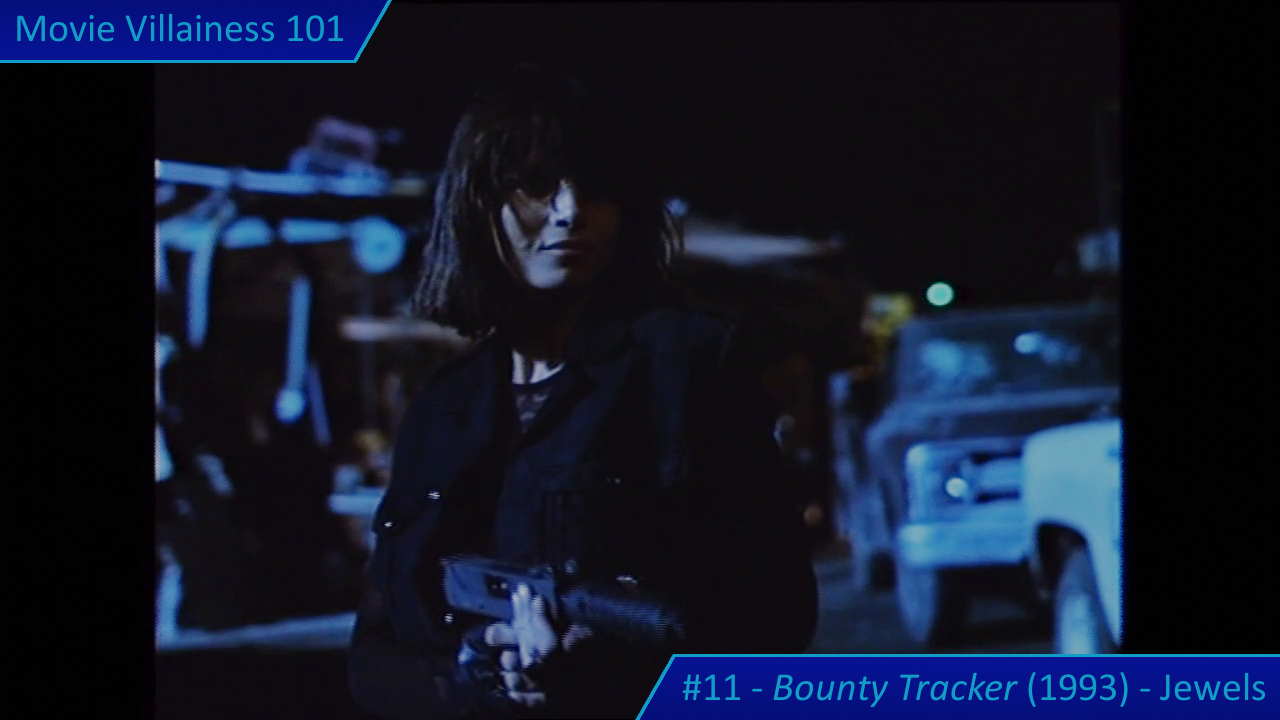
Before that, there’s a certain henchwoman to deal with. Jewels gets a couple of shootouts and an unexpected fight with Damone. Her martial arts skills are rather weak, so the hero defeats her quickly. The hero is daft enough to leave Jewels alive, but her next attack ends with a fatal gunshot. A somewhat bland ending, but this leather-clad henchwoman might have the highest female kill count in movie history.

Honourable Mentions: Cyndi Pass

Mission of Justice (1992) – Rachel Larkin (Brigitte Nielsen), Erin Miller (Cyndi Pass)
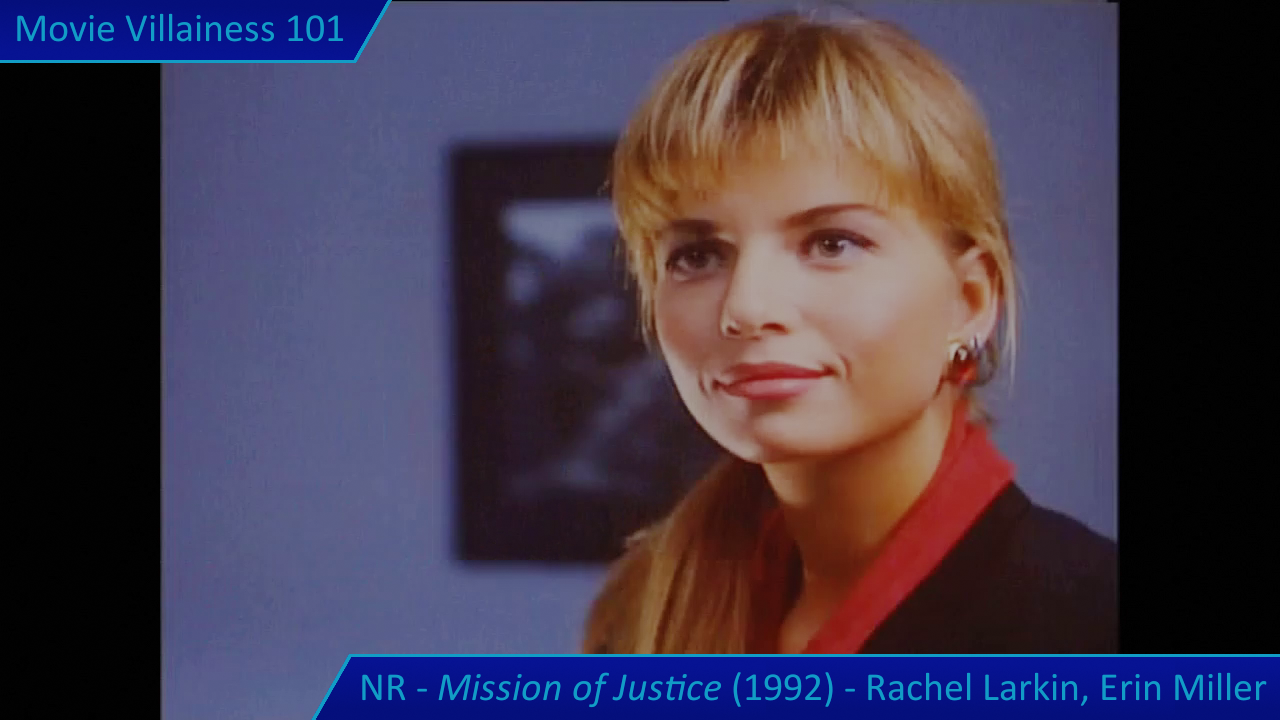
Both Matthias Hues and Cyndi Pass are in this one too, but instead of Lamas it’s Jeff Wincott as hero ex-cop Kurt Harris. His establishing scene is an old favourite: a store hold-up. That’s before a combination of red tape and a domestic violence victim convince him to quit the force. It’s not long before his boxer friend Cedric meets a sticky end, and Harris is on the case as a civilian investigator.

The hero’s partner and contact on the force is Lynn Steele, a woman as tough as she sounds. Played by martial artist Karen Sheperd, she takes down her fair share of bad guys. Harris’ off-book detective work leads him to mayoral candidate Dr Rachel Larkin (Brigitte Nielsen). The actress is attractive in a blonde wig and has a private army of vigilantes to clean up the streets. That’s the cover story, because Larkin’s true agenda is to gain money and power.

The villainess ditches the wig when she visits Cedric to persuade him to support her. The boxer puts up a fight against her brutal brother Titus (Hues), but has no hope of winning. Once Titus has done the roughing up, Larkin finishes the job with twin daggers, but the kill scene is brief. Most of the movie has Harris infiltrating the Peacemakers and doing some nocturnal detective work. Surprisingly, there are no corrupt cops on Larkin’s payroll, though Titus kills a bureaucratic sergeant to frame Harris for the murder.

The Peacemakers are an all-male group except for Erin Miller, who’s there as a female opponent for Steele during the climax. Miller is Larkin’s secretary and just as evil as her boss. The henchwoman enjoys torturing people for information and helps murder an elderly woman for her inheritance. A wonderful villainess duo, but Miller doesn’t put her martial arts training to use until the last encounter.

In fairness, she puts up a better fight against the heroine than most of the men. It’s a rough catfight in the office that results in a lot of destruction, but Steele wins comfortably. Miller comes back for another try, but it’s maybe ninety seconds of action in total.
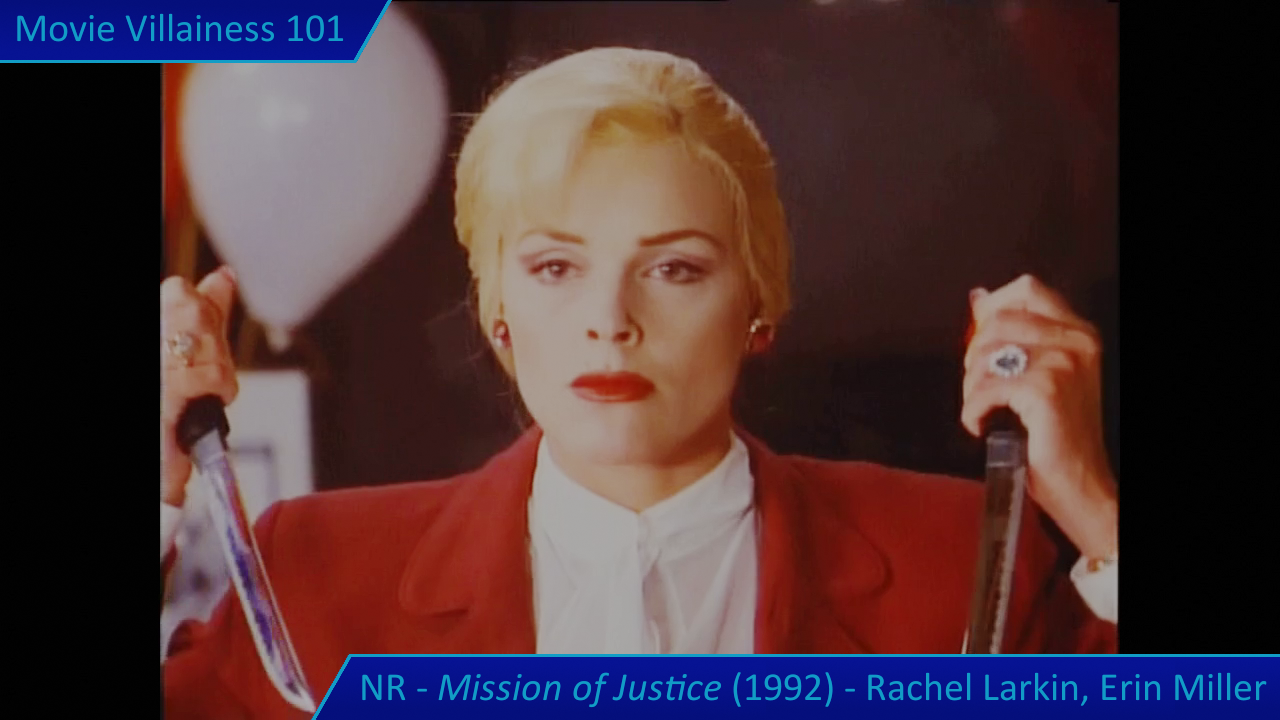
After Harris defeats Titus, he confronts Larkin during a press conference. Thanks to a recording of her involved in torture and a murder confession, the hero is exonerated. The villainess refuses to go quietly and comes at Harris with her twin daggers, but the last hurrah is over within seconds. Worth a watch, if only to see Cyndi Pass as a henchwoman before her role in the superior Bounty Tracker.
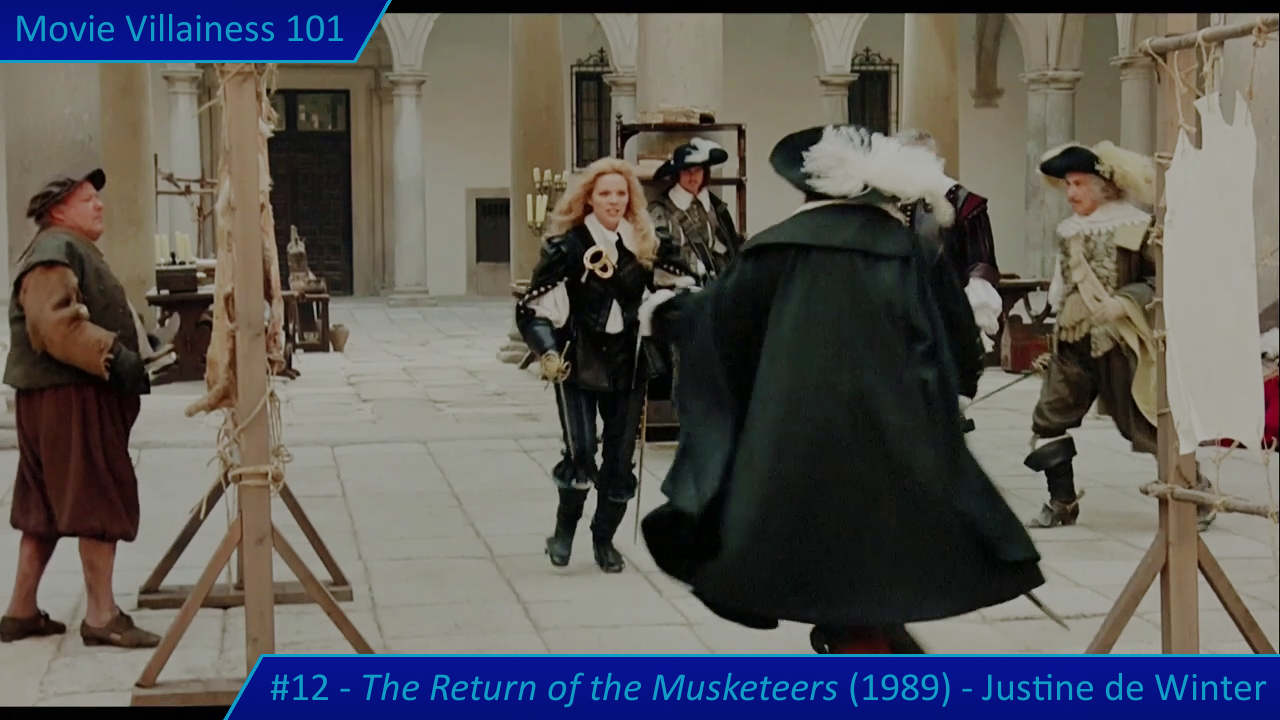
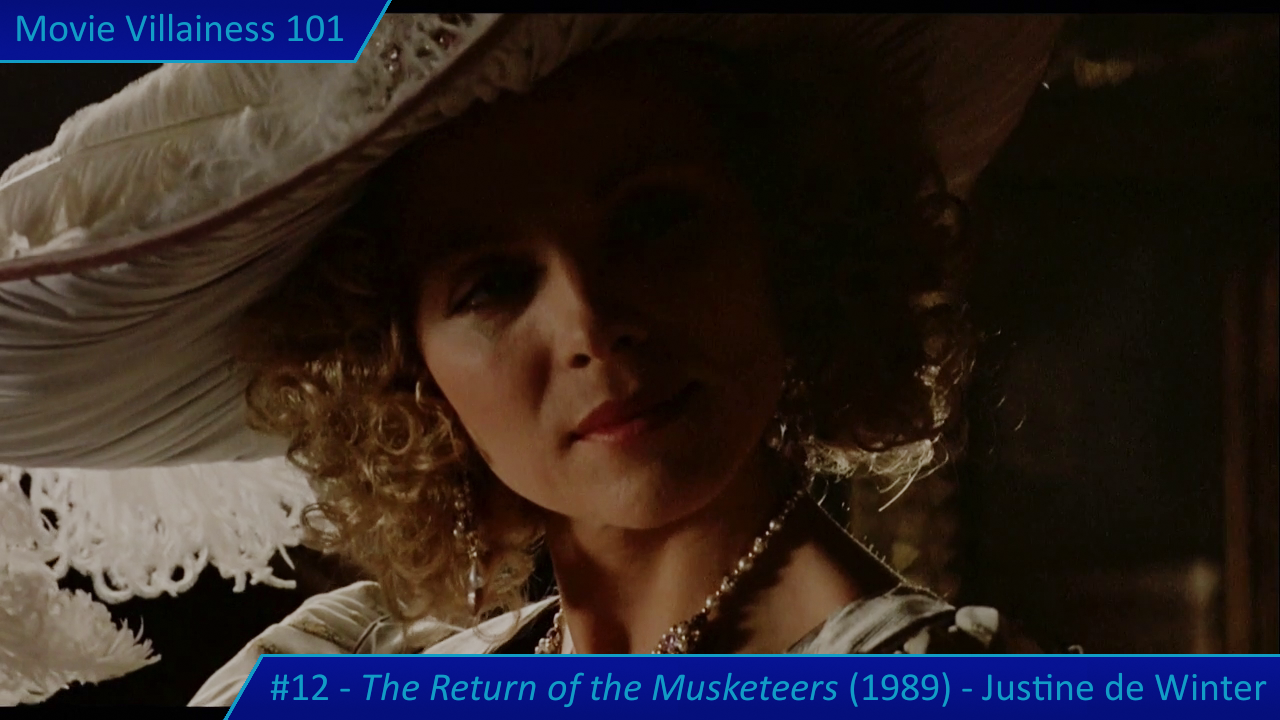
Movie Villainess 101 Rank #12

Even deadlier than her mother – the aging musketeers have met their match

Movie

The Return of the Musketeers (1989)

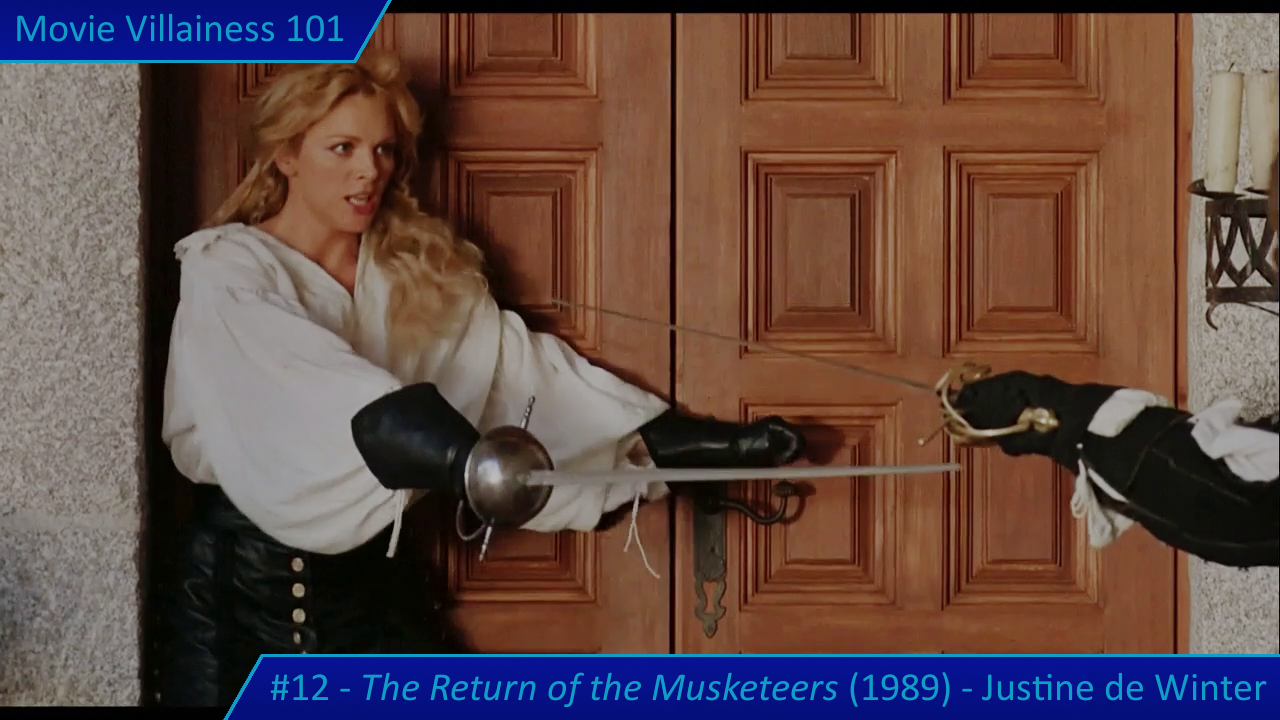
The third part of an unofficial trilogy, this movie follows on from the 1970s Musketeers films and has the director and most original cast members reunite. The production was overshadowed by the tragic death of Roy Kinnear, who plays hapless servant Planchet, during filming, hence the awkward rear shots of his stand-in and dubbed voice. A pity this entry gets overlooked, since its female villain is terrific.

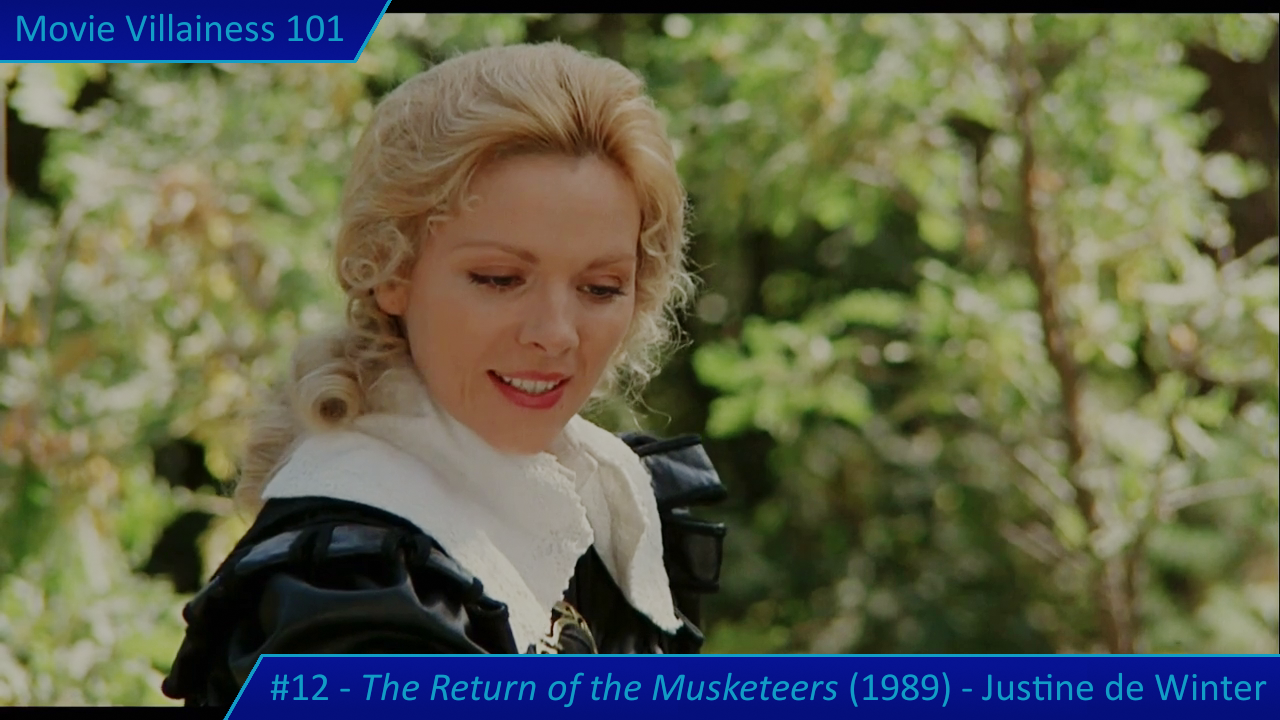
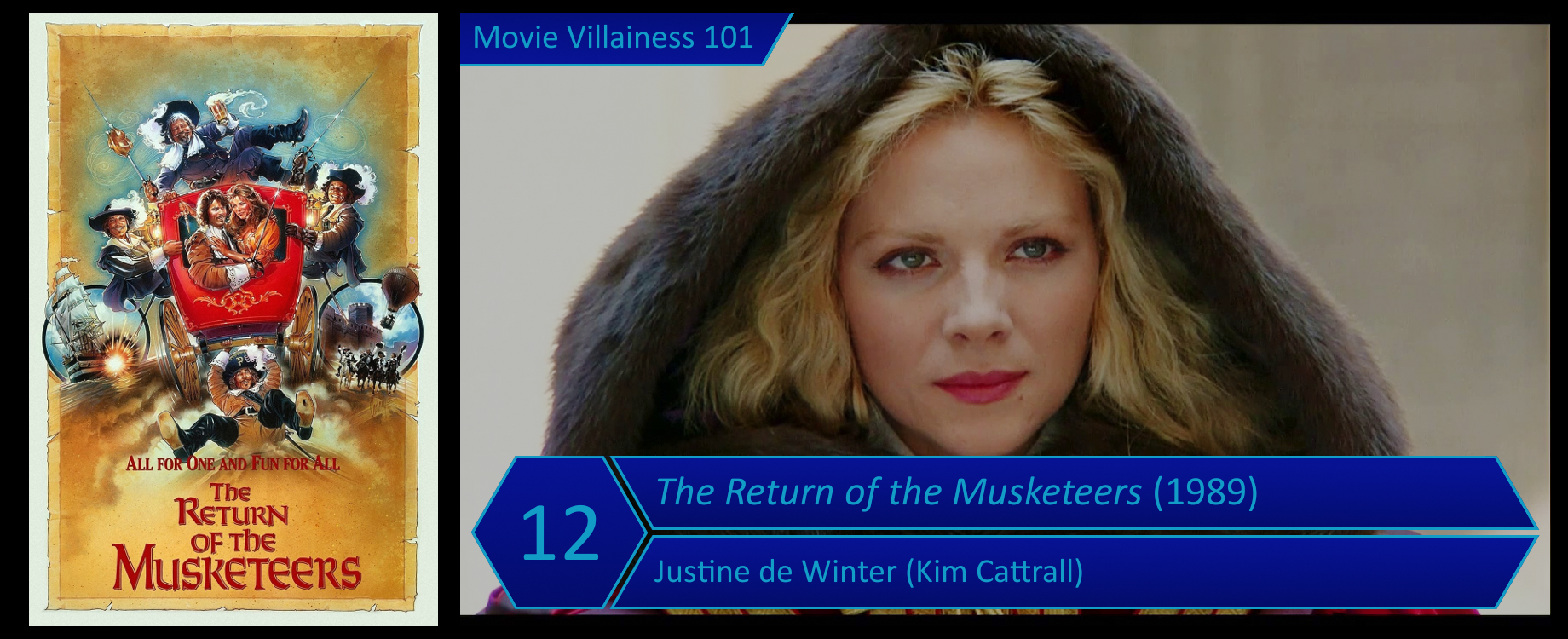
Justine de Winter is the daughter of Milady and Rochefort, and their offspring is a mistress of deception, complemented by her expertise in swordplay. Add two unmasking scenes and many encounters with her victorious, and the result is a legendary villainess.

Twenty years after the events of The Four Musketeers (covered below), the heroes are washed out. The devious Cardinal Mazarin hires D’Artagnan, the only one still in active service, to reunite his former comrades. He finds them reluctant to join and is at odds with his old friends after an important prisoner escapes. There’s a plot to work with English rebels, and Justine has no qualms about executing royal targets.

Politics is a subplot to her personal vendetta, and despite Rochefort returning from apparent death, there’s no doubt who the main adversary is. By the end, the heroes put aside their differences, travel to England and back, and save the King of France.

Villainess

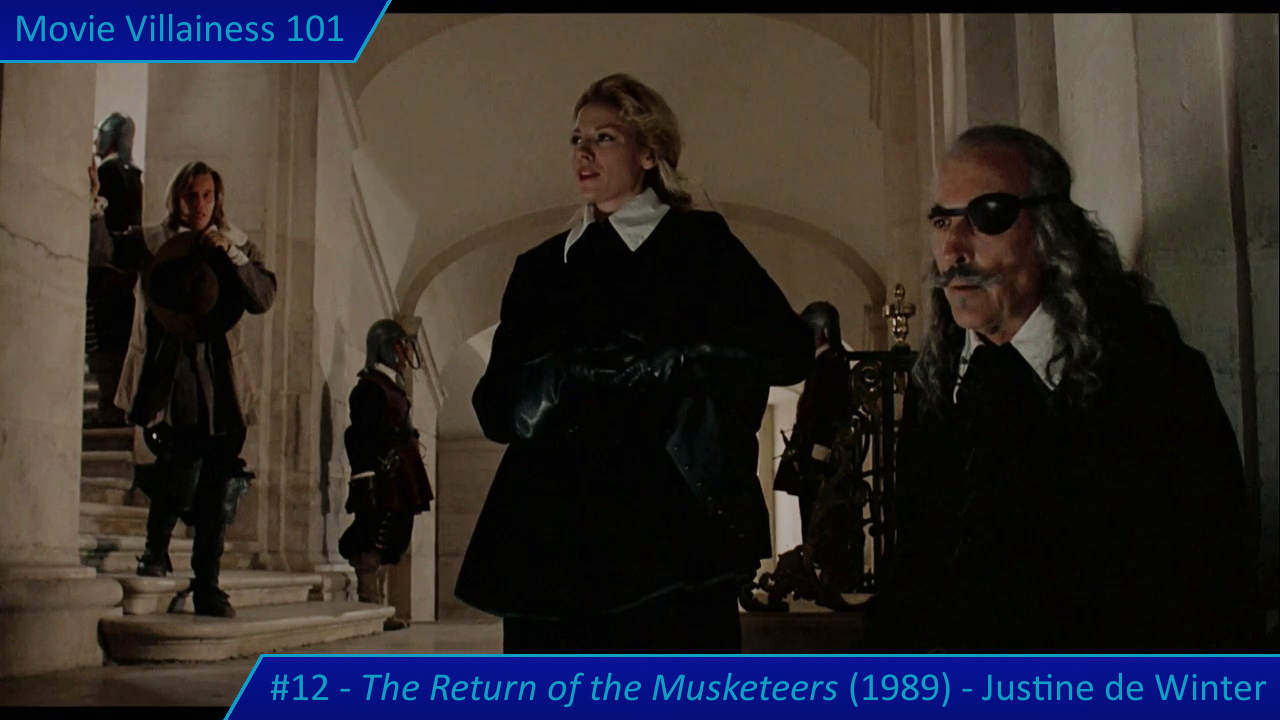
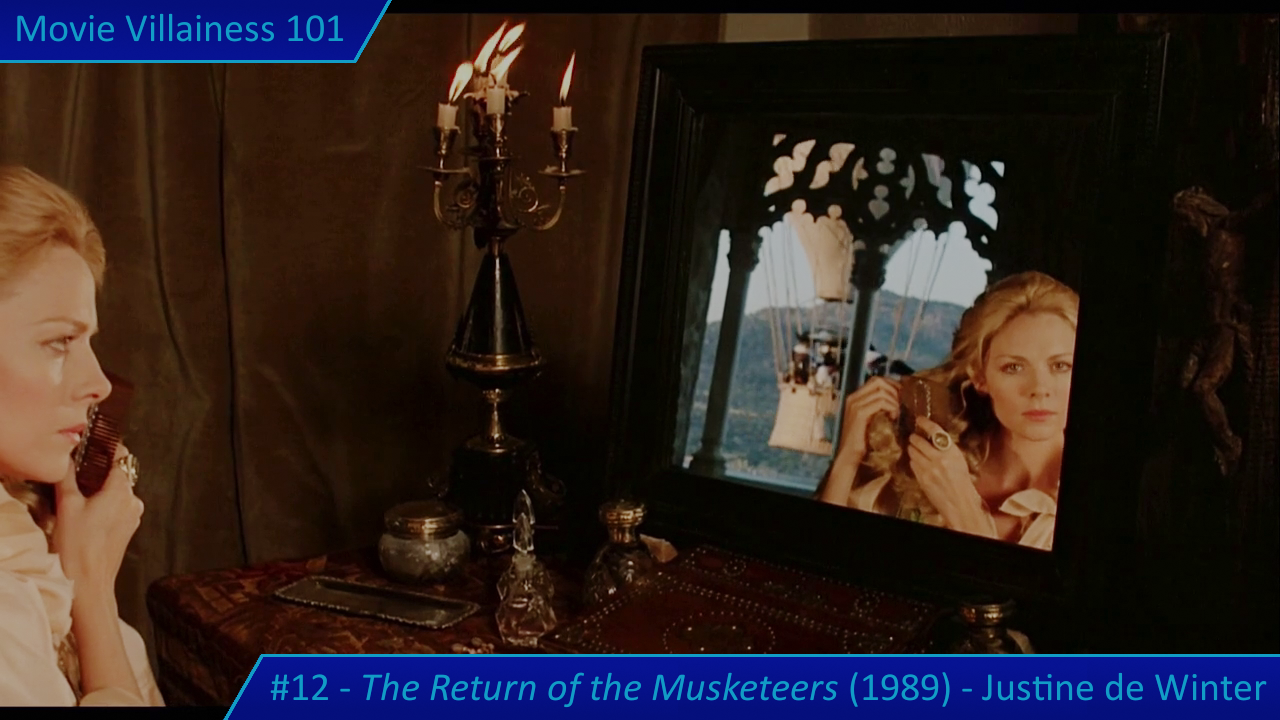
Justine de Winter (Kim Cattrall)

It takes a while for Justine to make an appearance. Disguised as a priest, she sets a trap for the headsman and confronts him with his own axe. Anyone who noticed Kim Cattrall in the credits will see through the deep voice and cloaked figure, but it’s reasonably effective.

Athos’ son Raoul (C. Thomas Howell) has a chance encounter with the assassin and chases them into the forest. He clashes blades with the fake priest and fences well until he knocks off the killer’s hat to reveal a beautiful blonde woman. Faced with a female adversary, he’s disarmed by her. Justine is after the musketeers who executed her mother and sees an opportunity after she learns who Raoul’s father is.
It isn’t too long before Justine confronts the heroes in a red cloak. Like her mother, this female assassin has a fondness for glass weapons, though she uses crossbow bolts instead of daggers. The musketeers are reluctant to fight a woman, but ditch their chivalry when they realise she can take all four at once without even any support. The villainess uses scaffolding to escape and nearly gets shot in the back until Raoul gets all noble and saves her. What happens next is on you, hero.
Distracted enough to fail, the musketeers are employed by the Queen to save King Charles I of England. Historians will know how that turns out, though probably not that the musketeers almost saved him by sidelining the headsman. Almost since the masked Justine takes over as the king slayer. An action that leaves Raoul and Rochefort shocked, but one the villainess acts casual about.

The musketeers track Justine to her hideout, which is full of traps she uses to turn the tables. A slapstick combat sequence typical of the series, with the hopeless heroes beaten many times by the agile and clever opponent. Justine escapes on a ship heading back to France. The musketeers get wise and use indirect methods to blow up the vessel and defeat Rochefort. His daughter has main villain immunity and comes away relatively unscathed.

Justine uses guile and beauty to kidnap the young King of France. The last fight takes place in a castle, with the musketeers launching a rescue attempt by balloon. This fools the inept guards, but Justine realises the threat and dons her leathers for the grand finale. In the chaotic climax, the villainess is a worthy match for D’Artagnan and his companions, though their actions force Justine to take the King hostage.

The musketeers save the boy, but Justine escapes by leaping down to a moat. Having had enough of her for one lifetime, the heroes let her ride off into the sunset.

Honourable Mentions: Three Musketeers

The classic Alexandre Dumas novel has been adapted for film many times, with various actresses starring as the villainous Milady de Winter. As one of the most rebooted tales in cinema history, there are far too many to discuss, and honourable mentions are restricted to the 1970s onwards.

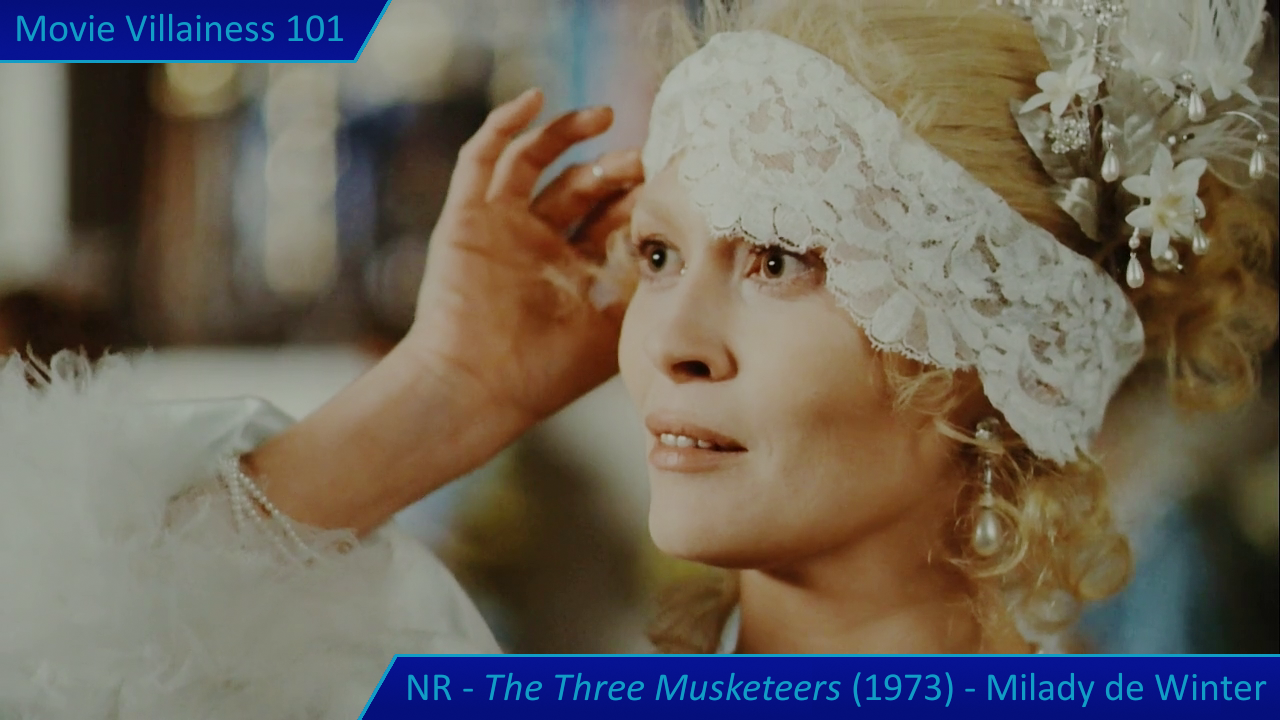
The Three Musketeers (1973) – Milady de Winter (Faye Dunaway)

The first two films in the Richard Lester trilogy were shot back-to-back, with the novel adaptation split into two parts. Most humour is slapstick, and might become tiresome depending on taste. The swordplay is light enough on violence to receive a universal rating in the UK.

Milady is mostly absent from this half, and only becomes important when the dastardly cardinal hires her to seduce an English duke and steal diamonds. This is a plot to undermine the King of France, and Milady takes a back seat to Richelieu and Rochefort in the villain stakes. Once the usual story elements – such as D’Artagnan fulfilling his dream to join the Musketeers – have played out, the bumbling heroes confront their enemies.

There’s time for a comical fight between Milady and the Queen’s dressmaker Constance, but don’t get too excited. The two women chase around furniture and use whatever items are available, while the men do the real fighting elsewhere.

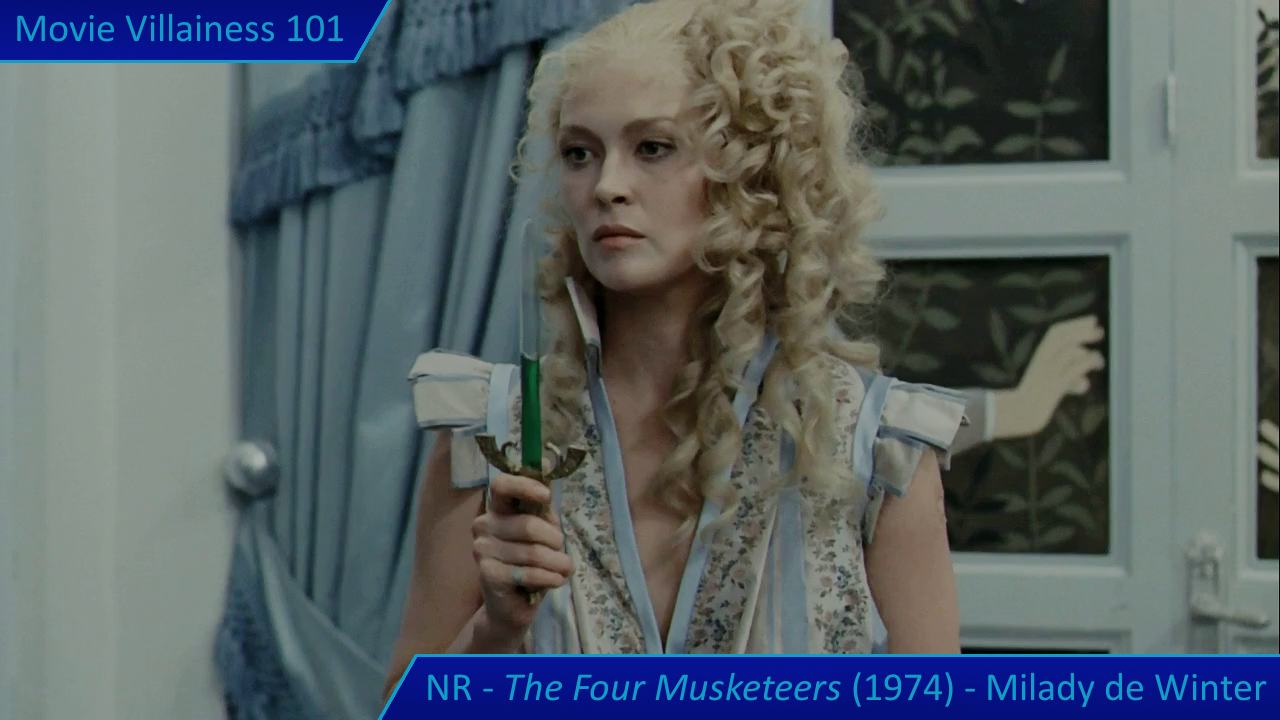
The Four Musketeers (1974) – Milady de Winter (Faye Dunaway)

Faye Dunaway returns in a larger role, out for revenge against the heroes for foiling her scheme. There’s a subplot about French rebels besieging La Rochelle and Richelieu using the conflict for his own ends, but the main story is the four musketeers dealing with the villainess and her lover.

Milady’s romance with Athos comes into play, revealing her murderous past. When her initial plan to seduce D’Artagnan fails – after he overhears her wicked scheme – she attacks him. The assassin is a capable sword fighter despite the hindrance of her long dress, and her poisoned glass daggers are deadly. D’Artagnan escapes, but we get a welcome action scene for the female villain.

Richelieu sends Milady to murder the English Duke, but she is captured by savages before she completes her mission. Imprisoned in the Tower of London, she charms a dim-witted sentry into releasing her and even convinces him to kill the Duke. Constance escapes a bumbling male assassin. But it’s all for nothing, since Milady disguises herself as a nun, infiltrates a convent, and strangles Constance with a rosary.

The murder enrages D’Artagnan enough that he agrees to a unanimous vote to behead the killer. Though seen at a distance, the ending is dark in tone. With the villainess dead, the stage is set for her daughter’s revenge twenty years later.

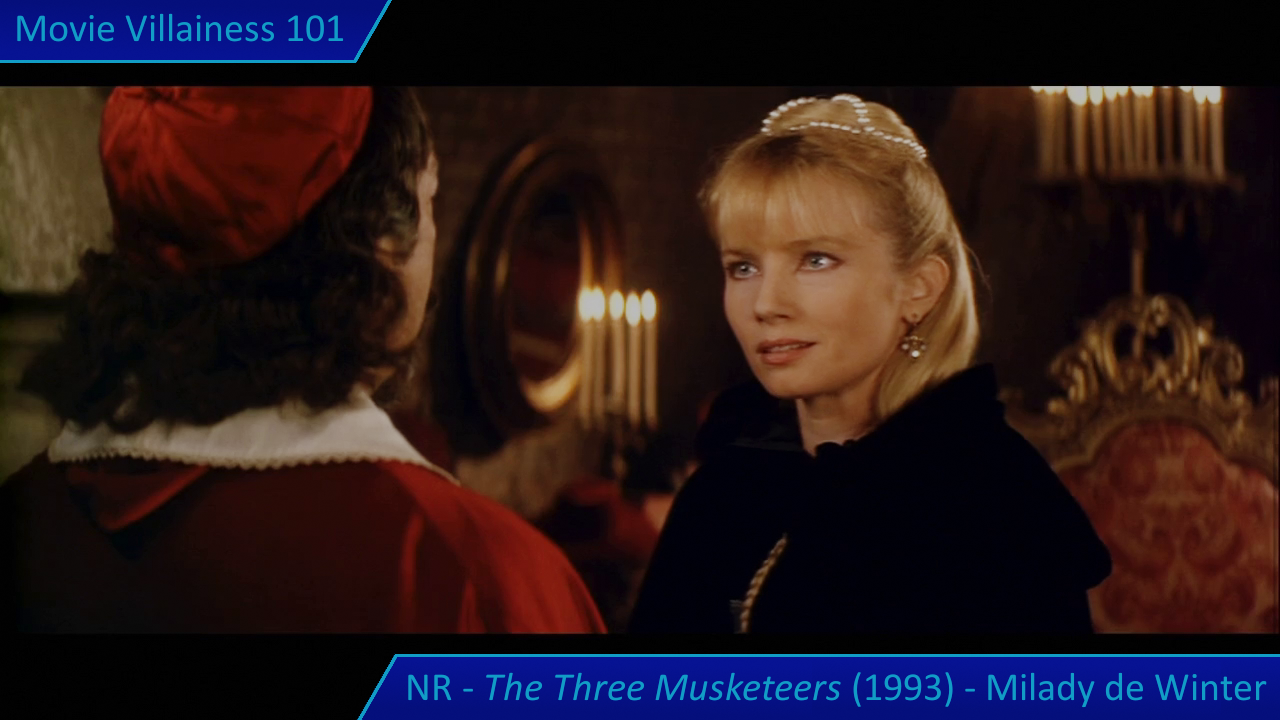
The Three Musketeers (1993) – Milady de Winter (Rebecca De Mornay)

Receiving the “and” credit usually means a brief role, and we pass the half-hour mark before the villainess makes an appearance. This is light-hearted family fare, but more serious than the Lester version. Plenty of adventure and sword fights, and Tim Curry hams it up as Cardinal Richelieu, the chief baddie plotting to assassinate the King.

Milady is a spy, and a beautiful and dangerous seductress, though sadly underused. Besides threatening Richelieu with a dagger and confronting Athos about their past, Milady plays no part in the evil scheme. The master spy is intercepted before she leaves France after a tame encounter. After that, she repents and commits suicide. Dreadful stuff for such a key character.

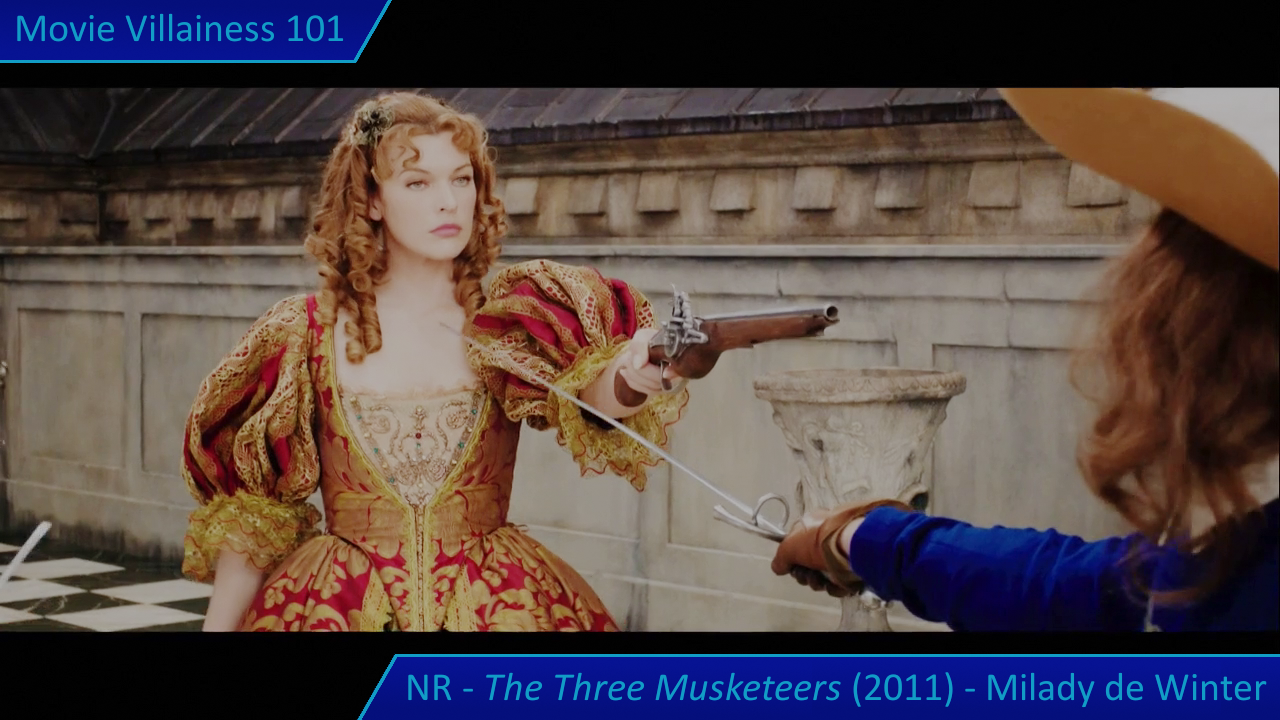
The Three Musketeers (2011) – Milady de Winter (Milla Jovovich)

Adapted for the video game era, the title heroes are now secret agents with multi-bladed daggers, and Milady is a double-crossing acrobatic beauty. The opening sequence plays out like an Assassin’s Creed mission, as the hooded Aramis breaks into Leonardo da Vinci’s vault to steal plans for a war machine.

Except for basic plot elements, the steampunk story bears no resemblance to the source material. This is a loud action tale, with one against many fights, giant explosions and ridiculous set pieces. Picture a raid on the Tower of London and a sky battle between two airships. That means sea vessels on balloons, by the way.

Milady is a physical foe, capable of duelling armed guards in a 17th-century dress. Besides the usual seduction and villainy, she imitates Indiana Jones by sliding through a trapped hallway. This sequence has Jovovich do her Resident Evil thing. After dealing with the rooftop sentries, the thief descends on a harness to the Queen’s private quarters. Then she somersaults through a string-based security system. They didn’t have laser beams back then, but who cares?

After such a badass setup, one hopes for an epic fight with the musketeers. That never comes, and Milady is captured and defeated too easily. She also commits suicide. Or so it seems, because she survives a long drop to the ocean and returns for the last scene to set up a nonexistent sequel.

Movie Villainess 101 Rank #13

The English translation is The Red Nights of the Jade Executioner – very appropriate

Movie

Les Nuits Rouges du Bourreau de Jade (2010)

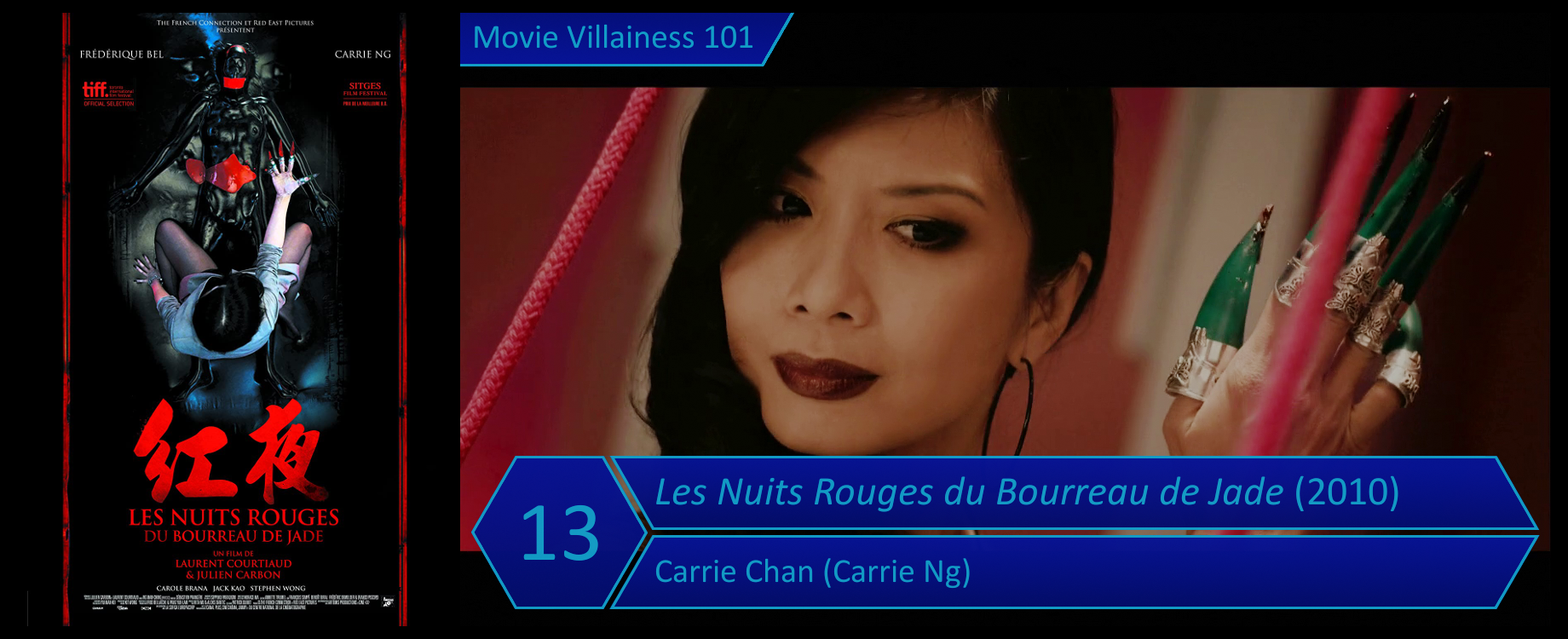
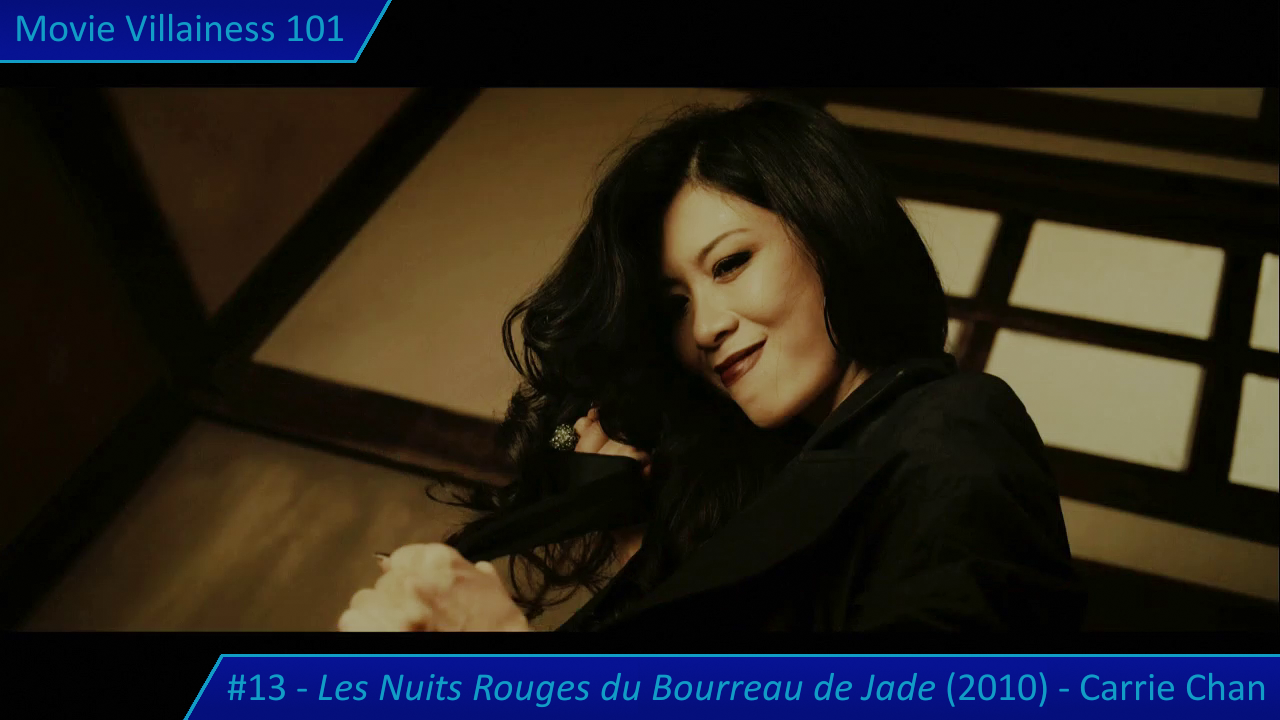
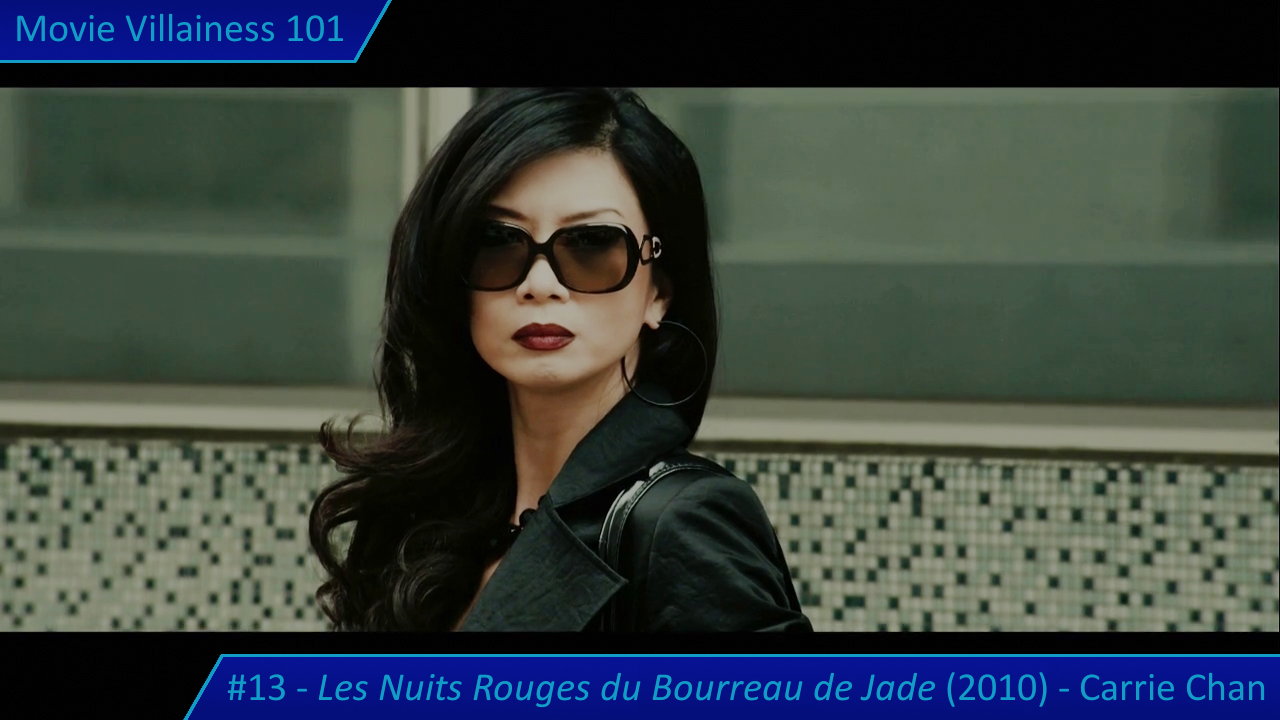
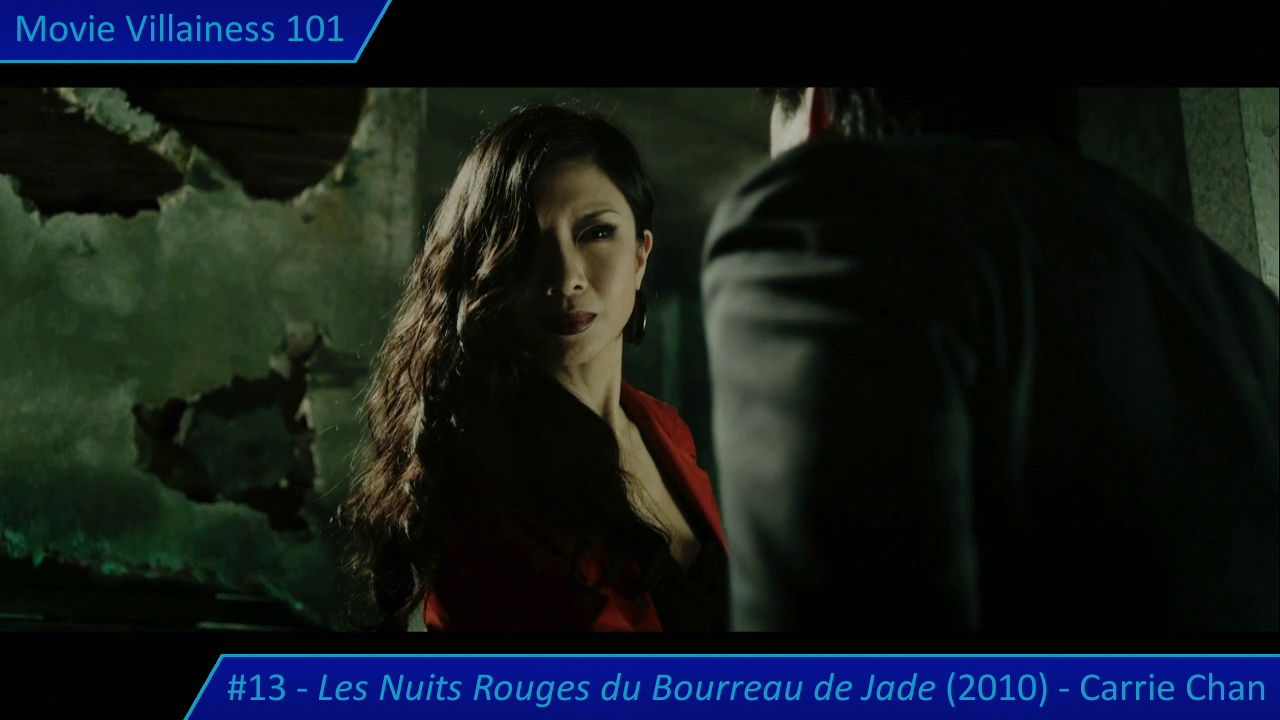
Also known as Red Nights, this joint French / Hong Kong production has extensive nudity and bloody violence throughout. The antagonist, Carrie, is arguably the main character. She sells perfume by day, but is a truly evil and sadistic serial killer by night. When the cast keeps their clothes on, there are erotic sculptures, brutal murders, and sexualised camera angles of women to remind us this movie is intended for an adult audience.

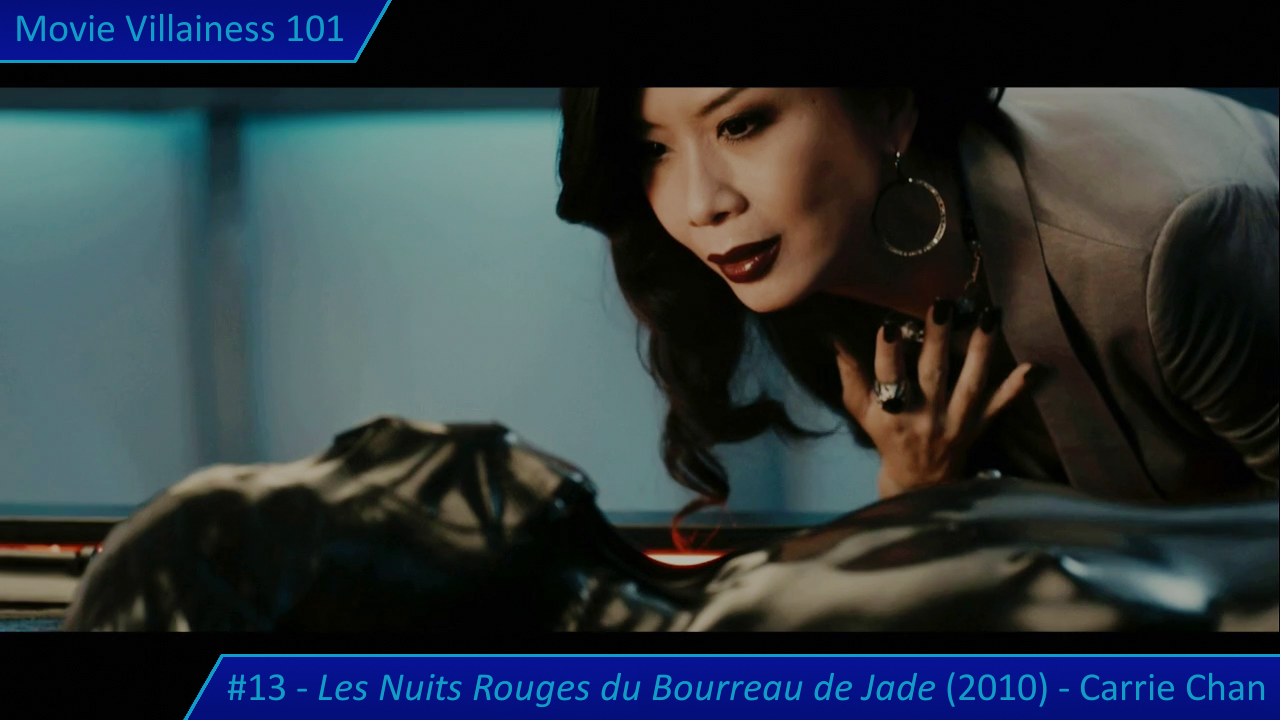
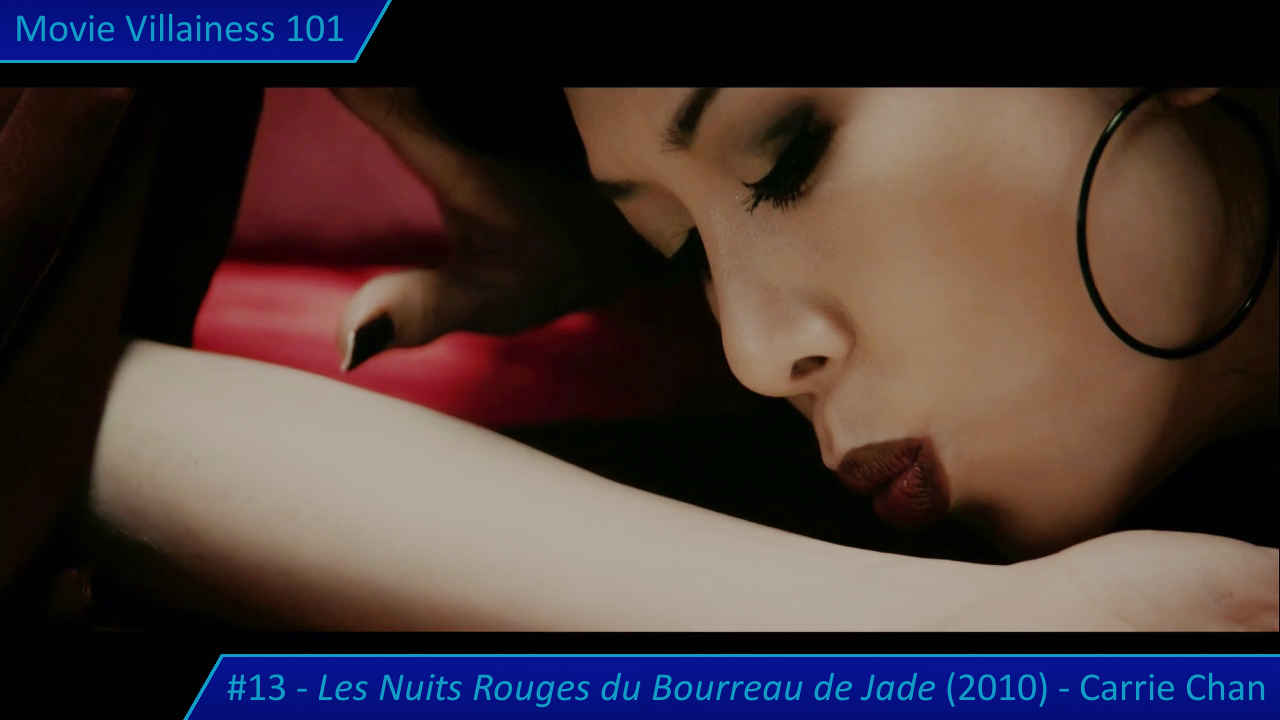
The opening scene introduces a beautiful, long-haired Asian girl named Tulip, whom Carrie blindfolds and drives back to her place. The villainess has a secret lair with a vac bed centre stage in a spherical construction. And the innocent Tulip ought to be more concerned about the gloved male assistant. Instead, the naive girl strips naked, lies down on the bed, and Carrie encases her body in latex. The sweat-drenched Tulip stretches her body after the session, but that’s just the warmup before the main event.

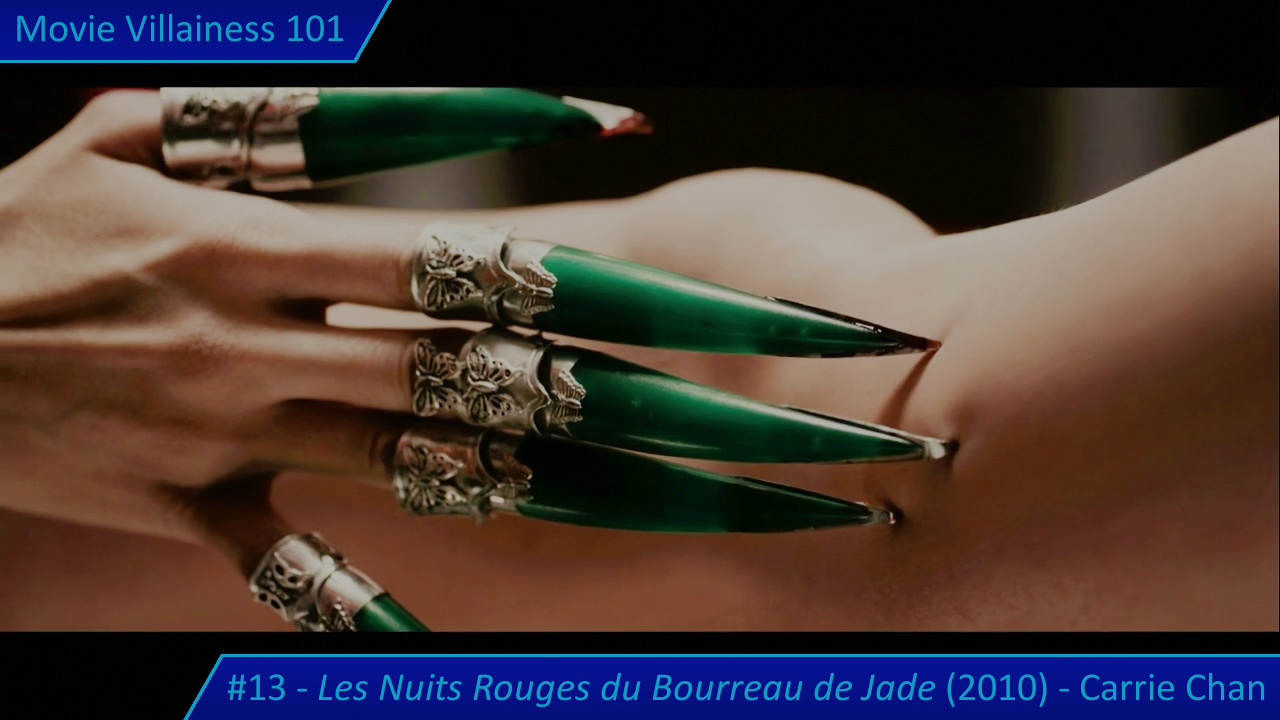
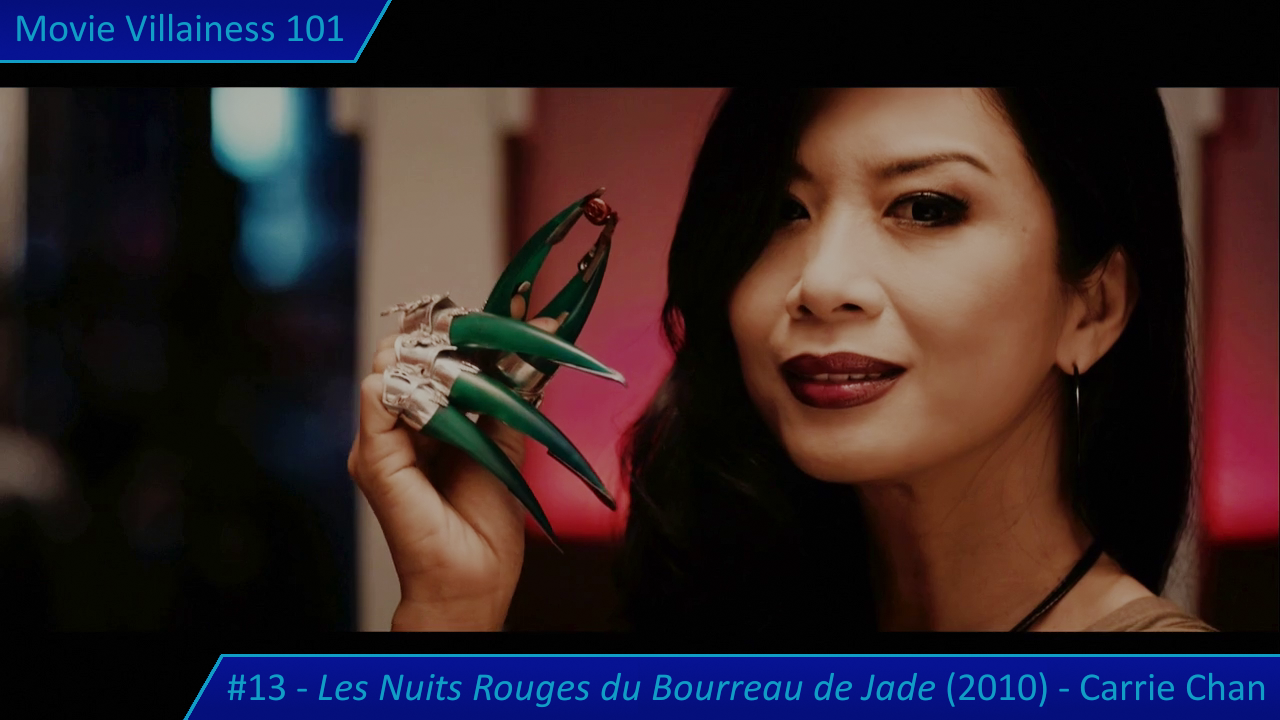
Carrie tapes over the breathing holes, then – while the victim squirms and suffocates under the latex – puts on her trademark jade claws, one for each finger and thumb of her right hand. This villainess likes to inflict maximum pain, but not before twisted fun. Once she’s done running her claws over the trapped Tulip, she kneels on the bed in a sexual pose and stabs the girl in the stomach. That’s the pre-credits sequence over, and the tone set.

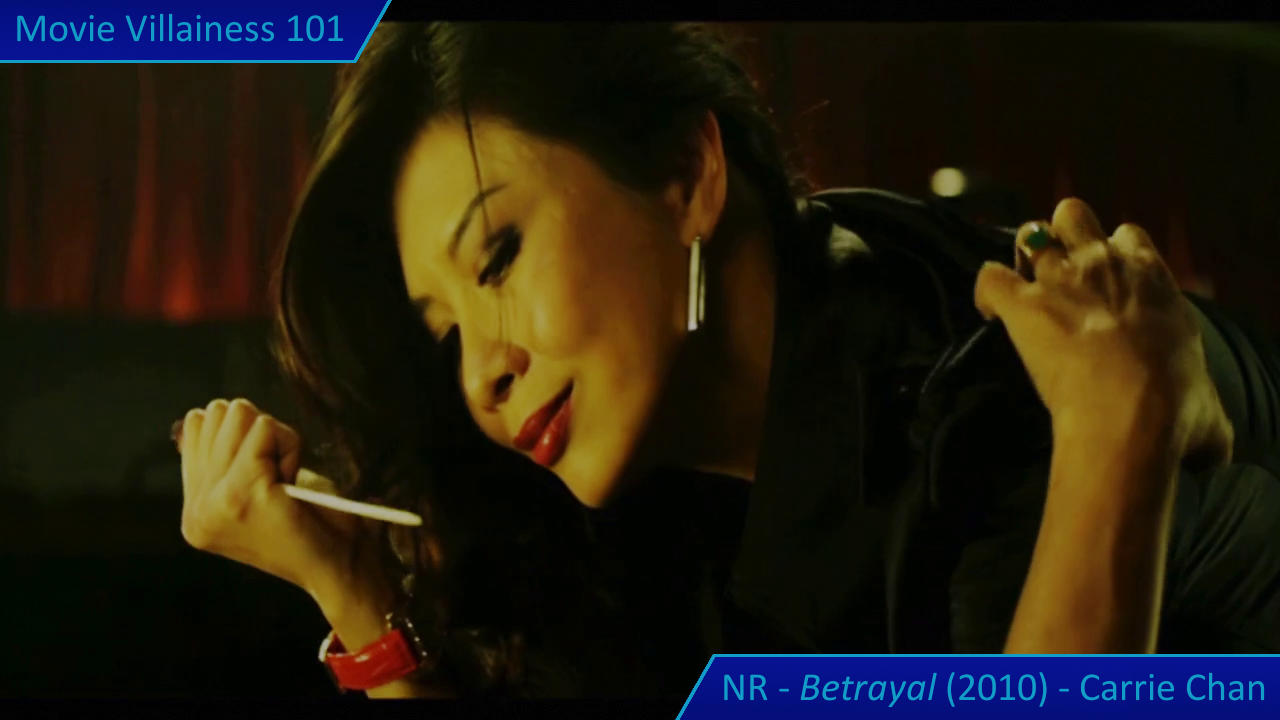
For viewers wanting a longer prologue – albeit tame in comparison – the US DVD release includes a fifteen-minute short titled Betrayal. In the minimal plot, a foolish gangster captures Carrie and goes back on a deal. She gets her revenge, using her belt to gag the man and a hairpin to stab him. This happens off screen, followed by a long scene where the high-heeled murderess stalks a woman who betrayed her through dark streets. After dealing with that problem, Carrie poses on a Hong Kong balcony wearing her jade claws.

Les Nuits Rouges is full of evil schemers, all interested in an ancient Chinese box and prepared to kill to get it. Carrie is the most ruthless, and since the prize is an ancient poison that heightens a person’s senses (including any pain), the villainess really wants it. The protagonist Catherine (Frédérique Bel) is a cold-blooded contract killer who murders her lover accomplice to sell the vial on the black market, but she’s out of her league. Carrie is unmatched in intelligence and villainy.

Villainess

Carrie Chan (Carrie Ng)

With the brutal introduction out of the way, it’s time to get down to business. Catherine – now a wanted woman – brings the stolen box to a broker contact. The killer practices with her weapon beforehand and brings it to the meeting, but doesn’t factor in that her contact is also a ruthless bitch. She’s already made a deal with Carrie and shoots first, using a weapon hidden under the table. The nervous woman is an amateur at this betrayal thing, as the gun jams and she has trouble firing the second shot.

The broker doesn’t suspect that Carrie is even more murderous, and gets slammed teeth-first into a table before she can go through with the double cross. Like in Betrayal, Carrie uses her belt as a makeshift weapon. We see the murder in full, except for a few cutaway shots to the wounded Catherine, but this choking death – despite being graphic – is mild compared with the two torture death scenes to come.

Catherine tracks Carrie by identifying a woman with the distinctive high heel shoes she saw at the dojo meeting place. There’s a standoff in the street as the two killers stare each other down, but Catherine is reluctant to pull the trigger with cops around. Carrie takes advantage of this – and her enemy’s wounded shoulder – to flee the scene. The foreign woman has connections in the Hong Kong underworld, but no longer has the precious box to bargain with. So she settles for a risky IOU.

Perhaps cutting her losses would be wise, but Catherine kidnaps Carrie’s associate Sandrine (Carole Brana) and reveals herself to the villainess. Mimicking a gunshot in a public place is hardly discreet, but this is a setup. Catherine has already spotted a vacant apartment across the street from her safe house, so she handcuffs Sandrine to a loose pipe and pulls the old “let her think she escaped” trick. Sandrine is oblivious to the ploy, and once Carrie realises she’s in Catherine’s sights, the sadist is a cool and fearless customer.

The assassin aims to wound as she still needs the box, so it’s a shot in the shoulder for the villainess. Before Catherine can do any more damage, the henchman switches off the lights. That doesn’t stop Carrie from taunting her foe before the narrow escape, though.

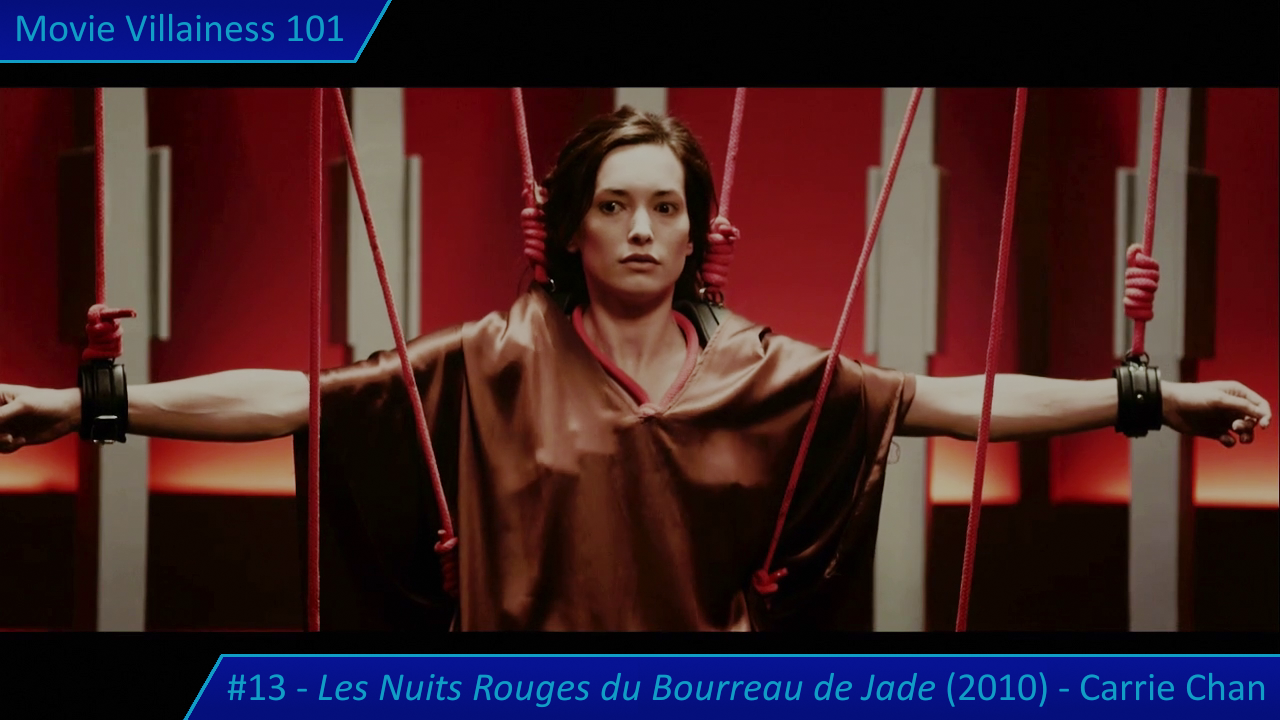
The villainess has already shown a sexual interest in Sandrine at her nightclub, and this presents the perfect opportunity to try out the poison on the woman who failed her. The victim soon realises her evil employer has paralysed her and watches in terror as she’s strapped into a harness and raised into the air. Once again, Carrie has a naked woman at her jade-clawed fingertips, and the torture begins in earnest.

The gruesome scene lasts several minutes, beginning with psychological groping before the villainess cuts deep into Sandrine’s bare foot. The victim is clearly in pain but unable to scream. Next up is a swipe that causes several cuts at once, and Carrie pauses occasionally to walk around the suspended Sandrine. Unlike the murder of Tulip, which cut to the opening titles, most violence happens on screen. One gruesome moment has Carrie slice out and remove a butterfly tattooed piece of skin as a trophy.

The killer pauses mid-torture to open a case full of surgical instruments and blades. Sandrine fears even worse is to come, but Carrie stirs a glass of martini with a sharp fork. The evil woman stands beside Sandrine and sips her drink, then pours the rest onto her bloody victim. Carrie phones Catherine and has her listen in to the muffled agony, which is so disturbing that even the cold-blooded hitwoman is unnerved. Then, the villainess stabs Sandrine in the chest to end her suffering.

The local gangsters have no use for a wounded woman, so they shoot Catherine on a beach. Yes, the protagonist doesn’t even make it to the end, but at least she gets a quick death. Far worse awaits the criminals after they poison Carrie’s lover at a deserted estate. He makes it to the roof and dies in her arms, and a stormy night is the setting for the revenge of the jade-clawed killer.

The criminals have guns, but that doesn’t help them. Carrie knows the building layout and uses a mirror reflection trick to surprise one guard and gut him. Another henchman gets a swipe to the face and goes down instantly. Carrie stalks the final villain through the dark halls, running her jade fingers across the wall as a scare tactic. She punches through a weak panel to stab the guy in the back.

With the last victim barely alive, Carrie pours the poison down his throat and tortures him. The camera pans up to the sky as he screams, and another villainess earns legendary status.

Honourable Mention: Asian Killers

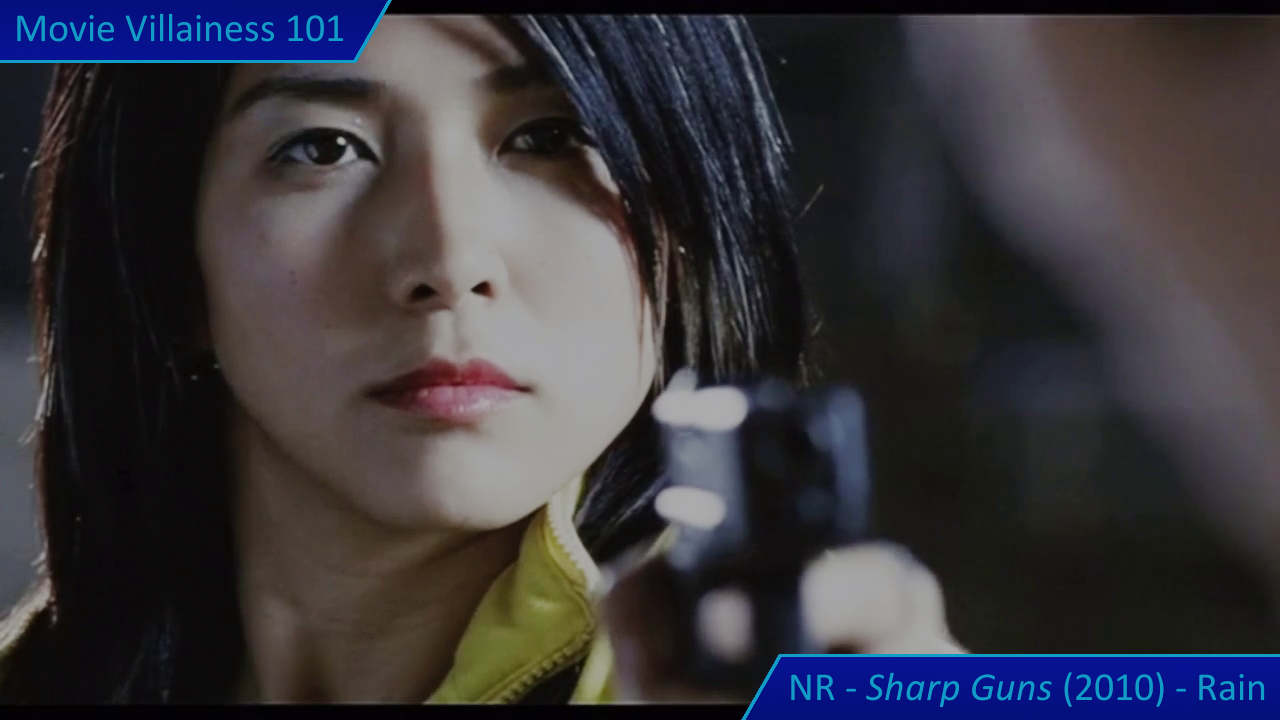
Sharp Guns (2001) – Rain (Anya)

This Hong Kong actioner is mundane and formulaic, except for the ruthless female assassin among the mercenary protagonists. Tricky On (Alex Fong) is hired to find and rescue a kidnapped teenage girl, but shouldn’t have trusted his old friend, especially since that guy is untrustworthy and has no problem executing his own men.

Tricky recruits a sharpshooter (the only character with a moral compass), another man for hired muscle, and a doctor who has no issues with violence. The standout – of course – is the sadistic Rain, who specialises in torturing people and is also skilled with close-combat weapons. She seems more interested in money than loyalty, which foreshadows a betrayal later in the film. However, this is all a ruse, as Rain helps Tricky gain revenge on the man who betrayed him.

An ice-cold killer, Rain isn’t someone you want to piss off. Her best moment comes after she gets herself arrested to gain access to a police station. By this point, a corrupt and misogynistic cop has added himself to Rain’s hit list by sexually groping her. Too bad the police missed the plastic lock pick and piano wire the assassin concealed in her clothes.

While the action rages, Rain surprises the cop and brutally strangles him in front of a terrified female prisoner. Her repulsion doesn’t stop the sadistic woman from enjoying her kill, though. Rain may be on the less evil side, but she’s not exactly good.

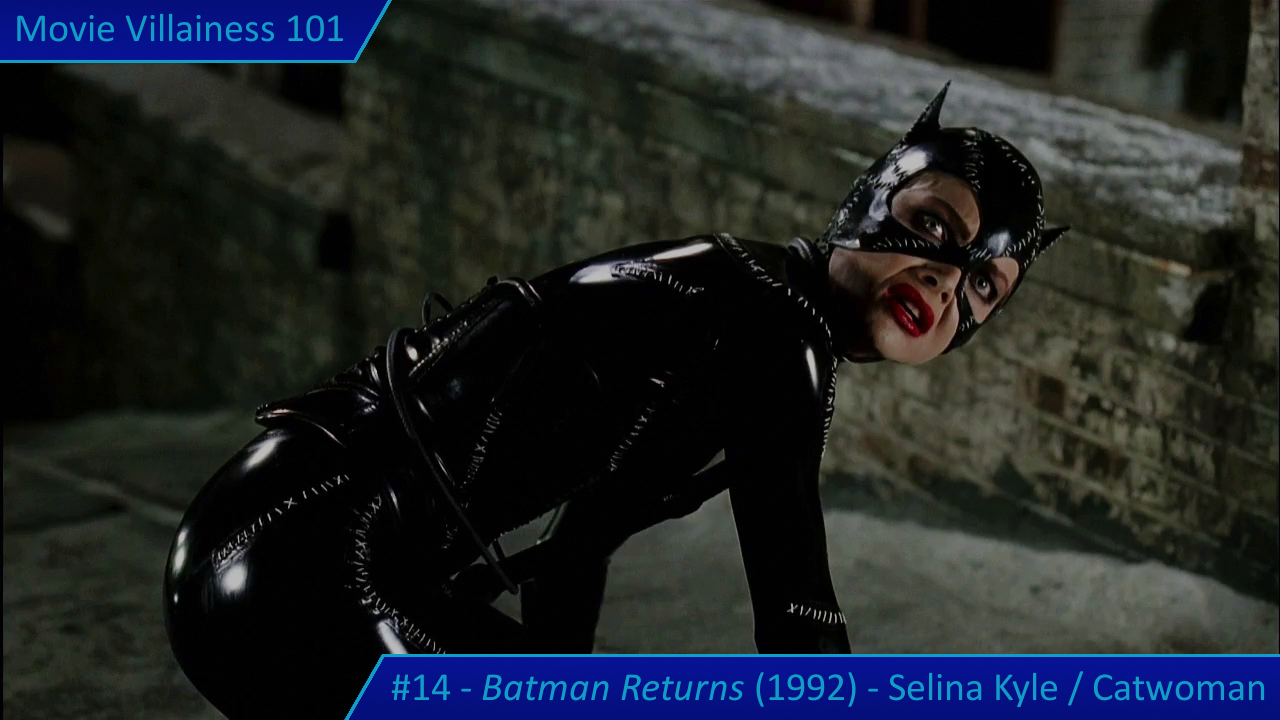
Movie Villainess 101 Rank #14

Don’t allow this sexually charged feline foe to get her claws in you

Movie

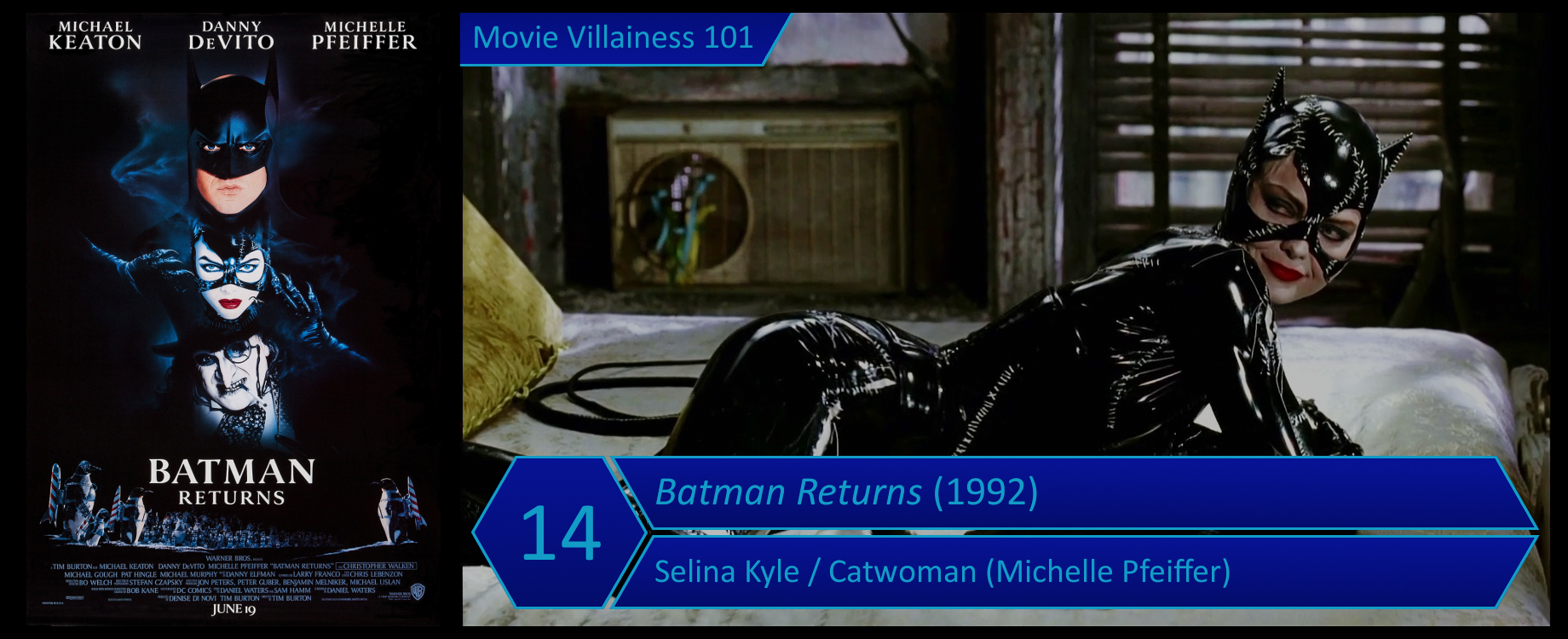
Batman Returns (1992)

This sequel to the 1989 blockbuster had Michael Keaton reprise his role as the brooding caped crusader and Tim Burton return to the director’s chair. No iconic Joker, but a villainous duo with Danny DeVito as the evil Penguin and Michelle Pfeiffer as the devious and sexually charged Catwoman. The tone is akin to The Nightmare Before Christmas (1993), with Gotham City in peril over the festive season and henchmen dressed in bizarre costumes.

The first half-hour gives us origin stories for the two antagonists. Backgrounds aren’t faithful to the source material, with Oswald Cobblepot (aka The Penguin) disfigured at birth and abandoned by his uncaring wealthy parents. That means locked in a cage and tossed into an icy river. Two decades later, the grown-up villain makes his grand entrance. A surprise Christmas present bursts open and unleashes a goon squad to cause havoc. Batman responds and has a chance encounter with a woman named Selina Kyle. Sound familiar?

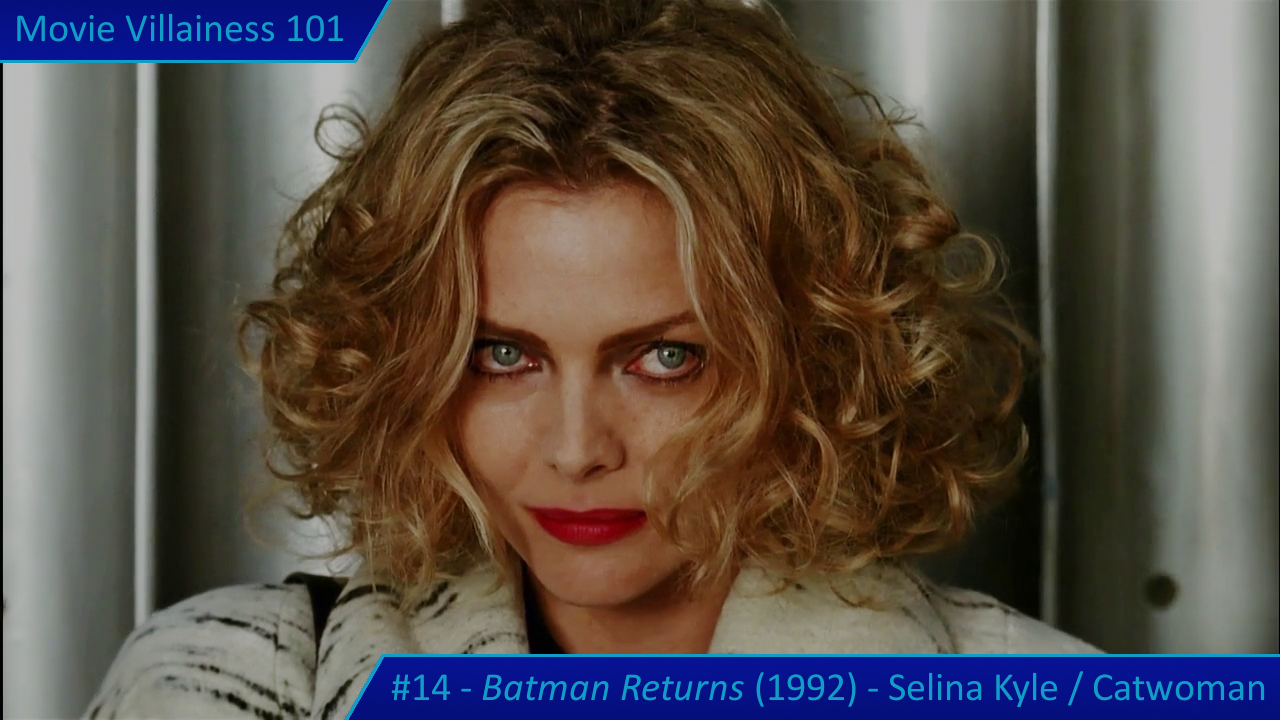
Instead of a jewel thief, she’s an accident-prone secretary tossed through a window after she discovers her boss’ dark secret. That boss is Max Shreck, played by Christopher Walken. He’s a minor villain, even if he likes to pretend otherwise. Selina survives the fall after she’s resuscitated by cats (!). Upon returning home, she gulps down a carton of milk. More importantly, she fashions a costume with a shiny black PVC dress and a sewing kit.

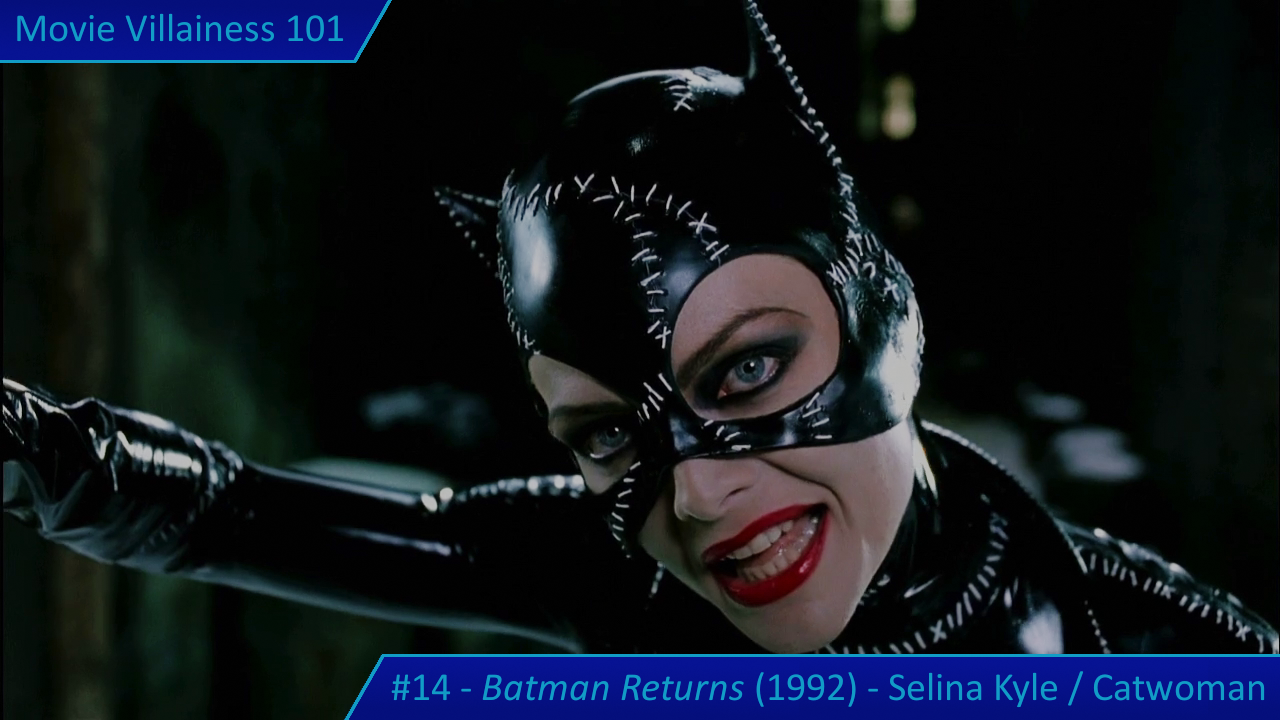
To begin with, the black-clad villainess is shown at a distance through her apartment window, and it’s only when she saves a woman from a mugger that we see Catwoman up close. How Selina developed acrobatic abilities with no training is a mystery, but she easily dispatches – and scratches – the criminal, then gives the victim a lecture on feminism.

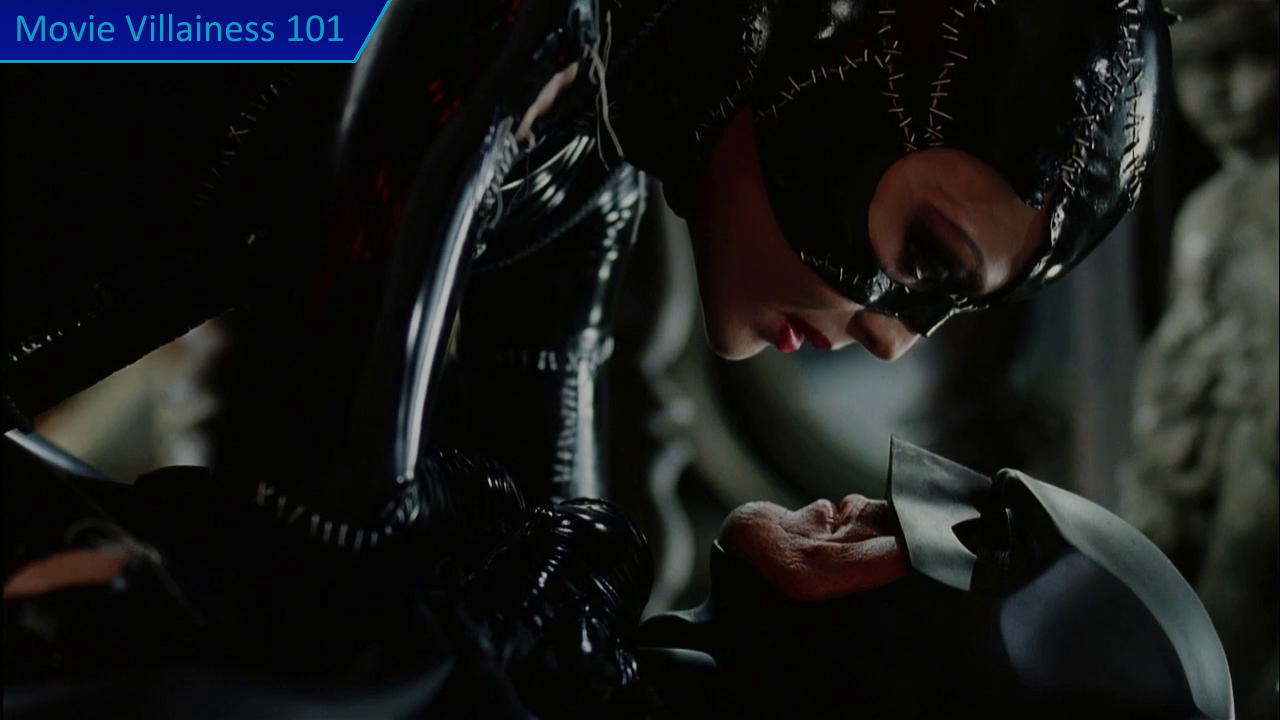
Michelle Pfeiffer often tops polls of the (many) actresses to play Catwoman in film and TV. Her weird origin gives her character a dangerous edge, and she’s closer to a villain than previous incarnations. This version also has the best double life / romantic subplot with Bruce Wayne, actually wears a cat-eared cowl, and wields the iconic whip. Catwoman doesn’t get top billing, but is the foe people remember most. If only for her stitched, tight-fitting catsuit.

Villainess

Selina Kyle / Catwoman (Michelle Pfeiffer)

The Penguin sells himself as a hero by rescuing a baby kidnapped by his own henchmen. He blackmails Shreck into helping him gain revenge on Gotham’s wealthy families. While chaos rages on the streets and Batman fights to maintain control, a certain woman in black unleashes her own destruction. And what better target than her former boss’ store?

Catwoman beheads several mannequins with her whip, showing skill that should take years of practice. She then vandalises and loots a display case. The writers remembered Selina is supposed to be a thief, but this is her only robbery. Two bumbling security guards try to stop her, but are quickly disarmed and sent packing. Then it’s time to crash the party with a burst gas pipe, aerosols left in a microwave as a makeshift timer, and a single word to herald the resulting explosion. Meow.

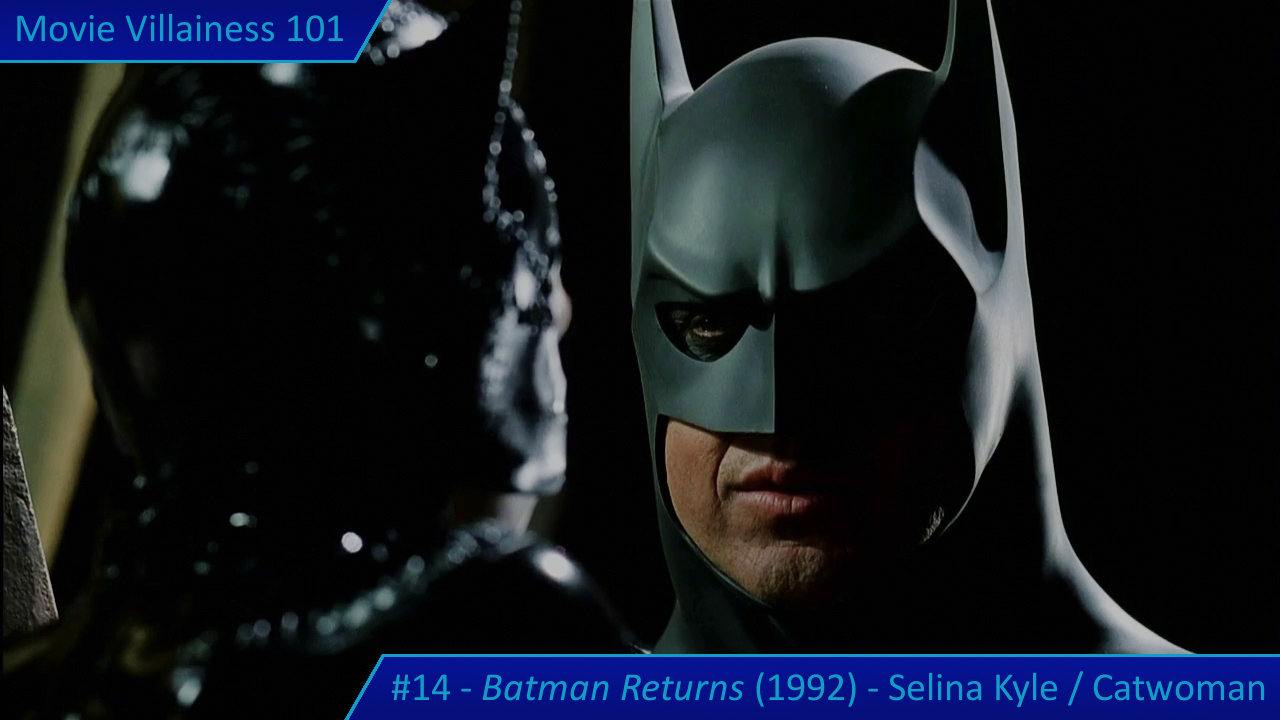
Penguin leaves Batman to handle the newcomer, and the hero manages okay until he strikes Catwoman in the face and she plays the female card. This gives her the opportunity to strike back when the noble Batman lowers his guard, but from that point on he treats Catwoman like any other opponent. After a sexual ploy to get close, she claws the hero’s chest – an attack thwarted by his body armour. Batman throws Catwoman from the roof into a truck of kitty litter. One life down, but she has eight remaining.

Shreck works with the Penguin and devises a scheme to elect him the mayor of Gotham City. This is merely a sideline, and while he happily schmoozes with female assistants, even those fall out of favour when the cat drops in. Seduction is an effective weapon, but Catwoman is hostile to her sleazy host’s sexual advances. This is an uneasy alliance destined to collapse later, but for now the villains have a common enemy.

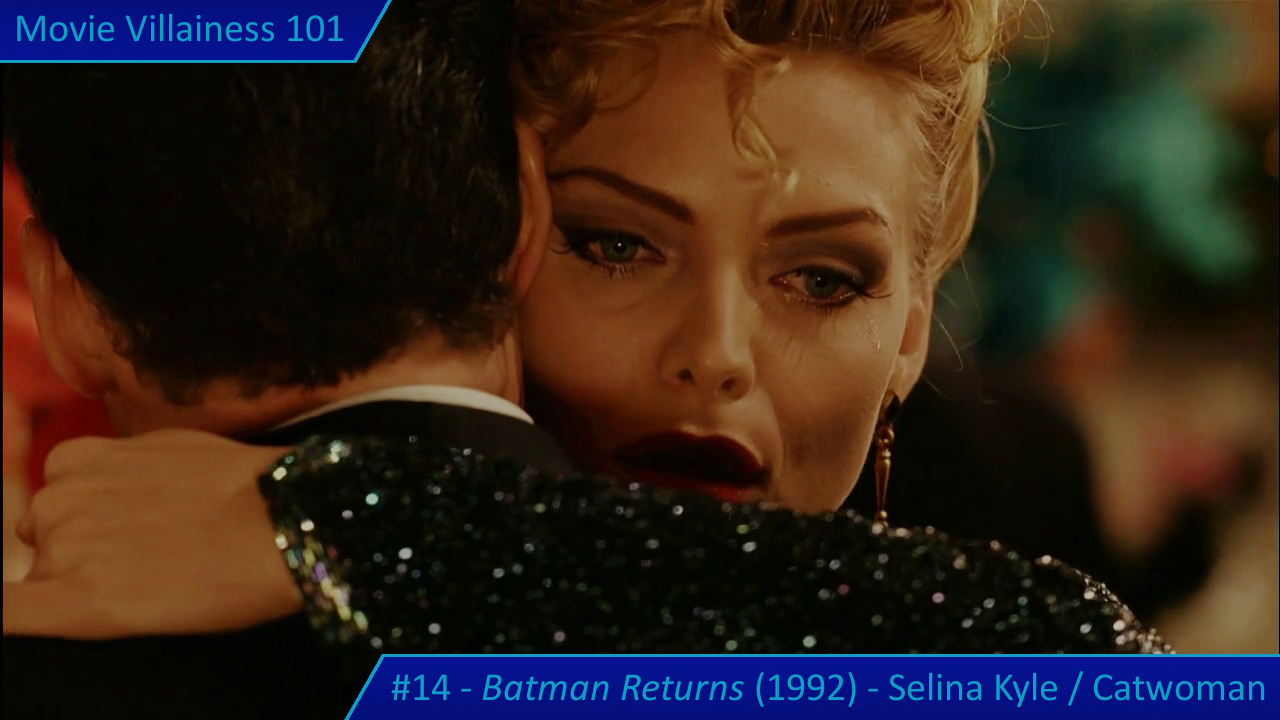
An emboldened Selina Kyle returns to Shreck’s office and after some… cat and mouse antics, the young woman romances Bruce Wayne. There’s soul-searching and close comfort in Wayne Manor before The Penguin wreaks more havoc. His latest scheme involves luring Batman into a trap and framing him for the murder of a buxom celebrity. Catwoman is the accomplice, and she and Batman have another fight. No chivalry or feigning injury this time, and the hero pulls no punches.

The villainess escapes with the hostage, and thanks to a combination of the Penguin (and his trick umbrellas) and the police, Batman lands on his back. A perfect (or should that be purrfect?) opportunity for sexual assault. The hero doesn’t resist and is somewhat lost for words. Catwoman ruins any chance of reconciliation when she stabs Batman, breaking off a clawed nail on his body armour.

Batman disappears into the night, only to find his Batmobile sabotaged and under the Penguin’s control. After causing a lot of property damage, the hero foils the plot and records the villain’s gloating transmission. As he recovers from Catwoman’s attack in the Batcave, Bruce uploads the audio file during a mayoral campaign speech. With Penguin’s credibility in tatters, he dumps Shreck and launches the final phase of his evil scheme.

Catwoman – who treads the line between anti-heroine and villainess – isn’t pleased that Penguin killed an innocent woman. And he’s not happy that she complains, so he hooks Catwoman to a helicopter umbrella that whisks her into the air. A daring escape – and glass-shattering fall – later, Catwoman emerges unscathed.

Time to dress up as Selina Kyle and romance Bruce Wayne at a ball, but their double lives collide when they repeat dialogue from the earlier roof encounter. That’s when they realise their opposite’s nocturnal identity. No time for debate, because the Penguin’s thugs arrive to kidnap Shreck.

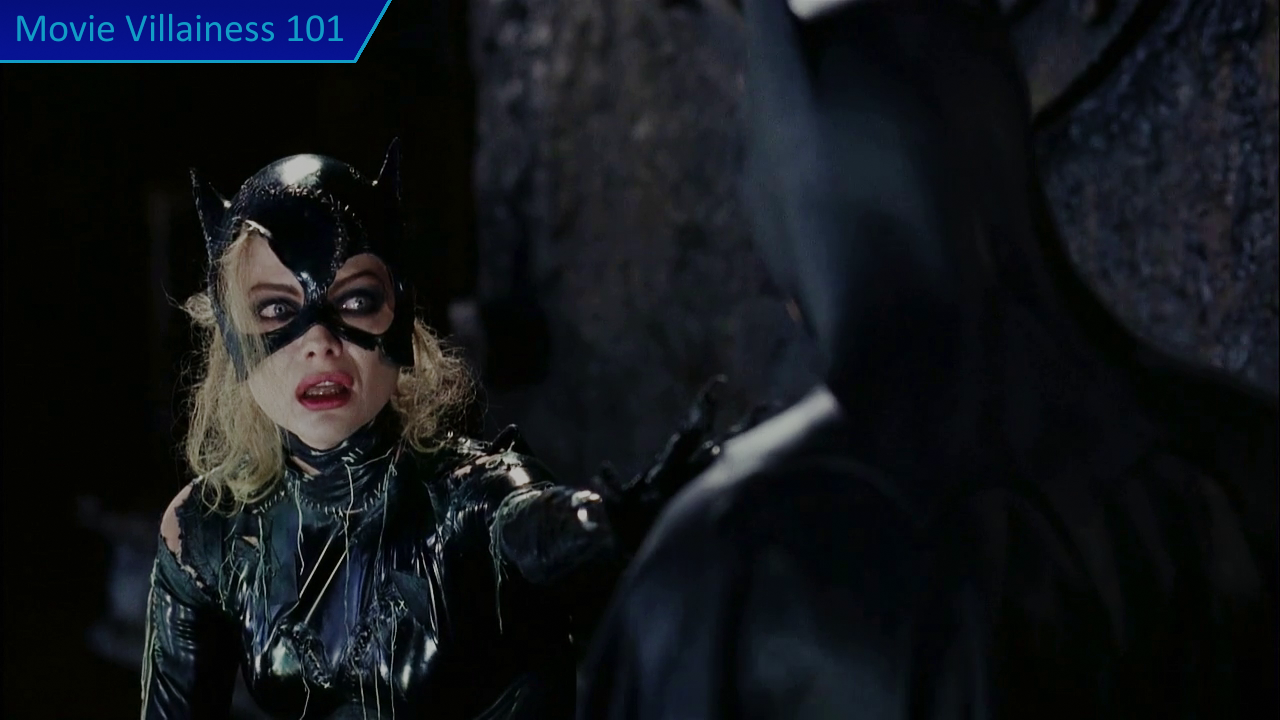
The finale is a disappointing mess, as the deranged villain orders penguins armed with rockets to attack Gotham, only to be foiled by a signal jammer. The Penguin is a better schemer than a fighter, and no umbrella tricks can save him. After a few unimpressive brawls, he falls over in the snow and dies. Shreck and Catwoman get a more interesting climax, as the wild, out-of-control woman desires revenge and an unmasked Bruce attempts to talk her out of it.

The hero appears to get through to Selina before she knocks him down with a claw swipe. The villainess advances on Shreck, shrugs off several gunshots to the chest (more multiple lives nonsense) and dies in an electrical explosion. Apparently, because while Bruce finds Shreck’s body, there’s no sign of Selina. Just before the end credits roll, Catwoman (with a repaired cowl) reappears in silhouette form, but the hinted return never happened.

Honourable Mentions: Catwoman

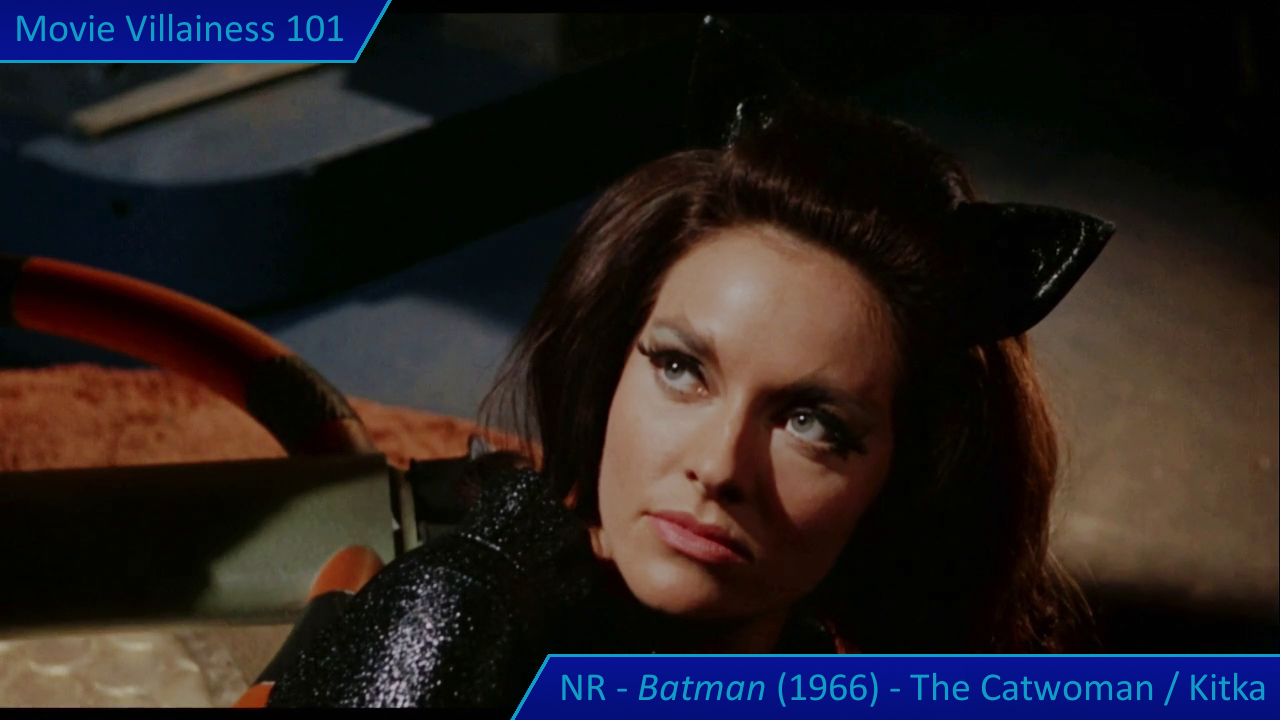
Batman (1966) – The Catwoman / Kitka (Lee Merriwether)

The 1960s Batman was a campy TV series with Adam West and Burt Ward as the dynamic duo, and a feature-length movie between the first and second seasons. Four principal adversaries – Penguin, Joker, Riddler, and Catwoman – team up to take over the world. The result is as colourful and silly as you would expect.

Julie Newmar – who played Catwoman in the series – was injured before filming began, so Lee Merriwether took on the role. Actually, it’s a dual role because Bruce Wayne and Dick Grayson aren’t the only characters with alter egos. When unmasked, Catwoman is Kitka, a Russian journalist as fake as they come. The Penguin puts on a flimsy disguise that Batman sees through, but Kitka’s feminine charms have him completely fooled.

After half an hour of hokum, Catwoman suits up in her black outfit and announces the evil scheme: to abduct the Security Council (think the United Nations). The sole villainess is a conniving femme fatale who poses sexily while the men do the muscle work. Catwoman throws in an evil smirk and mimes claw swipes, but that’s about it.

The big fight at the end has the superimposed comic-style text that this campy production is known for. As the duo fight on Penguin’s submarine, Catwoman gets the drop on the heroes and dunks them in the ocean. No hard physical contact in this era, so she trips and falls. Her mask comes off in the lame defeat, revealing her dual identity to a stunned Batman.

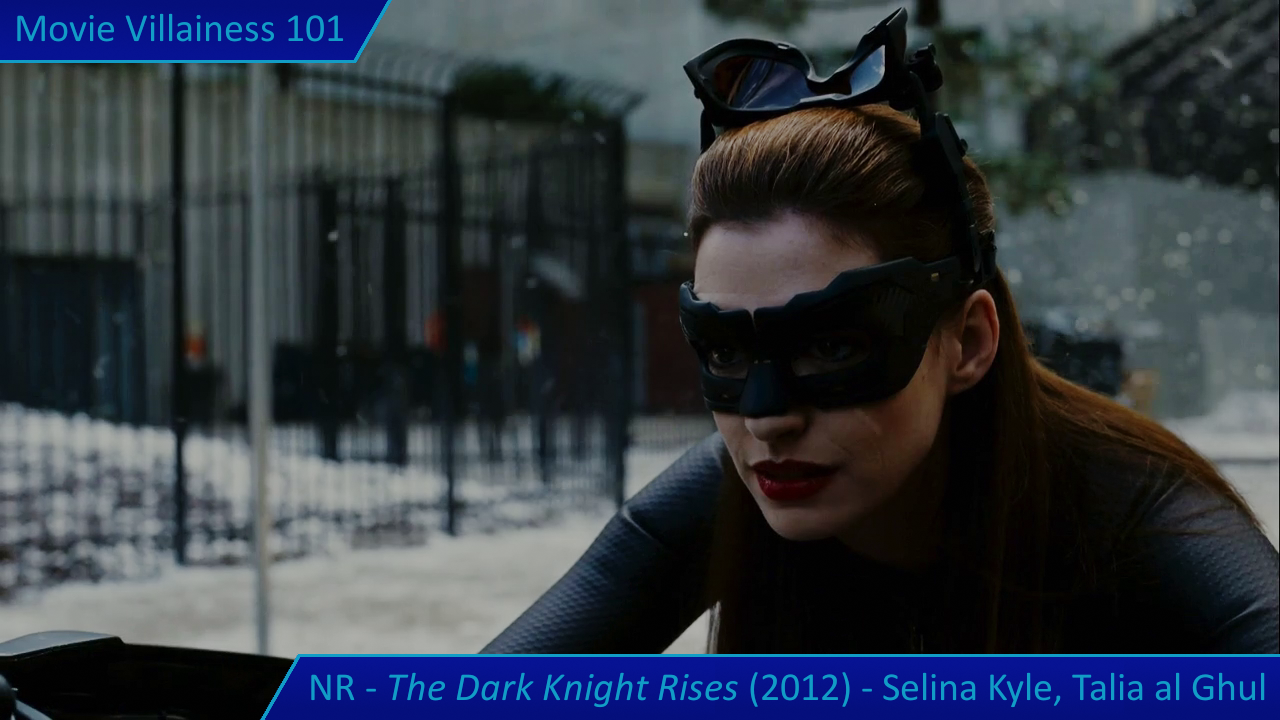
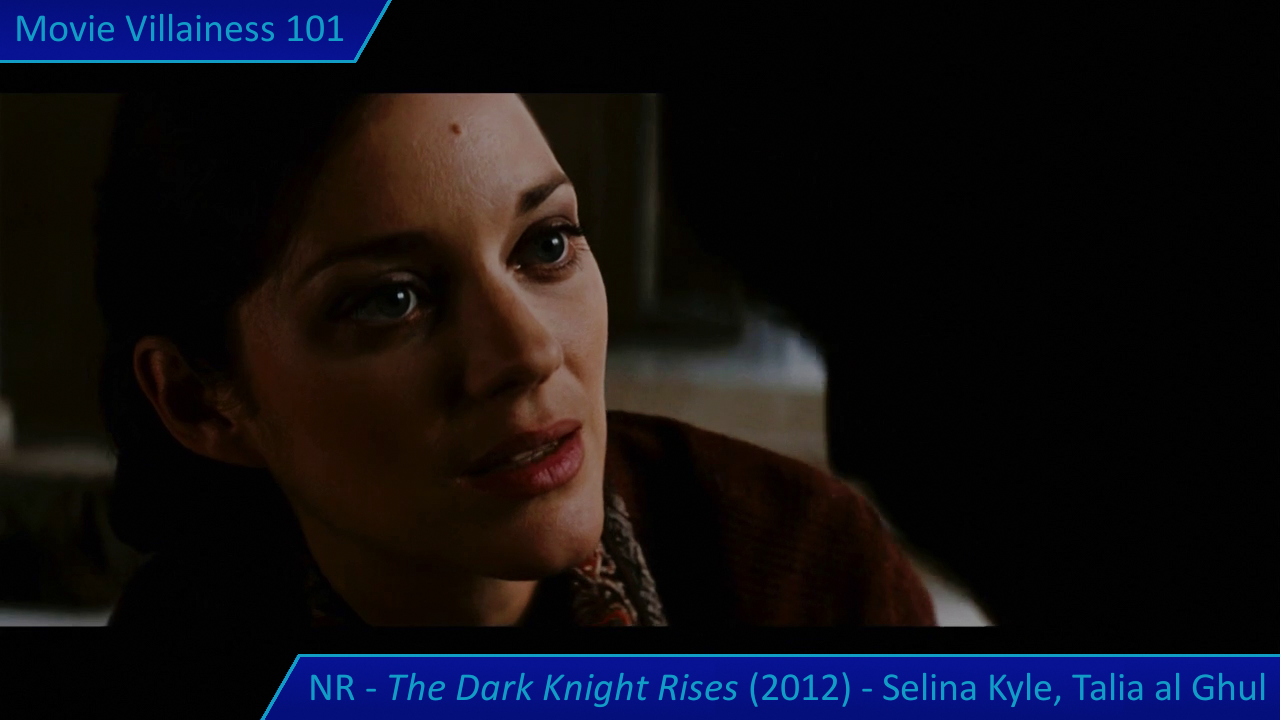
The Dark Knight Rises (2012) – Selina Kyle (Anne Hathaway), Talia al Ghul (Marion Cotillard)

A more serious take, the conclusion to Christopher Nolan’s Dark Knight trilogy had Christian Bale as Batman go up against Bane (Tom Hardy). Grounded in reality – as far as caped crusaders go – so the villain is a huge imposing guy in a mask without the venom backpack. Bane is bent on bringing chaos to Gotham’s streets. The twist is he’s supposedly the son of Ra’s al Ghul (Liam Neeson), the antagonist of Batman Begins.

Selina Kyle is a thief closer to the source material, but is never referred to as Catwoman, though several headlines mention a cat burglar at large. This devious woman is introduced as a maid in Wayne Manor who encounters the reclusive hero. Against a retired cripple, she easily escapes with an acrobatic window leap. Besides stealing pearls from a safe, Selina absconds with Bruce’s fingerprints. Her shady employer attempts to betray her, only to find she’s smarter and can easily defeat his goons in combat.

After Bane’s violent campaign convinces Batman to return, we see Selina in a catsuit. Her all-black outfit has cat-ear goggles and razor-sharp heels useful for threatening bad guys. Unlike other movies, Batman recognises Selina through her domino mask, and they defeat an army of thugs with little trouble. Selina even does a stealthy disappearing act when Batman turns around on a roof.

The hero is unwise to trust a criminal, because she rats him out to Bane. Selina can only watch as the brute beats Batman senseless and breaks his back. A paralysed Bruce finds himself in a hellhole prison and learns the only person who ever climbed the well-like entrance to escape is a child. As Bane takes over Gotham City, two prisoners heal Bruce as he hallucinates about Ra’s al Ghul. After several failed attempts, the hero makes the climb and returns home.

Selina Kyle, uncomfortable with the new Gotham, joins Batman on his mission to stop a nuclear bomb. Batman has a flying vehicle after his trademark Batmobile was destroyed in The Dark Knight (2008), and the reluctant heroine gets to ride the Batcycle. She’s a natural at the hero thing and takes out armoured vehicles. Selina even finishes Bane with the cycle’s rocket launcher. Overkill, maybe, but it needed something powerful to take down this foe.

In the climax, it’s revealed that Bane is not the true mastermind. That would be Talia, the daughter of Ra’s al Ghul, who’s been posing as a civilian named Miranda Tate. She gained Bruce’s trust, and they even had a brief romantic fling. But anyone familiar with the comics knows about the female heir, and Miranda drops several hints. The surprise works because of the late reveal, but by the time Talia stabs Batman in the back, there’s only twenty minutes to go.

For a trained assassin who escaped a hellish prison as a young girl, Talia’s contribution post-reveal is very limited. She issues kill orders and climbs into a moving truck, but it only takes a few missiles to crash her vehicle. That’s it for any action. The dying Talia gloats Batman will never disarm her bomb in time, but a female assassin without a fight scene is a waste of potential.

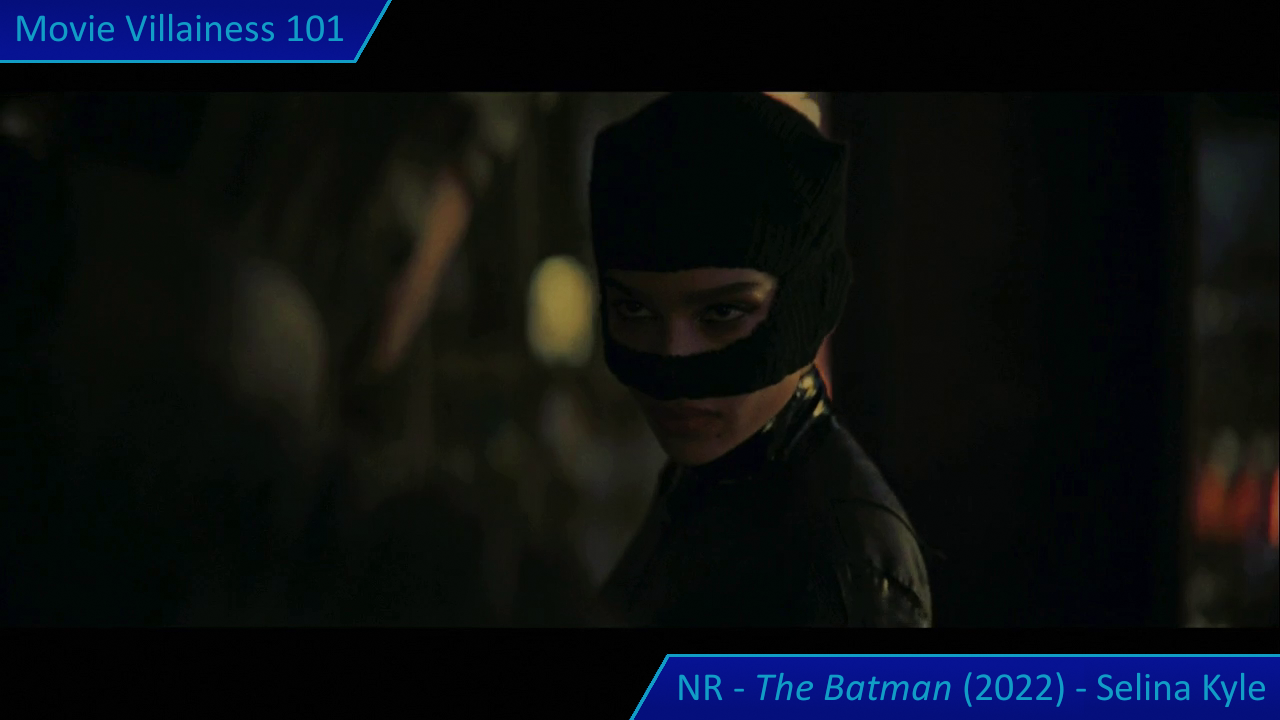
The Batman (2022) – Selina Kyle (Zoë Kravitz)

Ten years since the previous incarnation, it’s time for another reboot. Robert Pattinson is a raw and violent vigilante, and Gotham is so dark that even the Burton and Nolan movies seem bright. There’s less focus on Bruce Wayne and more on detective work, with Batman chasing a psycho who wants to bring chaos to the streets. The Riddler is a masked villain reminiscent of the Zodiac Killer, leaving cryptic messages for the police.

Selina Kyle – not referred to as Catwoman – is a prototype who wears a leather outfit and a makeshift balaclava. The motorcyclist anti-heroine has a mission of her own, and she’s adept at thievery, disguise, and beating up criminal scum. Her acrobatic kickboxing skills are less effective against body armour, and Batman defeats her with ease. After that, it’s flirty romance and the occasional partnership.

Selina is a subplot in an overlong, three-hour movie. Long fingernails are a natural weapon dangerous enough to claw the face of a mob boss. A length of chain stands in for a whip during a nighttime assault, and her mask already has distinctive cat ears. Overall, a faithful version of the comic character. Zoë Kravitz will apparently return for the sequel, so let’s hope for an iconic outfit and more involvement.

Movie Villainess 101 Rank #15

An anti-heroine, two villainesses, and a henchwoman – badass women are well represented

Movie

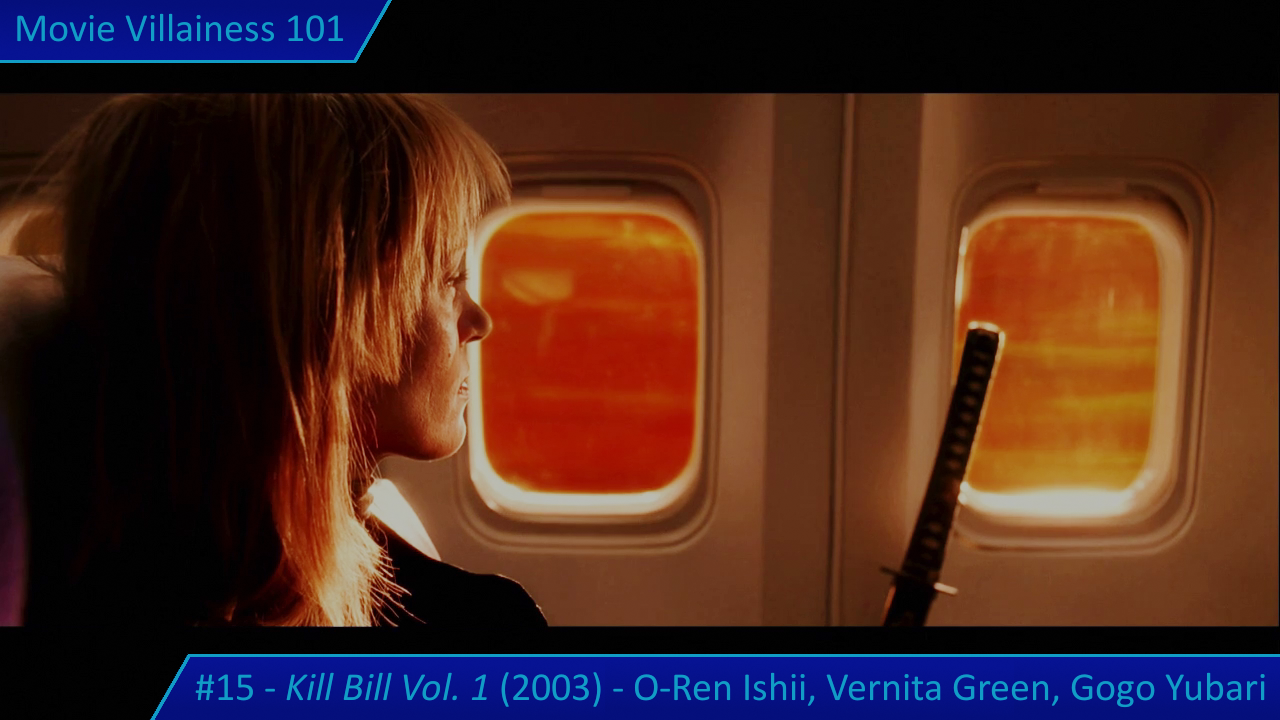
Kill Bill Vol. 1 (2003)

In Quentin Tarantino’s two-volume revenge saga, the men do the talking while women fight to the death. Often violent and bloody, but what do you expect when the protagonist is a deadly assassin and her former cohort are the targets? Uma Thurman’s Bride is left for dead at a wedding rehearsal, but the Deadly Viper Assassination Squad should have finished her when they had the chance.

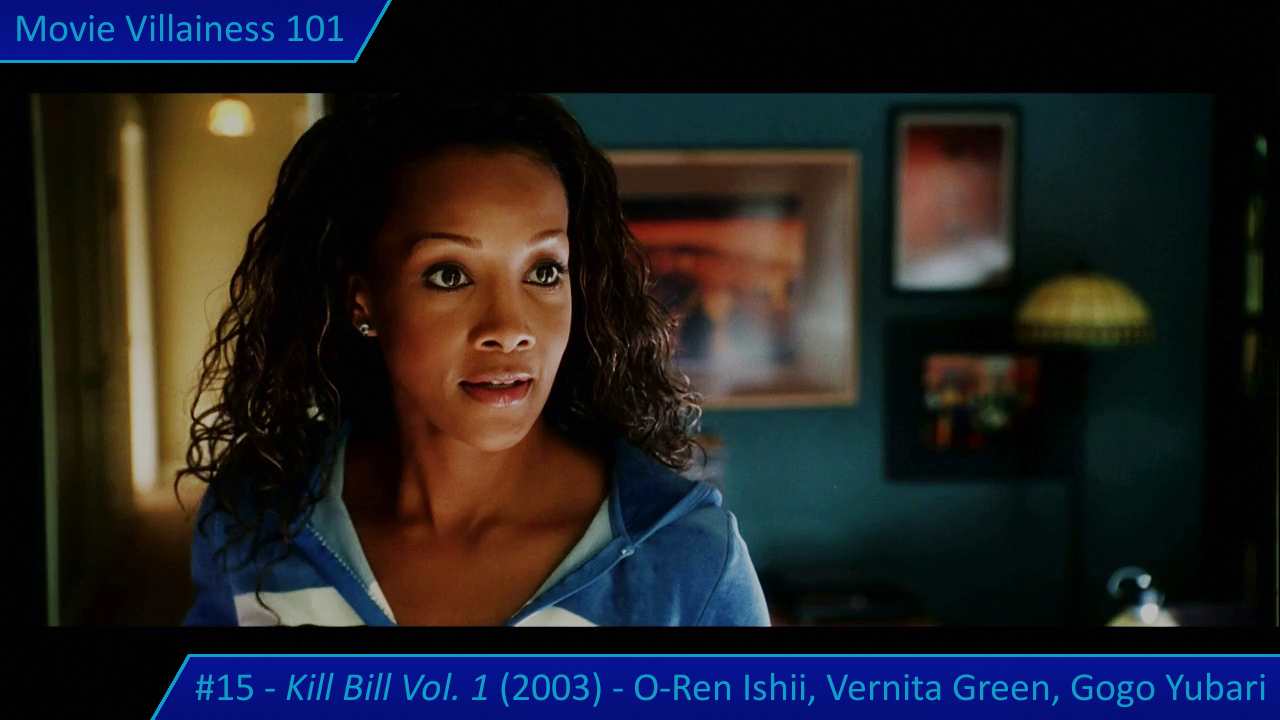
Ten chapters are split across two films, presented out of order. The first target we see is actually the Bride’s second: Vernita Green, aka Copperhead (Vivica A. Fox). She’s enjoying retirement in suburban America, but that doesn’t earn her any sympathy. She and the Bride fight each other and wreck the furniture in an even contest before Vernita’s little girl shows up, and the killers put their feud on hold. A brief pause before Copperhead draws a concealed gun. It’s a bad idea to miss the target, especially a woman armed with a throwing knife.

Moving back in time, Texas cops investigate the wedding chapel aftermath and the supposedly dead Bride, who turns out to be alive. Elle Driver (Daryl Hannah) is a psycho assassin, so she’s not pleased when Bill (David Carradine, though we don’t see his face) says it’s not chivalrous to kill a woman in a coma. Skip forward four years, and the Bride wakes up with a metal plate in her skull and a vendetta against the hit squad who killed her fiancé.

The four-hour saga (counting both films) is overlong with lots of dialogue. The Bride has a samurai sword made by a Japanese master smith, but did we need five minutes where she pretends to be an innocent Yankee tourist? He survives and should consider himself lucky. Most men (and women) are treated as expendable, often with fancy camera angles and tinted palettes to add variety to their demises. A handful of characters put up a worthy fight, but most last fewer than ten seconds.

While the solo female antagonists might just scrape legendary status, the ensemble trio of villainesses are worthy of a top fifteen ranking. And the Bride is a one-woman army, firmly in antihero territory.

Villainesses

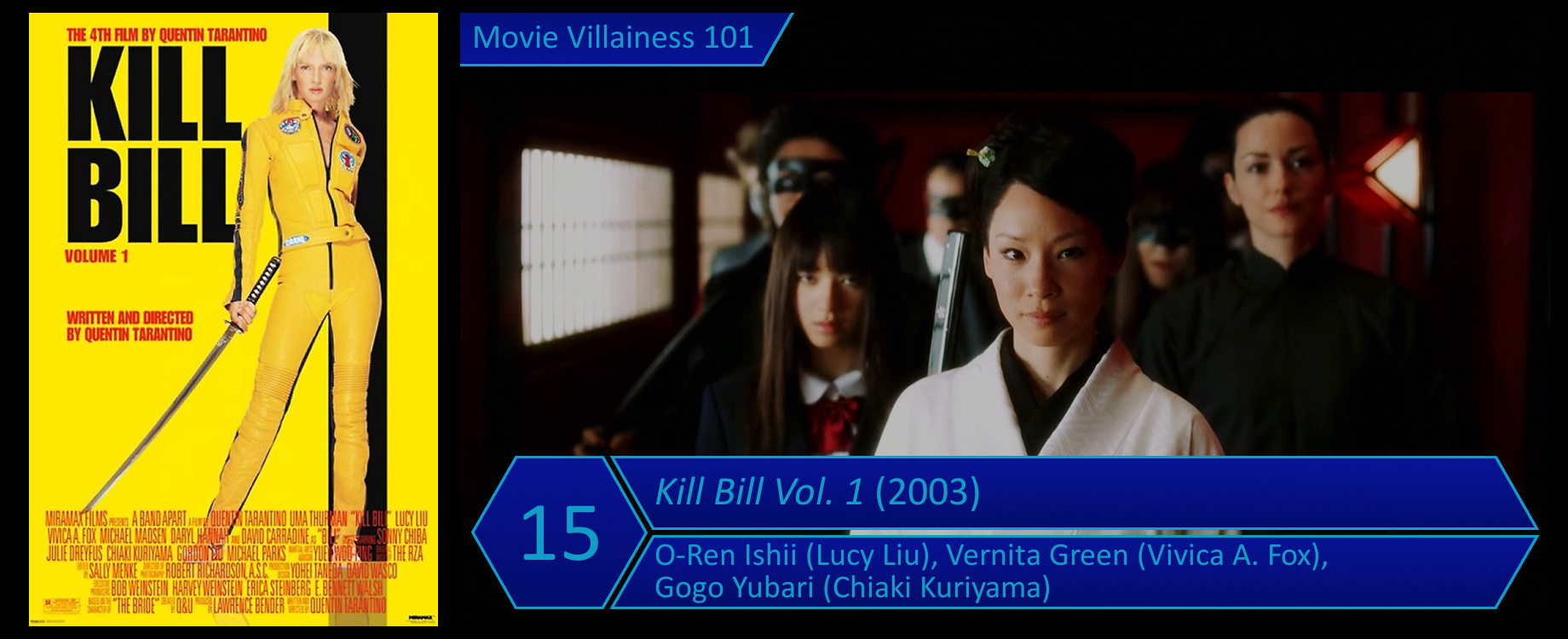
O-Ren Ishii (Lucy Liu), Vernita Green (Vivica A. Fox), Gogo Yubari (Chiaki Kuriyama)

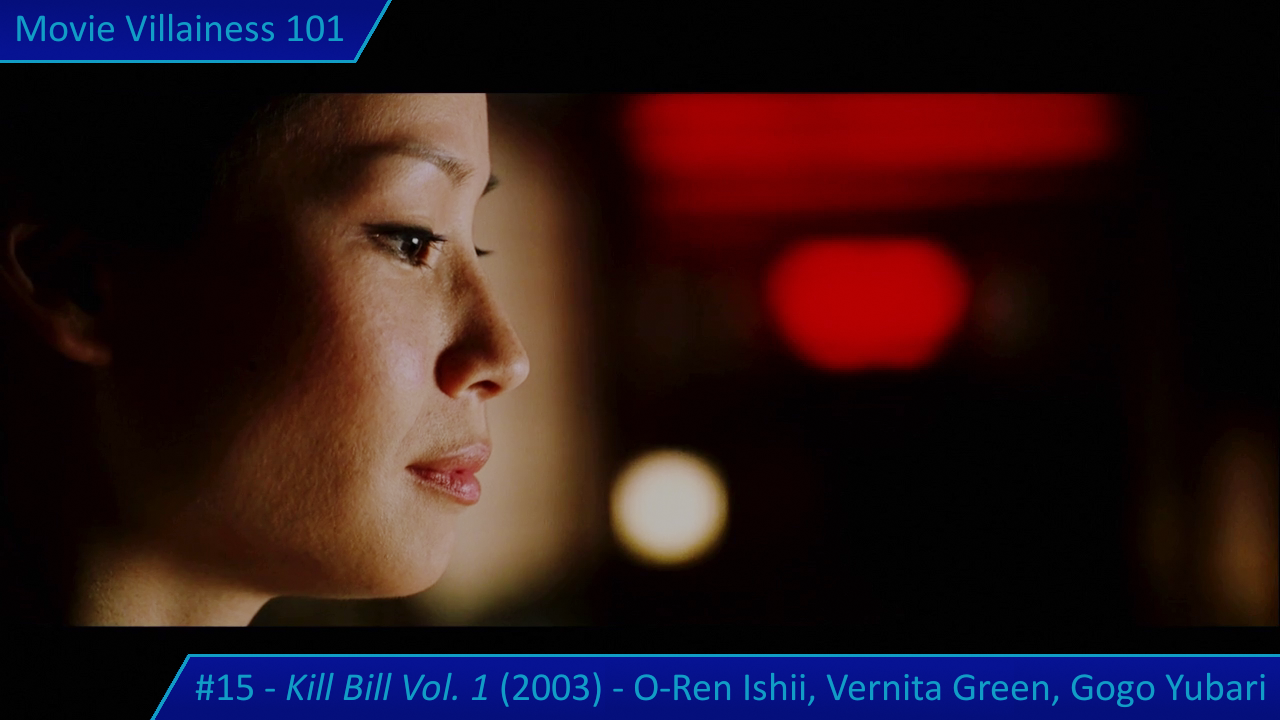
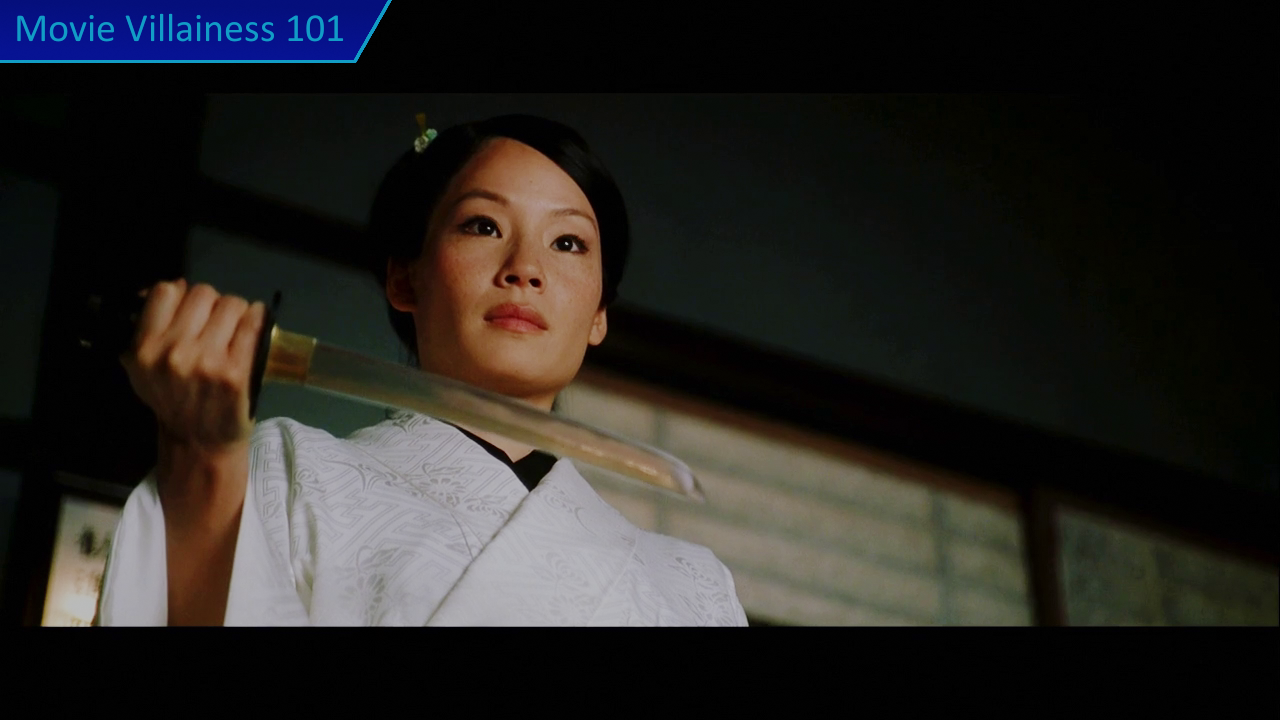
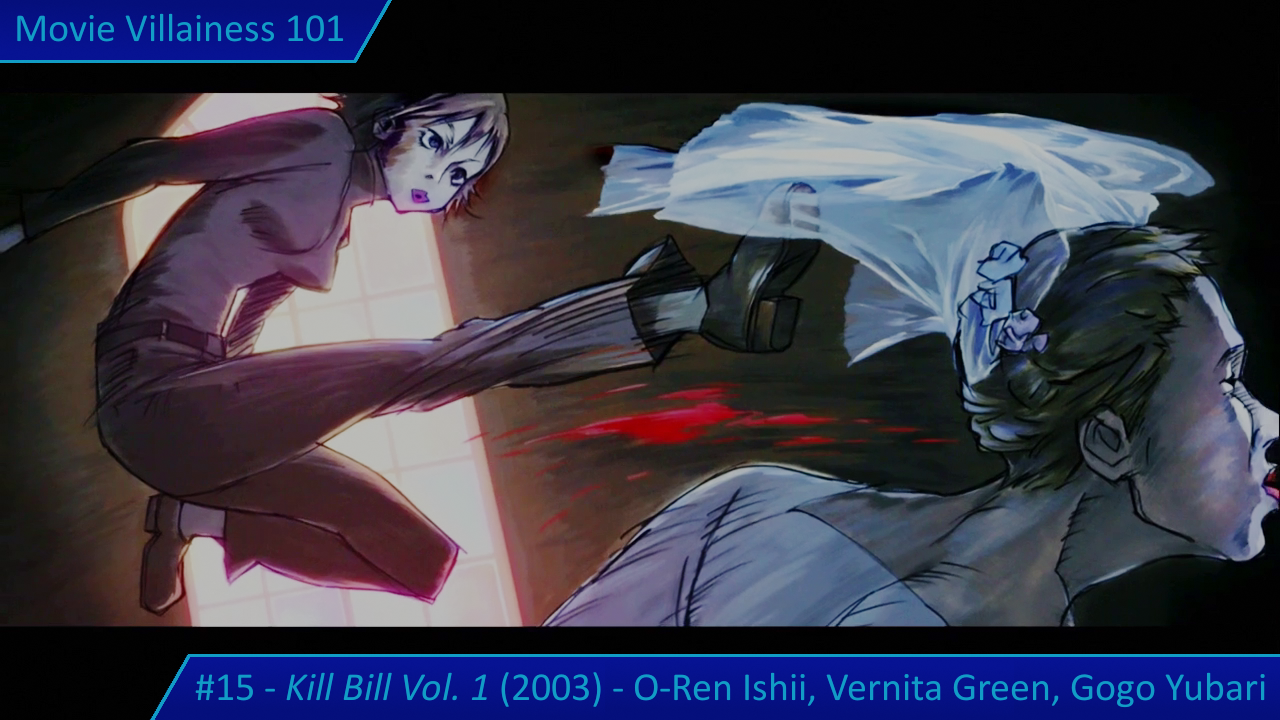
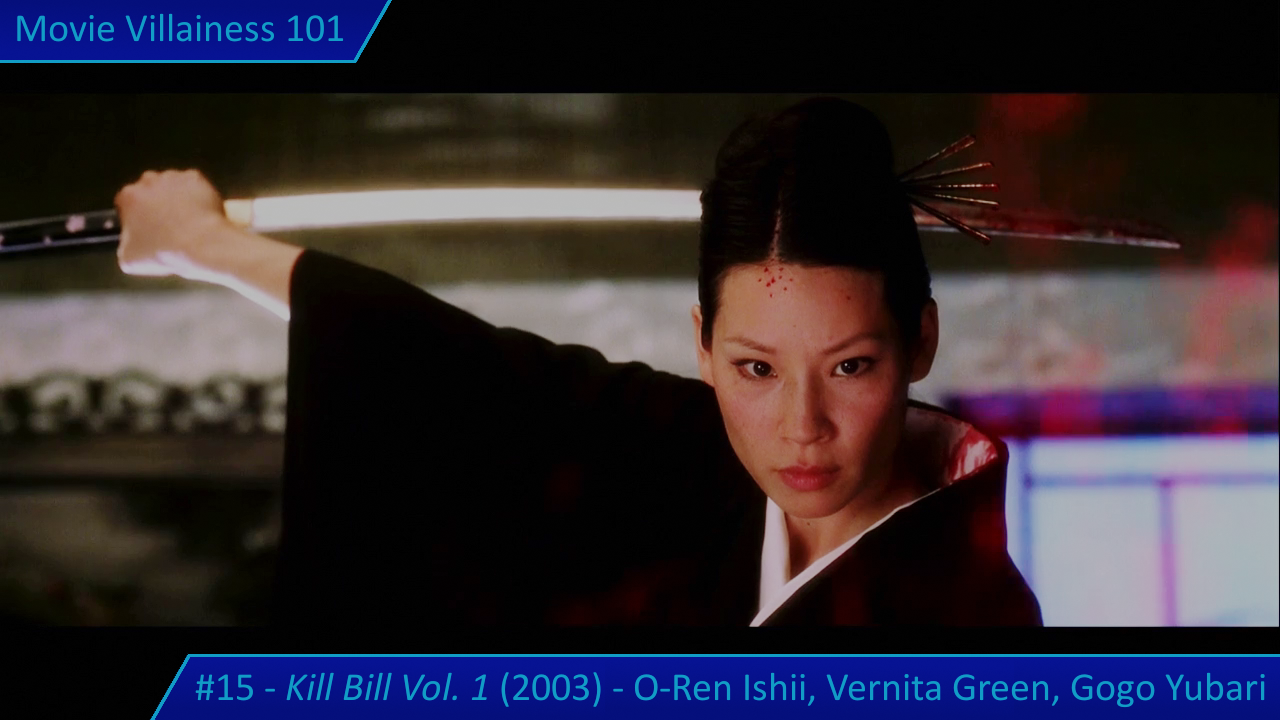
As the final boss of Volume 1 – using a video game analogy – O-Ren Ishii gets a badass introduction. Actually, three of them. First is an animated backstory that shows revenge against the Yakuza boss who murdered her parents, her rise as an assassin, and the wedding attack that made her the first target. The cartoon is as violent as the live-action segments. For those eager for “real” action, that comes soon enough when O-Ren decapitates a crime lord who refuses to fall in line. That ends all dissent and establishes the villainess as truly ruthless.

In Tokyo, there’s a montage of the Bride wearing a yellow jumpsuit on a motorcycle while O-Ren rides in a limousine flanked by her biker enforcers. A voice-over narration introduces the key lieutenants. These are the domino-masked leader of the Crazy 88 gang, timid assistant Sofie Fatale, and the far more deadly and sadistic Gogo. For O-Ren’s third introduction (we get she’s a badass), she enters her club with her minions close behind as epic music plays.

The final chapter of Volume 1 is a half hour long action sequence where the Bride takes on all comers. Like any crime boss, O-Ren has a horde of disposable goons. After the Bride chops off Sofie’s arm, one poor guy is sent in alone and routinely dispatched as the villainess watches from the balcony. Then come a few more guys, none of them any good. There’s a female in their ranks, but she doesn’t last much longer.

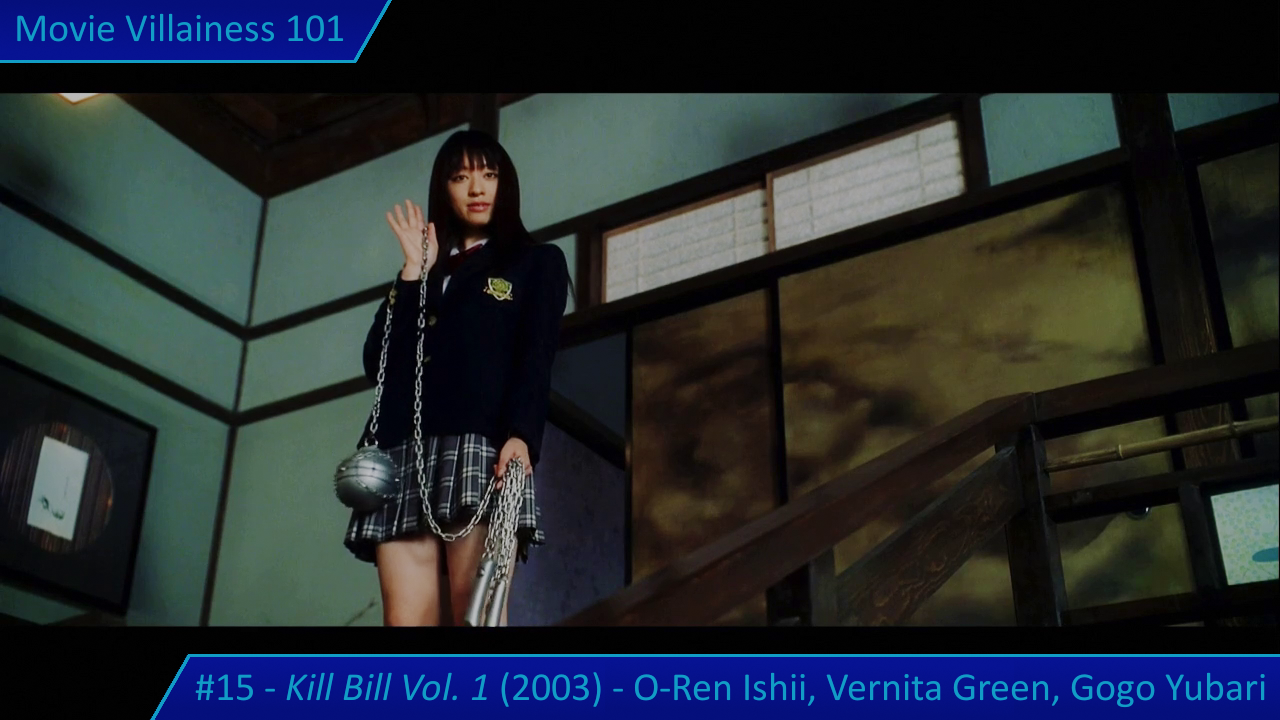
It’s not until Gogo steps forward that the Bride has any competition. As the only henchwoman with an introductory flashback, it’s obvious the ball and chain wielding psycho will be more difficult to defeat. After a lengthy opening attack where Gogo demolishes the club decor, she disarms the Bride and gets her in a chain chokehold. The Bride is equal to the challenge and improvises with a block of wood (and sharp protruding nails) to kill her opponent.

There’s a humorous interlude where O-Ren gloats it won’t be that easy before more masked thugs arrive. Most of the Bride’s carnage is shot in black and white, but the violence isn’t toned down. Plenty of people lose arms and legs, but don’t land a single blow against their well-trained adversary. Even the leader dies quickly, knocked from the upper balcony after the Bride slices off his leg. O-Ren walks away mid-fight, almost as if she expects her foe to kill her underlings. The villainess even admits this when the bloody victor steps into a snowy exterior landscape to confront the boss lady.

After all the buildup, don’t expect a great battle. It’s stylish enough – with the two swordswomen circling about each other as the tempo raises – but few blows are traded. O-Ren is a worthy match and slashes the Bride in the back. After a few more moves, it’s the crime boss’ turn to get cut, only this swipe cleaves off her scalp. O-Ren has just enough time to acknowledge the victory before she collapses dead in the snow.

My prevailing thought: “Is that it?” I suspect many other villainess fans will feel the same. So brilliant up to the last encounter, but ultimately a letdown.

Honourable Mentions: Kill Bill / Stylish Assassins

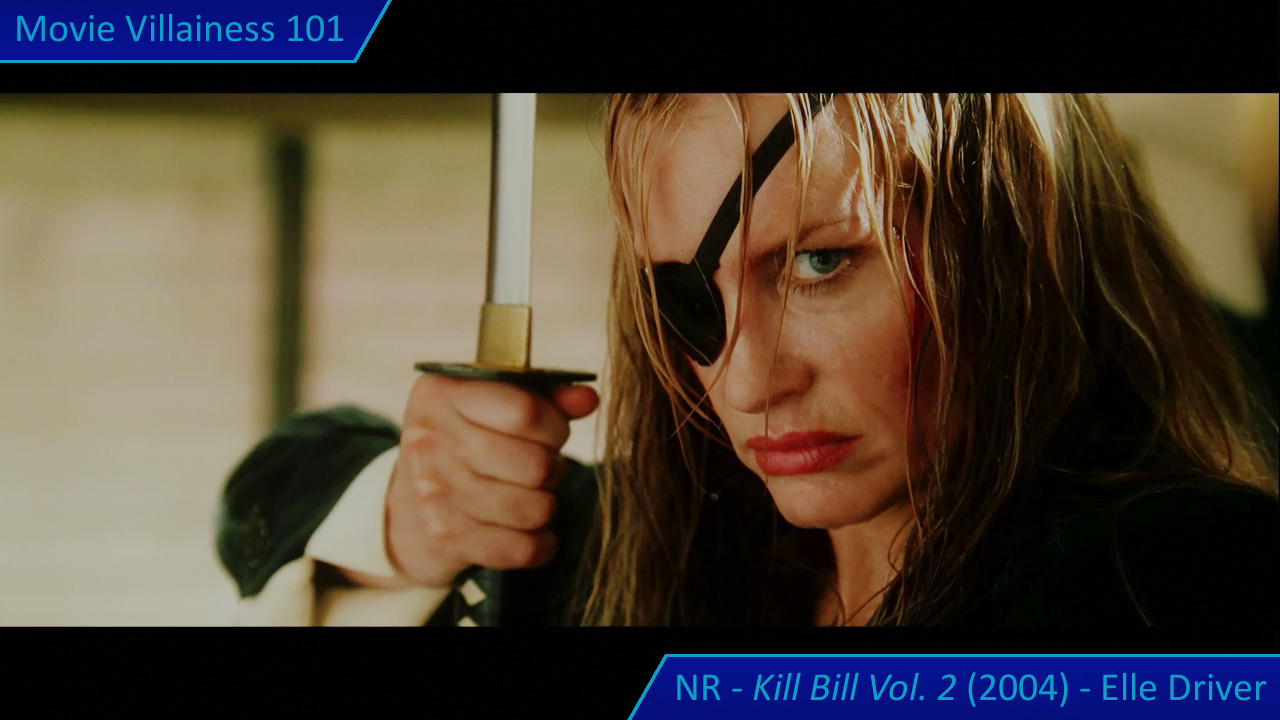
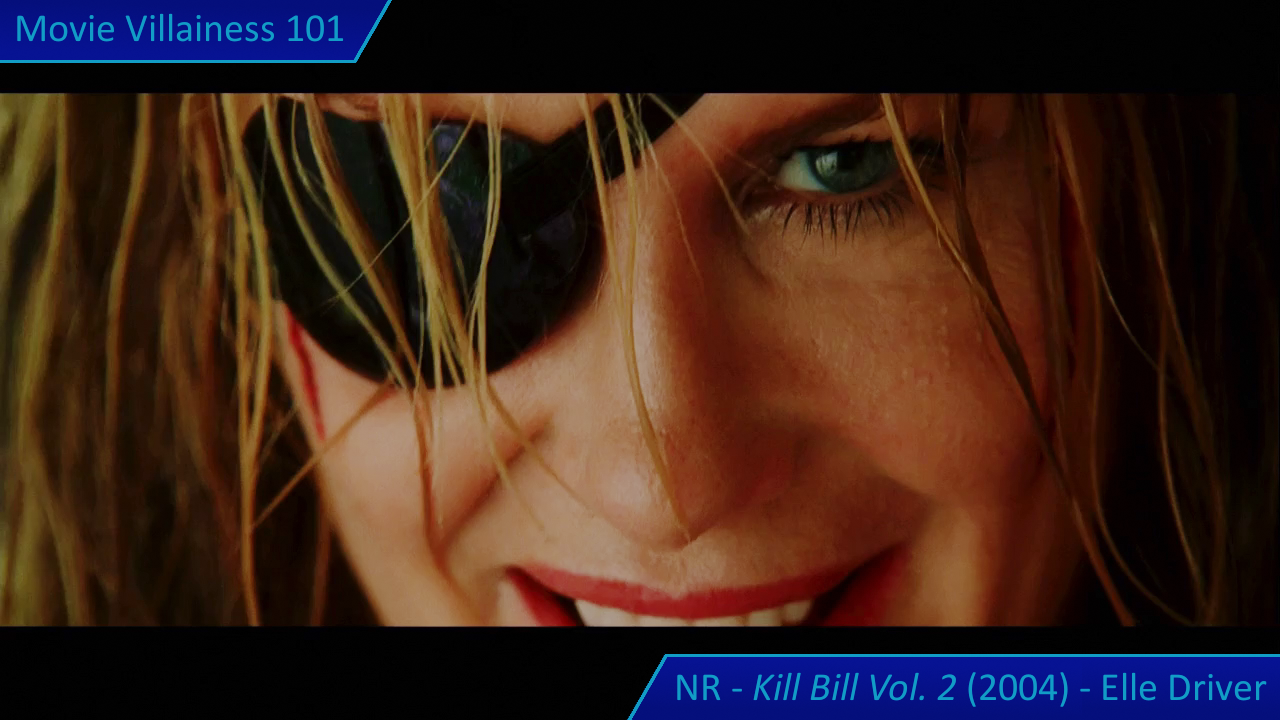
Kill Bill Vol. 2 (2004) – Elle Driver (Daryl Hannah)

While the first volume had 50% action, there’s barely 5% in the second half. The Bride has three targets remaining. Budd (Michael Madsen) is a washed-out hitman living in a trailer, and Bill has become a family man fond of lengthy conversations. Once more, it’s the females that deliver the excitement. If this summary seems brief, there’s not much to discuss despite the movie being over two hours long. Even a minor character – an Asian assassin whom the Bride talks down by revealing she’s pregnant – gets more action than Bill, who’s killed by a death touch.

Yes, the final boss fight never materialises. The movie subverts expectations, and skilled assassins achieve victory over superior opponents by cheating. The Bride – decked out in ninja garb – confronts Budd, only to get shot and buried alive in the desert. It’s a good thing she listened to her brutal sensei and can bust her way out of a wooden box.

The treacherous Elle murders Budd – who she could easily kill in a fair fight – by planting a snake in a bag of money. There’s a chilling scene where the assassin lists the symptoms of the poisonous venom, then the Bride returns and the proper fight begins. Elle has the sword and the advantage, but the Bride is a tough woman to take down. Like most locations where female assassins battle it out, the trailer ends up destroyed.

Telling a vengeful killer you murdered her old mentor is not the smartest play, and the Bride responds to Elle’s confession by plucking out her remaining eye. The anti-heroine leaves the blind woman alone with her pet snake, but the villainess’ fate is left to the imagination.

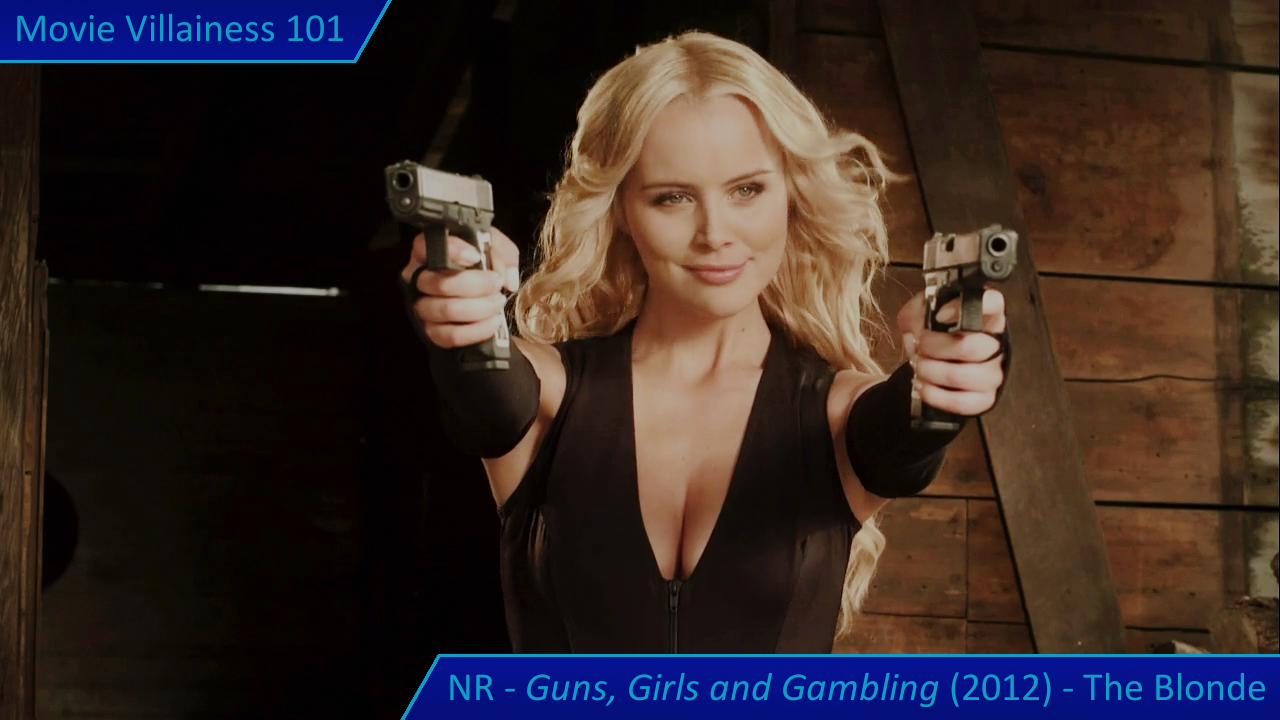
Guns, Girls and Gambling (2012) – The Blonde (Helena Mattson)

Not a Tarantino film, even though it pretends to be. Weird characters populate this “man caught in a gang war” tale, all introduced with title cards so we know who they are. Cowboys and Indians is a prominent theme (two assassins even go by those names), and there’s a modern western feel. Two bosses – The Chief (Gordon Tootoosis) and The Rancher (Powers Boothe) – fight over a tribal warrior mask stolen by a gang of Elvis impersonators. Yes, this movie is just as crazy as it sounds.

The man in the middle is John Smith (Christian Slater), and there are also appearances by Jeff Fahey as the double revolver-toting Cowboy, Gary Oldman as the ringleader Elvis Elvis, and Megan Park as the sweet Girl Next Door. Except she’s faking it, naturally. Plenty of people die before the final showdown is done, with minor characters biting the dust before the more important players.

The deadliest assassin is the unnamed Blonde, who recites Edgar Allan Poe before blowing her victims away. This woman – dressed in black and the subject of frequent sexy rear shots – is the coolest character, skilled in acrobatics and firearms. She emerges unscathed from her bloody encounters, escapes double-crosses, and rides off into the sunset with her prostitute accomplice and a suitcase full of money. Everyone else is on the losing side, except for John Smith, who played everyone from the start.

The Blonde’s standout moments are assassinating a man in a toilet cubicle (!) and besting the Indian who brings a tomahawk to a gunfight. In a movie full of corpses, this female assassin has the highest body count. So John Smith wisely lets the Blonde and her leather-clad lover keep their share.

Movie Villainess 101 Rank #16

This particular contract carries a high penalty for failure

Movie

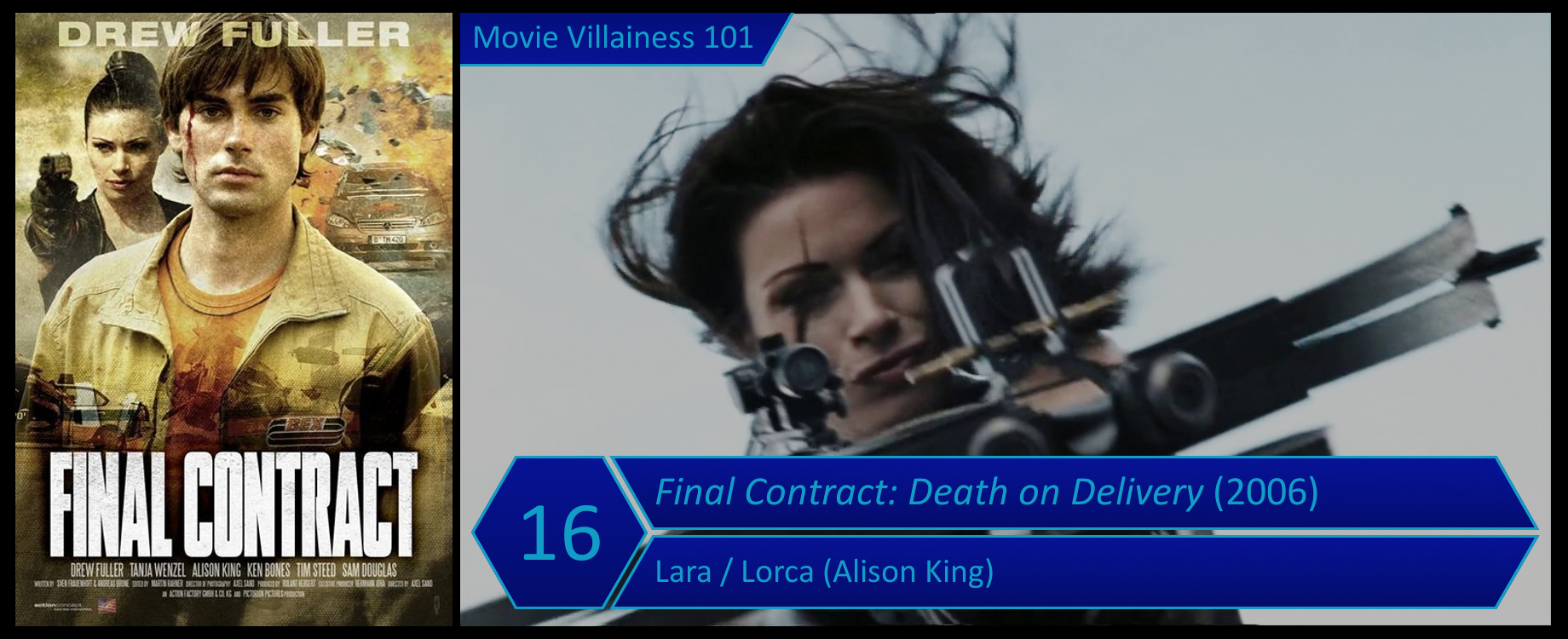
Final Contract: Death on Delivery (2006)

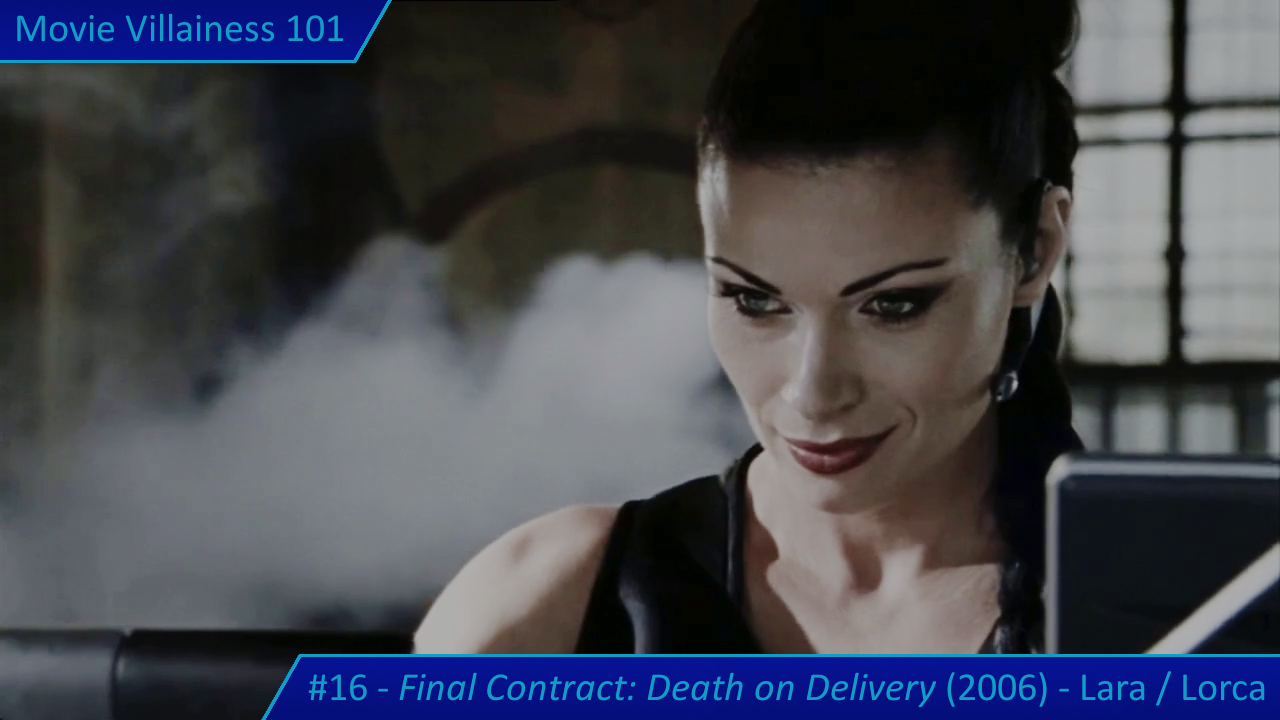
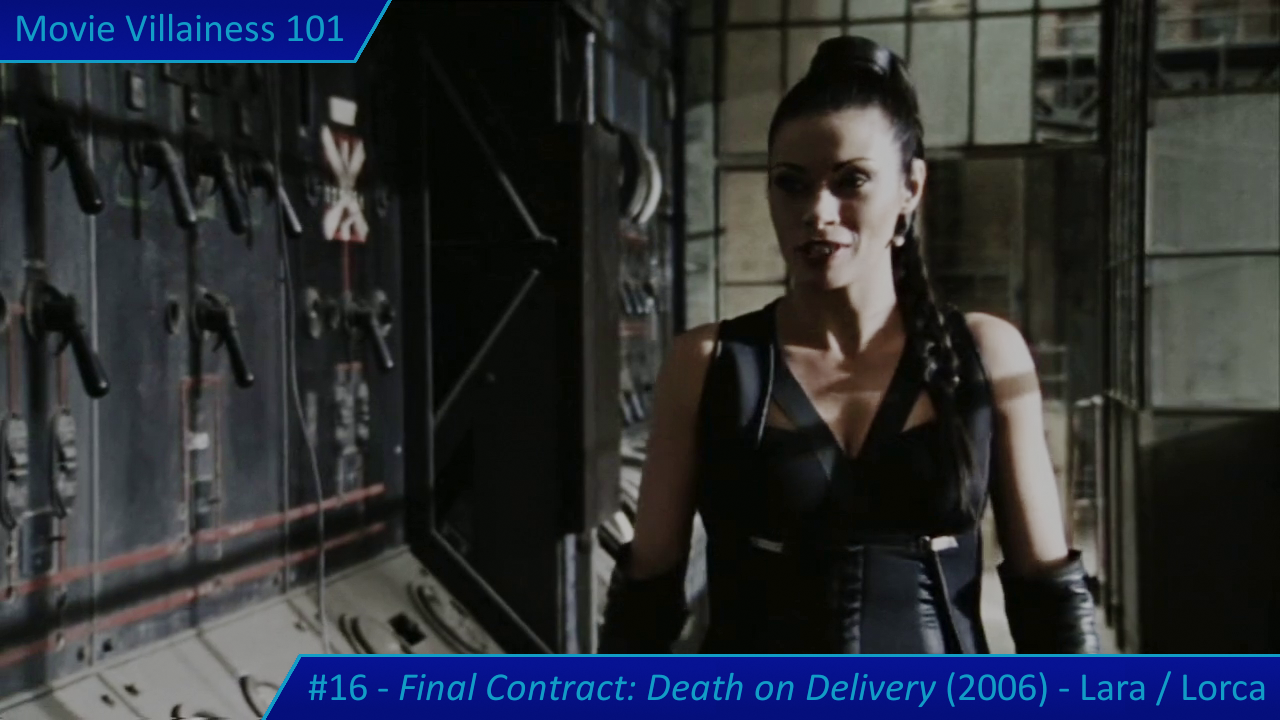
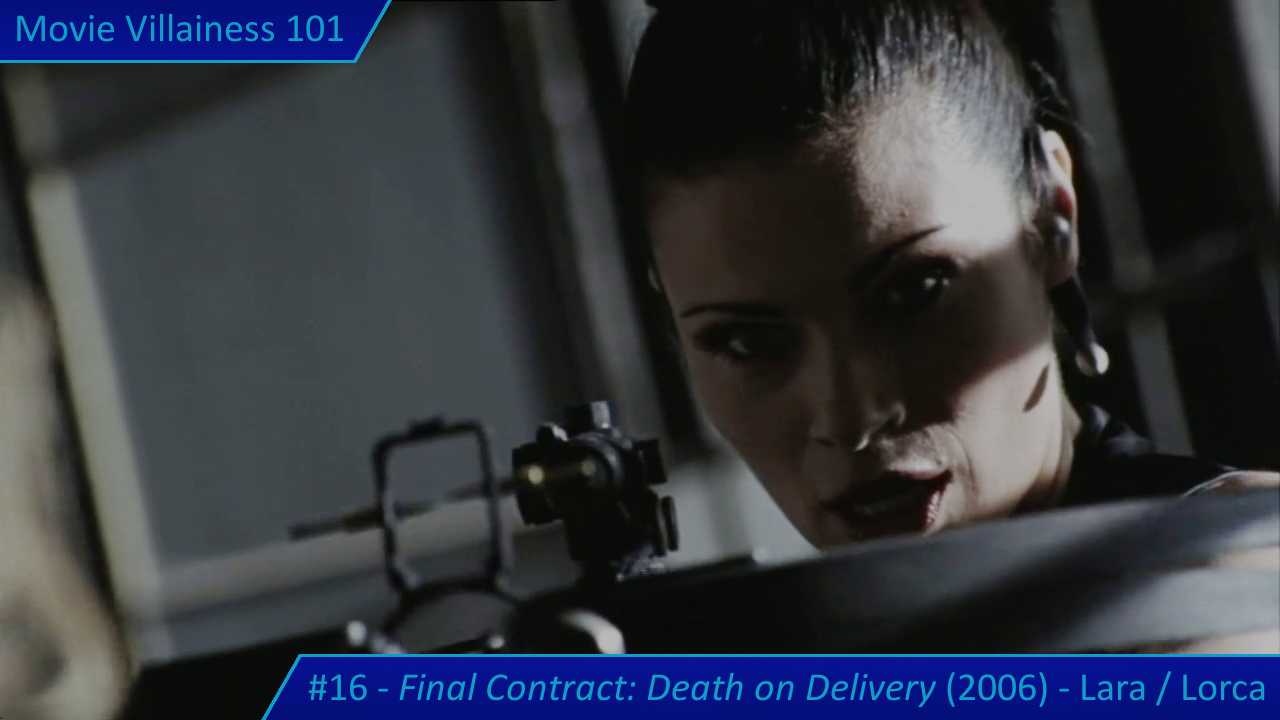
This fast-paced action flick is a throwback to the days of real stunts, unlikely heroes, and tough women with ponytails dressed in black. The villainess Lorca answers to a sleazy criminal paymaster, but be in no doubt. The primary threat (and selling point) is the ruthless assassin with the crossbow. Too bad the police finger an innocent patsy and spend the movie chasing him.

David (Drew Fuller) is an American motorcycle courier working for his uncle in Berlin, and he has a blossoming romance with fellow employee Jenny (Tanja Wenzel). David has teenage love issues and a few speeding tickets, but nothing serious. That changes when a beautiful woman jumps into his car.

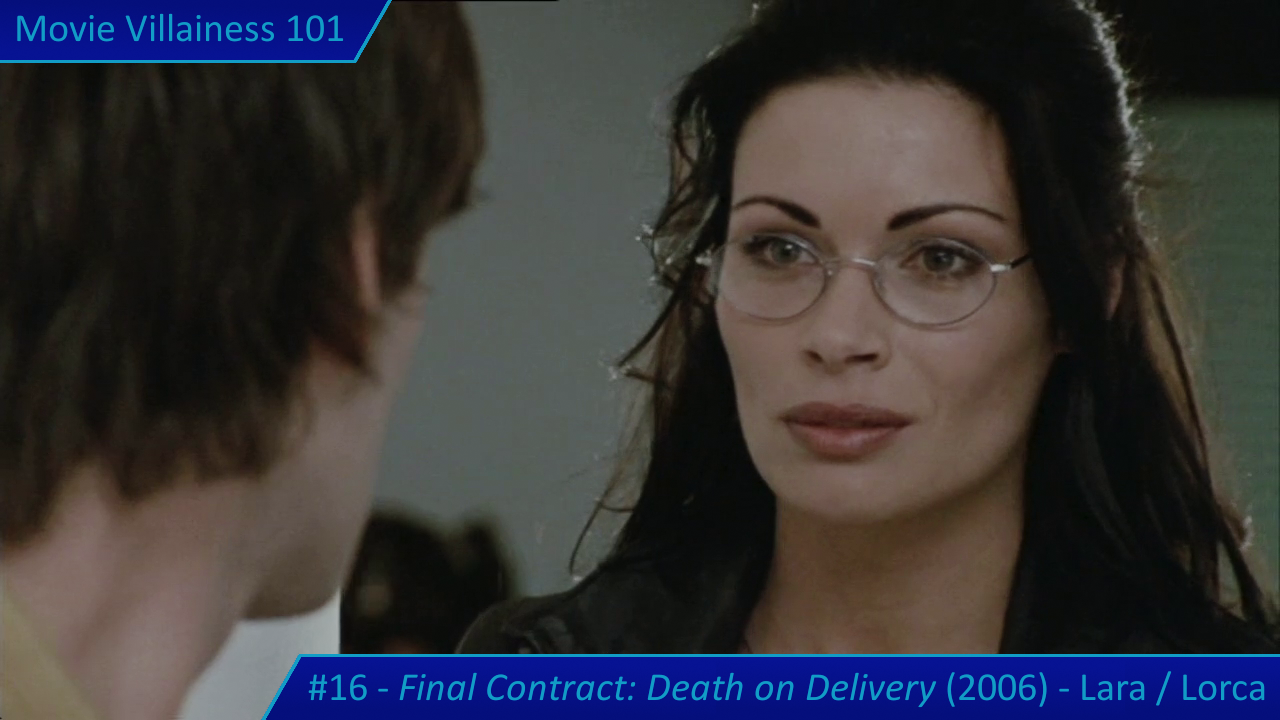
The brunette claims to be a cop hunting a contract killer who’s just murdered a key witness. Bad guys are after her, leading to the first of many chase scenes where David shows off his driving skills. The passenger Lara is handy with a sidearm, and after a high-speed shootout – and traffic chaos – she shows her appreciation with a kiss.

David realises Lara has left her bag behind, so he follows her into a hotel. She warns him that the lobby is under surveillance, so David agrees to check in at reception and enquire about a contact. Lara later joins David in the room, now scantily dressed and in full-on seduction mode. The young man lets his guard down and stands up Jenny (something she’s clearly not happy about) in favour of Lara. Pity it’s a setup and the woman David spent the evening with is actually Lorca. That would be the assassin who murdered a second witness while he slept.

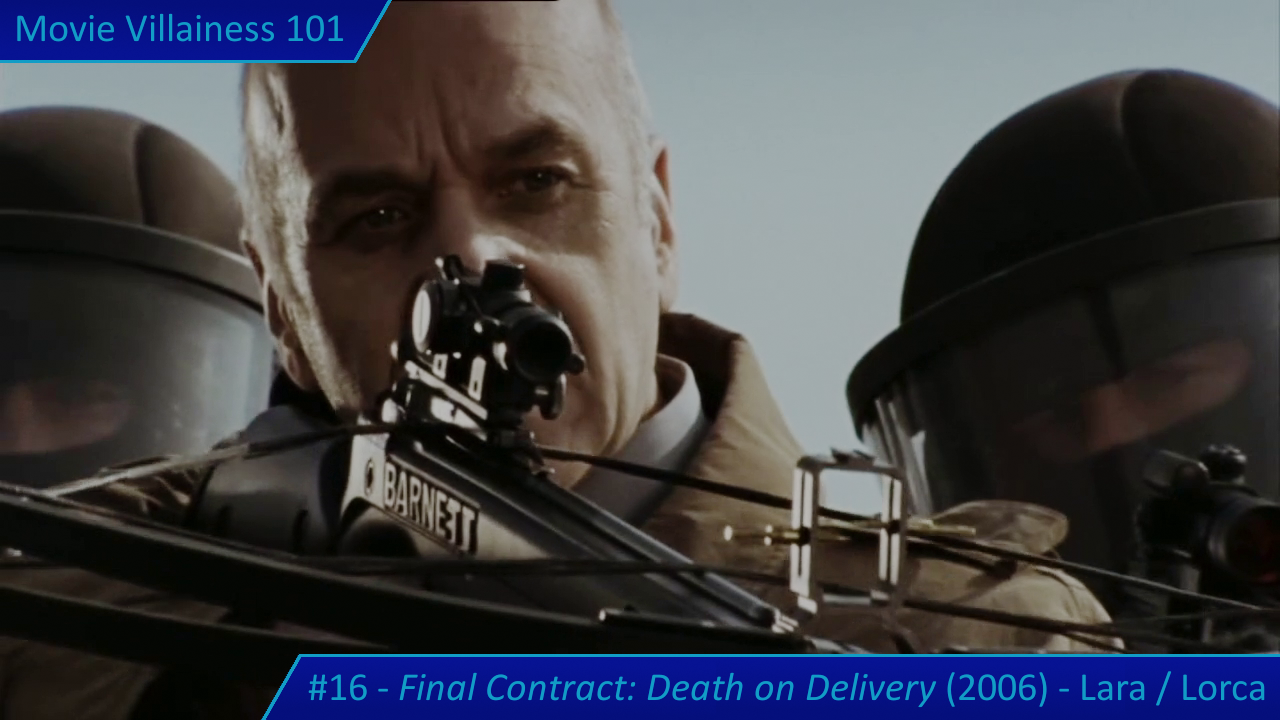
David wakes up to find the hotel swarming with police. Hillman (Ken Bones) is the man in charge and has a personal vendetta against the killer. So he’s awfully pleased when his response team corners David on the roof and takes the “assassin” into custody. The courier’s act of kindness was a trap, since Lorca stowed a crossbow inside to implicate him.

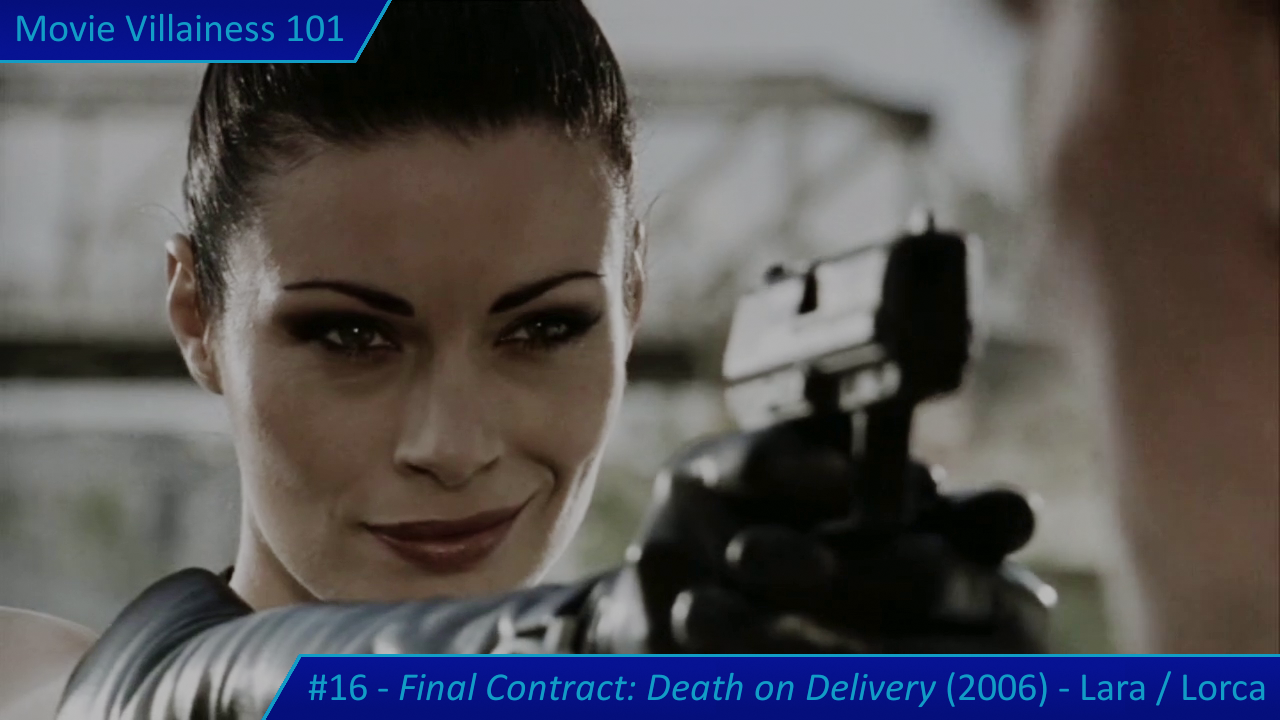
Two dumb cops take a detour and beat up David for crimes he didn’t commit. They’re enjoying their brutality until the real assassin shows up. Now dressed in black leather and looking far more villainous, Lorca executes the two men with a spinning kick and headshots. She contemplates killing David too, but spares his life. Seems the patsy is still important to her plan, if only as a distraction for the cops to chase while she targets the third and final witness.

Villainess

Villainess

With the entire Berlin police force after him, David is a stranger in a foreign land with few allies to call on. His frustrated uncle refuses to help, and Jenny is reluctant, given recent events. Lorca has vanished, but David has enough problems with the cops. There are multiple car chase scenes and lots of property damage, but David evades the authorities thanks to help from a shady mechanic. Jenny isn’t pleased with the danger she’s now in, and since the romantic tension is over, it’s time for the villainess’ return.

The third witness is well guarded, so Lorca beats up David and kidnaps Jenny to force him to co-operate. The hero has a clever idea to use the vehicle’s GPS tracker, but the villainess expects this, and the trail ends at an abandoned warehouse. Meanwhile, Jenny frees herself by cutting her bonds on a conveniently sharp object. A bold escape attempt, but one that ends quickly after Lorca recaptures her. The crossbow-wielding killer is pissed off with her heroism, so she tortures Jenny with electric shock therapy to show David who’s in charge.

The assassin has David wear special camera glasses, so she can watch everything on her hi-tech monitor screens. She instructs him to attend the courthouse, where she’s already stashed a gun for her patsy. David is out of options and can only watch as a young girl is brought in. The witness is a child, and if David refuses to eliminate her, Lorca will kill Jenny. To make matters worse, Hillman and the police are on site.

The prosecutor questions the girl and asks her to point out the offender. Lorca demands David shoot her and gets increasingly angry. Seeing no response as the witness identifies her client, the villainess grabs her trusty crossbow and threatens to shoot Jenny. After a tense exchange, David – who tracked the villainess using a clue Jenny provided – shoots the assassin. As Lorca struggles to comprehend the turn of events, it’s revealed David’s uncle is wearing the glasses at the courthouse.

Lorca isn’t finished and attacks David while his girlfriend watches in terror. Being a trained assassin, she has the advantage. After receiving a few blows, David takes advantage of a rare opening and throws the villainess over a guardrail. Seeing her plan fall apart, she uses a speedboat to make her getaway. David is determined to prove he’s innocent, and chases after the assassin on a motorcycle.

The final action scene follows, with a police helicopter following David. Snipers attempt to shoot the hero, despite Jenny (who’s now a suspect) doing her best to inform Hillman the woman in black is the assassin. After a lengthy pursuit that includes some narrow escapes, David rides up a ramp and performs an improbable jump to Lorca’s boat.

The villainess fights David and gets the better of her weaker opponent, but then readies her crossbow. That tips off Hillman who the real assassin is, and he finally realises his mistake. Now exonerated, it’s still up to David to best Lorca and send the speedboat crashing onto dry land. This takes the assassin out of the equation, and an apologetic Hillman has Lorca arrested while the heroes kiss and make up.

Honourable Mentions: Crossbows / Assassins

Hard Target 2 (2016) – Sofia (Rhona Mitra)

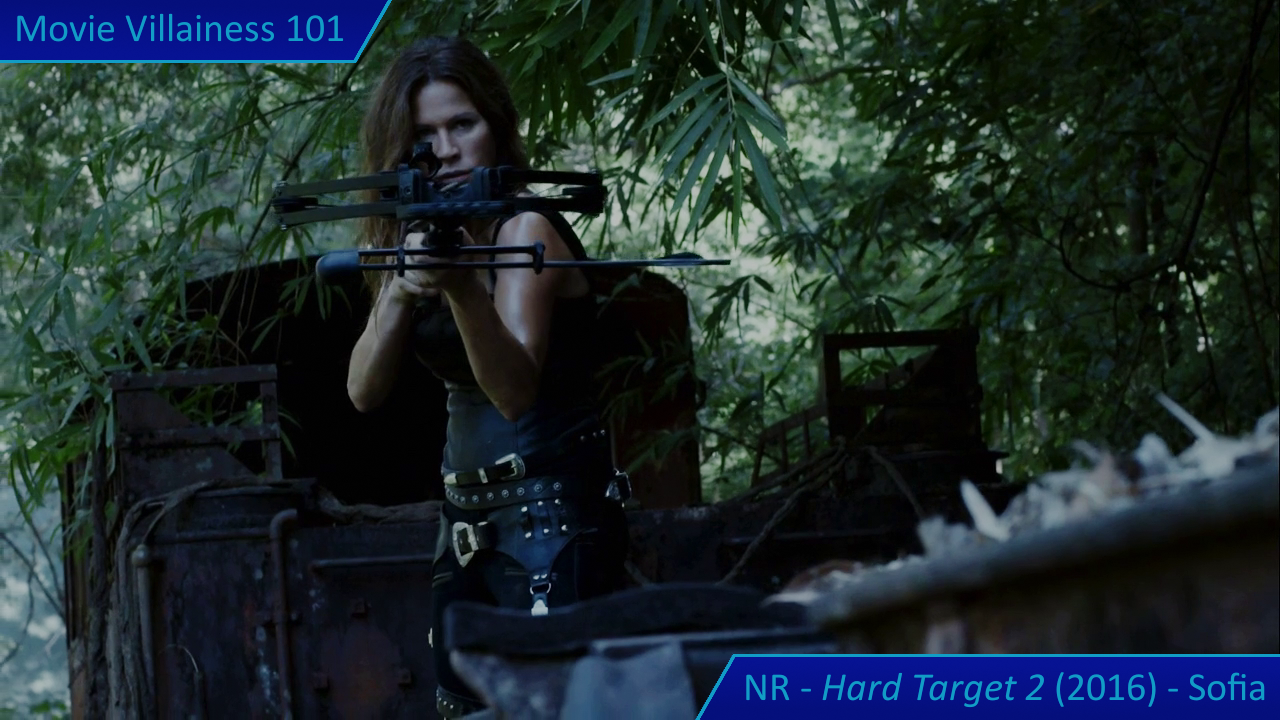
This sequel to the 1993 movie doesn’t involve Jean-Claude Van Damme or John Woo, but we get the leather-clad villainess Sofia. Yes, Rhona Mitra is another badass female, alongside Scott Adkins as a martial artist seeking redemption and Robert Knepper as a psychotic criminal fond of big speeches. Exactly the casting – or should that be typecasting? – we expect in the direct-to-video action market.

After MMA fighter Wes Baylor accidentally kills his friend and competitor, he winds up on a much less prestigious underground circuit in the Far East. When a sinister man named Aldrich offers Baylor a half-million payday, he accepts the offer. Except the proposed fight in Myanmar never was, and Baylor is the latest player in a sadistic game of hunt and kill. Aldrich’s crew includes generic rough types plus tough girl Sofia, who has a serious chip on her shoulder and loves crossbows.

Standard stuff, so don’t expect any surprises. As the hunting party tracks Baylor through the jungle, he teams up with a local named Tha (Ann Truong). She’s the resourceful type who gets into the occasional fight when Baylor is occupied, but is mainly there so the hero can confess his sins and pray to Buddha. Aldrich gets super annoyed with his target’s survival skills, so he orders out weaponised motorcycles to give the villains an unfair advantage.

One of the best action scenes has Sofia and two thugs chasing Baylor. The other hunters go down easily, leaving Sofia to fire her vehicle’s weapons and corner her prey in a deserted village. Baylor steals a bike of his own and fires a net to dismount the villainess. Not finished yet, she draws two mini crossbows and advances while scenery explodes behind her. After a thankfully brief bad-girl speech, Sofia fights Baylor with a baton and puts up a decent struggle before he sends her flying through a wall.

Baylor does the heroic thing and leaves Sofia alive, and inevitably it’s the two women who confront each other in the final battle. Sofia – armed with a big crossbow now – fights Tha, but prefers to show off her unarmed combat skills. This is a disappointing finale on a rusty old train, with the action interrupted by those cutaway moments directors seem so fond of. For an experienced killer, Sofia is beaten too easily and never looks like winning before she’s impaled on a spike.

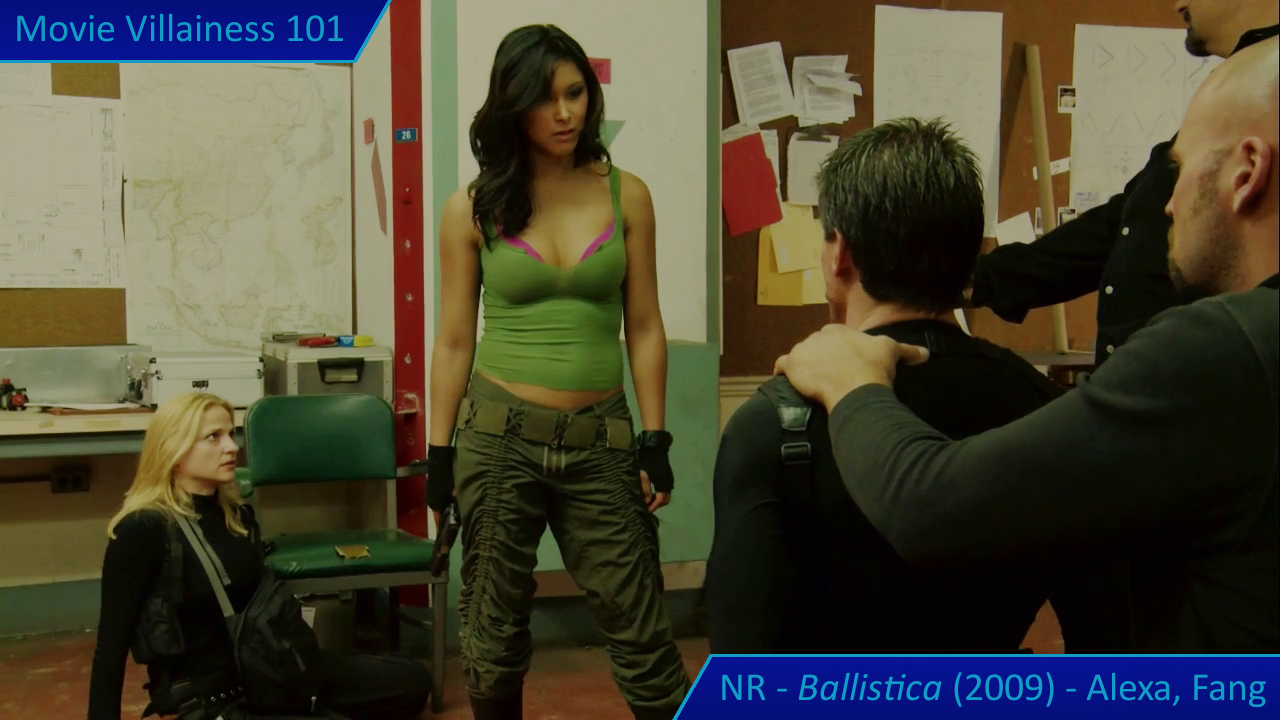
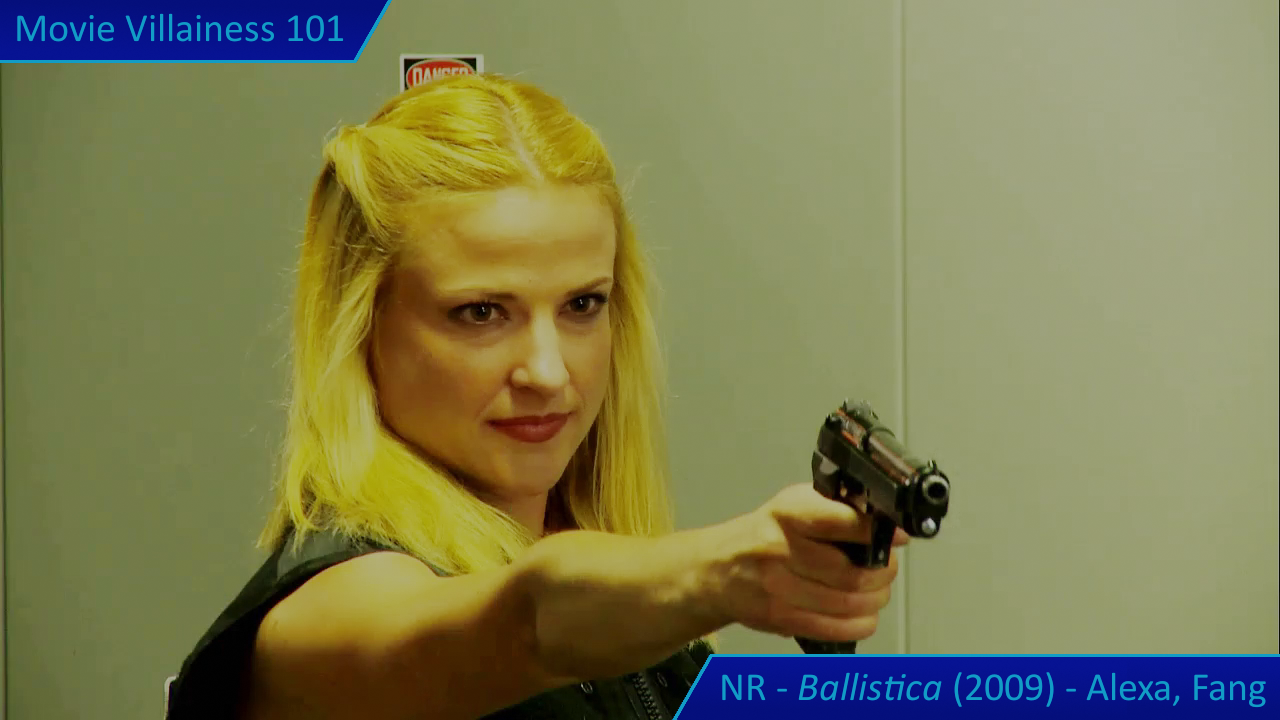
Ballistica (2009) – Alexa (C.B. Spenser), Fang (Lauren Mary Kim)

No crossbow this time, just secret agents able to dodge bullets at close range. The title refers to the ludicrous concept of – as the villainess puts it – kung fu with guns. Besides the bizarre fight scenes, there’s a training montage of the hero Damian (Paul Sloan) working out with dual pistols. And a shadowy CIA department, minor female agents as eye candy, and a treacherous blonde who seduces the main character before she reveals her true motives. Derivative stuff.

Several B-movie stars feature. Robert Davi is the agency boss who might be corrupt, Martin Kove is a dependable ally, and Andrew Divoff’s Russian baddie is the chief antagonist for acts one and two. Special effects are atrocious, and the fight scenes are poorly done with no physical contact, but there’s fun to be had if you can forget the laws of reality.

The plot involves a nasty bomb terrorists want to acquire. Lauren Mary Kim – known for stunt work, with the occasional acting role whenever a female Asian badass is required – plays the minor villainess Fang. She’s a nondescript… um, Asian badass who beats up the captured hero and throws a prototype weapon his way. Too bad she forgot to lock the door, and Damian tosses the bomb back. A stupid death scene to end a far too brief role.

Alexa is convincing as an innocent scientist who wants to help. She receives martial arts training, talks with Damian about his tragic past, and even gets to make love in a pool. This seems to be the standard sidekick trajectory until Damian kills his nemesis with half an hour left. Then Alexa reveals herself to be adept at ballistica and wipes out an entire SWAT team with acrobatic gunfire. Damian arrives to discover she has activated the bomb before the villainess puts a bullet in his chest.

Good thing Damian was wearing a pendant – yes, that shot-stopping trick we’ve seen countless times. While politics unfold back at base, Damian chases after Alexa in a car, bringing the bomb along for the ride. There’s a lengthy pursuit through the streets of Los Angeles with green screen backdrops. Then, the villainess crashes, and the confrontation continues on foot.

Alexa gives a speech when cornered by the hero. The usual nonsense about committing a terrorist act to secure funding, then a ballistica duel. Alexa is Damian’s equal in agility and style, but somehow the two elite agents can’t hit a target at arm’s length. Finally, the villainess gets Damian in her sights, but he loads a spare bullet mid-twist and finishes her.

Movie Villainess 101 Rank #17

Don’t let this woman develop a crush on you, Mr. Bond

Movie

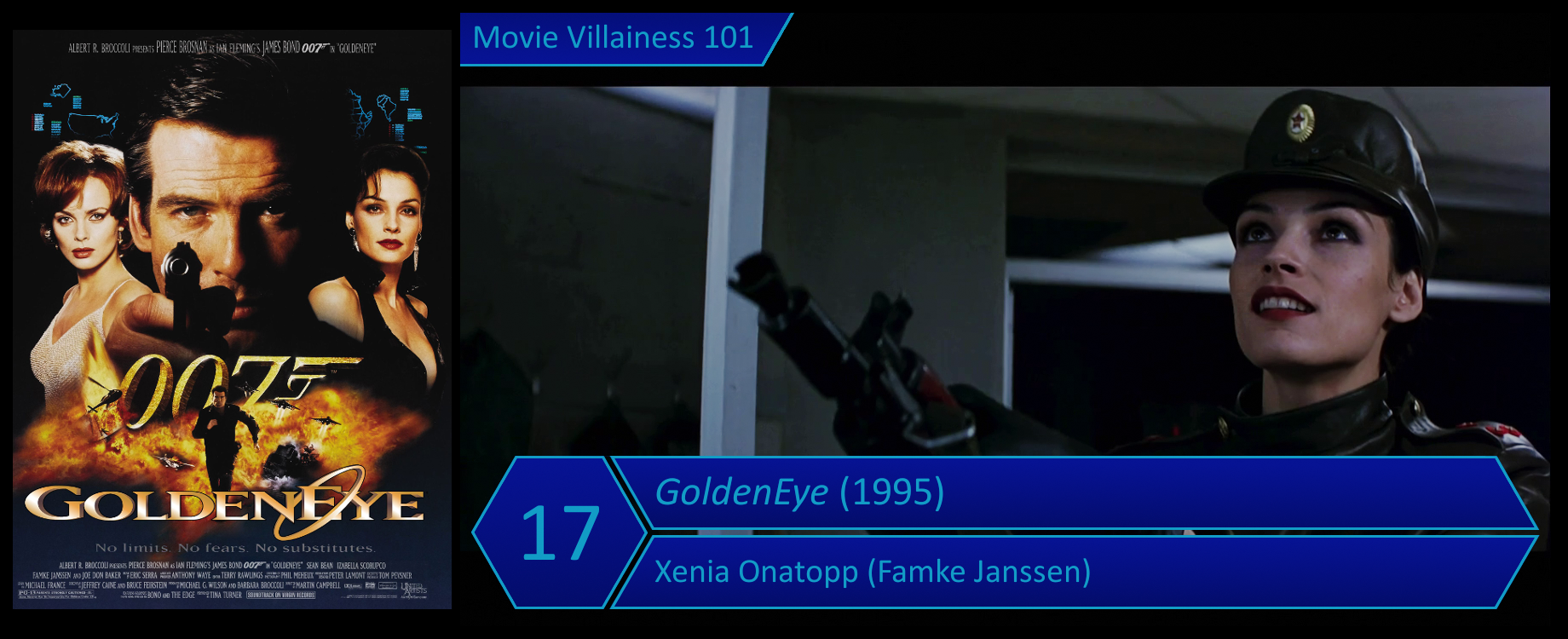
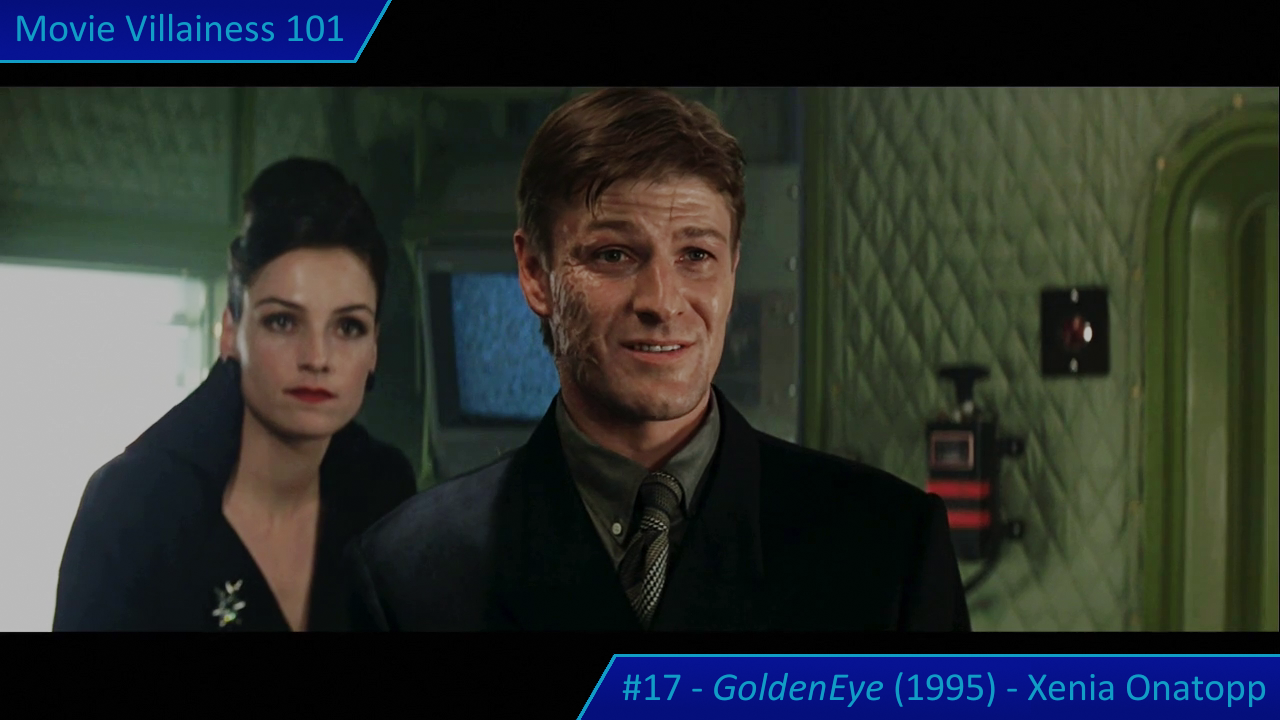
GoldenEye (1995)

Pierce Brosnan’s four Bond movies were escapist material, which allowed for outlandish characters like a Georgian assassin who crushes men between her thighs. Xenia is the first villainess from the Brosnan era to make the top twenty. This was the golden age of evil Bond girls.

The change of leading man comes with a new supporting cast. There’s now a woman in charge of the 00 section, with Judi Dench in her first appearance as M. Samantha Bond is Moneypenny, and Q (Desmond Llewelyn) is a mainstay. Bond one-liners and crazy gadgets are included, and director Martin Campbell – helming his first franchise reboot – brings style to the frantic set pieces. Massive explosions, dramatic escapes, and impossible stunts are packed into two hours of entertainment.

By this point, filmmakers were experimenting with the tried and tested formula. Two surprise bad guys are thrown into the mix, though savvy viewers will guess both twists before they happen. A secret lair and army are standard for a Bond villain, but controlling a Russian satellite weapon requires technical genius. The female lead is Natalya Simonova (Izabella Scorupco). If we discount her, that leaves only the egotistical Boris Grishenko (Alan Cumming) as the insider.

Besides introducing a new lead actor – with ambiguous camera angles before his grand reveal – the prologue assault on a Soviet chemical weapons lab gives us Sean Bean as 006 Alec Trevelyan. He is supposedly executed after the mission goes wrong, setting up a vendetta between 007 and Colonel Ourumov (Gottfried John). However, Bean is second on the credits and always plays bad guys, so it’s no shock he survives to become the main villain.

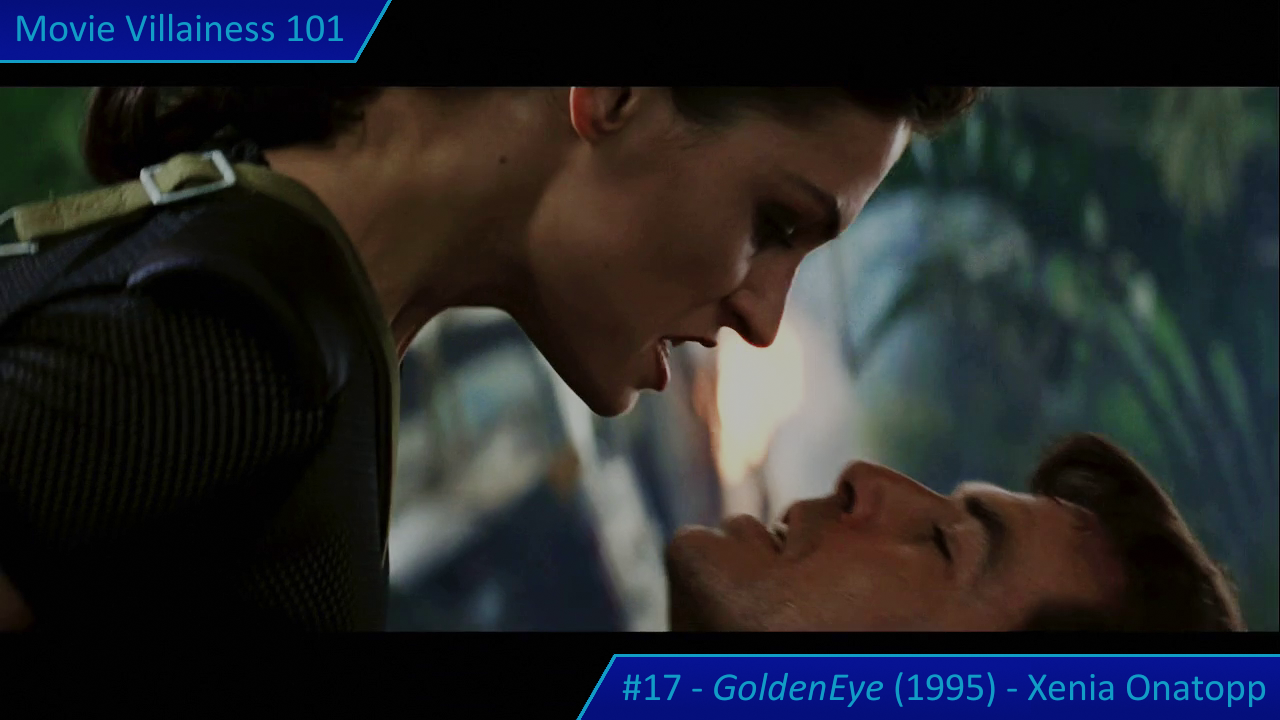
Xenia is the most physical female opponent Bond has ever faced. That covers sexual activity (not advisable with her) and getting beaten up by the hero. She can take a lot of punishment (and enjoys it) given her background as a Soviet fighter pilot.

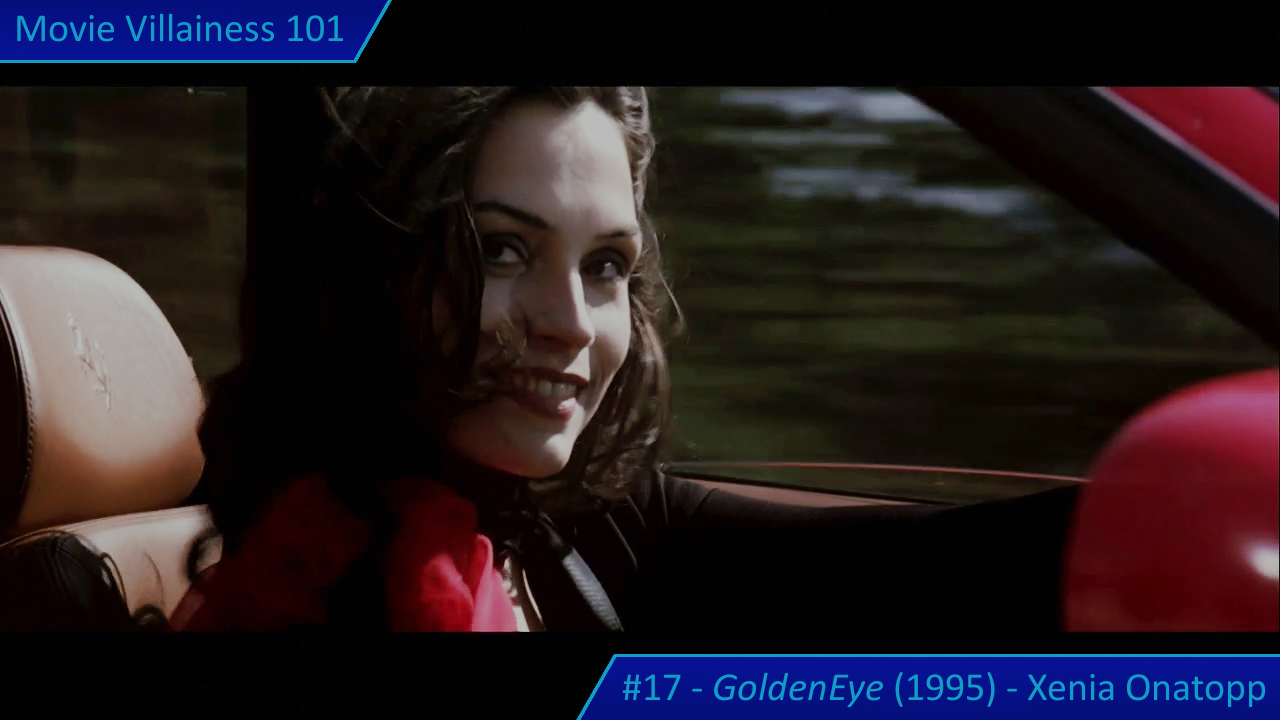
The villainess knows how to exploit male weaknesses. Her first appearance comes early when a female operative tests Bond’s driving skills. That goes how any fan would expect, with Bond flouting the rules and racing a mysterious brunette in a Ferrari. She’s an excellent driver herself, able to pull off swerving manoeuvres at high speed. There were several close calls before Bond wisely broke off the contest. And takes the safer option to romance his passenger.

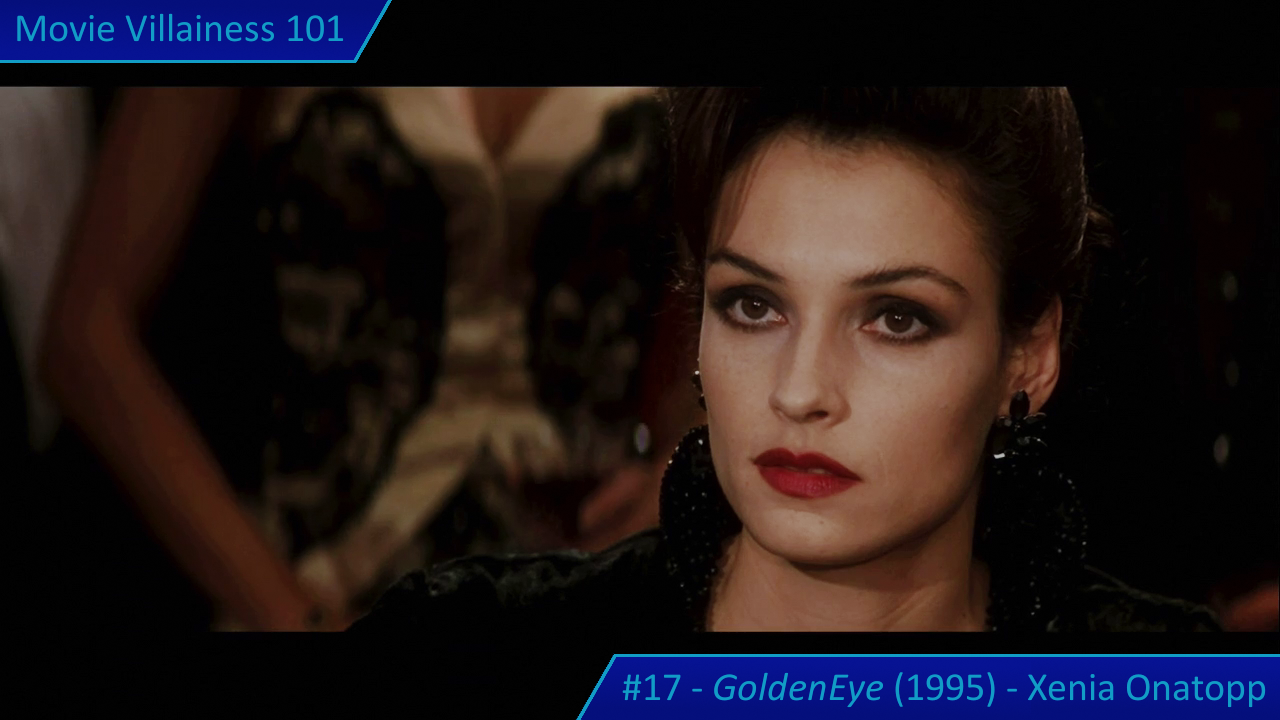
Bond catches up with Xenia at a Monte Carlo casino. She’s enjoying good luck at the baccarat table until the tuxedoed charmer shows up to change her fortune. The typical Bond introduction then follows, with names exchanged in classic style. Xenia has a date with an admiral, but Bond suspects something is amiss, so he has Moneypenny run a background check.

Not spending the night with Xenia turns out to be a smart move, since the assassin murders the admiral in bed with her signature thigh-crushing routine. When Bond discovers the body the next morning, it appears he died in ecstasy.

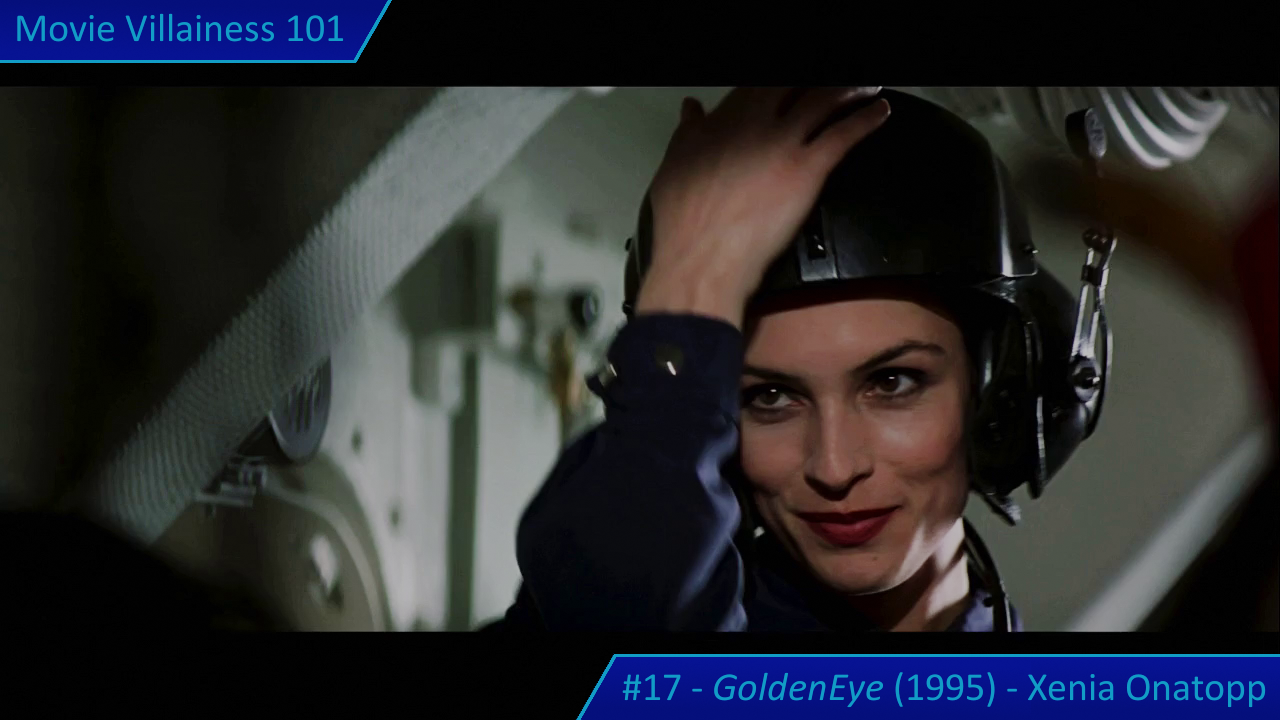
Xenia and her male accomplice use the officer’s stolen ID to board a French warship. The villainess murders two pilots to steal their flight jackets (and dark-tinted visor helmets), all to hijack a prototype helicopter. Bond arrives too late to stop them, and the detained hero can only watch as they escape.

Villainess

Xenia Onatopp (Famke Janssen)

Three murders in the opening half hour tell us Xenia is not a woman to trifle with. Ourumov – now a general – runs a weapons test at a remote Siberian facility, a ruse to steal the arming keys for a satellite-based electromagnetic pulse (EMP) weapon. Xenia slaughters the civilian staff with a submachine gun once they’ve outlived their usefulness, and even Ourumov looks uneasy at her enthusiasm for mass murder. The only survivor is computer programmer Natalya, who escapes the massacre through luck and ingenuity. As Bond women go, she’s at the more competent end of the spectrum.

We’re shown how devastating the stolen GoldenEye is when the villains fry the computers and cover their escape. Back in London, Bond watches the attack unfold on monitors, and Natalya is the only person who can identify the thieves. Of course, the person she contacts is the traitor, Boris. Natalya is already nervous when she arrives at an eerie church, and things get worse when she discovers her confidant is in league with Xenia.

Bond’s investigation takes him to St. Petersburg, where he receives help from CIA agent Jack Wade. Joe Don Baker is one actor to play multiple roles in the series, in a non-villainous role this time. The hero also forms an uneasy alliance with Russian mob boss Valentin Zukovsky (Robbie Coltrane).

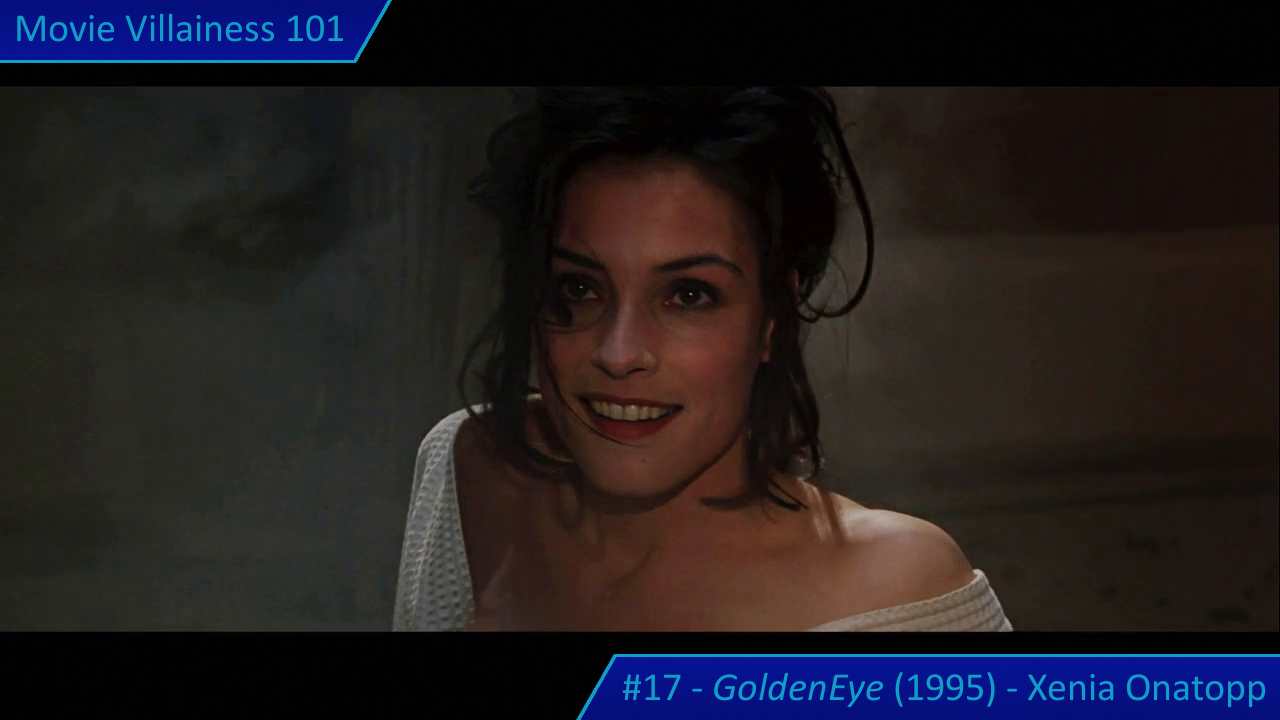
Bond asks too many questions, a pet peeve of villains. So it’s time to send Xenia for a (literal) steamy encounter in the hotel sauna. This meeting is more intimate – a bizarre mix of verbal exchanges and rough sex. Xenia attempts to thigh-crush Bond, but he frees himself. The hero has had quite enough of the foreplay and demands to meet the boss.

Another gloomy meeting spot: a statue graveyard, where Bond knocks Xenia out and discovers the missing helicopter. The hero is surprised to see his old partner Alec alive, but soon realises he’s walked into a trap. But does Trevelyan kill Bond? No, he locks him and Natalya in the helicopter and sets off radar-guided missiles to destroy the evidence and the pesky secret agent. A stupid move that allows the heroes to escape the blast with an ejector seat.

The hero barely has time to argue his case to Natalya before the Russians show up. In the interrogation, she fingers Ourumov, but the villain frames Bond for the defence minister’s murder. Xenia is absent from the action that follows: a chase through an archive building where Natalya is recaptured. After a dramatic escape, Bond steals a tank to pursue the bad guys. A one-sided chase with Bond even more indestructible than usual.

After wrecking half of St. Petersburg, the hero tracks the villains to an old Soviet missile train. The armoured vehicle survives a cannon blast, but not a head-on collision with the tank. Bond has the upper hand against Trevelyan, but his foe knows his weaknesses and has Ourumov bring Natalya in as a bargaining chip. Now that the true villain has shown his face, the accomplice is expendable.

Trevelyan repeats his mistake by locking Bond in with Natalya and setting off an explosion. Didn’t he learn the first time? After another narrow escape and a loud bang, the heroes swap dreary Russia for sunny Cuba. We get romance on the beach and a more human Bond, but that’s only a brief interlude. The final confrontation takes place at a secret control facility hidden underwater. Everything is formulaic: gadgets, a resourceful female ally, close-quarters fights. But it’s worked for thirty years, so why change things?

Bond’s last encounter with Xenia occurs in the jungle after his plane is shot down by a missile. With the hero dazed from the crash, the henchwoman descends on a rope from a helicopter and overpowers him. She’s armed, but wants to humiliate Bond, and squeezes him between her thighs. Natalya intervenes, but gets head-butted (if you’re watching the uncut version). After a quick struggle, Bond uses Xenia’s rifle to shoot the helicopter, and the villainess – still hooked to the rope – is crushed between two tree branches. A Bond one-liner to cap things off, but Xenia deserved a longer fight scene.

Honourable Mentions / Discussions: Timothy Dalton / Pierce Brosnan Bond Movies

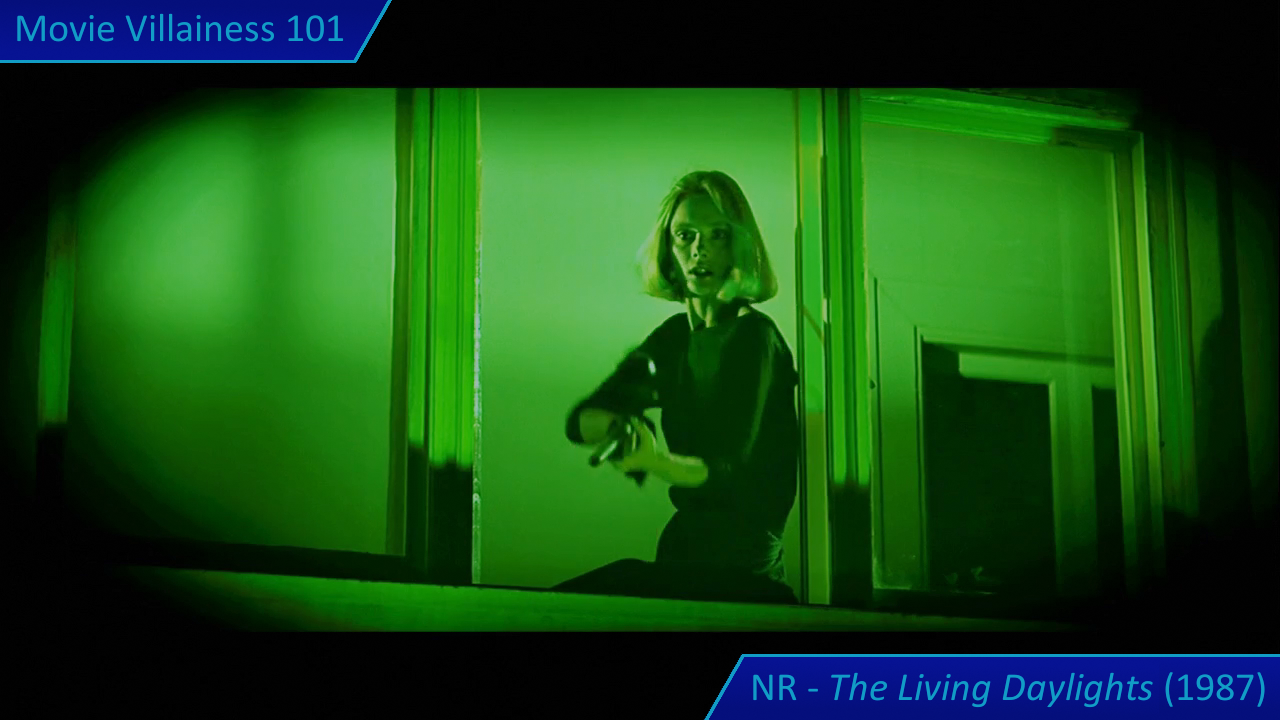
The Living Daylights (1987)

Timothy Dalton plays a more serious Bond, but the fantastical plot elements remain. Locations are still exotic, the gadgets hi-tech, and the women beautiful, but villain ambitions are toned down somewhat. The grittier 007 films tend not to feature female foes, and even the leading lady – Maryam D’Abo as the cellist Kara Milovy – is incompetent and present for romance only.

Kara gets an intriguing introduction, going from an innocent concert performer to a sniper whom Bond is reluctant to kill. This is later revealed to be a setup to fake a defection, and Kara is no weapons expert. When Bond asks Q to research female assassins, one muscular woman’s MO is strangulation by thighs. Foreshadowing for GoldenEye?

Other than Kara, the key players in this Cold War thriller are male, and the villains are some of the weakest in the series. The CIA uses Bond’s sexism against him by employing two beautiful agents, but besides trapping the hero, they are given little to do.

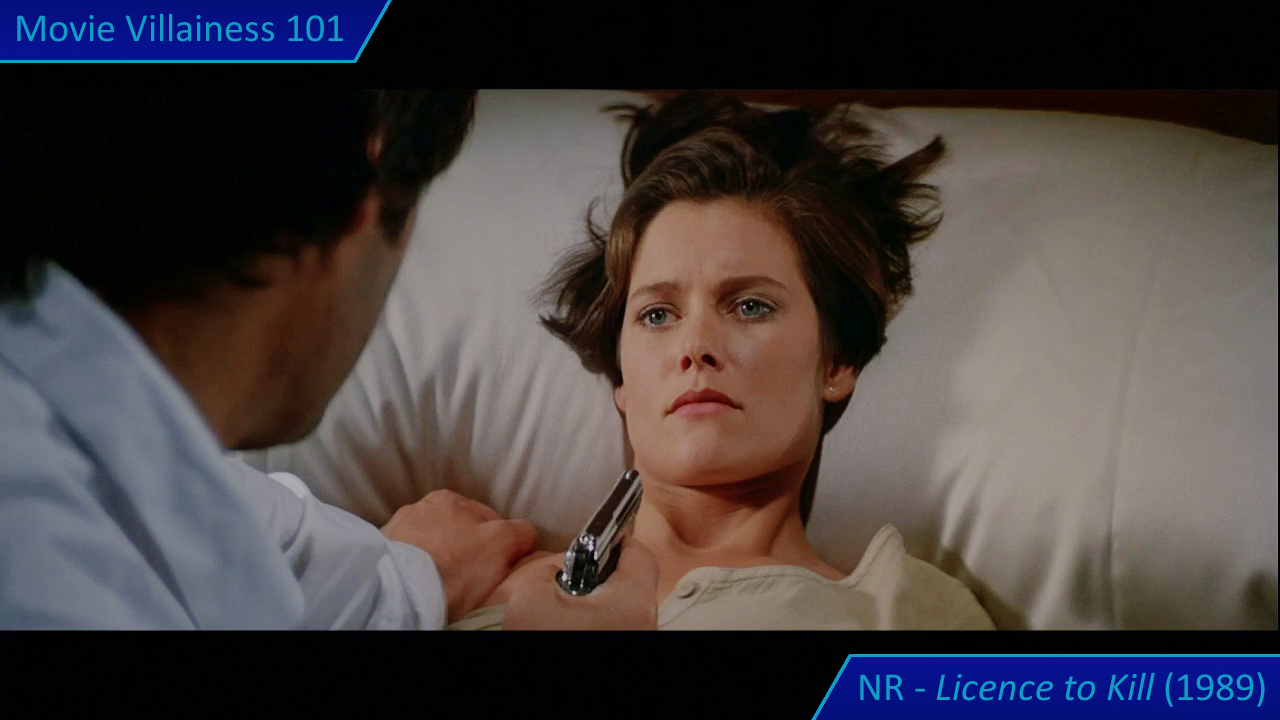
Licence to Kill (1989)

Dalton’s second and final entry dispensed with the humour and gave us a violent revenge thriller. James Bond goes rogue and seeks payback when drug dealer Franz Sanchez (Robert Davi) leaves Felix Leiter a hospitalised widower. The plot is not so outlandish, even if Sanchez runs a drug factory disguised as a temple. The trademark action and stunts are present, with a ten-minute tanker truck chase (as explosive as you might expect) to finish.

No henchwomen on show, but the female characters are stronger than expected. Pam Bouvier (Carey Lowell) is a competent lead who can handle herself in a fight. Absent for the first half, she makes a powerful impression in the second as an operative equal to 007. Most of the plot revolves around their infiltrating Sanchez’s organisation and turning the villains against each other. There’s an extended role for Q as an unlikely field agent, but ultimately this comes down to Bond versus the drug dealer.

Talisa Soto as the villain’s mistress Lupe is a more traditional Bond girl, but she proves a valuable ally. We get an unmasking scene after two Asian “ninja” narcotics agents – one female – capture Bond on a rooftop. Their interference messes up his plan to kill Sanchez, and the woman dies in a hail of bullets soon after.

Tomorrow Never Dies (1997)

An insane villain plans to start a war between two nuclear powers. Sound familiar? This time it’s the UK against China, and the bad guy is Elliot Carver, a media mogul who thinks global conflict will improve his ratings. After the era of fake news, this techno-thriller doesn’t seem so implausible. And there’s enough action, including a spectacular motorcycle chase in Saigon, to make this a watchable, if routine, adventure.

As the only Brosnan movie without a female villain, the enemies are fairly generic. Jonathan Pryce is a hammy foe who reveals his scheme too soon. For henchmen, he has a tough guy to do the fighting and a computer hacker for the technical stuff. Fortunately, the women are more interesting. Teri Hatcher is Carver’s wife, who had a previous relationship with Bond, and that suggests her life will end tragically.

China sends an agent of its own – Wai Lin – to investigate Carver’s network. She’s played by Hong Kong action star Michelle Yeoh, so does all the fighting and stunts you would expect. Other than a couple of moments of idiocy, she’s an effective secret agent. Her one-woman ninja army is a highlight during the otherwise weak climax on a stealth boat. She gets captured during the finale, and the romance feels awkward, but Wai Lin is among the best female leads.

Die Another Day (2002) – Miranda Frost (Rosamund Pike)

Michelle Yeoh was slated to return for Brosnan’s final Bond outing, but she dodged the proverbial bullet by not appearing. The end product is a mess, with a watchable – though far-fetched – first half followed by a truly awful second half. The villain is a North Korean colonel obsessed with conquering the South by any means necessary. After his supposed death, he takes on the identity of British entrepreneur Gustav Graves (Toby Stephens) to complete his evil scheme.

The ability to replace human DNA and completely change one’s appearance seems believable compared to other elements. Such as an invisible car, a solar-powered ray satellite operated by a wrist computer, and electrified armour. Other than the fencing match between Bond and Graves that turns into a brutal sword fight, the film is overblown and ridiculous, even for 007.

Halle Berry is NSA agent Jinx, who becomes the main protagonist for some parts. This includes daring solo action and spouting awful puns. When she converses with Bond, it’s truly painful. A female Korean interrogator stings her prisoners with scorpion venom, but she only features in the prologue.

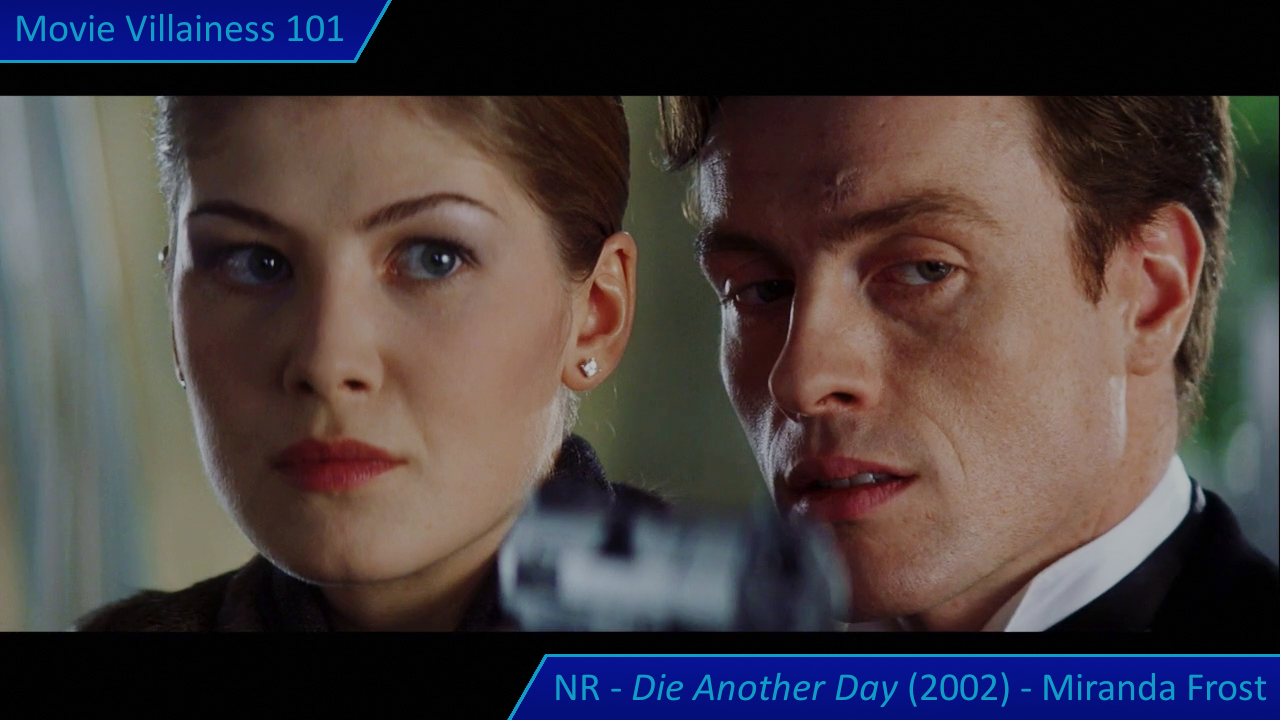
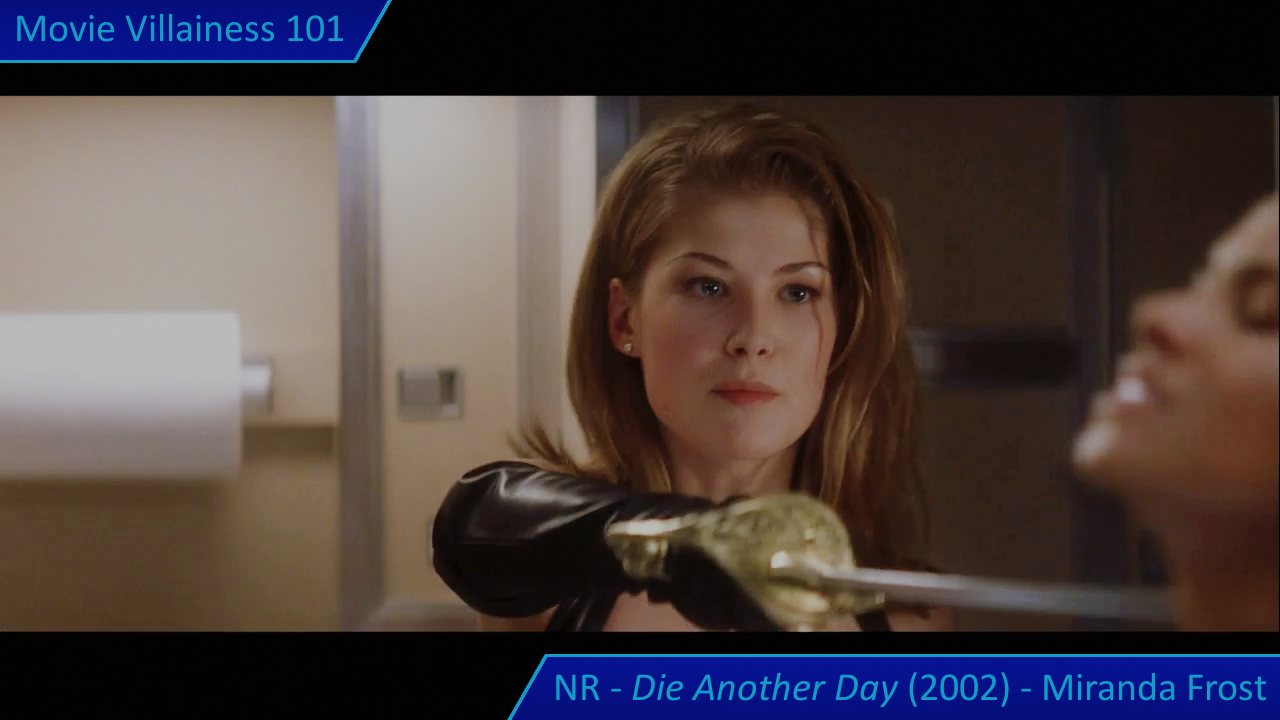
The main villainess is Miranda Frost, an MI6 operative working undercover as Graves’ publicist. In fact, she’s a double agent who betrayed Bond to the North Koreans. Frost is introduced as an Olympic champion fencer (complete with an unmasking scene). But when Bond confronts Grave in his ice palace (more silliness), he discovers his fellow agent is untrustworthy.

After Bond escapes and rescues Jinx (no surprises there), the two agents go after the villains. The climax takes place on a military aircraft with Bond battling Graves and his electric suit, while Jinx and Miranda have a sword duel. The skimpy outfits make the fight seem ludicrous, and Jinx completes Bond’s revenge mission. When he arrives to see Miranda already dead, he doesn’t look too happy.

Note: The “missing” third Brosnan film will be covered as a ranked villainess entry later

Movie Villainess 101 Rank #18

Legends never die, they say – and neither does this villainess

Movie

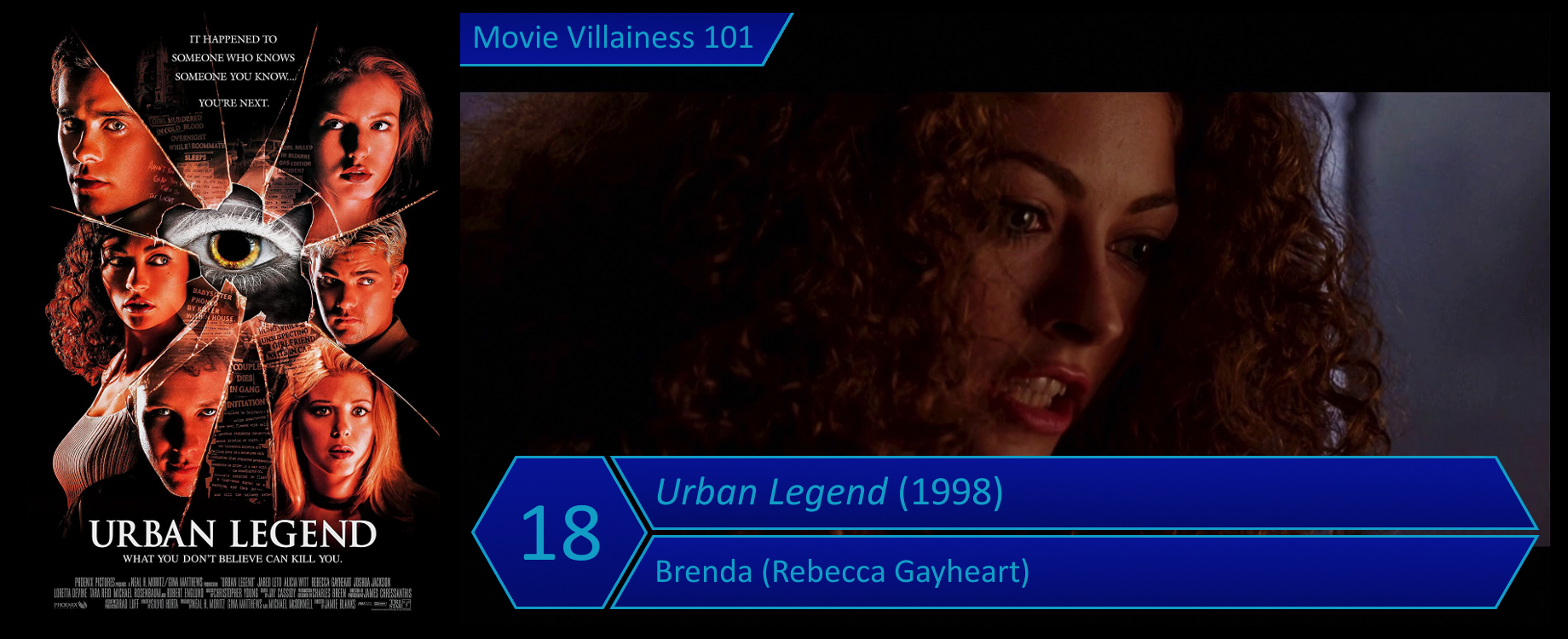
Urban Legend (1998)

One of the wave of slasher flicks released after the success of Scream (1996), this is a formulaic yet stylish horror outing. The villainess makes the legendary tier thanks to some inventive kill sequences – themed on urban legends – and a great post-reveal overdose of insanity.

The movie begins with a woman driving at night. When her vehicle runs low on fuel, it’s inevitable she’ll be the only person who pulls into a gas station. I could stop right there, as being the opening female in a slasher is invariably a death sentence.

To fill in the details, Brad Dourift plays the weirdo attendant in a cameo. So when he asks the woman to come inside and answer a phone call (cell phones were rare in the 1990s), she doesn’t hesitate to use her mace spray when things get creepy. After a daring escape, the real threat is revealed: someone hiding in the back seat. A bloody axe shatters the side window, and we have our first victim.

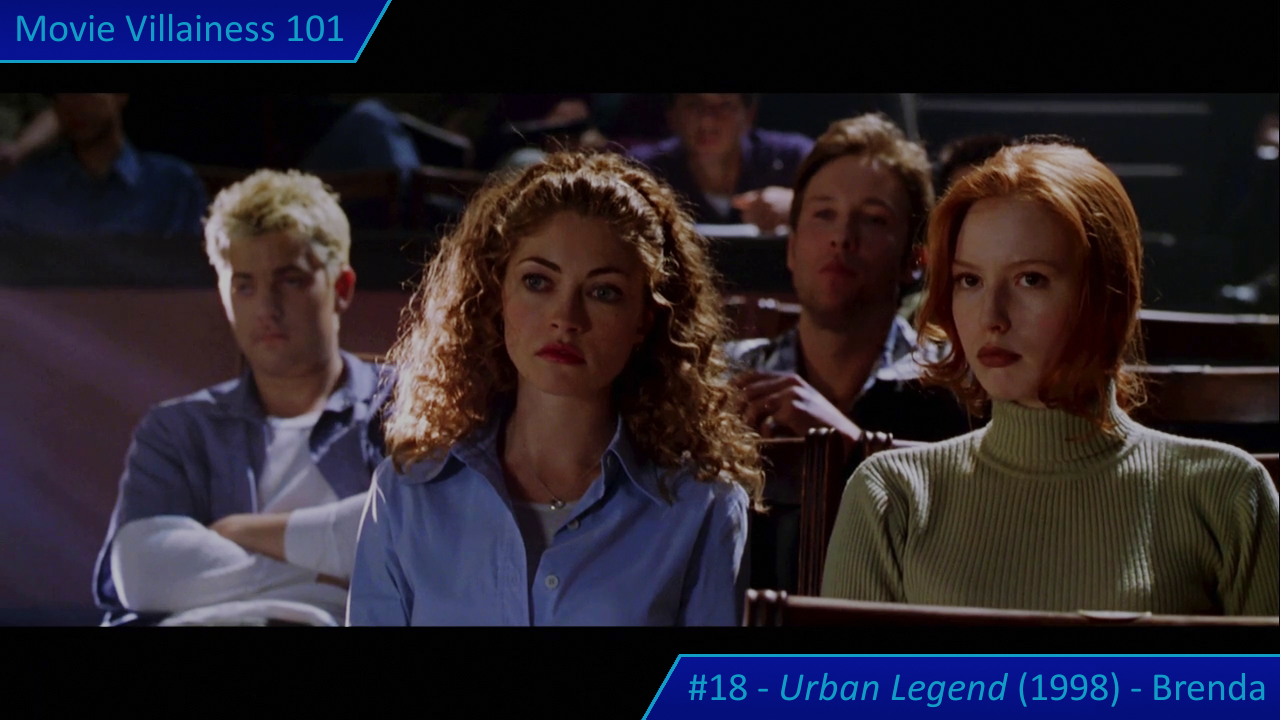
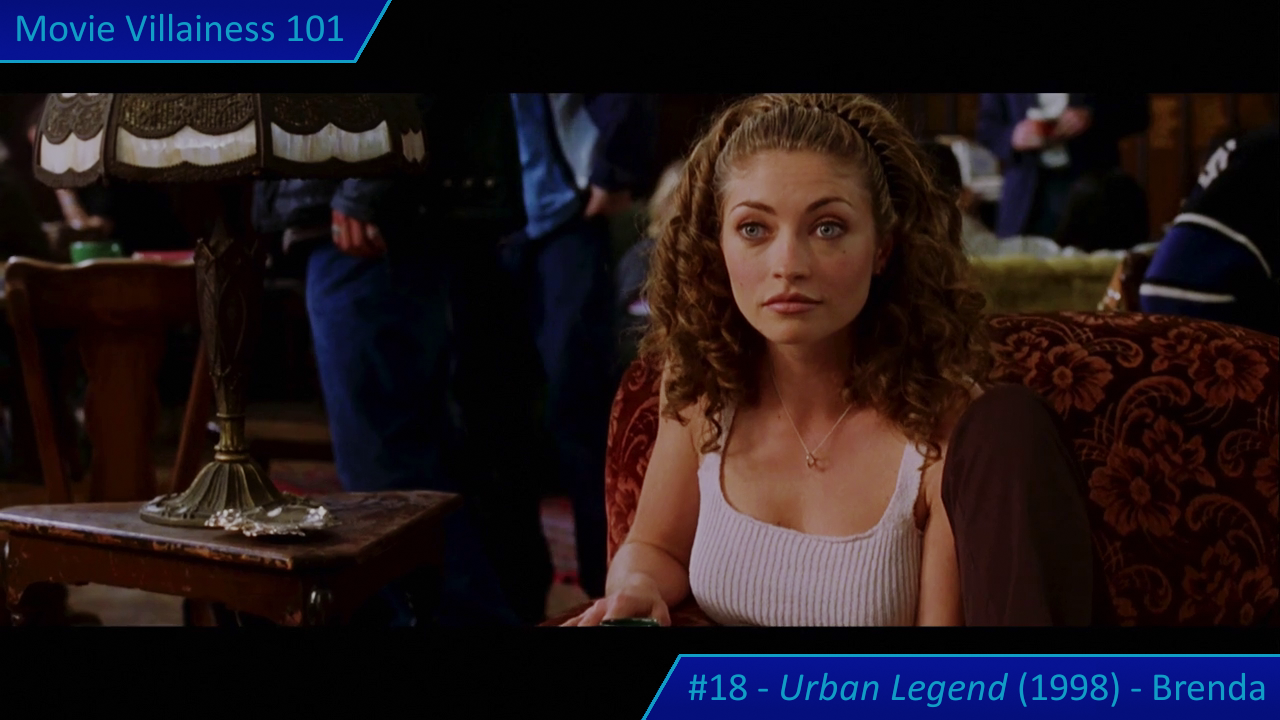
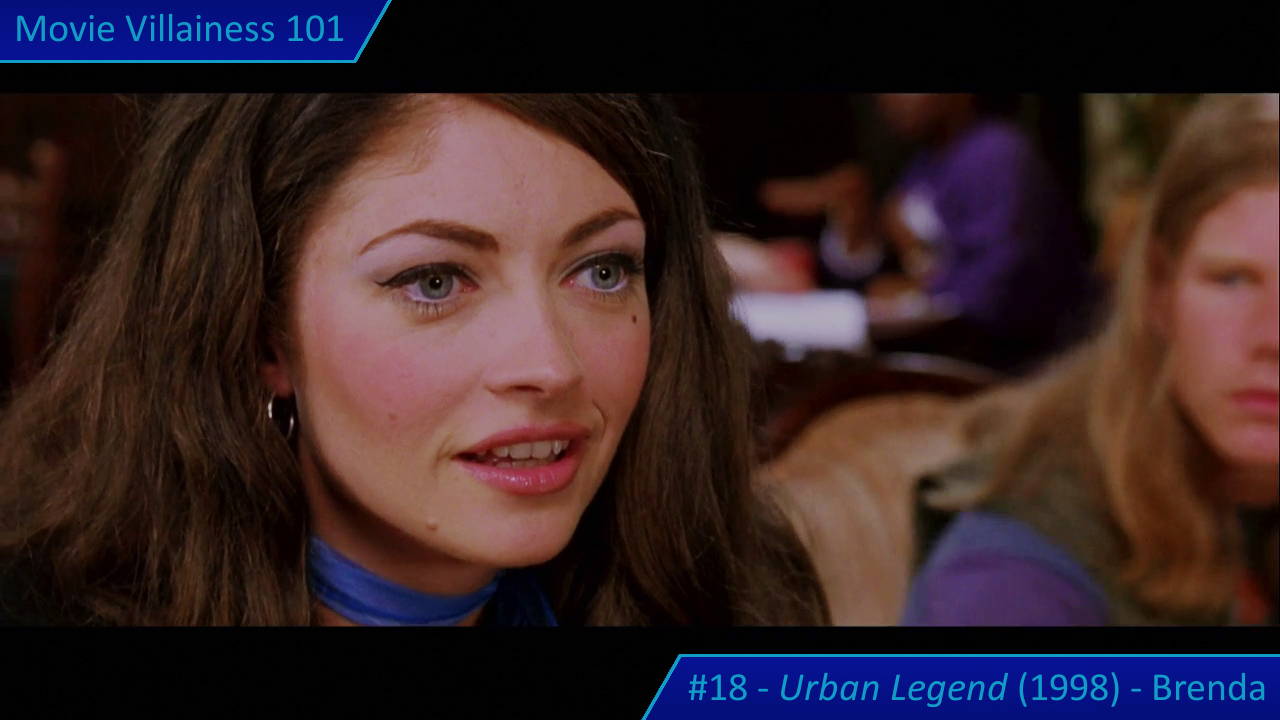
The action switches to the Pendleton University campus, which is full of attractive young students for the unknown psycho to kill off. Among them are the main character, Natalie (Alicia Witt) and her best friend, Brenda. For potential victims and psychos, we have reporter Paul (Jared Leto), sexy radio host Sasha (Tara Reid), urban legend guru Parker (Michael Rosenbaum) and joker Damon (Joshua Jackson). Stereotypes are in force, but the film feels fresh thanks to the theme.

To set the eerie tone – and explain the urban legend concept – meet Professor Wexler, played by Robert Englund of Nightmare on Elm Street fame. This gives Damon the opportunity to fake a death scene after swallowing Pop Rocks and soda. Legend says he will explode, but this is too early in the story for a public murder. False alarms are common, with many characters surprised in dark locations and/or when they’re alone. Jump scares and loud music will keep viewers on their toes, but it’s obvious when an actual kill is on the cards.

When Damon drives Natalie out into the woods, he’s surprised she rejects him. Perhaps choosing a more suitable location for a date would have helped? Damon has a lot more to worry about when the gloved killer surprises him and scares Natalie by jumping on the car. This makes her drive off without realising the murderer has hung Damon from a tree and tied the rope to the vehicle. How a lone female pulls off this physical feat isn’t explained, though Brenda is a strong swimmer. Must be psycho-killer adrenaline.

Naturally, the body has disappeared by the time Natalie brings security guard Reese to investigate. This woman is the typical unbelieving authority figure, played by Loretta Devine in a comedic homage to Pam Grier. Everyone thinks it’s another Damon prank, but Natalie is on edge and also knew the first victim, Michelle Mancini. If her reaction to news reports didn’t confirm it, looking in an old school yearbook does.

Natalie researches urban legends at the library and finds a sketch that matches Damon’s murder scene. Another image foreshadows the next: a girl murdered while her roommate sleeps. We’ve already been introduced to Tosh (Danielle Harris), an aggressive goth girl who has sex in the dark. Since she’s a minor character and the main cast needs to remain suspects, she’s next to die. The unwitting victim sets up an online date, only to realise she’s been messaging a psycho. Natalie returns and conveniently doesn’t turn on the light as the killer strangles Tosh.

When Natalie wakes up, she finds her roommate’s body with the wrists slashed and a message in blood. Reese has a body this time, so the Dean gets involved. Somehow Tosh’s death gets written off as suicide, but this is horror movie reality where every creepy person (and female swimmer!) has a parka coat like the murderer. And clueless teens party hard while dead bodies drop over campus.

Villainess

Brenda (Rebecca Gayheart)

Moving into the second half, it’s time for another minor character to get killed. The dean checks his back seat, but guesses the wrong urban legend. The killer – hiding under the vehicle – slashes the man’s ankles and releases the brakes so the car presses the latest victim against tire spikes. Nasty way to go, but Parker has it worse when the psycho phones him (using a voice disguiser) and explodes his dog in a microwave oven. Alone in the toilets, he’s easy prey for the killer, who force-feeds him Pop Rocks and drain cleaner.

That’s the same legend Wexler brought up at the lecture, so when Natalie and Paul find a parka coat (another one!) and an axe in the professor’s office, he becomes their number one suspect. He looks even guiltier when he vanishes during the last act.

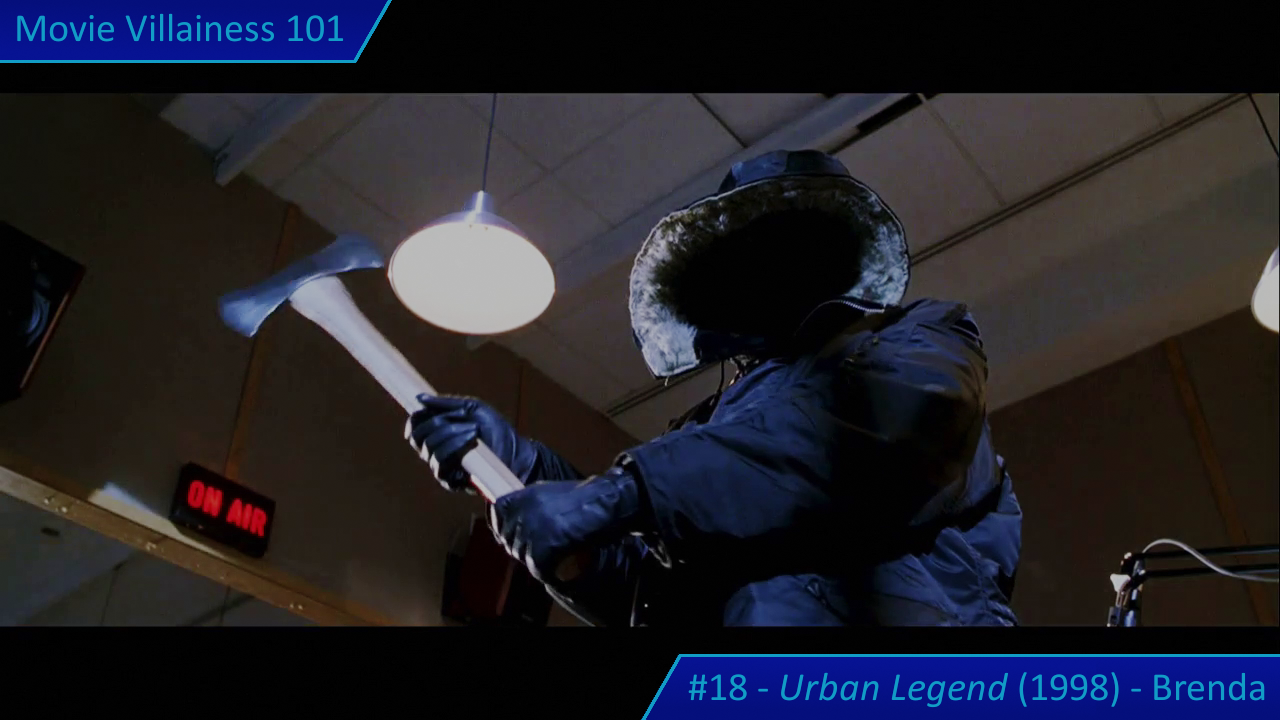
The best stalk and slash scene is when the murderer attacks Sasha during a radio show. She’s wearing her microphone, so the terrified screams are broadcast all over campus. Nobody takes her cries for help seriously, leaving the axe-wielding psycho free to chase her around the radio station. Sasha narrowly escapes a fall, but this merely prolongs her fate. Natalie arrives to watch the killer add another student to the death list and wave from an upstairs window.

Time to – you guessed it – eliminate another suspect. The weird janitor (there had to be one) ends up in a fatal accident when the killer re-enacts a gang initiation legend. For non-experts, this involves a car with its headlights switched off at night. This is familiar to Natalie, as she and Michelle caused the death of a man with the same deadly prank. Genre-savvy viewers will guess this backstory is important, but there are some red herrings to dispose of before the villainess’ reveal.

Wexler is ruled out when Natalie and Brenda discover his body in the trunk of Paul’s car. Thinking he’s guilty, Natalie flees into a deserted building. There was a massacre at the site many years ago, and the killer leaves a series of dead bodies for the heroine to find. This ends with Brenda’s “corpse” on a bed, but it’s a trick and the murderess knocks her surprised friend out cold.

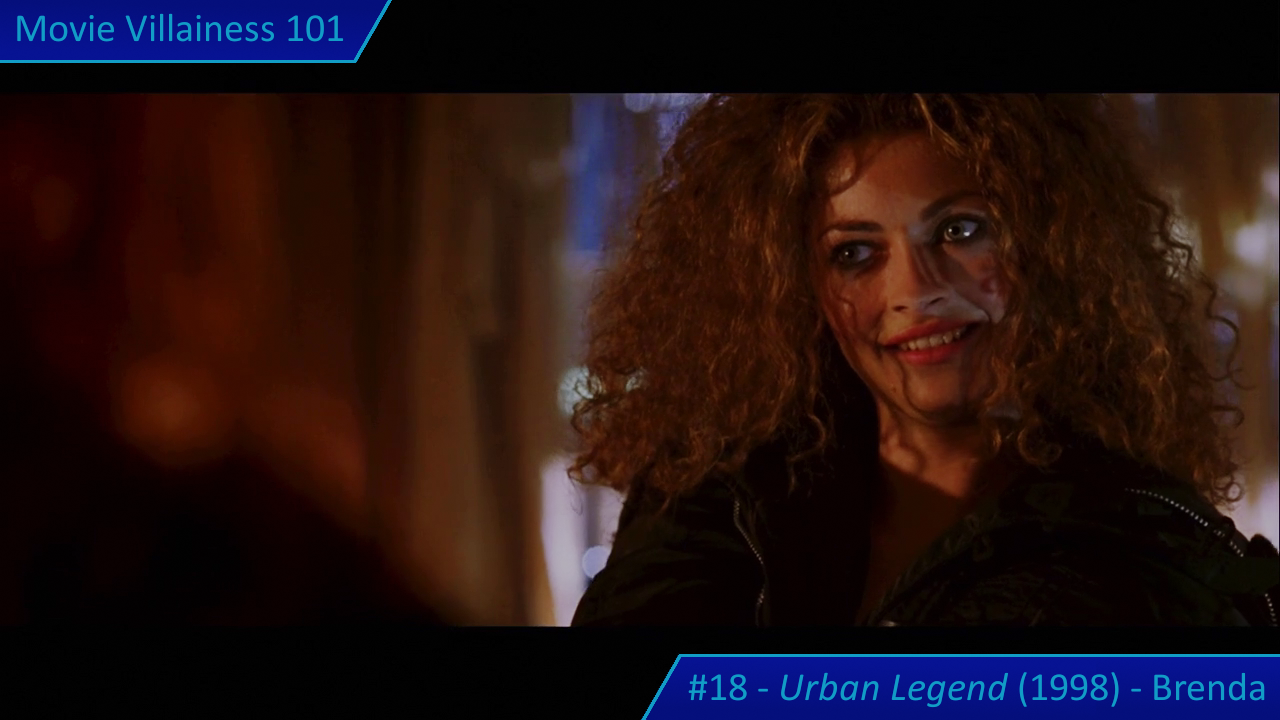
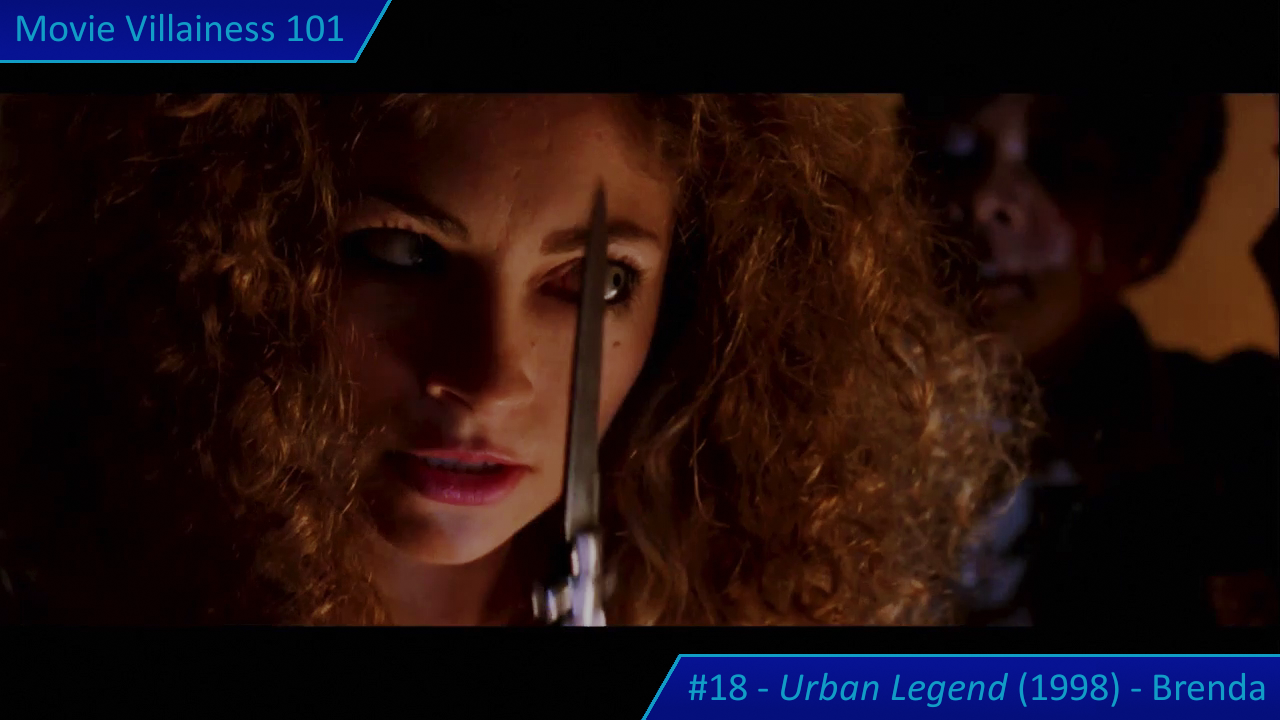
Natalie wakes up to find herself tied up and at the villainess’ mercy. Motive rants are the norm in these movies, but this bad girl prepares a full presentation. She even sets up a slide projector just because the images splashed across her face look sinister. It turns out the guy who died was Brenda’s boyfriend, and she didn’t take it well. The actress plays a full-on psycho brilliantly, and it remains a wonderful villainess reveal decades after the film’s release.

After Brenda finishes explaining, she prepares Natalie for the kidney heist – as gruesome an urban legend as it sounds. The murderess hasn’t killed everyone, and both Reese and Paul arrive to confront her in the finale. There’s a drawn-out confrontation with crazy words exchanged and Reese slashed. Paul has a lengthy struggle with the killer before she grabs the handgun and prepares to shoot Natalie. Reese reveals she has a second firearm, and the rescued victim blasts Brenda through a window.

Paul reminds us to expect a twist, and we finish with two. Brenda – like any horror film villain – is not so easily killed and surprises the survivors in a car. She’s out of urban legends by now, so recycles the axe murderer in the back seat. During a claustrophobic struggle with the enraged Brenda, Paul crashes the vehicle and sends the villainess flying off a bridge into the river below.

But that’s not the end of the story! Still alive, Brenda returns for the epilogue set at a different university campus with students who appear to be crew member extras. She recounts her version of events, now an urban legend.

Discussions: Urban Legend Series

Urban Legends: Final Cut (2000)

The premise remains the same: a psycho killer kills university students with murders themed on urban legends. The victims are budding filmmakers competing for a prestigious prize, which is really an excuse to have bizarre backdrops for gory deaths. When murders are shown, they’re usually more disgusting than frightening, and the sequel has none of the original’s style.

Amy Mayfield (Jennifer Morrison) teams up with the twin brother of a suicide victim to prove the death was actually murder. But somebody in a fencing mask and black overcoat will kill to protect their secret. The murderer switches things up with “disguises” such as a scarecrow mannequin and a Halloween mask that looks downright stupid. In the best scene, Amy is attacked in a sound studio and pursued across the deserted campus, but the overall movie is derivative even by slasher movie standards.

The urban legend killer is a male professor (Hart Bochner) who wants to massacre a film crew to pass their work off as his own. There’s a welcome return by Loretta Devine as the security guard Reese, who gets some genuinely funny moments. And female villain fans who make it to the end will be rewarded by a spoiler cameo from Rebecca Gayheart. However, it’s a case of too little, too late.

Urban Legends: Bloody Mary (2005)

The third film ditches the slasher theme in favour of supernatural horror, though its title villainess is a sympathetic character and the chief antagonist is actually a corrupt politician. Many decades ago, Mary Banner was killed during a high school prank gone wrong, and the boy responsible hid her body in a trunk to cover up the murder.

In the present, Samantha (Kate Mara) and her friends are victims of a similar incident, and Mary’s ghost returns to exact revenge. There’s no connection to the first two movies except for a brief mention of the serial killers in a newspaper clipping and a few urban legends. Deaths involve an invisible foe, mostly. One victim is roasted in a tanning bed, and a second girl is attacked by spiders that hatch inside her body.

Considering Mary is the title character, we see very little of her. Her main on-screen attack comes when she crawls out from under a bed to stab a guy with a broken bottle. Samantha teams up with a voodoo priestess to recover the girl’s body and return it to the grave, thus ending the curse. There’s an easy to solve murder mystery where a figure in black kills Samantha’s brother, and a scheming politician is the culprit.

The finale has Mary literally return from the grave to save Samantha, with cheap CGI effects to end this unrewarding tale. No honourable mention, but there’s always the legendary villainess in the original.

Movie Villainess 101 Rank #19

When it comes to deception, this murderess is an expert player

Movie

Hangman (2001)

The underlying theme – a sadistic killer using the children’s game to taunt the police – has been used many times. The guess the word puzzle is almost as common as chess, and nearly every movie that features it is called Hangman. To remove ambiguity, this film stars Lou Diamond Phillips as Lieutenant Nick Roos.

He caught the “Hangman Killer” several years back, leading to a rookie cop’s death and an internal investigation. Still traumatised by those events, the lieutenant has another psycho to deal with after a man’s body is found with HYPOCRITE written across his shoe soles. That’s the word Nick failed to guess when someone challenged him to an online game. Like all serial murder cases, this is just the beginning.

Grace Mitchell lived with the victim, is on antidepressant medication, and claims she heard nothing. With no other leads, the police question her about the dead man and place her under police protection in a hotel. A mystery man stalks Grace, hacks into computers, and uses a climbing rope to access his room. To avoid the officer on guard duty, he calls a masseuse up and gags her with duct tape. Think this guy might be the killer?

The following morning, the familiar Hangman game appears on a police computer with a video showing the masseuse’s neck in the noose. The psycho insists Grace play, but after inputting the vowels, she’s all a wreck and doesn’t come close to solving the puzzle. Nick does his best to console her, but the police receive a recorded message that leads them to the hotel. A second victim, and the word HIPPOCRATES is written on the topless woman’s back.

Nick’s troubled history gets dropped fairly quickly, and the choice of MO appears to be coincidental. The clues refer to the Hippocratic Oath taken by all doctors, and it’s revealed Grace knew both victims. She used to be a psychiatrist but was forced to resign because of ethics charges, and the murdered woman was Lynn Farmer, wife of a former patient. These incidents led to tension between Grace and her father, Henry. Since our mystery guy – Paul Jarvis – works at the hospital, it appears he is specifically targeting Grace and humiliating the cops.

After she identifies him as a potential suspect, the police find evidence in his office. Confident he’s got the killer, Nick grills Jarvis, shows him crime scene photos, and theorises he’s obsessed with Grace. Then, a smarmy lawyer presents a witness who places Jarvis at the hospital when the first victim was killed. While the movie seemed to have revealed the culprit in the first twenty minutes, it’s clear someone else is involved.

Villainess

Grace Mitchell (Mädchen Amick)

Roos is determined to solve the case, and even makes a crossword with the answers. A woman named Natalie Walsh, who works with Henry, provides an audio recording and reveals she is Grace’s stepmother. Another angle, but Nick spends time with the beautiful suspect and explores her luxury property.

Although tailing Jarvis produces no results, Nick and his partner arrest him again for assault. Knowing he’s not acting alone, his aggressive attitude and eagerness to be detained suggest another round of Hangman is coming Nick’s way. This time the victim is Natalie – who Jarvis kidnapped before his arrest – and once more the killer demands Grace play. She correctly guesses the Latin phrase PRIMUM NON NOCERE (Do no harm), but exceeds the time limit.

The murderer gloats, and the cops face further embarrassment when they trace the call to their own precinct. Despite a frantic search, they’re too late to save Walsh from the hangman’s noose. With Nick’s captain demanding results and another visit from Jarvis’ sleazy attorney, a detective provides a welcome lead. Both Henry and Walsh are listed owners of Grace’s land, so the inheritance provides a motive and implicates the father.

Even with Grave under police protection, Jarvis breaks into her home and attacks her. It’s then revealed she is his partner and lover, and they planned the entire thing to frame Henry. The accomplice improvised some details – which Grace isn’t pleased about – but that doesn’t stop her from having sex with him. The villainess says Henry’s fingerprints are on a laptop used in the last murder, but this is contradicted when Nick reports the computer was wiped clean. Looks like Grace is setting you up too, lover boy.

The police suspect her because of the slip-ups she’s made and do trial runs to time the distance from the station’s entrance to the basement crime scene. Meanwhile, Grace stages her latest crime kill: Henry in her barn. She uses dry ice to support a stepladder, which explains how Jarvis could (in theory) commit the murders alone. A convincing cover story, and the killer enjoys watching her hanging father squirm at gunpoint. Grace wants revenge against those involved in her lover’s death and is the mastermind behind a double frame-up.

The killer stages an attack, makes a fake video recording, and sets off an alarm clock to wake the police officers outside. Grace screams and hangs herself to set up a last-minute rescue by Nick. The exonerated woman murders Jarvis at a motel and fakes a suicide, giving the police a neat closed case. Everyone is satisfied except for Nick, who tries to get a confession from Grace. However, his bluff about her eyelash being found on the laptop is unsuccessful. Clever enough to plan a twisted scheme and escape justice, this relatively unknown villainess earns a place in the legendary tier.

Honourable Mention: Mädchen Amick

I’m Dangerous Tonight (1990) – Gloria (Daisy Hall), Wanda (Dee Wallace Stone)

Mädchen Amick is the heroine of this made for cable horror, though she gets to be the bad girl in a few scenes. That’s because the real antagonist is an ancient Aztec cloak that brings out the wearer’s evil side. Hence, normal people act out their vicious fantasies and become cold-blooded killers.

After college student Amy O’Neill (Amick) acquires an old chest, she fashions the cloak stored inside into a bright red evening dress. A pity she doesn’t know the cloak’s history, or that the historian who found it went completely nuts and killed his team. Anthony Perkins – better known for Psycho (1960) – shows up as a professor who’s too interested in the cloak’s legend, but he’s really there to provide exposition.

Amy is mean to her cousin Gloria and seduces her football player boyfriend at a social event. This causes a rift between the two women, though the bully reverts to her normal shy persona on removing the cloak. After the ancient curse causes Amy’s grandmother to fall to her death in a struggle, the student hangs the dress in a closet. However, Gloria finds the outfit and wears it on a date with her boyfriend.

Gloria – lacking Amy’s moral compass – is fully under the spell, so when her hunk shows more interest in the NFL, it’s time for revenge. In the standout moment, Gloria tears strangles her victim in the shower with a curtain rope, laughing like a maniac as she chokes him to death. Not finished yet, the bewitched Gloria attempts to ram Amy’s car off the road, only to crash and perish in the explosion.

That’s not the end, for the next dress wearer is a morgue attendant named Wanda. She goes on a killing spree, executing several low lives and drug dealers. This includes slitting a dealer’s throat to satisfy her cocaine habit. The police believe Amy is behind the killings, so she must face the red-dressed psycho alone. This leads to a showdown and a hectic knife attack climax that somehow ends with the heroine back in the dress.

Because of her good nature, Amy resists the curse and her boyfriend’s wishes, and she disposes of the dress by tossing it into a shredder. Amy dumps the torn fabric in Gloria’s grave and watches the scraps get buried with the coffin. The final – typical horror movie – scene has Perkins’ insane professor recover what’s left of the cloak, though it’s in no condition to be worn.

Movie Villainess 101 Rank #20

His instinct should be to avoid relationships with beautiful and dangerous women

Movie

Basic Instinct (1992)

A familiar story: Michael Douglas gets involved with a dangerous woman. He ought to know better by now. His character this time is Nick Curran, a San Francisco detective with a dark side. Basic Instinct is a modern film noir, with sets designed for stylish camera angles and composition rather than authenticity. The 1990s were a golden age for erotic thrillers, so expect nudity, mystery, and plot twists.

The movie opens with – what else? – sex and murder, when a rock star is stabbed repeatedly by a naked blonde wielding an ice pick. Before the kill, the mysterious beauty ties his wrists to the bedposts with a silk scarf. If this sounds like fiction, that’s because the MO is based on a novel by Catherine Tramell. As she was also the victim’s boyfriend, the police have a prime suspect, and the key question is “Did she do it?”

The killer is clearly a woman, and other suspects include Roxy (Leilani Sarelle) – in a lesbian relationship with Catherine – and Dr Beth Garner (Jeanne Tripplehorn). She enjoys passionate sex and argues with Curran in her spare time. Against the constant backdrop of dangerous romance, Stone’s character is the most mysterious. From her first appearance, where she rides with Curran and his partner Gus (George Dzundza), she toys with the police.

Next up is the infamous interview scene where Tramell crosses her legs in front of an all-male team of detectives. Are suspects allowed to smoke? It adds to the ambiance, anyway. The femme fatale passes a lie detector test, but she invents stories for a living. By this point, Curran is in deep and at odds with his fellow officers, someone whom Catherine can easily manipulate.

Villainess

Catherine Tramell (Sharon Stone)

Catherine researches Curran’s background, allegedly to research her latest novel, where a detective dies at the end. When Curran learns Dr Garner gave his file to an internal affairs cop, an assault follows. Not long after that, the guy turns up with a bullet hole in his head. Then it’s the detective in the hot seat being interviewed by his unsympathetic colleagues, with earlier dialogue repeated. Yes, Catherine has got well and truly under Curran’s skin.

The relationship with Beth – if there was one – falls apart as the suspended detective gets dangerously close to the suspect. If conversations about an ice pick weren’t provocative, the two have steamy sex and Catherine re-enacts the murder (minus the actual killing). Tension builds when someone tries to run Curran over. After a high-speed chase through the streets of San Francisco and a fatal crash, it’s revealed to be Roxy behind the wheel. No surprise, given their earlier encounters, when she claimed Catherine was her girl.

The novelist grieves, though this is forgotten when she has more sex with her latest lover. Catherine rejects his suggestion that the fictional detective in her novel should live, saying someone has to die. Curran should probably take the hint (and Gus’ advice) and get the hell away from this woman, but of course he doesn’t. When it’s revealed that Catherine spends time with convicted murderers and Beth is a former college acquaintance who changed her name, Curran has a new angle.

With Roxy dead, there are only two plausible suspects. When Curran and Gus meet an informant in a deserted office building, things are inevitably going to end badly. This murder occurs on screen, as a cloaked psycho armed with an ice pick attacks Gus. Curran races to the rescue, but arrives too late to save his partner. Beth shows up and reaches for something in her pocket. Not wise when a tense cop has a weapon trained on her, and he opens fire after Beth ignores his warnings.

Police find all the clues: an SFPD jacket, a blonde wig, an ice pick, the gun used to murder the internal affairs cop, and research on Catherine. The deceased Beth looks guilty, but she was nowhere near manipulative enough to be the true killer. Savvy viewers will expect a last-minute reveal, which comes with Curran and Catherine in bed. She reaches for an ice pick but doesn’t use it. Is there something between them? Or is the murderess planning to frame someone else?

Honourable Mentions: Sharon Stone

Calendar Girl Murders (1984) – Cassie Bascomb (Sharon Stone)

Sharon Stone played a female villain early in her career, though this TV movie role had her billed behind Tom Skerritt as Lieutenant Dan Stoner. As the title suggests, calendar girl models are getting bumped off, and Stoner must identify the killer. Suspects include a crazy stalker, an ex-lover with gambling debts, and a shady magazine editor. Naturally, none of them did it, and the old principle of “the least suspicious major character is guilty” applies.

The DVD transfer of this 1980s thriller isn’t great, with many dark scenes, including the first murder where Miss January is thrown from a balcony. Soon after that, Miss February (Claudia Christian in her movie debut) is stabbed in a kitchen, and the police are after a serial killer. The deaths are blood-free with no nudity, but the setting is an excuse to feature glamorous women in skimpy outfits.

The highlight is a water volleyball game at a luxury estate, where the killer arranges a blackout and almost drowns Miss March in the swimming pool. That’s the most inventive part of this pedestrian affair, with little action in the second half. To keep the audience awake, there’s a vehicle chase, and a witness ends up in hospital only for the black-gloved killer to see him off. Then it’s a bad-tempered interview with the red-herring lover before the true culprit is revealed.

Cassie Bascomb is a former model and daughter of the editor, and revenge provides a flimsy motive for murder. She and Stoner have a romantic fling, a filler subplot that’s a precursor to Basic Instinct without the raciness. In a slow-motion sequence that lasts a full minute, a sexy model in red spandex swings a fire axe on a garage movie set.

As for the anticlimax, Stoner’s wife is a photographer who develops incriminating photos of the murderer. The detective interrupts Cassie before she kills the wife in a fake arson attack, and the suddenly repentant murderess breaks down in tears. It’s impossible to make this sound any more exciting because it isn’t.

Basic Instinct 2 (2006) – Catherine Tramell (Sharon Stone)

San Francisco is swapped for London in this sequel, where Catherine Tramell is again suspected of killing a celebrity lover. Instead of a detective, the femme fatale ensnares psychologist Dr Michael Glass (David Morrissey) in a game of cat and mouse.

Glass suspects Tramell but still ends up in a relationship, including a provocative scene where Catherine splits her legs while sitting on a chair. This time, the backrest hides the explicit parts of Sharon Stone’s anatomy. Pretty soon, people in Glass’ life die, including an inquisitive journalist and his ex-wife Denise. Catherine’s latest novel is about a shrink, with the characters and events mirroring real life. Talk about recycling a plot.

As a result, everything feels tired, and while Stone does her best (and succeeds to some extent), the film is underwhelming. The resolution has Tramell manipulate Glass into shooting a police officer, and the trauma lands him in a mental institution. We’re shown flashbacks of him committing the murders, but it’s not clear whether he did or these are more lies spun by Catherine. Her smirk suggests she’s a villainess, but this is another example where the original is better.