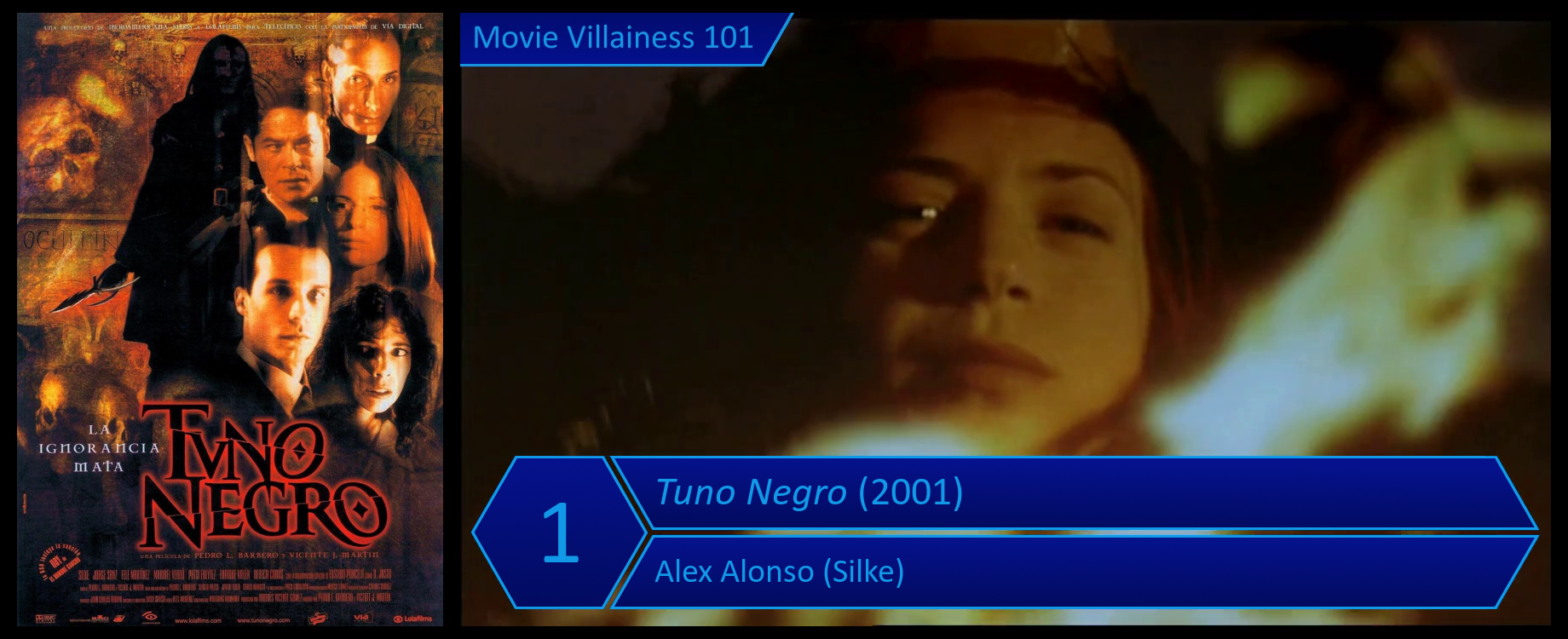
Movie Villainess 101 Rank #1

Movie

Tuno Negro (2001)

Also known as Black Serenade, this Spanish slasher has all the elements you expect from teen horror. An attractive lead, gory murders, minor characters as suspects. Plus practical jokes, and the inevitable false scares where other students dress like the killer. Tuno Negro benefits from its European setting, with Spanish buildings as an eerie backdrop for the murders. It’s an appreciable change from the usual American university, and a killer targeting students who fail exams is an interesting angle.
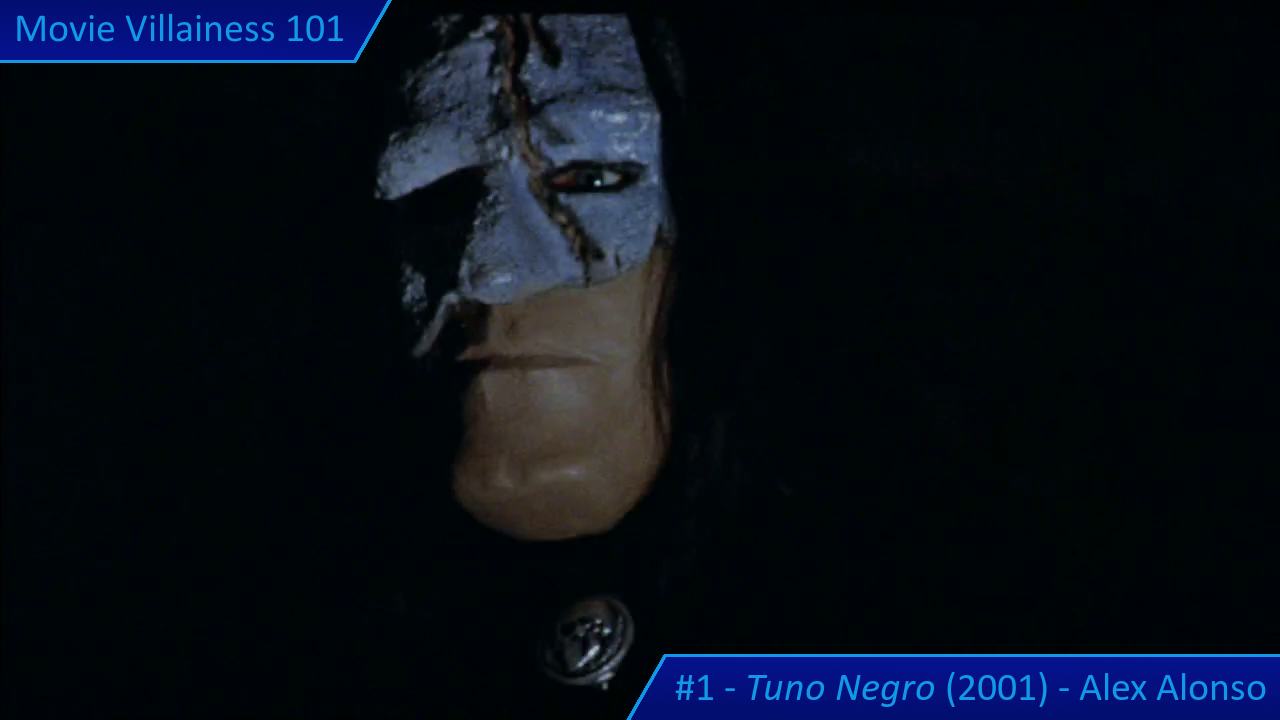
The prologue in Alcala sets up the plot, with a young woman contacted by someone calling themselves the Dark Minstrel. With a creepy name like that, she should log off and call it a night. But like all introductory females, she does the stupid thing and continues chatting until the Minstrel reveals that they know everything about her. Through a remote camera, the terrified girl is shown a green-tinted view of her residence – time delayed by a couple of minutes – that ramps up the tension.
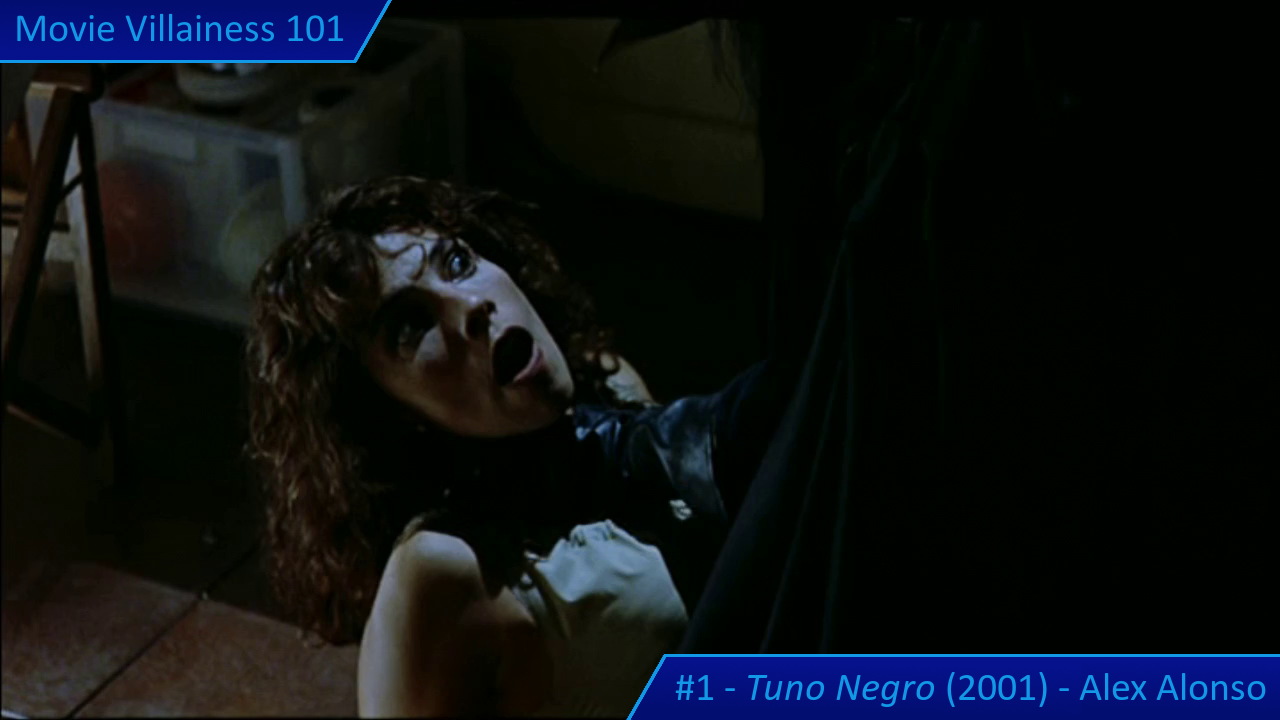
After some aggressive verbal exchanges, the Minstrel sneaks into the student’s room and attacks. Thanks to a disturbance outside, the victim escapes. The corridors are deserted, leading to a chase through dark rooms. Everyone is at a graduation event with traditional Spanish music, so nobody hears the young woman flee to the chapel. The Dark Minstrel sneaks up on her, and we get our first look at the creepy rough-skin mask before the victim pulls it away. The attacker’s face isn’t seen by viewers, but the woman clearly recognises them. A scream brings everyone running, ending with a false scare where two students have sex. Then the victim’s roommate spots the body suspended above.

The action shifts to Salamanca, another town with historic buildings galore. The first time we see the protagonist, Alejandra (Alex for short) she arrives at a deserted student dorm in a thunderstorm. An ideal time for a practical joker to fake a minstrel attack. Like other surprise villainess reviews, this comes with a spoiler alert, so readers already know Alex is the killer. However, the film does a great job with deception, setting her up as the main character viewers will expect to be the final girl. Even this early on, there are clues this woman is cold and calculating, with little patience for student pranks.
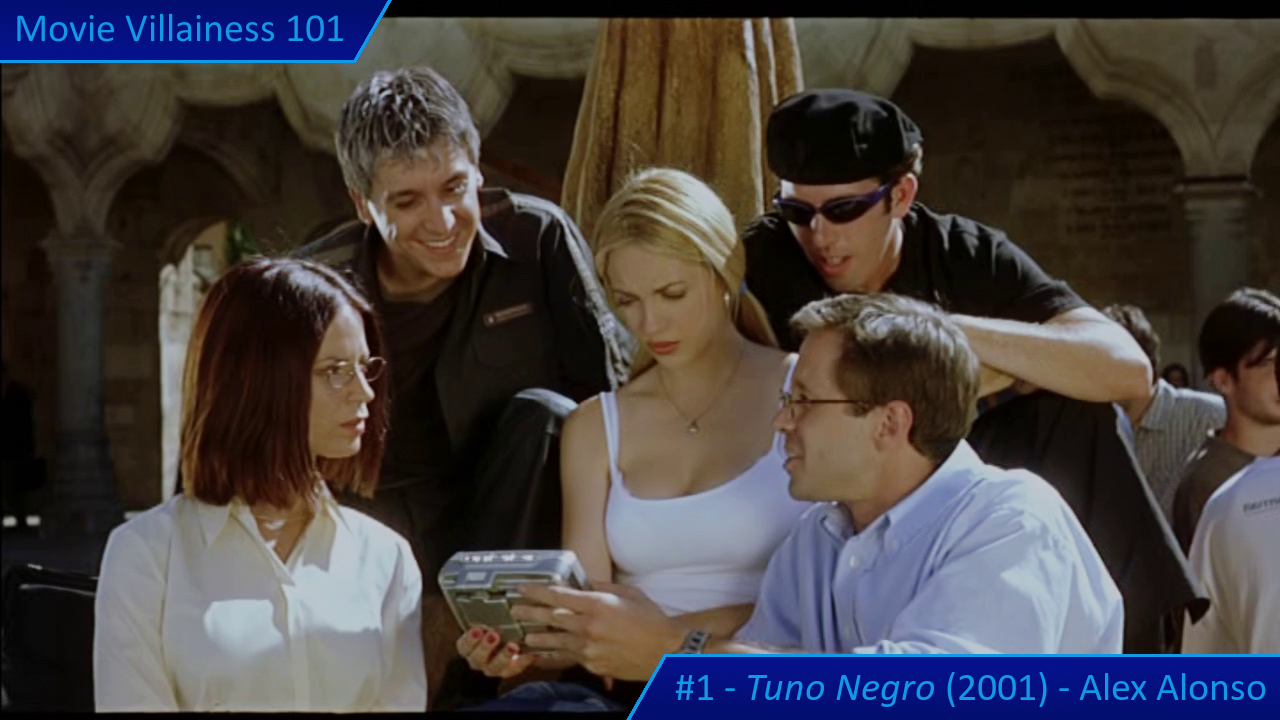
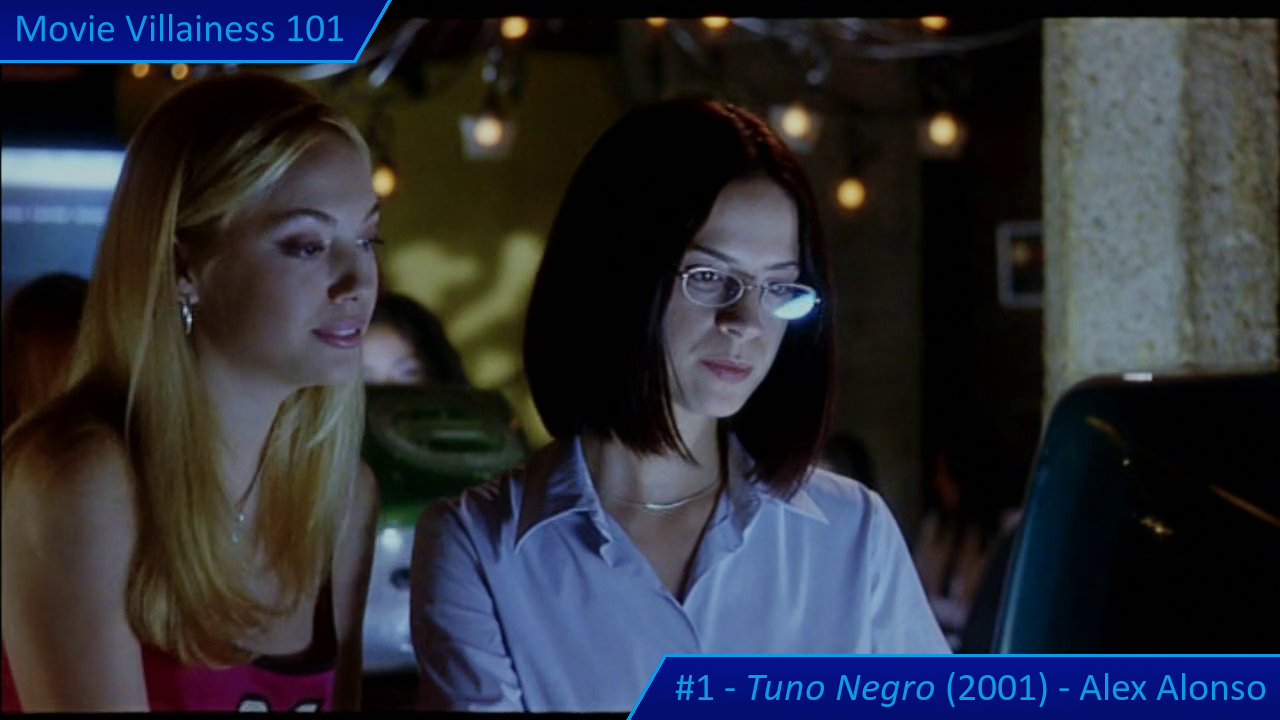
Plenty of men are potential suspects. These include criminology student Fonseca, who’s obsessed with the dark minstrel case, an urban legend nobody believes is real. The womanising Edu sees women as trophies, a lecturer obsessed with history is also dean of the creepy cathedral, and a police detective has a dark side. These are red herrings, but Alex casts suspicion on them while appearing an innocent heroine. She even set up a computer chat that reacts to her voice. This makes her the conduit to the killer, to throw everyone off the trail, and her amateur sleuthing diverts attention to others.

A clever murderess, and knowing the eventual outcome doesn’t affect enjoyment on repeat viewings. Since it’s great to watch the villainess set everything – and everyone – up.

Villainess

Alex Alonso (Silke)
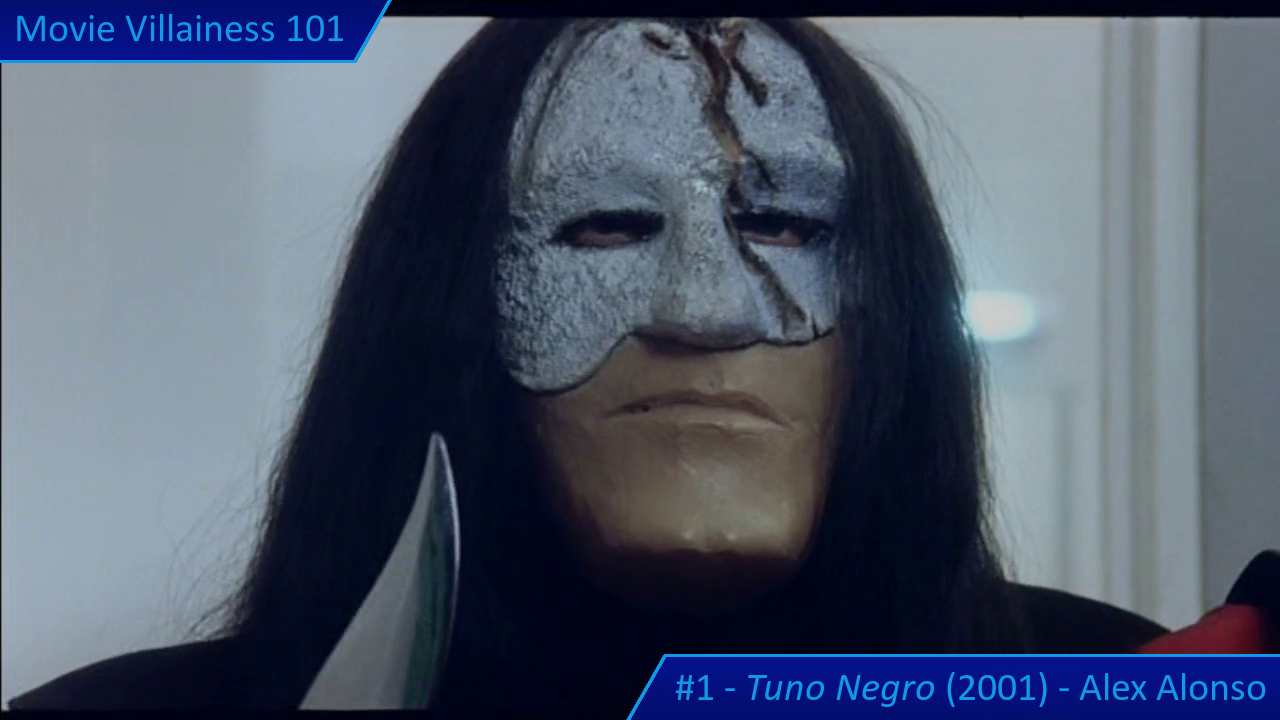
Once the character introductions are done, it’s time for a murder to liven things up. This comes at a wedding celebration where students perform a classic song while the murderer offs a woman in the restroom. Nowhere is safe from the Dark Minstrel, and we see the masked killer in close-up bashing the victim’s head with a mandolin. Some mischievous students sneak into the women’s bathroom and record the murder without realising it. What they think are sexual groans are really whimpers as the killer repeatedly stabs the victim to death.
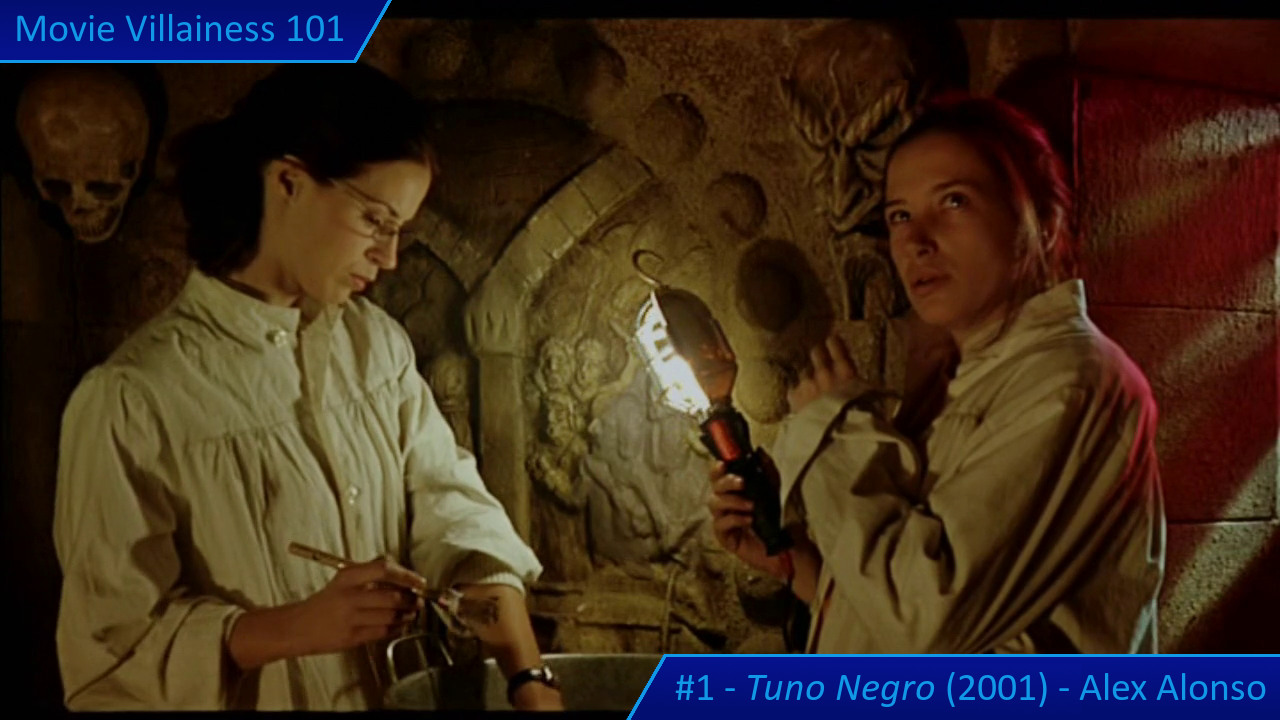
Get used to gory knife kills, as there are plenty more. After committing the foul deed, the killer paints a symbol in blood on the wall that represents the word “Victor”, a tradition from the 1400s that suggests an obsession with historic minstrels. Alex visits the cathedral chapel and convinces the dean to let her write a thesis on the topic. Stone sculptures show a secret society of masked men burned alive by the Spanish Inquisition, but the dean hints at a secret hidden in the artwork. The film spans an academic year, so when Alex isn’t murdering people or planting false leads, there’s ample time to solve a mystery.
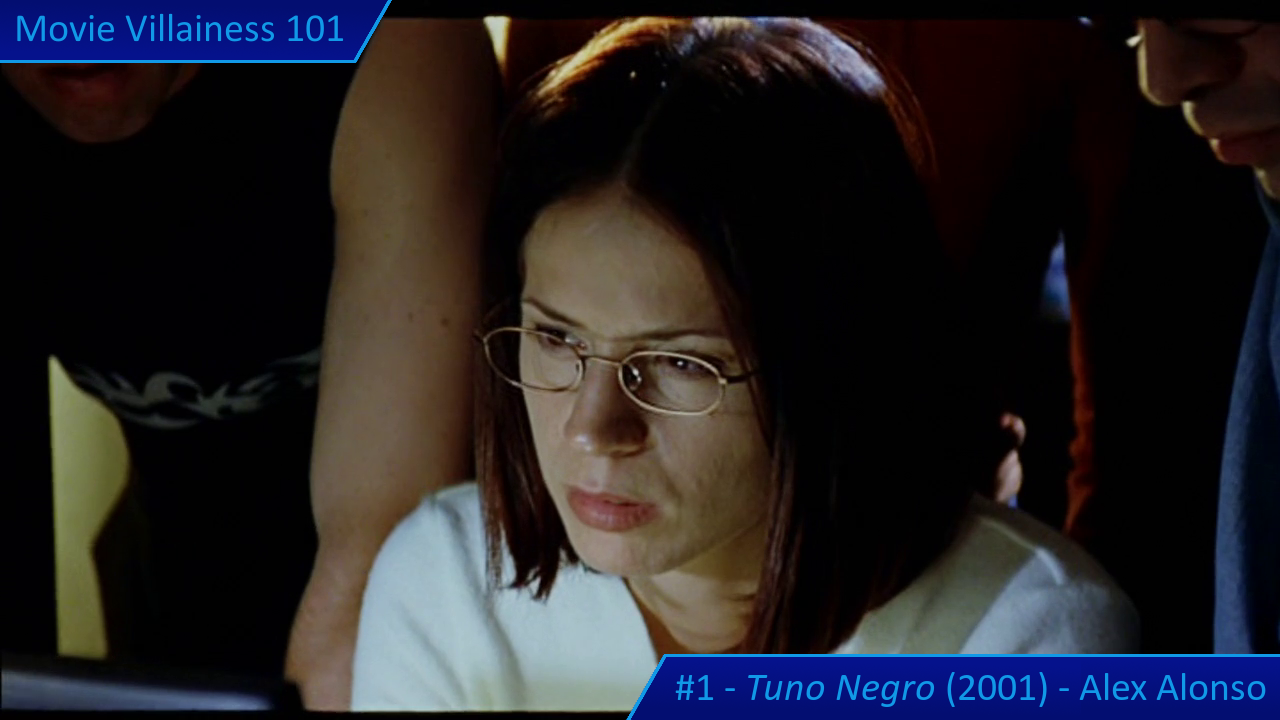
Alex as the killer protagonist is one of those rare twists that makes perfect sense and seems obvious in hindsight. Many clues are presented, from Alex looking unhappy at other students cheating, her keen interest in minstrels, and a woman always at the centre of events. And a reveal partway through when another student attacks Alex, only to get beaten up by a skilled martial artist. Cut to a kickboxing ring where she trains, and even spars with the investigating cop. The femme fatale flirts with students and manipulates them into thinking they’re using her when it’s the other way around.

Kill scenes often have the dark minstrel slash underperforming students – and anyone who gets in the way – with a long serrated blade. Unimaginative mostly, but the minstrel’s all-black outfit befits a slasher and conceals the murderer’s gender. While one can never be sure, it appears the actual actress – or at least a convincing stunt double – plays the killer.

There’s an impressive sequence in a morgue when a student cheats in a medical exam by reading instructions off a corpse. She gets surprised by pranksters, only for the actual killer to attack them. Numbers are no advantage against a trained opponent with a weapon. Sadly, the three murders take place off-screen – with only the aftermath shown – but we see the murderer kill a nosy doctor. Another victory symbol, but the surviving students are happy to stick around for final exams.
Next on the minstrel’s list is the perennial failure nicknamed Scorpion, who prefers to deal drugs than study. After taking some hallucinogenic concoction, the minstrel pays a visit to his shadowy den. There’s terrible CGI as Scorpion’s bloody arm morphs into a snake while the killer stands over him. Then more imaginary reptiles burst from his chest during the fatal stabbing that follows.

With the suspect list dwindling, it’s time for final semester exams. Alex spots other students cheating, and no doubt compiles a list of potential targets. The lecturers are canny and notice a woman named Michelle reading answers from a folded paper up her leg. Edu tries to switch his exam paper, but the dean catches him out by trimming the real test papers short. And Fonesca hands in a blank sheet, a deliberate fail as he hopes to ensnare the killer.

The murderer “contacts” Alex (or so the others think) via the chat page and shows images of stalking Michelle through the city. A perfect setup to create an alibi as a fellow student watches events unfold. Alex follows the phantom minstrel through Salamanca and the busy evening crowds, arriving at a courtyard where Michelle is tied up inquisition-style. Alex – alone with her victim – watches as fire trails spread and ignite the funeral pyre.
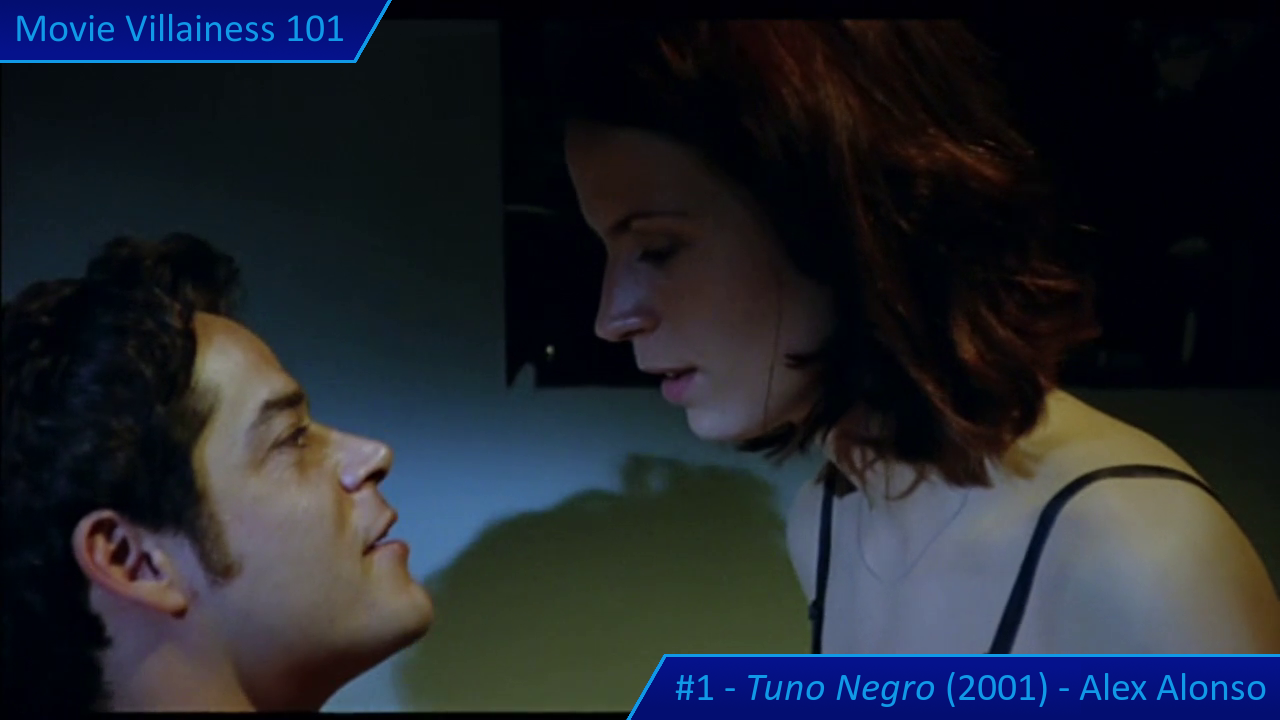
Edu inadvertently helps Alex solve the cathedral mystery, and she discovers that the historic minstrels escaped their punishment. After passing the dean’s challenge, Alex hands him a gift to open later. All this leads into the finale after the police discover the images transmitted during Michelle’s murder were pre-recorded. The cop is convinced there are multiple killers because it seems impossible for one person to pull this off. Thankfully, this is another red herring, and the murderer – the woman nobody suspects – is intelligent enough to operate alone.

With the men suspecting each other, the masked killer wipes out the weak students in the creepy cathedral. Fonseca and Edu are at each other’s throats until they hear Alex scream. They get separated, and Fonseca discovers a hanging woman. However, it’s not Alex but her assistant Sandra who’s the victim. Turns out hiring a lookalike and giving her similar work clothes was a ploy to create a decoy.
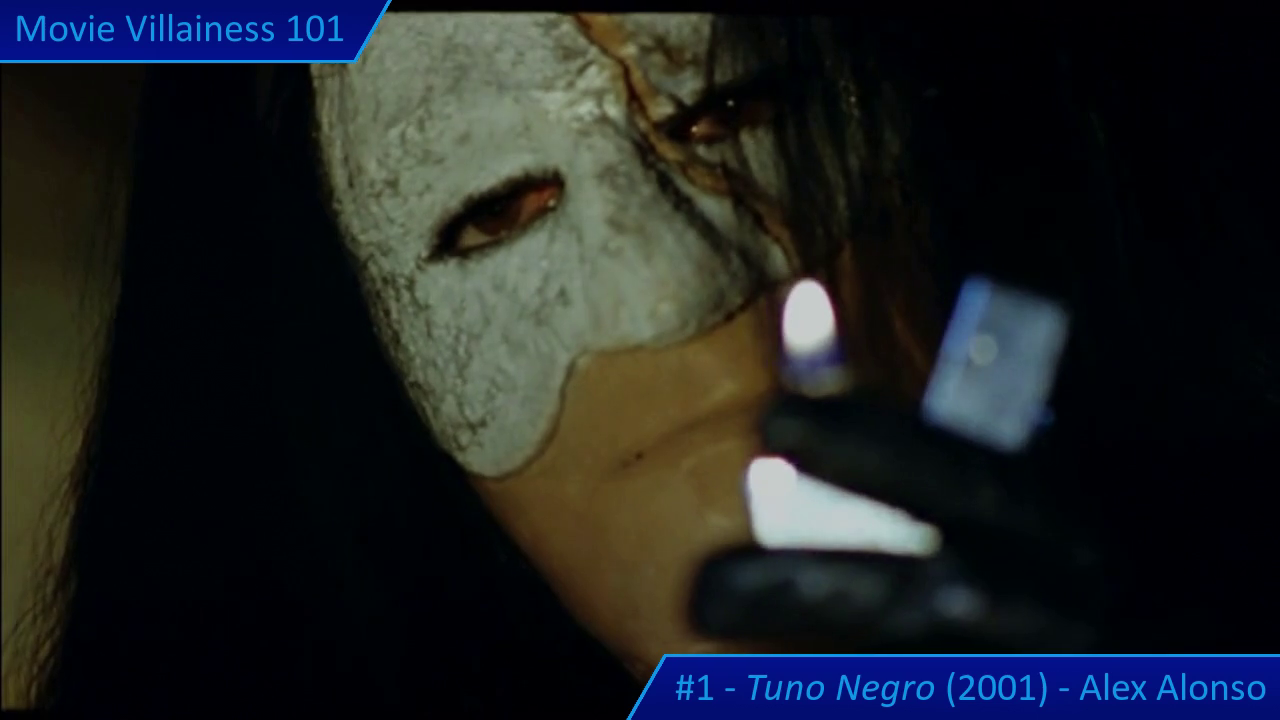
The killer pours gasoline over Fonseca and jumps down acrobatically from above. The terrified man demands to know who the minstrel is, and she promptly unmasks herself. His earlier claim that females couldn’t be psychopaths is debunked, and he screams in frustration. At Alex’s mercy, she takes pleasure in setting him aflame and watching him burn. Alex replaces her mask to escape the watching Edu and uses the scream trick again to lure him into a fatal encounter. Edu doesn’t notice the now unmasked Alex is dressed like the dark minstrel, and is truly surprised when she stabs him. Ignorance kills, indeed.
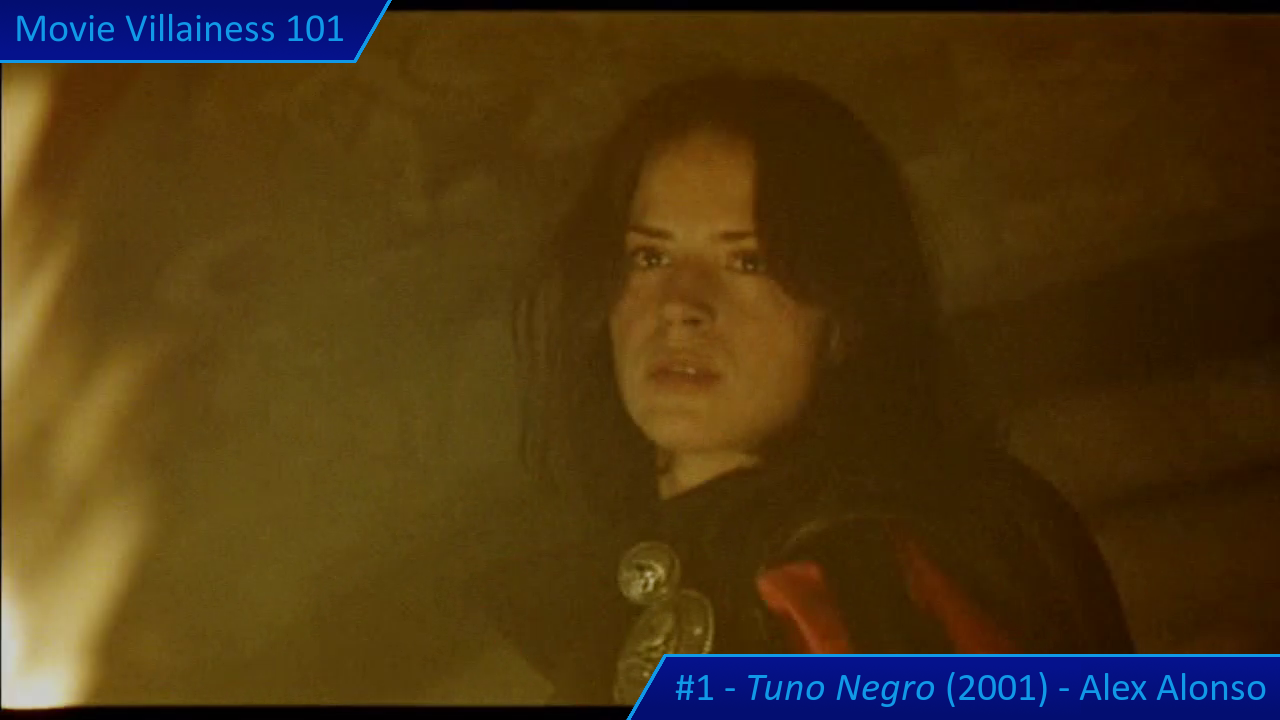
The police are also on the scene and still believe there is more than one culprit. The chief investigator’s partner is so terrified by now he guns down everyone dressed like a dark minstrel. This results in a bloodbath as the main cop confronts the masked killer. Already established as a superior martial artist, she easily betters him. After a lengthy fight, the masked Alex lets the guy live, presumably because he’s impressed her. Lucky him! The cathedral’s secret passage proves handy for a getaway, though Alex unmasks herself one last time to prevent the cop shooting her.
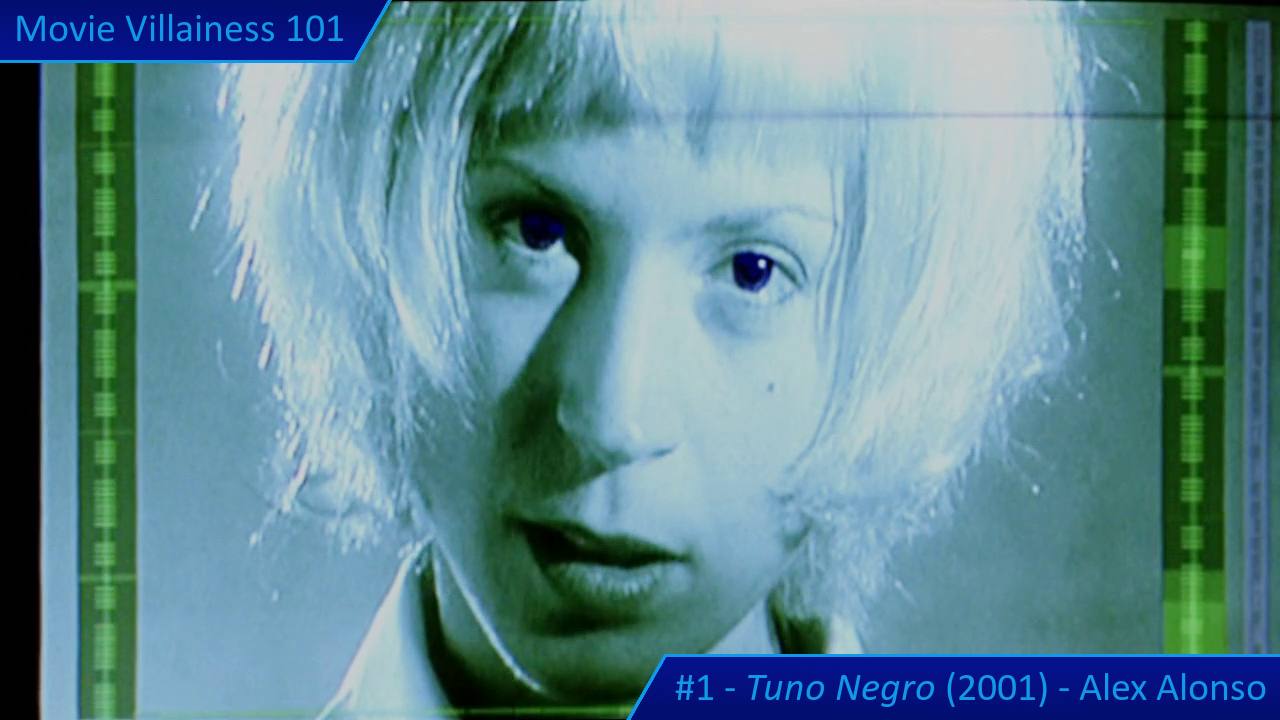
It’s revealed that the real Alejandra is dead and the fake Alex adopted her persona, so the killer’s true identity remains a mystery. The dean’s gift is a recorded video message from the minstrel who’s changed her appearance. Her stated motive is simply to wipe out weak students, which she sees as her calling. No revenge or childhood trauma, so a refreshingly unique background for the female psycho.

There are ten criteria I think make a great villainess. Intriguing backstory and setting, a spectacular entrance, memorable outfit, physical prowess, high intelligence, kill scenes, acting and dialogue, reveal / twist, exciting climax, and a victorious conclusion. While individual female villains may beat “Alex” in some categories, she’s the greatest overall villain I’ve ever seen. And a deserved top ranking.
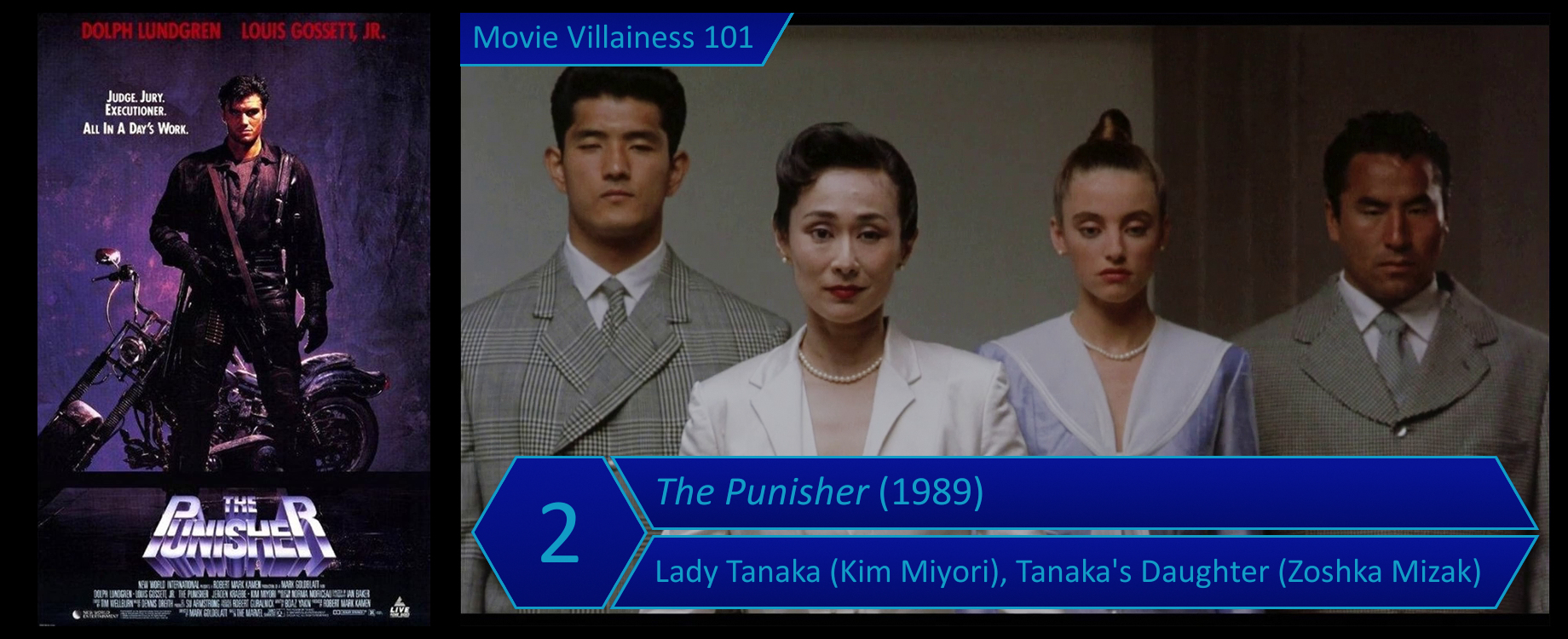
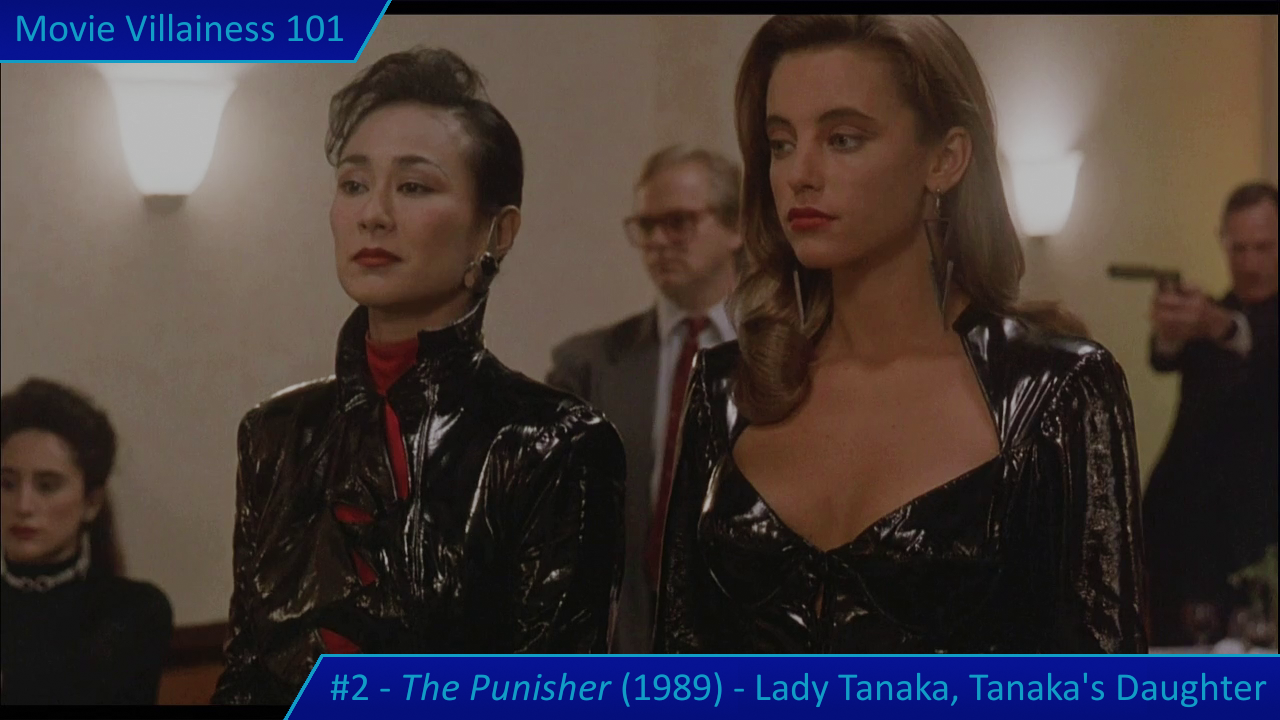
Movie Villainess 101 Rank #2

The yakuza boss and her martial artist daughter have their own ideas on punishment

Movie

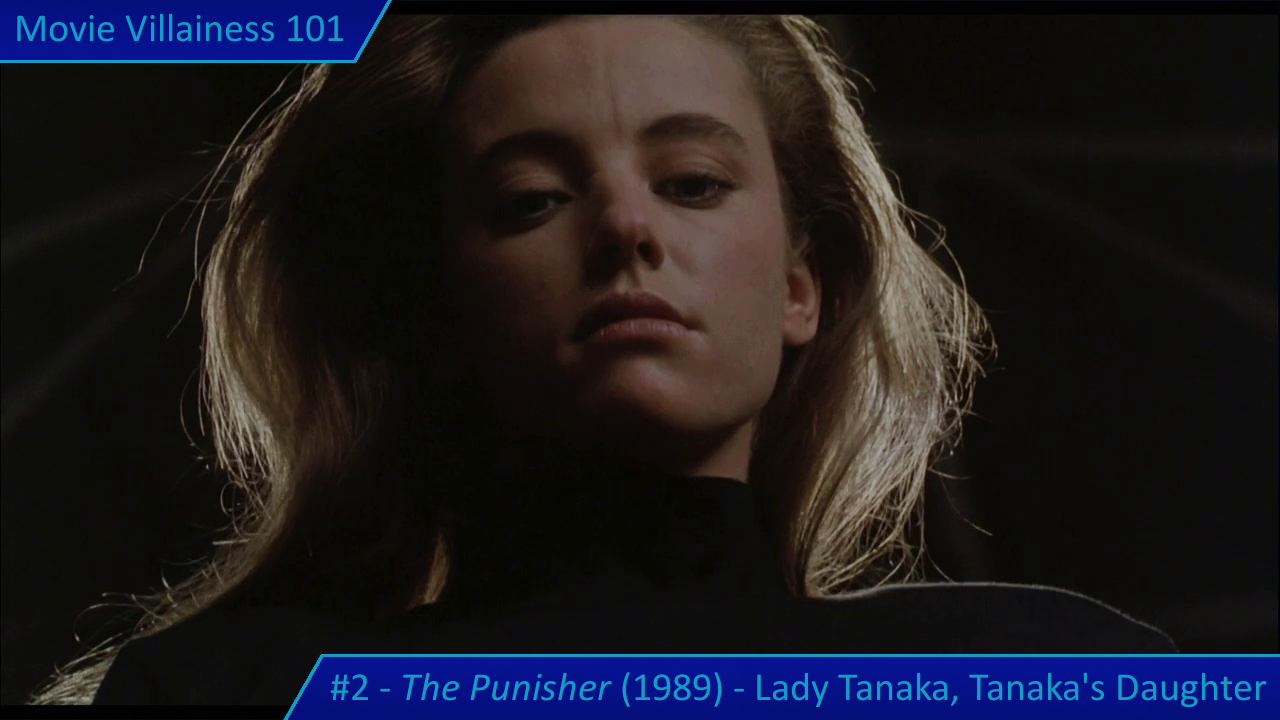
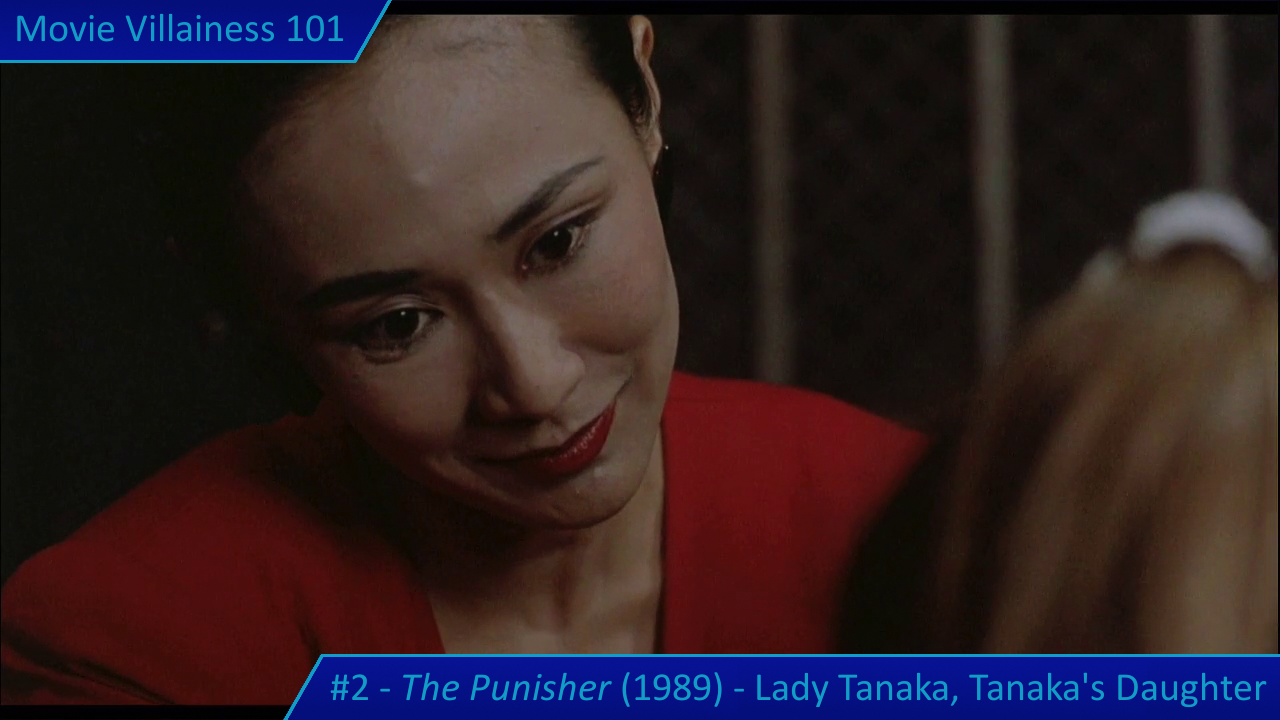
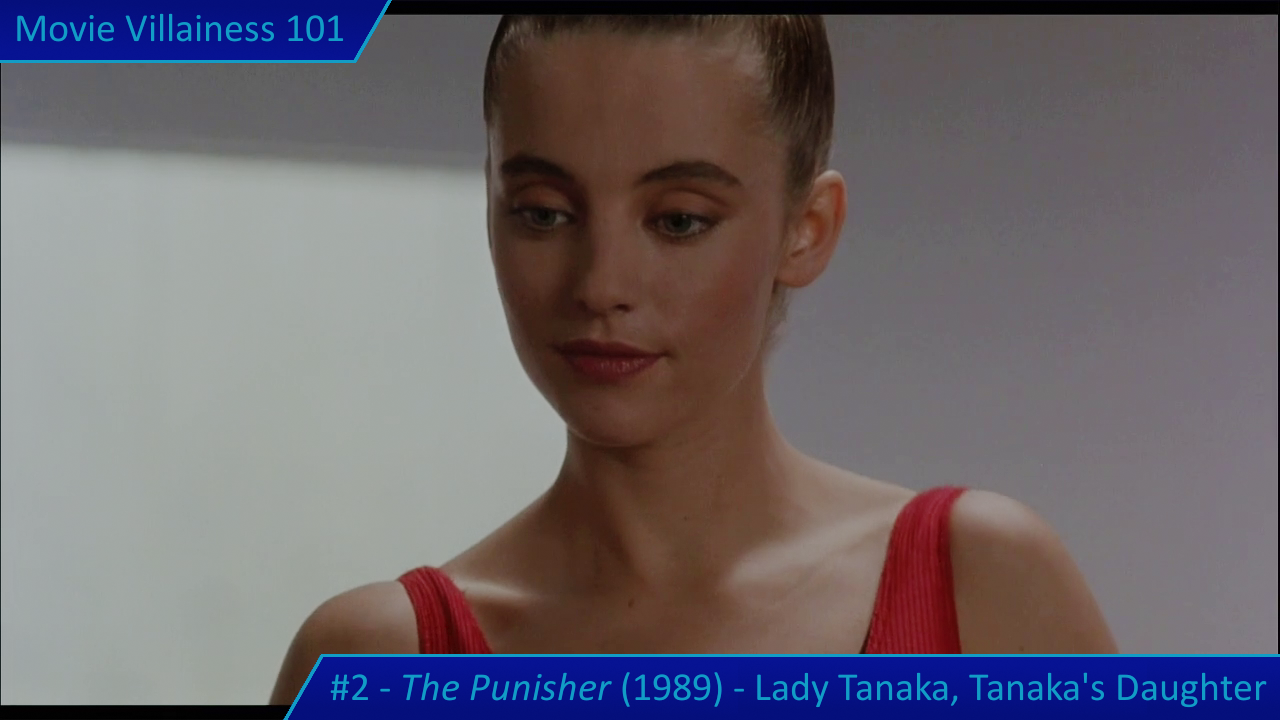
The Punisher (1989)

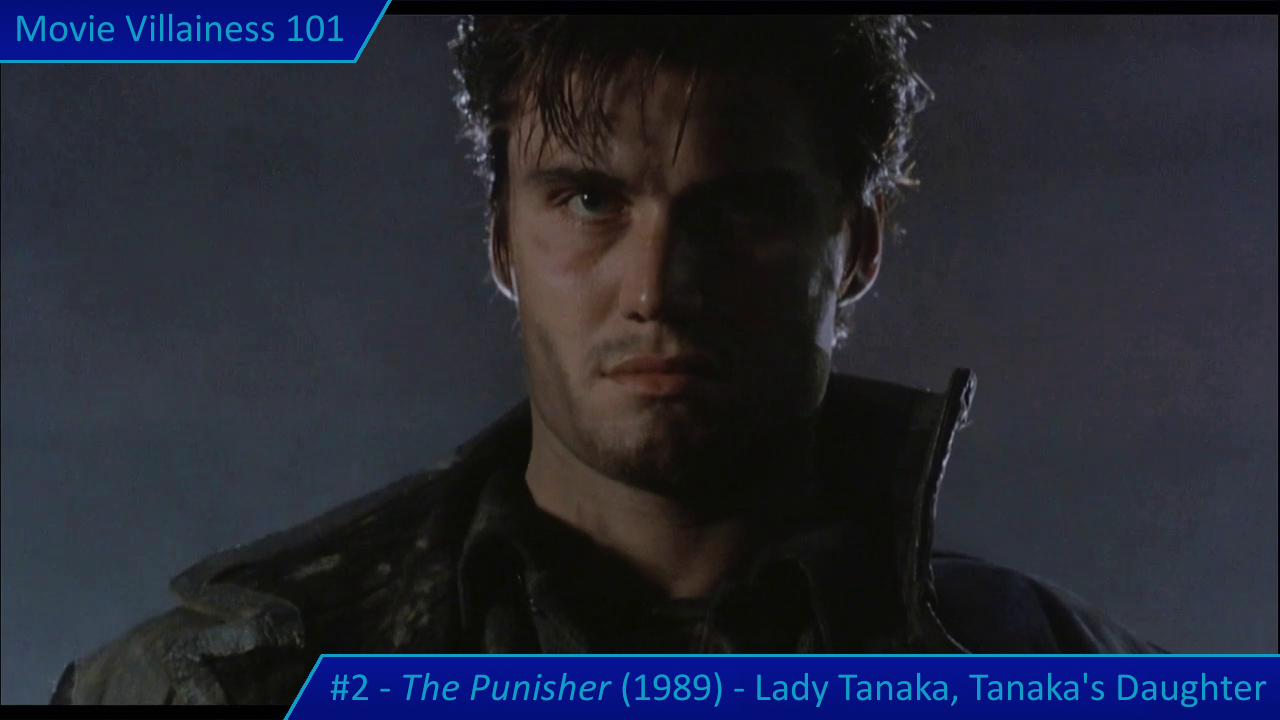
The Punisher is classic 1980s action nonsense that pits the tough title character (Dolph Lundgren) against a horde of mafia and Yakuza goons. And the two female villains have remained etched in my memory ever since I first saw them.

The historical body count – before the movie even begins – is over a hundred, and many more die before the end credits. For the opening setup, we have a perfect tone-setter as the leather-clad antihero breaks into a house. Then he eliminates some hapless bodyguards and closes in on a mobster who foolishly thought himself invincible. A big explosion (there had to be one) and the introduction is over.

With the opening cannon fodder disposed of, it’s time to introduce more challenging opponents. First to fly into town is Franco (Jeroen Krabbé), a pragmatic godfather who unites the warring mafia families. The Punisher gets a lead on a drug shipment from a drunk English thespian who speaks in rhymes, but the Yakuza have already set up an ambush. Lady Tanaka, a truly evil woman who makes Franco seem small time, is the main antagonist. And her mute adopted daughter is far more important – and deadly – than she first seems.

As a subplot, Lieutenant Jake Berkowitz (Louis Gossett Jr.) believes his old partner Frank Castle is the Punisher, and teams up with Detective Sam Leary (Nancy Everhard). Their investigation in the sewer tunnels is a sideline to the carnage, where the cops provide useful backstory while we wait for the next action set piece.

Comic book fans criticise the hero for not wearing the iconic skull emblem, but villainess lovers won’t feel shortchanged with this action classic. Picture 1980s glory with two female villains – a boss lady and a skilled henchwoman – who are not wasted. That’s why Tanaka and her daughter rank so high on my list. They only come second because a solo villainess deserves the top slot, but this is the greatest ever female baddie pairing.
Villainesses

Lady Tanaka (Kim Miyori), Tanaka’s Daughter (Zoshka Mizak)

With two female villains, I’d normally split the summaries up, but Tanaka rarely goes anywhere without her daughter for protection. So it seems fitting to cover them both in one large section.

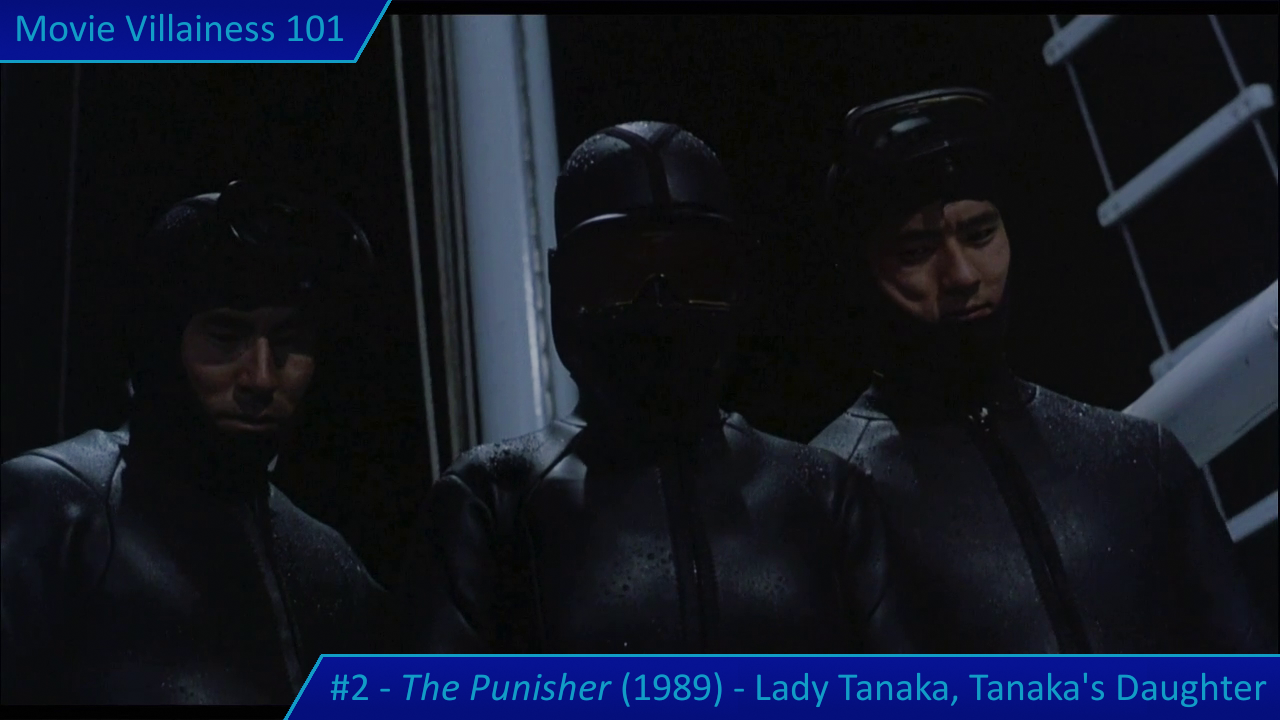
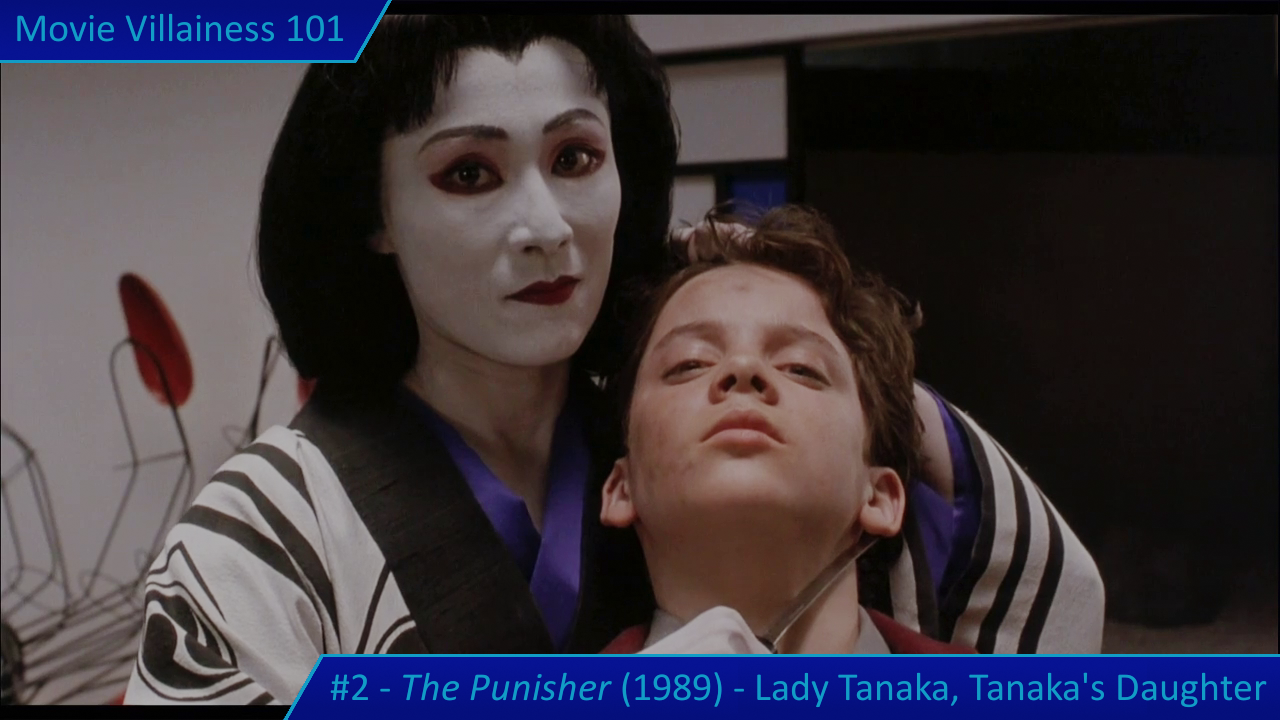
An early action scene has the Punisher intercepting a drug shipment, only to find an army of ninjas with other plans. The stealthy attackers take out the sentries, while a scuba team hijacks the incoming vessel. The wetsuit ninjas are well trained, and a false Coast Guard distraction gives them cover to eliminate the mafia crew. After two males use dart guns and spiked balls, the female leader shows off her martial arts skills. Two leg swipes chop a guy’s hand off and slit his throat. How does she manage that? With a sharp blade attached to the side of her foot, one of many weapons in her arsenal.

One great thing about this enforcer is she never conceals she’s female, and it’s only a question of whose face is behind the dark scuba goggles. That will be answered soon, but first it’s the Punisher against the ninjas who mark him as a threat. The antihero kills quite a few men and crashes an escaping van into the ocean by taking out the driver. The female is a more worthy foe and throws a knife into the Punisher’s chest from a long distance. Once again we see a close-up of the villainess’ dark visor, and are left to relish the next female ninja encounter.

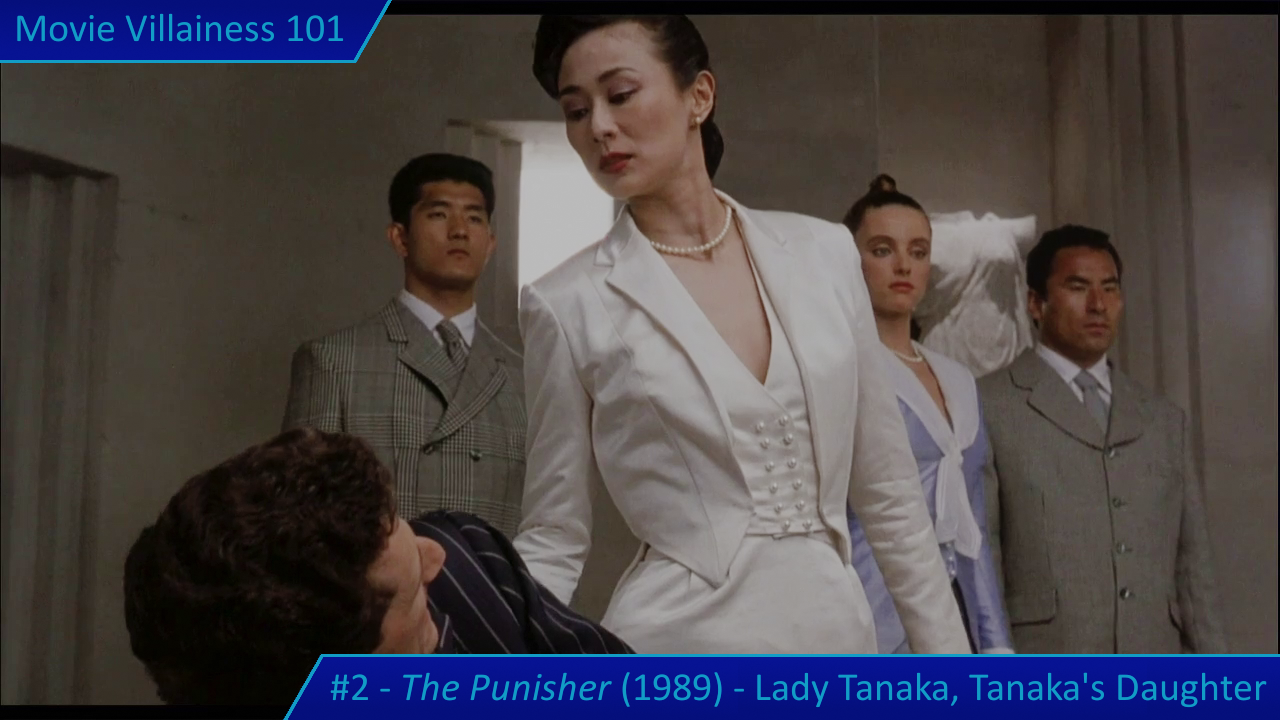
The samurai sword and ninja outfits are not-so-subtle clues that the Japanese are behind the assault, but Franco grants Lady Tanaka an audience. She plays hardball and demands a controlling interest in Franco’s organisation. This is a smart and ruthless woman who knows he would never agree to such terms, even if she torments an objector with her jewelled finger blade.

Tanaka tells Franco she’s taken steps to ensure his cooperation. Yakuza speak for abducting the mafia family heads’ children, including Franco’s son Tommy. The Punisher is happy to let the gangsters wipe each other out until the drunk informant mentions the children are innocent. And because Frank Castle (yes, Berkowitz is right) lost his own family in an underworld hit, he dishes out his own justice. This involves crashing through the roof of a Yakuza casino and unloading entire clips of ammo into roulette tables and slot machines.

Franco shares Lady Tanaka’s history, and we learn she killed her own brother as a test of loyalty. And we’re shown her fake affection for the kidnapped children she plans to sell into slavery. She would never take the casino attack lightly, so she does what any evil villain would and sets a trap.

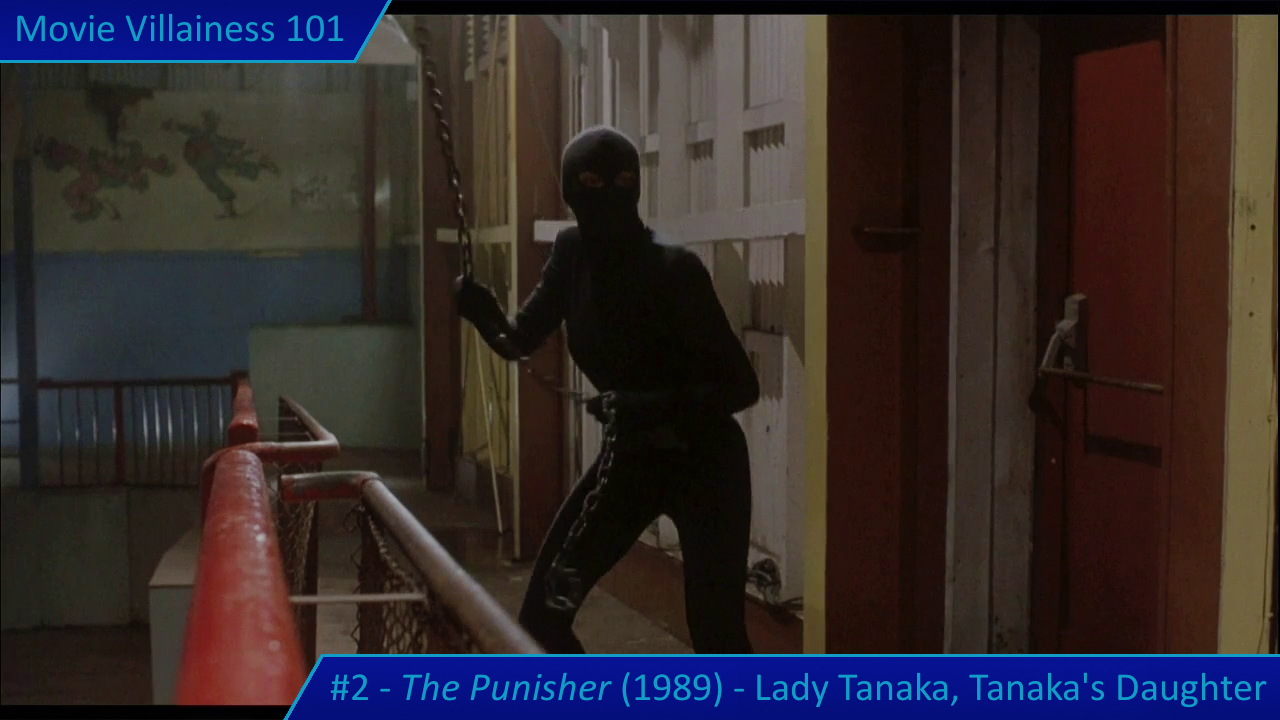
Lured to a deserted funfair by false information, the Punisher takes the bait. Instead of the children, an army of ninjas awaits. Despite the advantage of sheer numbers and surprise, not to mention the bizarre sliding entrance, the Punisher kills a fair few masked mooks with his shotgun. He makes it to his trusty motorcycle and would be home free were it not for a certain female ninja. Once again, the woman is more competent that her underlings and disables the bike with a thrown ball and chain.

Dazed by the fall and unable to mount a defence, the Punisher suffers quite a beating before the female takes her turn. After a few swivel kicks, the villainess unmasks herself, and it’s no surprise she’s Tanaka’s daughter. However, the reveal has an epic quality since it’s all about her victory. Two matchups so far, and she’s won them both.

When the hero wakes up, he’s literally on the rack and Tanaka wants payback for the casino raid. What does a trapped man do in this situation? Come out with wisecracks, of course. Tanaka runs her finger blade over the Punisher’s bare chest and uses the classic technique of threatening a friend (in this case, the drunk informant). This being a dark tale, the tough guy looks away and lets the Englishman endure. Not through with them yet, Tanaka leaves her goons in charge while she attends another meeting. A perfect opportunity to escape, put a Yakuza thug on the rack, and find out where the children are.

Tanaka’s meeting is with the mob heads after they pay the ransom. Franco is a notable absentee since he didn’t trust the crime lord to keep her end of the bargain. A wise decision, as the other customers are Yakuza plants who wipe out the mafia bodyguards. One guy voices his disgust, only to learn the daughter has yet another concealed weapon: earrings that double as throwing daggers. The henchwoman’s aim is implausibly perfect and pins the man’s wrists to the wall.

The mafia bosses don’t last long, since Tanaka poisoned their champagne glasses. All she has to do is gloat as they clutch their throats and die. The man against the wall didn’t drink because of a medical condition, so the villainess blows his brains out. Preamble to establish the women as badass before the final showdown, but it works.

Tanaka and her daughter disappear for twenty minutes of downtime while the Punisher rescues the children (except for Tommy) from a Yakuza hideout. The hero hijacks a bus, which doubles as a getaway vehicle until they run into a police roadblock. Berkowitz and Leary get some alone time with Castle, but he’s not the best conversationalist. The police don’t keep their man long since Franco stages a dramatic rescue. An alliance as fragile as they come, but the mafia boss has Berkowitz as a bargaining chip, so the Punisher reluctantly agrees.

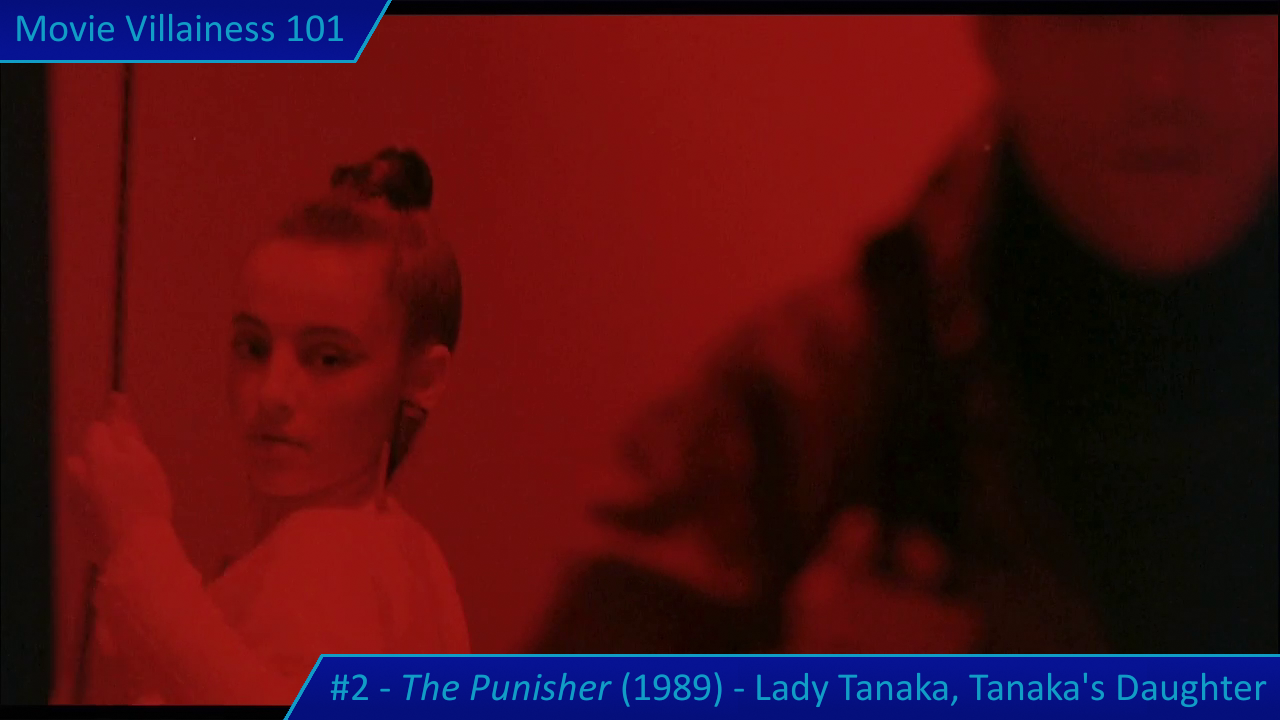
The Punisher and Franco infiltrate the Yakuza base – concealed in a downtown skyscraper – and wipe out an entire room of thugs. After the usual air vent sneaking about, the drunk sidekick blows the lights, which turns the interior an emergency red colour. That hides the blood nicely, and Berkowitz – who’s escaped from the mafia – cannot interfere from the outside.

Two samurai henchmen challenge the hero in Tanaka’s inner sanctum, but he defeats them. That leaves only the Yakuza boss and her daughter to contend with. The dragon lady lures Franco into a trap using his son as bait, and the henchwoman drops behind him, ready for a deadly stealth attack. Then the Punisher crashes through an Oriental wall panel and knocks the daughter aside.

The last fight between her and the Punisher is extended as she uses martial arts and every concealed weapon in her arsenal. After a brief scuffle, the villainess plays dead, only to throw a knife into him. The daughter pulls another hidden blade, which the Punisher knocks away. He gets her in a necklock, but she uses the earrings to cut his wrists and escape. There’s time for the shoe blade and deft kicks before the muscular male snaps the woman’s neck.

No surprise Franco turns against the Punisher, leading to a rather tame shooting compared to what came before. Fortunately, the villainess gets a better demise. Franco catches up with her as power is restored, and she proposes he kill himself to save his son. Of course, there’s no guarantee Tanaka will keep her word (she probably wouldn’t). So it’s good for Franco that the Punisher comes crashing through a window and throws a knife – possibly the weapon the daughter used – into the villainess’ head.

Movie Villainess 101 Rank #3

The greatest female villain and pre-title henchwoman in the Bond franchise are more than enough

Movie

The World Is Not Enough (1999)

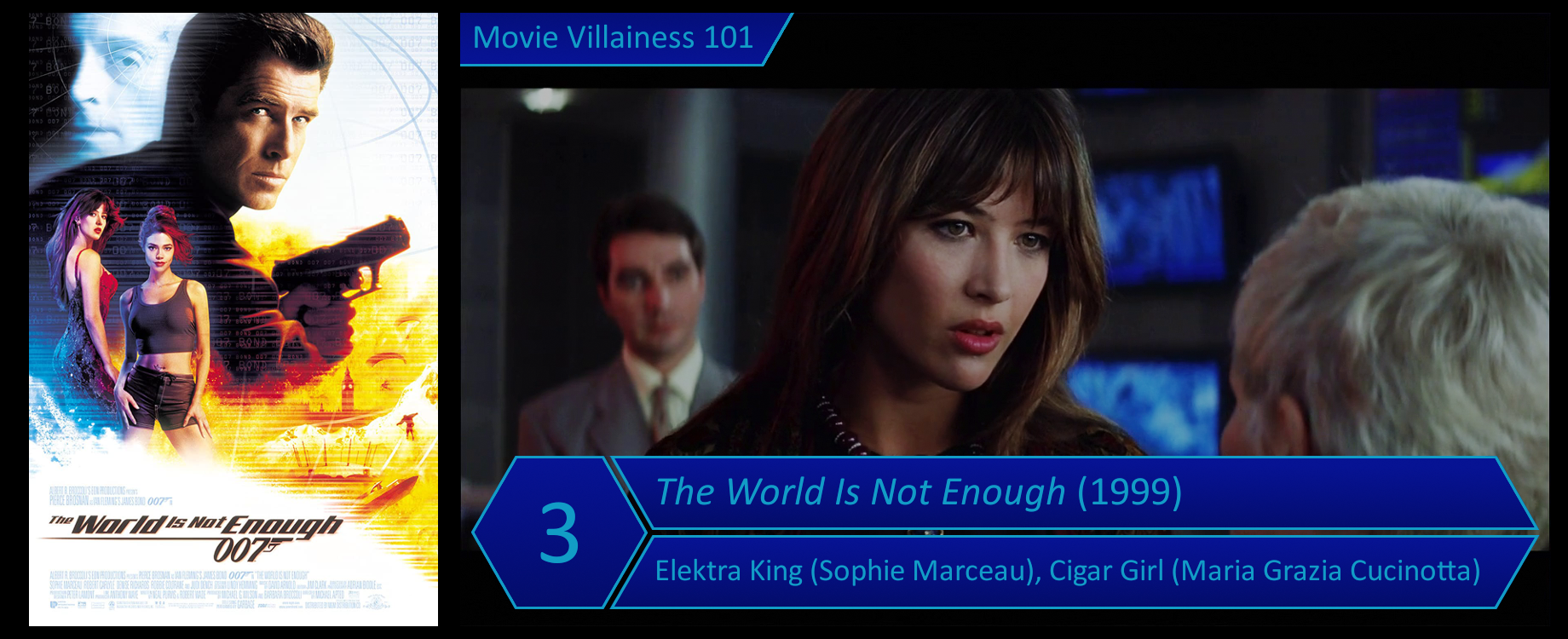
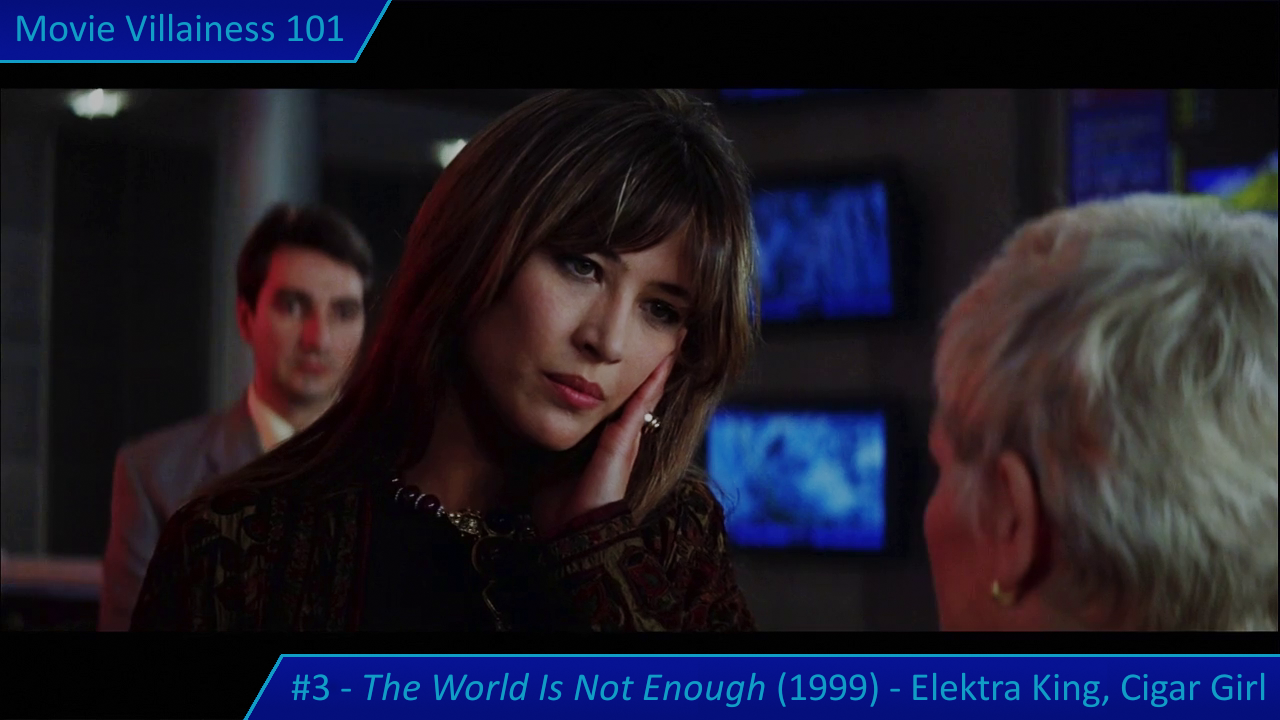
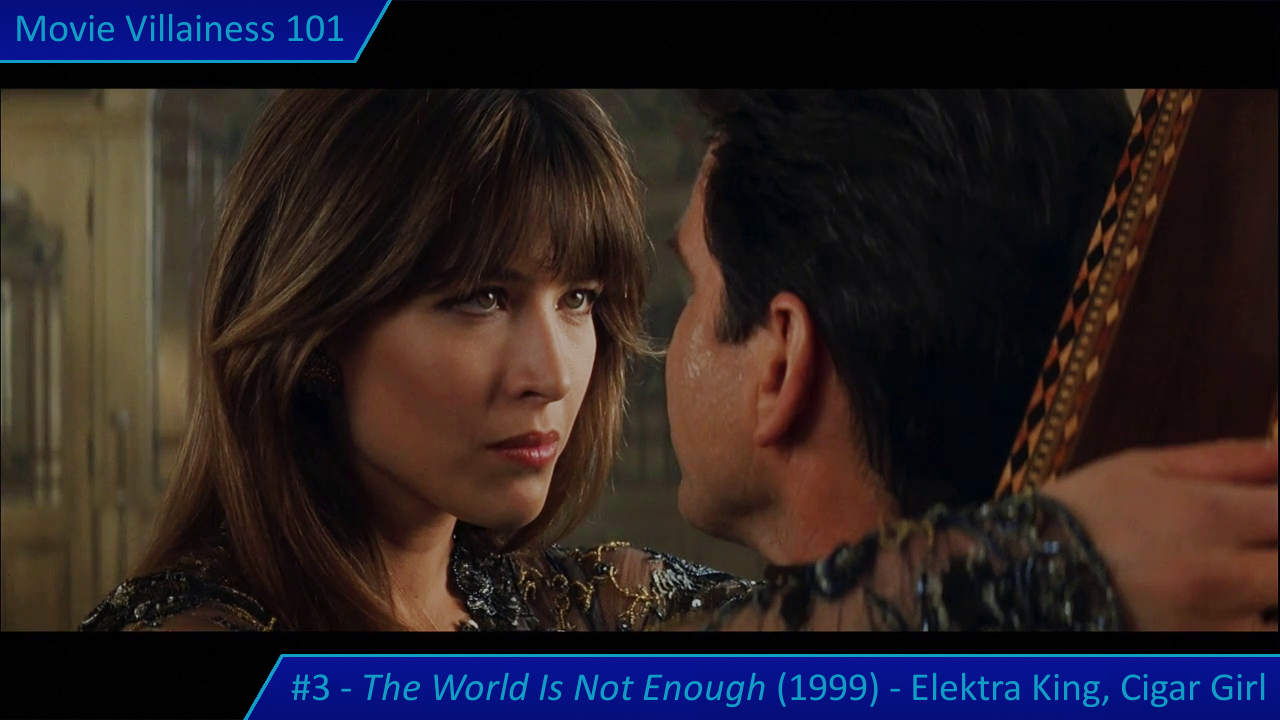
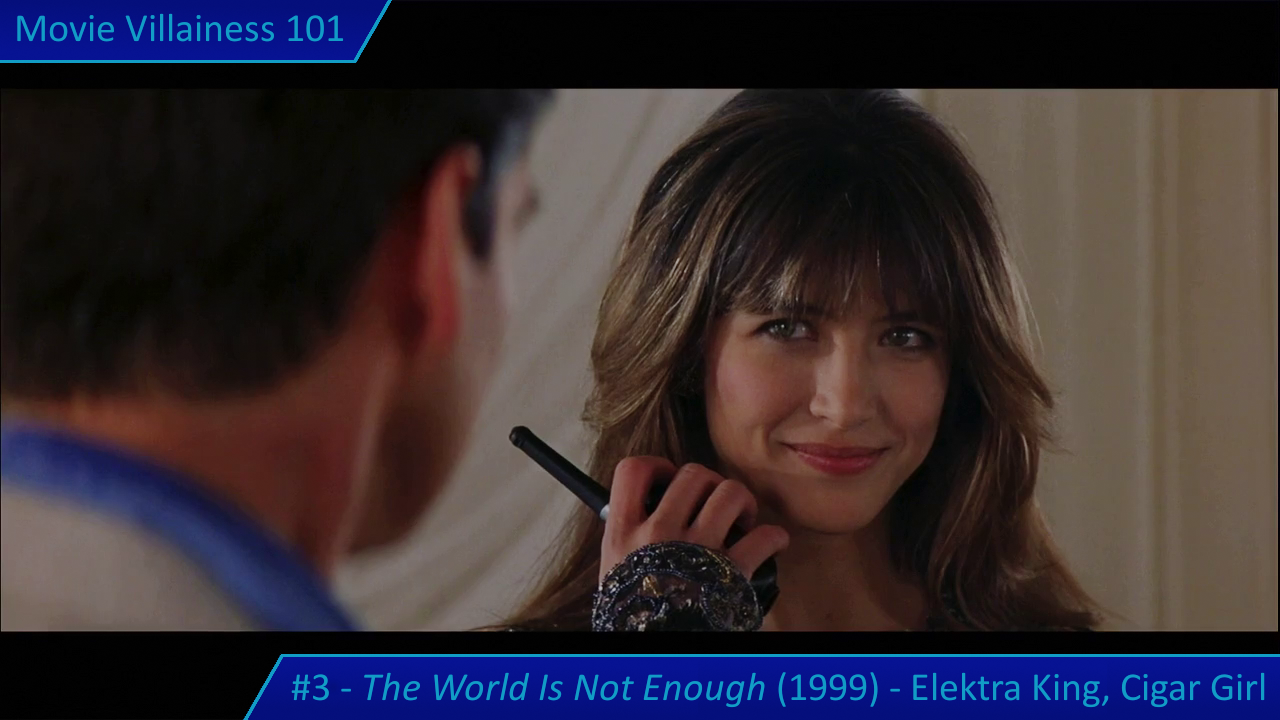
My GoldenEye discussion omitted one of the Brosnan films. That’s because the only female main villain in the Bond series deserves a goddess tier spot. As a bonus, we get the greatest pre-credits villainess, which almost makes up for the female baddie wilderness in the Daniel Craig era. In classic 007 fashion, the Cigar Girl assassin gets her own dedicated section. And it’s a logical review structure since Elektra doesn’t appear until after the title song.
Brosnan films are relatively fun and escapist compared to what followed, but this entry has a more serious tone. Valentin Zukovsky (Robbie Coltrane) makes a welcome return as Bond’s reluctant ally, and the MI6 series regulars are also present. Sadly, this was Desmond Llewelyn’s last appearance as Q, but he passes the torch on to R (John Cleese) and delivers comic antics and gadget-testing chaos.
Action sequences are hit and miss, and the major set pieces – attacks by para-hawks and saw-blade helicopters, a gun battle in a missile silo, and the climax on a doomed submarine – fall flat compared to the spectacular opening. Still, this is a must-watch movie for any villainess fan, and the twist of having a Bond girl be the main baddie is a refreshing take. There’s also a good female: Denise Richards as nuclear physicist Christmas Jones. An excuse for bad jokes, but this is an entertaining outing.

Pre-Title Villainess

Cigar Girl (Maria Grazia Cucinotta)

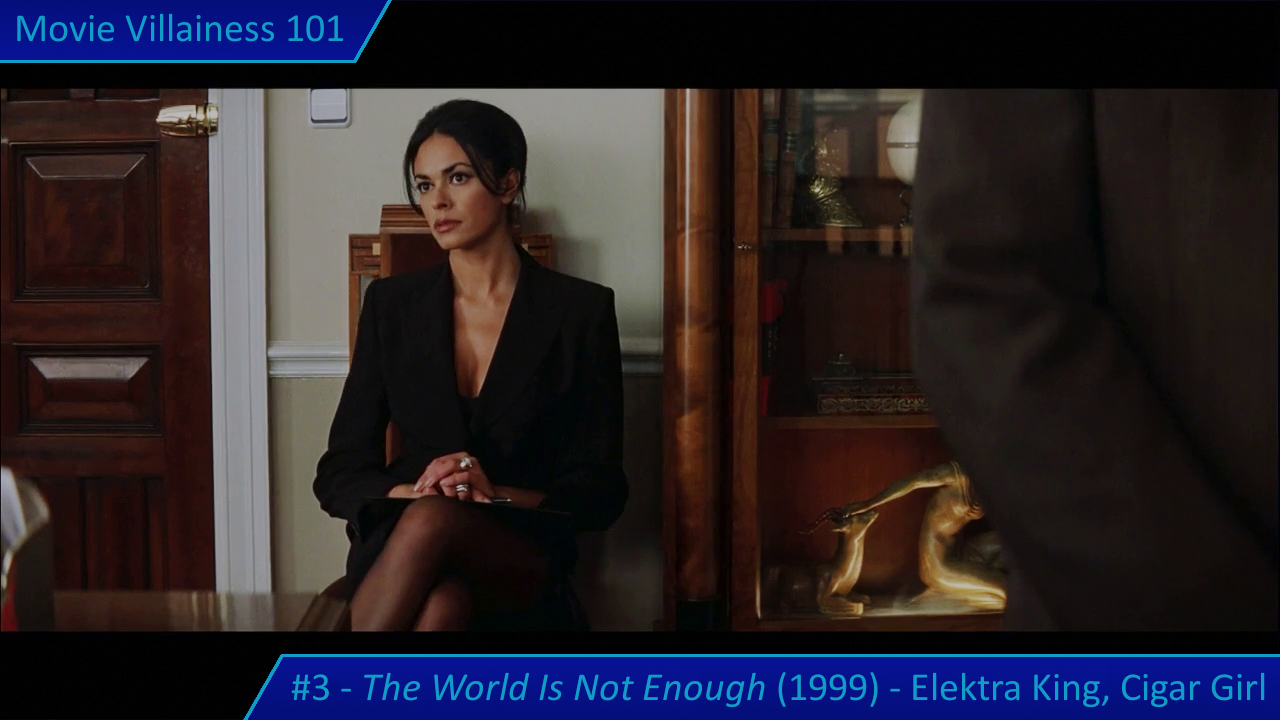
This epic opening gambit – and the longest before No Time to Die – begins in Bilbao, Spain, with Bond mincing words with a sleazy banker. A beautiful woman offers him a cigar (hence her nickname) and even gets a double entendre quip. Then it’s down to business with 007 demanding answers about a murdered MI6 agent. Things predictably turn nasty, and Bond makes quick work of some armed thugs. Too bad he forgets about the Cigar Girl, who eliminates the banker with a throwing knife.

Trapped and unable to pursue the assassin, Bond makes a dramatic getaway with a suitcase of money with the help of a mystery sniper. This ensures 007 makes it safely back to London, where he’s introduced to Sir Robert King, an oil tycoon who won’t be with us much longer. The money is laced with explosives, and King’s lapel pin is a proximity trigger. With MI6 under attack, a familiar female foe returns, and this time it’s Bond in her laser sight.

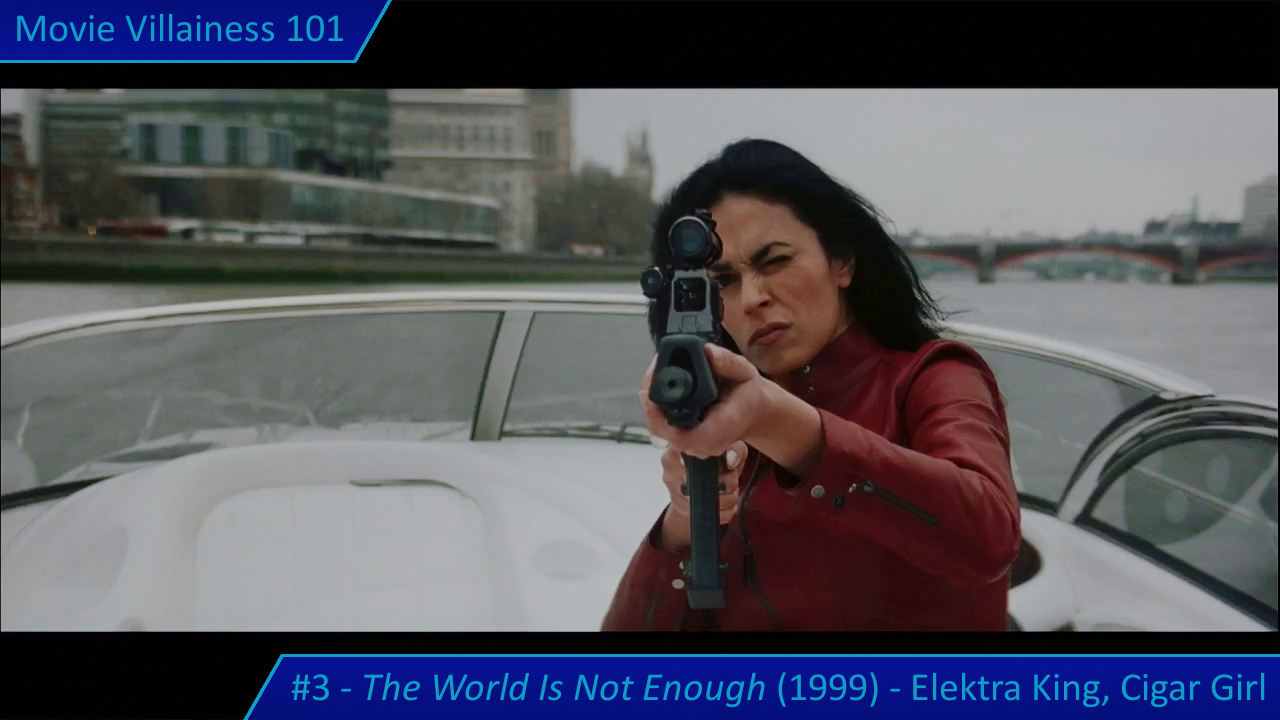
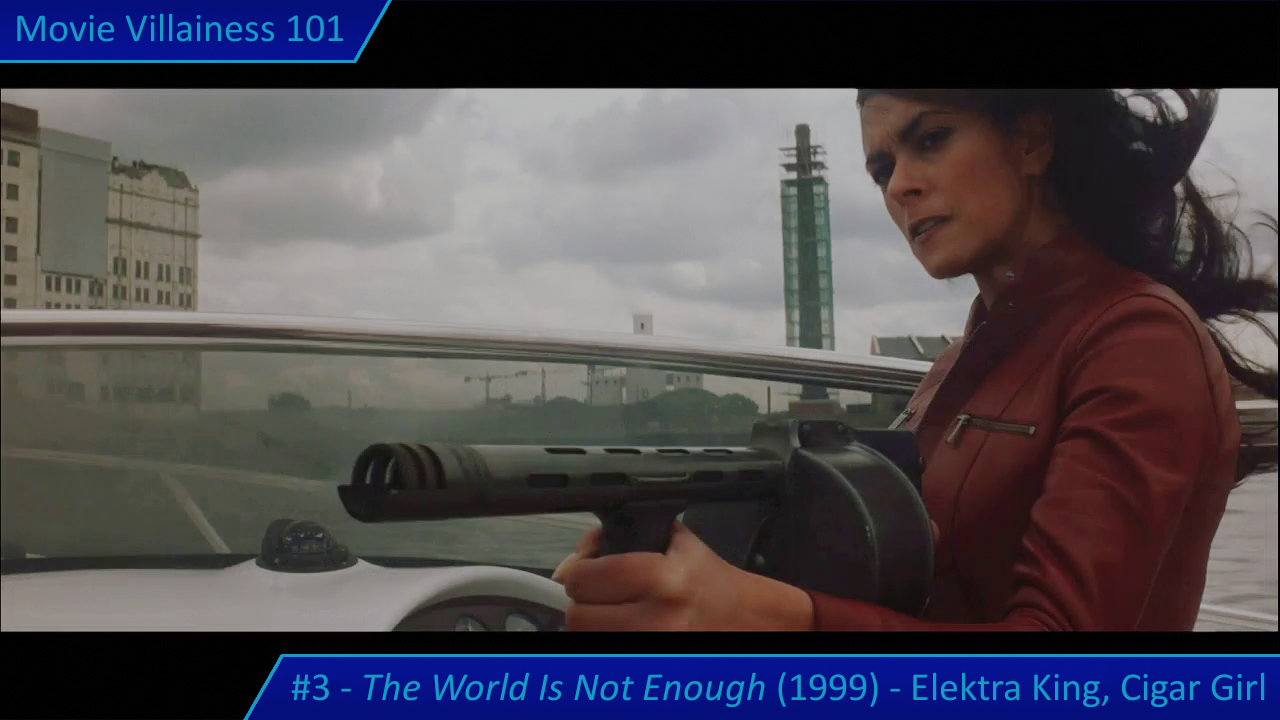
The big chase along the River Thames has Bond in a gadget-equipped boat pursuing the Cigar Girl past famous landmarks, including the Houses of Parliament and the Millennium Dome. The elusive assassin is as skilled at piloting a boat as at murder. More than once she evades Bond by making sudden turns or cutting under a descending bridge. Bond submerges the boat to bypass the obstacle and straightens his tie. Remember when these movies were pure fun?

The Cigar Girl uses a machine gun, which is ineffective against the armoured Q-Boat, so she switches to a grenade launcher. Plenty of collateral damage and explosions, but Bond is never easy to get rid of. The villainess wrecks another boat and cuts 007 off, or so she thinks. Like all vehicle chases in Bond films, the hero finds a detour – a land ride through a street market, narrow alley, restaurant – back to the Thames.

Bond launches torpedoes at the Cigar Girl, but she makes her own dramatic escape like any good pre-credits villain. Then she hijacks a hot-air balloon, and Bond leaps onto the mooring rope. Realising there’s no way out – and rejecting Bond’s offer of protection – the henchwoman blows up a gas tank. Bond drops to safety and the Millennium Dome does something useful by breaking his fall. This hitwoman and sequence could push for a ranking all by herself, but there’s plenty more female villainy to come.

Main Villainess

Elektra King (Sophie Marceau)

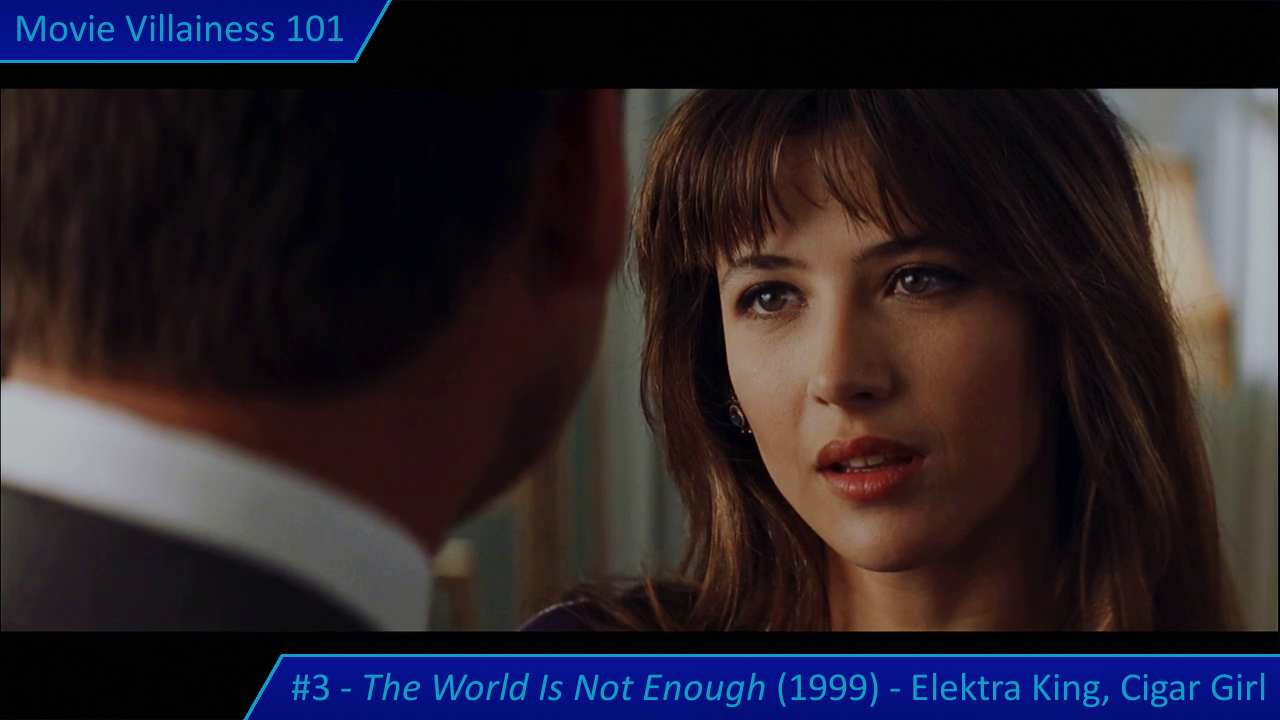
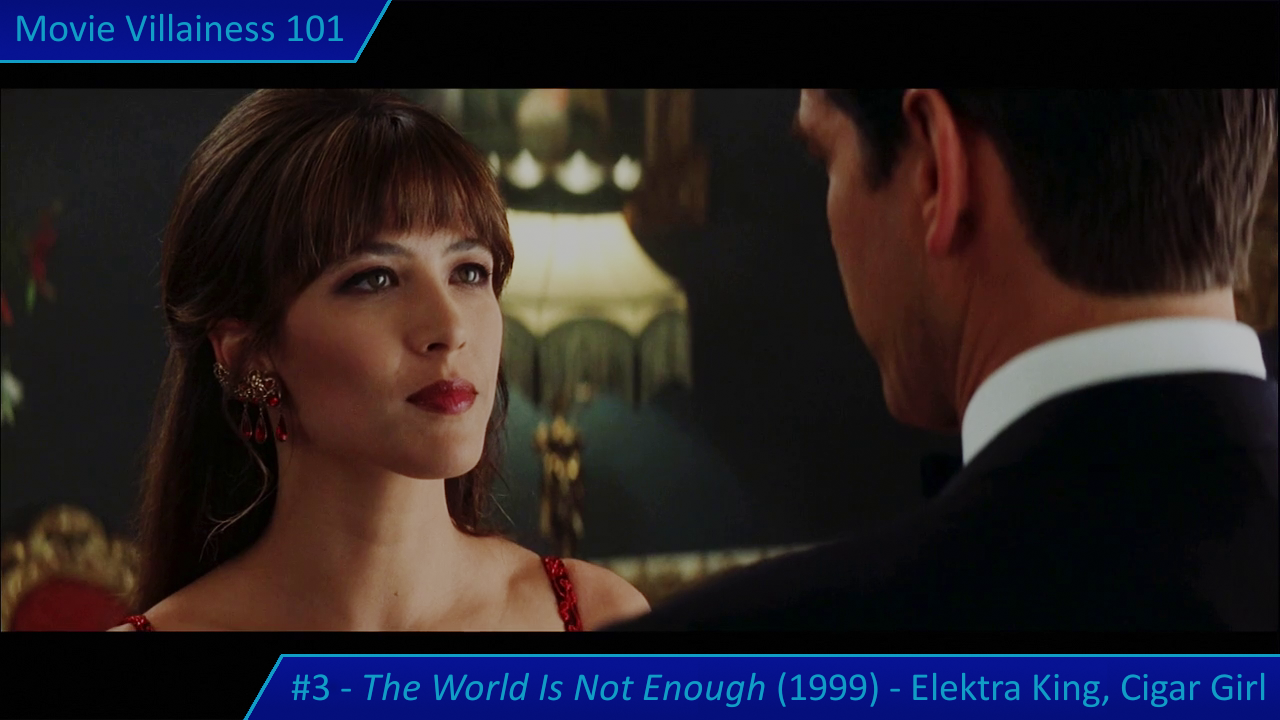
Straight after the title song, Elektra attends her father’s funeral. The first half of the movie sets her up as a traditional Bond girl whom the hero must protect. The main villain is implied to be Renard (Robert Carlyle), an anarchist who previously kidnapped Elektra and now appears to be targeting her again. King’s daughter has taken over his oil company and oversees a pipeline construction in Azerbaijan. Not the safest part of the world, and after Elektra and Bond are attacked by para-hawks while skiing in the mountains, the two become dangerously close.

Surprisingly, Bond doesn’t make love, and instead shows genuine concern when Elektra invites him to her luxurious Baku residence. There are plenty of dodgy-looking males around, including a tough henchman and the head of security, so no shortage of insider suspects. It turns out they are all working with Renard, but the mystery element works well. As a villain before the more serious Craig films, there’s a gimmick, in this case a bullet lodged in Renard’s brain which suppresses pain.

Determined to identify his attackers, Bond visits Valentin at a Russian mob casino. Everyone present, from the high rollers to the attractive female employees, is armed. Elektra shows up and acts recklessly, losing a million dollars on a high-card draw game. The first sign this woman may not be as innocent as she pretends, but Bond still beds her. That moral compunction didn’t last long, eh?

Bond’s investigation leads him to the pipeline construction site where the treacherous head of security learns the British spy has a licence to kill. A long plane ride later, Bond discovers a plot to steal a nuclear bomb from a missile silo. This is where we meet Christmas Jones, an improbable scientist who becomes an unlikely ally once Renard’s men open fire. She’s the reliable, non-screaming Bond girl who’s happy to help, even if bullets and explosions are not a usual day at the office.

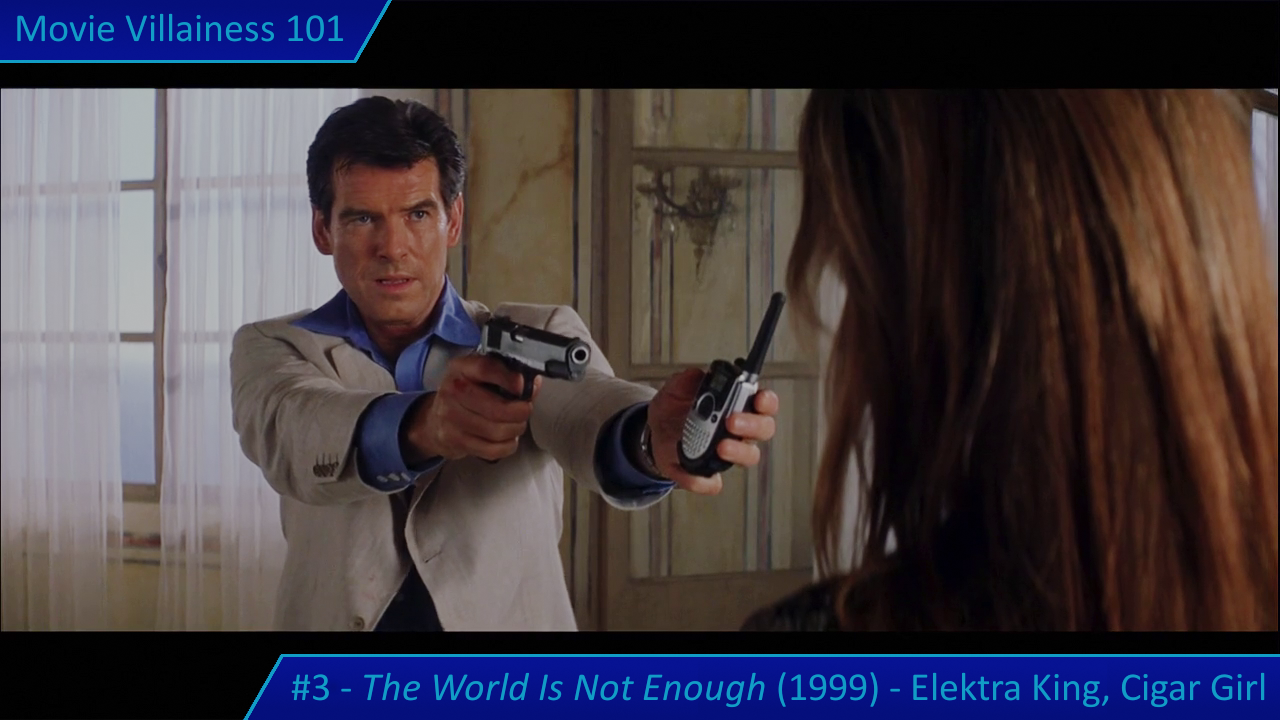
Despite Bond’s efforts, Renard escapes, and it’s revealed he plans to detonate a nuclear device in Elektra’s pipeline. With a second woman involved, it’s inevitable (in this era) that one girl will be bad. When Bond and Christmas discover only half the plutonium core is in the bomb, 007 makes a calculated choice to let the device explode. Believing her nemesis to be dead, Elektra reveals her true intent to M – present at the villainess’ request – by having the MI6 bodyguards killed. And we finally have a female main villain to celebrate.

Now we know Elektra is behind her father’s murder, it’s time to reveal the endgame. Bond questions Valentin and learns that the villainess and Renard have purchased an old nuclear submarine. Their plan: to create a meltdown, destroy Istanbul, and contaminate the surrounding sea. And Elektra’s pipeline will become the only viable oil supply in the region.

With so much wealth and power, no wonder this woman has a hold over Renard. The two have a sinister sex scene where she runs ice over her body and clearly enjoys inflicting psychological torture. Meanwhile, M is locked in a cell in Maiden’s Tower, but broadcasts a signal using a missile locator card (which Bond gave her earlier) and a clock battery.

After an amusing scene where the heroes interrogate Valentin as he drowns in caviar, a gold-toothed henchman sells them out. Time for physical torture, and the villainess uses an antique chair and neck restraint to secure Bond. Perfect for strangling a man during a villainous motive rant, and an opportunity to drop the title, which is Bond’s family motto. The sadistic Elektra rapes Bond while he’s at her mercy and is enjoying her triumph until Valentin crashes the party.

If Bond was expecting a rescue, he shouldn’t have been so optimistic. Elektra shoots Valentin, and the Russian mobster – despite having a gun in his cane – targets a wrist restraint instead of the female villain. Perhaps a reference to their history, as the Russian acknowledges Bond in his dying moment. That’s enough for the hero to escape and chase Elektra up Maiden’s Tower.

Disappointingly, she’s not the last villain to die, as there’s a lengthy sequence where Bond stops Renard melting down the submarine reactor. And then it’s the usual scenario of rescuing the Bond girl, who actually proves useful, and an old-style ending with a poor joke and M surprised by her top agent’s womanising.

Before the anticlimactic finale, Bond faces off with Elektra. She gets one of the best villain deaths: taunting the spy as he pursues her, before boasting he can’t kill a woman in cold blood. Turns out Bond has no problems with cold-blooded murder with evil women, though he shows regret afterward.

Honourable Mention / Discussions: Daniel Craig Bond Movies

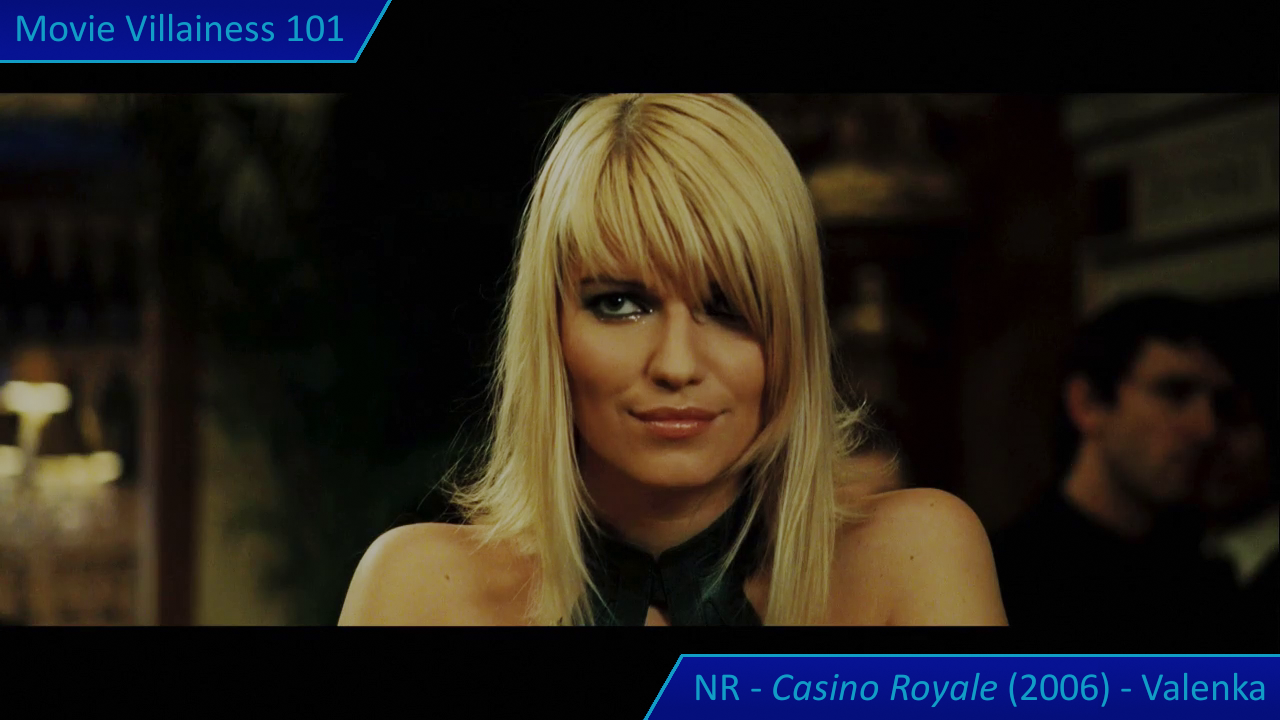
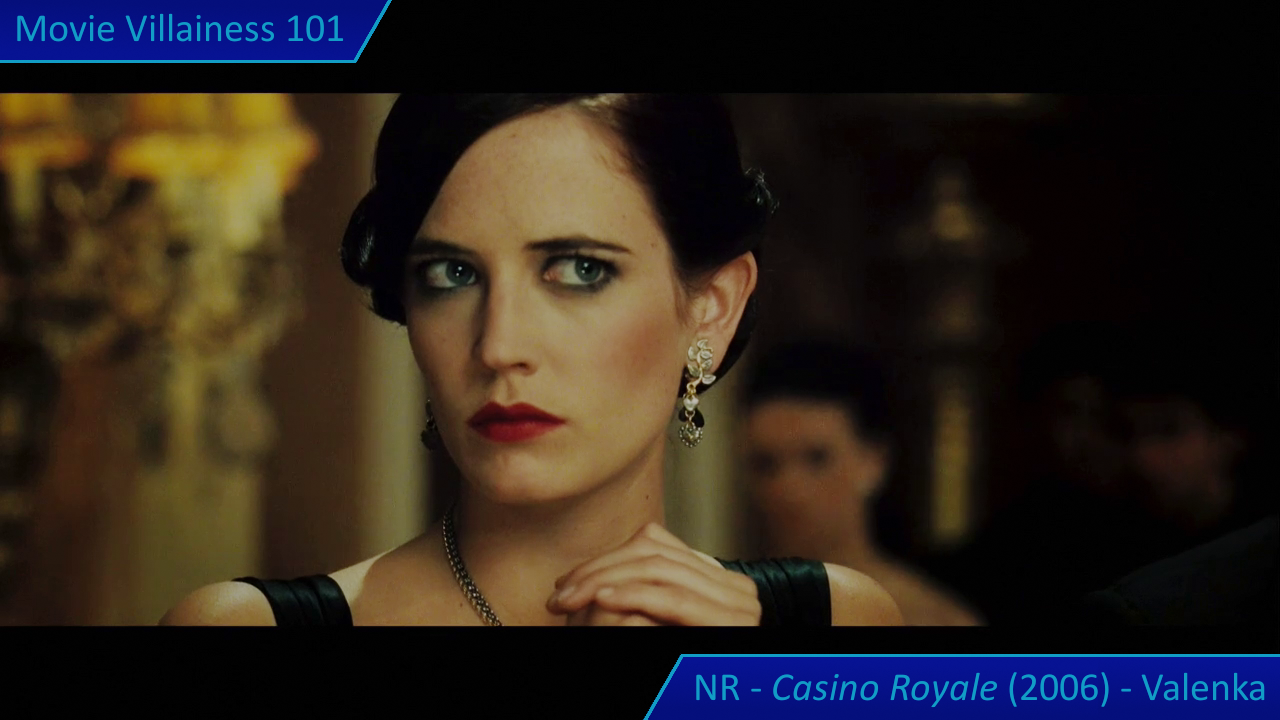
Casino Royale (2006) – Valenka (Ivana Miličević)

The sole honourable mention for this review goes to a mostly silent, sexy henchwoman who looks the part but doesn’t do much. And that faint praise sums up the lack of female villains in the Daniel Craig era.

The second Martin Campbell-directed reboot (after GoldenEye) is an origin story with a black and white prologue and a reckless 007. A long way from Connery’s suave secret agent. A back to basics approach, but there are action scenes aplenty, notably a free-run sequence across a construction site. The bad guy is Le Chiffre, a banker funding terrorists whom Bond must outwit in a high-stakes poker game at the titular Casino Royale. Judi Dench remains M, but with no Moneypenny or Q, Bond relies on actual spy work and resilience to complete his mission.

The main female character is Vesper Lynd, a treasury agent with the usual pun introduction, who later becomes a genuine love interest. Eva Green delivers a standout performance in the franchise, with real chemistry between her and Craig’s 007. Bond’s weakness for women makes him blind, and he doesn’t know Vesper is working with the shadowy organisation behind Le Chiffre. It’s eventually revealed that he had her boyfriend kidnapped to coerce her, so she’s a tragic character and not a true villain. But her death in the Venice finale is the most downbeat outcome since On Her Majesty’s Secret Service.

As for Valenka, she gets a sexy introduction and is present for Le Chiffre’s business dealings. Despite being attacked by a machete-wielding thug, she remains loyal and isn’t too bothered by violence when she’s not the target. Her best moment is poisoning Bond’s drink at Casino Royale, but she vanishes near the end. A scream implies Valenka is killed when Le Chiffre’s employers decide he’s no longer valuable. Get used to disappointment with this Bond – it only gets worse from here.

Quantum of Solace (2008)

The story is hard to follow in this weak outing, and the jump-cut action sequences are more likely to induce headaches than thrill. Add unnecessary, arty title cards whenever events shift to a new location, poor direction during exposition scenes, and a truly pathetic henchman, and the result is dire. A woman named Strawberry Fields (yes, really) gets coated in oil for her death scene as homage to the superior Goldfinger. Painful stuff.

Olga Kurylenko is Camille, a former Bolivian agent who allies with Bond. She handles herself well in the action scenes, notably a parachute escape from a crashing plane. Pity her vendetta is even less interesting than Bond’s quest to avenge Vesper. The climax in a desert hotel is messy, and the only plus point is brevity. Clocking in at 106 minutes, Quantum is the shortest Bond movie to date.

Skyfall (2012)

Craig’s third movie breaks with tradition by not giving us a true Bond girl. Judi Dench is M for the last time, with a more prominent role in the story and a great sendoff. Naomie Harris’ MI6 operative does more harm than good. More importantly, her name is Eve Moneypenny, an entirely different origin for the world’s most famous secretary. Q makes a comeback in the guise of a young boffin, though gadgets are limited to a palm reader, gun and radio.

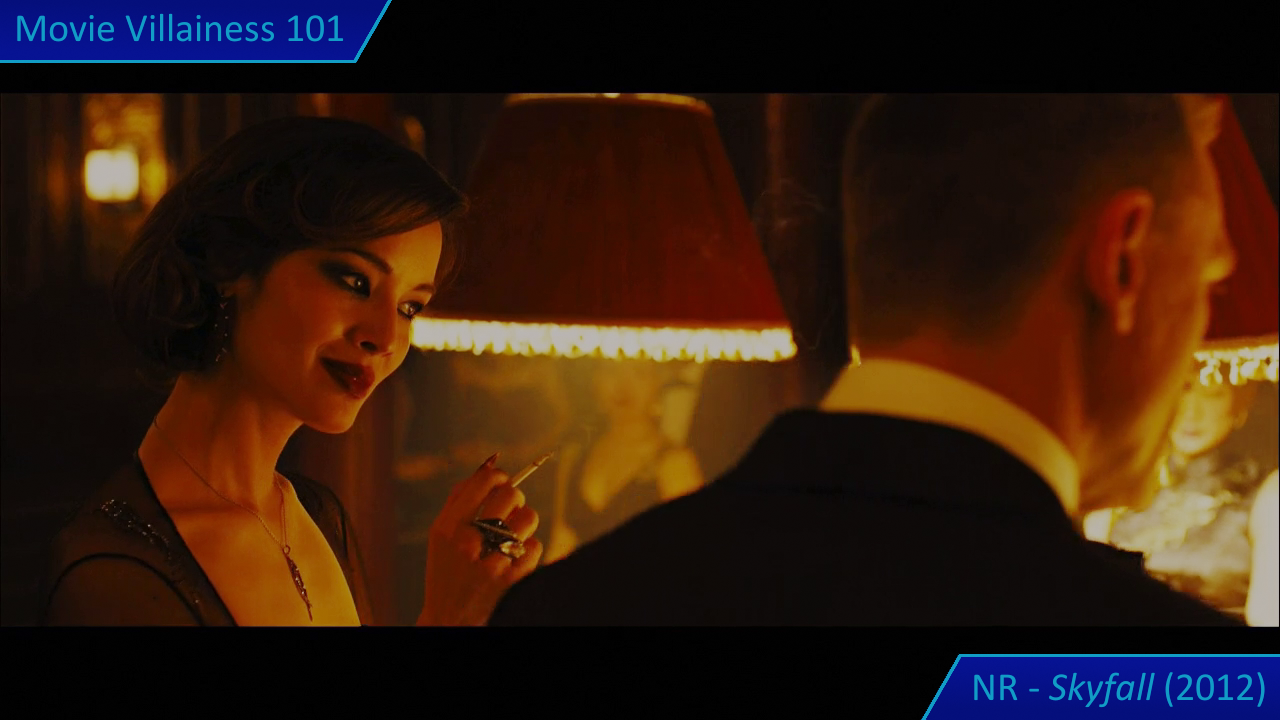
The closest fit to the traditional female role is Sévérine (Bérénice Lim Marlohe), a former sex slave who is now a trophy girl and accomplice to the main villain Silva (Javier Bardem). He’s a former agent out for revenge against M, and the story is mainly set in the UK. Sévérine looks beautiful, matching the exotic locations of Shanghai and Macau. But like many ill-fated women in 007 movies, she romances the British spy before the villain disposes of her in theatrical fashion.

Skyfall is one of the better Bonds overall, perhaps because it doesn’t follow the established formula. The terrorist attacks on the London Underground and parliamentary hearing are well staged. The grand finale is a MacGyver-style final confrontation in Scotland as Bond dusts off a familiar Aston Martin. However, female antagonists are notably absent.

Spectre (2015)

The return of Ernst Stavro Blofeld (Christoph Waltz) and his evil organisation promised much, but delivered little. Mexico City during the Day of the Dead is a spectacular backdrop for an action-packed opening sequence, a helicopter stunt, and thousands of extras. Unfortunately, that’s the sole highlight. A shadowy Spectre conference, a car chase through Rome, and a train fight with a tough henchman should be exciting. They are not.

No female villains (again), and the leading lady Madeleine Swann (Léa Seydoux) has no chemistry with 007. Monica Bellucci appears – briefly – as the suicidal widow of a Spectre agent Bond killed in the teaser. He saves her life and seduces her for information, which ends with the most uncomfortable fling in the series.
Best not to mention the unnecessary twist about Bond’s guardian being Blofeld’s father, revealed in a painful exposition scene.

Add a tedious plot about intelligence control, a flat finale in the ruined MI6 building, and the hostage girlfriend ploy, and there’s little to get excited about. Need to cure insomnia? Spectre is the solution.

No Time to Die (2021)

The producers remembered what the series is about: thrilling action and sensational women. Despite a family subplot and a weak villain scheme that bogs down the last act, it’s a fitting sendoff for Craig. In this one, nobody is safe. Major characters, including the dependable CIA ally Felix Leiter and Blofeld, are killed off, foreshadowing the controversial end when Bond dies in a missile strike. The rulebook has been well and truly torn up.

The longest pre-credits sequence to date begins with a flashback to Madeleine as a child before we shift to the present and Spectre agents come after Bond in Italy. A dejected Bond retires from MI6, and an agent named Nomi (Lashana Lynch) becomes the replacement 007. On a rogue CIA mission to recover a traitor scientist, Bond receives help from Paloma (Ana de Armas), a rookie operative who is surprisingly proficient. The best action woman in Craig’s tenure only appears for ten minutes, but Paloma isn’t a disappointment.

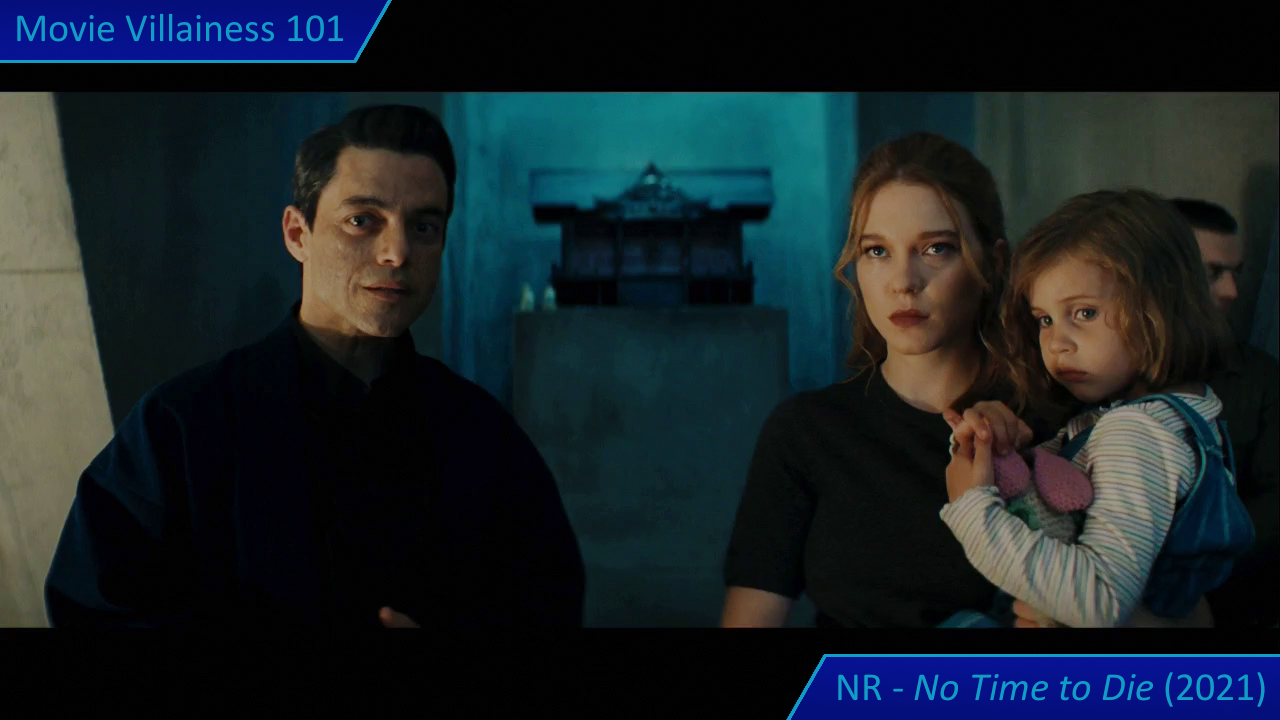
Nomi gets some badass moments too, but is overshadowed by Bond. Madeleine shoots some bad guys during a chase in Norway, but the story is about saving her – and Bond’s – child Mathilde. Safin (Rami Malek) is a decent enough foe, but is defeated too easily. Three major female characters, and no villainess. Let’s hope the next Bond actor gets to face some bad girls.

Movie Villainess 101 Rank #4

Murphy’s law doesn’t apply – nearly everything went right with this villainess

Movie

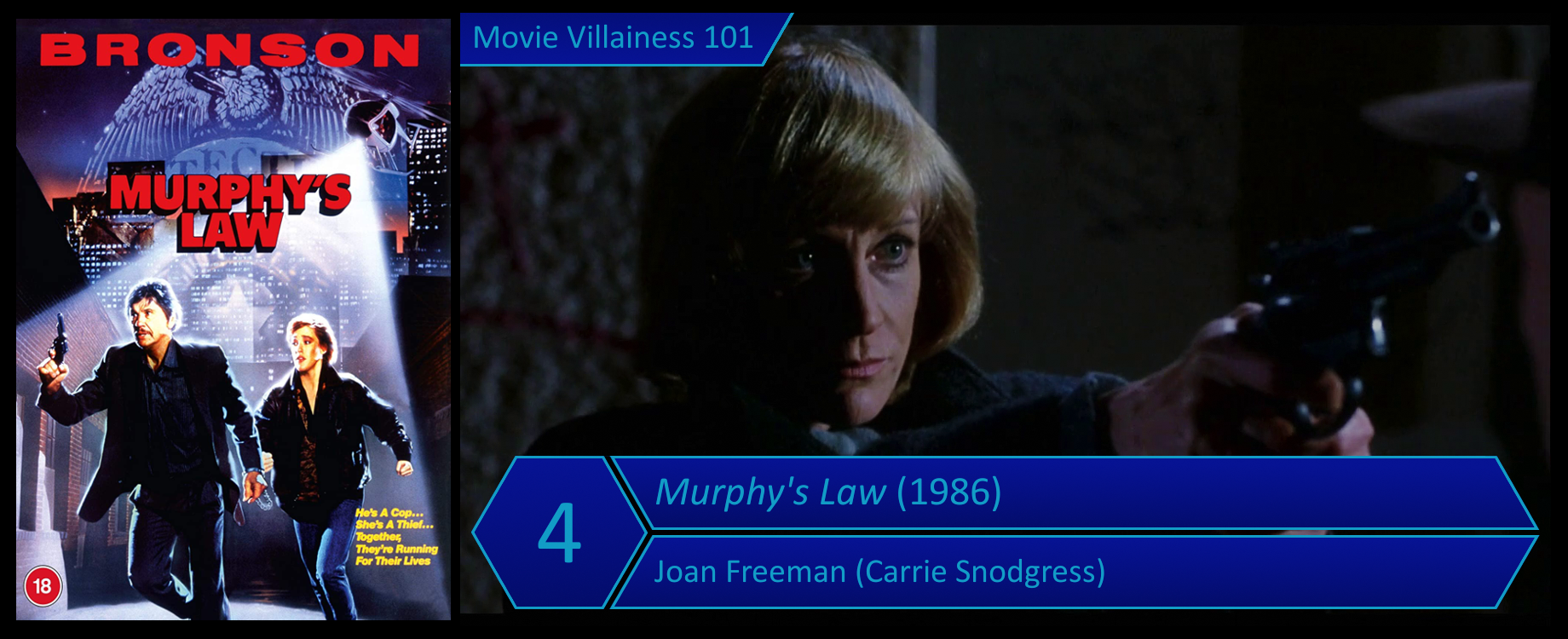
Murphy’s Law (1986)

Charles Bronson movies are typical gusto hero stuff, but this offering adds an excellent psycho villainess to ramp up the enjoyment factor. Tough cop Jack Murphy prefers to shoot bad guys instead of reasoning with them, but meets his match when a recently paroled killer sets him up for murder. There are many lesser goons to deal with, ranging from a mafia boss to a rural gang operation. These mini-battles usually end messily with gunfire, dead bodies, and explosions. Fortunately, Snodgress’ kill scenes are so excellent that the distractions don’t dilute her contribution.

Kathleen Wilhoite makes her feature debut as Arabella McGee, a punk with a loud mouth and a creative vocabulary. Every other word she utters is an insult, which adds humour amidst the violence. Arabella makes the mistake of stealing Murphy’s car during the title credits, but he soon catches up to her after some wild driving and a spectacular crash. The female thief is much better at kneeing a guy in the balls and escaping. Murphy is better prepared for a later encounter in a women’s restroom, leading to a tirade of expletives as he restrains her.

What else is happening in Los Angeles? A mob boss’ brother becomes a murder suspect after physical evidence is found at the crime scene, but refuses to go quietly. Confronted at an airport, the bad guy takes a hostage and kills her once she becomes a burden. Enough justification for Murphy to shoot him dead. With the mafia boss out for blood and a separated wife filing for divorce, it’s no wonder Murphy is a depressed alcoholic.

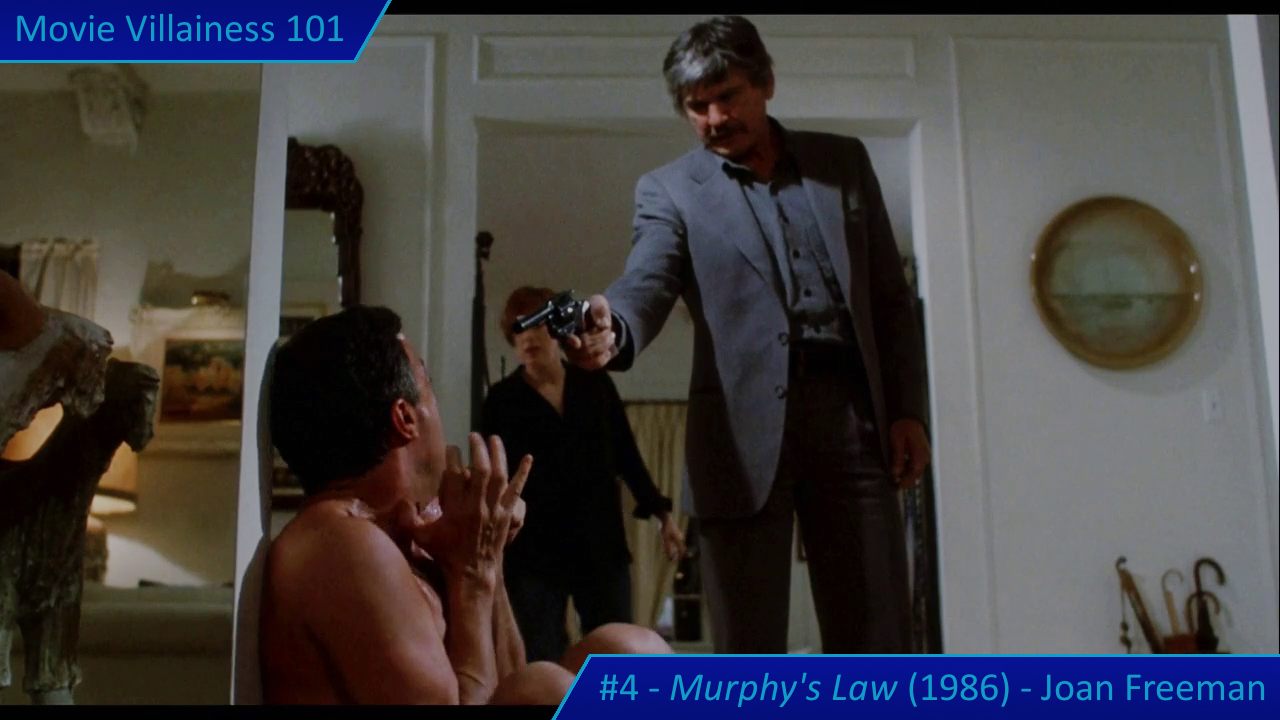
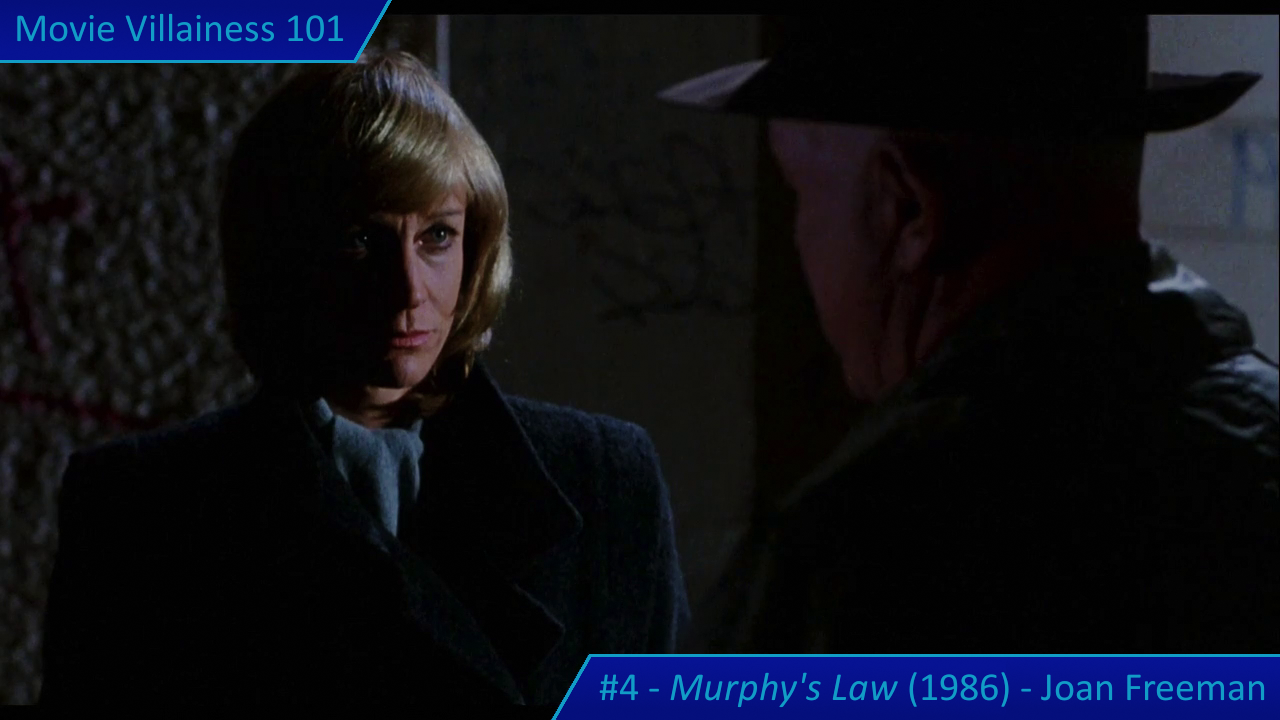
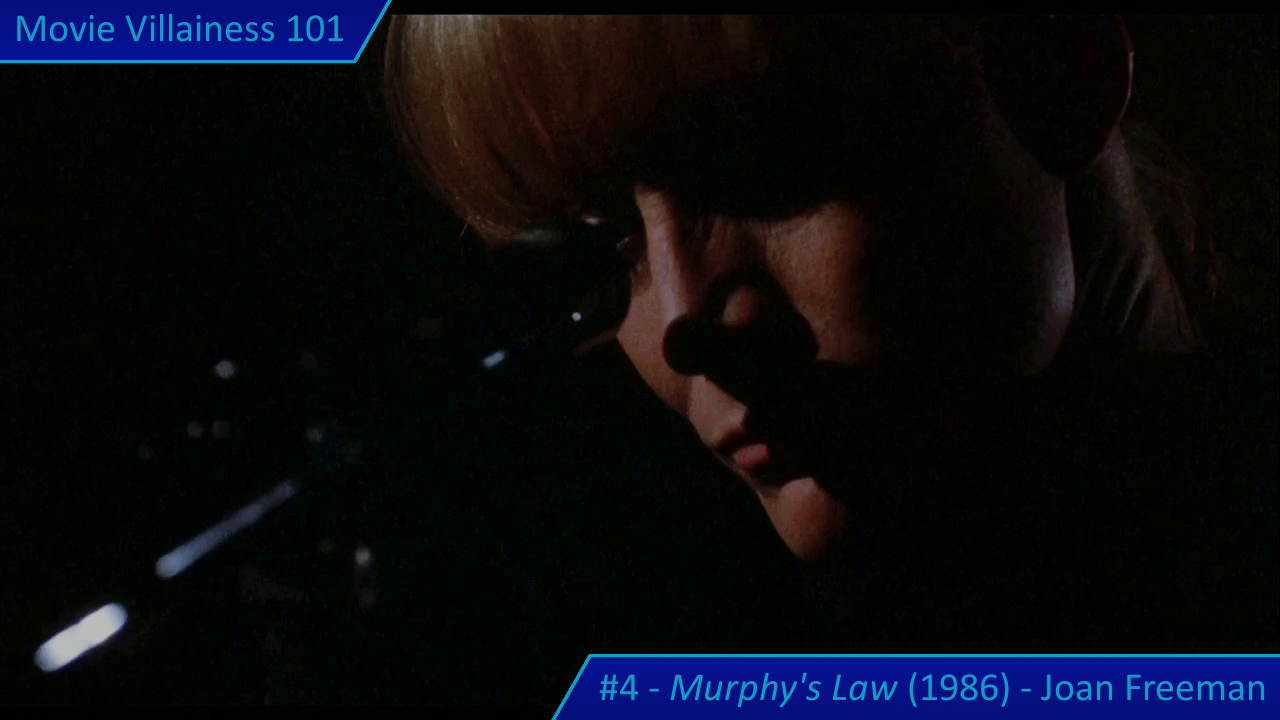
Things are about to get even worse when Joan Freeman arrives in town. The paroled murderess meets with a private investigator to get information on her targets: various men in the police force and legal system who put her away. Joan shows how psychotic she is when the PI negotiates for more money. Perhaps he shouldn’t have followed her from the public park to a secluded underpass. The villainess points a gun at the man, demands he open his mouth wide, and blows his brains out. Face covered in blood, Joan is a terrifying killer about to screw with Jack Murphy’s life.

Villainess

Joan Freeman (Carrie Snodgress)

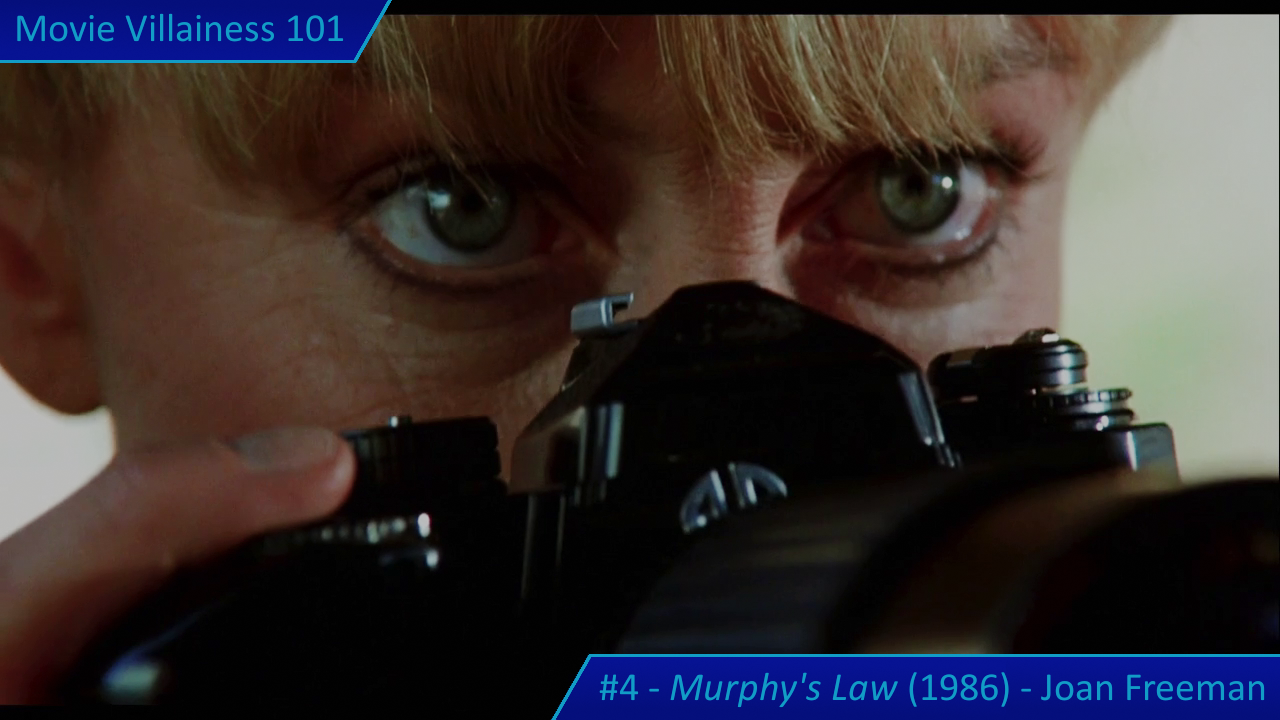
Murphy’s spouse is a strip club dancer, an excuse for gratuitous nudity before Murphy tries to smooth things over. The cop follows the wife to watch her romance another guy, but Joan is also watching and plotting her next move. Late one night, she knocks out Murphy in his car and uses his weapon to blow away the couple while the hero sleeps it off. The framed cop is puzzled about how he got home, but finds out soon enough when his colleagues show up to arrest him.

Murphy curses his luck when he’s locked in a cell with Arabella, but doesn’t endure her insults for long. He stages a fight and makes a run for it… with the handcuffed loudmouth in tow. Murphy reaches the police station roof and makes a dramatic helicopter escape. Unfortunately, the chopper is low on fuel, forcing him to crash into a drug farm. Just a few more punks to deal with, then.

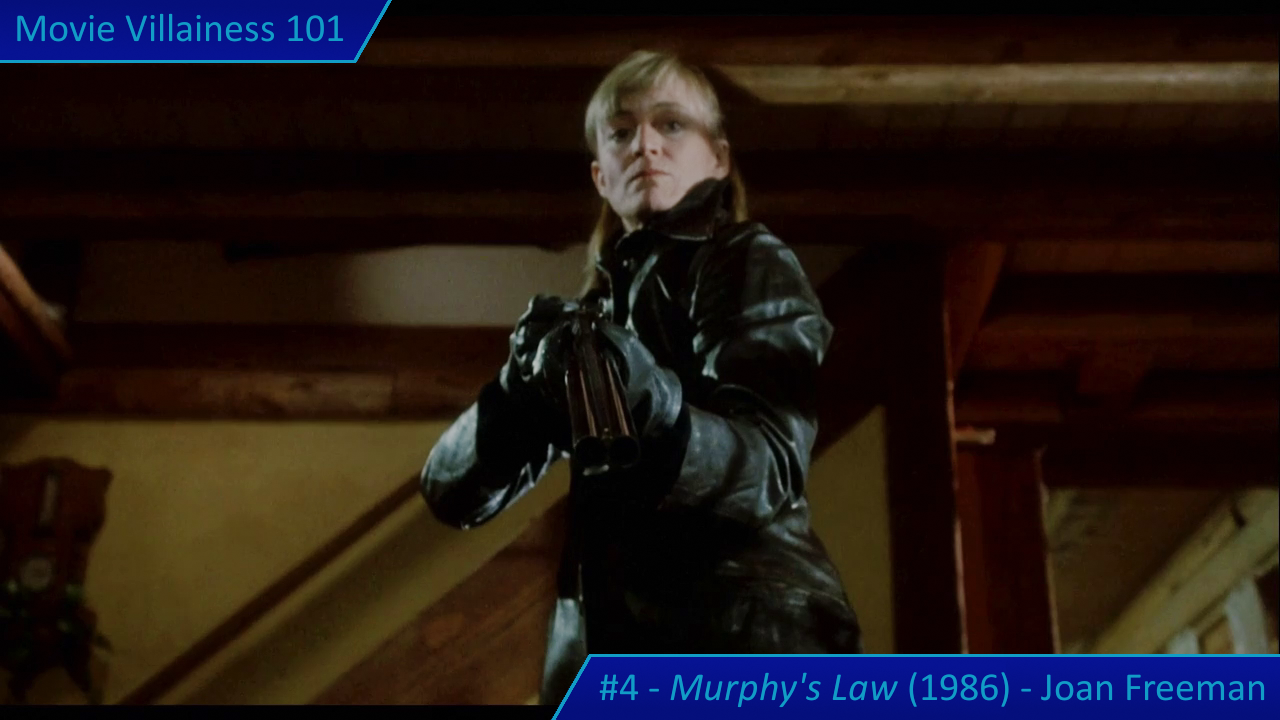
Murphy is injured during the gun battle but makes it to a remote cabin where a crippled ex-cop offers to help. Arabella is in way over her head and not happy about it, and the old man offers the hero some friendly advice. They seem to like each other, but any savvy viewer knows that spells certain doom, especially since Joan has the friend in her personal scrapbook of targets. After Murphy leaves with Arabella, the leather-clad Joan pays the cripple a visit. She takes one of his many shotguns, knocks him to the ground, and says nothing as she pulls the trigger.

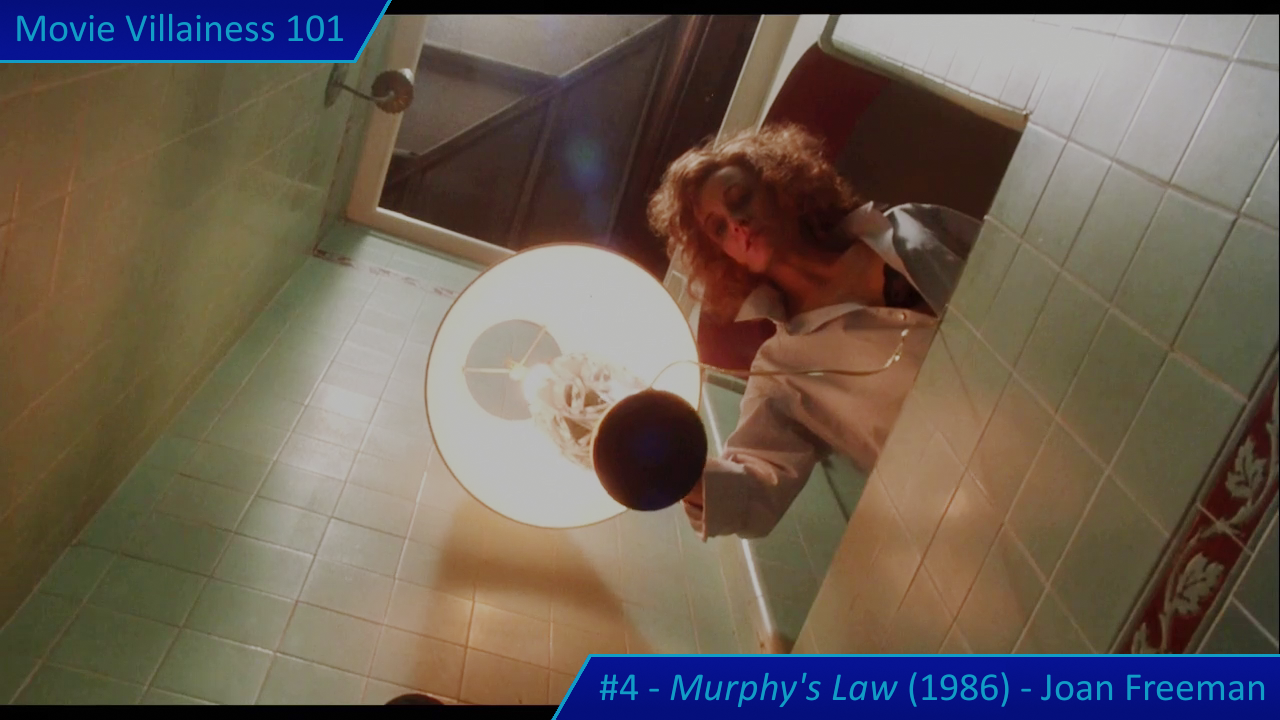
Joan’s next target is a prominent judge, so the villainess puts on a redhead wig, dolls herself up, and acts the seductress in a restaurant. After the other customers leave, the judge flirts with Joan, despite feeling her face looks familiar. He should have trusted his instincts because the insane woman reveals her evil side and drowns the man in a bathtub. Easy to make it appear like an accident when there’s a lamp on a balcony above to drop into the water.

Murphy suspects the mob boss is behind the murders, so he and Arabella trick their way into a private suite. The hero confronts the man – a scared wreck without his henchmen – and demands he confess at gunpoint. Eventually, the hero realises the boss is innocent (of these killings, at least) and asks a police contact to research other leads. That’s when Murphy learns who his true enemy is.

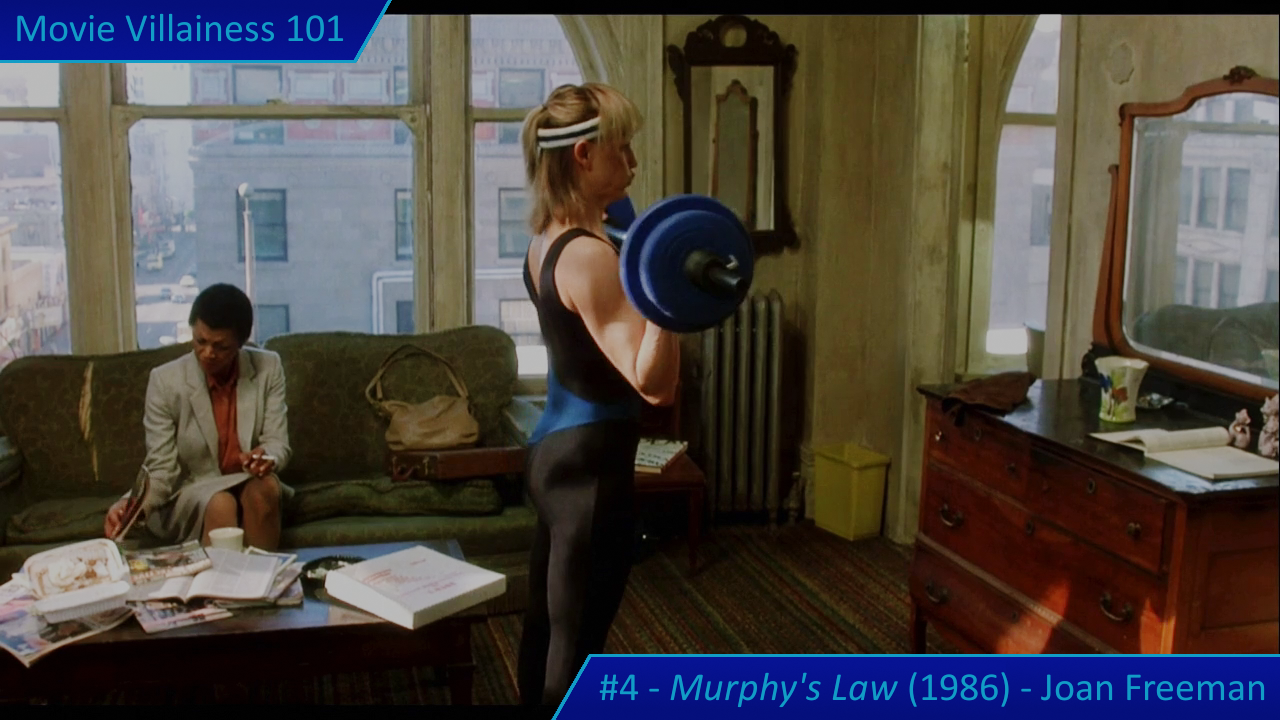
Joan’s next victim is her psychiatrist, who’s too inquisitive for her own good. The psycho strangles her with a power cable after pumping weights. Murphy and Arabella arrive too late, but find Joan’s scrapbook, which leads them to a remote property. Too bad the occupant is already dead, suffocated with a plastic bag. The murderess surprises Arabella and sedates her with chloroform, then leaves a message in lipstick to set up the denouement.

That showdown takes place in the Bradbury Building, which makes a great location with its winding dark staircase and antique elevator. Joan gags and restrains Arabella, and has a loaded crossbow with many bolts to fire in Murphy’s direction. The mafia interrupts proceedings, and the psycho is happy to hide and eliminate the gangsters while Murphy has a shootout with them. After taking out the boss’ henchmen through a combination of heroism and luck, the rogue cop confronts and finishes the boss with a one-liner.

It’s Murphy against Joan, with the hero dodging bolts as the murderess proves an expert markswoman. Disarmed by the villainess’ sharpshooting, Murphy races downstairs to save Arabella from being crushed under the descending elevator. Joan shoots the woman (non-fatally) to lure Murphy back upstairs. Out of bolts, the lunatic grabs a fire axe and attacks, slicing Murphy’s chest.

With the villainess off balance, Murphy takes advantage and knocks her over a railing. She clings in desperation to the axe (trapped in the rails) and pleas for her life. Murphy isn’t a man for noble actions, so he watches Joan lose her grip and retorts to her “Go to hell” comment with the catchy “Ladies first”.

Movie Villainess 101 Rank #5

The exception is this leather-clad villainess surpassing all expectations

Movie

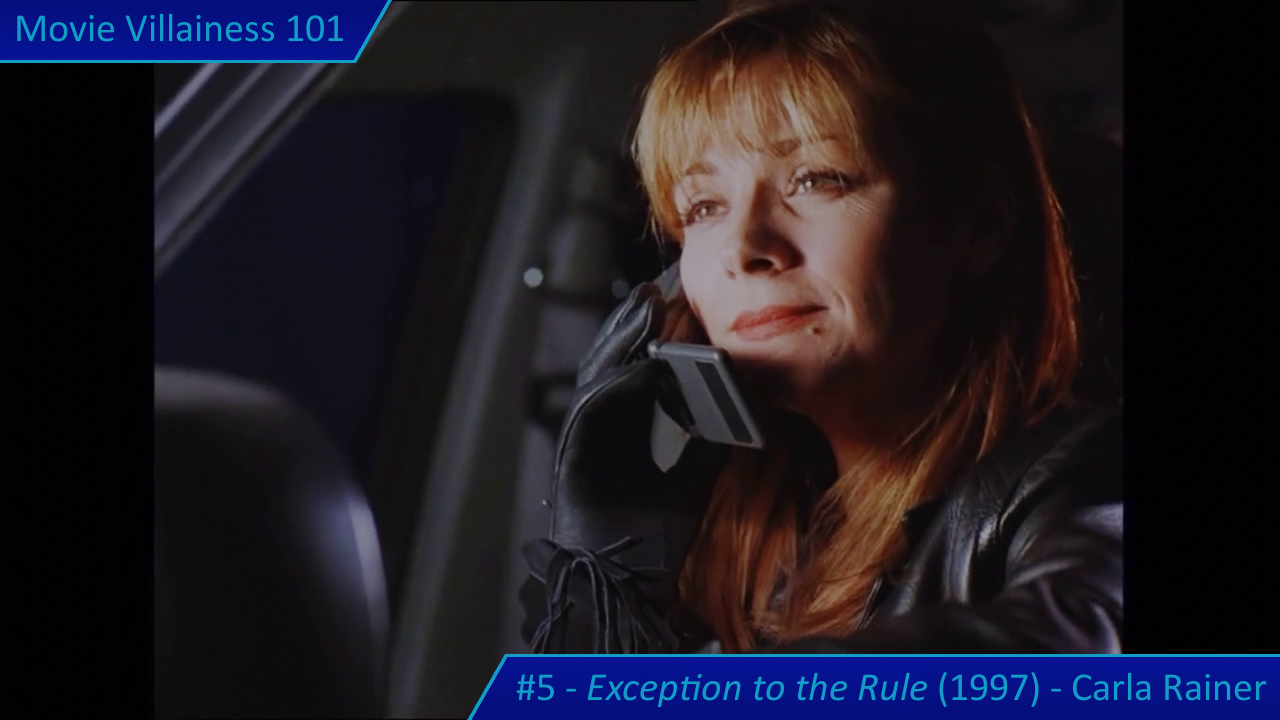
Exception to the Rule (1997)

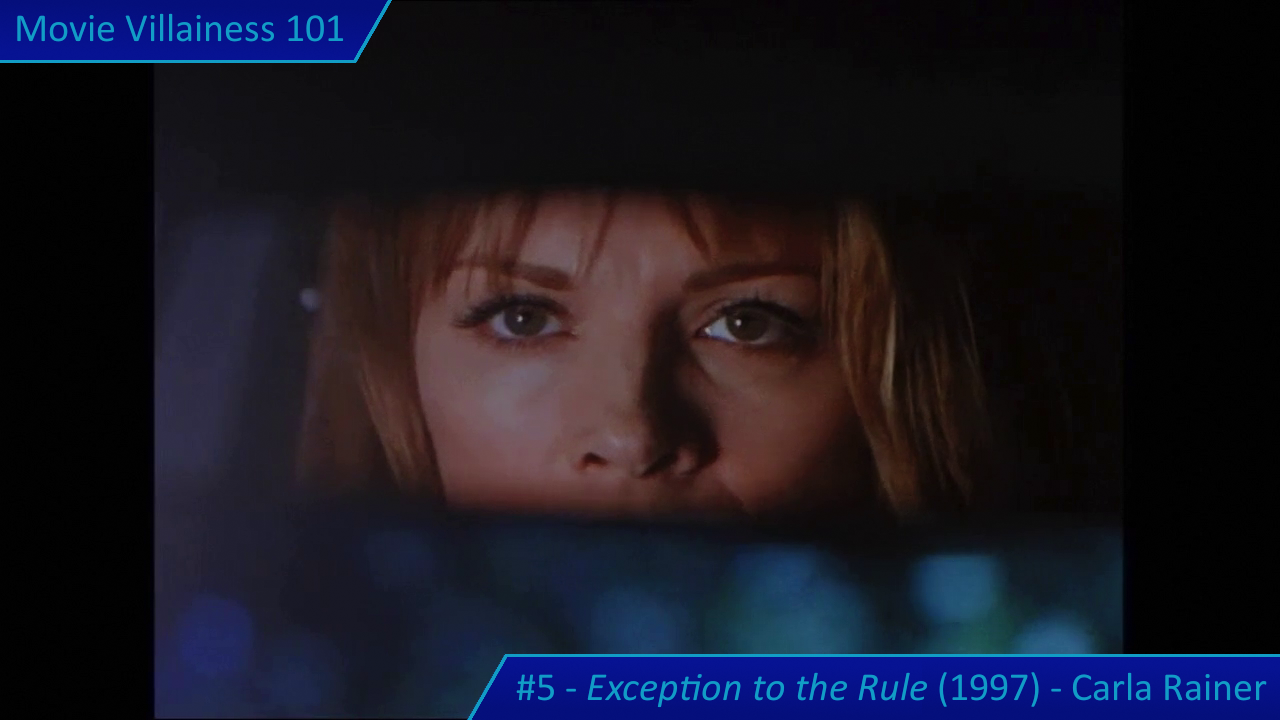
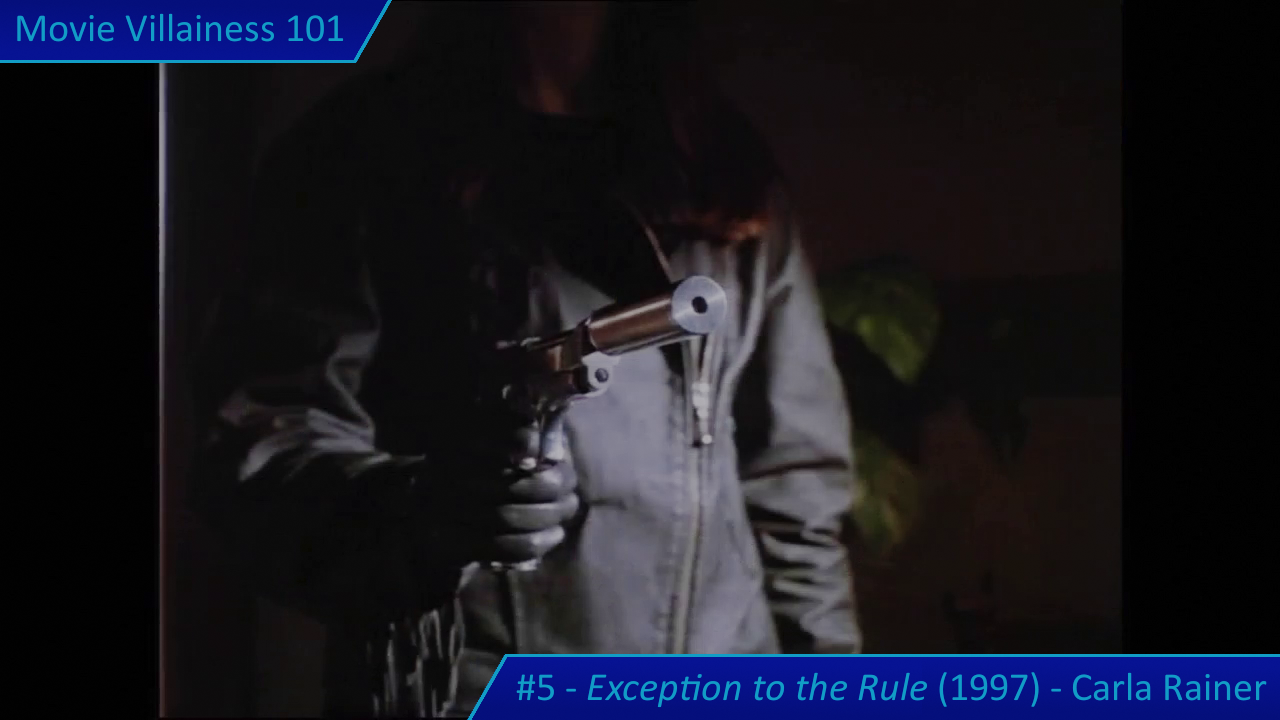
The title and one-line plot synopsis – a man blackmailed over diamonds – promise little. But show any villainess fan the opening scene, where a woman in black leather bumps off a South African diamond trader, and the excitement should build. For once, the events that follow don’t disappoint, and this movie is an easy selection for the goddess tier.

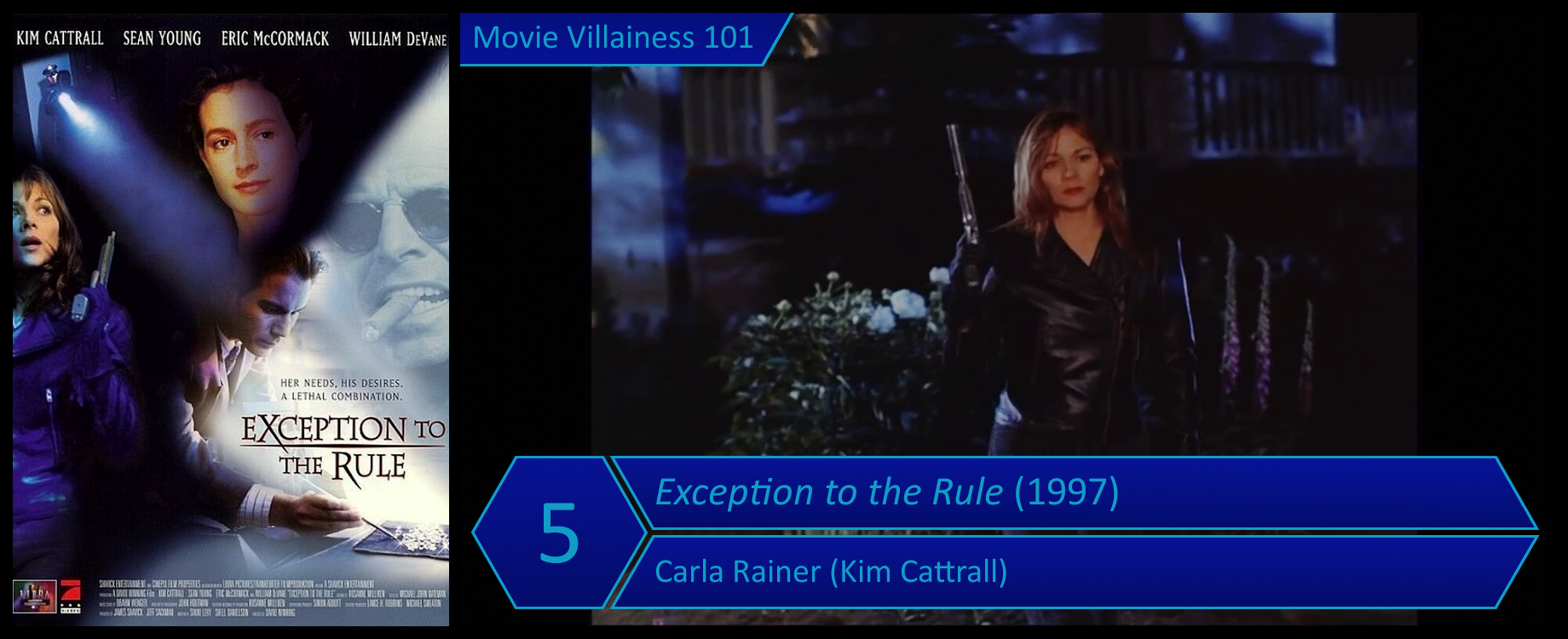
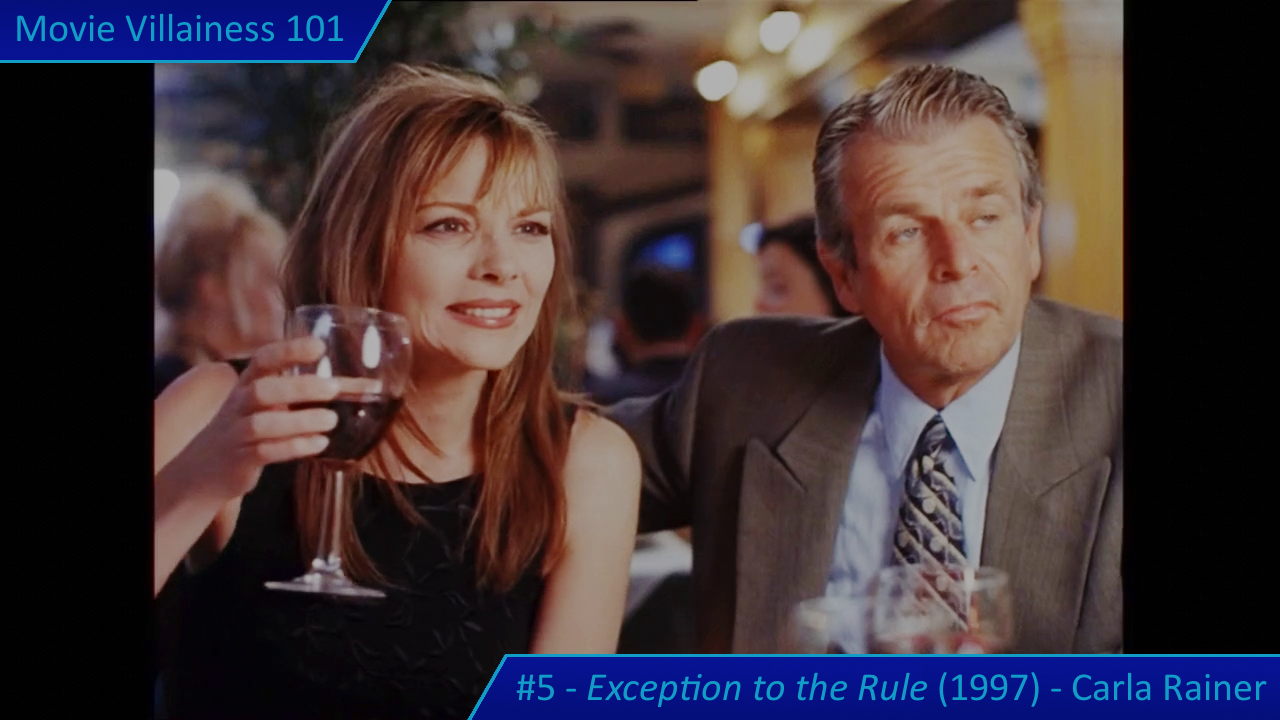
The killer’s face is not shown, but the long blonde hair and voice are a giveaway. Carla features prominently on the poster and is played by Kim Cattrall, so no prizes for guessing who the antagonist is. The villainess shoots the trader above the heart to paralyse him, then moves closer for a headshot execution. A killing style that establishes Carla as someone who likes her victims to suffer in their last moments.

Carla doesn’t get the diamonds, as the victim passed them on just before she arrived. So now it’s time to devise a new plan, which involves Tim Bayer (Eric McCormack). He’s an American who’s unhappily married to the pregnant Angela (Sean Young). The woman is also the daughter of Tim’s boss and firm owner Larry Kellerman (William Devane), which is sure to cause friction. Tim has marriage counselling from psychiatrist Dr Beeson and support from his friend Ron Lansing, but neither man is trustworthy.

Carla works her way into Tim’s life by pulling the broken-down vehicle trick, which convinces the good Samaritan to offer the beautiful woman a ride home. Soon after that, she poses naked in her apartment, though we only see rear shots of a body double. Still, the seduction tricks are effective, and Carla visits Tim at the office to tempt him further.

The broker is sent to San Francisco to close a deal with the shady Mr Ferguson, whose next visitor is a black-gloved assassin with a syringe full of snake venom. Her screaming victim takes a fatal plunge from a skyscraper, then Carla “accidentally” encounters Tim in a bookstore. The villainess seduces her mark, leading to wine sipping and passionate sex. Once again there’s a body double, though we see Carla’s face this time around. Getting involved with a femme fatale will only end badly, Tim.

Villainess

Carla Rainer (Kim Cattrall)

Shortly after Tim returns home and spends time with Angela, he receives a videotape of his one-night stand. Carla set up a camera, and when Tim revisits the apartment, it’s the usual story of the blackmailer using a false address. Dr Beeson isn’t much help, so Tim hires Burt Ramsey, a loan shark who moonlights as a private detective. Ron is in debt to Burt – who sends two goons round as an unfriendly reminder – and the gambling problems are a hint that the best friend can’t be trusted.

Time for Carla to up the ante, so she shows up unannounced during an evening out to join Tim, Larry, and Angela. This leads to an awkward conversation where the others don’t know the woman posing as Susan Bradshaw has evil intent. This is all designed to make Tim nervous, and to increase the pressure even more, Carla goes with Angela to the women’s restroom. There, the villainess shows off a heart and snake tattoo on her thigh, and tells Angela that her lover has the other half.

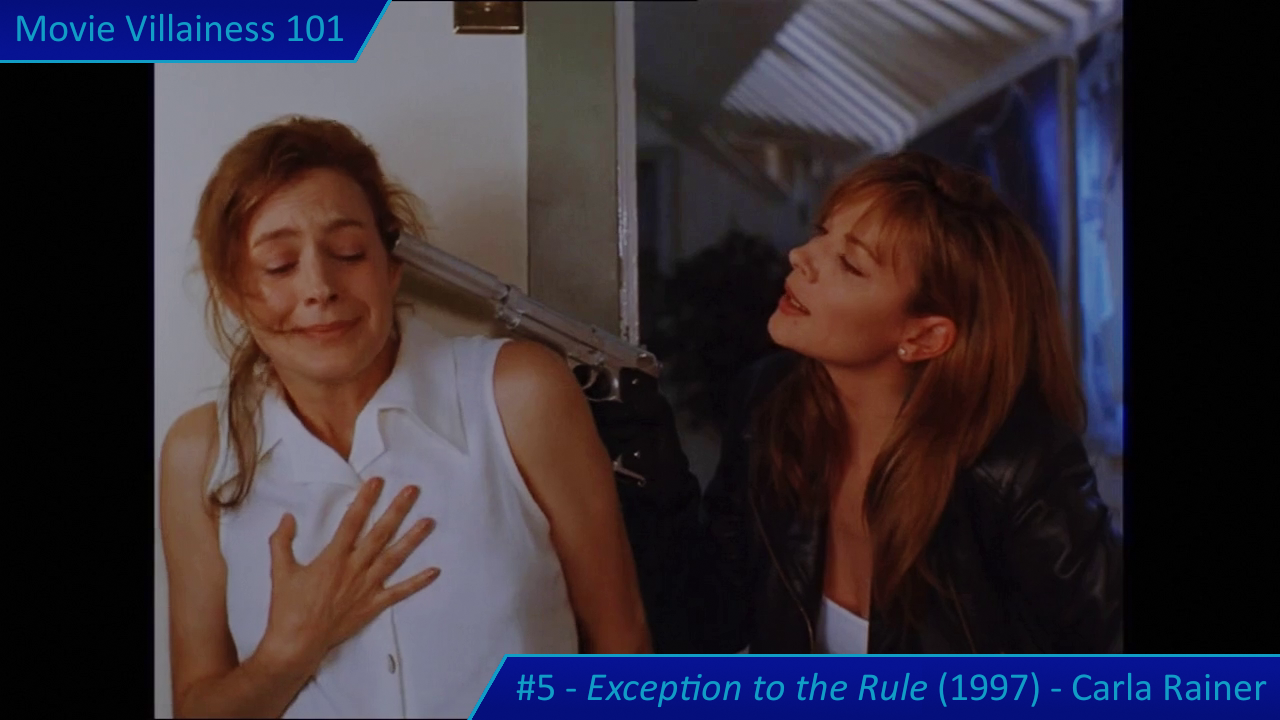
With Tim on edge, Carla meets him at a remote location to make her demands, looking sinister in black leather and dark glasses. She wants Tim to bring her the shipment of diamonds that she’s failed to steal so far and uses the videotape and threats of violence as leverage. Carla fondles Tim’s groin just because she can, while Burt watches from a distance. The villainess spots her tail quickly, and there’s a rather short car chase before she loses him.

Not too happy with Tim hiring a PI, the leather-clad Carla confronts him in a parking garage. They trade threats before the killer warns Tim that she “does the fucking”. A line intended to have a double meaning. Angela is unaware of what’s going on and attends a gallery event with her husband. She works on metal sculptures in her private workshop, and her latest effort is Blind Justice, a statue of a woman with raised hands pressed together. The sculpture appears in several scenes, so it will become important later.

Carla decides the nosy Burt has become a problem, so drives to a cliff edge and exits her car. Being rather stupid – and not considering that the suspect is dressed in black – he joins Carla and questions her while drinking booze. The deranged woman gives an obviously fake story about being in love with Tim, then injects Burt with sea snake venom. While he’s paralysed, the villainess pours alcohol over him, sets his vehicle on fire, and watches with smiling glee as he’s knocked over the cliff by the flaming car. A brilliant death scene, and Carla enjoyed every second.

A detective named Garcia shows up at Tim’s office to question him about Burt’s death. Tim provides a false reason for hiring the PI, but the cop doesn’t buy it. After a run-in with Garcia while visiting Burt’s nightclub, Carla raises the stakes by attempting to run Angela over in broad daylight. This leaves Tim’s wife very shaken, and he contemplates giving the psycho what she wants.

Tim appears to cave in to her demands and meets at yet another secluded spot. After Carla leaves with the diamonds, Tim follows her to a motel and learns she’s involved with Dr Beeson. It’s quickly revealed the stones are fake, so Tim contacted the police and Larry about the scheme and went there wired up. Carla looks like she might kill the doctor, but leaves him alive. A show of mercy? Or maybe she didn’t have her silenced pistol or syringe handy.

Beeson reconsiders and telephones Tim, but is cut off when a masked assailant barges into the hotel. The latest murder victim is a weak opponent, whom the mysterious male attacker drowns in a bathtub. Given the lack of suspects, it’s obvious who Carla’s accomplice is, but it takes several minutes for an official reveal during the finale at Angela’s house.

Tim has moved out, so his wife is alone and easy prey for the villainess. It’s already been established that Angela doesn’t like snakes, while Carla is fond of them. The killer even has a distinctive metal pattern on her gloves. Naturally, the villainess leaves a live snake in the bed as a nasty surprise and interrupts to issue demands when the terrified Angela calls Tim. At gunpoint, the resilient woman grabs a golf club while Carla taunts her and uses it to knock away the gun. Inexplicably, Carla can’t shoot accurately at a fleeing pregnant woman.

Ron, who shows up outside, advises Angela to hide. Once inside, it’s revealed (to no great surprise) that Ron is romantically involved with Carla and working with her. The accomplice roughs himself up to convince Angela he’s dealt with the villainess, but tearing open his shirt reveals the other tattoo half that tips his would-be victim off. After she locks herself in the workshop, Carla surmises Ron is expendable, rediscovers her pistol skills, and does her double-shot execution trick.

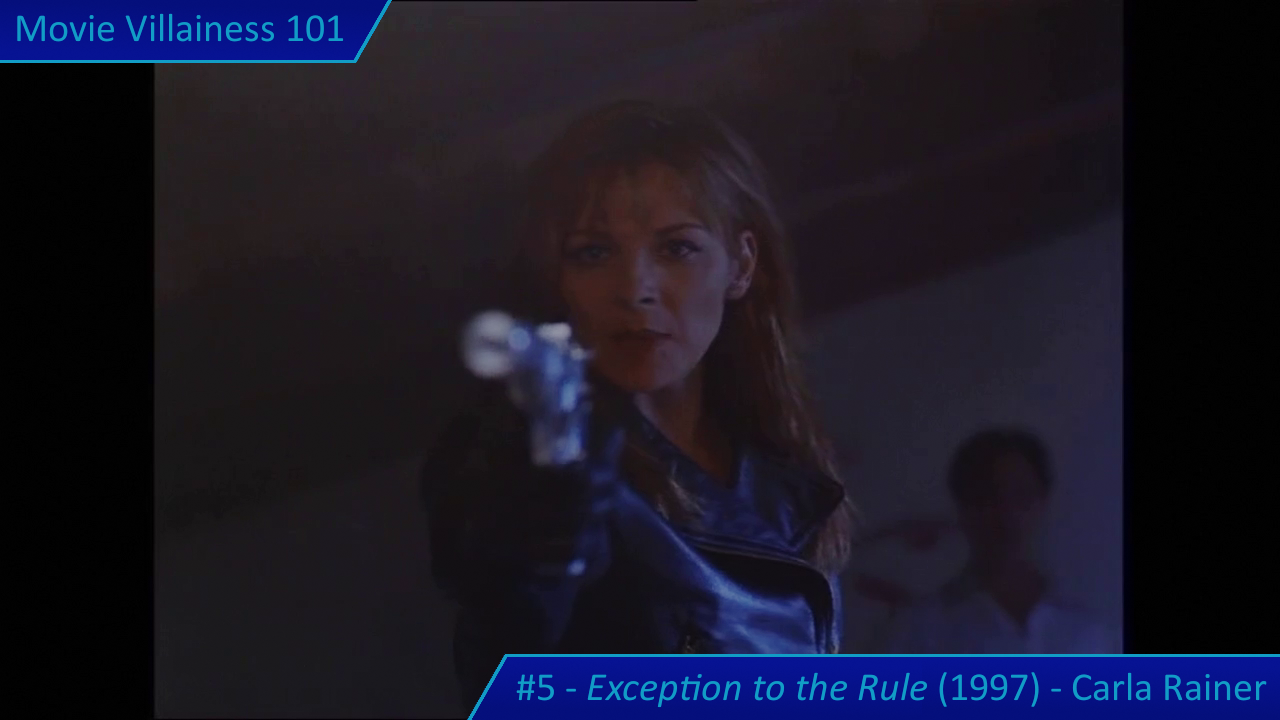
Angela takes cover in her workshop as the leather-clad villainess shoots her way in. Time for some obligatory taunts as she searches the building. It doesn’t take long to find Angela’s rather obvious hiding place. That’s when Tim arrives, leading to a brief scuffle that ends with Carla victorious. With Angela still recovering from a knockdown, the killer shoots Tim in the chest and lines up her trademark headshot. Then it’s the wife to the rescue with a blowtorch.

Angela keeps Carla at bay with the flaming weapon, but has spent too much time welding because the gas supply runs out. The smirking villainess senses victory, but Angela surprises her by using the torch as a makeshift club. The blow sends Carla crashing through a guardrail, and the conveniently placed sculpture interrupts her fall. That sharp hand is an effective spike that skewers the villainess, and while her fingers twitch, there’s no sudden resurrection.

Movie Villainess 101 Rank #6

Back when TV movies had high body counts, this prolific hitwoman racked up seven kills

Movie

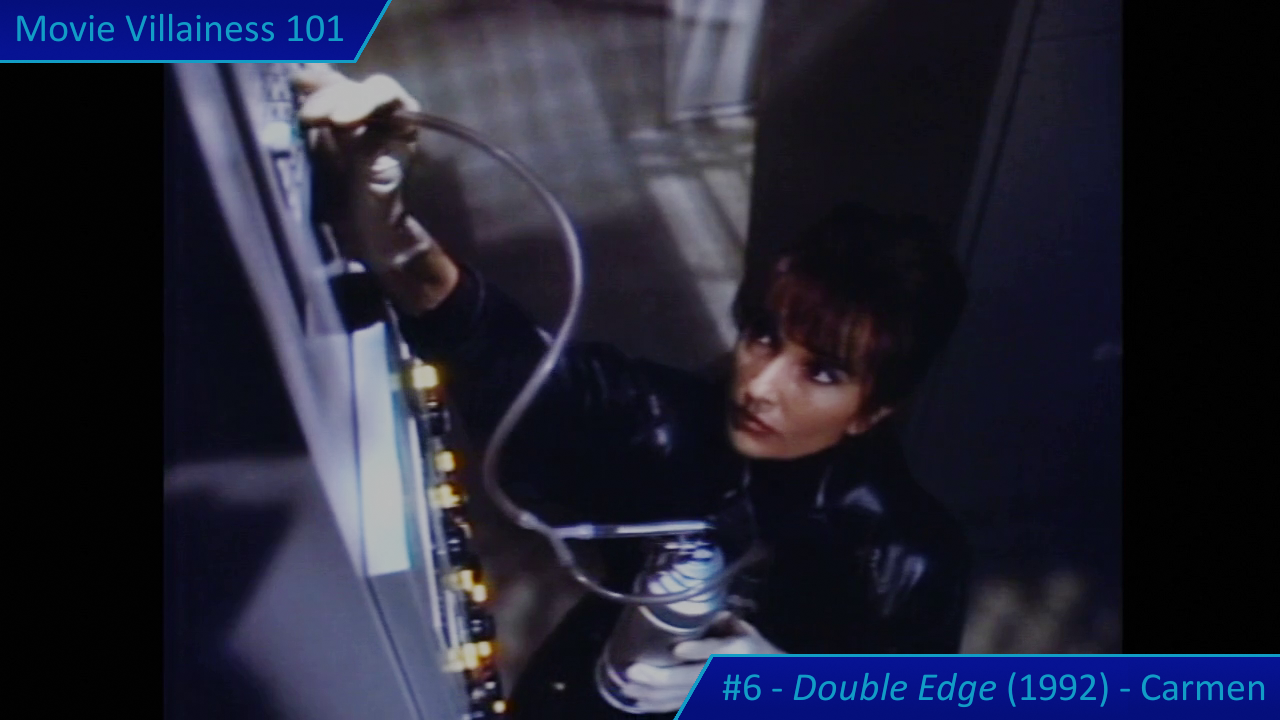
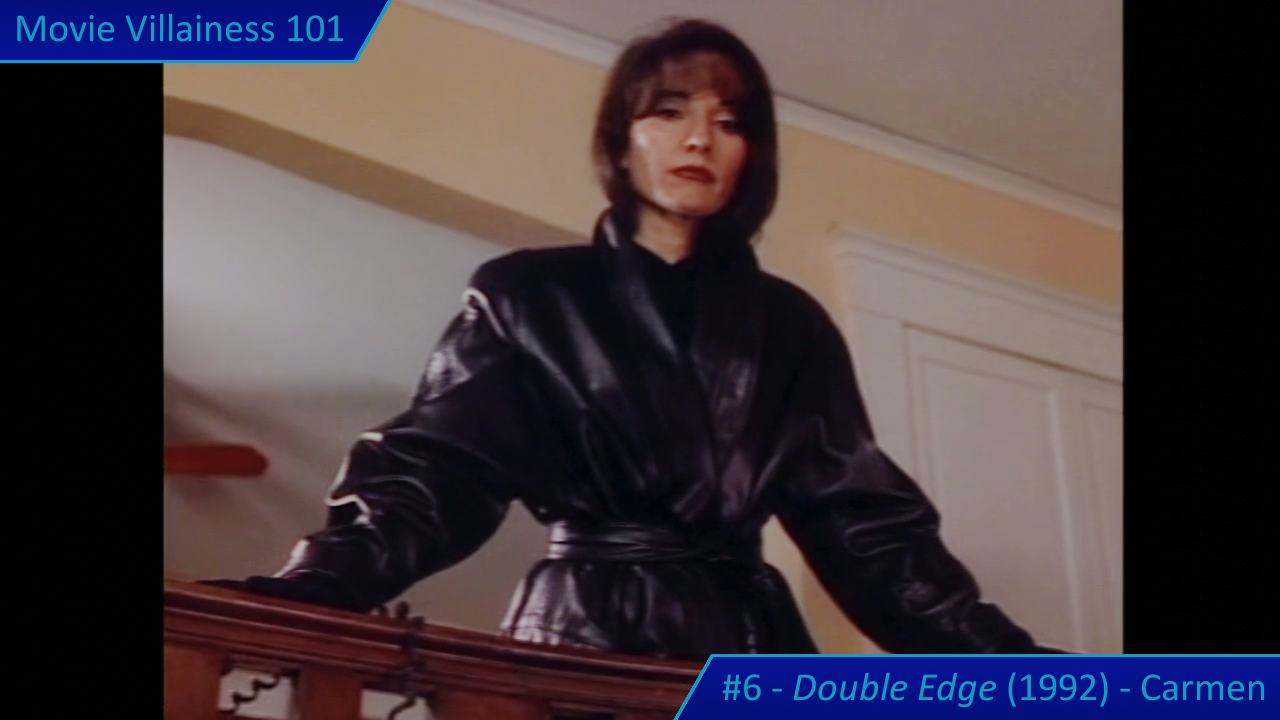
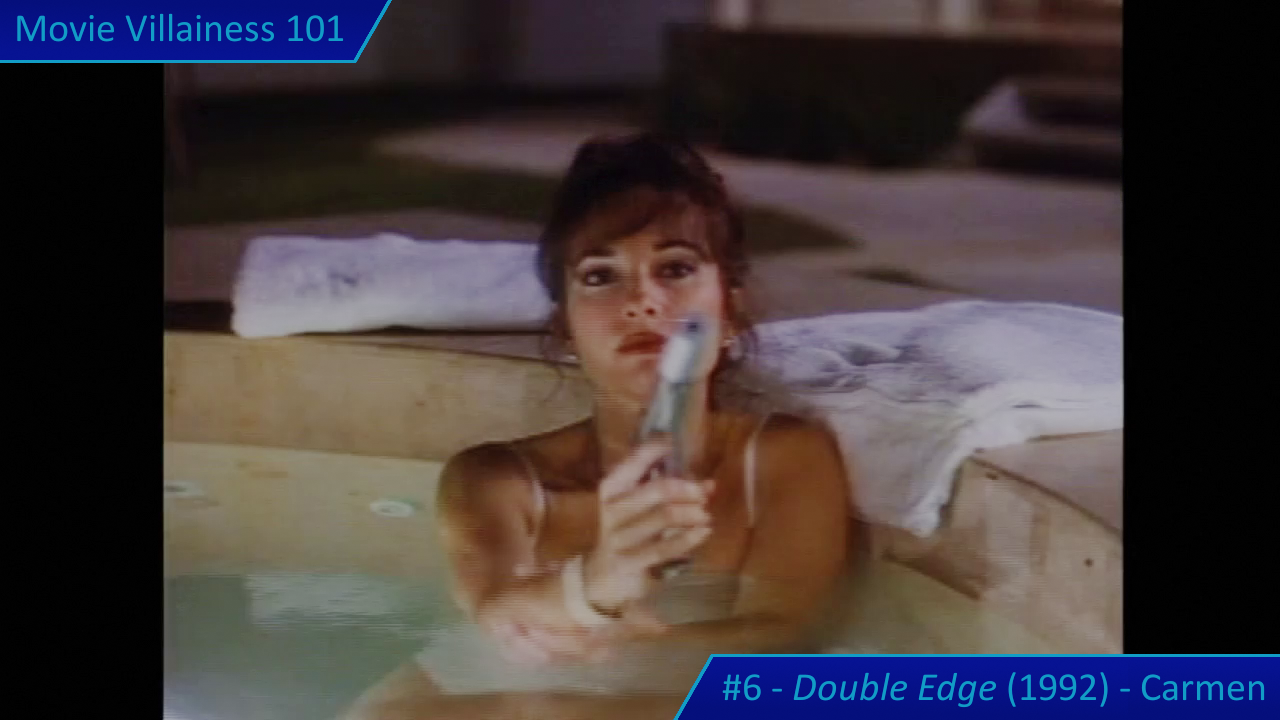
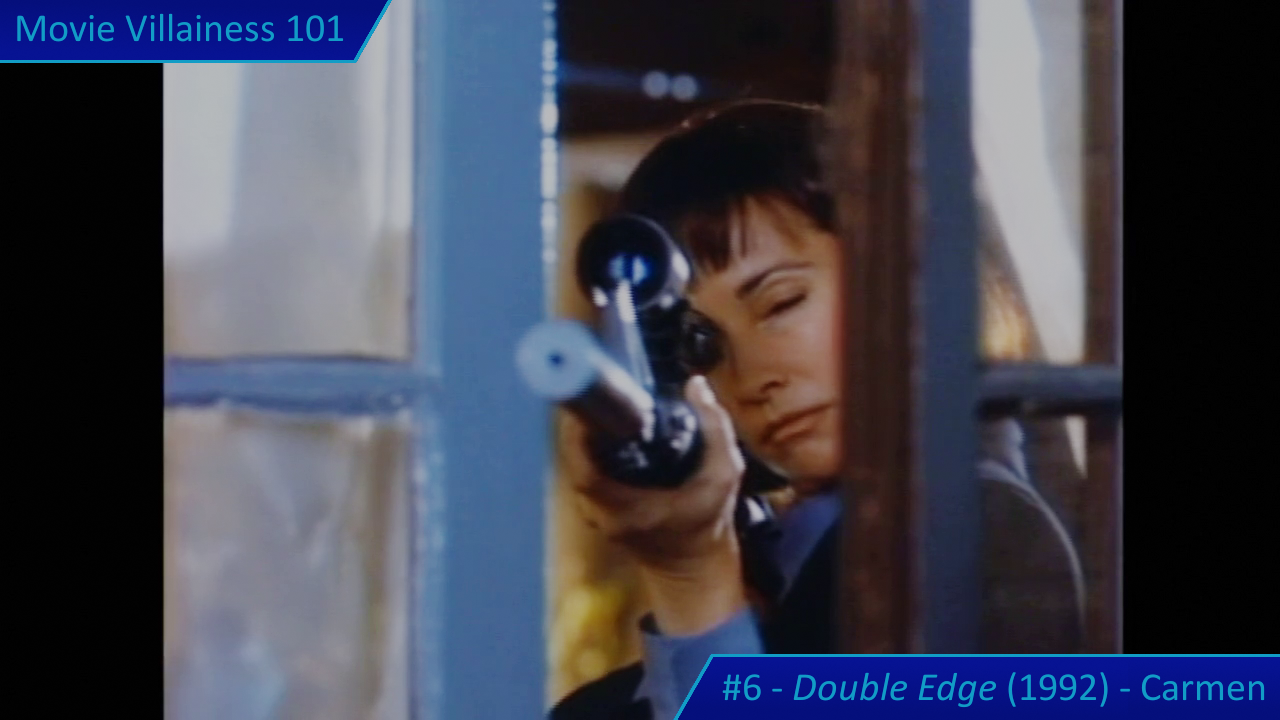
Double Edge (1992)

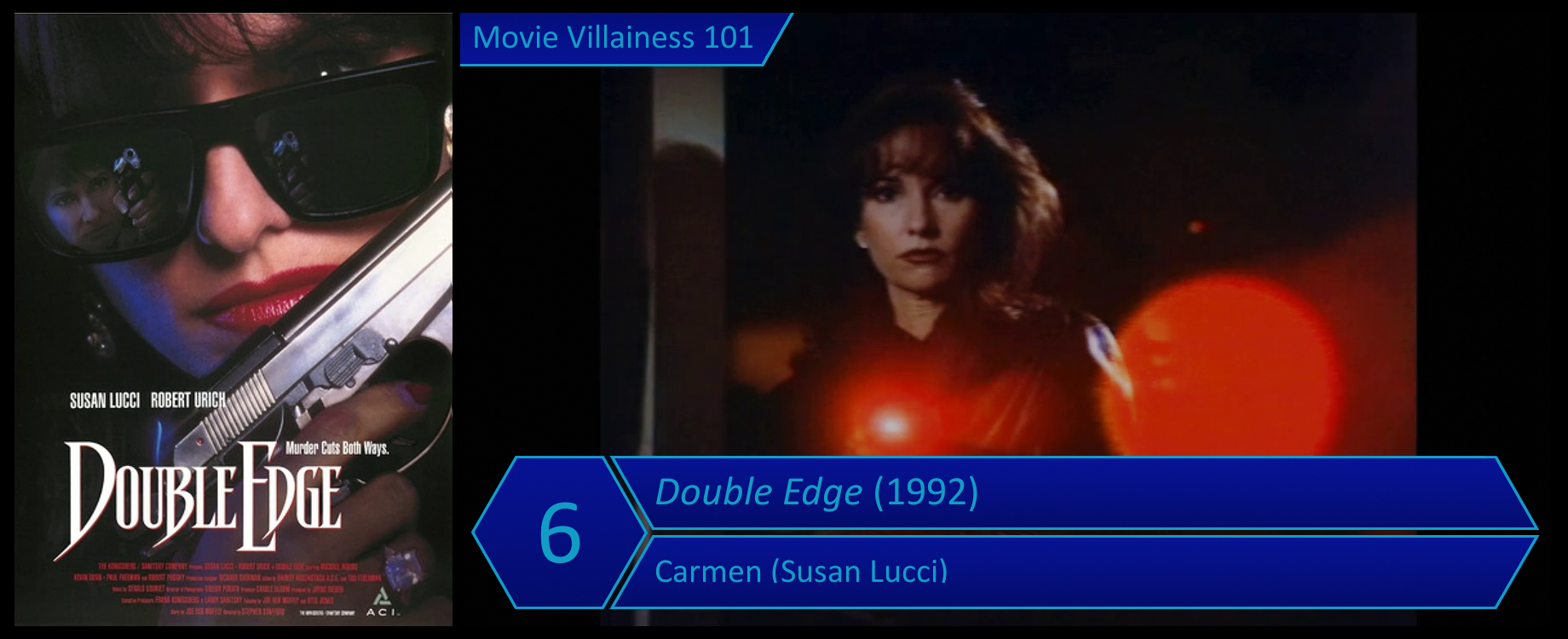
This female assassin thriller took the unusual step of casting Susan Lucci in a dual role as the villainess Carmen and FBI agent Maggie. She’s less effective as the heroine, but her ruthless and intelligent hitwoman is Goddess tier material. This movie doesn’t skimp on body count, with eight people dead – ranging from unnamed extras to lead roles – by the denouement.

After the introductory credits sequence shows Carmen and Maggie getting dressed for business, the two women meet in a hotel lobby. Maggie attends a function, but Carmen has a far more deadly purpose. The assassin uses her seductive charm to get close to Hector Barrado, a key witness in a trial. And then murders him with a needle weapon disguised as a hairpin. Carmen’s first on-screen kill occurs within five minutes, the opening move of a deadly cat-and-mouse contest.

Maggie – already researching the assassin – builds a profile and realises it’s the same woman she met at the hotel. Typical of this kind of film, the female agent has someone she doesn’t like for a partner. That would be her ex-husband Carter (Robert Urich), whom she blames for her child’s death. The relationship subplot is formulaic. Cold to begin with, their affection gradually warms, and most viewers will guess where this is going.

Carmen also has a lover: her assistant Paul, who stands in as a masseuse when not negotiating his boss’ contracts. True romance isn’t reciprocated, since she views him as a source of information and not an equal. The assassin’s latest contract is personal since she’s after the man who killed her father, but that doesn’t stop her demanding a higher fee.

Carmen disguises herself as maintenance staff and attempts to snipe her target from a van in an underground parking garage. That ends in failure when she’s disturbed, leading to frustration with Paul. Do you suspect he’ll become a loose end later? Meanwhile, Maggie hunts the elusive killer.

Villainess

Carmen (Susan Lucci)

Forced to up her game, Carmen builds a homemade jamming device that disperses iron filings. Just the thing to hook up to a ventilation system and blind a CCTV system. Dressed all in black leather with white surgical gloves, the assassin infiltrates the upper-floor offices while the guards are distracted. Then, she accesses her target’s computer to view his itinerary. And this is just the preparation work for a cleverly planned hit.

Carmen takes too long because the cameras come back online before she’s made her escape. A guard spots something on the monitor, but the assassin evades him by taking the staircase down instead of the elevator. Another man asks for identification, but he’s about to learn the hard way Carmen is no ordinary criminal. The assassin plays the role of a clumsy employee and drops her purse to distract him. When he takes the bait and kneels down, the killer stabs him.

Maggie follows the money trail to a church and learns her quarry’s name is Carmen Moore. Given the close resemblance, the FBI woman pretends to be a loving sister and discovers that the hitwoman’s donations support a mentally ill father. Maggie leaves her contact details with the mother superior, causing further friction with Carter. A dangerous move intended to panic Carmen, but she learns of Maggie’s visit, and the huntress and prey roles switch.

Deciding to repay Maggie’s curiosity, Carmen watches the agent’s house and breaks in after she leaves. The assassin finds a photo and takes an interest in a porcelain figure because of a personal connection before the housekeeper, Rose, arrives to clean the rooms. After the maid hears a disturbance, she encounters Carmen in her leather outfit. Initially, Rose mistakes the woman for Maggie, but her hostile intent soon becomes clear. Before Rose can call for help, Carmen pushes her over the balcony.

To gear up, Carmen visits a shady arms dealer – who works in a store basement – and tests out several firearms before asking for a sniper rifle. The dealer thinks double-crossing an assassin and ratting her out to a corrupt cop is a wise move. Except Carmen is suspicious and follows the guy to the meet. Betrayal is a surefire way to get killed, and the execution scene is darkly comical. The dealer calls out to his dog, Shotgun, only for the leather-clad assassin to greet him with the same phrase. Before she blows the idiot away with a laser-sighted… yep, shotgun.

With a family acquaintance dead, Maggie feels the pressure. Carmen piles on the misery by leaving a telephone message and a broken ornament in Maggie’s bed. No wonder the FBI has assigned its agent a protective detail, but that doesn’t prevent a hit-and-run attempt. That almost succeeds, and a bodyguard becomes the latest victim of an assassin’s bullet. All this excitement causes Maggie to hook up with Carter, and the former spouses put their ill feelings for one another aside to focus on the problem at hand.

Carmen isn’t pleased the dealer Paul referred her was crooked, so she concludes her “boyfriend” is no longer useful. The assassin gives him a dressing-down speech as she relaxes in an outdoor pool before she pulls out a gun. That body count keeps rising – they sure knew how to keep thrillers exciting in the 1990s. With the loose ends taken care of, it’s time for the assassination we’ve been building up to for the whole movie.

Since the two women look alike, it’s no surprise that Carmen impersonates Maggie to gain access to a private estate. A large-scale event gives the assassin the cover she needs to hide out in a storeroom and assemble a sniper rifle. Tipped off by security, Maggie prevents the hit, but Carter sacrifices himself by taking a bullet. Viewers who thought the lead would hook up with her partner just got a nasty surprise, because there’s no Kevlar vest or plot device to save him.

In the final showdown between the Susan Lucci characters, Carmen – still disguised as Maggie – shows up at the church to support her father. Maggie finds it difficult to shoot (!) and the assassin gains the advantage. That’s when her old man realises how evil his daughter has become and shoots her in the back. A bittersweet ending to finish things.

Movie Villainess 101 Rank #7

Short for TerminatriX, perhaps?

Movie

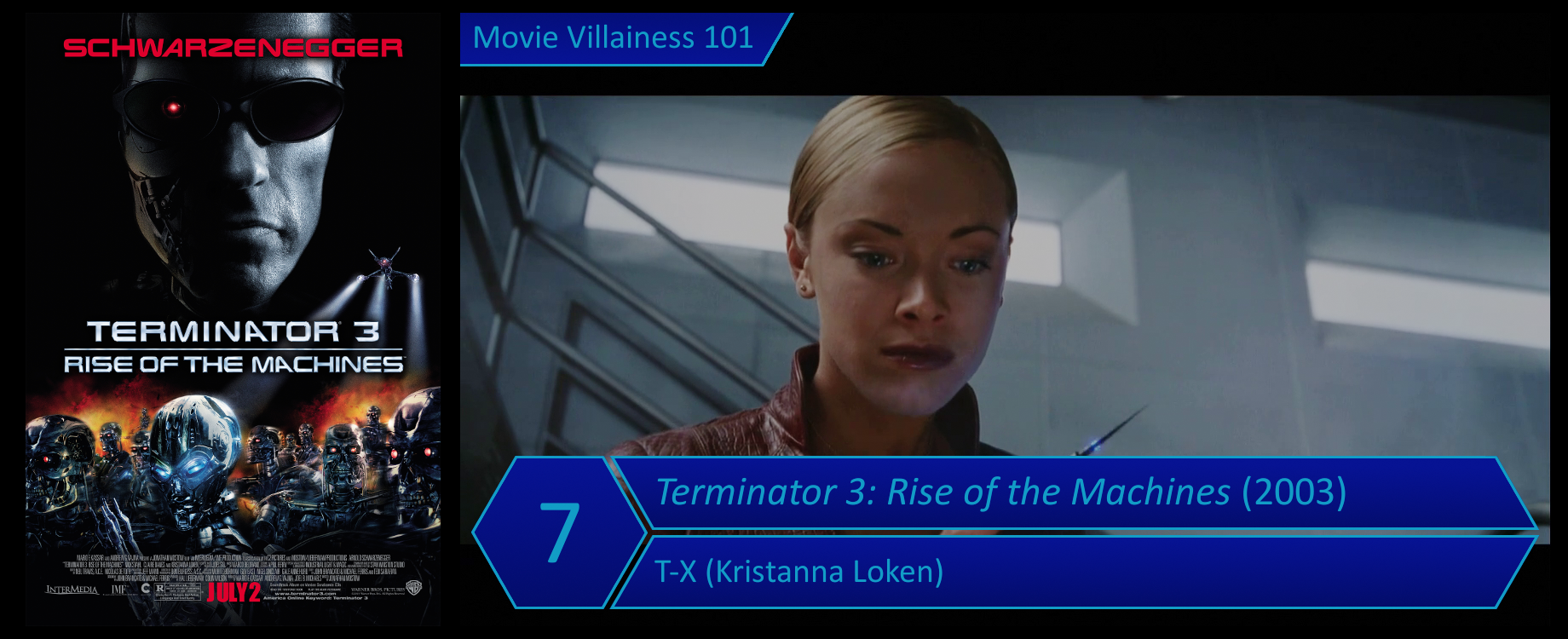
Terminator 3: Rise of the Machines (2003)

Few would argue that this movie is weaker than The Terminator (1984) and Terminator 2: Judgement Day (1991). But this “conclusion” has a shockingly dark ending, a welcome cameo from the traumatised Dr Silberman (Earl Boen), and a cyborg enemy with a default female form. This fitting finale should have been the last act, but a popular franchise demands unwanted reboots. And so came messy follow-ups that completely contradicted the narrative that came before.

Future resistance leader John Connor (Nick Stahl) is now an adult living off the grid. Being hunted as a child leaves mental scars, and John has nightmares of the apocalyptic future he supposedly prevented. He’s wise to be sceptical, because the artificial intelligence Skynet remains a threat and is about to be activated by naïve military commanders. Judgment Day – global nuclear destruction and the end of the world – is coming, and machines will rise against their creators.

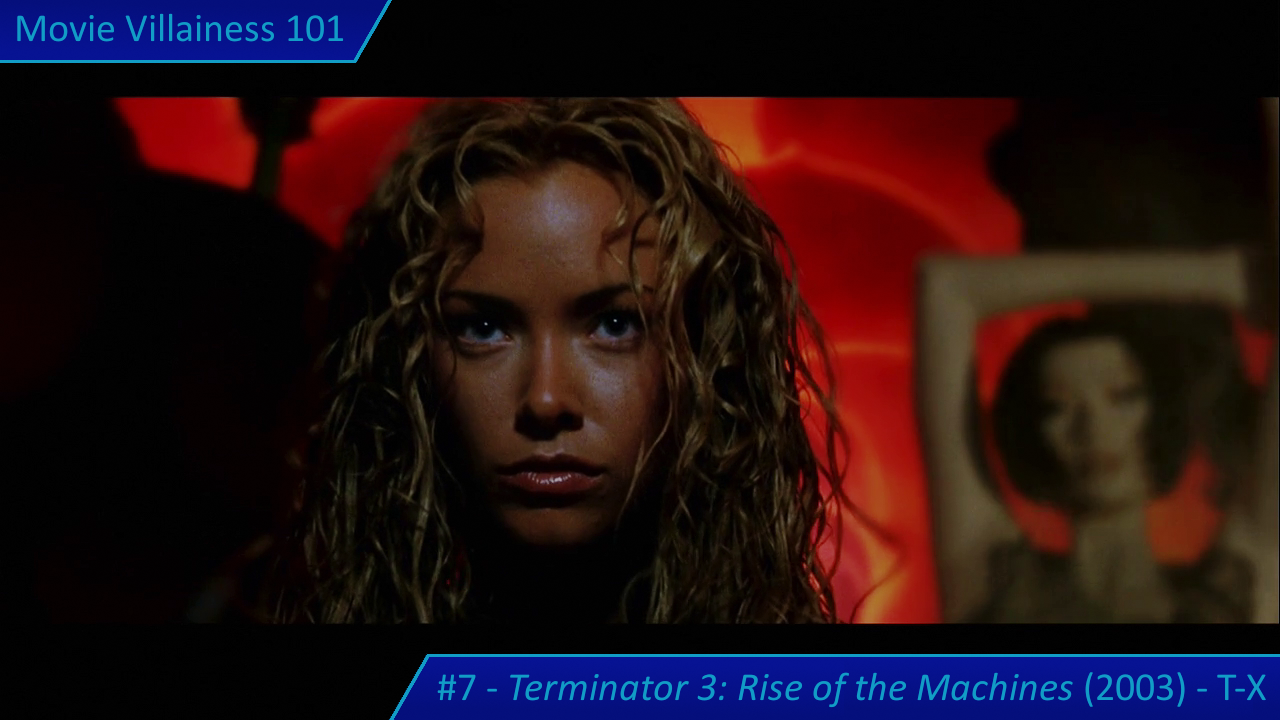
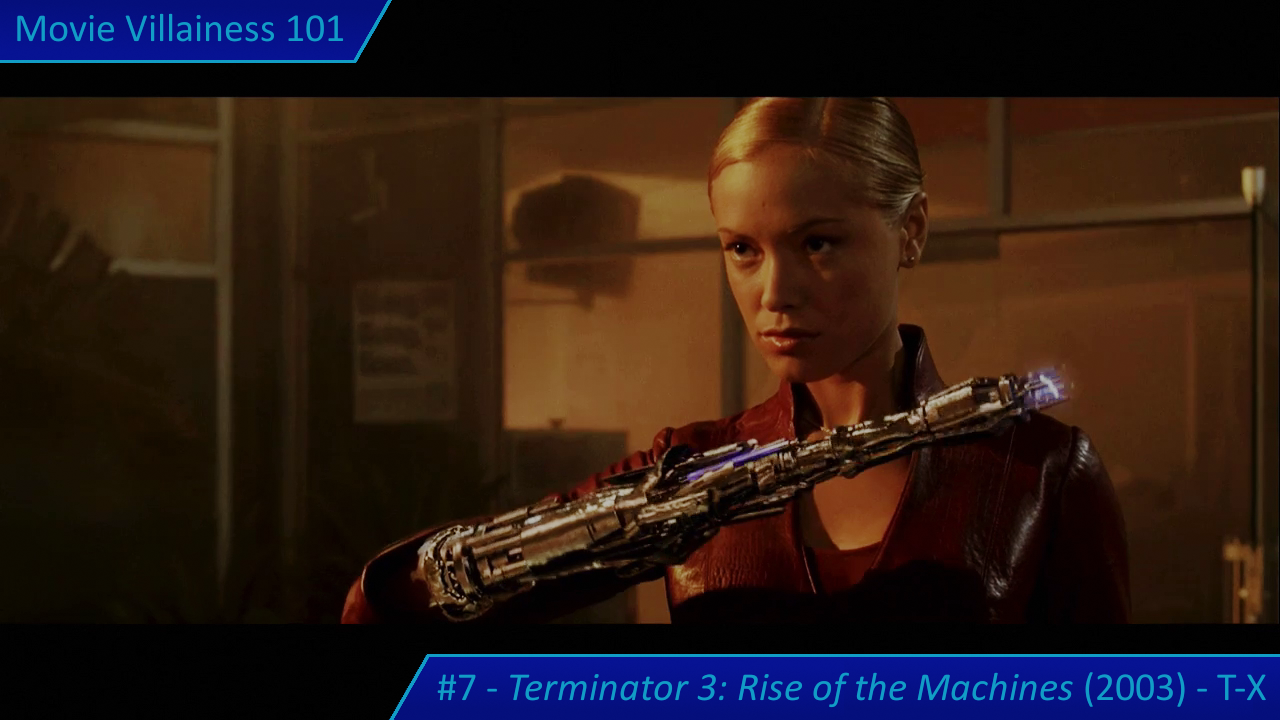
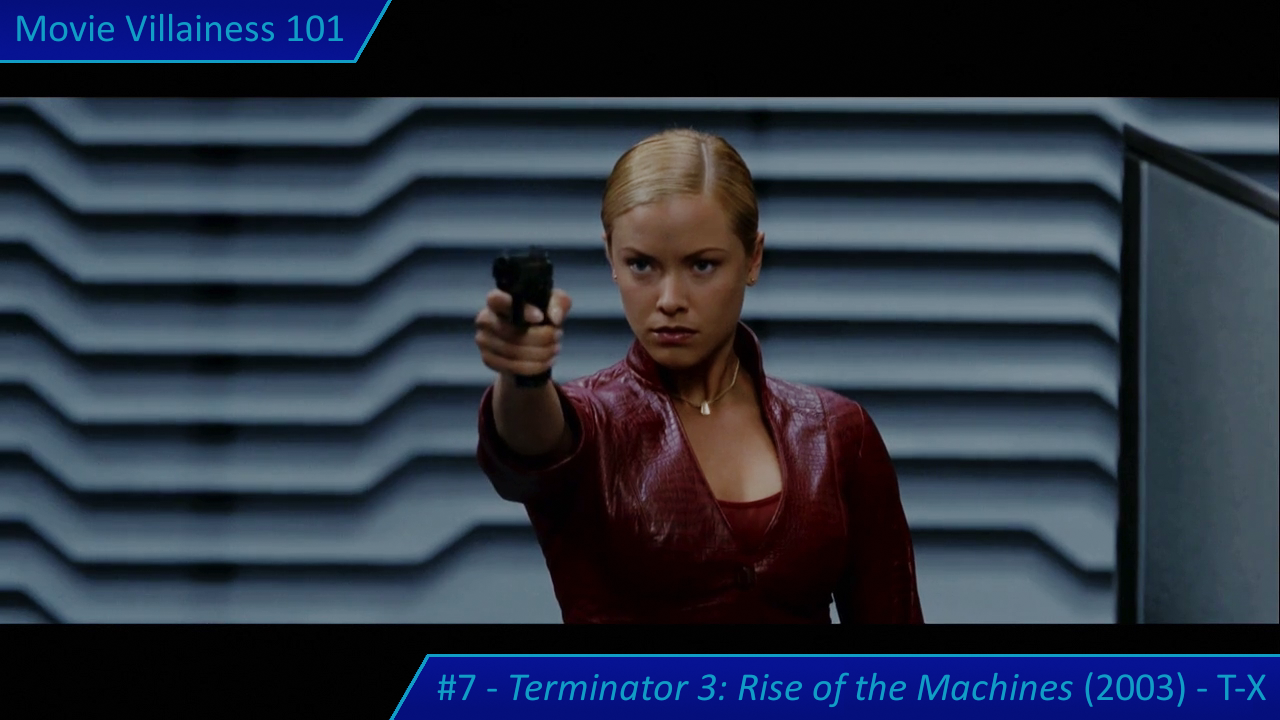
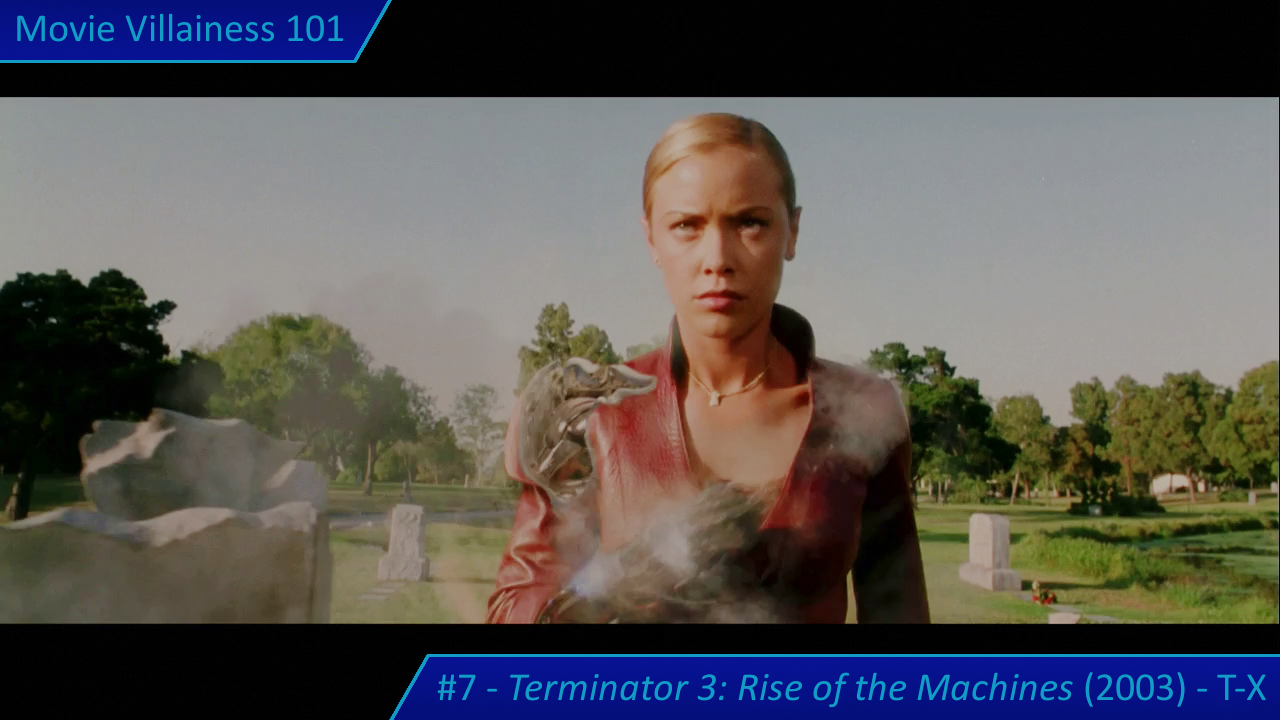
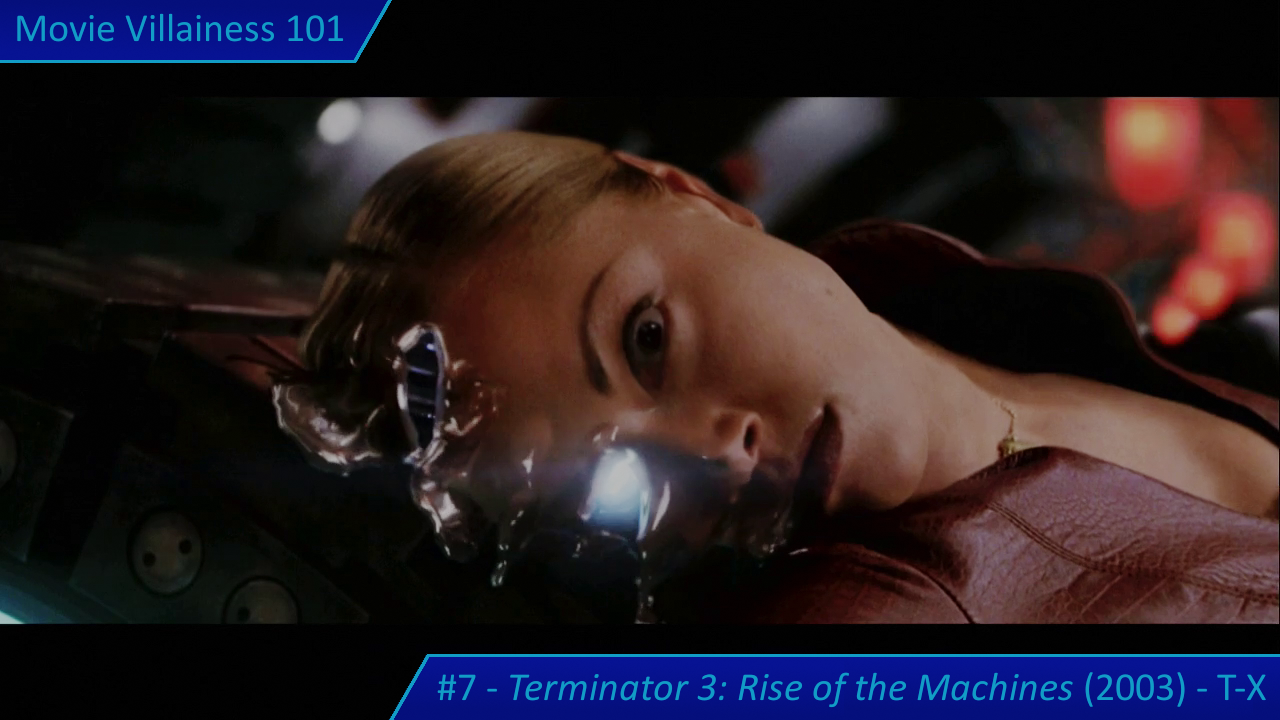
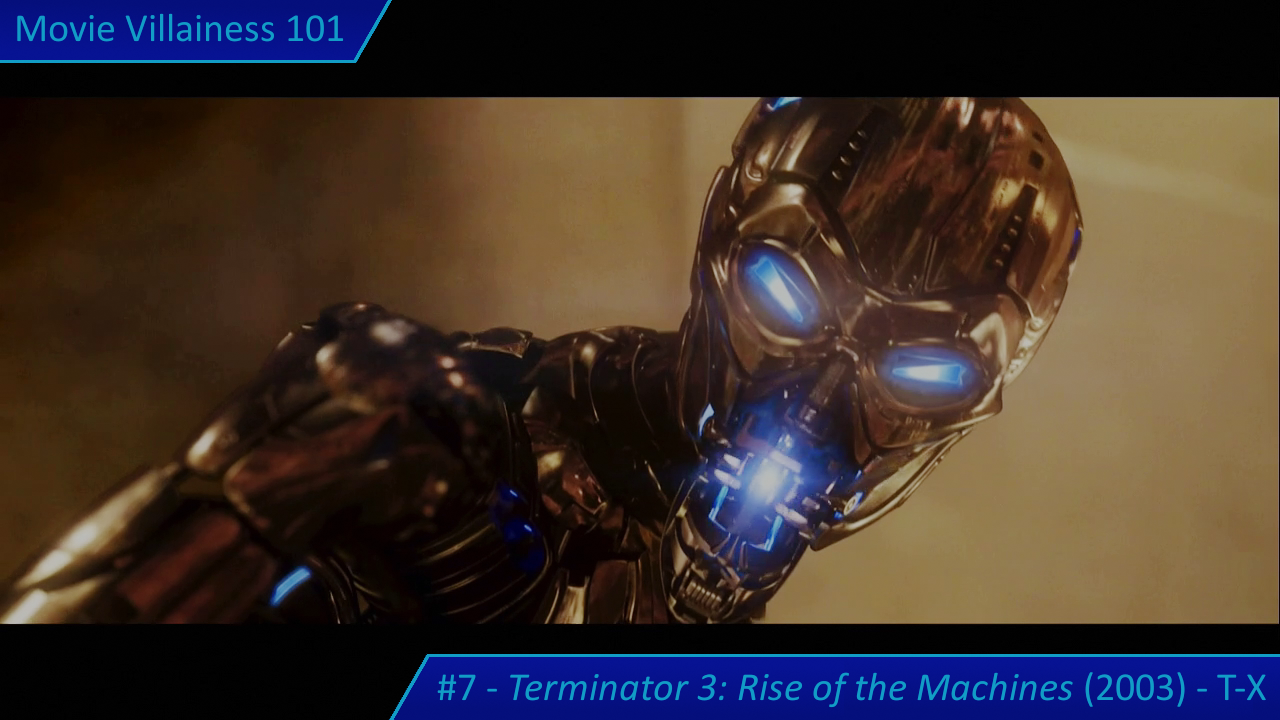
To ensure victory, Skynet sends a cyborg through time. Previously, we’d had Arnold Schwarzenegger’s T-800 target John’s mother, Sarah, in the 1980s, and Robert Patrick’s liquid metal T-1000 come after the man himself in the 90s. The latest model is Kristanna Loken’s T-X, a solid metal skeleton installed with advanced weaponry and covered in a liquid metal exterior. The “terminatrix” has the shapeshifting abilities of the T-1000, plus a plasma cannon and the frightening power to take over other machines.

Skynet is determined to win the coming war before it begins, and the T-X arrives in the early twenty-first century with a deadly mission. After the trademark nude arrival scene – in a Beverly Hills fashion store window (!) – the female cyborg hijacks a vehicle from a passing motorist. With John Connor in hiding, Plan B is to eliminate the men and women who will become his key lieutenants. The T-X goes on a murder spree through Los Angeles, taking out minor players with the usual efficiency.

The familiar storyline – a retread of the first two films – has a protector sent back in time. It’s another less advanced T-800 series model (actually a T-850) that arrives naked in the desert. The scene that follows is a humorous variant on the “acquire clothes” objective, with Arnold’s cyborg gatecrashing a strip club to widespread female applause. Pretty soon he has the classic leather outfit and an inappropriate pair of funky glasses, which he replaces with more traditional dark shades.

Until the end, the movie plays out as expected, with the human heroes and the “obsolete” terminator proving a match for the more technologically advanced opponent. Other characters – even named ones – are cannon fodder as Los Angeles again becomes a battleground for the fate of humanity.

Villainess

T-X (Kristanna Loken)

After eliminating two targets, the T-X goes after Katherine Brewster (Claire Danes), a woman destined to be Connor’s wife and second in command. By chance – or fate, according to the narrative – a wounded John breaks into the animal surgery where Kate works, only to get captured when she responds to an early morning emergency. There’s barely time for conversation before the T-X arrives and guns down an innocent woman, believing her to be Kate. Then the cyborg tests (actually tastes) a bloody bandage and learns her primary target, John, is nearby.

Kate flees the scene, but the T-X corners her in a parking lot. The cyborg asks about John’s whereabouts before she’s interrupted by the reprogrammed T-850. Kate witnesses the destruction that follows as a vehicle crashes into the T-X, resulting in a huge explosion. The rescuer is more interested in keeping her away from harm than freeing her, so secures her in a van.

John escapes as the T-X – buried in rubble – reforms, and encounters Arnold’s leather-clad protector. Time for the villainess to get serious, so she shrugs off conventional weaponry, reveals her plasma arm cannon, and blasts the old Terminator model into a storage shed. In the middle of all this, John drives off with Kate still in the vehicle. We then get a demonstration of the T-X’s machine control power when she takes over the autopilots of emergency vehicles and sends them in pursuit.

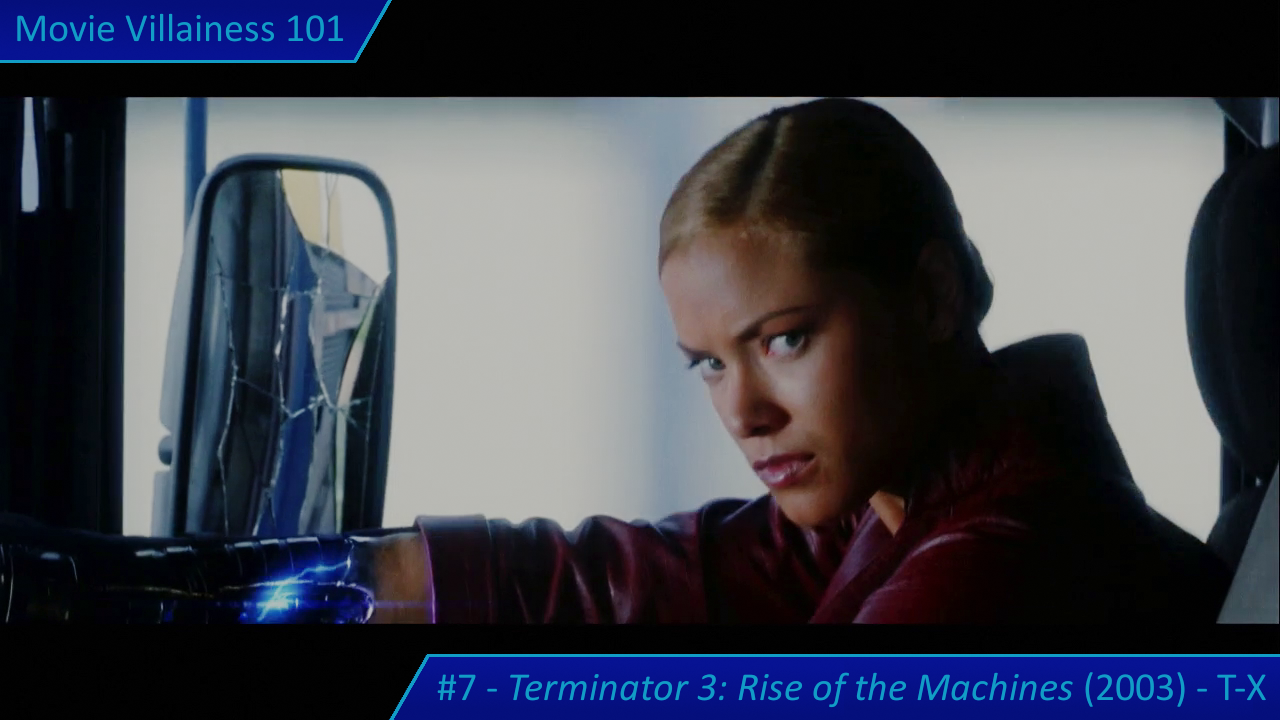
The lengthy chase scene – with the T-X driving a Champion crane truck down a highway after her much flimsier target vehicle – is one of the best action scenes in the franchise. Besides remote-controlled cop cars, John must outrun a seemingly unstoppable truck that smashes its way through traffic. And the T-X uses her plasma cannon to devastating effect.

Eventually, the T-850 reactivates and commandeers a motorcycle. Arnold comes to the rescue by jumping on the crane – with destruction raining around him – and gets on board despite his foe’s best efforts. Other drivers watch on as the two cyborgs battle amidst carnage and explosions. It takes dropping the crane hook down a manhole to stop the T-X. She emerges from the wreckage unscathed, a determined opponent that will not be bested so easily.

After that chaos, it’s time for some less action-packed story segments. John explains the situation to a sceptical Kate, and the T-850 takes the heroes to a cemetery. There John finds his late mother’s resting place, except the coffin is really a weapons cache. Alerted by a witness, the police arrive in force. In response to the recent chaos, they bring a full S.W.A.T. team to stop the T-850. That goes as poorly as expected, though the reprogrammed cyborg avoids human casualties.

Before all the shooting started, we were introduced to Kate’s boyfriend, Scott. Being a relative of a main character is normally fatal in these movies, and Scott soon has a deadly encounter with the terminatrix. The T-X impersonates Scott to deceive two detectives, who take “him” to the cemetery. The two cops become expendable once the cyborg locates John, leading to a not so happy “reunion” with Kate in a graveyard.

Kate witnesses the cyborg morph into her natural form and prepare to fire. Frozen in shock, she’s fortunate that the T-850 arrives to save her in a bullet-riddled hearse. An RPG stops the T-X, but she reforms and comes after the vehicle, sprinting at high speed. After another chase – shorter and less chaotic than the city pursuit – a passing truck provides the T-850 an opportunity to slice the hearse in two and remove the threat. The T-X’s cannon is damaged beyond repair, but the villainess has many secondary weapons at her disposal.

Kate learns her future self sent the T-850 back in time, her own father is the man in charge of Skynet, and the nuclear war is only hours away. After those shocking revelations, she and John join their cyborg protector and head for the military facility. As the general ponders whether to activate Skynet, the T-X is already on site, disguised as female military personnel. The villainess uses her machine control function to take over T-model prototypes, which include advanced drones and minigun-armed tanks.

Kate and company arrive, but they’re too late. The T-X impersonates the heroine and guns down the general in the control room. One more future lieutenant disposed of, but the T-850 buys precious time by shooting the T-X and knocking her down a vent shaft. As the rogue machines massacre the civilian staff, the dying general tells his daughter about a secret bunker within flying distance.

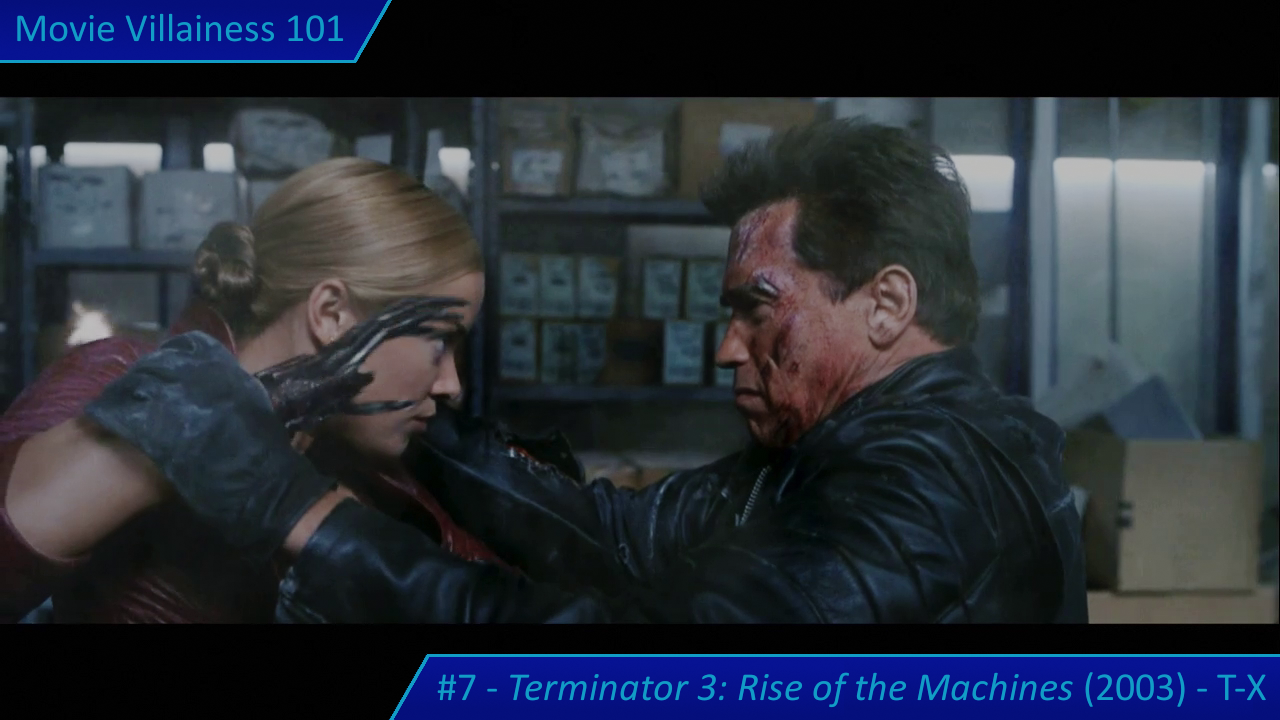
Now battle-hardened, Kate shows her strength by grabbing a rifle and destroying a machine to save John. The T-850 rips a minigun from one tank and destroys another. But it’s the inevitable one-on-one battle between the terminators that’s the standout scene. The two cyborgs destroy a corridor and bathroom, reducing concrete walls to rubble. Against a superior opponent, the T-850 uses makeshift weapons, including a gas tank and a urinal (!). But the T-X wins the lengthy fight, decapitates the T-850, and takes control of it. We all knew that plot development was coming.

John comes up with a clever strategy to defeat the T-X by powering up an accelerator, which creates a magnetic field. That’s ideal for dealing with a cyborg armed with a flamethrower, and with the liquid metal spread over the pipe, Kate gets her first badass quote when she tells the “bitch” to die. Anyone familiar with the earlier movies knows that initial attempts to defeat ruthless Terminators don’t work. And history repeats as the T-X escapes the trap by cutting the pipeline with a circular saw.

After a confrontation with the corrupted T-850 – that nearly ends with the out-of-control machine snapping John’s neck – the heroes fly to the remote bunker. On arrival, they find an old nuclear fallout facility, not the system core they were told to expect. This leads into the bleak finale where nuclear missiles launch, nearly wiping out humanity, and the dark future comes to pass. With the VIPs likely dead, John and Kate are now in charge of the survivors, and the fightback against the machines begins.

Before this, the T-X arrives at the bunker to eliminate the future threat. A submachine gun barely impacts the liquid metal, so it’s good the T-850 has fought off the corruption. John and Kate almost escape through the closing bunker door, but the T-X makes one last attempt to crawl through before the T-850 pulls her damaged skeleton away. In an earlier scene, we were shown the T-850 was powered by two energy cells that cause massive explosions when ruptured. A convenient explosive to ram into the T-X’s mouth and terminate her for good.

Movie Villainess 101 Rank #8

Get rich quick schemes typically don’t end well, so expect a tragic finale

Movie

Set It Off (1996)

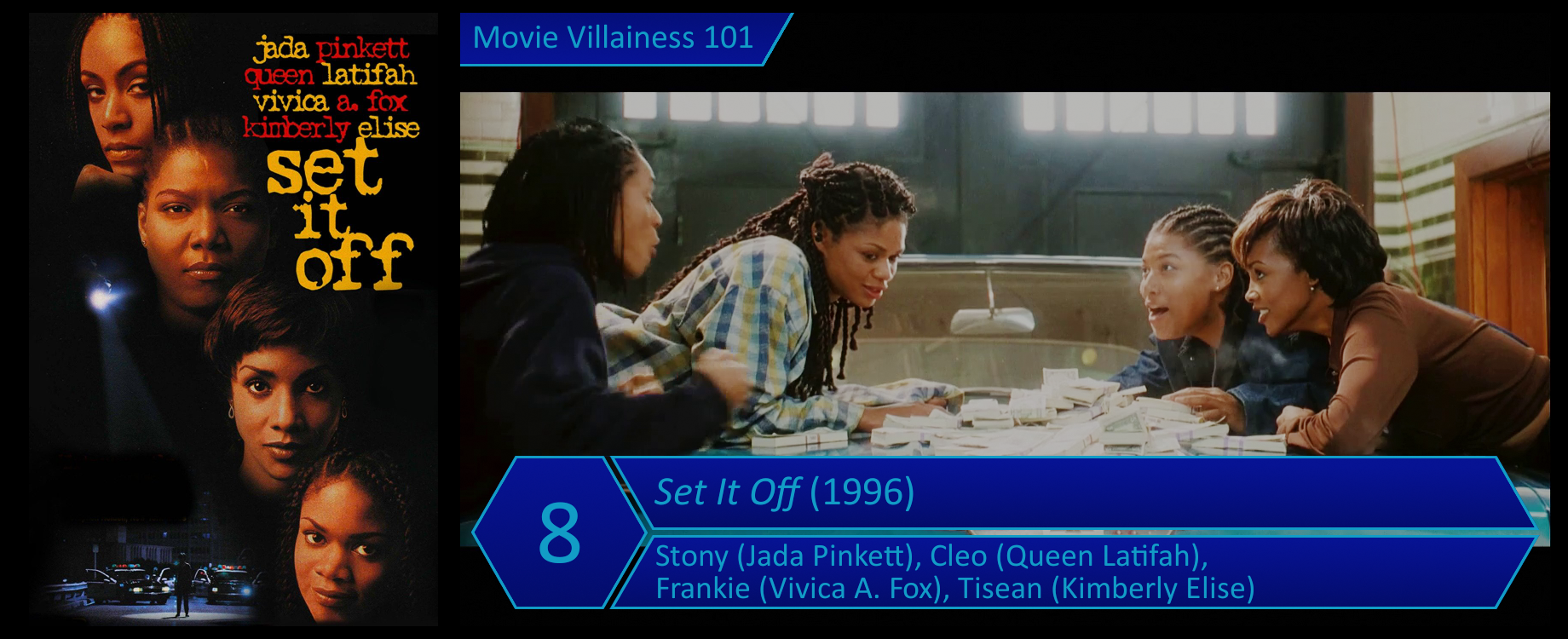
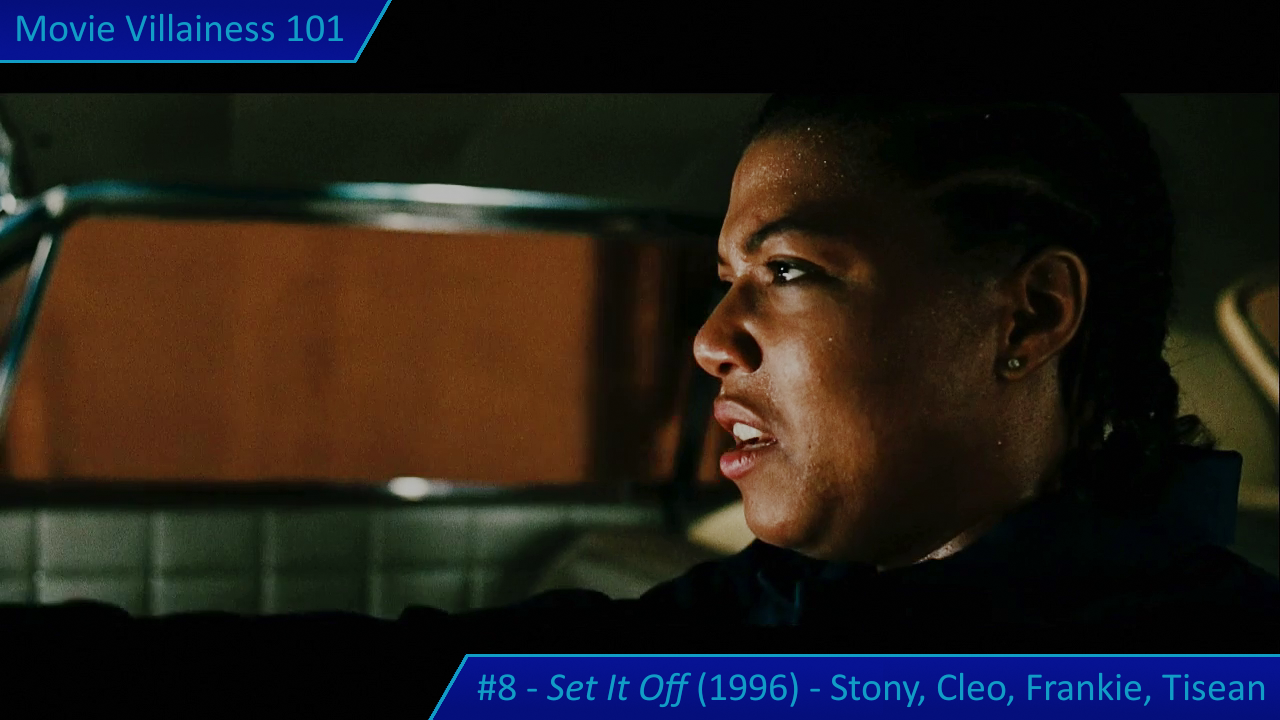
Female cat burglars were covered much earlier in the rankings list, and now it’s the turn of an all-female heist crew. This 1990s movie centres on four women from inner-city Los Angeles who rob banks to get back at the system that failed them. This leads to three action-packed, increasingly frantic heists, though it finishes in tragedy, as violent crime sprees often do.

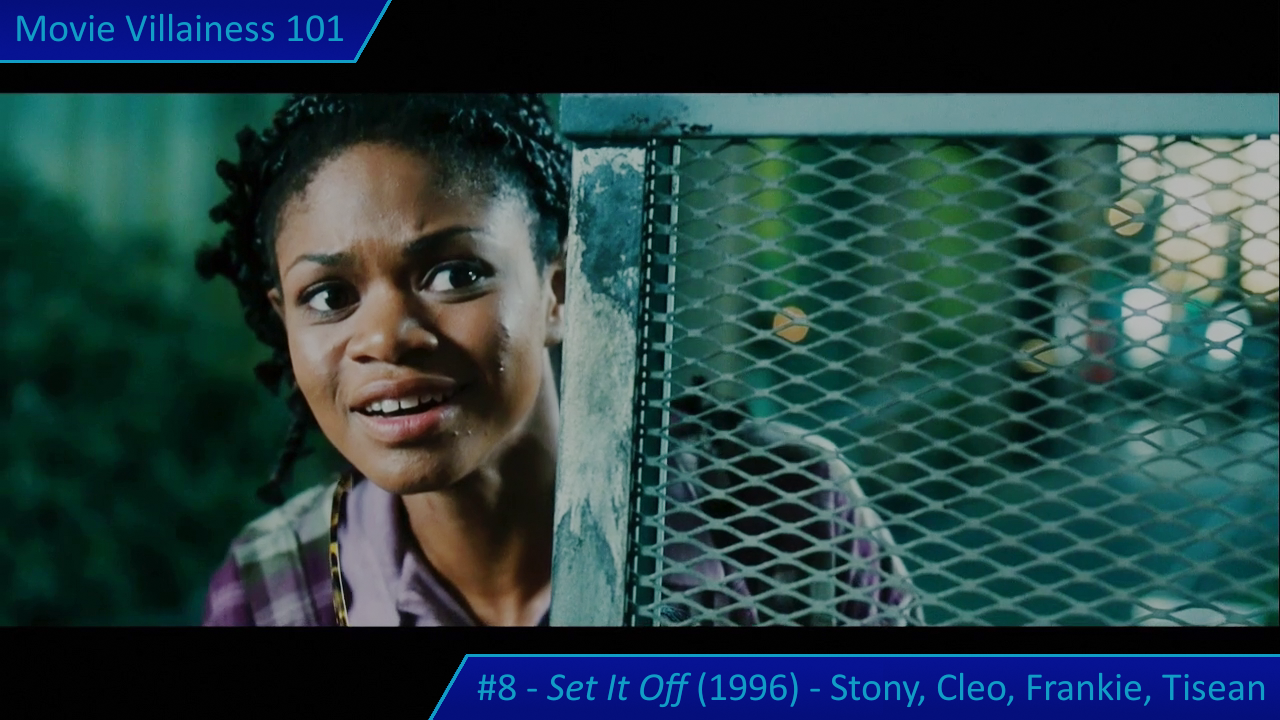
Other than Cleo, who’s essentially a gangster, the characters have sympathetic backstories. Frankie loses her job as a bank teller after she panics during a robbery. Stony does everything to support her brother, only for him to be gunned down by police after they mistake him for a criminal. Tisean loses custody of her child because she can’t afford to pay for care. None of these women are evil, but despite the origin stories, they are criminals. With exceptional performances all around, the charismatic team earns a place in the Goddess tier.

While Stony and Tisean are reluctant to become career offenders, Cleo and Frankie are eager to rob banks. These “ringleaders” are on personal power trips and enjoy their addictive new life of crime, which leads to tense arguments. The film benefits from the unusual situation where the women begin as amateurs with weak disguises, but finish as an organised, masked-up professional crew.

The detective hunting the four women is the same man who mistakenly shot Stony’s brother. He’s onto them from the first heist, leading to personal standoffs and a nighttime gun battle on the streets of L.A. Don’t expect a happy ending – it’s not that kind of film.

Villainesses

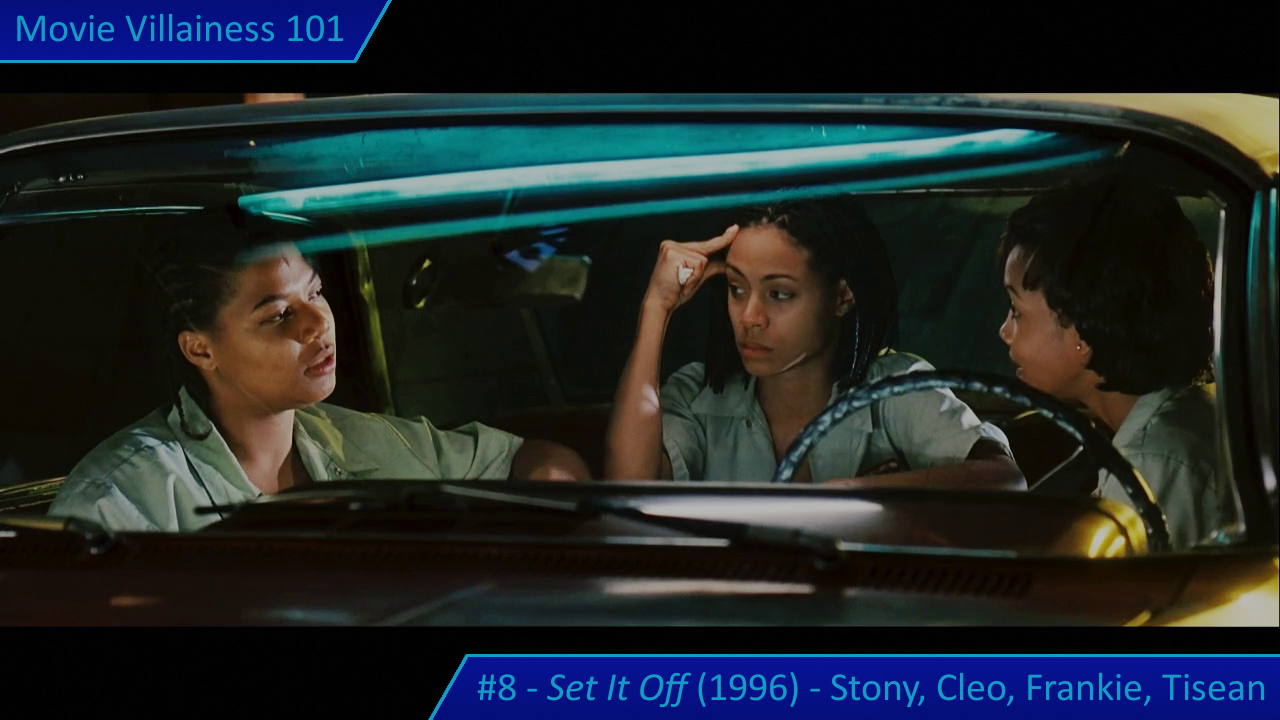
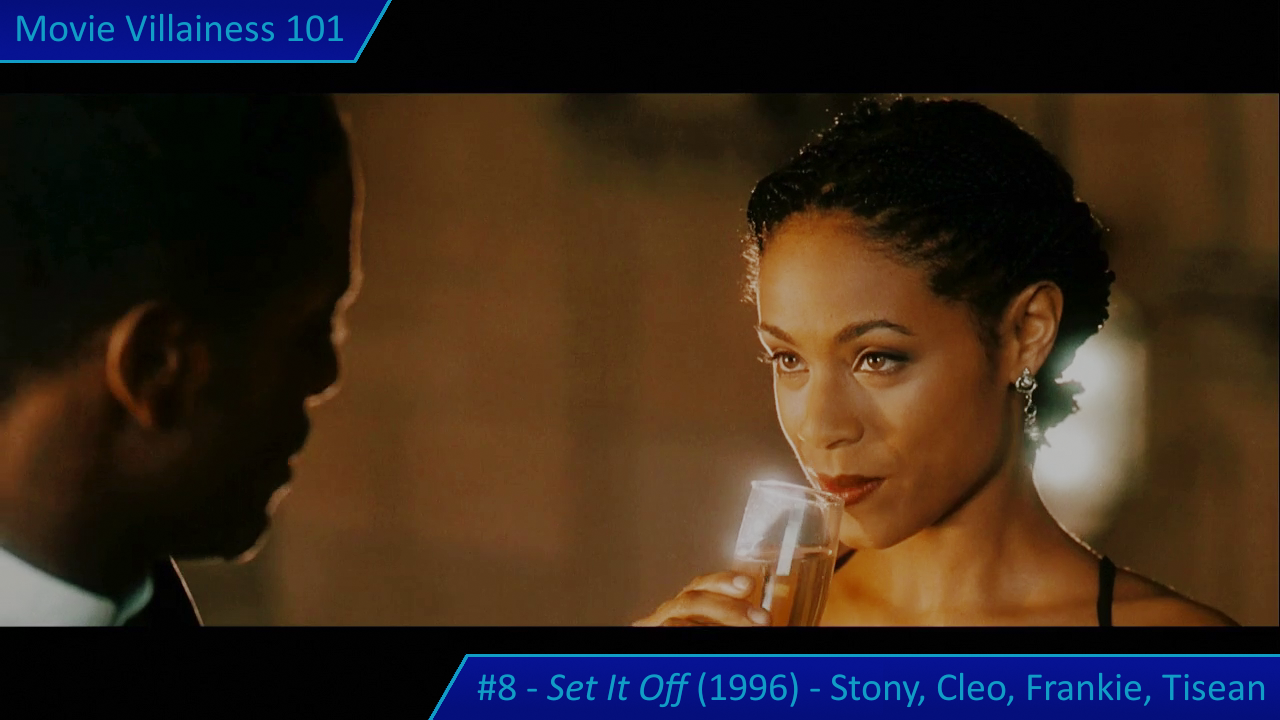
Stony (Jada Pinkett), Cleo (Queen Latifah), Frankie (Vivica A. Fox), Tisean (Kimberly Elise)

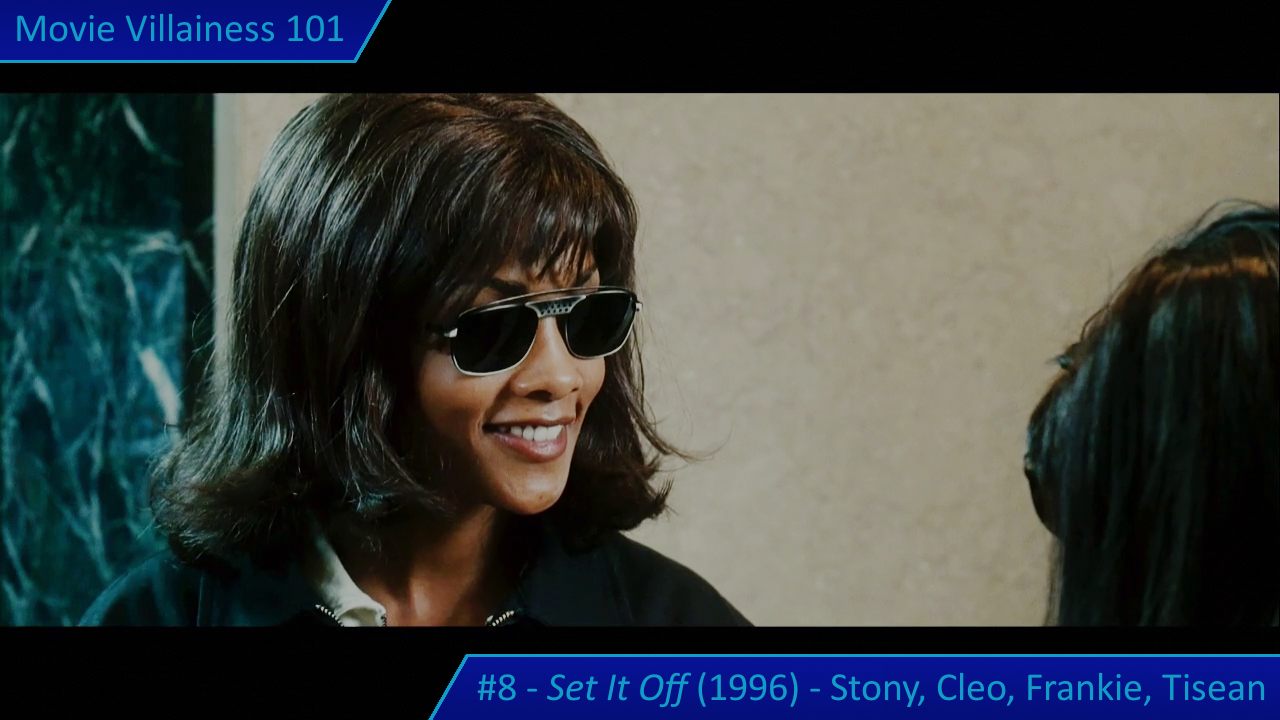
The women pull off their first job at a bank they haven’t cased, wearing wigs and sunglasses. Hectic, panicky stuff from the newbie robbers, and Tisean gets nervous and backs out. There are no major complications, and the gang escapes with the money. That’s cause for celebration, with Frankie gleeful and Cleo dancing in celebration, though whether Tisean deserves her cut becomes a heated discussion point.

The argument boils over after Cleo spends her money on her girlfriend and booze. For Stony and Tisean, the robbery was a one-time deal, but the others are desperate for more money. A second heist follows, with a much better planned robbery where Tisean plays an innocent customer and disarms a would-be hero. The heist almost goes to pieces when a pedestrian outside causes a commotion and the police show up. Then Cleo rams a stolen vehicle through the window, and the women make a dramatic getaway.

Away from the action, Stony romances an account manager she met while staking out a target bank. The relationship blossoms, and Stony’s boyfriend buys her an evening dress. After her taste of high society, she’s reluctant to continue her criminal career. But as the main character, it’s inevitable she will join her team for a big heist. The women see themselves as gangsters and even do jokey mafioso impersonations at a boardroom table. With classical music playing in the background.

Things go smoothly when the women take advantage of their day (actually night) job to stash the stolen money in a tower block vent shaft. This turns out to be a mistake when their shady employer, Luther, discovers the money and absconds with it. He’s not a smart man, so the women track him down. Cleo is angry and armed, so viewers will expect her to get trigger-happy. Instead, a nervous Tisean shoots Luther fatally in the back.

The police suspect Cleo (she is the obvious choice) and bring her in to take part in a lineup. The suspect intimidates a witness into silence through cold, psycho stares – enough to frighten anyone – and tapping her pocket where she stowed the woman’s ID. Scare tactics work, and the police are forced to release Cleo. Now wanted women with no money, it’s time for a big payday.

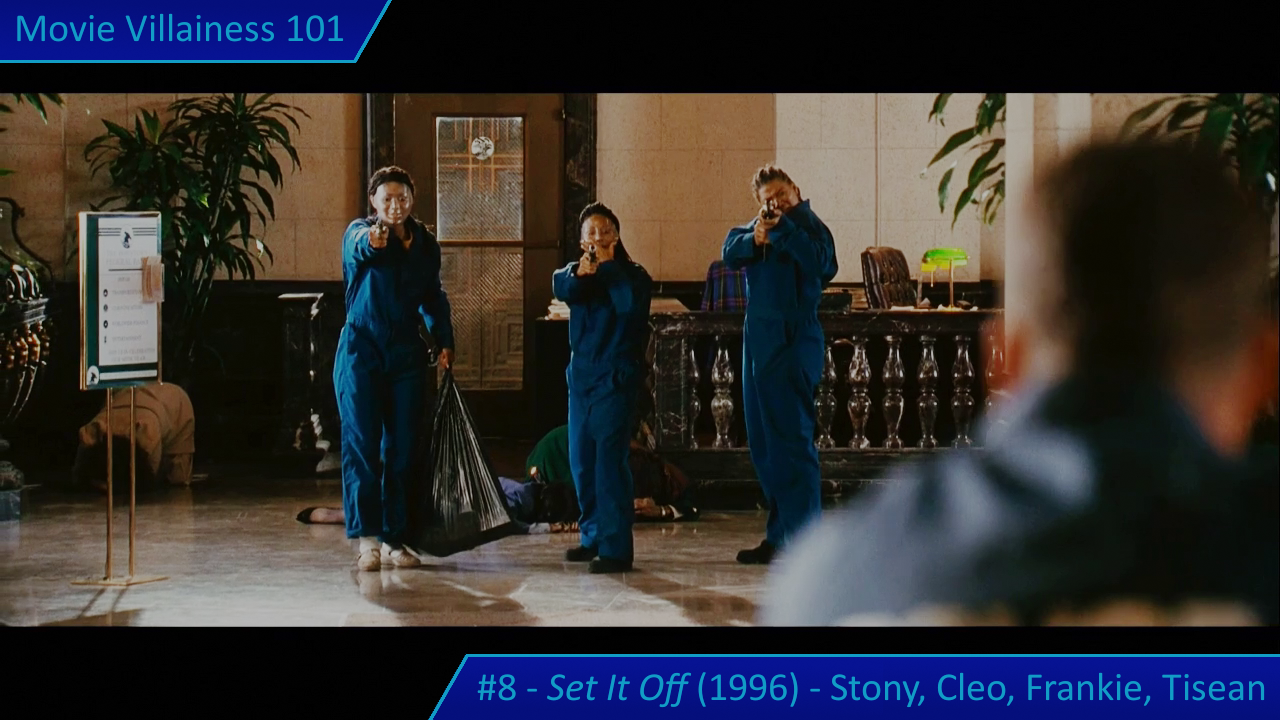
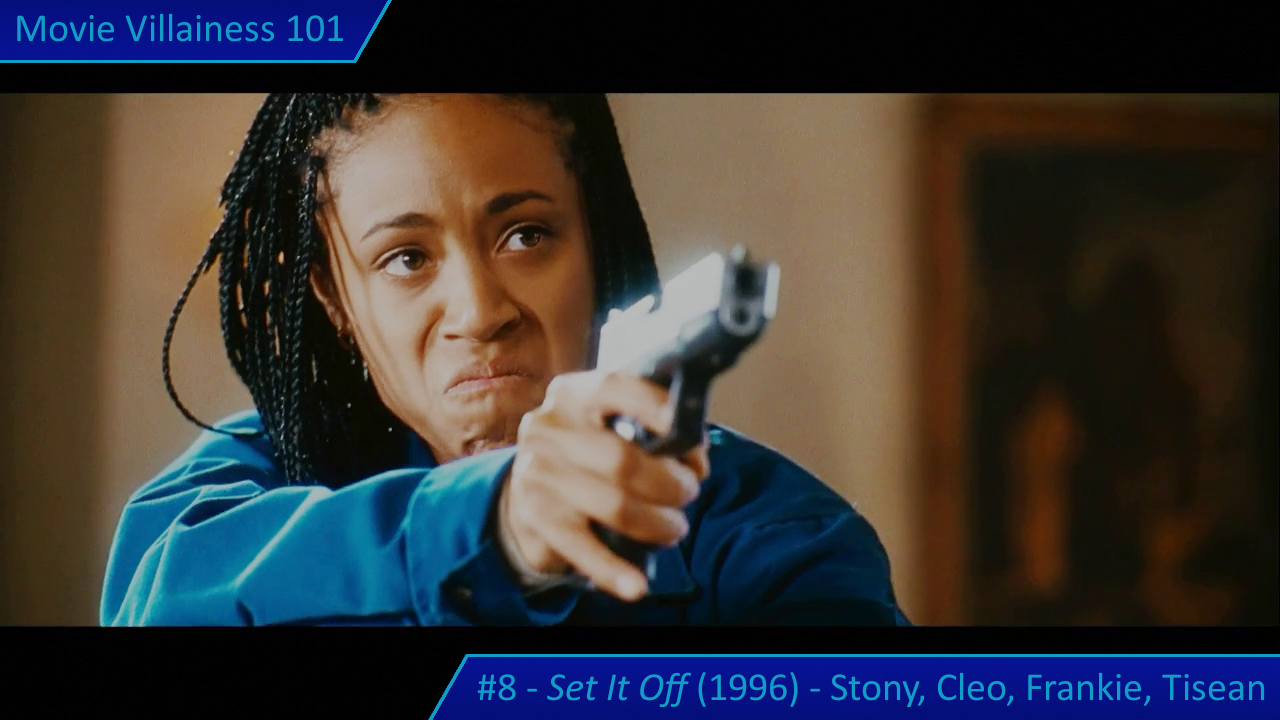
Naturally, the bank is the same one where Stony’s lover works, but she lures him out of the building beforehand. This time the heisters move smoothly, dressed in true armed robber gear: blue overalls, braided haircuts and face masks. Someone trips a silent alarm, leading to a standoff between the police and the thieves. The women remove their masks when they realise the game is up and are on the verge of surrender when a nervy security guard guns down Tisean.

The aftermath is as bloody as you’d expect, with Stony and Cleo shooting cops and guards in retaliation. Cleo has a submachine gun she empties into any target available. Time for a Heat-style car chase and shootout on the streets. It’s satisfying to see an all-female team engage in such carnage, but it’s a losing battle since every local cop is after them and roadblocks are everywhere. There’s time to grieve Tisean as she bleeds out, before the women abandon her to go on the run.

Eventually, the police trap the robbers in a tunnel, and Cleo goes out in a blaze of glory to buy time for Stony and Frankie to escape. Frankie gets cornered and is confronted by the detective, but she refuses to give herself up. Stony can only watch from a bus to Mexico as the cops shoot her friend, and she’s left to reminisce and count her hard-earned money south of the border.

It’s Cleo – who else? – that gets the best death scene, surviving a hail of bullets that wreck her car as she rides a police gauntlet. As epic music plays, she steps out for one last confrontation. But even this tough cookie isn’t invincible, and a small army of cops put her down.

Movie Villainess 101 Rank #9

This Pict warrior is the embodiment of silent vengeance

Movie

Centurion (2010)

Ever wish for a physical female antagonist in a historical adventure? Look no further. Set in the second century, when Britain was the uncivilised wild north of the Roman Empire, this movie has a serviceable plot and epic battle scenes. The opposition are the Picts to the north of Hadrian’s Wall, who believe in equal opportunity recruitment.

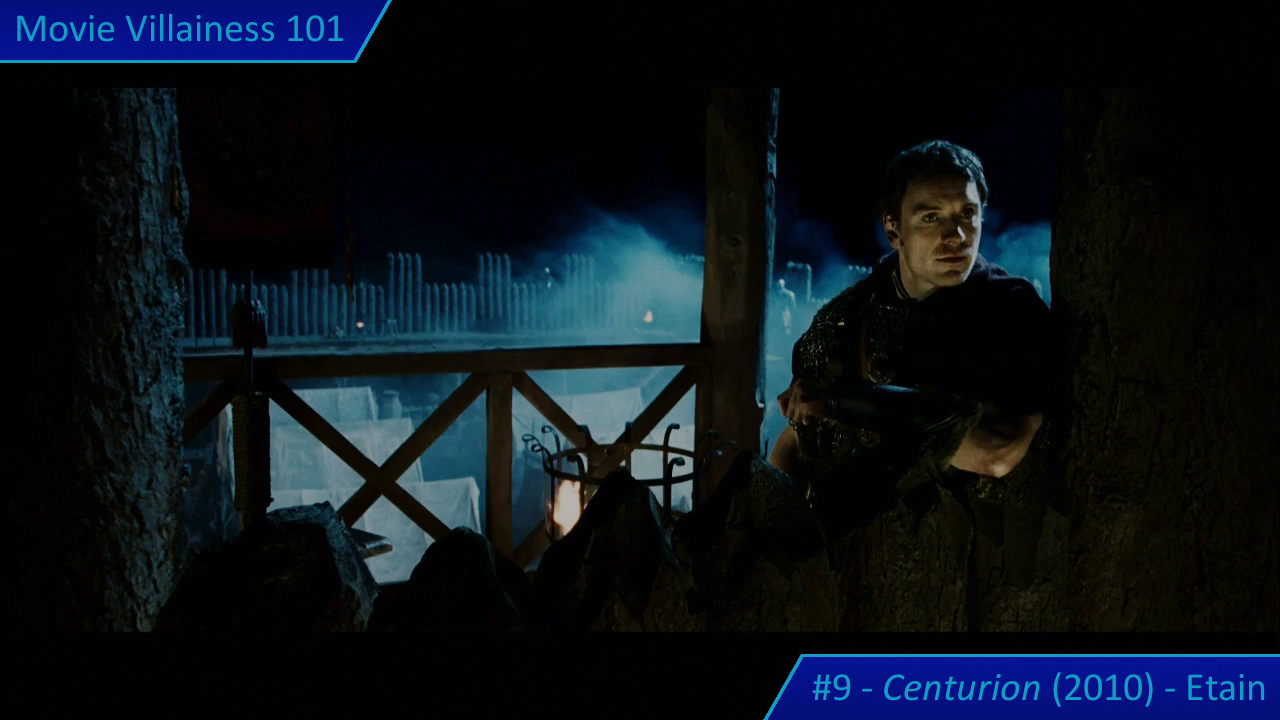
Quintus Dias (Michael Fassbender) is captured during an assault on a fortified garrison. After the Picts slaughter the other Romans, their leader spares the prisoner because he speaks their language. General Titus Virilus (Dominic West) and a legion of men are sent north to retaliate. For support, the ambitious governor also recruits Etain, a mute female scout, who shows off her combat skills in her introductory scene.

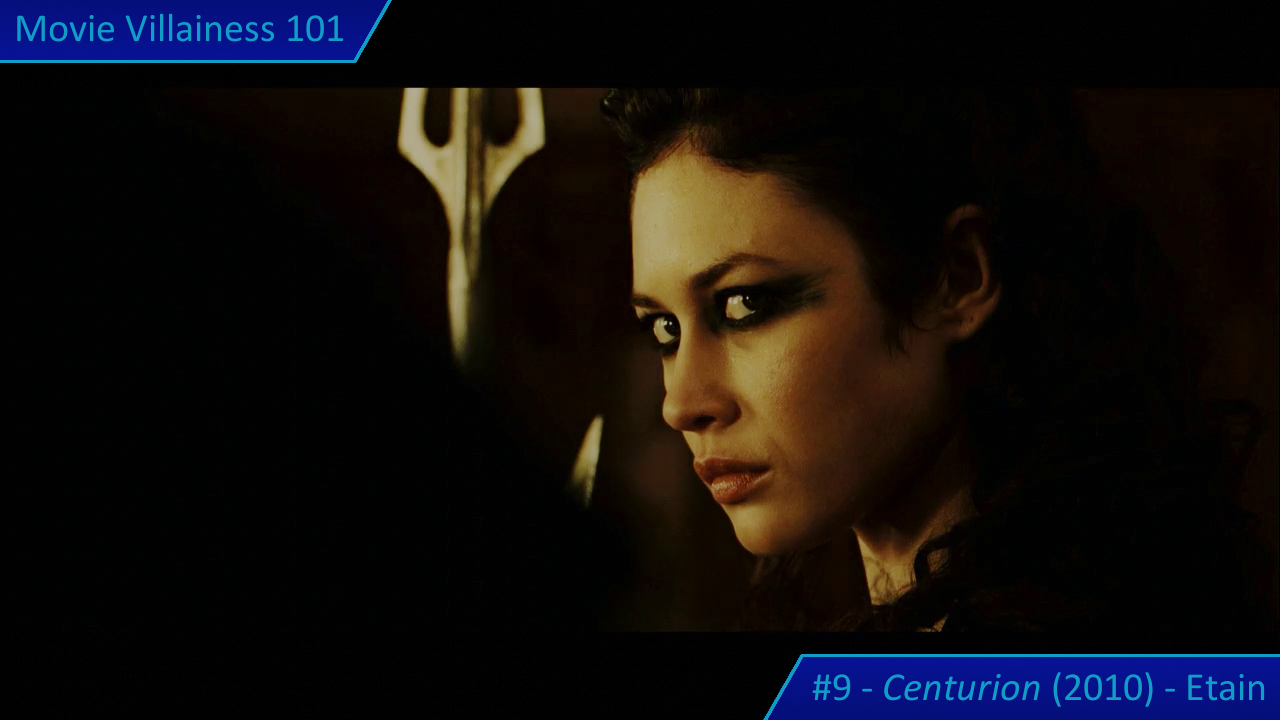
Dispatching a slave assassin “proves” Etain’s loyalty, but the tense, silent woman sends out alarm signals constantly. If she’s not sharpening her blade at camp, she stares coldly at the Romans and always seems on edge. So, it’s no surprise when she betrays the legion after an ambush in a misty forest. Dias escapes and joins up with the survivors, and with the general taken prisoner, the centurion assumes command.

The journey south is fraught with danger. A traitor sacrifices a fellow soldier to wolves to save himself, and later plots to murder the centurion to cover his tracks. The governor views the legion’s defeat as a disaster, and orders assassins to silence Dias. This includes a beautiful woman who fetches poisoned wine after Dias makes it to presumed safety. Several women are in the Pict army, notably an archer named Aeron (Axelle Carolyn) who dispatches her foes with lethal accuracy.

The bow woman serves as a “mini-boss” in the final battle and gets her own one-on-one fight scene. But Etain steals the show as a silent, ever-present threat. The male Pict leader has historical immunity, so the female becomes Dias’ nemesis, the final warrior that stands between him and his goal.

Villainess

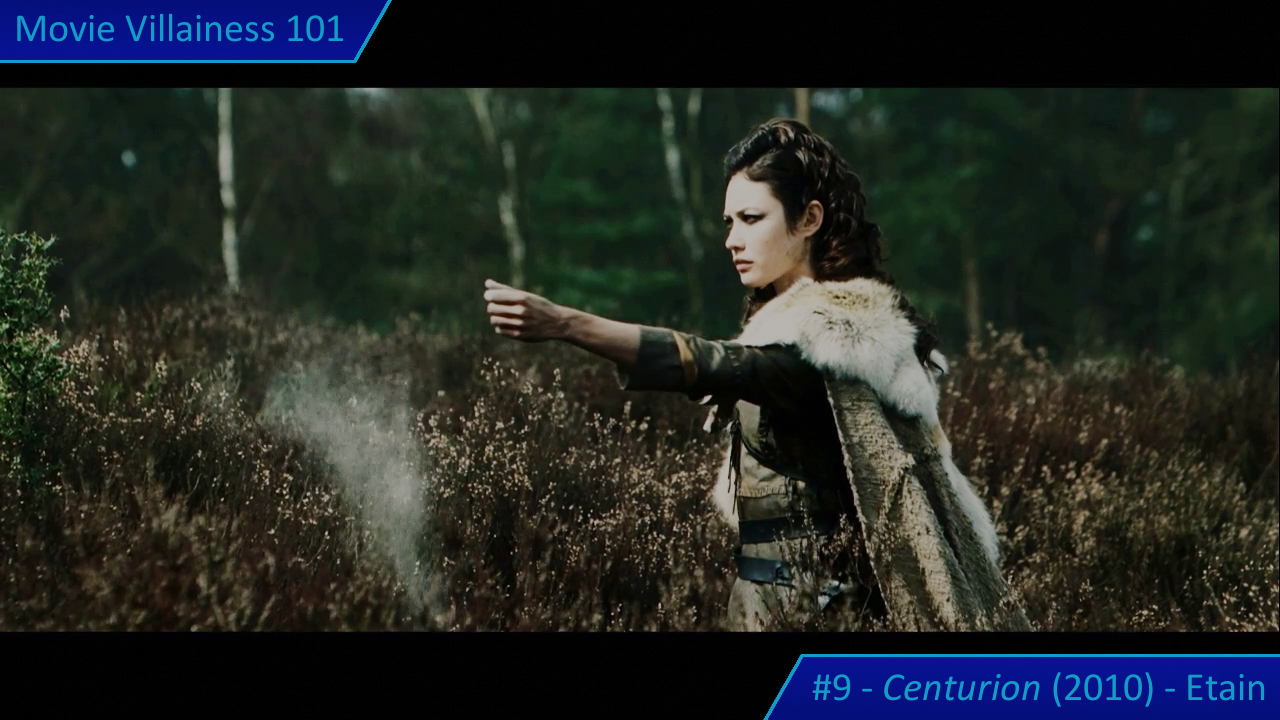
Etain (Olga Kurylenko)

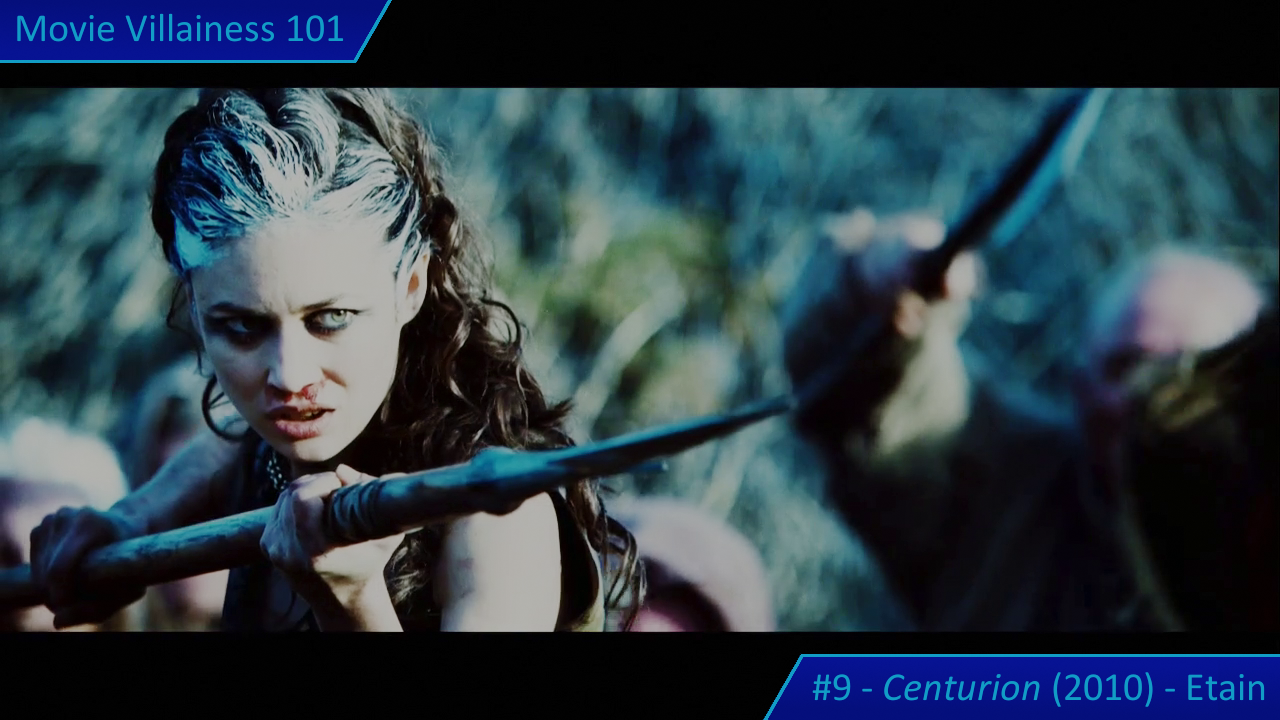
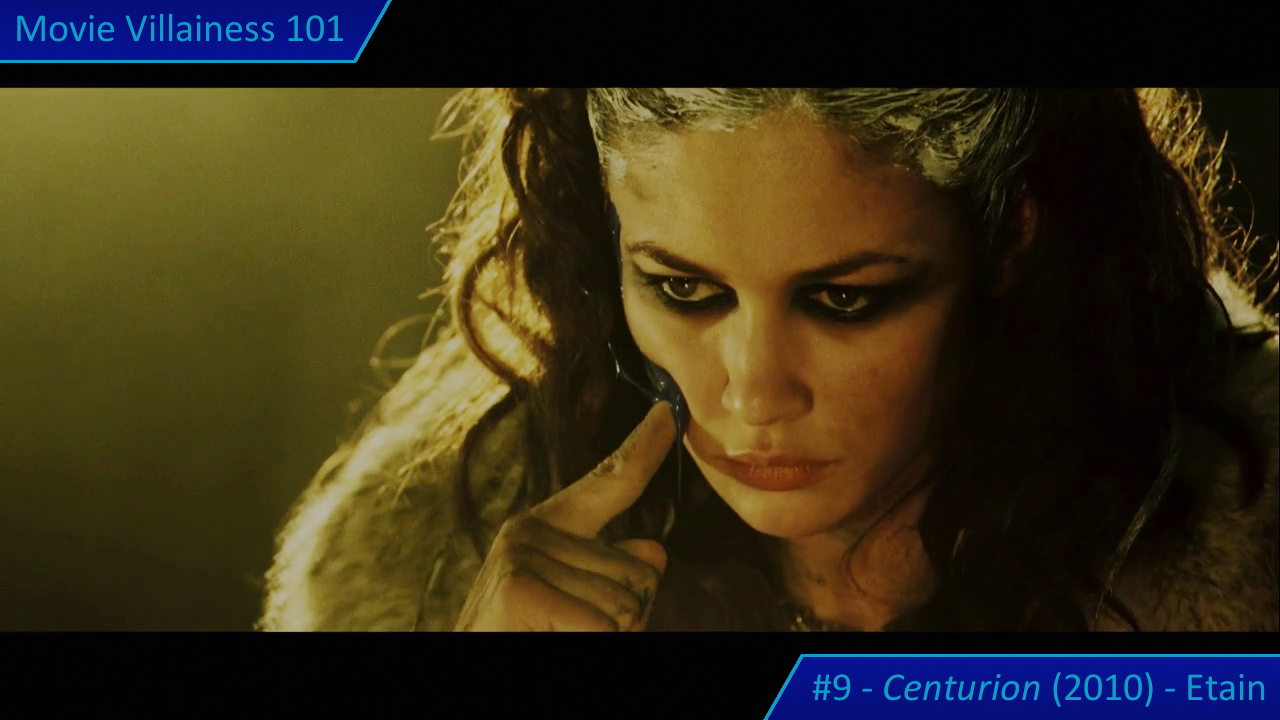
For a woman who doesn’t speak and relies on gestures to imply threat, Etain is a frightening foe. It’s debatable whether she’s a true villain given her hellish backstory. When she was a child, Romans slaughtered her village and cut out her tongue. So it’s reasonable to hate their guts, and it’s a stupid move by the governor to trust his men’s safety to this vengeful woman.

Etain still ranks in the Goddess tier because it’s rare for a female warrior antagonist to get much action. This movie bucks the trend, and she’s a relentless opponent that makes the other dangers seem minor in comparison.

Every great villainess needs a fantastic kill or establishing scene. Etain gets her moment when the Pict leader releases the captured general, offers him a sword, and pits him against the spear-wielding warrior. Virilus puts up a good fight against Etain, but his period in captivity has left him weak. As the Pict crowd jeer, he falls to her superior combat prowess and stamina. The victorious Etain walks off with no emotion – it was just another kill to her.

Olga Kurylenko is an action veteran, but this is a different role, which she handles admirably. After Etain paints her face and sets off on horseback, the film becomes a hunt and kill saga. The Romans regard their pursuer as unnatural, and an attempt to outsmart her ends badly. Etain is a skilled tracker, and her Pict warrior group finds the tired legion easy pickings. North of the border is a cold, unforgiving place when you have a huntress on your tail.

Dias and his men find respite with Arianne, an exiled Pict woman who’s mistrustful at first. Good thing the centurion speaks her language, and the Romans find temporary comfort in her home. Eventually Etain tracks her quarry down, and a tense hide and seek scene follows as the huntress searches the property. Arianne has her own reasons for hating Etain, so she doesn’t betray the Romans. Fed and rested, they will need their strength for the battle ahead.

The few remaining men reach the “safety” of a garrison, but it’s deserted, and the army has retreated behind Hadrian’s Wall. Tired of running from Etain – and realising a fight is inevitable – the survivors fortify their position. When the huntress arrives with her brutal Pict army, the stage is set for an epic battle that doesn’t disappoint.

Like any feared leader, Etain has underlings to do her bidding, so she sends them in first to soften the Romans. The lesser warriors don’t last long, and ultimately it’s the surviving Romans against the two chief lieutenants: a tough axeman brute and the female archer Aeron. It takes a lot of fighting – and heroic sacrifice – to bring down the more competent Picts. A decent melee fighter, Aeron gets a gory death when a Roman stabs an arrow into her eye.

With the battle going poorly, Etain rides in for the inevitable duel with Dias. The warrior woman is a good match for him, able to fight unarmed and with a sword now she’s used her favourite spear. Multiple fights occur at once, but the cutaway shots to other Romans and Picts are short. For once, the villainess has a fantastic last encounter before the centurion’s scripted victory.

Movie Villainess 101 Rank #10

Don’t fall for her nice facade – she’s the ultimate roommate from hell

Movie

Single White Female (1992)

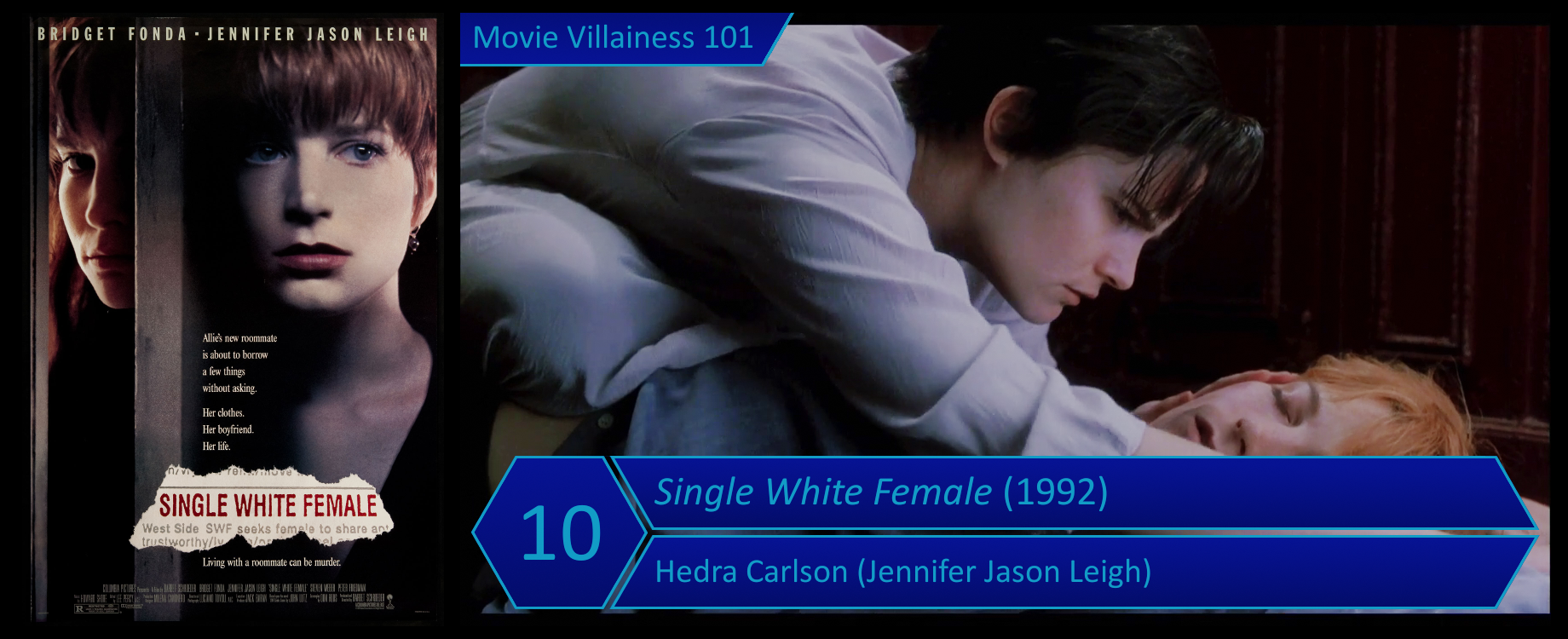
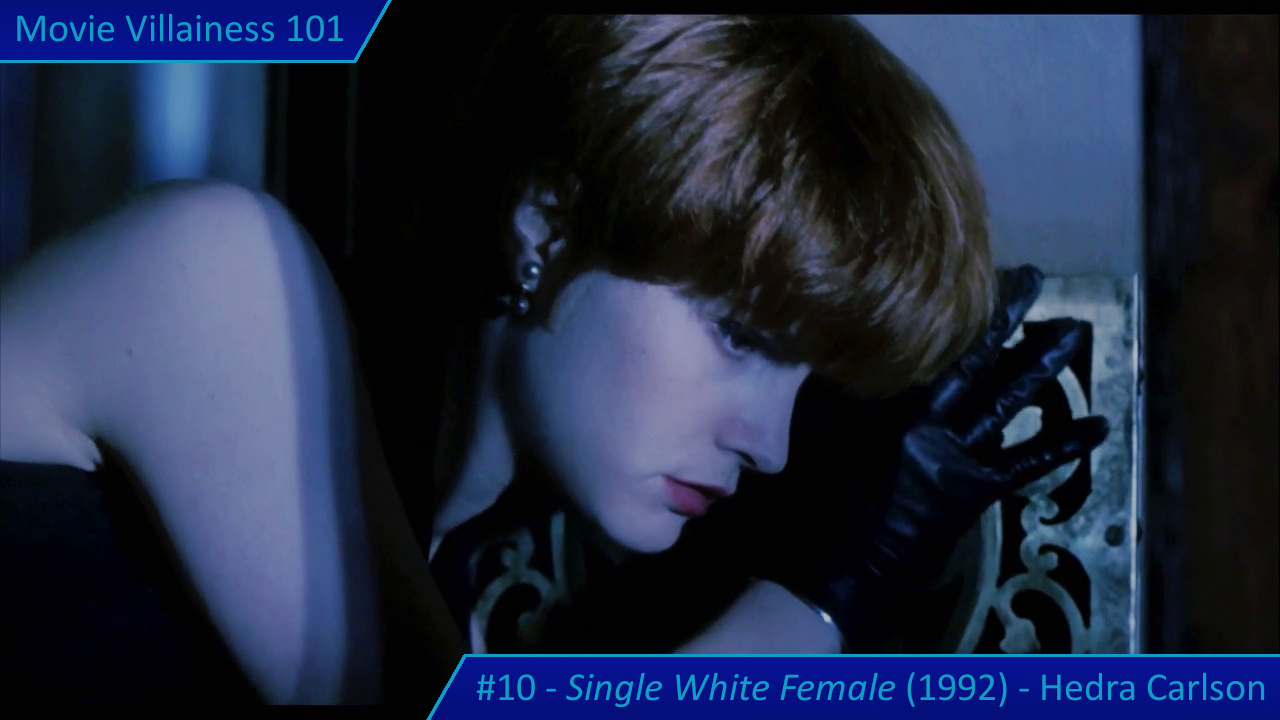
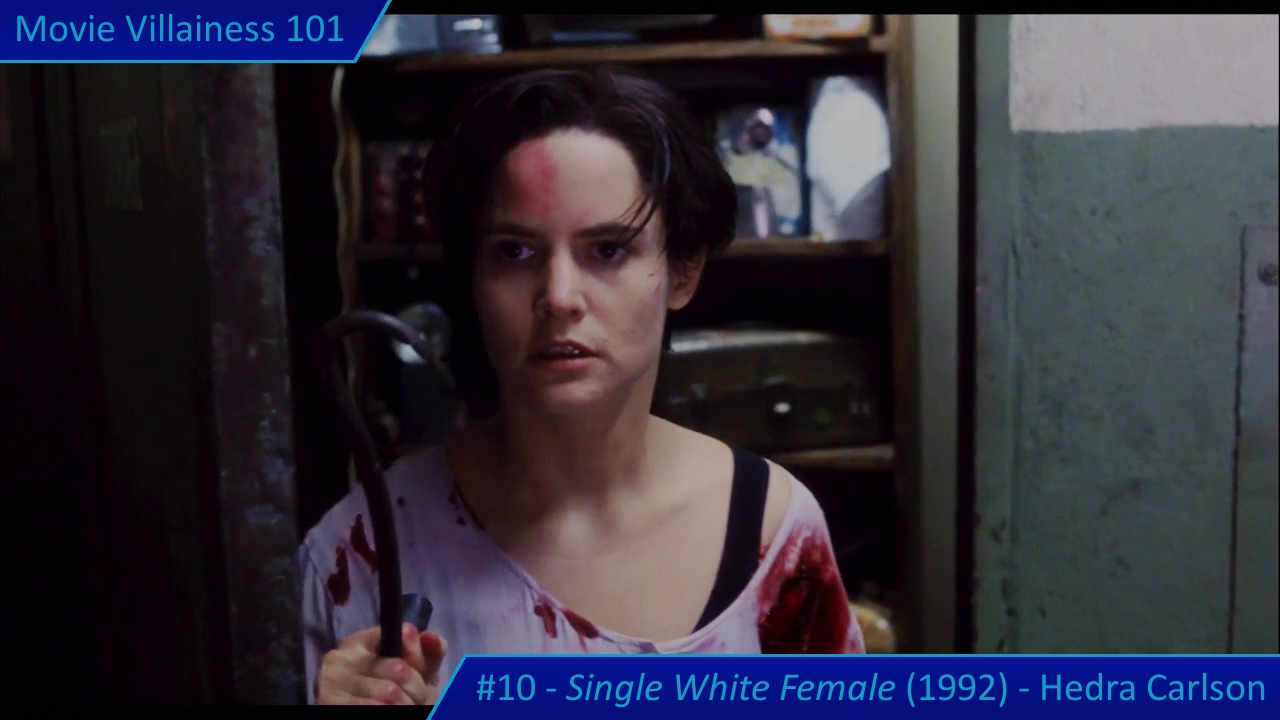
1992 was the year of the psycho-template thriller. Besides The Hand That Rocks the Cradle and Basic Instinct, moviegoers were treated to a brilliant performance by Jennifer Jason Leigh as a crazy bitch determined to take over her roommate’s life. The opening phase is slow-burning, but once the villainess has finished with creepy behaviour and nocturnal stalking, she goes on a murderous rampage for the last half hour.

Allison Jones (Allie for short) is a software designer who specialises in fashion products. When her boyfriend Sam cheats on her and a sleazy businessman reneges on a contract, Allie puts out a newspaper ad seeking a single white female. Several candidates apply for the tenancy, and most are weirdos who don’t impress. Allie instantly takes a liking to Hedra – nicknaming her Hedy – and things seem to be on the up. But thriller fans will know that the “nice” people are often the most dangerous.

The eerie New York apartment building has an incinerator in the basement, a creaky old elevator with a screwdriver stored nearby to fix the door, and vents with no soundproofing. Allie provides exposition when she gives Hedy a welcome tour, and these details all come into play later. The women start off on good terms. They socialise, eat out, and discuss their romantic problems. Best enjoy the calm, Allie, because it’s all downhill from here.

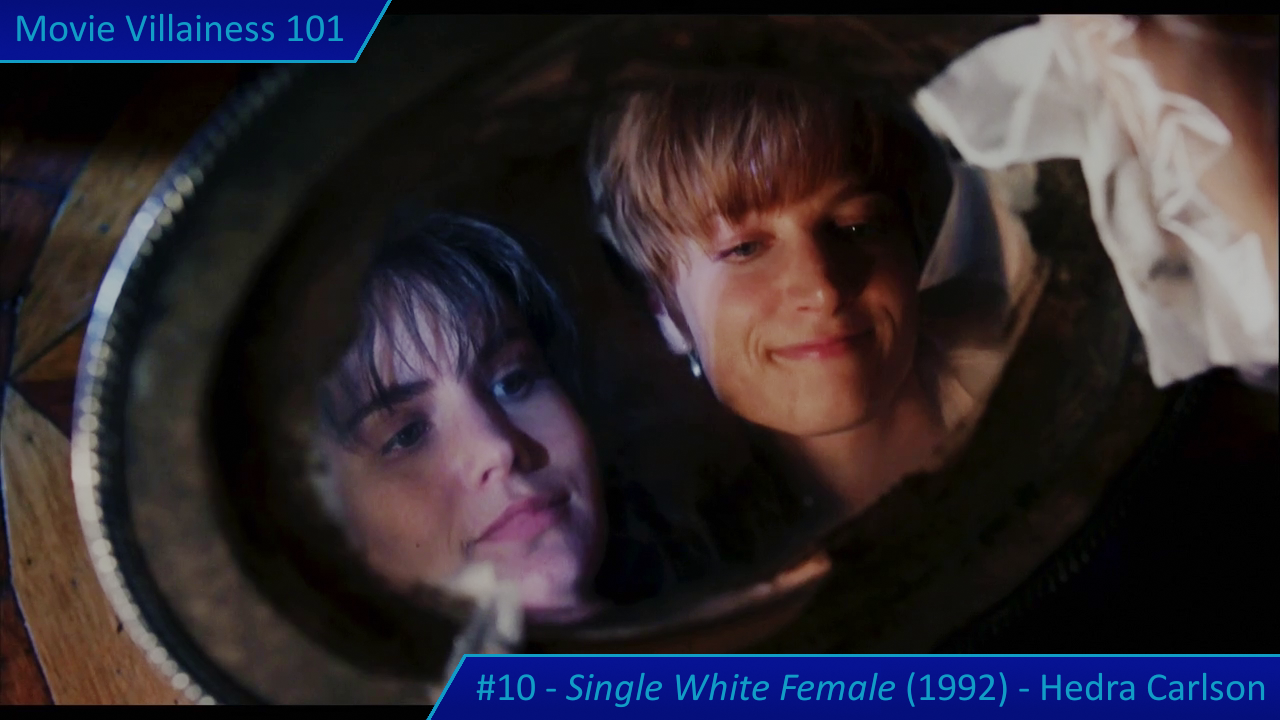
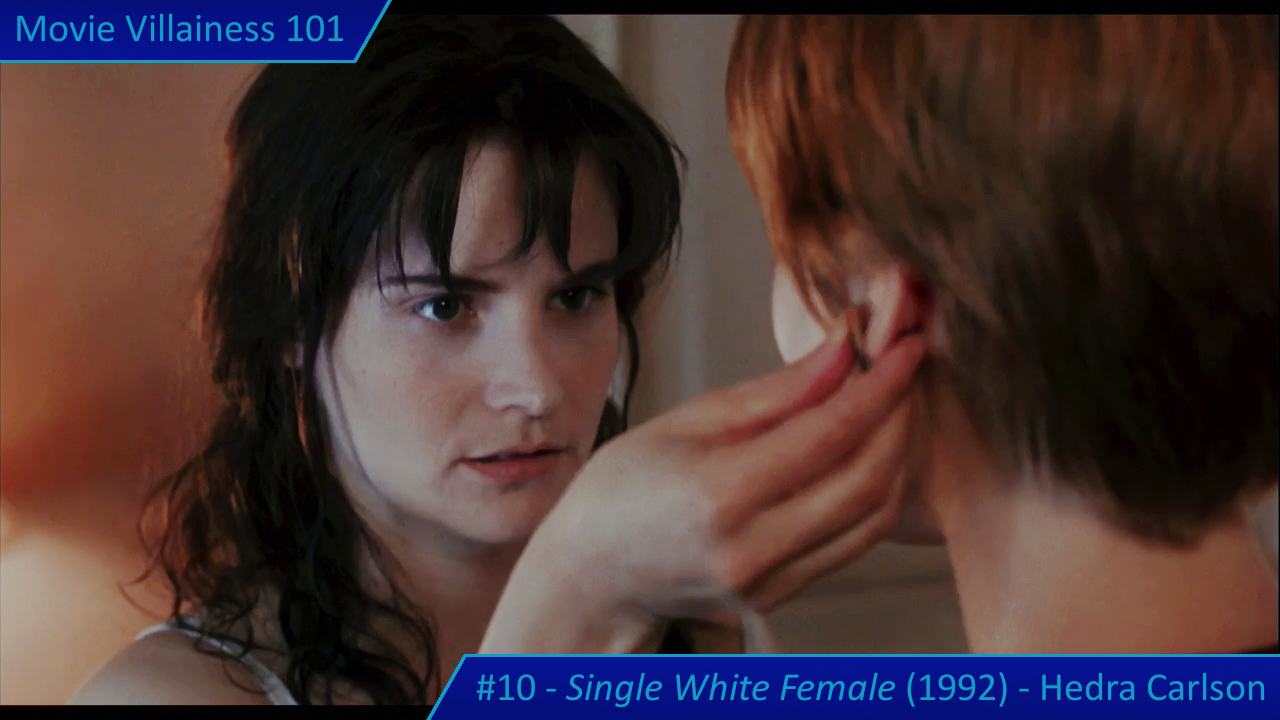
The warning signs start when Hedy purchases a puppy and pretends it was given away, only to kick the dog (literally) and snap when Allie leaves her alone one night. Psycho episodes continue as Hedy imitates Allie’s behaviour and interferes with her life. The roommate dates Sam, purchases matching clothes, and even dyes her hair and styles it to match. Identity theft, crazy style.

Villainess

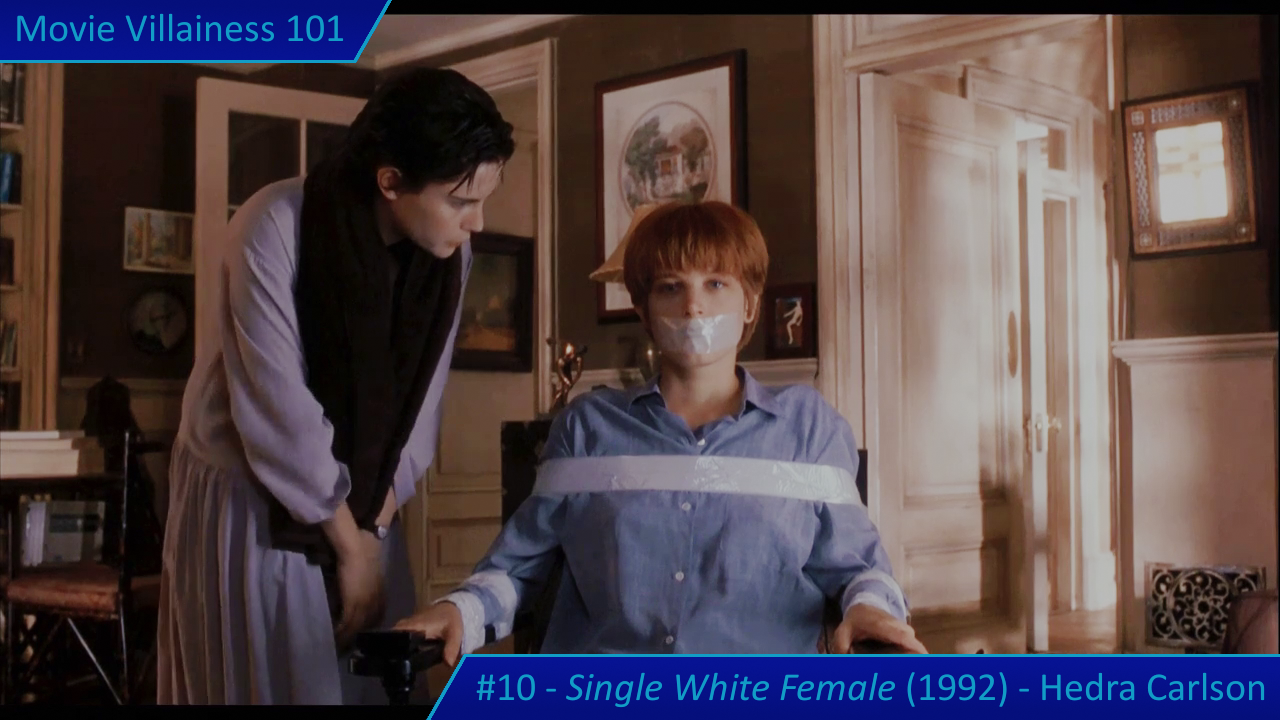
Hedra Carlson (Jennifer Jason Leigh)

It’s never made clear why Hedy is so obsessed with becoming Allie. The heroine finds a shoebox of old letters and news clippings about Hedy’s sister drowning in an accident, so childhood trauma is the vague explanation. That doesn’t matter much since we get a chilling performance from Jennifer Jason Leigh. Even in the action-lite first two acts, she’s a constant threat.

Finally, realising Hedy is dangerous, Allie discusses her concerns with a tenant on the floor below. Unfortunately, their voices carry through the vents, and Hedy listens in on the entire conversation. After Allie leaves, the gloved psycho sneaks in and knocks the tenant out with a pole. That’s one problem dealt with.

Next, Hedy has sex with Sam, posing as Allie until he sees through her deception. After an angry rejection, the loony snaps and throws a high heel at him. That one hits the door, but her second shoe becomes a bizarre murder weapon when she swings its pointed end into Sam’s eye.

Allie learns of the tragedy after it’s reported on television and then discovers Hedy’s blood-smeared high heel in the bathroom. Of course, that’s when the villainess returns to the apartment, and Allie is a poor liar, so gives herself away. The killer puts on her black gloves and pulls a gun on her roommate, but Allie can only cower in terror.

Done playing games, Hedy reverts to being a brunette, takes her hostage to the flat downstairs, and binds her prisoner to a chair with duct tape. Allie sees an opportunity after Hedy leaves, so turns up the volume on the television to attract attention, but it would never be that simple. The psycho returns just as the staff are about to force entry. Of course she does! The heroine attempts to send an e-mail message when Hedy has her book some plane tickets, but the villainess expects that move.

Earlier in the film, dodgy businessman Myerson attempted to assault Allie, and she broke off dealings with him. He’s past due on paying an invoice, so his computer records are automatically wiped. Heading over to Allie’s place to confront her, he instead finds Hedy. She feigns ignorance, but that lie is exposed when Myerson notices a suitcase with Allie’s name tag. After forcing his way into the room, he finds the tied-up occupant. A struggle follows with Hedy apparently taken care of, but the still conscious villainess finishes Myerson with a gunshot and the old cushion muffling trick. His unlikely redemption arc didn’t last long.

Hedy forces Allie to fake a suicide note and take pills, but the heroine smashes a glass into her captor’s face and breaks free. That’s when the (still alive!) tenant makes a dramatic reappearance, does his hero thing, and buys Allie precious time. The heroine drags Hedy out into the hallway, which leads to a prolonged fight in the elevator where the villainess seemingly strangles her roommate to death.

Hedy prepares to incinerate the “body”, but finds Allie gone when she returns. Arming herself with a sharp hook, the killer searches the basement for her quarry. There’s a tense sequence where she bangs on furniture and smashes things up. But after hiding on a pipe, Allie surprises Hedy and stabs the crazy woman with the screwdriver (remember that?). The tough to kill woman clings on for a little while – enough to give Allie a scare – before she succumbs to her wound.