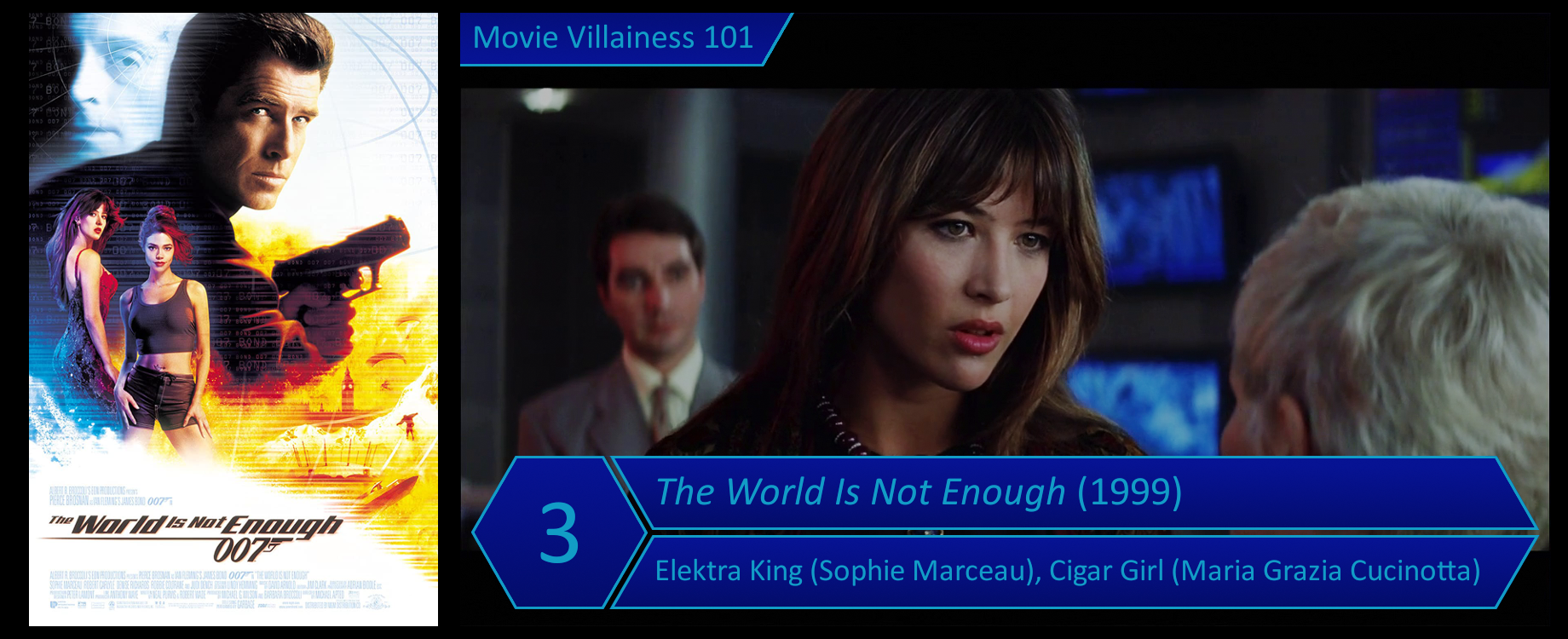
Movie
The World Is Not Enough (1999)
My GoldenEye discussion omitted one of the Brosnan films. That’s because the only female main villain in the Bond series deserves a goddess tier spot. As a bonus, we get the greatest pre-credits villainess, which almost makes up for the female baddie wilderness in the Daniel Craig era. In classic 007 fashion, the Cigar Girl assassin gets her own dedicated section. And it’s a logical review structure since Elektra doesn’t appear until after the title song.
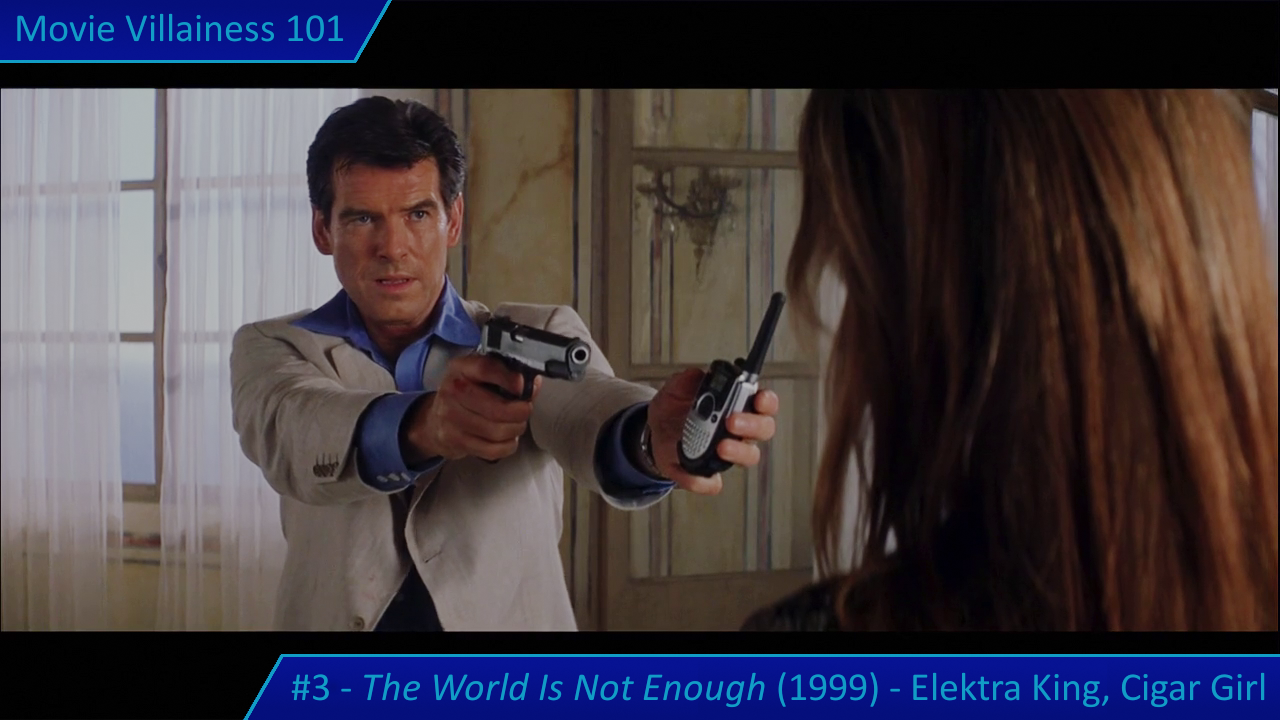
Brosnan films are relatively fun and escapist compared to what followed, but this entry has a more serious tone. Valentin Zukovsky (Robbie Coltrane) makes a welcome return as Bond’s reluctant ally, and the MI6 series regulars are also present. Sadly, this was Desmond Llewelyn’s last appearance as Q, but he passes the torch on to R (John Cleese) and delivers comic antics and gadget-testing chaos.
Action sequences are hit and miss, and the major set pieces – attacks by para-hawks and saw-blade helicopters, a gun battle in a missile silo, and the climax on a doomed submarine – fall flat compared to the spectacular opening. Still, this is a must-watch movie for any villainess fan, and the twist of having a Bond girl be the main baddie is a refreshing take. There’s also a good female: Denise Richards as nuclear physicist Christmas Jones. An excuse for bad jokes, but this is an entertaining outing.
Pre-Title Villainess
Cigar Girl (Maria Grazia Cucinotta)
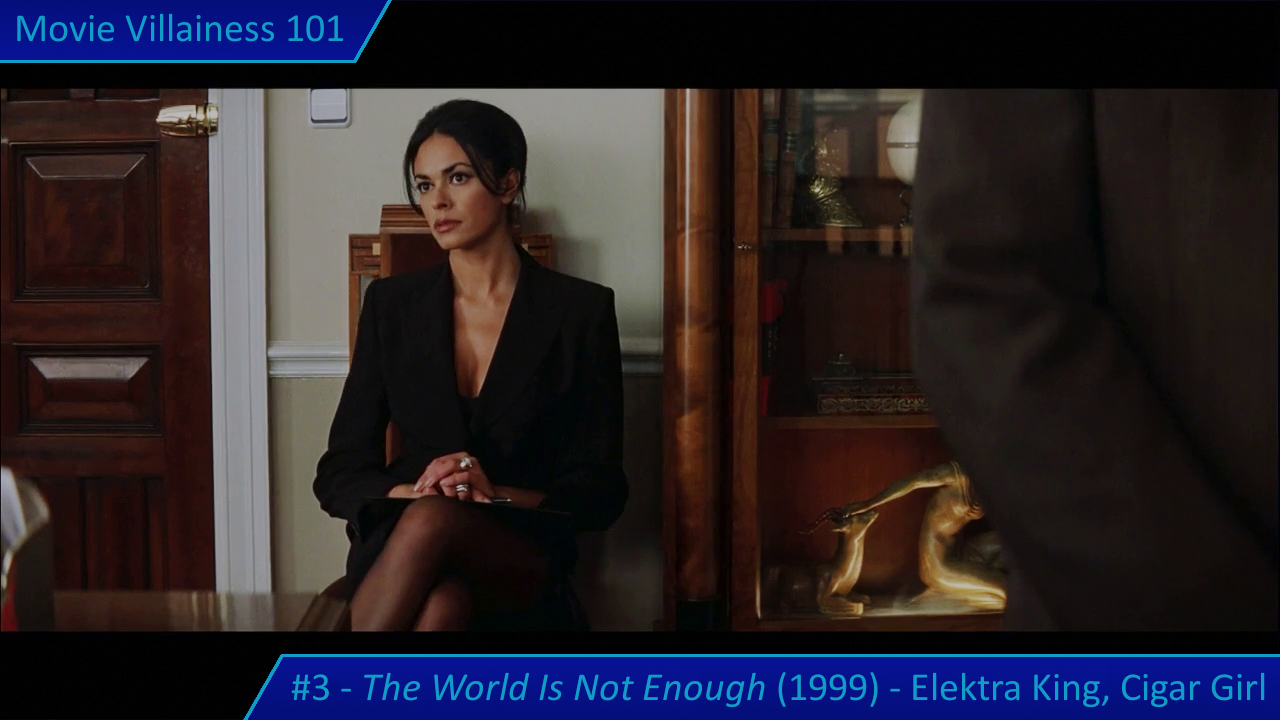
This epic opening gambit – and the longest before No Time to Die – begins in Bilbao, Spain, with Bond mincing words with a sleazy banker. A beautiful woman offers him a cigar (hence her nickname) and even gets a double entendre quip. Then it’s down to business with 007 demanding answers about a murdered MI6 agent. Things predictably turn nasty, and Bond makes quick work of some armed thugs. Too bad he forgets about the Cigar Girl, who eliminates the banker with a throwing knife.
Trapped and unable to pursue the assassin, Bond makes a dramatic getaway with a suitcase of money with the help of a mystery sniper. This ensures 007 makes it safely back to London, where he’s introduced to Sir Robert King, an oil tycoon who won’t be with us much longer. The money is laced with explosives, and King’s lapel pin is a proximity trigger. With MI6 under attack, a familiar female foe returns, and this time it’s Bond in her laser sight.
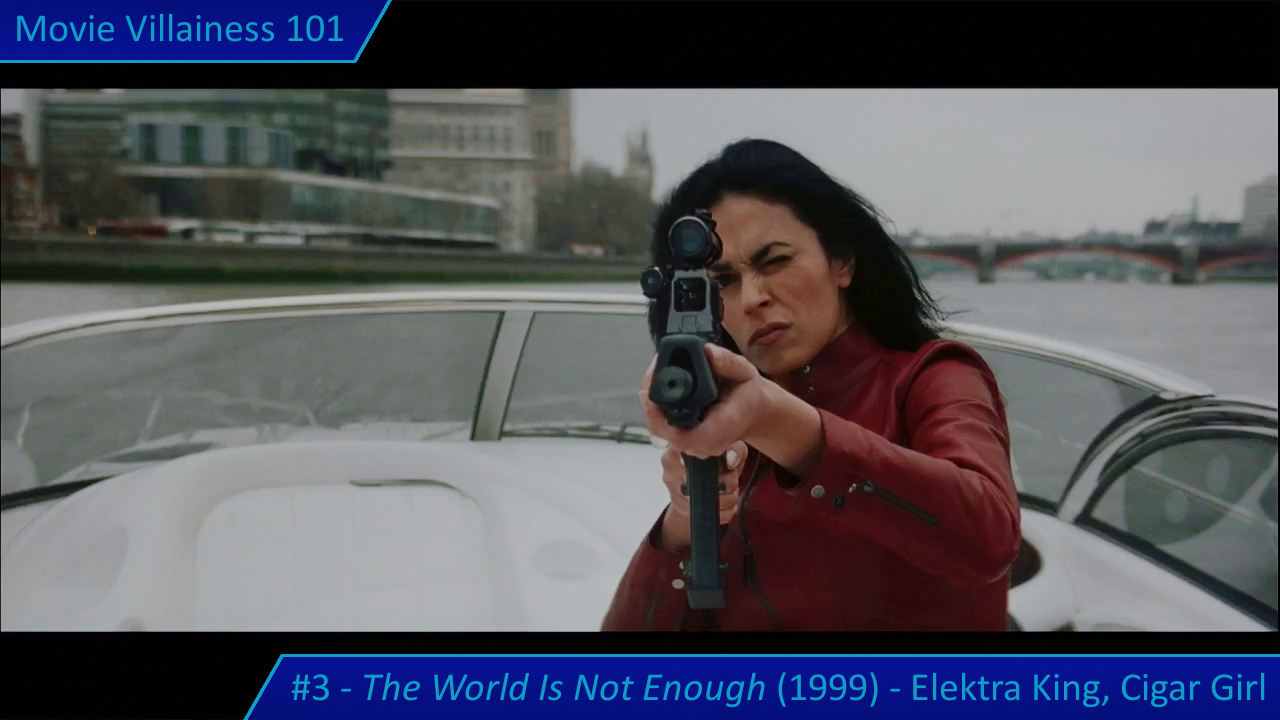
The big chase along the River Thames has Bond in a gadget-equipped boat pursuing the Cigar Girl past famous landmarks, including the Houses of Parliament and the Millennium Dome. The elusive assassin is as skilled at piloting a boat as at murder. More than once she evades Bond by making sudden turns or cutting under a descending bridge. Bond submerges the boat to bypass the obstacle and straightens his tie. Remember when these movies were pure fun?
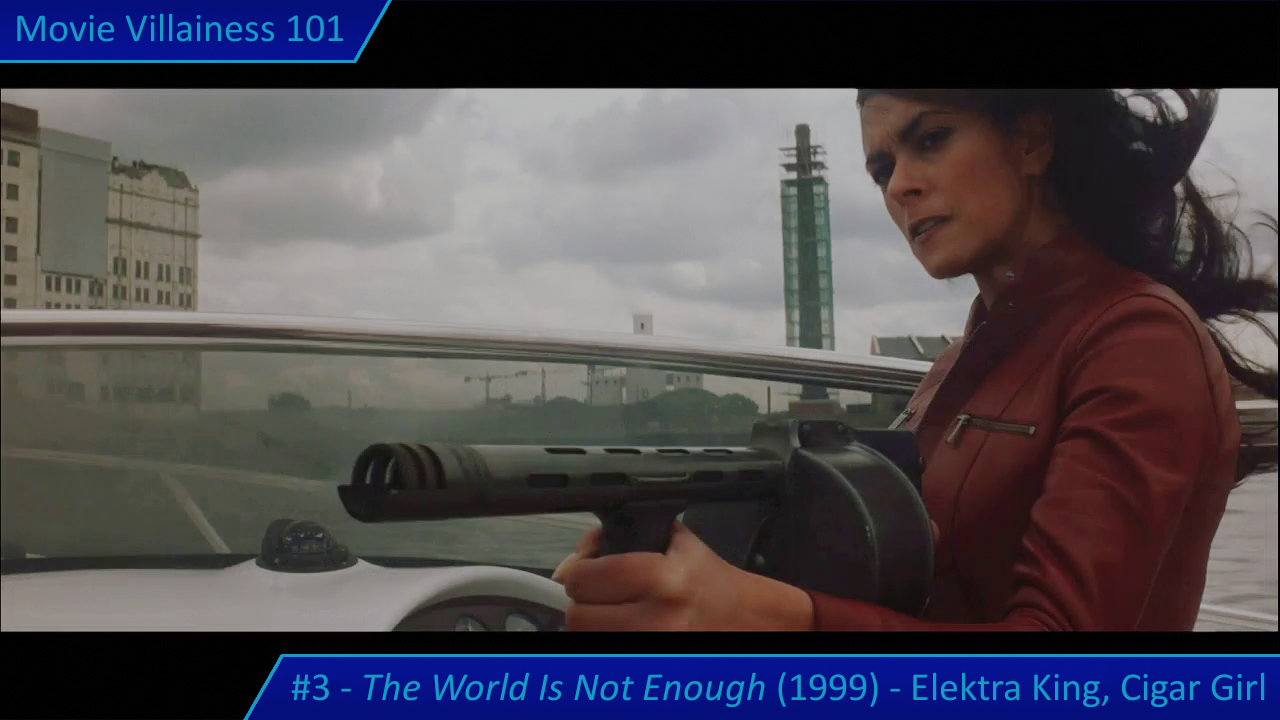
The Cigar Girl uses a machine gun, which is ineffective against the armoured Q-Boat, so she switches to a grenade launcher. Plenty of collateral damage and explosions, but Bond is never easy to get rid of. The villainess wrecks another boat and cuts 007 off, or so she thinks. Like all vehicle chases in Bond films, the hero finds a detour – a land ride through a street market, narrow alley, restaurant – back to the Thames.

Bond launches torpedoes at the Cigar Girl, but she makes her own dramatic escape like any good pre-credits villain. Then she hijacks a hot-air balloon, and Bond leaps onto the mooring rope. Realising there’s no way out – and rejecting Bond’s offer of protection – the henchwoman blows up a gas tank. Bond drops to safety and the Millennium Dome does something useful by breaking his fall. This hitwoman and sequence could push for a ranking all by herself, but there’s plenty more female villainy to come.
Main Villainess
Elektra King (Sophie Marceau)

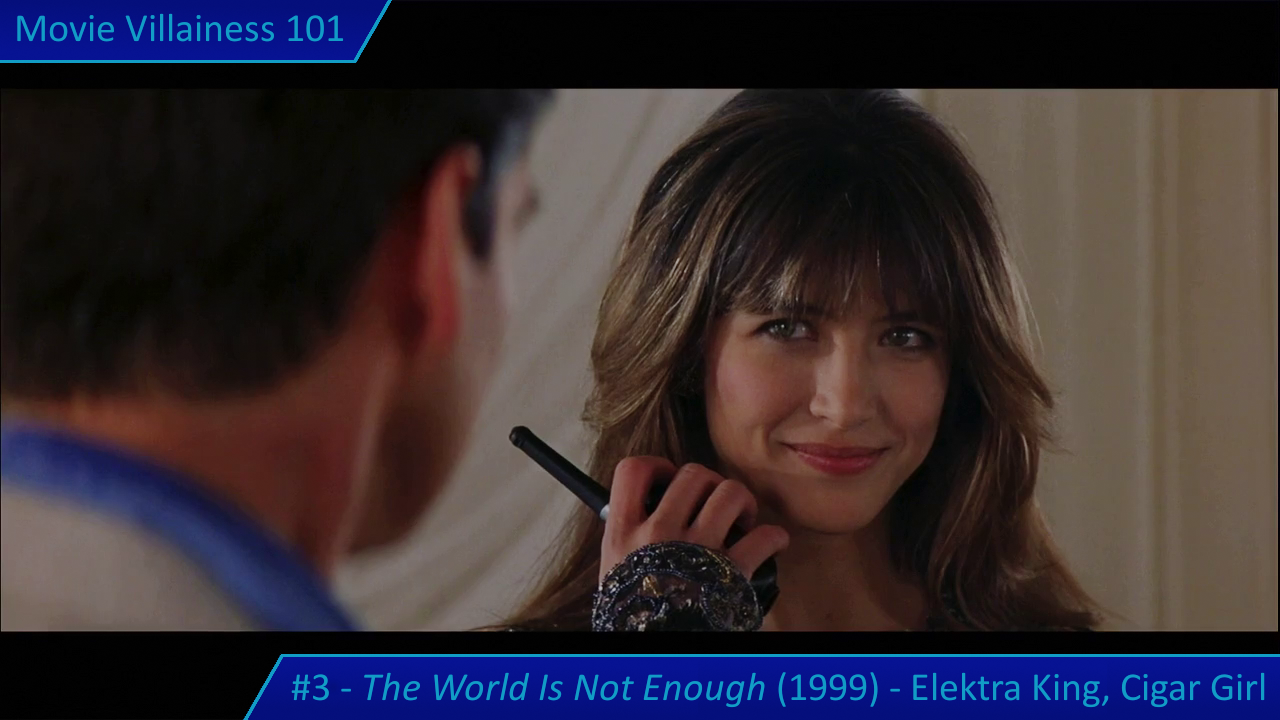
Straight after the title song, Elektra attends her father’s funeral. The first half of the movie sets her up as a traditional Bond girl whom the hero must protect. The main villain is implied to be Renard (Robert Carlyle), an anarchist who previously kidnapped Elektra and now appears to be targeting her again. King’s daughter has taken over his oil company and oversees a pipeline construction in Azerbaijan. Not the safest part of the world, and after Elektra and Bond are attacked by para-hawks while skiing in the mountains, the two become dangerously close.
Surprisingly, Bond doesn’t make love, and instead shows genuine concern when Elektra invites him to her luxurious Baku residence. There are plenty of dodgy-looking males around, including a tough henchman and the head of security, so no shortage of insider suspects. It turns out they are all working with Renard, but the mystery element works well. As a villain before the more serious Craig films, there’s a gimmick, in this case a bullet lodged in Renard’s brain which suppresses pain.

Determined to identify his attackers, Bond visits Valentin at a Russian mob casino. Everyone present, from the high rollers to the attractive female employees, is armed. Elektra shows up and acts recklessly, losing a million dollars on a high-card draw game. The first sign this woman may not be as innocent as she pretends, but Bond still beds her. That moral compunction didn’t last long, eh?
Bond’s investigation leads him to the pipeline construction site where the treacherous head of security learns the British spy has a licence to kill. A long plane ride later, Bond discovers a plot to steal a nuclear bomb from a missile silo. This is where we meet Christmas Jones, an improbable scientist who becomes an unlikely ally once Renard’s men open fire. She’s the reliable, non-screaming Bond girl who’s happy to help, even if bullets and explosions are not a usual day at the office.

Despite Bond’s efforts, Renard escapes, and it’s revealed he plans to detonate a nuclear device in Elektra’s pipeline. With a second woman involved, it’s inevitable (in this era) that one girl will be bad. When Bond and Christmas discover only half the plutonium core is in the bomb, 007 makes a calculated choice to let the device explode. Believing her nemesis to be dead, Elektra reveals her true intent to M – present at the villainess’ request – by having the MI6 bodyguards killed. And we finally have a female main villain to celebrate.
Now we know Elektra is behind her father’s murder, it’s time to reveal the endgame. Bond questions Valentin and learns that the villainess and Renard have purchased an old nuclear submarine. Their plan: to create a meltdown, destroy Istanbul, and contaminate the surrounding sea. And Elektra’s pipeline will become the only viable oil supply in the region.
With so much wealth and power, no wonder this woman has a hold over Renard. The two have a sinister sex scene where she runs ice over her body and clearly enjoys inflicting psychological torture. Meanwhile, M is locked in a cell in Maiden’s Tower, but broadcasts a signal using a missile locator card (which Bond gave her earlier) and a clock battery.

After an amusing scene where the heroes interrogate Valentin as he drowns in caviar, a gold-toothed henchman sells them out. Time for physical torture, and the villainess uses an antique chair and neck restraint to secure Bond. Perfect for strangling a man during a villainous motive rant, and an opportunity to drop the title, which is Bond’s family motto. The sadistic Elektra rapes Bond while he’s at her mercy and is enjoying her triumph until Valentin crashes the party.
If Bond was expecting a rescue, he shouldn’t have been so optimistic. Elektra shoots Valentin, and the Russian mobster – despite having a gun in his cane – targets a wrist restraint instead of the female villain. Perhaps a reference to their history, as the Russian acknowledges Bond in his dying moment. That’s enough for the hero to escape and chase Elektra up Maiden’s Tower.
Disappointingly, she’s not the last villain to die, as there’s a lengthy sequence where Bond stops Renard melting down the submarine reactor. And then it’s the usual scenario of rescuing the Bond girl, who actually proves useful, and an old-style ending with a poor joke and M surprised by her top agent’s womanising.
Before the anticlimactic finale, Bond faces off with Elektra. She gets one of the best villain deaths: taunting the spy as he pursues her, before boasting he can’t kill a woman in cold blood. Turns out Bond has no problems with cold-blooded murder with evil women, though he shows regret afterward.
Honourable Mention / Discussions: Daniel Craig Bond Movies
Casino Royale (2006) – Valenka (Ivana Miličević)

The sole honourable mention for this review goes to a mostly silent, sexy henchwoman who looks the part but doesn’t do much. And that faint praise sums up the lack of female villains in the Daniel Craig era.
The second Martin Campbell-directed reboot (after GoldenEye) is an origin story with a black and white prologue and a reckless 007. A long way from Connery’s suave secret agent. A back to basics approach, but there are action scenes aplenty, notably a free-run sequence across a construction site. The bad guy is Le Chiffre, a banker funding terrorists whom Bond must outwit in a high-stakes poker game at the titular Casino Royale. Judi Dench remains M, but with no Moneypenny or Q, Bond relies on actual spy work and resilience to complete his mission.
The main female character is Vesper Lynd, a treasury agent with the usual pun introduction, who later becomes a genuine love interest. Eva Green delivers a standout performance in the franchise, with real chemistry between her and Craig’s 007. Bond’s weakness for women makes him blind, and he doesn’t know Vesper is working with the shadowy organisation behind Le Chiffre. It’s eventually revealed that he had her boyfriend kidnapped to coerce her, so she’s a tragic character and not a true villain. But her death in the Venice finale is the most downbeat outcome since On Her Majesty’s Secret Service.
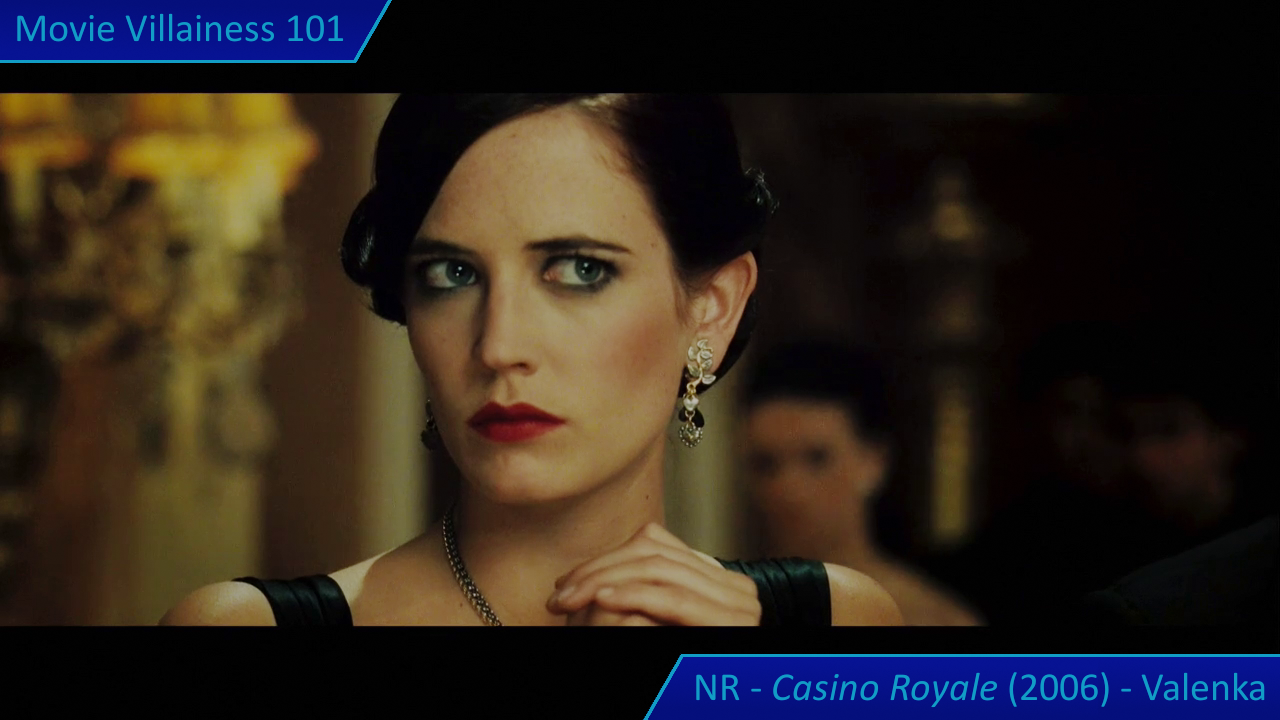
As for Valenka, she gets a sexy introduction and is present for Le Chiffre’s business dealings. Despite being attacked by a machete-wielding thug, she remains loyal and isn’t too bothered by violence when she’s not the target. Her best moment is poisoning Bond’s drink at Casino Royale, but she vanishes near the end. A scream implies Valenka is killed when Le Chiffre’s employers decide he’s no longer valuable. Get used to disappointment with this Bond – it only gets worse from here.
Quantum of Solace (2008)
The story is hard to follow in this weak outing, and the jump-cut action sequences are more likely to induce headaches than thrill. Add unnecessary, arty title cards whenever events shift to a new location, poor direction during exposition scenes, and a truly pathetic henchman, and the result is dire. A woman named Strawberry Fields (yes, really) gets coated in oil for her death scene as homage to the superior Goldfinger. Painful stuff.
Olga Kurylenko is Camille, a former Bolivian agent who allies with Bond. She handles herself well in the action scenes, notably a parachute escape from a crashing plane. Pity her vendetta is even less interesting than Bond’s quest to avenge Vesper. The climax in a desert hotel is messy, and the only plus point is brevity. Clocking in at 106 minutes, Quantum is the shortest Bond movie to date.
Skyfall (2012)

Craig’s third movie breaks with tradition by not giving us a true Bond girl. Judi Dench is M for the last time, with a more prominent role in the story and a great sendoff. Naomie Harris’ MI6 operative does more harm than good. More importantly, her name is Eve Moneypenny, an entirely different origin for the world’s most famous secretary. Q makes a comeback in the guise of a young boffin, though gadgets are limited to a palm reader, gun and radio.
The closest fit to the traditional female role is Sévérine (Bérénice Lim Marlohe), a former sex slave who is now a trophy girl and accomplice to the main villain Silva (Javier Bardem). He’s a former agent out for revenge against M, and the story is mainly set in the UK. Sévérine looks beautiful, matching the exotic locations of Shanghai and Macau. But like many ill-fated women in 007 movies, she romances the British spy before the villain disposes of her in theatrical fashion.
Skyfall is one of the better Bonds overall, perhaps because it doesn’t follow the established formula. The terrorist attacks on the London Underground and parliamentary hearing are well staged. The grand finale is a MacGyver-style final confrontation in Scotland as Bond dusts off a familiar Aston Martin. However, female antagonists are notably absent.
Spectre (2015)
The return of Ernst Stavro Blofeld (Christoph Waltz) and his evil organisation promised much, but delivered little. Mexico City during the Day of the Dead is a spectacular backdrop for an action-packed opening sequence, a helicopter stunt, and thousands of extras. Unfortunately, that’s the sole highlight. A shadowy Spectre conference, a car chase through Rome, and a train fight with a tough henchman should be exciting. They are not.
No female villains (again), and the leading lady Madeleine Swann (Léa Seydoux) has no chemistry with 007. Monica Bellucci appears – briefly – as the suicidal widow of a Spectre agent Bond killed in the teaser. He saves her life and seduces her for information, which ends with the most uncomfortable fling in the series.
Best not to mention the unnecessary twist about Bond’s guardian being Blofeld’s father, revealed in a painful exposition scene.
Add a tedious plot about intelligence control, a flat finale in the ruined MI6 building, and the hostage girlfriend ploy, and there’s little to get excited about. Need to cure insomnia? Spectre is the solution.
No Time to Die (2021)

The producers remembered what the series is about: thrilling action and sensational women. Despite a family subplot and a weak villain scheme that bogs down the last act, it’s a fitting sendoff for Craig. In this one, nobody is safe. Major characters, including the dependable CIA ally Felix Leiter and Blofeld, are killed off, foreshadowing the controversial end when Bond dies in a missile strike. The rulebook has been well and truly torn up.
The longest pre-credits sequence to date begins with a flashback to Madeleine as a child before we shift to the present and Spectre agents come after Bond in Italy. A dejected Bond retires from MI6, and an agent named Nomi (Lashana Lynch) becomes the replacement 007. On a rogue CIA mission to recover a traitor scientist, Bond receives help from Paloma (Ana de Armas), a rookie operative who is surprisingly proficient. The best action woman in Craig’s tenure only appears for ten minutes, but Paloma isn’t a disappointment.
Nomi gets some badass moments too, but is overshadowed by Bond. Madeleine shoots some bad guys during a chase in Norway, but the story is about saving her – and Bond’s – child Mathilde. Safin (Rami Malek) is a decent enough foe, but is defeated too easily. Three major female characters, and no villainess. Let’s hope the next Bond actor gets to face some bad girls.

